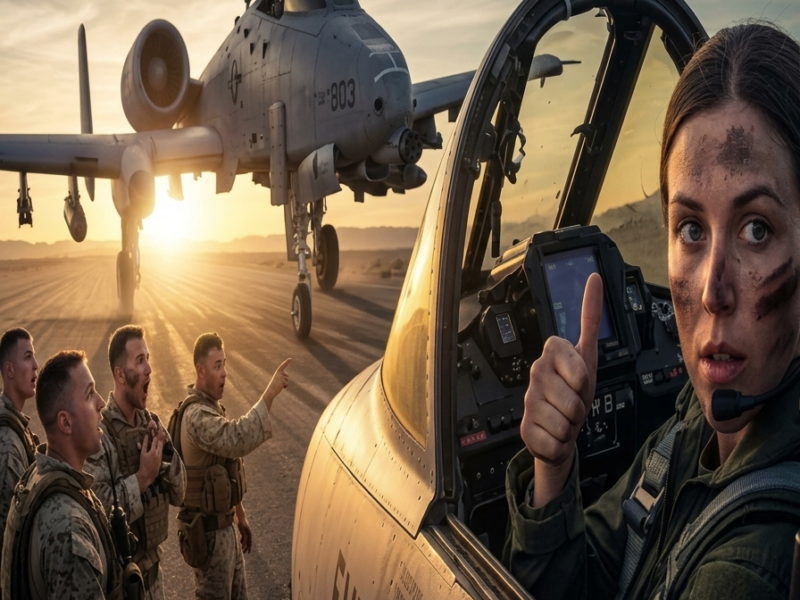
The entire hangar at Marine Corps Air Station Yuma fell silent when my A-10 rolled to a stop with the fuel gauge pinned at EMPTY
The silence inside the hangar at Marine Corps Air Station Yuma was not the ordinary quiet of a late afternoon. It was the heavy, suffocating stillness that descends only when men realize they are standing on the edge of a disaster.
My A-10 Thunderbolt II—the twin-engine beast built around a heavy cannon, scarred and covered in desert grime—rolled to a complete stop on the concrete floor. The twin Pratt & Whitney engines gave a final, agonizing metallic whine, coughing once before choking out completely. Inside the cockpit, the fuel pressure gauge was pinned dead against the stop: EMPTY.
I sat still for a moment, my hands gripping the flight stick so tightly my knuckles were white. The cockpit canopy creaked as I unlatched it and pushed it upward. The harsh Arizona air hit my face, thick with the smell of scorched hydraulic fluid, burnt JP-8 fuel, and something metallic that made my throat tighten.
Outside, a squad of Navy SEALs had been lounging near a row of equipment crates. When my aircraft first dragged itself over the airfield fence, flying so low it seemed to scrape the chain-link wire, they had laughed. They made crude jokes about Air Force pilots missing their approach, pointing at the asymmetrical angle of my wings and the trail of black smoke dragging behind my left engine.
Then I climbed out.
I swung my legs over the side of the cockpit ladder, my knees trembling so violently under my flight suit that I had to cling to the metal frame just to stay upright. That was when the SEAL team’s laughter died instantly.
A dark, wet stain covered the left shoulder and torso of my flight suit. It wasn’t oil. It was blood, fresh and sticky, soaking through the olive-drab Nomex fabric.
A Master Sergeant rushed forward, his boots sloshing through a puddle of jet fuel leaking from my fuselage. “How the hell did you make it back, Lieutenant? You’re leaking fuel like a sieve! How are you even alive?”
I didn’t answer. I couldn’t speak.
Even with the canopy open and the engines dead, I could still hear the shrill, artificial scream of the cockpit warning system ringing inside my head.
Fuel pressure critical.
Engine one failing.
Engine two failing.
For nine agonizing minutes, I had been flying a thirty-ton piece of airborne metal on nothing but vapor, prayer, and raw momentum. But the terror that had my heart hammer-locking against my ribs wasn’t the flight back. It wasn’t the dead stick landing or the near-zero fuel reserves.
It was what I had seen down in the dust.
Four hours earlier, the day had begun as a routine close-air-support exercise. My callsign was Viper One. The assignment was straightforward: provide mock air cover for a joint Marine-SEAL tactical team maneuvering through the extreme terrain of the Chocolate Mountain Aerial Gunnery Range, just north of the base. It was supposed to be a forty-minute training hop.
It lasted nearly two hours.
It began to go wrong when a localized dust storm, sudden and vicious, rolled off the jagged ridges. The desert floor disappeared under a boiling wall of yellow sand, swallowing the mountains and reducing visibility to zero in a matter of seconds.
I hauled the stick back, climbing to five thousand feet to stay above the dust devil, waiting for command to call off the drill.
Then, my primary radio went completely dead.
Static blasted through my helmet, followed by a cold, synthetic hum. I flipped to the secondary frequency, then the emergency guard channel. Nothing.
“Yuma Tower, Viper One. Radio check,” I said, keeping my voice steady. “Lost comms with ground unit. Requesting status.”
Silence.
I circled through a hole in the blinding haze, dropping lower into the soup. The thermal imaging camera under my fuselage cut through the blowing grit just enough to give me a grainy, black-and-white picture of the valley floor.
I saw movement. Three high-mobility tactical vehicles were scattered across a dry riverbed.
One was engulfed in a roaring column of flame, its frame twisted out of shape. Another had rolled onto its side, its tires still spinning uselessly in the air. Around the wreckage, small heat signatures were scrambling through the dirt. Men were waving frantically up toward the sky—not making standard military signal patterns, but waving with the desperate, erratic gestures of people about to be slaughtered.
They weren’t supposed to be engaged in live-fire maneuvers. There were no enemy forces scheduled in this sector.
I dropped the A-10 lower, the air frame shuddering as I sliced through the turbulence.
A voice suddenly crackled through a low-yield tactical backup frequency—a channel normally reserved for short-range intra-cockpit comms that shouldn’t have reached my altitude.
“Pilot… if you can hear me… do not fire!”
I froze, my thumb hovering just above the red weapon-select switch on my stick. “Say again, unidentified station. State callsign.”
“This is Captain Mason Reed, SEAL Team Three!” The man’s voice was ragged, choked with dust and heavy breathing. Gunfire popped sharply in the background of his transmission—heavy, automatic fire. “I say again, do not engage the targets on the ridge!”
“Captain, who is engaging you?” I demanded, turning the aircraft into a tight, hard bank to bring my nose around. “Who is firing on your position?”
His answer made my stomach drop into a cold abyss.
“Our own people.”
I leveled my wings and looked toward the eastern ridge. Two armored strike vehicles, bearing standard US military camouflage patterns and digital transponders, were moving systematically down the ridge line.
Their heavy 0.50-caliber machine guns weren’t pointed at an improvised target or a mock enemy bunker. They were firing controlled, lethal bursts directly into the overturned vehicle where Mason’s men were pinned.
My mind raced. A friendly fire incident? A tragic navigation error in the dust storm?
“Viper One,” Mason’s voice came back, lower this time, tight with sheer adrenaline. “They aren’t lost, Lieutenant. They’re trying to wipe us off the grid.”
“I’m calling this into Command right now,” I said, reaching for the master radio dial.
“Command isn’t listening!” Mason snapped. “Command is the one who sent them! Look at their vehicle markings!”
I zoomed the optical sensor on my display. Printed on the side doors of the attacking armored vehicles was a specialized unit crest: an iron hawk clutching an inverted spear.
It was the insignia of Blackwood Security Detachment—a shadowy, specialized contractor unit working directly under the regional division commander at Yuma, Colonel Marcus Vance.
I had seconds to decide. If I opened fire on those vehicles, I was firing on American equipment and personnel. It was treason. It was a court-martial. It was the end of my life.
If I did nothing, six men were going to die in that dry wash within the next thirty seconds.
“Screw it,” I muttered.
I jammed the throttle forward. The twin engines screamed as the A-10 plummeted out of the sky. I didn’t arm the heavy 30mm Gatling cannon—I couldn’t bring myself to pull the trigger on American troops—but I brought the massive plane down to less than fifty feet off the deck.
I buzzed the ridge at four hundred knots.
The sheer acoustic violence of an A-10 passing fifty feet overhead is enough to shatter glass and knock a grown man to his knees. The shockwave blew through the dust storm like a bomb, kicking up a wall of gravel and forcing the two attacking armored vehicles to slam on their brakes. One swerved wildly, almost slipping off the narrow dirt ledge.
“Mason!” I roared over the tactical radio. “Move east! Now!”
“We have wounded! We’re pinned!”
“Then trust me! Go!”
I banked the plane hard, pulling five Gs, bringing the nose around for a second ultra-low pass. The Blackwood vehicles tried to swivel their heavy turrets toward me, but I was moving too fast, using the low terrain and the blinding dust as a shield. I dropped a string of illumination flares directly between the attackers and the pinned SEAL team. The intense, blinding thermite smoke completely blocked the ridge unit’s line of sight.
One by one, the heat signatures of Mason’s surviving team dragged their wounded out from behind the burning wreck and slunk into the deep shadow of an adjacent canyon.
I stayed above them, flying circles through the blinding haze, serving as a human shield until my low-fuel light flashed red.
Then, just before I turned my nose back toward base, I saw something through my thermal targeting pod that made my hands go completely numb.
Standing beside the burning, overturned truck was a man in a tactical uniform. He wasn’t taking cover. He was frantically trying to pull a heavy, watertight metal case out from the ruined cargo bed.
The case had distinct stenciled markings across its lid: a yellow radiation diamond overlaid with a double-helix seal.
I knew those markings. Every pilot in the 355th Fighter Wing had been briefed on them six years ago during a classified containment drill. It was the seal of Project AETHER—a bio-tech weapons initiative that Congress had officially shut down, dismantled, and buried after a catastrophic lab accident in Nevada.
It wasn’t supposed to exist. It had been erased from military registries.
Yet there it was, sitting in the back of an unmarked truck in the middle of an Arizona training range, being hunted down by a rogue military detachment.
Back in the hangar at Yuma, the deafening echo of the dead engines was replaced by the low, anxious murmur of the ground crew.
I lowered myself down the last steps of the boarding ladder. My boots hit the oil-slicked concrete, and my knees buckled.
Before I could hit the ground, a pair of rough, calloused hands caught me by the webbing of my tactical vest.
It was Captain Mason Reed.
He had arrived at the airfield just minutes before me, brought in by a separate ground transport that had somehow bypassed the main gate. His face was covered in soot, sweat, and dried blood. His tactical uniform was torn at the shoulder, but his eyes were sharp, cold, and burning with a terrifying intensity.
He looked at the blood running down my arm—a shrapnel nick I hadn’t even felt when a stray round from the ridge had grazed my canopy frame.
“You’re hurt, Lieutenant,” Mason said softly, his voice a low rumble.
“I’m fine,” I rasped, my throat raw from dry air and high altitude. “The plane… the plane is empty.”
He didn’t look at the plane. He looked directly into my eyes, leaning in close enough so that the gathering crowd of mechanics and airmen couldn’t hear.
“You shouldn’t have turned around,” he whispered. “You should have kept flying straight to Davis-Monthan.”
“I saw the case, Captain,” I replied, my voice shaking. “I saw the AETHER mark on the crate.”
Mason’s jaw tightened. He glanced over his shoulder toward the glass-windowed observation tower at the far end of the hangar. Standing behind the tinted glass, dark silhouettes were watching us.
“Do you know whose name was stamped under that serial number?” Mason whispered, his grip tightening on my vest until I could feel the steel in his fingers.
I stared at him, my breath catching in my chest. “Whose?”
Mason looked back at the observation tower. “Colonel Marcus Vance. The man who just ordered your radio jammed and sent us out there to die.”
A cold, sickening horror washed over me. The radio failure hadn’t been an equipment glitch caused by the dust storm. Someone had deliberately flipped a switch in the tower, cutting off my communications so I wouldn’t hear Mason’s distress calls, ensuring that Blackwood Security could execute the team and recover the case without any airborne witnesses.
“They think the case was destroyed in the fire,” Mason said quietly, releasing his hold on my vest. “They don’t know I have the hard drive from inside it.”
Before I could answer, a squad of armed Military Police officers burst through the hangar doors, their boots pounding rhythmically against the concrete.
“Lieutenant Miller!” the lead MP barked, hand resting on his sidearm. “You are ordered to report to Command Headquarters immediately. Do not touch your gear. Leave the aircraft where it sits.”
Four hours later, I was released from the medical station after receiving four stitches in my shoulder and a clean bill of health. No charges had been filed—yet. Colonel Vance’s office had claimed my radio failure was a “technical malfunction” and my unauthorized low-altitude maneuver was under “administrative review.”
It was a cover-up, plain and simple. They were moving quietly, trying not to draw attention until they figured out what Mason’s team had managed to recover from the wreck.
It was nearly midnight when I finally made it back to my officer quarters at the edge of the base. The long, low-slung residential building was dark, the desert wind howling through the courtyard, rattling the dry palm fronds outside.
I slid my keycard into the door lock. The green light clicked.
As I pushed the door open, a small piece of paper slid across the tile floor, dislodged from where it had been tucked under the bottom frame.
I froze. I slowly bent down and picked it up.
It was a polaroid photograph.
The image showed a group of eight men in combat gear, standing in front of a desert forward-operating base. The timestamp in the corner read: SIX YEARS AGO. It was Mason Reed’s original team.
Every single face in the photograph had been systematically scratched out with a thick black marker. Seven men, seven black X’s over their faces.
Only one face remained untouched.
Mine.
I turned the photograph over with trembling fingers. Written in crude, heavy black ink on the back were three words:
YOU’RE NEXT, LIEUTENANT.
The air in my quarters felt suddenly ice-cold. I stood in the doorway, the keycard still clutched in my right hand, the polaroid in my left. My heart knocked violently against my ribs, each thud echoing like a war drum in my ears.
I backed out of the room, slamming the door shut, and scanned the dimly lit corridor. The long concrete hallway was empty, save for the flickering overhead fluorescent tube at the far end. The base was dead quiet, but the silence felt aggressive now, like a predator holding its breath in the shadows.
If someone had slipped that photo under my door, it meant they knew I was involved. It meant Blackwood Security wasn’t just trying to cover up an illegal weapons recovery—they were eliminating every loose end tied to Project AETHER.
And I was the newest end on their list.
I didn’t stay in my room. I stuffed the photograph into my pocket, grabbed my flight jacket, and stepped back out into the cool Arizona night. I needed to find Mason.
The transit barracks where the surviving SEALs were being held under “precautionary quarantine” was located on the northern perimeter of the base, shadowed by the massive steel structures of Maintenance Hangar 4. As I walked, keeping to the unlit edges of the asphalt roads, I noticed the subtle changes around the base.
There were too many patrols.
Standard base security usually consisted of bored young airmen cruising in white pickup trucks. Tonight, the perimeter was manned by dark, unmarked tactical SUVs. Men in gray combat fatigues—Blackwood contractors—were standing near the primary access points, sidearms holstered low on their thighs, eyes searching every passing vehicle.
Colonel Vance was locking down the base. He was building a cage around us.
I ducked behind a row of fuel bladders as a Blackwood SUV rolled past, its heavy tires crunching slowly over the gravel. Once the red taillights faded into the dust, I sprinted across the open tarmac toward the back entrance of Maintenance Hangar 4.
The side door was unlocked. I slipped inside, closing it silently behind me.
The interior of the hangar was vast and cavernous, filled with the sharp scent of hydraulic fluid and ozone. Half-disassembled helicopters sat like metal skeletons under the dim sodium lights.
“Step any closer and I’ll break your neck before you hit the deck,” a voice growled from the darkness behind me.
A cold steel barrel pressed firmly against the base of my skull.
“Mason,” I choked out, keeping my hands raised high. “It’s Miller. Viper One.”
The pressure on my skull vanished instantly. I turned around to see Mason Reed stepping out from behind a stack of wooden crates. He was stripped of his heavy body armor, wearing only a black t-shirt and tactical pants, a suppressed SIG Sauer pistol held low at his side. His face was pale, his eyes rimmed with red.
“You’re an idiot for coming here, Lieutenant,” Mason said, though his tone held more relief than anger. “This entire block is crawling with Vance’s mercenaries.”
“I didn’t have much of a choice,” I said, pulling the polaroid from my pocket and handing it to him. “This was waiting for me under my door.”
Mason took the photo. As his eyes fell on the scratched-out faces, his jaw muscles clenched so hard a small pulse fluttered in his temple.
“They’re thorough,” Mason said softly, his voice dropping an octave. “These seven men… they were my squad in Nevada six years ago. When Project AETHER was shut down, we were told the bio-chemical warheads were destroyed under UN supervision. We were the security detail that escorted the transport convoy.”
“And what happened to them?” I asked.
“Two died in a ‘training accident’ in Okinawa three years ago,” Mason said, pointing to the crossed-out faces one by one. “One drowned in San Diego. Two died in a helicopter crash in Colombia. The last two were killed in the dry wash this morning.” He looked up at me, his eyes dead and hollow. “I’m the only one left from the original detail. And now you’ve stepped right into the crosshairs.”
“What is in that case, Mason?” I demanded, stepping closer. “What is Vance trying to hide?”
Mason reached into his pocket and pulled out a heavy, hardened military flash drive. The metal casing was scorched and dented, but the green indicator light on its side flickered weakly.
“It’s not just a bio-weapon,” Mason said. “AETHER wasn’t a biological agent designed to kill troops. It was an advanced neurological disruptor—a chemical aerosol designed to target human cognitive functions. It renders soldiers completely unable to process fear, pain, or… orders.”
I stared at him, horrified. “A compliance weapon?”
“A puppet weapon,” Mason corrected bitterly. “If you spray a battlefield with AETHER, the enemy troops stop fighting and simply wait for instructions. But the side effects were catastrophic. Permanent brain damage. Madness. Total destruction of the central nervous system within forty-eight hours.”
He squeezed the drive in his fist. “Six years ago, Congress ordered every drop of AETHER destroyed. But Colonel Vance didn’t destroy it. He hid a stockpile out here in the Arizona desert, selling off small batches on the black market to private military syndicates to fund his own off-the-books operations.”
“And the truck this morning?”
“A hand-off gone wrong,” Mason said. “We weren’t supposed to be in that sector. We stumbled onto Vance’s retrieval team while they were moving a canister to an international buyer. When Vance realized we saw the markings on that crate, he gave the order to Blackwood to execute us and blame it on an accidental ordnance strike.”
Suddenly, the heavy steel doors at the far end of the hangar screeched open.
Bright, piercing white spotlights cut through the darkness, blinding us both. The heavy, rhythmic thud of combat boots echoed off the corrugated metal walls.
“Captain Reed! Lieutenant Miller!” A sharp, amplified voice boomed through the hangar’s loudspeaker system.
It was Colonel Marcus Vance.
“I know you’re both in there,” Vance’s voice echoed, cold, precise, and devoid of any emotion. “There is nowhere to go. Marine Corps Air Station Yuma is under total lockdown. Every exit is sealed.”
I crouched low behind the wooden crates, pulling my standard-issue M9 pistol from my shoulder holster. My heart was pounding so hard I could barely hear Mason whispering beside me.
“How many?” I whispered.
“At least ten,” Mason replied, peeking around the edge of the crate. “Blackwood contractors. They’re wearing night-vision gear and body armor. They aren’t here to arrest us, Miller. They’re here to clean the room.”
Through the glare of the spotlights, I saw Colonel Vance standing on the raised catwalk near the entrance. He was a tall, lean man in his late fifties, his silver hair cropped close, wearing a pristine dress uniform adorned with rows of service ribbons. Beside him stood the commander of the Blackwood contractors—a massive man with a scarred neck holding a short-barreled assault rifle.
“Give up the drive, Captain,” Vance called out, his voice smooth and conversational, as if he were discussing flight schedules over coffee. “You’re soldiers. You know how this works. The strategic picture is larger than your personal ethics. Project AETHER represents decades of military advantage. I won’t let it be destroyed by a disgraced SEAL and a rogue pilot.”
“He’s stalling,” Mason whispered to me, adjusting his grip on his suppressed pistol. “He’s positioning his men to flank us from the left aisle.”
“What’s the play?” I asked, my breath catching in my throat.
“See that fuel truck parked near the maintenance bay?” Mason pointed toward an old, yellow aviation fuel tanker parked thirty yards away under the low overhang. “The relief valve on the back is rusted open. It’s dripping fuel.”
“You want to blow up the hangar?”
“I want to create enough smoke to get to the flight line,” Mason corrected, his eyes locking onto mine with terrifying clarity. “Can you fly that A-10 again?”
I swallowed hard, remembering the dead fuel pressure gauge and the ruined left engine. “Not that one. But my wingman’s jet is sitting in Hangar 2, fully fueled and prepped for tomorrow’s dawn sweep.”
“Then that’s our ride,” Mason said.
Before I could ask how two men were going to escape a military base in an A-10 warplane, Vance’s voice cut through the air again.
“Time’s up, gentlemen. Eliminate them.”
Red laser dots danced across the wooden crates in front of us.
“Now!” Mason roared.
He leaned out from behind the cover and fired three rapid shots toward the overhead electrical junction box. The bullets shattered the high-voltage transformers, sending a massive spray of yellow sparks cascading down into the gloom.
Half the hangar went pitch black instantly.
Automatic gunfire erupted. Heavy 5.56mm rounds tore through the wooden crates, sending splintered wood and paper packing material flying through the air like a blizzard.
Mason didn’t shoot at the contractors. He aimed his pistol straight at the pool of jet fuel beneath the yellow tanker truck and pulled the trigger.
A bright orange fireball erupted in the center of the hangar with a deafening BOOM.
The shockwave knocked me off my feet, the intense heat scorching the skin on my face. Heavy black smoke surged toward the ceiling, swallowing the spotlights and plunging the entire facility into a chaotic, screaming hellscape.
“Go! Go! Go!” Mason yelled, dragging me up by my collar.
We sprinted through the blinding smoke, using the roaring flames of the burning fuel truck as a thermal wall to block the contractors’ night-vision goggles. Bullets snapped violently through the air around us, ricocheting off the steel girders and punching holes in the aluminum walls.
We slammed through the emergency exit door, bursting out into the cold desert night air.
The warning sirens across the airfield were wailing now—a high-pitched, warbling scream that shattered the night. Red emergency beacons flashed along the tops of every building.
“Hangar 2 is three hundred yards east!” I shouted over the noise of the sirens, pointing across the open tarmac toward a row of hardened aircraft shelters.
“They’ll have the flight line covered!” Mason shouted back, checking his magazine. “We’ll never reach the jet on foot!”
Just then, a Blackwood tactical SUV rounded the corner of the building, its high beams catching us in a stark, blinding light. The vehicle accelerated, its engine roaring as it charged directly toward us, a gunner leaning out of the passenger window with an automatic shotgun.
“Look out!” I screamed.
Mason grabbed me and threw us both over the concrete barrier lining the taxiway just as the shotgun blasted a chunk of masonry into powder right where my head had been a second before.
We were trapped against the wall, exposed, with no heavy cover, and a squad of armed mercenaries closing in from three directions.
Mason looked down at the flash drive in his hand, then up at the flashing red lights of the airfield.
“Miller,” Mason said, his voice strangely calm amid the deafening alarms. “If we die here, Vance buries this forever. Nobody will ever know what happened to my men.”
“We aren’t dying here,” I rasped, pulling a spare magazine from my belt.
“Listen to me!” Mason grabbed my flight jacket, pulling me close. “There’s a secondary file on this drive. It’s not just evidence against Vance. It’s the broadcast key for the defense network automated comms link.”
My eyes widened. “The automated comms link? That bypasses local command!”
“If you can get that A-10 airborne and climb to fifteen thousand feet, that drive can patch directly into the NORAD tactical satellite array,” Mason said, his voice deadly earnest. “You can broadcast the entire file to every military command center in the Western hemisphere simultaneously. Vance won’t be able to stop it.”
“We can broadcast it,” I corrected him. “You’re coming with me.”
Mason gave a dark, bitter smile as he looked out over the concrete wall at the approaching tactical vehicles.
“That A-10 is a single-seat aircraft, Lieutenant,” Mason said softly. “There’s only room for one of us in that cockpit.”
The realization hit me like a physical blow. The A-10 Thunderbolt II was a single-seat attack aircraft. There was no co-pilot chair. No jump seat. No room for a second man unless he crammed himself into the tiny, unpressurized storage bay behind the cockpit ladder—a death trap if the aircraft climbed above ten thousand feet.
“No,” I said, my voice shaking as I gripped my pistol. “I’m not leaving you behind to get butchered by Vance’s clean-up crew.”
“You aren’t leaving me, Lieutenant—you’re executing the mission,” Mason replied, his face hard as granite. He shoved the hardened flash drive deep into the front pocket of my flight suit and zipped it shut. “If I go with you, we’re just two targets in one place. If I stay here, I draw their fire and buy you the three minutes you need to spool up those twin engines.”
“Mason—”
“Move, aviator!” Mason roared, shoving me backward down the concrete trench.
Before I could argue, Mason stood up from behind the barrier, stepping out into the open taxiway in full view of the approaching Blackwood SUV. He raised his SIG Sauer and dumped four quick, precise shots directly through the vehicle’s windshield.
The SUV swerved violently, its tires screeching as the driver lost control, crashing headlong into a row of steel baggage carts with a deafening metallic crunch.
“Run!” Mason shouted, turning to fire at a second group of contractors flanking from the south.
I didn’t look back. I turned and sprinted through the shadows of the taxiway, my flight boots pounding heavily against the asphalt. Tears burned in the corners of my eyes, mixed with the harsh sting of sweat and desert dust.
Ahead of me, the massive curved steel roof of Hangar 2 loomed against the dark sky. The high-bay doors were partially open, revealing the sleek, deadly silhouette of my wingman’s A-10—Tail Number 408.
As I neared the hangar entrance, two Blackwood contractors stepped out from the shadows of the fuel bunker, tactical lights mounted on their rifles cutting through the darkness.
“Halt! Hands where we can see them!” one shouted.
I didn’t stop. I dropped my shoulder and slammed full-force into the first contractor, tackling him into the concrete wall. We crashed to the ground in a tangle of limbs. I swung my right elbow back with everything I had, catching him clean across the jaw with a sickening crack.
The second contractor leveled his rifle at my chest, but before he could pull the trigger, a sharp, suppressed gunshot cracked from two hundred yards away across the airfield.
The contractor gasped, his eyes going wide, and dropped to his knees as a crimson stain bloomed across his tactical vest.
Mason had hit him from the high ground of the barrier wall.
“Get in the air, Miller!” Mason’s voice crackled through my radio earpiece, faint and distorted by static. “They’re bringing up heavy armor!”
I scrambled to my feet, sprinted into Hangar 2, and threw myself up the steel boarding ladder of Tail Number 408.
The cockpit was familiar, a home of cold switches, analog dials, and glass displays. I practically dropped into the ejection seat, my hands moving by pure muscle memory accumulated over eight years of flying.
I reached for the main battery switch—ON.
The cockpit illuminated in a soft, green glow. Dial needles twitched to life.
I slapped the APU (Auxiliary Power Unit) switch. Deep inside the belly of the plane, a high-pitched turbine whine began to build, rising to a piercing scream that filled the closed hangar.
Come on, come on, spool up! I prayed silently, staring at the engine temperature gauges.
Through the front glass of the canopy, I saw three Blackwood vehicles speeding across the tarmac directly toward Hangar 2. Behind them, standing on the elevated roof of the airfield control tower, was Colonel Marcus Vance, holding a tactical radio to his ear, directing his forces like a chess master.
“Vance to all units,” his voice suddenly flooded the local base frequency, which was screaming through my helmet headset. “Tail Number 408 is attempting unauthorized launch. Destroy the aircraft before it reaches the main runway. Repeat: destroy the aircraft.”
They weren’t going to try to capture me anymore. They were going to blow me off the tarmac.
The APU green light flashed on the panel.
I reached down and slammed the left engine throttle past the detent to IDLE. Fuel injected into the Pratt & Whitney engine. The turbine roared to life with a deep, bass vibration that shook the entire frame of the jet.
I didn’t wait for the right engine to fully spool. I didn’t wait for the canopy to finish closing. I reached down, grabbed the emergency brake release, and slammed both throttles forward to full military power.
The thirty-ton aircraft lurked forward out of the hangar like a enraged dinosaur, its left engine screaming, its right engine slowly catching up with a cloud of gray exhaust.
As the nose of the jet cleared the hangar doors, a heavy machine gun burst from one of the Blackwood trucks ripped across the pavement. Bullets slammed into the armor-plated belly of the plane with loud, hollow THUKS.
The titanium “bathtub” armor built around the cockpit protected my body, but a round shattered the lower right rearview mirror, showering my lap with safety glass.
“Viper One to Tower,” I growled into my mask, steering the heavy jet onto the primary taxiway with the rudder pedals. “You want to play war on my airfield? Let’s play.”
I didn’t steer toward the main runway. The main runway was two thousand yards away—plenty of time for their armored vehicles to block my path.
Instead, I aligned the nose of the heavy attack jet straight down Taxiway Delta—a narrow, two-lane strip of concrete flanked by concrete blast walls and parked support vehicles. It was never meant for aircraft takeoffs.
“He’s taking off on the taxiway!” a frantic contractor shouted over the radio. “Block him! Block the strip!”
A heavy eight-wheeled armored transport lurked into the middle of Taxiway Delta five hundred yards ahead, turning broadside to form an impenetrable wall of steel across my path.
I stared straight through the glass HUD (Head-Up Display) at the armored vehicle blocking my way. My airspeed indicator was crawling upward: 70 knots… 80 knots… 90 knots.
I needed 130 knots to lift off. I was running out of concrete fast.
My hand hovered over the red firing button on the stick. The heavy 30mm Avenger Gatling cannon was loaded with eleven hundred rounds of depleted-uranium armor-piercing shells.
I had been trained never to fire live ordnance inside a friendly domestic airbase. It was the ultimate violation of military protocol.
I looked at the fuel bladders lining the taxiway. I looked at the dark silhouette of Mason still firing from the far barrier, fighting a losing battle against a dozen men to give me this chance.
I flipped the Master Arm switch to ARMED.
The HUD illuminated with a crosshair symbol overlaid on the broadside of the armored vehicle blocking my path.
“Clear the runway,” I whispered.
I squeezed the trigger.
The 30mm Gatling cannon didn’t sound like a gun. It sounded like the sky itself tearing in half—a terrifying, continuous BRRRRRRRRRRRRRRRRRRRRT that shook the entire airframe so violently my vision blurred.
A stream of high-explosive, armor-piercing 30mm shells—each the size of a beer bottle—leaped from the nose of the A-10 at four thousand feet per second.
The heavy armored transport five hundred yards away didn’t just stop; it literally disintegrated under the sheer kinetic impact. The heavy steel plating collapsed, the engine block vanished in a fountain of sparks and shrapnel, and the entire vehicle was blown backward thirty feet, bursting into a roaring wall of fire.
Airspeed: 120 knots. 125 knots.
I yanked back on the control stick with all my strength.
The nose of the A-10 pitched upward. The main landing gear skipped once, twice off the concrete, tearing through the cloud of fire and burning debris from the destroyed transport.
The aircraft lifted into the black night air, clearing the base perimeter fence by less than ten feet.
“Viper One is airborne,” I breathed into my mask, my heart hammer-locking in my throat as I pulled the gear handle up.
“Not so fast, Lieutenant,” a cold voice whispered through my headset.
I looked down at my tactical radar display.
A pair of high-speed radar locks had just illuminated on my panel. Coming up fast behind me, climbing out from the secret military test facility adjacent to the base, were two high-performance F-16 fighters—bearing Blackwood insignia.
They weren’t trying to intercept me. They were painting my jet with sidewinder heat-seeking missiles.
The cockpit of Tail Number 408 transformed into a choir of screaming alarms.
WARNING. MISSILE LOCK. ELEVATION LOW.
The twin yellow threat-indicator lights on the glare shield flashed in a frantic, hypnotizing rhythm. Down on the dark desert floor behind me, two bright orange trails of fire erupted from the tarmac as a pair of dark, needle-nosed F-16 Fighting Falcons vaulted into the night sky, their afterburners glowing like twin angry eyes.
Colonel Vance had brought air power.
He had covered every contingency. He knew that if an A-10 got into the air, ground forces couldn’t stop it. So he had held two black-budget contractor jets in reserve, piloted by mercenaries paid millions to make sure no unauthorized flight ever left Yuma airspace alive.
“Viper One,” a dark, calm voice came through my primary radio channel—one of the F-16 pilots. “You are flying an stolen military asset over a restricted defense zone. Disengage your engines and pitch down for immediate land-and-surrender, or we will eliminate you.”
I didn’t answer. I slammed the stick to the left, putting the A-10 into a steep, four-G bank that pressed me heavy into my seat.
The A-10 Thunderbolt II was never designed to win a dogfight against an F-16. The F-16 was twice as fast, could fly twice as high, and carried far more sophisticated air-to-air missiles. In a high-altitude drag race, I was a turtle being hunted by a pair of hawks.
But the A-10 had one thing the F-16s didn’t.
It could fly in the dirt.
I pushed the nose straight down, diving back toward the jagged, jet-black teeth of the Chocolate Mountains. The altimeter spun backward like a broken clock: 8,000 feet… 5,000 feet… 2,000 feet… 800 feet.
“What is he doing?” the second F-16 pilot muttered over the unencrypted channel. “He’s diving into the canyon! He’s going to crash!”
I leveled off at three hundred feet above the canyon floor.
It was pitch black. Below me, the jagged walls of granite and limestone rose up like knife blades on either side of my wings. I was flying purely by Night Vision Goggles (NVG) and the terrain-following lines on my HUD. One wrong movement of the stick, one gust of mountain wind, and my plane would turn into a fireball against the canyon walls.
Behind me, the two F-16s hesitated. Their heavy, high-speed swept wings weren’t designed for low-altitude maneuvering in tight mountain passes. They were forced to pull up, circling at five thousand feet like vultures, waiting for me to break out into the open sky.
“He can’t stay down there forever,” the lead F-16 pilot scoffed. “He’s trapped in the trench. As soon as he climbs to get horizon lock, take the shot.”
They were right. I couldn’t stay in the canyon. My fuel was dropping, and to send the broadcast key on the flash drive, I needed a clear, unobstructed line-of-sight to the NORAD tactical satellite constellation.
I needed to be at fifteen thousand feet.
I reached down with my left hand and pulled the scorched flash drive from my suit pocket. I jammed it into the specialized data-link port located on the side console beneath the weapon management system.
The main cockpit display flickered. Lines of green code, complex encryption sequences, and automated military routing numbers flooded the glass screen.
[CRITICAL ENCRYPTION KEY DETECTED]
[NETWORK: NORAD-TACTICAL-SAT-04]
[STATUS: AWAITING HIGH-ALTITUDE UPLOAD]
[MINIMUM ALTITUDE REQUIRED: 14,000 FT]
“Fourteen thousand feet,” I muttered, my fingers tightening on the throttle. “I have to jump.”
I looked at my tactical display. The two F-16s were orbiting directly above the mouth of the canyon, positioned like sentries. The moment my nose broke out of the canyon walls, they would fire AIM-9 Sidewinder missiles before I could complete even half the data transfer.
I needed a distraction. I needed a way to blind their radar for thirty seconds.
I flipped my weapon control panel to the countermeasures selection. In an A-10, the flare and chaff dispensers are located in the wingtips and wheel pods. I had thirty bundles of chaff—strips of aluminum foil designed to confuse radar—and forty thermal flares.
It wasn’t enough to confuse two modern jet fighters.
Unless I gave them a target they couldn’t ignore.
I pulled up the radio panel and manually entered the short-range frequency for the automated ground control beacon at the Yuma weapons range.
“Yuma Range Control, this is Viper One,” I said, my voice steady, cold, and calculated. “Requesting emergency calibration test fire on target grid Bravo-Two.”
A synthetic, automated computer voice responded instantly in my helmet: [BEACON ACTIVE. TARGET GRID BRAVO-TWO CONFIRMED.]
Target Grid Bravo-Two was an old, abandoned radar calibration tower sitting on top of the highest peak of the Chocolate Mountains—a three-hundred-foot steel structure loaded with obsolete electronic reflectors.
I banked the A-10 hard to the right, flying straight toward the base of the peak.
I waited until the mountain wall filled my entire windshield.
“Now,” I growled.
I pulled the control stick violently back into my lap. The A-10 rocketed almost straight up the vertical face of the mountain peak, its twin engines screaming at absolute maximum thrust.
The two F-16s high above saw the sudden climb on their radar.
“Target is popping up! Target is breaking cover!” the lead F-16 pilot yelled over the radio. “Fox Two! Missile away!”
A bright white streak of fire detached from the wing of the lead F-16, plunging downward toward my climbing jet. A second later, the second F-16 launched its missile as well. Two heat-seeking warheads were tracking straight for my exhaust plumes at three times the speed of sound.
I didn’t deploy my flares. Not yet.
I waited until the distance counter on my HUD hit three hundred yards… two hundred yards… one hundred yards.
Just as the missiles were about to hit my tail, I pulled the nose back even further, barrel-rolling the A-10 over the top of the mountain peak, passing just fifty feet above the steel structure of the radar calibration tower.
At that exact microsecond, I hit the master button for the entire countermeasure system.
TH-TH-TH-TH-TH-TH-TH-TH-TH-TH-OUT!
All forty thermal flares and thirty bundles of radar chaff exploded simultaneously in a massive, blinding sphere of magnesium fire directly around the steel radar tower.
The two incoming Sidewinder missiles, blinded by the massive heat flash and confused by the dense cloud of aluminum chaff, locked onto the metal tower and the blazing flare cluster instead of my plane.
BOOM! BOOM!
A massive double-explosion shattered the night sky. The radar tower vanished in a towering ball of flame, showering the mountaintop with burning debris and creating a massive thermal cloud that completely blinded the sensors of both F-16s above.
“Where is he? Lost radar lock! Lost thermal!” the F-16 pilot screamed through the static.
I didn’t wait to watch the fireball. I punched through the top of the smoke cloud, punching into the clear, freezing air of the upper atmosphere.
The altimeter climbed like a rocket: 8,000… 10,000… 12,000… 14,000 feet.
[ALTITUDE REACHED]
[UPLOADING BROADCAST DATA… 12%… 34%… 68%…]
“He’s above the cloud layer!” the second F-16 pilot yelled, recovering his orientation. “I have visual! Moving to cannon range!”
The second F-16 swept in fast from my three o’clock position, its 20mm Vulcan cannon lighting up the night with a long tongue of yellow flame.
Tracer rounds ripped through the air around my cockpit. One heavy round slammed into my right wing, tearing away a three-foot section of the aluminum flap. Another round punched straight through the rear of my canopy glass, shattering the canopy cover and filling the cockpit with a roaring, freezing hurricane of sub-zero wind.
The cold air hit me like a physical punch, tearing the oxygen mask from my face and dropping the cockpit temperature to thirty below zero in a second. My skin felt like it was being scorched by liquid nitrogen.
I gripped the stick with frozen fingers, my lungs gasping for thin air, holding the plane level with everything I had.
[UPLOAD… 89%… 94%… 99%…]
“Die, rogue pilot,” the F-16 pilot cold-bloodedly whispered through my static-filled headset as he lined up his crosshairs directly on my head.
[UPLOAD COMPLETE. BROADCAST TRANSMITTED TO ALL DOMESTIC COMMAND NETWORKS.]
A green flash illuminated the HUD. The file—the evidence, the names, the coordinates of Project AETHER, and the footage of Colonel Vance’s betrayal—had just been delivered to every high command station from Pentagon Headquarters to the Pacific Fleet Command.
“It’s done,” I choked out through my freezing, blue lips.
At that exact second, a new voice broke through every radio frequency across the state of Arizona—a voice carrying the absolute, unquestioned authority of the Chairman of the Joint Chiefs of Staff.
“All air units in Yuma sector, this is Pentagon Strategic Command! Stand down immediately! I say again, STAND DOWN IMMEDIATELY! Flight 408 is under direct presidential protection!”
The F-16 on my wing suddenly pulled off its attack vector, its nose dipping sharply as its pilot received the direct order from Washington.
“What… what is happening?” the mercenary pilot stuttered over the radio, his confidence completely shattering.
“Base Commander Marcus Vance,” the Pentagon voice continued, cold as ice. “Federal agents and Military Police are currently entering your command post. Relinquish your command. You are under arrest for high treason.”
I let out a long, ragged breath, my body shuddering uncontrollably from the freezing wind blowing through the ruined canopy. The jet was damaged, the right wing was bleeding hydraulic fluid, and my strength was completely gone.
I reduced the throttle, letting the nose of the heavy attack plane drop toward the distant lights of the runway.
I had survived the sky. But down on the ground, as the dust cleared over the ruined base, I didn’t know if the man who had saved my life was still breathing.
The morning sun rose over the Arizona desert not with warmth, but with a stark, blinding clarity that exposed every scar left on Marine Corps Air Station Yuma.
When Tail Number 408 dragged its shredded fuselage onto the primary runway, it didn’t taxi to the hangar. It couldn’t. The right landing gear collapsed the moment the rubber touched the tarmac, sending the A-10 sliding five hundred feet down the concrete in a shower of brilliant yellow sparks before grinding to a halt in the sand beside the taxiway.
I didn’t wait for the emergency crews. I threw myself out of the shattered cockpit, dropping five feet onto the cold desert sand, my legs giving out beneath me.
I lay there on my back, gasping at the clear blue sky, watching as dozens of black sedans, Federal Bureau of Investigation vehicles, and heavy tactical transports loaded with U.S. Army Military Police flooded through the main gates of the airbase.
The siege was over. The broadcast had worked.
Within minutes of the transmission reaching Pentagon Strategic Command, a tier-one federal task force had been mobilized. Colonel Marcus Vance’s private empire had collapsed in less than an hour.
I dragged myself up from the sand, using the bent pitot tube of my aircraft’s nose for support. Medical corpsmen ran toward me with stretchers and orange blankets, but I pushed them away with my bloody hands.
“Where is he?” I rasped, my throat raw from inhaling freezing air at fifteen thousand feet. “Where is Captain Reed?”
The corpsmen exchanged uneasy glances. None of them answered.
I pushed past them, staggering toward the smoking ruins of Maintenance Hangar 4.
The area around the hangar was a war zone. The yellow fuel tanker was a blackened, melted shell of twisted steel. The concrete blast walls were pockmarked with hundreds of bullet impacts, and the ground was littered with spent brass casings.
A line of arrested Blackwood contractors, stripped of their weapons and tactical vests, were kneeling on the concrete with their hands zip-tied behind their backs, guarded by heavily armed federal agents.
Standing near the perimeter fence, being handcuffed by two high-ranking Army CID officers, was Colonel Marcus Vance.
His pristine dress uniform was covered in dust, his silver hair unkempt, his eyes filled with a bitter, burning fury. As I stumbled past him, he turned his head and glared at me, his jaw set in a tight, silent line.
I didn’t even stop to look at him. Vance was a ghost now—a man destined to spend the rest of his natural life in a supermax military prison for treason and treasonous murder.
My eyes searched the blackened threshold of Hangar 4.
There, sitting on an overturned ammo crate in the shade of a damaged armored truck, was a lone figure.
His right arm was wrapped tightly in heavy white medical gauze, red blood soaking through the middle. His face was covered in carbon scoring, sweat, and dirt, but he was holding a paper cup of lukewarm navy coffee in his left hand, taking slow, deliberate sips.
Captain Mason Reed.
I stopped ten feet away from him, my knees shaking, a feeling of overwhelming relief washing over me so hard I almost fell to my knees again.
Mason looked up. A faint, tired smile touched the corner of his cracked lips.
“You fly like a lunatic, Lieutenant,” Mason said, his voice a dry, gravelly scrape. “You tore up half the taxiway on your way out.”
“I had bad motivation,” I replied, letting out a ragged laugh that turned into a cough. “I had a guy telling me I only had three minutes.”
Mason looked down at his coffee cup, then looked across the airfield toward the lines of federal transports arriving to secure the remaining Project AETHER canisters hidden in the desert vaults.
“They found the vaults,” Mason said softly. “The whole stockpile is being secured by the Department of Energy. It’s over, Miller. The project is dead. For real this time.”
“And your team?” I asked, stepping closer. “Your men?”
Mason reached into his pocket. He pulled out the polaroid photograph—the one that had been slid under my door eighteen hours ago.
He looked at the seven crossed-out faces of his brothers-in-arms—the men who had been hunted down and murdered one by one over six agonizing years to protect a filthy military secret.
He pulled a silver lighter from his pocket with his left hand. He flicked the wheel. A yellow flame danced in the morning light.
Mason held the corner of the polaroid to the flame.
We stood in silence, watching together as the edges of the photograph curled and turned to ash, the black X’s melting away into the fire until there was nothing left of the paper but a grey smudge blowing away in the dry desert wind.
“Their names will be put on the Wall of Honor at Fort Bragg by tomorrow morning,” Mason said, his voice tight with an emotion he had kept locked away for six years. “No cover-ups. No lies. Official combat honors.”
He stood up from the ammo crate, his tall frame leaning heavily on his good leg, and looked directly into my eyes. He didn’t offer a salute. He didn’t offer a speech.
He simply reached out his uninjured left hand and grasped my hand tightly.
“Thank you, Viper One,” Mason said gently. “You gave them back their honor.”
“They earned it, Captain,” I replied, squeezing his hand back. “They earned it six years ago.”
Two hours later, after being cleared by the base medical team, I stood alone on the edge of the flight line.
The morning desert wind was cool now, sweeping across the vast expanse of concrete, carrying away the lingering smell of jet fuel, burning rubber, and cordite.
In the distance, a team of maintenance engineers was hooking a tow bar to Tail Number 408, slowly pulling my battered, bullet-riddled A-10 back into the main repair facility. Its wings were scarred, its canopy was shattered, and its nose was blackened by cannon smoke, but it stood strong against the desert horizon—a testament to titanium, steel, and survival.
A young crew chief walked up beside me, holding a clipboard, looking at the scarred jet with a mixture of awe and disbelief.
“She’s going to need a new engine, a new canopy, and three new wing panels, Lieutenant,” the airman said softly. “It’s a miracle this thing stayed in the sky.”
I looked at the heavy 30mm cannon barrel sticking out of the aircraft’s nose, cold and silent now in the sunlight.
“It wasn’t a miracle, Chief,” I said, pulling my flight gloves from my belt and slipping them into my pocket. “It was just doing what it was built to do—protecting the people on the ground.”
I turned my back on the flight line and walked slowly toward the briefing room to file my final report. The desert sun was high in the sky now, bright, warm, and clean, burning away the dark shadows that had covered the valley for far too long.
The end.









