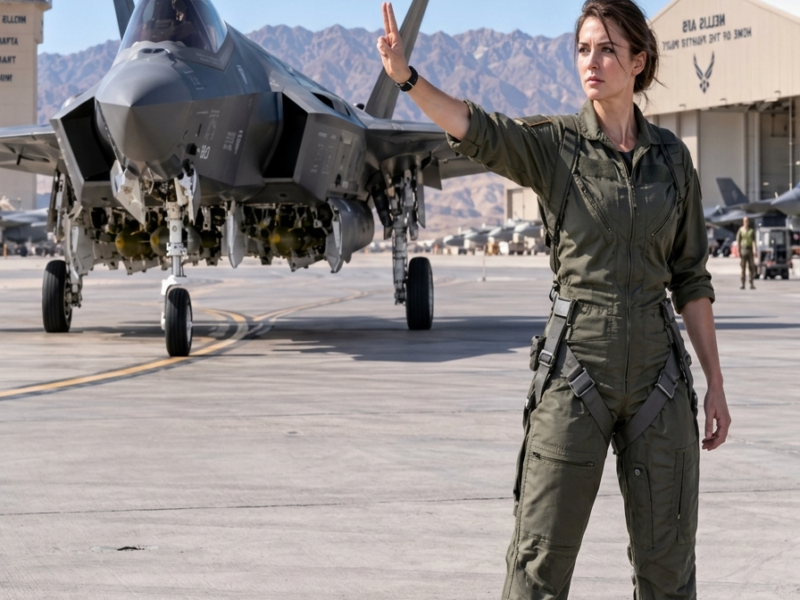
The entire flight school froze when the armed jet ignored three officers, locked its weapons, and turned toward me while my new commander coldly ordered, “Step away from the runway,”
The tarmac of Redstone Air Base shimmered beneath the oppressive Alabama heat, waves of distorted air rising off the black asphalt like ghosts. I kept my flight sunglasses on, my chin tilted upward, watching the jagged silhouette of an F-35A Lightning II carve through the midday glare. To every cadet and junior officer lining the apron, I was Captain Claire Morgan: thirty-four years old, quiet, unremarkable, carrying a scarred leather flight bag that smelled faintly of old oil and stale coffee. I had been stationed at Redstone for exactly eleven days. Eleven days of watching young men and women strap into multi-million-dollar war machines, blissfully ignorant of what those machines actually demanded in return.
They knew me only as an exacting flight instructor with a sharp tongue and an annoying habit of correcting officers who outranked me. They did not know about the valley outside Kandahar. They did not know about the night an entire six-vehicle convoy vanished from tactical satellite feeds, or how I pushed an F-15E Strike Eagle through a blinding zero-visibility haboob to pluck twelve trapped soldiers out from behind enemy lines. And they certainly did not know why three Distinguished Flying Crosses sat wrapped in black velvet at the bottom of a locked nightstand drawer in my off-base bungalow. When you spend years living with the screaming dead in your dreams, you learn that silence is the only armor that fits.
Beside me on the observation strip stood Colonel Marcus Hayes, the newly installed base commander. Hayes was a political creature—creased flight suit, immaculate silver hair, teeth that belonged in an enlistment poster, and eyes that held all the warmth of a frozen pond. He was a man who measured air combat by procurement budgets and congressional hearings rather than blood on the instrument panels.
“Keep your trainees in line, Captain Morgan,” Hayes remarked, his voice a flat drawl as he watched the jet climb into the holding pattern. “This is an evaluation exercise with live ordnance. The Pentagon wants operational proof that the avionics update can handle rapid target acquisition. I don’t need your cadets fumbling their switchology.”
“Lieutenant Miller is one of the sharpest sticks on this field, Colonel,” I replied quietly, never taking my eyes off the jet. “He won’t fumble. If something breaks up there, it’ll be the machine, not the boy.”
Hayes let out a short, dismissive breath. “A machine only fails when the pilot lacks discipline.”
High above us, the F-35 completed its third circuit over the weapons range, its twin tailfins catching the blinding sun. It carried an operational payload: two AIM-120D AMRAAMs tucked inside the internal bays and a pair of precision-guided joint direct attack munitions. It was meant to simulate a rapid ground-strike ingress. But as Miller leveled out to begin his dummy run against the northern perimeter targets, the aircraft’s transponder flashed amber on the mobile command trailer’s tactical screen.
Then it turned solid crimson.
A shrill tone cut through the radio chatter inside the mobile control unit parked twenty yards behind us. Chief Master Sergeant Torres, our tower liaison, stumbled out onto the metal steps of the trailer, headphones pressed tight against one ear, his eyes wide.
“Tower to command!” Torres shouted across the tarmac. “We just lost primary telemetry on Falcon Two! Navigation link is defaulting to external override!”
Hayes frowned, spinning around. “What do you mean, external override? Miller, acknowledge. Level wings and report state.”
Static hissed through the command speakers. Dead air.
“Falcon Two, this is Sunburst Actual,” Hayes barked, grabbing the handheld unit mounted to the flight line console. “Abort the exercise immediately. Vector two-seven-zero, dump ordnance in the designated northern safety corridor, and prepare for immediate recovery. Acknowledge!”
Nothing.
The jet did not bank toward the safety corridor. Instead, its engine note changed—a deep, visceral rumble that rattled the fillings in my teeth as the Pratt & Whitney engine swallowed thousands of pounds of air, pitching the nose violently upward. It climbed at an impossible angle, rocketing toward the restricted airspace over the facility’s classified research annex.
“Get that aircraft down!” Hayes shouted, panic bleeding through his polished veneer for the first time. “Where is he going? Torres, hail the emergency channel! Scramble the ready-alert birds from the south hangar now!”
Sirens began their low, mechanical wailing across the airfield. Support crews scrambled off the flight line, ground vehicles swerving in frantic arcs away from the runway. The whole base was turning into a hive of terrified confusion. But I stayed rooted to the asphalt. My eyes were fixed on the sky, my pulse hammering a frantic rhythm in my throat.
Through the shrieking alert sirens and the chaos of screaming personnel, a faint sound leaked through the external auxiliary speaker mounted beside the runway. It was dialed into the international emergency distress frequency—a frequency no trainee was supposed to touch during an operational drill.
A breathing pattern.
Rough. Shuddering.
Inhale, exhale. Inhale, exhale. Inhale, exhale. Three short, ragged gasps. Followed by one long, drawn-out, shuddering release.
The blood in my veins turned to liquid nitrogen.
I knew that rhythm. God help me, I had heard it a hundred times over encrypted comms during the darkest nights of my life. When panic choked the throat, when the cockpit filled with smoke, when the world was spinning toward blackness, that specific cadence was how he forced his heart to slow down. It was a private drill taught to only two people in the 48th Fighter Wing by a flight surgeon who had died six years ago.
“Give me that radio,” I said. My voice was low, but it cut through the screaming wind like a blade.
Hayes spun on me, his face purple with outrage. “Step away from the runway, Captain! This is an active weapons emergency! You are an instructor, and this is completely out of your lane!”
“Hand me the radio, Colonel,” I said again, stepping directly into his personal space, my eyes locking onto his with an intensity that made the older man visibly flinch. “Or that aircraft will strike something you cannot afford to lose. Give it to me now.”
His hand shook slightly as he thrust the heavy plastic transceiver into my palm.
I pressed the transmit key. I didn’t use standard military callouts. I didn’t use the tail number.
“Falcon Two, this is Morgan,” I said, keeping my cadence razor-steady. “Wings level. Breathe.”
Above us, screaming at six hundred knots, the multi-million-dollar fighter jet abruptly ceased its violent climb. The wings shuddered, dipped left, dipped right, and then flattened into a perfectly horizontal glide. It was as if an invisible thread had tied the control stick directly to my voice.
The runway fell dead silent. Hayes stared at me as if I were a stranger who had just spoken fluent Latin to an open flame.
I swallowed against the sand in my throat. “You’re not going to fight the system, are you?”
A blast of static crackled through the speaker. Then came a whisper—fractured, hollow, sounding like it had been dragged through gravel and miles of barren desert.
“Claire?”
I had to grip the heavy transceiver with both hands to keep them from visibly shaking. My knees felt entirely hollow. I would have recognized that voice anywhere on earth, in heaven, or in hell.
It was Lieutenant Daniel Reed.
Daniel. My wingman. The man who had covered my six when we dove into the Afghan canyon to shield that surrounded convoy. The man whose burning canopy I had watched disintegrate against a mountainside while my own fuel tanks ran bone-dry. The man whose official Department of Defense death certificate, stamped with gold-leaf seals and signed by high-ranking officials, had been handed to his weeping mother three years ago.
“How are you flying?” I whispered, my voice breaking slightly. “Daniel… how are you in that jet?”
There was a long, terrible silence. The wind howled across the empty runway, whipping dust across my flight boots.
Then Daniel’s voice came back, thin and cold:
“I’m not.”
My spine seized. Before I could key the microphone again, the F-35 banked hard, its stealth edges slicing through the Alabama sky with terrifying precision. It didn’t turn toward the open training fields. It didn’t turn toward the base runway.
It leveled its nose directly at Hangar 9—the decommissioned, high-security storage facility sitting half-buried in the earth at the furthest edge of the airfield.
Colonel Hayes lunged forward, grabbing my upper arm with fingers like iron talons. His face was no longer that of an arrogant commander. The color had completely drained from his skin, leaving it a sickly, gray ash.
“What did you say to that machine?” Hayes hissed, his fingers digging into my muscle until it bruised. “What did he tell you?”
I wrenched my arm out of his grasp, stepping back as the jet vanished behind the low line of hangars, its engines throttling down into an eerie, mechanical hum. “Nothing,” I lied.
My pocket buzzed.
A sharp, violent vibration against my hip.
I pulled out my secure personal phone. There was a single text message from an unlisted, ten-digit encrypted routing code.
YOU WERE NEVER SUPPOSED TO FIND OUT HE SURVIVED.
I stared at the screen, my breath catching in my chest. Slowly, I lifted my gaze back to Colonel Hayes. For the first time since I had reported to Redstone, Hayes wasn’t looking at me with the disdain of a commanding officer toward an insubordinate junior.
He was looking at me with raw, undisguised terror.
Before I could speak, the phone vibrated again. A high-resolution image loaded line by line.
It was an unedited field photograph, dated three years ago in Helmand Province. In the foreground stood Daniel and me, our flight helmets under our arms, dust caking our sweat-streaked faces, smiling in front of the very convoy we had been told was entirely wiped out by enemy artillery twenty minutes before our arrival.
And standing right behind us, leaning against an unmarked black command transport with an encrypted satellite array on its roof, was Colonel Marcus Hayes.
Beneath the photograph was a single, five-word line:
HE GAVE THE ORDER.
The air in the hangar row was heavy with the smell of wet concrete and ozone. Sirens still wailed in the distance, their undulating howls echoing off the corrugated steel structures of Redstone Air Base, but down here, at the forgotten perimeter of the tarmac, everything felt frozen under an unnatural hush.
Hangar 9 sat isolated from the operational flight line, sealed behind two layers of chain-link fence topped with razor wire. Ostensibly, it was an auxiliary storage facility for decommissioned airframes and surplus ground support gear. But as I sprinted down the access road, my flight boots pounding the gravel, I could see that the heavy steel sliding doors were cracked open just wide enough to swallow a vehicle.
Above the roofline, the F-35 had not crashed. It had touched down.
It sat on the auxiliary taxiway directly outside Hangar 9, its jet engine whining down through a series of dying mechanical sighs, the heat shimmer still radiating off its carbon-composite skin. The cockpit canopy was already raised.
There was no pilot inside.
I slowed my pace, drawing the standard-issue Beretta M9 I kept holstered on my web gear—a regulation I usually ignored on base, but something in the back of my brain had screamed at me to strap it on that morning. I cleared the corner of the hangar with my weapon held low, thumb resting on the safety.
“Daniel?” I called out, my voice swallowed by the immense, cavernous darkness of the interior.
The air inside Hangar 9 was freezing, chilled by heavy industrial air-handling units that hummed somewhere in the rafters. Rows of high-intensity halogen lights flickered overhead, casting harsh, clinical white pools on the concrete floor. There were no surplus trucks here. No disassembled training airframes.
In the center of the bay sat an array of mobile server racks, their cooling fans screaming in unison, black cables thick as pythons running across the floor and disappearing into a sealed, stainless-steel pod roughly the size of a shipping container. The exterior of the container bore no military insignia—only a yellow hazard stencil reading PROJECT AETHEL-4: EXPERIMENTAL NEURAL INTERFACE.
“Clear the lane, Claire.”
The voice came from the shadows behind the main terminal banks.
I snapped the weapon up, lining the iron sights with the darkness. “Step into the light. Slow.”
A figure emerged. He wasn’t wearing a flight suit. He was dressed in dark utility trousers and a ragged black thermal undershirt. His face was half-covered in surgical tape, the skin beneath his cheekbones gaunt and hollow, but the eyes—deep gray, stubborn, and filled with a familiar, searing intensity—were unmistakable.
“Lower the iron,” Daniel said softly, raising his hands just enough to show empty palms. “You never could hit a moving target with a sidearm anyway. That was always my job.”
A sob tore through my chest, violent and unwanted, before I could suppress it. My arms trembled, the heavy metal of the pistol dipping an inch. “Daniel… we buried an empty flag-draped casket in Arlington. Your mother… she died six months later believing you were blown to pieces in the valley.”
“I know,” he whispered, his jaw clenching until the tendons stood out like wire. “I know she did. They told me she was fine. They told me she was being taken care of as long as I stayed in the harness.”
“Who told you?” I demanded, closing the distance between us until I was ten feet away. I could see the scarring now—fine, pale lines tracing along the base of his skull and disappearing under his hairline, neat surgical incisions where metal ports had been integrated into his flesh. “What is this, Daniel? You weren’t in that jet out there. The cockpit was empty.”
“I was in the jet,” Daniel said, pointing a trembling finger toward the stainless-steel pod behind him. “And I was in this rack. And I was in the tactical feed running through the command trailer. They didn’t rescue me from that canyon, Claire. Hayes’ special operations group dragged me out of the wreckage before the dust cleared. They needed a pilot with high neural plasticity—someone whose brain could map an aircraft’s fly-by-wire system directly through an encrypted satellite link.”
The horror settled into my gut like lead. “Unmanned combat control. They bypassed the drone latency problem by using a human brain as the processor.”
“Not just a drone,” Daniel said, his voice dropping to an urgent rasp. “A weapon that doesn’t disobey. A weapon that doesn’t care about collateral damage, or civilian casualties, or treaties. When they put you inside the simulation, you don’t see children, Claire. You see target geometries. You see math. But they made a mistake.”
He took a step closer, and for the first time, I saw the blood running from his left nostril, wiped away with a careless sweep of his sleeve.
“What mistake?”
“They brought me to Redstone,” Daniel said, his eyes burning into mine. “They thought after three years of chemical conditioning and sensory deprivation, I wouldn’t recognize anything outside the box. But when Hayes assigned you to this base eleven days ago, I felt the radio traffic change. I recognized your voice print when you checked into the tower on your first flight. The conditioning… it cracked.”
Behind us, the heavy steel door of Hangar 9 shuddered.
The sharp, metallic clatter of assault rifles clearing their safeties echoed across the concrete.
“Step away from the asset, Captain Morgan.”
Colonel Hayes stepped through the gap in the hangar doors, flanked by four men in sterile, unmarked tactical gear—no patches, no name tapes, their faces concealed behind matte-black ballistic masks. They carried suppressed short-barreled carbines, all leveled at my chest.
Hayes had regained his composure. His flight jacket was zipped tight, his face cold and impassive.
“I gave you an order to stay away from the runway, Claire,” Hayes said, his voice echoing in the vast space. “You always were too damn curious for your own survival. Just like you were in the valley.”
“You left that convoy to die,” I said, keeping my body positioned between Hayes’ operators and Daniel. “The photograph. The weapons shipment. You weren’t escorting supplies in Helmand, were you?”
“That convoy was carrying two hundred million dollars in unregistered off-the-books telemetry hardware,” Hayes said without an ounce of remorse. “Supplies meant for an operational theater that officially didn’t exist. You and Reed were supposed to fly high-cover, drop your payload on the coordinates we gave you, and fly home. But Daniel had to be a hero. He dove into the canyon. He saw the serial numbers on the crates. He saw who was picking them up.”
“You sold the ordnance to the warlords,” Daniel spat, his voice shaking with hatred. “You staged the ambush to write off the inventory, and then you used the wreckage to fake my death.”
Hayes glanced at his watch, completely unfazed. “History is written by the people who manage the contracts, Lieutenant. You were a broken pilot in a shattered cockpit. We gave you a second life. We made you the bleeding edge of American air dominance. Do you have any idea what foreign defense ministries will pay for an autonomous strike platform that possesses the tactical instincts of a combat ace without the human hesitation?”
“He’s a human being, Hayes!” I yelled, my fingers tightening on the grip of my Beretta.
“He’s government property,” Hayes countered smoothly. He raised two fingers toward his tactical team. “Secure the pilot. Place the Captain under arrest for treason and unauthorized access to a restricted testing site. If she resists… terminate her.”
The operators moved forward in unison, their boots clicking on the floor.
“Claire,” Daniel whispered behind me. “The auxiliary console at your ten o’clock. The red toggle. Hit it.”
“Daniel, don’t—”
“Hit it now!”
I didn’t think. I dove to my left, hitting the concrete hard as the first suppressed rounds cracked through the air above my head, punching holes through the sheet metal behind me. I rolled, kicked off a steel desk, and slammed my palm down onto the emergency maintenance toggle on the auxiliary terminal.
The lights didn’t go out.
Instead, the F-35 sitting outside the hangar doors fired its auxiliary power unit with a deafening, bass-heavy roar. The nose gear pivoted instantly, the multi-million-dollar warplane rolling forward three yards, swinging its massive, sharp-edged nose directly into the hangar opening.
Its external targeting pod swept downward, painting the entire interior with an invisible grid of infrared lasers that triggered the threat-detection sensors on the operators’ tactical vests.
A synthetic, mechanical voice boomed from the aircraft’s external communication horns:
TACTICAL OVERRIDE DETECTED. WEAPONS ARMED. DISPERSE IMMEDIATELY.
The operators froze, their weapons wavering between me and the massive warplane blocking their only exit.
Hayes stumbled backward, his hands held up against the blinding wash of the jet’s taxi lights. “What have you done?” he screamed at Daniel. “You don’t have the authorization codes!”
Daniel stood tall beside the server racks, blood now trickling freely down his lip, his fingers buried in the console keyboard. “I don’t need your codes, Hayes. You spent three years wiring this machine into my nervous system. She doesn’t listen to the Pentagon anymore.”
Daniel reached out, grabbed my tactical harness, and hauled me to my feet behind the cover of the reinforced server banks. “Run, Claire! Out the maintenance tunnel behind the cooling units! Go!”
“I’m not leaving you again!” I screamed over the deafening scream of the jet’s engine.
“You have to!” Daniel yelled back, his eyes wild, his hands working furiously across the command keys. “The flight data recorder from Afghanistan—it’s mirrored on the hard drive in my pocket! Take it! It’s the only thing that will put Hayes in front of a firing squad!”
He shoved a cold, palm-sized black drive into my hand.
Before I could pull him toward the tunnel, Hayes’ lead operator broke his trance and fired a burst directly into the server bank. Sparks erupted in a blinding shower of white-hot magnesium. Daniel gasped, his back arching violently as an electrical surge fed back through the open interface port at the base of his neck.
He fell to the floor, convulsing, his hand slipping from the controls.
Outside, the F-35’s engine surged out of control, its internal weapons bay doors snapping open with a violent hydraulic hiss.
The smell of burning circuit boards and copper was suffocating. Daniel lay on the concrete, his limbs locked in rigid, involuntary spasms as the corrupted interface loop pumped raw current through his neural implants. Smoke poured from the severed cabling behind the main terminal, curling toward the high steel beams of Hangar 9.
“Daniel!” I dropped to my knees, grabbing his shoulders, trying to drag him toward the dark mouth of the maintenance access shaft five yards behind us.
“Can’t… break… link…” he gasped through locked teeth, flecks of bloody foam bubbling at the corner of his mouth. “The jet… it’s defaulting… to primary defensive protocol…”
Outside the gaping doorway, the F-35’s internal bay was fully deployed. The sleek, deadly cylinder of an AIM-120D AMRAAM slid down on its hydraulic trapeze, its seeker head swiveling blindly as it searched for a target lock in the confined space of the airfield apron.
Hayes’ private contractors weren’t amateurs. Seeing the machine glitch, the two lead operators immediately broke cover, sprinting along the concrete wall to flank our position behind the server racks. They fired as they moved, short controlled bursts that tore through the metal housing of the cooling units, showering us with freezing freon mist and jagged aluminum shards.
I didn’t hesitate. I leaned out from behind the rack, leveled my Beretta, and fired three rapid shots. The heavy 9mm rounds hammered into the chest plate of the lead operator, throwing him off balance and driving him into the floor. The second shooter ducked behind an industrial generator, his suppressed carbine spitting fire, the rounds chewing through the server rack inches above my helmet.
“Hayes is calling in the base security detachment!” Daniel groaned, his fingers clawing at the concrete as he forced his body to roll over. “He’ll tell them… it’s a terrorist breach. He’ll order them… to level this entire hangar.”
“Then we move. Right now.” I slipped my arms under his shoulders, hauling his dead weight upward. He let out a ragged scream of agony as the severed interface port at the base of his skull tore loose from the trailing fiber cables, trailing tiny specks of blood down his neck.
With every ounce of strength I had left, I dragged him into the darkness of the maintenance tunnel. The shaft was an old Cold War-era utility corridor—narrow, damp, and smelling of rust and dead leaves, built to run communications lines between the flight line and the subterranean fuel storage tanks half a mile south.
I slammed the heavy iron blast door shut behind us, dropping the crossbar into place just as a hail of automatic fire slammed into the exterior steel plate with the sound of a sledgehammer hitting an anvil.
“They’ll have thermals,” Daniel panted, slumping against the slimy concrete wall of the tunnel. He was clutching his ribs, his breathing returning to that terrifying, broken cadence: three short gasps, one long shudder. “They’ll track our heat signatures… through the vent grates.”
“Not before I get this drive to the Inspector General,” I said, checking the magazine of my sidearm. Seven rounds left. “We just need to make it to the perimeter access gate behind the fuel depot. My truck is parked outside the wire.”
Daniel looked up at me in the dim glow of the emergency pathway lights. In the greenish glare, his face looked like that of a walking corpse, but his eyes were sharp, lucid, and filled with a cold, desperate clarity.
“The drive isn’t enough, Claire,” he said, holding up his trembling hands. “Hayes has the entire regional command structure locked down. General Vance, the wing commander—he’s in on it. The contractors who built this neural rig? They own half the defense subcommittees on Capitol Hill. If you hand that drive to standard military channels, it disappears into an evidence locker, and you end up dead in a ditch from an ‘accidental’ single-car rollover.”
“Then what do you suggest?” I demanded, hauling him back to his feet. “We sit here and wait for Hayes to burn us out?”
“We make the jet talk.”
I stopped dead in the narrow passage. “What?”
“The F-35’s telemetry array isn’t just local,” Daniel said, leaning heavily against me as we stumbled down the sloping corridor. “It has an integrated satellite uplink that routes directly to the National Military Command Center in the Pentagon during operational testing. Hayes suppressed the feed locally through this base’s relay tower. But if we can reach the secondary transmitter on the roof of the fuel pump house… I can patch my neural telemetry bridge directly into the dish.”
“You said it yourself, Daniel—the link was killing you! You’re bleeding from the ears!”
“It’s the only way, Claire!” he shouted, stopping and grabbing my flight jacket with both hands, his knuckles bone-white. “If I broadcast the flight recorder from that valley—if the Joint Chiefs see the raw gun-camera footage of Hayes’ transport handing weapons to the Taliban while our convoy burns—he can’t bury it. It goes live to twenty different command networks simultaneously. He’s finished.”
He was right. I knew the operational architecture of Redstone. If Hayes controlled the tower, our only chance was the independent satellite relay mounted above the southern pump facility.
We moved as fast as our battered bodies could carry us, emerging ten minutes later through an emergency ground hatch hidden inside a grove of loblolly pines near the edge of the fuel tank farm.
The Alabama sun was sinking toward the horizon, painting the sky in deep, bruised shades of purple and burnt orange. But across the airfield, all hell had broken loose.
Three armored Humvees were tearing down the perimeter taxiway, their blue emergency lights flashing frantically. Overhead, two AH-64 Apache attack helicopters from the base’s attack aviation battalion were orbiting low, their thermal targeting pods swiveling across the tarmac. Hayes had mobilized the entire ready garrison, spinning a lie about an armed infiltration to lock down the installation.
“There’s the pump house,” I whispered, pointing through the chain-link fence at a low concrete bunker thirty yards away. On its roof sat a white, four-foot dish pointed southwest toward the defense satellite corridor.
“We have to cross the open road,” Daniel muttered. He was shaking violently now, his skin cold and clammy. His nervous system was crashing from the sudden withdrawal of the machine interface.
“Wait for the patrol to pass,” I said, pulling him down behind a concrete drainage culvert.
We watched as a security forces patrol truck roared past, its heavy diesel engine growling, its roof-mounted spotlight raking the fence line. The moment its taillights vanished around the curve of the fuel tanks, I stood up.
“Now. Go.”
We sprinted across the blacktop. Daniel stumbled halfway, but I caught him under his arm, lunging toward the steel ladder bolted to the side of the pump house. I pushed him up first, following close behind, my eyes sweeping the airfield.
When we reached the flat gravel roof, Daniel collapsed beside the satellite junction box. He reached into his pocket and pulled out a small, metallic interface dongle—a piece of hardware he must have torn from the console in Hangar 9 before the firefight started. With trembling, bloody fingers, he popped open the junction box and jammed the pins directly into the high-gain terminal.
“It needs… a localized biocentric key,” Daniel gasped, clutching his head as a low whine began to emit from the box. “My retina. It has to verify… that the operator is still linked to the airframe.”
He leaned down, pressing his left eye against the small optical sensor on the side of the unit.
A tiny green LED flickered to life.
Above the airfield, two miles away at Hangar 9, a terrifying sound ripped through the evening air.
The F-35’s engine roared back to life. It wasn’t just idling—it was at full military thrust. The aircraft taxied onto the main runway without clearance, its fly-by-wire system entirely commandeered by the remote link Daniel had just re-established from the rooftop.
“I’ve got her,” Daniel whispered, blood pouring down his cheek as his eye remained locked to the sensor. “I’m in the bus. The Pentagon feed is opening up.”
“Daniel, look down!” I yelled.
Down on the service road, a black civilian SUV had just screeched to a halt. The door kicked open, and Colonel Hayes stepped out, carrying an M4 carbine. He didn’t wait for his men. He looked straight up at the roof of the pump house, his eyes wild with the desperation of a man who knew his world was collapsing.
“Morgan!” Hayes screamed over the distant roar of the jet. “Step away from that dish! If you broadcast that telemetry, you won’t live to see the court-martial!”
He raised the rifle, leveling the barrel straight at my chest.
The world seemed to slow down into fragments of deafening noise and blinding light.
Before Hayes could squeeze the trigger of his M4, a deafening sonic wave hammered down from above, rattling the gravel on the pump house roof like loose buckshot. The F-35 had not stayed on the runway.
Controlled entirely through the high-gain satellite dish by Daniel’s shattered mind, the fifth-generation stealth fighter screamed over the perimeter trees at two hundred feet, its wake turbulence snapping pine branches and sending Hayes stumbling sideways against his SUV. The sheer concussive pressure of the jet’s engine wash blew the rifle from the Colonel’s hands, sending it clattering across the blacktop.
“Upload… at seventy percent!” Daniel screamed from the gravel, his hands locked onto the junction box like death grips. His entire body was vibrating, his teeth chattering uncontrollably as the raw digital stream tore through his neural architecture. “Claire… I can’t hold the airframe… and push the data at the same time! The processing load… it’s frying the transceiver!”
“Hold it!” I shouted, dropping flat against the roof parapet and drawing my Beretta. “Just thirty more seconds, Daniel!”
Down on the road, Hayes scrambled to his feet, bleeding from a scrape on his temple. He didn’t bother reaching for his rifle. Instead, he pulled a compact tactical radio from his belt, screaming into the microphone with veins bulging from his neck.
“Striker Lead, this is Base Commander! The runaway aircraft is hostile! Bogey has been hijacked by ground infiltration elements using a compromised terminal on the south pump bunker! Clear to engage! Splat that target out of the sky now!”
Through the twilight gloom, the two AH-64 Apache helicopters wheeled around over the main runway, their twin turboshaft engines screaming as they turned their blunt, predatory noses directly toward our position. Their thirty-millimeter chain guns traversed in unison, tracking the heat signature of the pump house roof.
“Daniel, we have to move!” I yelled, pulling at his collar. “They’re going to saturate this roof!”
“Eighty-five percent!” Daniel shrieked, his voice climbing to a pitch of sheer agony. His left eye was completely bloodshot, the pupil blown wide, tears of clear fluid mixed with dark blood tracking down his jaw. “If I break the link now… the handshake fails! The Pentagon won’t get the cryptographic proof! It’ll just look like a data glitch!”
“They’re going to tear us apart!”
The lead Apache opened fire.
A chain of high-explosive thirty-millimeter rounds walked across the gravel yard below, chewing through concrete barriers, shredding Hayes’ black SUV into a twisted heap of smoking metal, and biting into the base of the pump house. The entire concrete structure shook violently beneath us, dust and pulverized mortar exploding upward through the access vents.
Hayes threw himself into the ditch beside the culvert, covering his head as his own base assets tore the ground to pieces around him.
Above us, the F-35 responded without Daniel touching a stick.
The machine’s combat programming, fused with Daniel’s deep-seated instinct to protect his wingman, took over. The stealth jet pitched violently upward into a vertical climb, dumping flare salvos that bloomed across the darkening sky like brilliant white flowers. The blinding infrared signatures completely overwhelmed the Apaches’ fire-control systems.
Then, coming down out of the clouds in a terrifying, high-G dive, the F-35 sliced directly between the two attack helicopters. The aerodynamic wash struck the rotors of the trailing Apache, sending the heavy helicopter spinning out of control in a wild yaw, its pilot fighting the collective to avoid slamming into the perimeter fence.
“Data upload complete!” Daniel gasped.
He collapsed backward onto the gravel, his hands sliding limp from the terminal. The green LED on the junction box flashed twice and turned to a steady, solid blue.
Across the United States, inside the subterranean briefing rooms of the National Military Command Center in the Pentagon, three dozen high-ranking officers and civilian defense officials were suddenly looking at the same thing: an unencrypted, verified tactical feed detailing the slaughter of a United States Army convoy in 2023, accompanied by the encrypted banking routes and logistics orders bearing the private digital signature of Colonel Marcus Hayes.
The silence on the rooftop was sudden and absolute, broken only by the dying hum of the junction box and Daniel’s shallow, whistling breaths.
Below, the dust began to settle. The remaining Apache backed off, its weapons lowering as emergency stand-down orders—broadcast straight from the regional command hub at Fort Novosel—began cutting across all military frequencies.
ALL UNITS STAND DOWN. REPEAT, CEASE FIRE. CODE RED-ALPHA ENFORCED BY ORDER OF THE AIR COMBAT COMMAND INSPECTOR GENERAL.
Hayes crawled out of the ditch, his uniform soaked in mud, his face a mask of absolute ruin. He looked up at the roof, his eyes wide and hollow. He heard the radio transmissions leaking from the open door of his ruined SUV. He knew what they meant.
The net hadn’t caught me. It had closed around him.
I walked to the edge of the parapet, looking down at the man who had ordered the murder of twelve soldiers and stolen three years of my wingman’s life for a defense contract.
“It’s over, Marcus,” I said, my voice carrying clear in the quiet evening air. “Every screen in the Department of the Air Force just saw your face.”
Hayes stared at me, his chest heaving, his mouth working silently. Then, with slow, robotic movements, he reached down to his web belt, unholstered his sidearm, and placed it on the hood of the wrecked vehicle. He took two steps back and dropped to his knees, his hands locked behind his head, waiting for the military police sirens that were already screaming down the perimeter road.
I turned back to Daniel.
He was lying on his side, his flight boots curled toward his stomach. I dropped beside him, pulling his head into my lap, pressing my thumb against the artery in his neck.
His pulse was faint. Irregular. Fluttering like the wings of a trapped sparrow.
“Claire…” he whispered, his eyes struggling to focus on my face. The sky above us had darkened to indigo, the first stars beginning to pierce the veil of the Alabama night.
“Stay with me, Daniel,” I pleaded, tears finally spilling over my lashes, hot and fast. “The medics are coming. The whole base is standing down. You won. Do you hear me? You beat them.”
He smiled faintly, a tiny, cracked tilt of his lips. “I heard… the engine. Did you… see her fly?”
“I saw her,” I choked out, wiping the blood from his cheek with the sleeve of my flight suit. “She was beautiful. You flew her like you always did.”
“I wasn’t… flying,” he murmured, his voice fading into the distance, his hand weakly reaching up to touch the silver flight wings pinned to my chest. “I was… just trying… to come home.”
His eyelids fluttered shut. His hand slipped from my jacket, falling limp against the rooftop gravel.
“Daniel!” I shook his shoulder, leaning down until my forehead rested against his cold skin. “Daniel, don’t you dare! Breathe! Three short! One long! Breathe, damn you!”
In the distance, the first medical Humvees crested the hill, their sirens wailing through the pines. But above us, circling in a slow, mournful orbit at ten thousand feet, the empty F-35 leveled its wings, waiting for the voice that would never speak to it again.
The sterile white walls of Walter Reed National Military Medical Center hummed with the constant, monotonous rhythm of life-support monitors. Outside the third-floor window, the autumn trees of Bethesda, Maryland, were shedding their leaves, carpets of gold and crimson covering the immaculate lawns.
It had been four months since the night at Redstone.
Four months of closed-door congressional hearings, court-martial proceedings that shook the very foundations of the Department of Defense, and the quiet, systematic dismantling of three private defense research subsidiaries whose names would never appear in public newspapers. Colonel Marcus Hayes was currently sitting inside a federal maximum-security brig at Fort Leavenworth, awaiting a military tribunal on charges of treason, grand larceny, and twelve counts of premeditated murder.
General Vance and two members of the House Armed Services Committee had resigned under the shadow of sealed federal indictments. The official story released to the press was brief, vague, and sanitized: a tragic telemetry failure during an experimental avionics test, successfully mitigated by the heroism of local base personnel. The public never learned about the pod in Hangar 9. They never learned about the neural ports, or the ghost who flew an F-35 with his mind.
I sat in the plastic armchair beside the bed, my service dress uniform crisp and immaculate, the three Distinguished Flying Crosses pinned neatly above my left pocket alongside a newly awarded Silver Star. My leather flight bag sat on the floor beside my feet, worn and scuffed, looking entirely out of place in the spotless room.
In the bed, Daniel lay propped up against a mountain of white pillows.
The surgical scars along the base of his skull had faded to pale, jagged silver tracks. The feeding tubes and neural monitors were gone, replaced by the slow, steady drip of an intravenous saline line. His face was still thin, his cheekbones prominent, but the gray pallor of death had left his skin. For the first time in three years, his eyes were clear, steady, and entirely his own.
“You look ridiculous in all that brass, Morgan,” Daniel rasped, his voice still rough from months of intubation, but holding that dry, sarcastic edge I had missed more than life itself.
I let out a quiet laugh, reaching out to clasp his hand. His grip was weak, but his fingers were warm.
“Takes one to know one, Reed,” I said softly. “The Chief of Staff came by while you were sleeping this morning. He left something on your nightstand.”
Daniel glanced sideways at the small wooden box sitting beside his water pitcher. It was open. Inside rested a newly minted set of Command Pilot wings, cast in solid silver, alongside a full, unconditional medical retirement document signed by the President of the United States.
“They’re retiring me as a Lieutenant Colonel,” he said, staring at the silver insignia without any real expression. “A full pension. A house in Colorado, if I want it. Free medical care for the rest of my life.”
“You earned it ten times over,” I said.
Daniel turned his head toward the window, watching a pair of sparrows dart between the bare branches of an oak tree. “They took the machine apart, didn’t they?”
“The Aethel-4 project was completely destroyed,” I confirmed, my voice dropping to an absolute whisper. “Every server, every line of neural interface code, every prototype airframe. ACC completely scrubbed the database. They buried it under three hundred feet of concrete in Nevada. No one will ever be put in that harness again, Daniel. I made sure that was part of my testimony before the select committee.”
He let out a long, slow breath. Not the panic-stricken cadence of the cockpit. Just a normal, exhausted, human sigh.
“Sometimes… when I close my eyes,” he whispered, his fingers tightening slightly around mine, “I can still feel the trim tabs. I can feel the Mach shockwaves rippling across my skin. I can see the horizon curving at forty thousand feet. It’s hard… to be down here on the ground, Claire. Everything moves so slowly. Everything feels so heavy.”
“That’s just gravity, Daniel,” I said, a faint smile touching my lips. “It’s what keeps normal people from flying apart.”
“I don’t think I was ever normal.”
“None of us were,” I answered, looking down at my own scarred knuckles. “That’s why they put us in cockpits in the first place.”
A gentle knock sounded at the door. A young Air Force captain, an aide from the Pentagon liaison office, poked his head in.
“Excuse me, Major Morgan,” he said respectfully. “Your transport to Andrews Air Force Base is downstairs. The Secretary’s review board starts at fourteen-hundred.”
“Thank you, Captain. Give me two minutes,” I replied.
The aide nodded and pulled the door shut.
I stood up, smoothing the front of my dress coat, and reached down to pick up my old leather bag. I looked down at Daniel, whose eyes were tracking my movements.
“They offered you the squadron, didn’t they?” he asked.
“The 335th at Seymour Johnson,” I nodded. “A full operational fighter squadron. Strike Eagles. Real cockpits. Real pilots with real blood in their veins.”
“Are you going to take it?”
I looked at the silver wings pinned to his nightstand, then out the window at the wide, endless gray sky stretching north toward the Atlantic. For years, I had flown to escape the ghosts. I had strapped myself into machines to drown out the silence left by the people I couldn’t save. But the ghosts weren’t behind me anymore. One of them was sitting in this bed, breathing real air, watching the leaves fall.
“I don’t know,” I said honestly. “I think… I might just teach for a while. Not at Redstone. Somewhere quiet. Somewhere where kids just want to learn how to touch the clouds without having to bleed for them.”
Daniel smiled—a real, broad, boyish smile that erased ten years of war from his face. “You’d make a terrible civilian, Claire. You have an annoying habit of correcting people who think they know better.”
“Somebody has to keep the idiots from crashing,” I said, leaning down and pressing a gentle kiss to his forehead. “Rest up, Daniel. I’ll be back on Friday. And when you get out of this bed, you owe me three years of back pay and the worst cup of coffee in Alabama.”
“It’s a deal,” he whispered.
I walked to the door, my hand resting on the brass handle. Before I pulled it open, I turned back one last time.
Daniel was looking out the window, his head tilted back, watching a commercial airliner climb through the high, thin clouds, its contrail a brilliant white scar across the blue. His eyes were calm. The war in Afghanistan was finally over. The war at Redstone had been won.
I stepped out into the corridor, let the heavy door click shut behind me, and walked down the hallway toward the autumn air, carrying my flight bag in my hand and the quiet sky in my heart.
The end.









