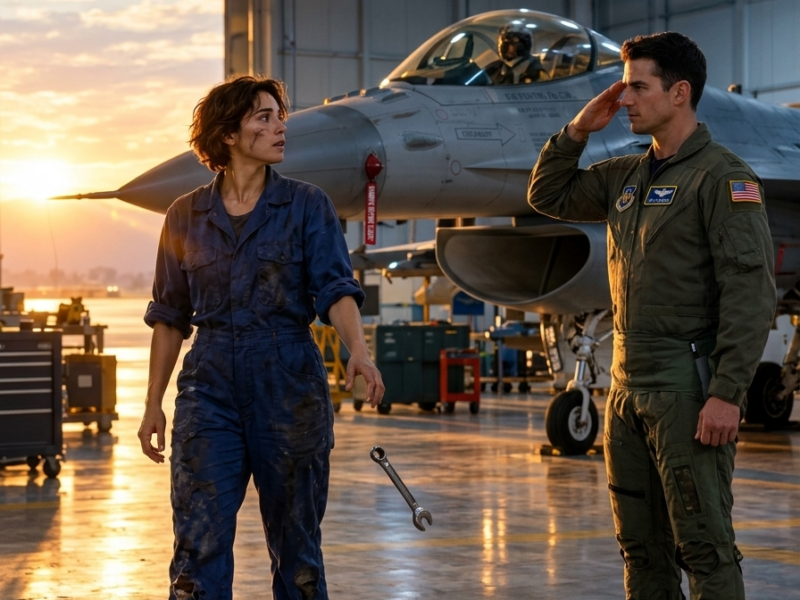
The entire flight line went silent when an F-16 pilot suddenly stepped away from his jet, saluted the grease-covered woman everyone called “just a mechanic,” and whispered, “Major?”
The asphalt of Redstone Air Force Base radiated a dry, suffocating heat that made the horizon shimmer like liquid glass. It was mid-afternoon, and the flight line was alive with the deep, rhythmic thrum of jet engines, the hiss of pneumatic lines, and the constant clack of heavy wrenches against metal. Sweat trickled down my neck, soaking into the collar of my faded grey coveralls. I didn’t mind the heat, nor did I mind the grease that seemed permanently etched into the lines of my palms. To the aircrews, the ground crew, and the young officers marching past in pristine flight suits, I was nobody. I was the silent figure kneeling beside the landing gear, buried beneath a maze of hydraulic lines and titanium plating. I was “just a mechanic.”
It was the perfect shield. For six long months, I had existed in the shadows of Redstone, maintaining the very warplanes I used to command. I ate my lukewarm lunch alone on a wooden crate behind Maintenance Bay 4, listening to the ambient noise of the airfield, and I left as soon as my shift ended without making a single friend. When you spend three years hiding from ghosts, solitude isn’t just a preference—it’s a survival tactic.
I was deep under the port wing of an F-16 Fighting Falcon, torqueing a stubborn fuel line coupling, when the ambient roar of the tarmac suddenly died away. The shift in energy was instantaneous. The clatter of tools ceased. A nearby crew chief froze, his radio crackling with unattended chatter.
I wiped a streak of dark grease from my forehead with the back of my gloved hand and glanced out from beneath the fuselage.
Standing ten feet away was Captain Ryan Cole. He had just stepped away from his aircraft, ignoring the ladder his crew chief had set up. He wasn’t looking at the jet, nor was he checking his pre-flight clipboard. His eyes were locked onto me. Before I could process the sudden silence, Ryan brought his right hand up, locking his fingertips to his brow in a crisp, rigid salute—a textbook military rendering of respect aimed not at a base commander, but at a woman wearing grease-stained coveralls holding an adjusted crescent wrench.
“Major?” he whispered.
The word hung in the heat-heavy air like a static shock.
I froze beneath the wing, my fingers tightening instinctively around the handle of my wrench. I lowered my head, hiding my face beneath the bill of my worn baseball cap, but it was too late. Captain Ryan Cole lowered his salute slowly, his shoulders stiff, his jaw set in a tight line. Around us, half a dozen mechanics and groundhandlers stared in utter bewilderment. Nobody spoke.
For six months, my identity had been entirely erased. I fixed engines. I checked hydraulics. I ensured these multi-million-dollar war machines made it into the sky and back down safely. Whenever a visiting officer or a curious transfer asked about the woman who worked straight through lunch without taking a break, the answer from the line chief was always identical: “She’s just a mechanic. Knows her way around an engine, but keeps to herself.”
I had never corrected them. It was far easier that way. It kept the questions at bay. It kept the past buried.
Ryan took three deliberate steps toward me, his combat boots echoing against the concrete. “Where did you learn to tune an F-16 fuel bypass like that?” he asked softly, his voice low enough that the surrounding crew couldn’t hear. “I’ve watched three different depot techs try to fix that throttle lag. You solved it in twenty minutes.”
I stood up slowly, wiping my hands on an oily rag, keeping my posture slightly slouched—a mechanic’s posture, not an officer’s. “Experience,” I shrugged, keeping my voice flat.
Ryan didn’t break eye contact. He stared at my hands—calloused, stained, but steady. Then his eyes drifted up to my face, studying the sharp contour of my jawline, the faint scar running along my left hairline, and the cold, guarded look in my eyes.
“You flew?” he asked.
“No,” I lied smoothly. It was the safest lie I had told in three years.
Ryan stepped even closer, effectively blocking me from the sightlines of the nearby crew. “Major Evelyn Hart?”
My heart slammed against my ribs like a trapped bird. Hearing that name spoken aloud on an active military flight line sent a chill straight down my spine, despite the blistering heat. That name belonged to a ghost. It belonged to a life that had been violently demolished three years ago on a moonless night over the Nevada desert.
Three years earlier, I had commanded a top-secret flight evaluation unit testing next-generation avionics and thrust-vectoring systems. It was a classified program—Project Vane. During a routine night intercept test, a sudden, catastrophic system failure ripped through my wingman’s aircraft. Within seconds, two experimental jets went down. Two brilliant pilots—my friends, people I had trained with—died in the inferno.
When the military court of inquiry convened, the official report came back swift and brutal: pilot error. Command failure. The investigation pointed the finger directly at me, claiming I had ignored red-line warnings and pushed the systems past their operational parameters. They claimed I was responsible for the destruction of classified assets and the loss of human life. Before the formal court-martial could convene to seal my fate and put me in a federal brig, I disappeared.
Or at least, that was what the official record said.
In reality, someone had tipped me off that the court-martial was a formality—a cover-up to protect a defense contractor’s fatal design flaw. I had changed my name, buried my dress whites, abandoned my wings, and taken the only job on the periphery of aviation where nobody looked at your eyes as long as your hands could turn a wrench.
Ryan’s eyes softened slightly, but the tension in his frame remained. He had been a young lieutenant attached to the logistics squadron at Edwards AFB three years ago. He had seen me in my full dress uniform. He had seen me accept commendations before the disaster.
“I knew you weren’t dead,” Ryan whispered, his voice trembling slightly. “When they reported you missing, when they closed the file… I didn’t believe it.”
I looked around frantically. A few crew chiefs were still sneaking glances in our direction, clearly wondering why an operational fighter pilot was standing in deep, hushed conversation with a civilian mechanic. “Keep your voice down,” I hissed, leaning in closer. “You’re going to get us both pulled into a room you don’t want to be in.”
Ryan’s expression hardened, the nostalgic shock giving way to genuine concern. “Why are you here, Evelyn? Why are you hiding in plain sight at Redstone?”
“Because the people who buried my career—and buried those two pilots—are still here,” I said, my voice dropping to a dangerous register. “They are in this command structure. If they find out I’m alive and working on these jets, I won’t just be arrested. I’ll disappear for good.”
Before Ryan could digest my words, an emergency horn screamed across the tarmac. The sharp, wailing cadence signaled an immediate flight line hazard.
Over the intercom, a panicked controller’s voice cut through the static: “Alert on Flight Line Bravo. Aircraft 408 experiencing uncommanded hydraulic dump. Ground crew hold positions.”
Aircraft 408 was Ryan’s F-16.
The jet was idling twenty feet behind us, its jet fuel starter whining down as auto-safeties triggered. Red hydraulic fluid began pooling rapidly on the pristine white concrete beneath the rear fuselage, spreading like a pool of dark blood.
My breath caught in my throat. I knew that pattern. I knew that exact rate of fluid displacement. It wasn’t a ruptured hose or a worn seal. It was a primary manifold valve blowout.
The exact same failure that had disabled my wingman’s jet three years ago. The failure that had killed two people.
Ryan looked at me, his eyes wide with sudden realization. I looked at the aircraft, my mind racing through schematics I had memorized a decade ago.
“Stay here,” I ordered, dropping the wrench onto the concrete.
“Evelyn, wait—” Ryan called out, but I was already moving.
I ducked beneath the tail section of the F-16, ignoring the hot oil dripping onto my shoulder. I pulled a flashlight from my belt and flashed it directly into the open belly hatch where the primary flight control hydraulics converged. My father, an old Air Force master sergeant who had spent thirty years turning wrenches before I ever put on a flight suit, had given me one piece of advice that had saved my life a dozen times: Never trust a failure that repeats itself. Nature doesn’t copy-paste mistakes; men do.
I reached up into the dark cavity, my fingers feeling along the cold titanium lines. Beneath the main hydraulic actuator panel, my fingertips brushed against something that didn’t belong—a small, aftermarket bypass wire wrapped in black heat-shrink tubing. Tucked right beneath it was a tiny red mark stamped onto a secondary bracket.
I grabbed a pair of needle-nose pliers from my pocket, reached into the housing, and pulled out a thin, rectangular metal strip that had been wedged inside the pressure sensor valve. It was designed to slowly degrade under heat, triggering a total hydraulic collapse twenty minutes into a flight.
I held it up to the beam of my flashlight. There was a faint serial number hand-scratched into its side: VANE-09-B.
It was the exact same part code found in the twisted wreckage of my flight three years ago.
Ryan crouched down beside me under the aircraft, his breathing heavy. He looked from the metal strip to my face. “That’s… that’s a sabotage device,” he stammered, his voice pale with shock. “If I had taken off… if I had hit full military power on departure…”
“You would have lost control at five thousand feet,” I whispered, the cold reality settling over me. “And the crash investigation would have blamed pilot error.”
“That’s impossible,” Ryan said, shaking his head in denial. “This aircraft came straight out of depot maintenance this morning.”
“No,” I whispered, my voice trembling with a mixture of rage and terror. “It means someone never stopped. They’re still sabotaging these aircraft. And they’re still using the same cover-up.”
Heavy footsteps echoed against the pavement outside the fuselage. A shadows fell over the pool of hydraulic fluid.
“Is there a problem down here, Captain Cole?” a deep, authoritative voice boomed through the open bay.
I stiffened. I knew that voice. I would know it anywhere.
I slowly backed out from beneath the jet and stood up. Standing before us, flanked by two armed Security Forces airmen, was Colonel Marcus Vance—the chief of maintenance oversight for the entire regional command, and the man who had headed the investigation that destroyed my life three years ago.
Colonel Vance adjusted his pristine officer’s cap. His cold grey eyes swept over Ryan, then drifted down to me. He looked at my grease-stained face, my dark hair pinned back, and the metal strip still clutched in my gloved hand.
For one long, agonizing second, nobody moved. The wind howled across the open tarmac, carrying the scent of jet fuel and burning rubber.
Then, a slow, dark smile crept onto Colonel Vance’s face.
“Major Hart,” Vance said softly, his tone laced with venomous satisfaction. “I was wondering when you’d surface.”
Ryan instinctively took a step forward, placing his body between Vance and me, his hand resting near his sidearm. “Colonel, what is the meaning of this? This aircraft was tampered with—”
“Stand down, Captain,” Vance interrupted smoothly, glancing at the two armed guards beside him. “You are talking to a disgraced deserter wanted for sabotage and treason against the United States Armed Forces.”
I squeezed my eyes shut for a fraction of a second, feeling the entire world narrow down to this moment. The secret I had spent three years hiding, the quiet life I had built out of shame and survival, was gone. But as I looked at Ryan, and then at the sabotaged F-16 behind him, a cold, hard clarity washed over me.
I was no longer just hiding. The truth behind the deaths of my friends was standing ten feet in front of me, and the trap was about to spring.
“Step away from the mechanic, Captain Cole,” Colonel Vance repeated, his voice dropping an octave, carrying the unyielding weight of rank. “That is a direct order.”
Ryan hesitated, his boots glued to the oil-stained concrete. He looked back at me, his eyes searching mine for answers. “Major… what is he talking about?”
“Do what he says, Ryan,” I said quietly, stepping around his shoulder so Vance could see my face clearly. “He’s been waiting for this for three years.”
Vance smiled, a tight, bureaucratic sneer that didn’t reach his eyes. He gestured to the two Security Forces airmen. “Detain her. Escort her to Command Building 101, Holding Room B. No comms, no visitors, no record of her arrest in the logbooks until I personally sign off on the intake.”
The airmen looked hesitant for a split second—unaccustomed to taking an order to arrest a civilian mechanic under such intense, secretive terms—but Vance’s rank carried immediate authority. They stepped forward, unholstering their handcuffs. I didn’t resist. As the cold steel snapped around my wrists, I kept my hands folded in front of me, my fingers tightly clasping the tiny metal strip hidden inside my palm. I had slipped it into my sleeve the moment Vance had spoken.
“Colonel,” Ryan barked, his voice ringing across the tarmac. “You can’t just take her! That aircraft had a physical bypass device in the hydraulic manifold! If I had taken off, I would have died!”
Vance turned slowly, looking down his nose at the young captain. “What you saw, Captain, was a catastrophic mechanical failure due to negligent maintenance. Maintenance performed, it appears, by an unregistered civilian employee using a falsified identity. The Air Force OSI will investigate how a former officer under federal indictment managed to slip into our maintenance depot.”
“She saved my life!” Ryan yelled.
“She compromised a multi-million-dollar fighter jet, Captain,” Vance corrected smoothly. “Return to your squadron lounge. You are grounded pending a full safety review of your flight line.”
Two minutes later, I was shoved into the back of an unmarked black SUV. The tinted windows swallowed the sunlight of the airfield as we drove away from the maintenance bays toward the administrative sector of Redstone. I sat in silence between the two armed airmen, my mind spinning at a thousand miles an hour.
Vance hadn’t stumbled upon me by accident. He had known I was at Redstone. The sabotaged F-16 wasn’t meant for Ryan—it was a lure. Or worse, it was part of a routine operation that I had happened to interrupt. If Vance was actively planting bypass valves on operational F-16s, it meant the defect in Project Vane wasn’t an accident. It was a feature. Someone was intentionally engineering controlled failures, likely to siphon off funds for replacement parts, or to cover up a massive defense procurement fraud that spanned across multiple military installations.
And three years ago, my flight had accidentally exposed the glitch.
The SUV ground to a halt behind Building 101—a windowless concrete bunker used for intelligence processing and high-security detentions. I was marched down a long, sterile corridor painted in faded military green, the smell of bleach and old floor wax thick in the air.
They placed me in Holding Room B—a tiny, cinderblock box with a single metal table, two chairs, and a heavy steel door that clicked shut with a sickening deadbolt sound.
I sat in the cold chair, listening to the hum of the fluorescent lights overhead. I brought my hands up and let the thin metal strip drop silently onto the metal tabletop.
VANE-09-B.
It was a custom-machined titanium restrictor plate. In my mind, I traced the wiring schematics of the F-16 hydraulic system. To install this specific part, you needed access to the depot-level maintenance logs, a master security key card, and precise knowledge of the aircraft’s internal diagnostic bypasses. A simple mechanic couldn’t do it. A line pilot couldn’t do it. Only someone with high-level clearance and complete oversight of the base maintenance infrastructure could pull it off.
The heavy steel door unlocked with a loud clunk. Colonel Vance walked in alone. He carried no clipboard, no tape recorder, and no official paperwork. He closed the door behind him and stood against it, crossing his arms over his chest.
“You look terrible, Evelyn,” Vance said, his voice strangely conversational. “Coveralls don’t suit you. You were much more striking in your pilot greens.”
“Where are the rest of the investigators, Vance?” I asked, keeping my voice deadpan. “Where’s the OSI? Where’s the Staff Judge Advocate? Or did you forget to mention to the base commander that you captured the Air Force’s most wanted ‘traitor’?”
Vance chuckled softly, a low, dry sound. “Let’s not be dramatic. The base commander is currently at a conference in San Antonio. I am the senior officer on deck for the next forty-eight hours. Which means I control what goes into the logs, and what quietly gets swept into the incinerator.”
He walked over to the table, his eyes falling on the metal strip resting between my hands. His smile faded slightly, replaced by a cold, calculating stare.
“You always were too sharp for your own good,” Vance said, sitting down opposite me. “If you had just stayed dead when you ran three years ago, you could have lived a quiet life fixing tractors in Kansas or working at some civilian crop-dusting outfit. But you couldn’t stay away from the jets, could you?”
“Why are you sabotaging F-16s, Vance?” I leaned forward, the handcuffs clinking against the table. “Project Vane wasn’t an avionics glitch. It was an intentional design flaw. You and Apex Defense Systems pushed through a faulty hydraulic system, collected billions in defense contracts, and when the system started failing in the field, you planted these restrictor plates to make it look like pilot error or localized mechanical sabotage.”
Vance didn’t flinch. He didn’t deny it. Instead, he leaned back in his chair, taking out a pristine silver lighter and turning it over in his fingers.
“Do you have any idea how complex modern defense manufacturing is, Evelyn?” Vance asked calmly. “Apex Defense employs forty thousand people across three states. They build the backbone of our tactical air fleet. If a fundamental flaw in their flight control architecture were made public—if two dozen squadrons had to be grounded indefinitely—it would cripple American air power for a decade. It would crash stock markets. It would destroy military leadership.”
“So you killed my wingmen to save a defense contractor’s stock price?” Rage, cold and white-hot, flared in my chest.
“Your wingmen died because they panic-pulled their sticks during a standard system override test,” Vance snapped, his composure breaking for a fraction of a second. “They lacked the discipline to handle a high-stress failure! And you… you were supposed to take the fall like a good officer. You were supposed to let the investigation lock you away quietly so the program could be patched in secret!”
“And what about Ryan Cole today?” I pressed, my voice shaking with fury. “Was he just collateral damage too?”
Vance smiled thinly. “Captain Cole was becoming overly curious about maintenance discrepancies in his squadron. He was starting to ask the same stupid questions you asked three years ago. A unfortunate hydraulic failure during a routine training exercise would have solved that problem nicely.”
“You’re a monster,” I whispered.
“I am a realist,” Vance corrected, standing up and dusting off his uniform trousers. “And now, I have a very simple problem to resolve. You are an escaped fugitive who broke into a secure military facility, altered maintenance components on a combat aircraft, and caused a critical hydraulic failure. When Security Forces attempt to transfer you to a federal facility tonight, you will attempt to escape. Regrettably, lethal force will be required.”
My heart hammered against my ribs, but I forced my face to remain absolute stone. “You won’t get away with it, Vance. Ryan knows. He saw the part.”
“Captain Cole is currently being placed under administrative hold for medical evaluation,” Vance said smoothly, reaching for the door handle. “By tomorrow morning, his testimony will be dismissed as acute operational stress. And you will be a tragic footnote in the base ledger.”
Vance opened the door, stepped out, and locked it behind him with a heavy thud.
I sat alone in the dim light of the holding cell. Silence descended over the room, broken only by the steady, quiet rhythm of my own breathing. I looked down at my hands, bound by steel handcuffs.
Vance thought he had trapped me. He thought he was dealing with the same heartbroken, confused officer who had fled three years ago when her world collapsed. But he had forgotten one crucial detail.
For three years, I hadn’t been sitting in an office or flying high-altitude routes. I had been down in the dirt, in the engine bays, under the bellies of these machines. I knew every wire, every bolt, every emergency release lever, and every blind spot in this base’s infrastructure better than any officer who sat behind a desk.
I flexed my wrists, feeling the cold steel. Then I looked at the table leg—a hollow aluminum tube held together by standard Phillips-head bolts.
I didn’t have a flight suit. I didn’t have a weapon. But I had my hands, my knowledge, and a debt to pay to two dead pilots whose names were about to be cleared.
The holding cell was completely silent except for the faint, high-pitched whine of the overhead air vent. I gave myself five seconds to suppress the adrenaline surge, forcing my heart rate back down to a steady, controlled rhythm. Panicking was a luxury for people who had time. I had less than two hours before Vance’s “transfer team” arrived to execute my quiet elimination.
I leaned down and evaluated the metal chair I was sitting on. It was standard government issue—heavy steel tubing, held together at the frame joints by standard hex-head bolts.
I raised my cuffed hands to my teeth and bit down hard on the sturdy plastic button of my coveralls sleeve, ripping it free. Tucked beneath the hem of my left sleeve was something I had carried every single day since I went into hiding: a three-inch hardened steel shim, fashioned from an old engine feeler gauge. It was thin, rigid, and razor-sharp on one edge.
Working behind my back, I slipped the thin steel strip into the double-locking mechanism of the heavy-duty handcuffs. I felt for the internal ratchet tumbler, applying gentle upward pressure while rotating my right wrist.
Click.
The left cuff sprang open. Two seconds later, the right cuff fell away, dropping silently into my lap. I rubbed my raw wrists, breathing a quiet sigh of relief, but there was no time to celebrate.
I stood up and approached the steel door. It had a narrow, heavy-glass observation window reinforced with wire mesh, looking out onto a dark hallway. Down the hall, I could hear the faint sound of a muted television—the guard station at the end of the corridor. Vance had left two base security airmen on watch outside the main door.
I looked up at the ceiling. The air conditioning vent was covered by a standard steel louvered grille, secured to the cinderblock wall by four rusted screws.
Using the steel shim as a makeshift screwdriver, I leaned against the table, reached up, and began working on the top left screw. The rust resisted at first, metal scraping softly against metal, but with a firm twist, it gave way. One by one, I backed all four screws out, catching them in my hand so they wouldn’t drop to the concrete floor and make a sound.
I quietly lifted the heavy metal vent cover and set it gently onto the table. Behind it lay a dark, rectangular air duct—barely eighteen inches wide, coated in a thick layer of dust, but running straight through the interior wall toward the building’s main utility core.
I pulled myself up, bracing my elbows against the lip of the duct, and slid torso-first into the dark metal shaft. The sheet metal groaned slightly under my weight. I froze, holding my breath for ten seconds, listening for footfalls in the hallway. Nothing. I pulled my legs up, reached back out to pull the vent cover back into place as best I could to delay discovery, and began crawling forward in total darkness.
The air inside the duct was stifling and smelled of rust and dried insulation. I maneuvered by touch, feeling the seams of the sheet metal with my fingertips. I knew the blueprint layout of Building 101; like most Air Force administrative facilities built in the 1980s, the main HVAC lines routed directly above the central communications closet before dropping down to the main electrical room on the ground floor.
After crawling twenty yards through the cramped, dusty maze, I saw thin slivers of light shining through a lower intake vent. I peered down through the slats.
Directly below me was the primary comms room. Racks of servers blinked with green and amber status lights, their cooling fans humming in a harmonious drone. Sitting at a desk directly beneath the vent was Captain Ryan Cole.
He wasn’t under arrest, but two armed guards were stationed outside his glass-walled office door. Ryan was staring at his desk, his face buried in his hands, looking utterly defeated. On the desk in front of him lay his flight helmet and a formal notice of administrative suspension.
I tapped lightly on the inside of the metal duct. Tap-tap… tap.
Ryan froze. He slowly lifted his head, his eyes searching the room before drifting up toward the ceiling vent.
I pressed my face against the louvered grille. “Ryan,” I whispered, keeping my voice barely above a breath.
Ryan’s eyes went wide. He almost jumped out of his chair, but quickly caught himself, casting a nervous glance toward the glass door where the two guards were standing with their backs turned. He walked casually toward the center of the room, standing directly under the air vent.
“Evelyn?” he whispered, looking up in disbelief. “How the hell… Vance said you were locked in the basement vault!”
“Vance is planning to execute me tonight under the guise of an escape attempt,” I said rapidly. “He’s in deep with Apex Defense. They’ve been deliberately hiding a lethal design flaw in the F-16 flight control systems for three years. Every ‘accidental’ crash attributed to pilot error was a cover-up.”
Ryan’s jaw tightened, his disbelief instantly turning into cold rage. “I knew it,” he muttered. “I checked the maintenance registry on my jet twenty minutes ago before they revoked my access. The maintenance signatures for the hydraulic inspections on four other jets in my squadron were forged. They all trace back to Vance’s personal oversight team.”
“He’s grounding your entire squadron one by one to retrofit them with bypass valves before an external audit arrives,” I explained. “Where is the master telemetry and maintenance server? If I can get the raw flight data logs from the night my wingmen died, alongside the maintenance logs from your jet today, we can prove the signature match.”
“It’s on the base mainframe,” Ryan said, his voice urgent. “Building 500—the Command Operations Center. But you’ll never get in there, Evelyn. The place is locked down tighter than a missile silo. You need an active officer’s encrypted key card and biometric verification just to get through the main lobby.”
“Then I need your key card,” I said.
Ryan reached into his pocket and pulled out his heavy silver ID badge, attached to a tactical lanyard. “I can get you through the outer perimeter security gates if I drive, but the moment Vance realizes you’re out of that cell, the whole base is going to go to Condition Red.”
“He won’t check the cell for another thirty minutes,” I said. “Can you clear those guards outside your door?”
Ryan looked back at the glass door, a faint, dangerous smirk touching his lips. “They’re junior airmen from my own squadron. They think they’re protecting me from ‘operational distress.’ Watch this.”
Ryan walked back to his desk, grabbed a heavy metal fire extinguisher mounted on the wall, and intentionally knocked over a heavy steel filing cabinet with a deafening CRASH.
“Help!” Ryan yelled, throwing his shoulder against the wall.
The glass door flew open immediately as both guards rushed in, sidearms drawn. “Captain! What happened—”
Before the first guard could finish his sentence, Ryan swung the base of the fire extinguisher in a tight arc, striking the guard’s tactical vest and driving him into the wall. Ryan slammed his forearm across the second guard’s throat, sweeping his legs out from under him with a rapid combat move. Both guards hit the floor, dazed and disoriented.
Ryan snatched their hand-held radios, switched them off, and pulled the key card from his belt.
Above him, I pushed the ceiling panel aside and dropped lightly down to the linoleum floor, landing in a low crouch like a shadow taking form.
Ryan handed me his key card, his eyes filled with absolute determination. “Let’s go clear some names, Major.”
We moved through the rear service corridors of Building 101, avoiding the main security checkpoints by using the maintenance access tunnels beneath the facility. The air down here was thick with the damp, earthy smell of old concrete and steam pipes. Ryan led the way with a tactical flashlight, while I followed close behind, my eyes darting to every overhead junction box and pipe valve, mapping our position relative to the surface.
“Building 500 is three hundred yards across the main parade grounds,” Ryan said in a low voice as we reached a heavy metal ladder leading up to an emergency hatch. “It’s wide open space out there. If Vance raises the alarm now, security patrols will spot us before we cover fifty feet.”
“Then we don’t cross the parade grounds,” I replied, pointing up toward the ceiling of the utility tunnel. “These steam conduits run directly into the primary server farm under Command Operations. It’s how they heat the building in the winter. We go in through the sub-floor.”
Ryan looked at the tight, heat-radiating space around the glowing copper pipes and nodded grimly. “Lead the way.”
Ten minutes later, after crawling through a suffocating heat grid that left us both dripping in sweat, we reached a heavy steel floor grating. Looking up through the slots, we could see rows of black server racks illuminating a dimly lit room with flickering blue and green LED lights. This was the heart of Redstone’s digital infrastructure—the secure telemetry repository where every flight parameter, maintenance log, and radio transmission from every aircraft was permanently archived.
I used my steel shim to lift the latch on the floor grate from below. We slid out quietly, stepping onto the anti-static floor mats.
“Which server holds the archived flight logs from three years ago?” Ryan whispered, watching the heavy, reinforced door at the far end of the room.
“Rack 12-Alpha,” I said without hesitation. I had memorized the data-tree architecture during my time as flight commander. “It’s where all classified test-flight telemetry from Project Vane was stored before the investigation was sealed.”
I knelt before the primary terminal of Rack 12-Alpha, my grease-stained fingers flying across the industrial mechanical keyboard. The monitor flared to life, casting a cool blue glow across my face.
SYSTEM ACCESS REQUIRES COMMANDER CLEARANCE OR TWO-FACTOR OFFICER AUTHENTICATION.
Ryan immediately stepped forward, slapping his officer ID card onto the scanner and pressing his thumb against the biometric reader.
AUTHENTICATING… ACCESS GRANTED: CAPTAIN R. COLE.
WARNING: ACCESSING RESTRICTED ARCHIVES (PROJECT VANE). LOG ENTRY CREATED.
“We don’t have much time,” I said, my eyes racing across lines of code. “The moment that log entry reaches the central network, Vance’s console in Command Oversight will flag it.”
I bypassed the summary reports—the fake, polished documents Vance had presented to the court-martial—and dug straight into the raw binary telemetry files stored in the deep memory partition. I opened two side-by-side windows on the monitor: the raw sensor data from my wingman’s jet three seconds before his fatal crash three years ago, and the sensor data pulled from Ryan’s F-16 just two hours ago on the tarmac.
The telemetry lines hovered on the screen.
“Look at that,” I whispered, pointing my index finger at the digital graph.
Ryan leaned in close, his breath hitching.
The two waveforms were identical. Right down to the microsecond, both hydraulic pressure curves showed a synthetic, step-down voltage drop—a digital footprint that could only be generated by an artificial override code embedded in the flight control software. It wasn’t a mechanical failure, nor was it pilot error. It was an automated software command that forced the hydraulic valves wide open, starving the flight surfaces of power and inducing an irrecoverable dive.
“They didn’t just sabotage the hardware,” Ryan said, his voice trembling with horror. “They built a backdoor into the flight control computer itself. They could crash any jet in the fleet with a single remote command.”
“And they used physical bypass valves—like the one I found today—to blame it on mechanical failure whenever they needed to hide the digital footprint,” I added, plugging a secure tactical flash drive into the terminal’s high-speed port. “It’s a complete, systematic execution system.”
DOWNLOADING TELEMETRY DATA… 45% … 70% … 100%
TRANSFER COMPLETE.
I snatched the drive from the port. “We have it. Everything. The software signatures, the forged maintenance logs, the telemetry match. This clears my crew, Ryan. It proves—”
Suddenly, the overhead fluorescent lights slammed off, plunging the server room into pitch-black shadow, instantly replaced by the flashing red strobe of emergency security lights. A loud, rhythmic klaxon began to blare throughout the entire building.
BEEP! BEEP! BEEP!
“SECURITY BREACH IN SECTOR 4. ALL PERSONNEL LOCK DOWN IMMEDIATELY.”
The heavy steel door at the front of the server room hissed open.
Standing in the doorway, illuminated by the flashing red strobes, was Colonel Vance. But he wasn’t alone this time. Behind him stood four armed Security Forces guards equipped with tactical body armor and carbines. Vance held a sleek black sidearm in his right hand.
“Did you really think it would be that easy, Evelyn?” Vance said, his voice echoing over the blaring klaxon. “You’re crawling through my facility like a ghost, but you forget—I built this network.”
Ryan stepped in front of me, drawing his service pistol and aiming it directly at Vance’s chest. “It’s over, Vance! We have the raw flight data! We have the backdoor code signatures! The entire Pentagon is going to see this!”
Vance didn’t look at Ryan’s gun. He slowly raised his own pistol, pointing it directly at my forehead.
“No one is going to see anything, Captain,” Vance said, his voice terrifyingly calm. “Because in about thirty seconds, a catastrophic electrical short in this server rack is going to trigger a fire suppression dump. Halon gas will flood this room. The servers will be wiped, and two rogue officers who committed high treason will die of hypoxia before anyone can open the door.”
Vance reached behind his back and pressed a heavy red toggle switch on the master wall panel.
A deafening hiss exploded from the ceiling vents as heavy, colorless Halon gas began pouring into the room, rapidly displacing the oxygen.
The air in the server room transformed instantly. Halon gas—heavy, dense, and invisible—flooded down from the ceiling vents, creating a suffocating pressure in the room. My chest tightened immediately as oxygen levels plummeted. Beside me, Ryan coughed violently, his hand shaking as he maintained his sightline on Colonel Vance through the heavy, oppressive haze.
“Drop your weapon, Captain,” Vance ordered coldly, stepping backward toward the heavy steel doorway. “You have maybe forty seconds before you pass out. Give me the drive, and I might just turn the ventilation back on.”
“Don’t… listen to him… Ryan!” I gasped, my lungs burning for air. My vision was already beginning to narrow at the edges, dark static creeping into my peripheral sight.
I looked down at the terminal console in front of me. The emergency override panel for the server room’s environmental controls was locked behind an old, mechanical key-switch. But beneath the panel lay the master power distribution block—a high-voltage junction box that controlled the building’s environmental scrubbers and fire suppression relays.
My mind raced through the electrical schematics of Command Operations. If I couldn’t stop the gas, I had to create a force violent enough to trigger the building’s automated emergency evacuation protocol, which forced all blast doors to swing open automatically to allow firefighters access.
I grabbed a heavy steel grounding rod resting against the side of Rack 12-Alpha—a solid four-foot bar used during server maintenance.
“Evelyn… what are you…” Ryan stumbled, falling to one knee as his brain was starved of oxygen.
Vance saw what I was holding and his eyes widened in sudden realization. “Shoot her!” he roared to the guards behind him.
BANG! BANG!
Muzzle flashes strobed through the red-lit room. Bullets slammed into the metal casing of Rack 12-Alpha, sending hot sparks and shattered circuit boards flying into the air. One bullet grazed my left upper arm, a sharp, searing pain ripping through my shoulder, but I didn’t stop.
I summoned every ounce of strength remaining in my body, raised the steel grounding rod like a spear, and slammed it directly into the high-voltage main busbar of the server array.
BOOM!
A blinding, violent arc of blue electrical energy exploded from the junction box. A shockwave of heat and light threw me backward onto the floor. Thousands of volts surged through the server power grid, frying the circuits in an instant. Blue smoke erupted from every rack in the room, and the sudden power surge short-circuited the facility’s master security board.
CRITICAL SYSTEM FAILURE. AUTOMATIC OVERRIDE INITIATED.
CLANG!
The heavy blast doors along the corridor unlatched and swung wide open automatically as the building’s main fire suppression system failed. Fresh, cool night air rushed into the room, blowing away the dense cloud of Halon gas.
Ryan gasped, pulling in lungfuls of air, his hands scrambling across the floor.
Colonel Vance, blinded and disoriented by the violent electrical explosion, stumbled backward into the corridor, clutching his face. The four guards were on their knees, coughing violently in the smoke-filled hallway.
“Move!” I screamed, grabbing Ryan by his tactical vest and hauling him to his feet.
We sprinted out of the server room, bypassing the dazed guards, and burst into the main corridor. Vance cleared his eyes, saw us fleeing, and fired two wild shots down the hallway.
“Block the exits! Kill them!” Vance screamed into his radio, his voice cracking with unhinged desperation.
We threw open the heavy double doors at the end of the hall and burst out into the cool night air of the main flight line.
The airfield was illuminated by massive floodlights. In the distance, fire trucks and security vehicles were already racing toward Building 500, their sirens wailing across the tarmac. The electrical explosion had tripped alarms across the entire base.
“Where are we going?!” Ryan yelled over the roar of sirens, blood dripping from a cut on his forehead.
“To the only place where Vance can’t hide!” I shouted back, clutching my bleeding arm.
We ran straight toward the main operational ramp, where General Thomas Blake—the Commander of Air Combat Command, who had just arrived from San Antonio on an emergency transport—was stepping off his C-37 executive jet, surrounded by his full staff and base leadership.
Vance and his security detail rounded the corner of the hangar fifty yards behind us, their weapons drawn. “Stop them! They are armed fugitives!” Vance screamed, aiming his sidearm directly at my back.
“General Blake!” Ryan roared at the top of his lungs, throwing his hands in the air as we slid to a halt twenty feet from the General’s entourage.
The General’s personal security detail immediately drew their weapons, forming a defensive wall around the three-star general. General Blake—a stern, grey-haired veteran with four decades of service—looked from Ryan to me, his eyes widening as he saw my face, my bleeding shoulder, and my grease-stained coveralls.
“What is the meaning of this?!” General Blake demanded, his voice echoing over the idling jet engines.
Vance sprinted up, breathless, his face pale, his uniform disheveled. “General! Sir! These two individuals just sabotaged the main server facility in Building 500! They are under arrest for treason and destruction of military property!”
“He’s lying, General!” I stepped forward, holding my head high, standing as straight and tall as I had three years ago when I commanded a squadron. I pulled the encrypted flash drive from my pocket and held it out. “I am Major Evelyn Hart, former commander of Project Vane. Three years ago, Colonel Vance framed my flight crew to cover up a lethal control software flaw in the F-16 fleet.”
General Blake froze. “Major… Hart? Major Hart died three years ago.”
“I survived, sir,” I said, my voice steady, unyielding, and echoing across the entire flight line. “And for three years, Colonel Vance has been letting pilots fly rigged aircraft to protect his investments with Apex Defense. Tonight, Captain Cole’s jet was sabotaged with the exact same bypass component that killed my wingmen. On this drive is the raw telemetry, the backdoor software code, and the forged maintenance logs bearing Colonel Vance’s digital signature.”
General Blake looked from me to the flash drive in my hand, and then turned his icy glare onto Colonel Vance.
Vance’s composure shattered completely. “Sir, she’s a fugitive! She’s lying! You can’t listen to a word she says—”
“Silence, Colonel,” General Blake commanded softly, a cold, terrifying tone in his voice. He motioned to his personal aide. “Take the drive. Put it in my secure reader immediately.”
The aide took the flash drive and ran toward the executive transport jet. For five long, agonizing minutes, nobody on the flight line moved. The only sound was the howling wind and the distant hum of aircraft engines. Colonel Vance stood frozen, sweat pouring down his temple, his hands trembling at his sides.
The aide returned, stepping down the stairs of the jet, his face pale. He leaned in and whispered directly into General Blake’s ear, handing him a tablet displaying the verified telemetry data and software signatures.
General Blake looked at the tablet screen for ten long seconds. Then he slowly lifted his head, his eyes burning with absolute, deadly fury.
He looked directly at Colonel Vance.
“Colonel Vance,” General Blake said, his voice cut like steel. “Relieve yourself of your sidearm.”
Vance backed away a step, his eyes darting around frantically. “General, please… you don’t understand the political ramifications—”
“Guards,” Blake barked. “Arrest Colonel Vance. Strip his rank, place him in maximum security hold, and contact the Inspector General and the Department of Justice immediately.”
Before Vance could speak another word, General Blake’s security detail swarmed him, slamming him against the hood of a service vehicle and snapping hand-cuffs onto his wrists. The man who had ruled Redstone with an iron fist was dragged away into the dark, screaming oaths that were swallowed by the wind.
General Blake walked slowly toward me. He looked at my grease-stained face, my torn coveralls, and the blood soaking into my left sleeve. Then, standing in the middle of the floodlit flight line, the three-star general brought his right hand up to his brow and rendered a crisp, formal salute.
“Welcome back, Major Hart,” General Blake said, his voice softening slightly. “Your crew’s names will be cleared by morning. And you have a long overdue debt to collect from the United States Air Force.”
I looked at Ryan, who smiled through the grit and sweat on his face. Then I looked down at my hands—the hands that had fixed engines, held wrenches, and kept silent for three long years.
I slowly raised my right hand to my cap and returned the salute.
The ghost was finally gone. Major Evelyn Hart had returned.
The end,









