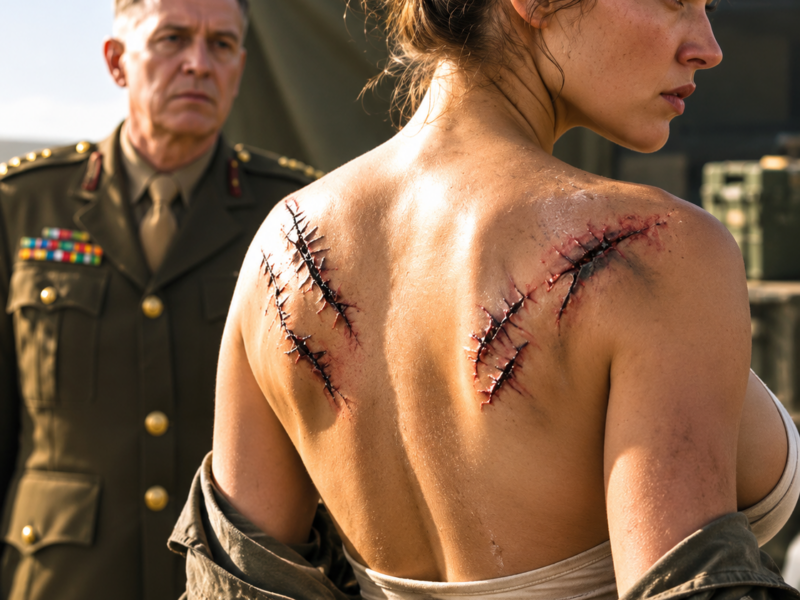
The entire fitness field went silent when Sergeant Sarah Martinez began unbuttoning her uniform in front of her commanding officer.
For several seconds, Colonel James Harrison stood motionless.
The morning sun reflected off the fitness equipment behind him.
Around the testing area, soldiers had stopped talking.
Some were still holding water bottles.
Others stood beside the testing stations, unsure whether they should look away or remain where they were.
Sarah slowly lowered her shirt and began putting her uniform top back on.
Her movements were careful.
The pain in her shoulder had intensified during the test, and now the effort of lifting her arm made her wince.
Harrison noticed.
“Sergeant Martinez,” he said quietly.
She turned toward him.
“I owe you an apology.”
Sarah buttoned her uniform.
“Sir, I appreciate that.”
“No. I don’t think you understand.”
His voice had changed.
“I questioned your discipline. I questioned your effort. I stood here and called your performance mediocre without taking the time to understand what you were dealing with.”
He glanced at the scars she had just revealed.
“You’ve been doing all of this while carrying injuries that would have taken many soldiers out of service permanently.”
Sarah looked directly at him.
“I wasn’t asking for special treatment, sir.”
“I know.”
“I was asking to be allowed to do my job.”
Harrison nodded.
“And I failed to recognize that.”
He turned toward the other personnel who had gathered.
“Everyone, listen up.”
The soldiers straightened.
“Sergeant Martinez has just reminded me of something I should never have forgotten. A fitness score tells us something about physical performance. It does not tell us everything about a soldier’s commitment, courage, or ability to contribute.”
He paused.
“Effective immediately, I want this situation reviewed with our medical and personnel teams. We need to understand whether our current evaluation process is properly accounting for service-connected injuries.”
Sarah looked surprised.
Harrison continued.
“And I want to make something else clear. No soldier should have to expose their wounds in public just to prove that they’re still giving everything they have.”
Those words reached Sarah more deeply than she expected.
For nearly two years, she had believed that hiding her injuries was the only way to protect her identity as a capable soldier.
Now her commander was acknowledging that the system itself had to do better.
But Sarah wasn’t ready to celebrate.
She had seen promises made in military offices before.
What mattered was whether anything would actually change.
Later that morning, Harrison invited Sarah to his office.
This time, he didn’t bring a fitness report.
He had requested her medical and duty records through the proper channels and wanted to understand the full situation.
Sarah entered wearing her uniform jacket.
“Have a seat, Sergeant.”
She sat across from him.
Harrison placed a copy of her fitness assessments on the desk.
“I’ve been looking at your scores again.”
Sarah waited.
“Your running performance is still strong. Your core exercises meet the required standards. Your logistics evaluations are excellent. Your leadership assessments are consistently above average.”
He looked up.
“And I focused almost entirely on your push-up numbers.”
“Yes, sir.”
“That’s not good leadership.”
Sarah didn’t respond.
Harrison leaned back.
“I served in combat. I’ve seen soldiers come home wounded. But I haven’t always understood what happens after they return.”
He looked at the medical summary.
“Your records show that some fragments remain embedded in your shoulder and back. They also document chronic pain and restricted movement.”
“Yes, sir.”
“Why didn’t you bring this to my attention earlier?”
Sarah took a moment before answering.
“Because I was afraid it would change how people saw me.”
“Change how?”
“I’ve watched soldiers get treated differently after being wounded. People start making decisions for them. They assume they can’t handle certain responsibilities. They stop asking what the soldier wants.”
She looked down at her hands.
“I fought too hard to return to active duty. I didn’t want one medical report to become the only thing people knew about me.”
Harrison nodded slowly.
“Did you ever feel pressured to push through pain just to prove you could still meet the standard?”
Sarah hesitated.
“Sometimes.”
“Did you tell your medical team?”
“Not always.”
“Why?”
“Because I didn’t want to be told I needed to stop.”
Harrison’s expression became serious.
“Sergeant, I need you to understand something. Continuing to serve does not mean ignoring medical advice. And it doesn’t mean risking permanent damage to prove you’re tough.”
Sarah looked at him.
“My father used to tell me that quitting was the only thing I should never do.”
“Your father sounds like a determined man.”
“He was.”
“But there’s a difference between quitting and adapting.”
Sarah said nothing.
Harrison continued.
“If a soldier loses the ability to perform one exercise safely, that doesn’t automatically mean they’ve lost the ability to serve. We need to evaluate the whole soldier.”
For the first time, Sarah felt that someone in authority was listening without trying to define her limitations for her.
Harrison closed the file.
“I’d like you to work with me on this.”
“What do you mean, sir?”
“I want you involved in a review of our fitness assessment process for wounded personnel who remain on active duty.”
Sarah looked surprised.
“You want me to help write policy?”
“I want you to help identify problems that someone sitting behind this desk might never notice.”
She considered the offer.
“I’m willing to help. But I don’t want the process to become an excuse to lower standards.”
“Neither do I.”
“Some soldiers need modified exercises. Others need rehabilitation plans. Some may need different assignments. But they still need to be evaluated honestly.”
Harrison smiled faintly.
“That’s exactly the kind of thinking I need.”
The review began the following week.
Harrison brought together medical officers, physical therapists, fitness instructors, personnel specialists, and several soldiers who had returned from deployments with lasting injuries.
Sarah attended every meeting.
At first, she found it uncomfortable.
She was accustomed to solving logistics problems, not discussing the details of her own medical limitations in front of senior officers.
But she quickly realized that her experience revealed problems the existing paperwork had failed to capture.
One physical therapist explained that two soldiers with similar injuries could have very different functional abilities.
A medical officer pointed out that pain levels could fluctuate depending on weather, fatigue, and the type of movement being performed.
A fitness instructor admitted that many test administrators had little training in recognizing when a soldier’s movement was limited by an old injury rather than poor effort.
Sarah listened carefully.
Then she spoke.
“We keep treating the test as if every soldier starts from the same place.”
The room became quiet.
“Some of us do not. That doesn’t mean we shouldn’t be held accountable. It means the assessment has to measure what we’re actually asking people to do.”
She explained how push-ups aggravated the shrapnel near her shoulder.
She described how traditional sit-ups pressed against fragments in her lower back.
She also explained that running remained one of her strongest events because the blast had not seriously injured her legs.
“Why should a single exercise determine whether someone is physically capable of serving?” she asked.
One of the medical officers nodded.
“That’s an important question.”
Sarah continued.
“We should evaluate the soldier’s actual duties. A logistics NCO needs endurance, strength, coordination, and the ability to work under pressure. But that doesn’t mean every person must demonstrate those qualities through exactly the same movement.”
Harrison listened without interrupting.
By the end of the meeting, the group had agreed to develop a more individualized assessment process for personnel with documented service-connected injuries.
It would not mean automatic passing scores.
It would not eliminate medical evaluations.
And it would not allow commanders to ignore readiness requirements.
Instead, qualified medical professionals would help determine safe alternatives that measured the essential physical abilities required for each soldier’s duties.
For Sarah, it was the first meaningful change to come from the confrontation.
But it wasn’t the last.
A few weeks later, Sarah met another wounded soldier.
His name was Private First Class Miguel Rodriguez.
He was twenty-three years old and had recently returned from Syria after an improvised explosive device destroyed part of his right hand.
He had lost two fingers.
His doctors believed he could recover enough function to continue serving in certain assignments.
Miguel didn’t believe them.
When Sarah first met him, he was sitting alone outside the rehabilitation building.
His right hand rested in a protective brace.
He looked up when she approached.
“Sergeant.”
“Private Rodriguez?”
“Yes, ma’am.”
“Mind if I sit?”
He shrugged.
Sarah took the empty seat.
For a moment, neither spoke.
Then Miguel said, “They’re telling me I might be able to stay in the Army.”
“That sounds like good news.”
“Not to me.”
Sarah waited.
“I can’t even fasten some of my equipment properly. How am I supposed to do my job?”
“What was your job before you were wounded?”
“Communications.”
“Were you good at it?”
Miguel gave a short laugh.
“I was one of the best in my platoon.”
“Then your experience didn’t disappear when you lost two fingers.”
He looked at her.
“That’s easy for you to say.”
Sarah nodded.
“You’re right. It is.”
She didn’t tell him that everything would be fine.
She didn’t promise that he would return to his previous assignment.
Instead, she told him about Afghanistan.
She described the mortar attack, the surgeries, and the months when she couldn’t perform exercises that had once seemed effortless.
She also told him something she rarely admitted.
“For a while, I thought if I couldn’t do everything the way I used to, then I wasn’t the same soldier anymore.”
Miguel looked at his hand.
“What changed?”
“I realized I was measuring myself against someone who no longer existed.”
Sarah paused.
“I had to learn what I could do now, not spend every day punishing myself for what I couldn’t do before.”
Miguel remained quiet.
“Adapting isn’t giving up,” she said. “It’s finding another way to accomplish the mission.”
He looked at her again.
“Do you really think I can stay in?”
“I think you deserve a proper evaluation before anyone decides what you can or cannot do.”
That answer wasn’t as comforting as a guarantee.
But it was honest.
And Miguel needed honesty more than encouragement.
Over the next several months, Sarah became increasingly involved in the mentorship program.
She worked with wounded soldiers returning from combat zones.
Some had visible injuries.
Others were dealing with chronic pain, hearing loss, traumatic brain injuries, or psychological trauma.
Their circumstances were different.
But many shared the same fear.
They believed their injuries had ended the military careers they had worked so hard to build.
Sarah understood that fear.
She also understood that determination alone was not enough.
Some soldiers needed rehabilitation.
Some needed medical accommodations.
Some needed reassignment.
And some eventually discovered that leaving active duty was the healthiest decision for them.
Sarah never treated medical discharge as failure.
She simply refused to let anyone make that decision without considering the soldier’s abilities, goals, and medical needs.
Miguel became one of the program’s early success stories.
With help from occupational therapists, he learned new ways to handle communications equipment.
He practiced using adapted controls.
He worked on his grip strength and coordination.
His progress was slow.
There were days when frustration got the better of him.
Once, after dropping a piece of equipment for the third time, he threw it onto the table.
“I’m never going to get this right.”
Sarah picked it up.
“Then we’ll try again tomorrow.”
“I’ve been trying for weeks.”
“And you’ve improved every week.”
“Not enough.”
Sarah placed the equipment back in front of him.
“You’re not competing against the soldier you were before the injury. You’re building the soldier you can be now.”
Miguel looked at her.
Then he tried again.
Months later, he completed his evaluation and was approved to return to a communications assignment with appropriate adaptations.
He didn’t return to exactly the same role he had held before.
But he returned to the work he cared about.
When he received his new assignment, he came looking for Sarah.
“Sergeant Martinez.”
She turned from her desk.
“What’s going on?”
He held up the assignment paperwork.
“I’m staying.”
Sarah smiled.
“Congratulations, Private.”
He shook his head.
“You helped me get here.”
“You did the work.”
“I wouldn’t have started without you.”
Sarah extended her hand.
Miguel shook it with his left.
For a moment, neither said anything.
Then he added, “I hope I can do for someone else what you did for me.”
Sarah smiled again.
“That’s how it works.”
The changes at the Georgia training facility began attracting attention.
Other commanders asked Harrison how the review had started.
He told them about Sarah’s fitness test.
He told them how he had criticized a soldier whose injuries he hadn’t bothered to understand.
And he told them how wrong he had been.
Harrison didn’t hide his mistake.
In fact, he began using it as an example during leadership training.
“Your soldiers are more than their performance reports,” he told a group of new officers. “If someone is struggling, investigate the reason before deciding you’ve identified the problem.”
He also made a point of changing how fitness counseling was conducted.
Commanders were encouraged to review medical limitations through appropriate channels before making assumptions about declining performance.
Fitness instructors received additional guidance on identifying potential injury-related movement restrictions.
And soldiers were given clearer information about requesting medical evaluations and individualized assessments.
The goal wasn’t to make military standards meaningless.
It was to make sure those standards measured readiness accurately.
Sarah remained cautious.
She knew that one new policy wouldn’t change every commander.
She also knew that wounded soldiers could still face pressure to hide their limitations.
But the conversations had begun.
And that mattered.
About a year after the confrontation, Sarah received an unexpected offer.
Her work with the mentorship program had attracted attention from senior Army leadership.
She was invited to interview for a position at the Pentagon, where she could help develop policies supporting wounded personnel across multiple installations.
The opportunity came with a promotion and a chance to influence thousands of soldiers.
Harrison congratulated her when he heard the news.
“You’ve earned this, Sergeant.”
Sarah read the assignment description carefully.
The position was impressive.
It offered influence, visibility, and the opportunity to shape Army policy on a much larger scale.
But something didn’t feel right.
She had spent the past year working directly with wounded soldiers.
She had watched people arrive believing their careers were over and gradually discover new possibilities.
She had seen the fear in their faces.
She knew what it meant to have someone sit beside you without immediately telling you what your future should look like.
The Pentagon position would move her away from that work.
After several days of consideration, she declined.
Instead, she requested a transfer to a warrior transition unit at a major military medical center.
When Harrison heard her decision, he called her into his office.
“Are you certain?”
“Yes, sir.”
“You understand what you’re turning down?”
“I do.”
“You could influence policy for the entire Army.”
Sarah smiled.
“I can still make a difference here.”
Harrison studied her.
“Most people would take that opportunity.”
“Most people aren’t me.”
He laughed.
“Fair enough.”
He signed the transfer recommendation.
Before she left, he stood and offered his hand.
“Sergeant Martinez, I owe you more than that apology I gave you on the fitness field.”
Sarah shook his hand.
“You’ve already done something about it, sir.”
“Not enough.”
“Then keep doing it.”
Harrison nodded.
“I intend to.”
At the medical center, Sarah found the work she had been looking for.
Her days were filled with rehabilitation meetings, training sessions, medical reviews, and conversations with soldiers who were trying to rebuild their lives.
She became known for asking one question before anything else.
“What do you want to be able to do?”
Not what the soldier had done before.
Not what someone else expected.
What they wanted to do now.
She learned that one soldier wanted to return to vehicle maintenance.
Another hoped to become a training instructor.
A young sergeant with a serious knee injury wanted to remain in the Army but feared he would never pass another fitness assessment.
Sarah worked with medical teams to help each person understand their options.
Sometimes that meant developing a rehabilitation plan.
Sometimes it meant exploring a different military specialty.
And sometimes it meant helping a soldier prepare for civilian life without feeling ashamed of the decision.
Her experience made her effective, but it never made her assume she knew exactly what another person was feeling.
She had learned that two people could carry similar injuries and experience completely different struggles.
One afternoon, a soldier arrived at her office after receiving a recommendation for medical separation.
He was angry.
He believed his commander had given up on him.
Sarah listened until he finished.
Then she asked, “Have you spoken with your medical team about every available option?”
He shook his head.
“Then let’s start there.”
She helped him arrange a review.
The result wasn’t what he had hoped for.
His injuries made returning to his previous operational duties medically inadvisable.
But the review identified another role where he could continue serving.
He accepted the assignment.
Before leaving, he stopped at Sarah’s desk.
“I thought being wounded meant my service was over.”
Sarah looked up.
“Sometimes an injury changes the way you serve. It doesn’t erase what you’ve already given.”
He nodded.
“Thank you, Sergeant.”
She watched him leave.
Then she returned to work.
Years passed.
Sarah continued serving, and her reputation grew beyond the medical center.
She became a mentor to newly wounded soldiers and an adviser to commanders who wanted to improve their rehabilitation and retention programs.
Colonel Harrison, who had since been promoted to full colonel, became one of the strongest supporters of her work.
Their relationship had changed completely.
He no longer saw her as a soldier whose fitness numbers needed improvement.
He saw her as a leader whose experience had exposed a weakness in the way the Army understood readiness.
He regularly asked for her input.
And Sarah never hesitated to challenge him when she believed a proposed policy would fail the soldiers it was supposed to help.
Their partnership was built on mutual respect.
Not because Harrison had never made mistakes.
But because he had been willing to acknowledge one and change his behavior.
The mentorship program expanded.
The individualized assessment process was refined.
More commanders received training on service-connected injuries and the importance of coordinating with medical professionals.
And soldiers who might once have been judged by a single declining fitness score were given a more complete evaluation of their abilities.
The changes did not solve every problem.
There were still delays, disagreements, and difficult decisions.
But more soldiers had a chance to be heard before someone decided what they could no longer do.
For Sarah, that was worth more than any award.
One afternoon, nearly five years after the day on the fitness field, Sarah received an invitation to speak at an Army leadership conference.
The topic was wounded personnel and the responsibilities of commanders.
Harrison introduced her.
He stood at the podium and addressed the audience.
“Several years ago, I made a mistake that changed the way I think about leadership.”
He paused.
“I evaluated a soldier by the numbers on a fitness report. I saw declining push-up scores and assumed I was looking at a problem with discipline or motivation.”
He looked toward Sarah.
“What I failed to see was a soldier who had survived a mortar attack, undergone multiple surgeries, and returned to active duty with permanent injuries.”
The room was silent.
“That soldier was Sergeant First Class Sarah Martinez.”
He invited her to the podium.
Sarah walked forward.
Her uniform carried the ribbons and insignia earned over years of service.
The metal fragments were still in her body.
She still experienced pain, particularly in cold weather.
But she had learned to manage it through appropriate treatment, rehabilitation, and a training plan designed around her actual medical condition.
She stood before the audience.
“I want to make one thing clear,” she began.
“I’m not here to tell you that standards don’t matter.”
She looked across the room.
“Standards matter. Readiness matters. Accountability matters. But if we’re going to evaluate soldiers, we have to understand what we’re evaluating.”
She described her injury.
She described her recovery.
And she described the morning when she had finally shown Harrison the scars she had kept hidden.
“I didn’t show those scars because I wanted sympathy,” she said.
“I showed them because I was tired of having my commitment questioned by people who didn’t know what I had already overcome.”
She paused.
“But I also learned something important afterward.”
She looked toward Harrison.
“Leadership isn’t about never being wrong. It’s about what you do when you discover that you are.”
Harrison lowered his head slightly.
Sarah continued.
“Some soldiers will return from combat with visible injuries. Others will carry injuries that nobody can see. Some will be able to return to their original duties. Others will need a different path.”
She let the silence settle.
“Our responsibility is not to pretend those differences don’t exist. It’s to help each soldier find the best way forward while protecting their health and preserving their dignity.”
The audience applauded.
Sarah stepped away from the podium.
She had never considered herself a public speaker.
But she understood that her story could help someone else avoid the experience she had endured.
And that made it worth telling.
A few years later, Sarah reached twenty years of military service.
Her retirement ceremony took place at the medical center where she had spent so much of her career helping wounded soldiers.
Miguel Rodriguez attended.
He was now a senior noncommissioned officer and had become a mentor himself.
Colonel Harrison also attended.
During the ceremony, he spoke about the impact Sarah had made.
“Sergeant First Class Martinez taught me that a soldier’s greatest contribution cannot always be measured by a fitness score or a performance report.”
He looked toward her.
“She showed us that strength is not the absence of injury. It is the ability to adapt, to keep contributing, and to help others find a way forward.”
He paused.
“And she taught me that a commander must be willing to listen before making a judgment.”
Sarah received her award.
Then she stepped forward to deliver her retirement remarks.
She looked at the audience.
At the soldiers she had mentored.
At the medical professionals who had helped her recover.
At the commanders who had supported the program.
And at Harrison, who had once stood on a fitness field and questioned her commitment.
“When I first joined the Army, I believed strength meant never backing down,” she began.
“My father taught me to keep going when things got hard. I took that lesson seriously.”
A few people smiled.
“But Afghanistan taught me something I hadn’t understood before.”
She touched the fabric near her left shoulder.
“Sometimes strength means knowing when to stop. Sometimes it means asking for help. And sometimes it means accepting that the person you were before an injury may not be the person you become afterward.”
She looked toward Miguel.
“I used to think that adapting meant losing something. Now I understand that adapting can be how we keep moving forward.”
Her voice softened.
“The scars on my back are permanent. The metal fragments are still there. I still have days when the pain reminds me of that morning in Afghanistan.”
She paused.
“But those injuries do not get to decide the value of my service.”
The room remained quiet.
“I hope every soldier who comes after me understands this: You do not have to hide your wounds to prove your strength. You do not have to destroy your health to prove your dedication. And you do not have to face recovery alone.”
She looked around the room.
“We serve one another. That responsibility doesn’t end when someone gets hurt.”
When she finished, the audience rose in applause.
Sarah stood still for a moment.
Then she smiled.
After the ceremony, Miguel approached her.
“Sergeant First Class Martinez.”
She laughed.
“You don’t have to call me that anymore.”
“Habit.”
He handed her a framed photograph.
It showed the first group of soldiers who had completed the expanded mentorship program.
Miguel stood in the center.
Behind him were soldiers with different injuries, different uniforms, and different stories.
Some had returned to their previous assignments.
Others had found new roles.
A few had transitioned into civilian careers.
But all of them had received support during the most difficult period of their lives.
Sarah studied the photograph.
“You kept this?”
“I made copies for everyone.”
She smiled.
“That’s good.”
Miguel looked at her.
“You know, I used to think my career was finished when I lost those fingers.”
“I remember.”
“You told me adapting wasn’t giving up.”
“And you proved it.”
He shook his head.
“You helped me understand it.”
Sarah placed the photograph carefully into her bag.
“Then make sure you teach the next person.”
“I will.”
They shook hands.
Then Miguel gave her a final salute.
Sarah returned it.
That evening, Sarah drove back to her hometown in Texas.
Her parents were waiting at the house where she had grown up.
Her father was older now.
His hair had turned almost completely gray, and he walked more slowly than he once had.
But when Sarah stepped out of the car, he stood on the porch and smiled.
“Twenty years,” he said.
“Twenty years.”
He hugged her carefully.
She rested her head against his shoulder.
For a moment, she was eighteen again.
The girl who had climbed trees, raced bicycles, and believed she could overcome anything through determination alone.
Her father looked at her.
“Are you proud of what you did?”
Sarah thought about the question.
She remembered Afghanistan.
The explosion.
The hospital.
The fitness field.
The scars she had finally allowed someone else to see.
She remembered Miguel and the countless soldiers who had found a new path forward.
“Yes,” she said.
“I’m proud.”
Her father nodded.
“Good. You should be.”
They sat together as the evening settled over the small Texas town.
Sarah knew the metal fragments would remain in her body.
She knew some days would still hurt.
But she no longer saw those things as proof that her life had been interrupted.
They were part of her story.
Not the whole story.
The little girl who had once believed strength meant never showing pain had become a leader who taught others that courage could also mean asking for help.
And the soldier who had once feared being treated as broken had helped build a system that allowed wounded warriors to keep serving with dignity.
She had not returned to the exact life she had before Afghanistan.
She had built something different.
Something meaningful.
And perhaps that was the greatest lesson of all.
True strength isn’t pretending nothing has happened to you. It’s learning how to move forward without letting what happened define everything you can become.
the end.









