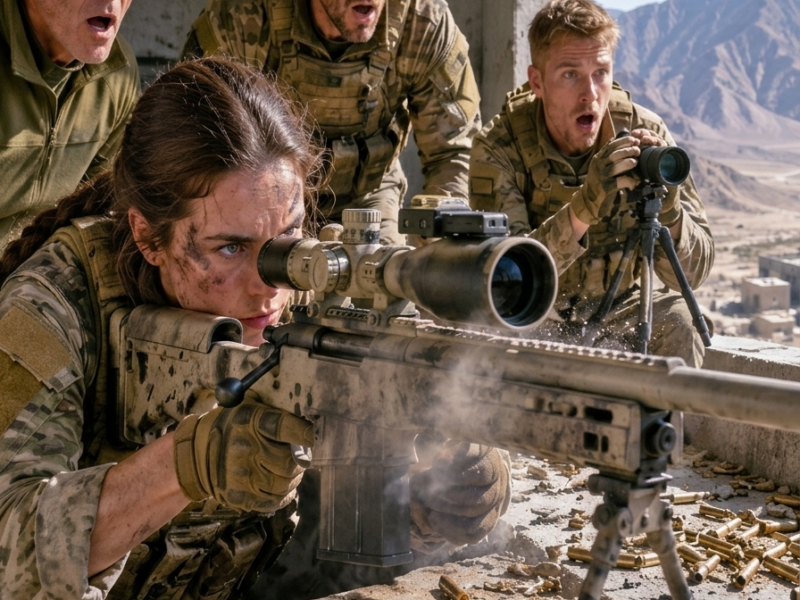
The entire firing range went silent when the general pointed at the woman in the faded gray jacket and said, “Any snipers here?”
The high-desert wind off the Groom Range didn’t just blow; it scraped. It carried coarse Nevada grit that pitted the windshields of the supply trucks and turned every breath into the dry, metallic taste of pulverized shale. At 0600 hours, the heat haze was already shimmering off the dry lake bed, distorting the horizon into a liquid, undulating ribbon.
Thirteen men had stepped up to the concrete firing line. Thirteen elite marksmen from DEVGRU, men who had spent their lives learning how to account for Coriolis effect, humidity, ambient density, and the subtle flex of a match-grade barrel under rapid fire. Each had dialed in their elevation, checked their wind-flags, and squeezed off five rounds from the experimental CheyTac M200 Intervention bolt-action rifle mounted on its heavy titanium bipod.
Thirteen times, the spotter’s spotter scope returned the same verdict: Miss. Short. Left. High.
The target was a thirty-inch steel silhouette perched on an eroded ridge four thousand meters out—nearly two and a half miles. At that distance, the .408 CheyTac bullet would take over six seconds to arrive, floating through three distinct micro-climates and crosswinds whipping through cut canyons that no handheld anemometer could measure.
“Pack it up,” Major Vance grunted, wiping sweat from his forehead. “The optic assembly is uncalibrated. We’re burning barrels for nothing.”
General Marcus Vance, commander of Special Operations Command Joint Task Force, didn’t move. He stood behind the spotting bench, his starched desert fatigues uncreased despite the dust, his dark eyes scanning the firing line with icy disappointment. He wasn’t looking at his operators. He was looking past them, toward the rusted logistics flatbed parked forty yards back.
“Any snipers here?” Vance’s voice cut through the idling diesel engine of the support truck like a blade.
The range went silent. The SEALs lowered their heads, some rolling their shoulders in quiet frustration, others cleaning their optics in stony silence.
I stood beside the rear tire of the five-ton truck, my hands buried deep in the pockets of my faded gray canvas jacket. My boots were worn at the heels, stained with motor oil from three years of working as a civilian contract mechanic at the Tonopah Test Range. To the operators, I was just the quiet woman who refueled the generators, cleared the brass casings, and kept her head down.
“Anyone else?” the general asked again, his eyes sweeping the perimeter.
Nobody moved. Then his gaze locked onto me.
“You,” he said.
I almost laughed. A dry, humorless rasp caught in my throat. “I’m not a sniper, General. I fix the fuel pumps.”
He took three slow steps toward me, his boots crunching on the gravel. “Then why are you looking at that rifle like you’re staring at an old lover?”
Because I knew it. Not just the heavy barrel or the bulky skeleton frame. I knew the specific, hairline fracture on the aluminum cheek-rest. I knew the three parallel scratches carved into the dark walnut grip—scratches made by a tactical knife handle during a cold night in the Hindu Kush.
I had carried that exact rifle eight years ago under a name that no longer existed in any Department of Defense database: Specialist Clara Thorne, Ghost Element 0-9. A unit that officially never operated, never took a salary, and never left a paper trail.
“Ma’am,” Vance said, his voice dropping into a tone that was far too quiet for a firing range. “Step up.”
My fingers trembled inside my pockets as I walked to the firing bench. Behind me, a young SEAL lieutenant scoffed. “She’s going to embarrass herself. That trigger pull is three pounds, ma’am. Careful you don’t snap your wrist.”
“Let her try,” Vance commanded, his eyes fixed on my face.
I didn’t answer. I reached out and touched the stock. The cold metal sent a jolt of electric memory straight through my spine. I lay down in the dirt, ignoring the sharp rocks digging into my ribs, and pulled the buttstock tight into the pocket of my right shoulder.
The desert noise faded. The murmur of the operators, the hum of the truck engines, the howl of the wind—all of it compressed into a tight, silent tunnel.
I adjusted the cheek-piece by muscle memory, feeling the three small grooves beneath my skin. I didn’t look through the scope yet. I closed my eyes and listened to the wind. It wasn’t a single blast; it was a three-beat rhythm. A strong gust off the northern ridge, a thermal lift off the salt flat, and a dead pocket in the ravine.
My mind dragged me backward through time, violently ripping away eight years of forced oblivion.
A flat roof in the Korengal Valley. Rain falling like needles. A little girl crying in an alley below. A man in a dark tunic stepping out of a doorway, holding a satellite phone.
And my team leader’s voice screaming into my earpiece: “Take the shot, Clara! Take it now!”
I had taken it. The round had hit with brutal precision. But when we swept the building two hours later, there were no weapons. No insurgent radios. Just a folder of documents stamped RESTRICTED – US EMBASSY KABUL and an American intelligence operative who had been trying to expose an illegal narcotics pipeline managed by senior officers within our own command.
The next morning, my records were scrubbed. My security clearance was revoked. I was signed into a psychiatric ward, diagnosed with severe stress-induced psychosis, and quietly drummed out of the military with a dishonorable discharge that disappeared three weeks later, leaving me without a past, without a rank, and without a voice.
“Ma’am,” General Vance said quietly, standing right behind my left shoulder. “You have thirty seconds.”
I opened my eyes and looked through the Schmidt & Bender 5-25×56 optic. The steel plate four thousand meters away looked no larger than a grain of pepper suspended in boiling oil.
I didn’t dial the turrets. The wind was too chaotic for mechanical adjustment. I held over—three mils high, two and a half mils left, anticipating the mid-flight thermal draft.
“Ten,” the range officer called out.
I exhaled, letting half the air out of my lungs, holding my body at the absolute nadir of my heartbeat.
“Five.”
My finger took up the slack on the match trigger. The world stopped.
Click. BOOM.
The heavy recoil slammed into my shoulder, driving my elbows into the dirt, sending a cloud of dry dust blooming ten feet in front of the muzzle. The signature was massive, a thunderous crack that echoed off the distant canyon walls.
For three seconds, four seconds, five seconds… total silence held the range.
Then, faint and high, like a single bell chiming across a vast cathedral, came the metallic strike: PLINK.
Nobody spoke. Nobody breathed.
I lowered the bolt, cleared the chamber, and slowly stood up, brushing the yellow dirt from my knees.
General Vance walked toward me slowly. The hard, stoic expression he had worn all morning was gone, replaced by a pale, hollow stillness. He crouched beside the rifle, his hand touching the three grooves on the grip.
“Where did you learn to shoot like that?” he whispered.
I looked down at him, my voice devoid of any emotion. “From the man who ordered me to kill you.”
Vance’s face drained of color. Slowly, deliberately, he reached into his breast pocket and pulled out a worn, black-and-white polaroid photograph, protected inside a clear plastic sleeve.
He handed it to me.
It was a photograph of me, nineteen years old, standing on a sun-bleached rooftop in Bagram, resting my arm on the very same rifle. But it was the back of the photo that caught my eye. Written in blue ballpoint ink, in the sharp, slanted handwriting of my former commander, Colonel Thomas Miller, were six words:
She doesn’t know what she saw.
General Vance looked up at me, his eyes dark with ancient secrets. “I think it’s time you remembered.”
The air-conditioned interior of the mobile command trailer smelled of stale coffee, ozone, and hot circuit boards. Outside, the midday sun was baking the range into a white furnace, but inside, the chill was cold enough to make my teeth chatter.
General Vance sat behind a folding steel desk, the polaroid photograph lying between us like a unexploded grenade.
“Colonel Thomas Miller died three weeks ago,” Vance said quietly, pouring two fingers of bourbon into a paper cup and pushing it across the desk toward me. “Heart attack at his home in Virginia. Officially.”
I didn’t touch the cup. “And unofficially?”
“Unofficially, someone slid a monofilament wire through his car’s brake line while he was parked at the Pentagon,” Vance replied, his voice dropping an octave. “The police report called it a high-speed collision. I called it a cleanup.”
I leaned back against the paneled wall, folding my arms. “Miller was a coward. He signed my discharge papers while I was locked in a padded room at Landstuhl. He told the board I suffered from paranoid delusions.”
“He lied to save his own neck,” Vance said flatly. “And to save mine.”
I frowned, my chest tightening. “What are you talking about?”
“Eight years ago, in the Korengal Valley, you were ordered to eliminate an informant named Ibrahim Kahlil,” Vance said, leaning forward, resting his forearms on the desk. “You were told Kahlil was selling satellite imagery to Taliban commanders in Quetta. You took the shot from two thousand meters.”
“I remember the shot,” I said, my voice hardening. “I also remember going into that compound two hours later with the assault team. Kahlil wasn’t a traitor. He was holding a ledger. A ledger that listed millions of dollars in untraceable wire transfers originating from a CIA front company in Dubai, terminating in personal accounts held by three officers in Joint Special Operations Command.”
“Including me,” Vance whispered.
The air in the trailer seemed to vanish. I reached into my jacket pocket, my hand instantly dropping to the heavy folding knife I always carried. “You?”
“My name was on page fourteen of that ledger,” Vance said, his face completely motionless. “According to those records, I received six hundred thousand dollars in November 2016 to clear flight paths for uninspected cargo planes leaving Kandahar Airfield.”
“Were you guilty?”
“I was the logistics coordinator for the entire sector, Clara,” Vance said, his eyes locking onto mine with terrifying intensity. “My signature was on every flight manifest that crossed the Hindu Kush. But I never saw a single dollar of that money. Someone was using my digital signature key—a key that was stored in Colonel Miller’s private safe.”
He pulled a dark, encrypted flash drive from his pocket and set it beside the photograph.
“Miller knew the operation was going sour,” Vance continued. “He knew Kahlil was about to turn the ledger over to the Department of Defense Inspector General. So he used you. He put his best Ghost operator on that roof, gave you a target coordinate, and told you it was a high-value enemy combatant. You did your job.”
“And when I found the ledger,” I said, the rage rising in my throat like bile, “he realized I wasn’t just a weapon. I was a witness.”
“He couldn’t kill you immediately,” Vance explained. “Not with your team watching. So he framed you. He had medical officers inject you with psychoactive compounds during your post-mission debrief, manufactured a history of severe PTSD, and erased your service record. By the time you woke up in a civilian hospital in Oregon, Specialist Clara Thorne no longer existed. You were just a broken girl with no memory of how she got there.”
I stared at the general, my chest heaving, the bitter taste of eight years of stolen life filling my mouth. “Why are you telling me this now, General? Why today? Why at a firing range in Nevada?”
Vance stood up, walked to the small reinforced window, and looked out at the vast, desolate expanse of the desert.
“Because three days before Miller was murdered,” Vance said softly, “he sent me that photograph in the mail. No letter. No explanation. Just the photo with those six words on the back. And this morning, forty-eight hours after the Pentagon confirmed Miller’s death, a team of private security contractors took over the logistics depot where you work.”
I went rigid. “What?”
“They aren’t military, Clara,” Vance said, turning around, his face dark with warning. “They’re a private maritime asset recovery team hired by the syndicate that Miller worked for. They aren’t here to inspect fuel pumps. They’re here because Miller’s personal archive—the original, unredacted ledger from Korengal—was never destroyed.”
He pointed toward the CheyTac rifle sitting on the gun rack near the door.
“Miller didn’t destroy that ledger,” Vance whispered. “He hid it inside the one place nobody would ever look. Inside the hollowed-out stock of the rifle he assigned to you.”
Before I could reply, the trailer door flew open with a violent metallic bang.
Major Vance—the general’s executive officer—stepped into the doorway, his uniform covered in dust, his face pale. Behind him, three men in unmarked black tactical uniforms and high-cut helmets pushed past the security perimeter. They carried silenced SIG Sauer carbines, their movements fast, silent, and disciplined.
“General,” Major Vance said, his voice tense. “We have a security breach at the main gate. Department of Energy security guards are requesting immediate backup.”
The lead contractor—a tall, scarred man with cold gray eyes and a corporate contractor patch on his shoulder—stepped forward, ignoring Major Vance entirely. His eyes swept the trailer, passing over General Vance, passing over the equipment, and stopping directly on me.
“Clara Thorne,” the man said. His voice was smooth, devoid of any regional accent. “You’re a difficult woman to find. Your social security number has been dormant for seven years.”
General Vance stepped between the contractor and me, his posture towering. “Who authorized your team onto this range, Commander? This is a restricted DOD testing facility.”
The contractor pulled a laminated card from his vest and held it up. “Directorate of Special Oversight, Office of the Secretary of Defense. We have exigent authorization to secure all equipment and personnel associated with Operation Silent Arch.”
He looked past the general’s shoulder, his eyes locking onto the CheyTac M200 resting on the wall rack.
“We’ll take the weapon,” the contractor said flatly. “And the woman.”
“Like hell you will,” I muttered, my hand tightening around the folding knife in my pocket.
“General,” the contractor said, his tone turning razor-sharp. “You know how this works. You have thirty seconds to clear your staff from this trailer, or I will exercise administrative authority under Title 50.”
General Vance didn’t flinch. He looked at the contractor, then looked over at me. A faint, almost imperceptible nod passed between us—the silent understanding of two soldiers who knew they were already surrounded.
“Major,” General Vance said to his executive officer. “Disconnect the primary telemetry lines.”
“Sir?” Major Vance hesitated.
“Do it now!” the general roared.
In that single second of distraction, General Vance lunged forward, slamming his heavy shoulder into the lead contractor’s chest, sending the man flying backward through the open doorway of the trailer.
“Clara! Take the weapon!” Vance screamed.
I didn’t hesitate. I vaulted over the steel desk, snatched the CheyTac M200 off the rack, and kicked the side emergency exit door open with all my weight.
The heavy aluminum door swung out, hitting one of the black-clad contractors in the face with a sickening crunch of breaking cartilage. He fell backward off the stair landing, his carbine clattering onto the gravel below.
I dropped to the ground, grabbed his fallen weapon, and cleared the safety in a single fluid motion.
“Get to the vehicle!” Vance shouted behind me, firing his sidearm into the trailer doorway to keep the remaining contractors pinned down.
We sprinted through the blinding dust toward the general’s armored Chevrolet Suburban parked fifty yards away. Behind us, the sudden, muted pop-pop-pop of suppressed automatic weapons erupted through the desert air, bullets punching neat, round holes through the aluminum siding of the command trailer.
“Major Vance!” the general called out as we reached the SUV.
Major Vance was twenty yards behind us, running hard, but a single bullet caught him in the upper thigh. He stumbled, collapsing into the dirt with a harsh cry.
“Go!” Major Vance yelled, pulling a grenade from his vest and pulling the pin with his teeth. “Get the general out of here!”
“No!” General Vance reached out, but I grabbed his tactical vest, hauling him bodily into the passenger seat of the Suburban.
“He’s giving us a window! Drive!” I screamed, sliding into the driver’s seat and hitting the ignition button.
The heavy V8 engine roared to life just as a blinding orange flash and a heavy concussive boom shattered the air behind us. Major Vance’s grenade had detonated right at the base of the command trailer, sending a wave of shrapnel and dark smoke mushrooming into the blue sky.
I slammed the SUV into gear, floored the accelerator, and spun the wheel hard to the left. The heavy armored tires tore through the loose sand, spraying gravel across the firing line as we tore toward the western perimeter fence.
Behind us, two black high-performance Polaris DAGOR tactical vehicles burst through the smoke, their heavy machine guns mounting the rear beds, giving chase across the open salt flat.
“They’re on our tail!” General Vance yelled, pulling his service pistol and racking the slide. “Where are we going?”
“The old mining shaft at Mile Marker 14!” I yelled over the roar of the engine, my eyes glued to the rearview mirror. “It’s the only place on this range with overhead cover!”
I glanced at the CheyTac rifle resting across the rear seats. The stock was scratched, battered, and covered in yellow desert dust.
“Check the cheek-piece!” I shouted to the general. “There’s a recessed release pin under the third groove!”
General Vance reached into the back, his heavy fingers fumbling with the dark walnut stock. He pressed his thumb hard against the third scratch I had carved eight years ago.
With a soft metallic click, the side panel of the aluminum cheek-rest popped open, revealing a hollowed-out internal chamber lined with dark foam.
Inside lay a single, metallic silver micro-drive, no larger than a human fingernail, coated in a fine layer of dry oil.
General Vance held it up to the light, his eyes wide. “He kept it… all these years.”
“That drive contains every wire transfer, every flight record, and every name involved in Kahlil’s murder,” I said, my teeth clenched as I swerved the heavy SUV to avoid a deep wash in the desert floor. “And now every contractor between here and Las Vegas is going to try to kill us to get it back.”
The sun was dropping below the jagged ridgeline of the Groom Range, painting the desert in long, blood-red strokes of light and shadow.
The Suburban’s engine was whining in protest, its radiator pierced by shrapnel during our escape, thick white steam curling from beneath the crumpled hood. I drove the dying vehicle deep into the narrow mouth of Echo Canyon—a dry, rocky gorge six miles west of the main testing range.
The canyon walls rose three hundred feet on either side, sheer cliffs of jagged red sandstone that blocked out the sky and cut off all cellular and satellite transmissions.
“The engine’s done,” I said, pulling the SUV behind a massive fallen boulder and shutting off the ignition. The engine let out a final, metallic sigh and died.
General Vance stepped out into the freezing evening air, his pistol in hand, his face lined with deep exhaustion. “They’ll be here in ten minutes. The DAGORs can navigate these rocks easily.”
I opened the rear door and pulled the CheyTac M200 from the back seat, along with two spare magazines of .408 ammunition I had grabbed from the firing bench.
“We aren’t running anymore, General,” I said, checking the bolt action. “This canyon is a bottleneck. They can’t bring their vehicles past the narrows.”
“Clara, there are at least eight of them,” Vance reasoned, looking up at the sheer cliffs. “They have thermal optics, night vision, and air support coming from Creech Air Force Base if they have high-level clearance.”
“They don’t have air support,” I said coldly, looking him in the eye. “If they called in Air Force assets, it would create an official record. They’re off-grid. This is a black recovery operation. They die here, nobody comes looking for them.”
I grabbed the heavy rifle, swung it over my shoulder, and pointed toward a narrow, winding trail that cut up the eastern cliff face toward an abandoned watchtower built during the atmospheric nuclear testing era of the 1950s.
“Can you climb?” I asked him.
Vance smiled thinly, holding up his pistol. “I was in 75th Ranger Regiment before you were born, Specialist. Lead the way.”
We climbed in silence, our boots finding footing on the narrow shale ledges. The wind was picking up again, howling through the narrow canyon like a dying animal, sweeping away our tracks as fast as we made them.
Ten minutes later, we reached the watchtower—a rusted steel structure anchored into the solid rock, overlooking the entire floor of Echo Canyon. From here, the entrance to the gorge was completely exposed, a narrow gap seventy yards wide through which anything entering the canyon had to pass.
Below us, the faint, low rumble of heavy diesel engines echoed off the rock walls.
Two black Polaris vehicles appeared at the canyon mouth, their headlights turned off, moving slowly through the gloom using infrared driving lights.
I lay down on the cold steel floor of the watchtower, extending the heavy bipod legs of the CheyTac, and rested the barrel against the rusted railing.
“Distance to the narrows?” General Vance whispered, sitting beside me with his spotting binoculars.
“Seven hundred and twenty yards,” I replied, adjusting the elevation dial four clicks up. “Wind is coming from the west at twelve knots, gusting to fifteen.”
“Target acquisition?”
“Lead vehicle,” I said, my eye locking onto the driver’s silhouette visible through the thermal scope. “The contractor with the scarred face is in the passenger seat.”
“Take the engine block first,” Vance instructed. “Disable the transport.”
I exhaled slowly. The world shrunk down to a circle of crosshairs green light. My pulse slowed, dropping to forty beats per minute—the same cold, meditative state I had entered eight years ago on a rooftop in Korengal.
Click. BOOM.
The heavy .408 round tore through the twilight air, striking the lead Polaris square in the radiator block. The impact was violent; the heavy steel engine block split open, sending a cloud of burning oil and white steam exploding into the air. The vehicle veered sharply to the right, slamming hard into the canyon wall, its front axle shattered.
The second vehicle immediately slammed into reverse, its tires spinning wildly against the loose shale, but I was already cycling the bolt.
BOOM.
The second shot struck the rear differential of the fleeing DAGOR, locking its back wheels instantly. The vehicle skidded sideways, flipping onto its side with a metallic crunch that echoed down the gorge.
“Two vehicles mobility-killed!” Vance called out through his binoculars. “Foot soldiers deploying! Six… no, seven operators moving into the rock fall on the left wall!”
“They’re moving into a kill zone,” I whispered, adjusting my reticle.
Through the scope, I watched the black-clad contractors scatter into the boulders, their weapons raised, searching the high cliffs for the muzzle flash.
“Clara,” General Vance said softly, his voice trembling slightly. “Look at the man leading the ground squad.”
I shifted the scope toward the shadow moving rapidly behind a large fallen slab of sandstone.
The man paused, turning his head toward the watchtower. His face was lit by the dim ambient light of his tactical display.
My finger froze on the trigger.
The man had a heavy scar running from his jawline down to his collarbone—a scar I had watched a medic stitch closed in a field hospital in Bagram eight years ago.
It was Captain Ray Vance—General Vance’s nephew, and my former spotter from Ghost Element 0-9. The man who had confirmed the target coordinates for Ibrahim Kahlil.
The man who had held me down while the medical team injected the sedatives into my arm.
“He’s alive,” I whispered, my voice barely audible over the howl of the wind. “Ray is alive.”
General Vance bowed his head, a heavy, bitter breath escaping his lips. “When Miller erased your team, he didn’t kill them all, Clara. He bought some of them. Ray took the deal. He was given a new identity, a private security firm, and millions of dollars in untraceable funds to ensure the secrets stayed buried.”
“He let me think I was crazy,” I said, my voice turning terrifyingly calm. The rage that had burned in my chest for eight years suddenly vanished, replaced by an absolute, icy clarity. “He watched them wipe my mind, and he took a paycheck for it.”
“Clara…” Vance started, touching my shoulder. “He’s my brother’s son.”
“He died eight years ago, General,” I said flatly. “Just like I did.”
Below us, Ray Vance signaled his three remaining men. They were moving in a tactical wedge, using smoke grenades to cover their advance toward the base of the watchtower cliff.
The white smoke rolled through the canyon floor, obscuring their outlines, but the thermal optic on the CheyTac cut straight through the aerosol cloud, painting their body heat in brilliant, glowing orange silhouettes.
I didn’t wait for them to reach the trail.
BOOM.
The first round passed through two feet of red sandstone, striking the first contractor in the upper torso. He dropped without a sound.
BOOM.
The second round caught the second contractor as he attempted to break for the left rock wall.
Ray Vance realized what was happening. He dropped into a narrow cleft between two boulders, pulling a high-frequency satellite communicator from his vest.
“Clara!” Ray’s voice suddenly boomed out through a tactical loudspeaker mounted on his chest, his voice amplified and distorted by the canyon walls. “I know it’s you up there! I recognized the shot cadence! Nobody holds over like that except you!”
I didn’t answer. I cycled the bolt, placing the crosshairs directly over the cleft in the rock.
“You don’t understand what happened in Korengal, Clara!” Ray shouted, his voice echoing off the sandstone cliffs. “It wasn’t just Miller! It went all the way to the Undersecretary of Defense! If that ledger goes public, it will collapse three private defense corporations and bring down twenty general officers! They will burn this entire state to find that drive!”
“Let them burn it,” I muttered to myself.
“Come down, Clara!” Ray yelled, his tone shifting into a desperate, pleading pitch. “Hand over the drive! I can get you out of the country! I can give you your life back! A new identity, money, medical care… everything they stole from you!”
I leaned into the stock, feeling the three small scratches against my jawbone.
“You can’t give me my life back, Ray,” I whispered into the cold night air. “You spent it.”
I adjusted the windage knob two clicks left.
“General,” I said softly without taking my eye off the scope. “Turn on your phone.”
Vance blinked. “What?”
“Turn on your satellite phone,” I instructed. “Stream the audio from this tower directly to the Department of Justice Inspector General’s hotline. The emergency access code is written on the back of the micro-drive.”
General Vance pulled the small silver drive from his pocket, looked at the etched digits on the reverse side, and quickly dialed the twelve-digit priority sequence on his encrypted handheld device.
Within three seconds, a sharp tone beeped on the line.
“Department of Justice Special Investigations. State your priority code.”
“This is General Marcus Vance, Joint Special Operations Command,” Vance said into the receiver, holding the phone close to his mouth. “I am currently at Echo Canyon, Tonopah Test Range. I am holding the unredacted financial ledgers for Operation Silent Arch, proving widespread systemic corruption, illegal narcotics trafficking, and the extrajudicial murder of American informants in Afghanistan.”
Down in the canyon, Ray Vance heard the echo of the general’s voice carrying over the cliffs.
“No!” Ray screamed, bursting from the cover of the boulders, raising his carbine toward the watchtower. “Kill the line!”
He didn’t get the chance to fire.
I squeezed the trigger.
The heavy .408 round struck with absolute, undeniable finality. The gunshot echoed down the long, dark gorge of Echo Canyon, ringing like a distant, heavy church bell that carried across miles of empty desert.
Ray collapsed into the yellow sand, his carbine clattering against the rocks, silent and still.
The remaining contractors froze in the shadows, their courage completely shattered by the sight of their commander’s death. One by one, they dropped their weapons into the dirt, raising their hands into the air as the distant, heavy thrum of approaching military helicopters began to vibrate through the canyon floor.
General Vance lowered his phone. He looked at the white strobe lights of four heavy CH-47 Chinook transport helicopters descending over the canyon ridge—not contractors, but the full tactical deployment of the 75th Ranger Regiment, sent by the Chairman of the Joint Chiefs himself.
“It’s over, Clara,” General Vance said quietly, setting his hand on my shoulder. “The recording is on the DOJ server. The drive is secure. You’re clean.”
I slowly stood up from the steel floor of the watchtower. I looked down at the heavy CheyTac M200 rifle resting against the railing.
The wind off the Groom Range was dying down, the cold desert night turning quiet and still.
I reached out, touched the three small grooves carved into the walnut grip one last time, and then turned my back on the rifle.
For eight years, I had been a ghost, living in the shadow of a lie that had stolen my past, my rank, and my sanity. But as the heavy transport helicopters settled onto the canyon floor, their blinding searchlights cutting through the darkness, I took a deep breath of the cold desert air.
I wasn’t a ghost anymore.
I walked down the winding trail into the light.
The end.









