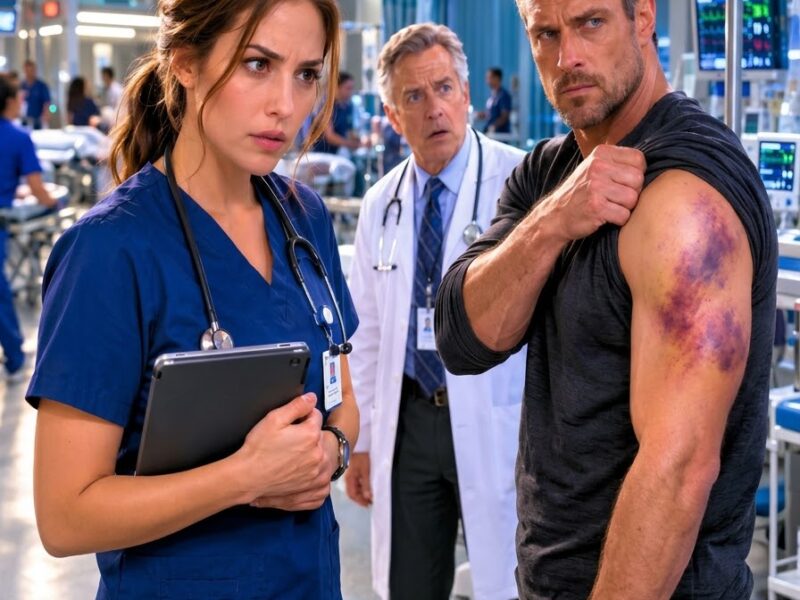
The entire ER went silent when I was wheeled into Room 4, and the chief doctor coldly told me my diagnosis was impossible
The smell of antiseptics, floor wax, and damp rain hung heavy in Room 4 of Mercy General Emergency Department in Norfolk, Virginia. Outside, a late-autumn rain pounded relentlessly against the reinforced glass windows, blurring the streetlights into streaks of yellow and orange. Inside, the world had shrunk down to the harsh white glow of fluorescent lights, the rhythmic beep of a heart monitor, and the terrifying silence of an unanswered question.
For six months, my life had been reduced to a blur of waiting rooms, clinical dismissals, and quiet desperation. Doctors in three different counties had told me the same thing: it was stress, it was generalized anxiety, it was a psychosomatic manifestation of grief, or it was simply all in my head. They gave me prescriptions for antidepressants, anti-anxiety pills, and physical therapy routines that did nothing to stop the deep, bone-scraping aches that burned through my limbs at night.
Then came tonight. A rainy Tuesday. I was walking across our kitchen floor to pour a glass of water when a sharp, icy sensation shot down my spine. Before I could catch myself, my legs simply ceased to exist. They gave out beneath me like snapped wires, and I crashed into the counter, dragging down a rack of glasses that shattered around me.
Now, I was lying on an ER gurney, unable to feel anything below my waist.
Dr. Marcus Harrison, the hospital’s chief of emergency medicine, stood at the wall-mounted workstation, his face illuminated by the harsh blue light of the high-resolution imaging display. He had been looking at my contrast MRI scans for nearly ten minutes without saying a single word. The quiet confidence he had carried when he first walked into the room had entirely vanished.
“This doesn’t make sense,” Dr. Harrison murmured under his breath, leaning closer to the screen until his nose almost touched the glass. He clicked the mouse rapidly, toggling through cross-sectional views of my lumbar spine and vascular pathways.
I pulled the coarse hospital blanket tighter around my chest, my hands trembling violently. “What is wrong with me, Doctor? Please… just tell me what it is.”
Dr. Harrison hesitated, his hands hovering over the keyboard. When he turned to face me, the clinical distance had been replaced by genuine, unadulterated confusion. “According to these images, Maya… you shouldn’t be experiencing these symptoms. Anatomically, your nerve pathways are completely clear. But the imaging shows a dense, crystalline structural anomaly along the deep tissue of your lower lumbar region. It’s a cellular formation that… well, frankly, it doesn’t align with any known human pathology. It looks less like a disease and more like a sequence of deliberate, encoded scar tissue.”
That sentence terrified me far more than a terminal diagnosis ever could have. A disease had a name. A disease was something science had cataloged. Encoded scar tissue inside my spinal column sounded like something out of a nightmare.
The door to Room 4 slid open with a soft metallic hiss, breaking the heavy quiet.
A man stepped into the room. He wore a faded blue Navy sweatshirt, dark jeans, and mud-splattered boots. His short hair was damp from the rain, and his posture was taut, like a spring coiled too tight. It was Jake Miller, my husband of four years.
Jake had spent eleven years operating as a Navy SEAL with Team Eight before transitioning into an instructional role at Little Creek. I had seen him face storm surges, mechanical failures on military aircraft, and severe personal losses without ever losing his composure. He was a rock—a steady, unshakable force in my world. But as his dark eyes locked onto the glowing computer monitor behind Dr. Harrison, his face drained of all color.
“Show me the left side,” Jake said, his voice terrifyingly calm. It wasn’t a request. It was an operational command.
Dr. Harrison frowned, straightening his shoulders to assert authority over his department. “Sir, I understand you’re upset, but this is a private medical examination. I need you to step outside into the waiting area until I conclude—”
“Show me the left side of the scan, Doctor,” Jake repeated, stepping deeper into the room. The air around him suddenly felt heavy, charged with an invisible electricity.
Reluctantly, Dr. Harrison clicked the interface, rotating the 3D projection of my spinal matrix to show the left lateral axis.
Jake reached down and took my shivering hand in his. His palm was warm, rough, and familiar, but his grip was tighter than usual. With his free hand, he reached up to his left sleeve, grasped the cuff of his sweatshirt, and slowly pulled it up past his elbow.
A jagged, pale line crossed the inside of his forearm. It was about four inches long, raised and uneven, bordered by tiny, faint dots that looked like microscopic punctures. I had seen that mark a thousand times while holding his hand, while watching him cook, while leaning against him on the couch. Whenever I had asked about it, he had always offered the same brief, dismissive answer: An old training accident in Coronado.
I had believed him.
Dr. Harrison stared at Jake’s forearm, then blinked and turned his eyes back to the high-resolution MRI scan on his monitor. The crystalline pattern woven into my spinal tissue matched the strange, tiny puncture marks along Jake’s scar in precise, mathematical symmetry.
“Where did you get that?” Dr. Harrison asked softly, his voice dropping an octave.
Jake’s jaw tightened until the muscles flexed visibly along his cheek. “Afghanistan. Eleven years ago.”
The ambient noise of the emergency room outside—the chatter of nurses, the rhythmic paging over the intercom, the rolling casters of supply carts—seemed to fade away into absolute silence. The room grew colder, as if the air conditioning had suddenly plunged to freezing.
“You told me it was a training accident,” I whispered, looking up at my husband through a veil of unshed tears.
Jake didn’t look down at me immediately; his eyes stayed locked on the screen. “I had to, Maya. I signed an NDA that carried a federal treason charge if breached. Eleven years ago, my unit was deployed to the border of Helmand and Kandahar provinces. We were sent to clear a subterranean compound built deep inside a limestone ridge. It wasn’t an insurgent stronghold. It was a cold-war era research facility that had been repurposed.”
He took a slow, measured breath, grounding himself. “We were ordered to pull out a target. A teenage girl. When we found her, she was kept in a sealed chamber beneath the concrete floor. She was barely conscious, severely hypothermic, and her skin was covered in the exact same raised, luminous tracking marks that appeared on your thighs three weeks ago.”
I felt my heart slam against my ribs. “What tracking marks?”
“The ones you thought were broken capillaries,” Jake said quietly, his thumb rubbing the back of my knuckles. “When we extracted her, the compound took heavy artillery fire. A piece of shrapnel laced with a bio-reactive sealant tore through my forearm. The girl bled onto my arm while I was carrying her out to the LZ. Her blood mixed with the wound. That’s where the scar came from.”
Dr. Harrison was no longer acting like an ER doctor; he was acting like a man who had suddenly realized he was standing on a landmine. His fingers flew across his keyboard. He bypassed the hospital’s standard Electronic Health Records system and opened a classified, legacy medical registry—a black-budget database accessible only to high-clearance military medical directors.
He leaned into the terminal and typed a sequence of alpha-numeric characters etched into the microscopic border of Jake’s military medical history: PROJECT ECHO-77.
The computer screen flickered once, twice, and then a dense file expanded across the screen.
“This… this can’t be here,” Dr. Harrison stammered, his hands shaking so violently he had to rest them on the edge of the desk. “This database is air-gapped from the primary hospital network. It shouldn’t even be querying this node.”
“What is it?” I asked, my voice breaking.
Dr. Harrison didn’t answer. He slowly turned the wide-format LED monitor toward the gurney.
On the screen was a black-and-white military intelligence photograph from 2015. It showed a teenage girl sitting on an aluminum cot inside a field hospital tent. She looked malnourished, exhausted, and frightened beyond measure.
But it wasn’t her fear that made me lose my breath.
She had my eyes—an unusual, striking shade of dark hazel with golden specks around the pupil. She had the identical small, dark birthmark right above her left collarbone. And right beneath her chin, curving slightly toward her throat, was a tiny, crescent-shaped scar—the exact scar I had acquired when I fell off a playground slide at age six.
“I don’t understand,” I sobbed, shaking my head violently. “That’s me. How is that me? I was in Virginia in 2015. I was in high school!”
Jake leaned down, his eyes filling with tears that he had spent over a decade holding back. “Her name wasn’t what the military manifest listed, Maya. We were told she was a foreign national. But when I carried her into the MEDEVAC chopper, she pulled my dog tags and whispered a word in perfect, unaccented English.”
“What word?” I whispered.
“She said… Protect her,” Jake choked out. “She wasn’t you, Maya. She was the woman who gave birth to you.”
“Your mother,” Jake added softly.
The world stopped spinning. My breath caught in my chest. My mother had supposedly died in a car accident when I was three years old—at least, that was the story my father had told me before he abandoned me to the state foster care system.
“Her file was sealed under Department of Defense Directive 5210,” Dr. Harrison said, his voice barely audible as he read the classified telemetry on the screen. “She was subject zero for a genetic stabilization protocol designed to neutralize systemic synthetic toxins. But… Maya, this file wasn’t just archived. Someone accessed this record from an external server three weeks ago. The exact day your symptoms started.”
Before I could process his words, the overhead fluorescent lights buzzed violently, flickering from white to a dull, amber hue. The cardiac monitor beside my bed gave a long, descending beep before its screen went completely black. Down the hallway, doors began slamming, and panic echoed from the main nursing station as all auxiliary power failed simultaneously.
The computer monitor in Room 4 flickered out, plunging the room into shadows cast only by the storm lighting outside.
Jake immediately dropped to one knee, pulling a concealed 9mm sidearm from the small of his back—a weapon he was never supposed to bring inside a civilian hospital. He cocked the slide with a crisp, lethal metallic clack and shifted his body between me and the reinforced glass door of Room 4.
“Jake…” I whimpered, the cold terror locking my throat.
He didn’t look back. He kept his eye on the darkened hallway outside, where heavy, synchronized footsteps were approaching through the panic of the darkened hospital.
“They know we found her,” Jake whispered.
The heavy footsteps outside Room 4 moved with terrifying precision. They were not the chaotic, hurried paces of nurses or panicked patients navigating a blackout. They were disciplined, measured, and weighted—the tactical boots of a trained breach element.
“Stay down, Maya,” Jake commanded, his voice dropping into a low, gravelly register that I had never heard him use at home. He raised his sidearm, taking a low-profile stance behind the heavy steel frame of the medical storage cabinet near the door.
Dr. Harrison was paralyzed with fear, clutching a plastic clipboard against his chest as if it could shield him from whatever was coming down that hall. “Listen to me, we need to call security—this is a civilian facility—”
“Security is already dead or compromised, Doctor,” Jake cut him off without turning his head. “Look at the hallway emergency lights. They didn’t just cut the main grid. They dropped the secondary battery back-ups using a localized EMP pulse. This is a blackout operation.”
Before Dr. Harrison could digest the news, the glass door of Room 4 shattered inward.
A flash-bang grenade bounced across the vinyl flooring, emitting a blinding, searing flare of white light and a deafening shockwave that rattled my teeth in my skull. Pain exploded behind my eyes, and a high-pitched ringing filled my ears, drowning out my own screams.
Through the haze of smoke and blinding light, I saw Jake move.
He didn’t flinch. Anticipating the burst, he had closed his eyes and dropped below the primary blast threshold. As two tall figures dressed in unmarked, dark-grey tactical gear pushed through the ruined doorway, Jake fired three swift rounds. The suppressive pops of his hand-gun echoed in the tight space. The lead operative crumpled to the floor with a heavy thud, his weapon clattering across the tiles.
The second operative stepped over his fallen partner, bringing a compact automatic rifle to bear. Jake lunged forward, grabbing the barrel of the weapon, forcing it upward just as a burst of suppressed gunfire chewed through the ceiling tiles, raining plaster down on my gurney. Jake slammed an elbow into the man’s tactical helmet, wrenched the rifle from his grip, and drove a sharp knee into his midsection before sweeping his legs out from under him.
The struggle was over in less than ten seconds. Two heavily armed men lay neutralized on the floor of my hospital room.
“We have to move. Now!” Jake yelled, grabbing a tactical vest and a sidearm from one of the downed men. He sprinted to my bed, unlocked the heavy caster wheels, and slammed his weight against the frame, pushing the entire gurney out into the smoke-filled hallway.
“Wait! What about me?” Dr. Harrison yelled, stumbling out of the room behind us, his hands trembling.
“Get to the stairwell and hide in the basement maintenance rooms!” Jake barked back over his shoulder. “If they see you with us, you’re dead!”
The hospital corridor was a scene of utter chaos. Emergency back-up red lights blinked weakly through thick clouds of tear gas and smoke. Patients were screaming from their rooms, and nurses were trying to navigate the darkness with flashlights. But Jake didn’t stop. He pushed my gurney through the double doors leading toward the rear service elevators, his boots crunching over broken glass.
My lower body remained completely paralyzed, a dead weight pinned under the sheet. Fear pooled in my gut like liquid lead. “Jake, where are we going? I can’t walk! I can’t run!”
“I’m not leaving you,” he snapped, his voice fierce with absolute devotion. He reached a heavy cargo elevator at the back of the facility, pulled an emergency bypass key from the tactical vest he had stripped off the operative, and jammed it into the control panel. The heavy steel doors groaned and slid open.
He shoved the gurney inside, slapped the button for the underground loading dock, and pulled the emergency manual grate closed.
As the elevator lurched downward into the dark shaft, Jake dropped to his knees beside my gurney. He set his stolen rifle on the metal floor and reached for my trembling hands.
“I need you to listen to me very carefully, Maya,” he said, staring directly into my eyes. The ambient red emergency light carved sharp shadows into his face. “What Dr. Harrison pulled up on that screen… it wasn’t just a medical record. It was the master ledger of Operation Blackthorn.”
“What is Blackthorn?” I sobbed, wiping away tears with the back of my hand. “And why did that girl in Afghanistan look like me?”
Jake exhaled a long, shuddering breath. “In 2015, my SEAL team wasn’t deployed to fight insurgents. We were assigned to a Special Operations Joint Task Force hunting down an illegal biological research syndicate operating out of unmapped Soviet-era bunkers. They weren’t building weapons. They were performing synthetic genetic editing on human subjects to create a permanent, transmissible cellular immunity to biological neurotoxins.”
He touched the scar on his forearm. “Your mother was Subject Zero. She wasn’t just a victim; she was the only human subject whose DNA successfully bound with the synthetic stabilization compound without suffering immediate cognitive shutdown. But the process mutated her vascular system. It created a unique, self-replicating biological code in her blood.”
“If she was Subject Zero…” I whispered, the horrifying truth beginning to assemble itself in my mind, “…then what am I?”
“You’re the continuation,” Jake said quietly. “Your mother escaped that facility with the help of an internal mole before we even landed. She hid in the United States under a fake identity, gave birth to you, and passed that synthesized code down through her lineage. The reason your legs stopped working tonight isn’t because you’re sick, Maya. It’s because the synthetic code in your DNA has reached its final activation phase. It’s rewriting your nervous system.”
The elevator shuddered to a violent halt, throwing us both forward. The red overhead lights flickered out, replaced by total darkness.
Above us, in the elevator shaft, the sound of metal cables groaning under immense tension echoed down.
“They tapped the elevator’s primary power trunk,” Jake muttered, snapping his night-vision goggles down over his eyes. He grabbed his rifle and pulled me off the gurney, scooping my limp body into his arms with practiced ease. My arms automatically wrapped around his neck, my heart hammering wildly against his chest.
“Hold on to me,” he whispered.
He used his heavy boots to kick open the manual emergency escape hatch at the bottom of the elevator cab doors. Cold night air rushed in from the subterranean delivery bay.
Jake leaped out of the elevator into the shadows of the loading dock just as a heavy, metallic crunch resonated from above. The elevator cab we had been standing in seconds ago was crushed like a soda can as a heavy counterweight was dropped straight down the shaft from the floor above.
Dust and twisted metal showered the concrete floor.
Jake moved quickly through the dark loading dock, keeping his back to the wall, carrying me effortlessly despite the extra weight of his tactical gear. He navigated past parked delivery trucks and stacks of wooden pallets until we reached a parked black SUV with blacked-out windows—a vehicle that clearly didn’t belong to hospital staff.
He laid me down gently in the backseat, pulling a heavy tactical jacket over my torso, then slid into the driver’s seat and hotwired the ignition. The engine roared to life with a deep, guttural rumble.
“Jake, who are these people?” I asked, pulling myself up slightly using the headrest of the front seat. “Who is trying to kill us?”
Jake threw the vehicle into reverse, slamming foot down on the gas. The tires screeched against the slick concrete as we smashed backward through the loading dock’s plastic security gates, bursting out into the torrential rain of the hospital’s rear alleyway.
“They’re not trying to kill you, Maya,” Jake said, peering into the rearview mirror as headlamps flared to life behind us in the dark storm. “They spent twenty-five years searching for your mother’s genetic line. They don’t want you dead.”
He turned the steering wheel hard, sending the heavy SUV drifting around a tight city corner.
“They want to harvest you.”
The rain did not let up as we drove south toward the dense, swampy pine forests bordering North Carolina. The wipers slammed back and forth across the windshield in a rhythm that offered no comfort. Every shadow along the desolate highway looked like a pursuing vehicle; every flicker of lightning across the dark sky felt like an alarm.
I lay stretched across the back seat of the SUV, feeling entirely helpless. The numbness in my legs had begun to spread upward, creeping into my lower abdomen like a heavy frost. But strangely, alongside the loss of sensation, a strange, warm sensation was thrumming near the base of my skull. It felt like a low-frequency hum, a subtle vibration that matched the rhythmic pulse of my own heartbeat.
“Jake,” I said, my voice hoarse from crying. “How long have you known?”
Jake didn’t take his eyes off the dark road ahead. His knuckles were white where he gripped the steering wheel. “I didn’t know it was you, Maya. I swear to God I didn’t.”
“Then why did you marry me?” The question came out sharper than I intended, laced with the terrifying paranoia that was slowly consuming me. “Was I just an assignment? Was I a mission?”
Jake slammed his foot on the brake, bringing the SUV to a sliding stop on the shoulder of a deserted dirt road lined with towering loblolly pines. He shifted into park, unbuckled his seatbelt, and turned around completely in his seat to look at me. His eyes were bright with unhedged emotion, raw and exposed.
“Look at me,” he demanded softly.
I looked at him, my breathing shallow.
“When I pulled that girl out of that compound in Afghanistan eleven years ago, I was twenty-two years old,” Jake said, his voice trembling slightly. “I watched her die on the MEDEVAC flight before we reached the carrier. She bled out in my arms. But before she stopped breathing, she pressed a small silver locket into my palm. Inside was a picture of a baby girl in Norfolk, Virginia, with an address written on the back.”
He reached inside his tactical vest and pulled out a tarnished silver medallion suspended from a thin steel chain. He handed it back to me.
I took it with shaking fingers. I popped the delicate clasp open. Inside was a tiny, faded photograph of me as an infant, tucked against a hand-written note in faded blue ink: Maya. Save her from the light.
“I spent five years trying to find out who that baby was,” Jake continued, his voice heavy with memories. “By the time I left active duty and tracked down the record to an orphanage in Virginia, you were twenty-one. You were working at a bookstore in downtown Norfolk, living a quiet, normal life. I came to protect you from a distance. I was supposed to just keep watch, to make sure the people who killed your mother never found you.”
Tears streamed down his cheeks, catching the dull glow of the dashboard lights. “But then I met you. I talked to you. I fell in love with you, Maya. Not because of a mission, not because of a scar on my arm, but because of who you were. I tried to walk away three times, but I couldn’t. So I chose to stay and build a life with you. I prayed to God every single day that the genetic sequence in your blood would remain dormant forever. That you would just live a long, happy, normal life.”
He reached out and gently brushed a stray lock of hair away from my forehead. “I failed to keep it dormant. But I will die before I let them take you.”
The sincerity in his eyes melted the ice of doubt in my chest. I pulled his hand to my cheek, pressing my face into his palm. “Where are we going?”
“To the only place that’s off their grid,” he said, shifting the car back into drive and turning off the dirt road into the deep forest. “My old team leader, Master Chief Vance Miller. He ran the extraction operation with me in 2015. He left the Navy three years after I did and built a hardened off-grid sanctuary deep in the Great Dismal Swamp. He has the equipment we need to read the rest of your mother’s file.”
We drove deep into the swamp for another twenty minutes, navigating unmarked gravel paths that wound through stagnant water and towering cypress trees draped in Spanish moss. Finally, the headlights caught the outline of a heavy timber structure surrounded by a ten-foot chain-link fence topped with razor wire.
The vehicle stopped at a heavy steel gate. Out of the darkness stepped an older man with a thick grey beard, wearing a heavy oilskin duster and carrying a tactical shotgun resting effortlessly in the nook of his arm.
Vance Miller approached the driver’s window. Jake rolled it down two inches.
“You’re late, Miller,” Vance said, his voice like grinding stones.
“We got hit at Mercy General,” Jake replied. “They used an EMP pulse to blind the grid.”
Vance’s weathered face tightened. He looked past Jake into the back seat, his sharp blue eyes locking onto me. He didn’t look surprised; he looked deeply, profoundly sorrowful.
“So the daughter’s sequence finally woke up,” Vance said softly. He tapped the roof of the SUV twice. “Get inside. The storm’s turning into a hurricane, and the directional antennas I set up just picked up three blacked-out rotorcraft crossing into Virginia airspace from the coast.”
The steel gate swung open with a heavy mechanical groan, and Jake drove the SUV into the enclosed compound.
The interior of Vance’s sanctuary looked less like a home and more like an operational command post. High-grade server racks hummed along the log walls, powered by a bank of silent lithium batteries connected to underground geothermal generators. Maps of the mid-Atlantic coastline were pinned to large corkboards, covered in red and blue tactical markers.
Vance helped Jake lift me from the car and carry me inside, laying me down on a wide, padded bench in the middle of his workshop.
“How far has the paralysis advanced?” Vance asked, strapping a military-grade diagnostic monitor around my bicep.
“Lower abdomen,” I answered, trying to keep my voice steady. “And there’s… there’s a hum in my head. It feels like a radio frequency.”
Vance exchanged a dark look with Jake. He walked over to a primary server terminal and tapped a series of keys. A high-resolution schematic of human DNA appeared on the main wall projector, but it wasn’t standard double-helix architecture. It was interlaced with synthetic node markers that pulsed in real-time.
“That hum isn’t in your mind, Maya,” Vance explained, pulling up a chair beside me. “It’s an electromagnetic output. The compound your mother was injected with wasn’t just a genetic stabilizer. It was designed by a private military contractor called Vanguard Genomics. They were attempting to engineer a human host capable of acting as a living, un-hackable biological storage device—a biological hard drive.”
I stared at the glowing screen in sheer disbelief. “A hard drive?”
“In 2015, when your mother realized what they were going to do to her, she didn’t just escape,” Vance said, his voice laced with grim admiration. “She wiped Vanguard’s primary servers. She downloaded their entire master database—decades of illegal biological weapon designs, political blackmail, and corporate black-budget financial ledgers—directly into her own modified genetic structure. Then, she passed that data down to you through her blood.”
The realization hit me like a physical blow. “The data isn’t on a drive… it’s inside my cellular structure.”
“Yes,” Vance said. “And the reason your legs are paralyzed is because the file is auto-decrypting. Your body is preparing to broadcast or transfer that data. And Vanguard’s satellite network just picked up the signal.”
Suddenly, a high-pitched red beacon began flashing on Vance’s server rack. A loud, rhythmic alarm echoed through the cabin.
Vance turned to the security monitor displaying real-time thermal camera feeds of the swamp surrounding the property. Three massive, blacked-out tilt-rotor aircraft were hovering low over the tree canopy just half a mile away. Dozens of thermal signatures were rappelling down ropes into the dark, rain-soaked woods.
“They didn’t come to negotiate, Jake,” Vance said, racking the slide of his shotgun with fatal finality. “They’ve surrounded the perimeter.”
“How long until they hit the perimeter fence?” Jake asked, sweeping a collection of extra magazines and tactical equipment into his chest rig.
“Two minutes, maybe less,” Vance replied calmly, pulling down heavy steel blast shutters over the reinforced cabin windows. The heavy metal plates slid into place with thick thuds, sealing us inside the dimly lit, metal-reinforced bunker. “They’re running a heavy assault element. At least twenty operators. They know we have hard cover, so they’re going to bring thermal charges to breach the main door.”
I pulled myself upright on the wooden bench, clutching the silver locket around my neck. “Jake, you can’t fight twenty men! There has to be another way out!”
Jake walked over to me, dropping to his knees so his face was level with mine. He reached up, gently cupping both sides of my face with his rough hands. “Maya, Vance built an underground escape tunnel beneath this cabin. It leads to a hidden boat dock on the river two miles south. Vance is going to take you through that tunnel.”
“No!” I yelled, tears streaming down my face. “I am not leaving without you!”
“Listen to me,” Jake urged, his eyes blazing with an intensity that burned through my panic. “The data inside your blood is trying to decrypt itself. If they capture you, they will put you in a medical laboratory and drain every drop of blood from your body until they get what they want. I am going to stay up here with Vance’s automated defense grid and delay them long enough for you to reach the river.”
“Jake, please—”
“I swore an oath to your mother eleven years ago that I would protect you,” Jake whispered, leaning forward to press his forehead firmly against mine. “And I made a vow to you four years ago at an altar in front of God. I am not letting them take my wife.”
He kissed me deeply, a hard, desperate kiss filled with all the love, fear, and determination in his soul. When he pulled back, he squeezed my hands once, tightly, then stood up and looked at Vance.
“Get her to the boat,” Jake commanded.
Vance nodded grimly. He stepped toward a heavy steel hatch in the corner of the floor, unlocked the hydraulic latches, and pulled it open to reveal a narrow, illuminated tunnel slanting down into the concrete foundation. He pulled a specialized, lightweight transport gurney out from under a workbench, lifted me into it, and secured me with safety straps.
“Hold on tight, child,” Vance said gently.
Before we descended into the hatch, I looked back at Jake one last time. He was standing near the cabin door, rifle raised, his silhouette framed by the red flashing emergency lights. He gave me a single, crisp nod.
Then Vance lowered my gurney down the ramp, and the heavy steel hatch slammed shut above us, sealing us in the damp subterranean silence.
A second later, even through feet of solid concrete and dirt, the ground shook violently.
The assault had begun.
The dull thuds of explosive charges echoed down the concrete shaft, followed by the muffled, frantic chatter of automatic gunfire and the concussive booms of defensive mines Vance had rigged around his cabin. My heart pounded so hard I could barely breathe. Every gunshot I heard above felt like a blade twisting in my heart. Was that Jake? Was he hit? Was he alive?
“Keep your eyes on me, Maya,” Vance said, his heavy boots echoing in the narrow concrete tunnel as he pushed my gurney forward at a rapid pace. “Jake is the best operator I ever served with. He knows how to buy time.”
“He’s fighting an army for me!” I cried out, wiping rain and damp dust from my eyes as we moved deeper into the damp dark.
“He’s fighting for his family,” Vance corrected tightly. “There’s a difference.”
As we moved through the tunnel, the strange hum in the base of my skull suddenly spiked in intensity. Pain shot through my temples, sharp and white-hot. I gasped, clutching my head with both hands.
“Maya! What is it?” Vance stopped the gurney, looking down at me in alarm.
“It hurts…” I gritted through my teeth. “It’s… it’s changing!”
On my arms, beneath the smooth surface of my skin, thin lines of pale, bioluminescent light began to glow. The microscopic patterns traced their way up my forearms, following the exact geometry of the scar on Jake’s arm, radiating outward along my vascular system.
The auto-decryption phase had reached its peak.
Suddenly, my legs twitched. A sharp, searing sensation—like pins and needles turned into liquid fire—flooded down through my hips, through my knees, and into my feet. The motor function was returning, but not as normal nerve impulses. It felt like electrical current running directly through my muscles.
“The file…” I gasped, my eyes wide with terror and shock. “It’s not just data, Vance… It’s a key.”
Before Vance could respond, a deafening explosion blasted through the tunnel behind us. The steel hatch at the entrance of the subterranean passage had been blown inward by a heavy breaching charge. Thick grey smoke surged down the narrow shaft, accompanied by the clatter of tactical boots dropping down into the tunnel.
Vance pulled his sidearm, turning back toward the smoke. “They breached the cabin early! Move, Maya! Go!”
He slammed his hand onto a manual override lever on the side of the tunnel, triggering a set of heavy steel blast doors that began to slide shut between us and the approaching threat.
Through the narrowing gap of the sliding metal door, through the swirling clouds of smoke, I saw three figures emerge from the gloom. Two were enemy operators clad in grey tactical armor.
And between them, dragging one dead leg behind him, covered in blood and dust, was Jake. He was hands-bound, held at gunpoint by a tall man in a tailored dark coat who stepped into the light of the tunnel.
“Jake!” I shrieked, struggling against the straps of the gurney.
Jake raised his bruised face, looking through the shrinking gap of the blast door. His lip was split, his eye swollen shut, but his remaining good eye burned with fierce defiance.
“Run, Maya!” he roared at the top of his lungs, his voice echoing through the chamber just before the heavy blast door slammed shut with a final, echoing shockwave, locking him on the other side with our enemies.
The heavy blast door was five inches of solid reinforced steel. The moment it latched shut, the frantic sounds of struggle on the other side were reduced to dull, distant thuds.
“Jake!” I screamed, pulling violently against the restraints on the transport gurney.
With motor control returning to my legs in a rush of burning adrenaline, I threw my body weight to the side. The gurney tipped over, crashing onto the damp concrete floor. I scrambled out of the straps, my legs shaking violently beneath me like a newborn fawn’s, but holding my weight. The paralysis was gone, replaced by a strange, hyper-aware electrical tension that hummed along every nerve ending in my body.
Vance rushed to my side, gripping my shoulders to steady me. “Maya, listen to me! That blast door will only hold them for five minutes! They brought commercial cutting torches! We have to get to the river!”
“They have Jake!” I sobbed, clutching Vance’s tactical vest. “The man in the coat—he has him!”
“And if you give yourself up right now, Jake died for nothing!” Vance barked, his eyes fierce and unyielding. “Jake stayed behind to give us a chance to execute the plan. Now get on your feet and move!”
His words hit me like a splash of ice water. He was right. If I broke now, if I surrendered, Jake’s sacrifice—and my mother’s death eleven years ago—would be meaningless.
I wiped the tears and soot from my face, locked my jaw, and stood up straight. “Lead the way.”
We sprinted down the remaining three hundred yards of the subterranean tunnel. The air grew damp and heavy with the smell of river mud and decayed leaves. At the end of the passage, we burst through a camouflaged wooden doorway disguised as an overturned tree root, emerging onto a concealed wooden dock hidden beneath a dense canopy of weeping cypresses.
Tied to the dock was a high-speed, blacked-out military riverine assault boat, its twin silent electric motors humming softly in the water.
The storm was reaching its peak. Rain tore through the trees in violent gusts, and lightning split the midnight sky, illuminating the churning dark waters of the swamp river.
“Get in!” Vance shouted, jumping down into the boat and powering up the navigation arrays.
I stepped onto the deck, but before I could step into the passenger cabin, a cold, metallic voice rang out through the darkness behind us.
“That’s far enough, Miss Miller.”
I froze.
Standing at the edge of the tree line, framed by the flash of distant lightning, was the man in the dark coat. Behind him stood four heavily armed operators with assault rifles raised. And kneeling in the wet mud in front of them, his hands zip-tied behind his back, was Jake. A tactical knife was pressed firmly against his throat by one of the guards.
“Vance, step away from the controls or your former teammate loses his head right here,” the man in the coat said smoothly. His voice was refined, devoid of any human empathy.
Vance slowly raised his hands, stepping away from the boat’s console, his eyes locked on the tactical situation.
The man in the coat stepped onto the wooden dock, his leather shoes clicking against the wet planks. He looked at me with a sickening smile of absolute triumph. “Twenty-five years, Maya. Twenty-five long years my organization searched for your mother’s legacy. She thought she was clever, hiding the master cipher inside human cellular tissue. She thought passing it to a child would keep it safe forever.”
He reached into his coat and pulled out a sleek, metallic diagnostic scanner with a long needle array at its tip.
“Your body has auto-decrypted the file,” he continued, taking a slow step toward me. “The biological nodes on your skin are glowing. The data is uncompressed and ready for extraction. All I need is three hundred milliliters of your spinal fluid, and Vanguard Genomics will reclaim every piece of intellectual property your mother stole.”
I looked past him, down at Jake kneeling in the mud.
Jake’s face was covered in blood, but he was staring right at me. He shook his head slowly, whispering through his broken lips: Don’t do it.
The hum in the back of my skull had reached a fever pitch. But it wasn’t pain anymore. It was clarity.
The bioluminescent lines tracing along my arms and neck weren’t just a sign of data uncompressing. The synthetic sequence my mother passed down to me wasn’t just a passive storage drive. It was an active biological engine—and my mother had programmed a fail-safe.
I looked the man in the coat directly in his cold blue eyes.
“My mother didn’t just steal your data,” I said softly, my voice carrying over the sound of the rain and wind. “She changed it.”
The man frowned, pausing his advance. “What are you talking about?”
“She knew you would come for me eventually,” I said, taking a deliberate step forward, off the boat and onto the dock. The silver locket resting against my collarbone felt warm against my skin. “She didn’t write a hard drive into my DNA. She wrote a virus. A biological wipe command designed to execute the moment the master cipher interacted with an external electronic grid.”
The man’s smile vanished. He looked down at the diagnostic scanner in his hand.
The small screen on his device began flashing erratically in bright red symbols. Simultaneously, the communication headsets worn by his four tactical operators exploded into loud spikes of static feedback. Down the river, the three heavy tilt-rotor aircraft hovering in the sky began to wobble violently as their encrypted telemetry networks suddenly corrupted, forcing their auto-pilot systems to initiate emergency blind landings into the trees.
“What did you do?!” the man roared, dropping the smoking scanner as it overheated in his hand.
“She gave me the key,” I whispered.
In that split second of complete chaos and hardware failure, Jake moved.
Deprived of their radio comms and blinded by the unexpected failure of their night-vision gear, the guards hesitated. Jake drove his weight backward, slamming his head into the nose of the guard holding the knife to his throat. The guard stumbled back with a cry of pain. Jake swept his legs out, brought his bound hands over his knees, and grabbed the fallen guard’s sidearm from its holster.
With two lightning-fast shots, Jake neutralized the nearest guard, spun on his side, and cut the zip-ties on his wrists using the operative’s tactical blade.
Vance didn’t miss his cue. He dropped behind the armored railing of the river boat, pulled a hidden submachine gun from beneath the console, and opened fire on the remaining two operators on the shore, driving them back into the brush.
The man in the coat panicked. He pulled a compact pistol from his coat pocket and aimed it directly at my chest. “You insane little—”
Before he could pull the trigger, Jake charged across the wooden dock like an unstoppable freight train. He tackled the man around the waist, lifting him off his feet, and slammed him shoulder-first off the dock into the black, rushing torrent of the swollen river below.
The man splashed into the wild current, swept away instantly by the surging floodwaters toward the deep swamp.
Jake breached the surface of the water, gasping for air, and grabbed the edge of the wooden dock.
I dropped to my knees, reaching down with both hands. The bioluminescent light on my skin faded back beneath the surface of my tissue, leaving only the warmth of my own blood rushing through my veins. I grabbed Jake’s hands—strong, scarred, and real—and pulled him out of the water onto the planks beside me.
He collapsed onto his back, gasping for air, rain washing the blood and mud from his battered face.
I leaned down and threw my arms around his neck, burying my face into his shoulder, weeping uncontrollably as the storm raged around us.
Jake wrapped his arms tightly around my back, holding me close, his chest heaving against mine. “I’ve got you,” he breathed into my hair, his voice cracking with emotion. “I’ve got you, Maya. It’s over.”
Vance stepped up to the edge of the dock, holding his weapon at the low ready, scanning the dark treeline as the sound of the failing enemy helicopters faded deep into the distant forest. He looked down at us and offered a rare, weary smile.
“The server nodes back at Vanguard’s headquarters just suffered a total cascade failure,” Vance said, checking a ruggedized tactical tablet. “The master cipher wiped their black-budget servers globally. They don’t have the data anymore, Maya. And they don’t have a signal to track.”
Jake pulled back slightly, looking into my eyes. The hazel specks in my pupils reflected the first soft, gray light of dawn breaking through the storm clouds in the east.
He reached up, his thumb gently wiping away a tear from my cheek.
“Where do we go now?” I asked softly, feeling the steady, rhythmic beat of his heart beneath my hand.
Jake smiled—a real, genuine smile that reached his eyes for the first time in eleven years.
“Wherever we want,” he whispered. “We’re finally free.”
The end.









