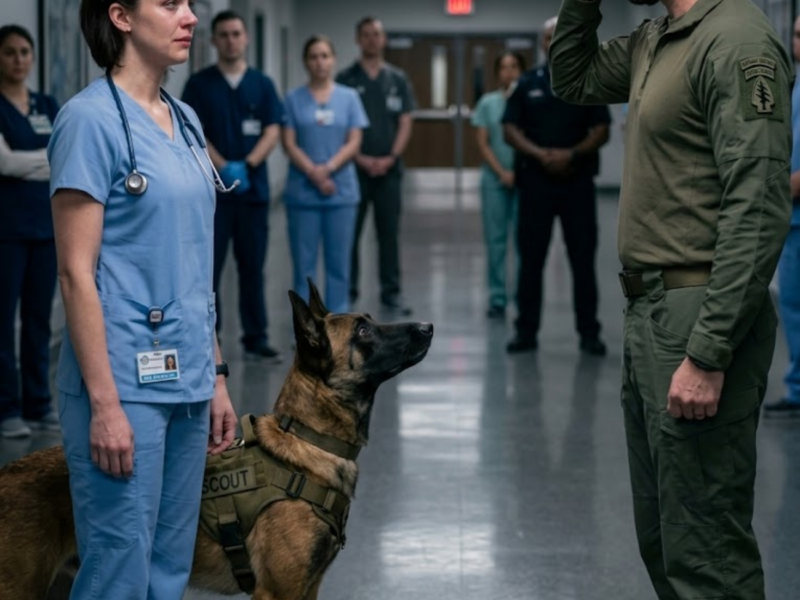
The entire emergency room went silent when a Navy SEAL’s military K9 broke away from his handler
The emergency department at St. Jude Memorial was never completely quiet, but on a stormy Tuesday night in mid-November, the noise seemed to swallow itself whole. Fluorescent tubes hummed against the linoleum. Heart monitors chirped in an erratic, desynchronized chorus. Outside, an autumn deluge lashed the ambulance bay glass, turning the headlights of incoming rigs into smeared streaks of red and amber.
I kept my eyes down, fixing my attention on the suture tray in my hands. The silver instruments rattled against the stainless steel basin, betraying the slight tremor in my fingers. It was an involuntary reaction, one I had spent three long years trying to bury under the bland, clinical routine of civilian nursing. To the doctors and senior charge nurses, I was simply Clara Evans: a quiet, hyper-efficient rookie nurse who never took sick days, never talked about her personal life, and always wore surgical scrubs with sleeves pulled tightly down to the knuckles.
Nobody asked questions about the quiet nurse. That was precisely the way I wanted it.
Then the automatic double doors hissed open, admitting a blast of frigid, rain-soaked air that made the triage paper fluttering on the front counter whip violently.
Two men walked in, flanking a massive, broad-shouldered man wearing a dark tactical jacket dripping with rainwater. Even without the rain gear, there was no mistaking the military posture, the predatory balance, the sharp, calculating eyes scanning every exit and corner. On his chest hung an identification lanyard designating him as Captain Jake Mercer.
Beside him walked an animal that stopped every single person in the corridor dead in their tracks.
It was a Belgian Malinois-German Shepherd cross. The dog wore a heavy nylon harness strapped with ceramic trauma plates and dark tactical webbing. His muzzle was broad, his ears high and alert, his fur scarred in irregular silver patches across his flanks. A certified military working dog. The kind trained to smell explosives buried five feet under packed gravel, the kind trained to take down grown men in full body armor without hesitating for a single second.
The dog did not look at the doctors. He did not look at the security guards reaching cautiously for their batons.
He looked directly across thirty feet of crowded, antiseptic hospital floor and locked his amber eyes on me.
“Back up,” Captain Jake Mercer snapped, his voice a low, gravelly rasp that cut through the room like a combat blade. He reached down to catch the dog’s thick tactical lead. “Atlas, heel.”
The dog completely ignored the command.
In the military working dog world, an animal disobeying a direct command from a handler is a catastrophic anomaly. These dogs are conditioned through thousands of hours of rigorous drill to respond like biological extensions of their handlers’ wills.
Yet Atlas surged forward with a sudden, fluid power that yanked the heavy nylon lead straight out of Mercer’s wet grasp. The leash clattered against the floor, whipping behind him as he crossed the crowded emergency room floor in three massive, effortless bounds.
Panic erupted instantly. A physician dropped a chart binder; two orderlies flattened themselves against the crash cart.
“Code Gray! Security to Trauma Bay Three!” a triage nurse shouted over the intercom.
“Stay back! Nobody move!” Mercer shouted, his hand instinctually dropping toward his hip where a sidearm would normally sit, his jaw tightening into iron.
I stood frozen beside Trauma Bed Two. My fingers locked around the edges of the metal tray until the rim bit painfully into my palms. My mind screamed at me to step backward, to retreat behind the curtain, to preserve the carefully crafted illusion of an ordinary twenty-six-year-old nurse who knew nothing about war.
Atlas did not lunge. He did not bare his teeth.
He skidded to a halt on the slick linoleum inches from my shoes. The sudden momentum blew a gust of wet, rain-soaked fur and ozone against my shins. He lowered his massive head, his chest heaving, his ears pinned flat against his skull in a posture of profound, aching submission.
The entire emergency room went completely silent.
He wasn’t threatening me. He was trembling.
“Atlas, out!” Mercer ordered, advancing with heavy, deliberate strides, his gaze cold and lethal. “Get away from her! Atlas, leave it!”
The dog did not budge. Slowly, reverently, Atlas extended his muzzle and pressed his wet, warm nose directly against the underside of my left wrist.
My breath trapped itself in my throat. My vision blurred around the edges.
Beneath the thin blue latex of my hospital glove, right at the pulse point of my wrist, lay a jagged, four-inch white scar. It was the entry and exit trace of a shrapnel fragment from an 82mm mortar blast. Nobody at St. Jude knew it was there; I never took off my compression sleeves in the breakroom, and I never changed in the communal locker room. Nobody here knew that before nursing school, I had spent four grueling years as a flight medic attached to a forward combat search-and-rescue squadron in Kandahar.
Nobody knew why I had left the military with an honorable discharge, a hollow chest, and a recurrent nightmare that smelled of burning diesel fuel.
Atlas let out a low, shuddering whine—a sound so full of raw, mammalian grief that it made my heart crack straight down the middle. Then, slowly, with deliberate gentleness, the eighty-five-pound war dog collapsed onto his belly, resting his heavy chin directly over the toes of my running shoes.
A resident physician whispered from behind a counter, “I’ve never seen that dog do that. Mercer brings him in for clearance evaluations every six months. That dog usually won’t let anyone within five paces.”
Captain Mercer stopped three feet away. His face was carved out of granite, but his eyes were darting between the dog and my face, processing the impossible scene in front of him.
“What did you do to him?” Mercer demanded.
“Nothing,” I said. My voice was paper-thin. I cleared my throat, trying desperately to sound like a frightened civilian. “I… I just work here. I didn’t touch him.”
Mercer stepped closer, reaching down with a gloved hand to seize the dog’s harness. “Atlas, up. Now.”
The moment Mercer’s hand grazed the nylon strap, a deep, mechanical growl ripped from the depths of Atlas’s chest. The dog’s lips curled, exposing sharp white canines, his eyes never leaving Mercer’s face. He was guarding me. He was actively threatening his own handler to keep him away from me.
Mercer recoiled slightly, shock flashing across his features. A seasoned Navy SEAL, a man whose skin bore the weathered creases of countless classified deployments, suddenly looked unnerved.
“What unit were you with?” Mercer asked quietly. The question wasn’t hostile anymore; it was an interrogation wrapped in sharp suspicion.
“I don’t know what you’re talking about,” I lied, keeping my chin tilted down. “I’m a civilian nurse.”
“You’re lying,” Mercer said evenly. “Atlas was trained at Lackland Air Force Base before he was transferred to Special Operations. He doesn’t submit to strangers. He doesn’t guard civilians. He has only ever recognized two handlers in his entire life.” Mercer took another half-step forward, his voice dropping into a razor-thin whisper. “One was me. And the other was a master sergeant who died three thousand miles from here in an ambush in the Maiwand district.”
The name struck my chest like an actual hammer blow.
Maiwand.
In an instant, the sterile, brightly lit hospital room vanished. In its place came the roaring heat of an August afternoon in the Afghan desert. The suffocating stink of burning tires and scorched metal. The deafening, rhythmic hammer of incoming machine-gun fire tearing through the chassis of a shattered MRAP vehicle.
I remembered throwing myself onto the burning dirt, my medic pack tearing open, blood soaking through my utility uniform as I tried desperately to clamp a severed femoral artery on a dying soldier.
And beside that soldier, chained by loyalty and madness, had been this dog. A younger, terrifyingly fierce Atlas, snapping at the dust, howling until his throat tore, refusing to let the rescue winch lift him until his handler’s body was secured.
I remembered the soldier’s bloody fingers clutching my tactical vest. His voice, bubbling through a punctured lung, had hissed in my ear: Don’t let them take Atlas. Promise me, Doc. Don’t let them turn him into a weapon for the wrong people.
I had thought Atlas died on that hill. When our medevac helicopter took a rocket-propelled grenade through the tail rotor and crashed into a dry wadi two clicks away, I had been dragged out unconscious by the quick-reaction force. By the time I woke up in Landstuhl Regional Medical Center in Germany, I was told there were no other survivors from the ground team. The soldier was dead. The dog was dead.
I looked down at the animal resting across my feet. The silver scar on his left ear. The tiny nick on his black nose.
The dam inside me broke.
“Atlas,” I breathed, my voice barely louder than an exhalation.
The dog let out a sharp yip, his tail thumping once against the floor tiles with enough force to crack the polish.
Mercer turned dead white. “You really do know him.”
I couldn’t answer. If I spoke, the entire construct of my new, peaceful life would shatter.
Atlas suddenly stood up. He didn’t look at me; instead, he stepped toward Mercer and began pawing aggressively at the left breast pocket of the captain’s rain-slick tactical jacket. Mercer tried to swat the dog’s paw away, but Atlas was relentless. His claws hooked into the zipper pull, tearing the pocket open.
A small, heavy metal object fell out. It hit the emergency room floor with a bright, metallic clatter and slid straight to the tip of my shoe.
I looked down.
It was an oxidized, battered military dog tag, blackened around the edges by heat and smoke. Stamped into the steel were a name and a service number:
SERGEANT FIRST CLASS ETHAN COLE — US ARMY SPECIAL FORCES.
The room seemed to tilt sideways. The fluorescent lights blurred into a blinding smear of white. Ethan Cole was the soldier who had bled to death under my hands in Maiwand.
Mercer knelt, picking up the dog tag with fingers that were visibly stiff. “He died six years ago,” Mercer muttered, his eyes boring into mine.
“I know,” I whispered, the tears finally welling in the corners of my eyes. “I held the pressure dressing on his chest until his pulse stopped.”
Mercer stared at me for three long seconds. His expression shifted from hostility to something far darker, something heavy with unspoken dread.
“No,” Mercer said, his voice dropping so low the medical staff around us couldn’t possibly hear. “You don’t know.”
Mercer reached inside his inner coat pocket and withdrew a small, transparent evidence pouch. Inside was a water-damaged, folded photograph. He unfolded it with agonizing slowness and turned it toward me.
The photograph showed a dusty runway lined with blast walls. Standing together in the harsh desert sunlight were three figures: Sergeant Ethan Cole, grinning with an arm slung around the massive shoulders of a young Atlas… and standing to Ethan’s right, wearing dusty combat fatigues and a medic’s armband, was me.
I remembered the day that picture was taken. It was three days before the convoy went out.
Mercer flipped the photograph over.
On the back, scrawled in black permanent marker that had faded to dull purple, were four words in Ethan Cole’s distinct, sloping handwriting:
Trust her if I die.
A tear spilled over my cheek, cutting a path through the sterile hospital powder on my face. “Where did you get this?” I demanded, my voice shaking with sudden fury. “Ethan is gone. Who are you, Mercer?”
Mercer stared at the photograph, then looked up into my face, his jaw set like concrete. “That’s impossible. Ethan told me this photograph was destroyed in the blast.”
Before I could answer, Atlas suddenly went completely rigid.
Every hair along the dog’s spine stood on end. His ears swiveled toward the main sliding doors of the emergency room. A sound came from his throat—not a bark, not a growl, but a sharp, high-pitched whine of sudden, electrifying recognition.
Atlas spun around, ignoring Mercer’s reach, ignoring my outstretched hand, and bolted toward the triage foyer.
Standing just inside the automatic doors, soaked by the relentless rain, was a tall man wearing a dark civilian trench coat and a low-profile baseball cap pulled low over his brow. Rainwater dripped from the brim of his hat, obscuring his eyes, but his mouth was visible.
He looked straight past the screaming nurses, past the security officers, and locked his gaze squarely on me.
Then, his lips curved into a cold, familiar, crooked smile.
Captain Jake Mercer drew his concealed service weapon in a single, terrifyingly fluid motion, his voice cracking like a gunshot through the ward:
“That’s the man we’ve been hunting for six years.”
Atlas didn’t attack the man. Atlas was running toward him, whimpering, whining, throwing his massive weight forward like an obedient hound returning to his true master.
And as the man in the rain slowly raised his head, the shadow fell away from his face.
It was Ethan Cole.
The scream of the emergency room alarm tore the air in two.
“Down! Everybody down!” Mercer bellowed, his service pistol drawn, his frame dropping into a low combat stance as he pushed me violently behind the steel partition of Trauma Bay Two.
The hospital floor instantly descended into madness. Civilians shrieked, nurses scrambled under reception desks, and two armed hospital security officers drew their tasers, their eyes wide with confusion and terror. But the man in the baseball cap didn’t draw a weapon. He didn’t flinch. He didn’t even widen his stance.
He simply stood there under the flickering lights of the sliding entrance, water pooling around his combat boots, his gaze locked entirely on me.
“Ethan?” The word left my mouth as a dry, ragged gasp.
It was impossible. I had felt his pulse stop. I had felt his body turn slack and cold beneath my hands in the back of that burning vehicle. I had watched the fire consume the chassis before the extraction team dragged me away. I had lived with the guilt of his dying breath every single night for three years.
Yet the man standing thirty feet away possessed the exact same angular jaw, the identical thin scar running from his left eyebrow down to his cheekbone, and the piercing, pale gray eyes that had once commanded an entire twelve-man operational detachment.
Atlas reached him.
Instead of tearing into the intruder, the war dog slid to a halt at the man’s knees. He leaped up, planting his massive front paws against the man’s chest, whining frantically and licking the rain from the man’s bearded jaw.
The man reached down with bare, scarred hands and gripped Atlas’s thick neck, burying his face into the dog’s wet fur for half a heartbeat.
“Good boy,” the man whispered. The acoustic quality of the hospital foyer carried the voice across the linoleum. It was Ethan’s voice. Deeper, raspy, scarred by smoke, but undeniably his. “Good boy, Atlas. You found her.”
“Cole!” Mercer shouted, his weapon trained dead-center on the man’s chest. “Step away from the animal and put your hands behind your head! Do it now, or I swear to God I will drop you right where you stand!”
Ethan slowly looked up from the dog. He didn’t look at Mercer’s gun. He looked directly into Mercer’s eyes, his expression completely devoid of fear.
“You won’t shoot me, Jake,” Ethan said calmly. “Not here. Not with twenty civilian witnesses and a hospital full of cameras. And certainly not before you find out who sold our coordinates in the Maiwand valley.”
Mercer’s hands tightened on the polymer grip of his sidearm. A muscle leaped in his jaw. “You’re a ghost, Ethan. The Department of Defense declared you KIA six years ago. Your name is on the wall at Arlington. But the intelligence files say something else entirely. They say you went rogue. They say you took the encrypted biometrics drive from that convoy and walked into the mountains.”
“They lied to you,” Ethan said softly. “Just like they lied to Clara.”
His eyes shifted back to me. The intensity of his gaze was suffocating.
“Clara,” Ethan said, taking a slow step forward. Atlas moved with him, glued to his left hip in perfect, lethal formation. “You shouldn’t have stayed in the system. The moment you signed your discharge papers with your real identity, their algorithms flagged you. They followed Mercer here tonight. They used him as a bloodhound to find Atlas, and they used Atlas to find you.”
“Who did?” my voice cracked. My hands were shaking so hard I had to press them against the cold wall to steady myself. “Ethan, what are you talking about? Who followed you?”
Before Ethan could answer, the glass behind him shattered into a million glittering shards.
A supersonic crack echoed through the entrance bay—a suppressed rifle shot from the parking structure across the street. The heavy slug punched through the glass partition, whistling through the space where Ethan’s head had been half a second prior.
Ethan had already moved. The man moved with the terrifying speed of an apex predator, grabbing Atlas by the harness and diving behind the reinforced concrete pillar of the entrance foyer.
“Sniper!” Mercer roared, instantly pivoting toward the street. “Clara, stay down!”
A second shot blew through the triage desk, sending wood splinters and computer monitors exploding across the nurses’ station. The sirens in the ceiling tripped, flooding the room with blinding red emergency strobes and a deafening, pulsing klaxon.
“Jake!” Ethan yelled from behind the pillar, his voice cutting through the ringing alarms. “East parking garage, level three! That’s not a federal team! It’s a cleaning crew! If they take Clara, they burn the hospital to the ground to erase the trail!”
Mercer looked at Ethan, then looked at me. For a split second, I saw the agonizing conflict tearing through the captain’s mind. He was a military officer who had spent six years chasing a phantom, believing his former comrade was a traitor. But the tactical reality unfolding in front of him shattered that narrative. Federal agents don’t use suppressed high-caliber rifles on public hospitals to take targets into custody.
Death squads do.
“Move!” Mercer yelled at me, lunging across the floor and grabbing my scrub top, hauling me behind the steel gurney. “To the maintenance corridor! Go!”
“Atlas! With her!” Ethan barked.
The dog did not hesitate. Leaving Ethan’s side, Atlas bounded across the exposed, glass-strewn floor, ignoring the red strobes, and threw his body against my side, pushing me toward the double doors that led deeper into the hospital’s basement levels.
A third round hit the linoleum three inches from my foot, spraying powdered limestone and concrete into my ankles.
Ethan broke from his cover, drawing a compact submachine gun from beneath his long trench coat. He fired a controlled three-round burst through the shattered window toward the parking structure, forcing the sniper to pull back.
“Basement!” Ethan shouted at Mercer. “Take her through the steam tunnels! Meet me at the delivery docks in four minutes! If you hesitate, she dies!”
Ethan didn’t wait for a response. He spun on his heel and sprinted down the north corridor, deliberately drawing the gunfire toward the administrative wing, away from the patients, away from the staff, and away from me.
Mercer didn’t question the order. His tactical training took over. He grabbed my arm with an iron grip, half-carrying, half-dragging me through the swinging metal doors marked Authorized Personnel Only. Atlas ran ahead of us, clearing every corner, his ears twitching, low rumbles vibrating in his chest as he checked the shadows.
We tumbled down a flight of concrete stairs into the humid, echoing belly of the hospital.
The air here was hot and thick, smelling of industrial bleach, boiler steam, and ancient concrete. Pipes wrapped in yellow insulation ran along the ceiling like exposed veins.
I tore my arm out of Mercer’s grip, backing against a concrete wall, breathing so hard my ribs felt like they were going to splinter.
“Talk to me!” I screamed at Mercer, my voice bouncing violently off the underground walls. “Talk to me right now! Who is shooting at us? Why did Ethan say you used me?”
Mercer stopped, his weapon lowered at the low ready, his chest heaving under his soaked jacket. The harsh glare of a single bare bulb exposed the deep lines of exhaustion and fury etched into his face.
“Three months ago,” Mercer said, his voice flat, brutal, and raw, “a classified server at the Pentagon was breached. The only thing stolen was the personnel file of the medical crew assigned to the 75th Ranger task force in Afghanistan during Operation Blackout. Your file, Clara.”
I shook my head, my mind spinning. “I was just a medic! I treated casualties! I didn’t have access to classified operational data!”
“You didn’t need it,” Mercer said, stepping closer. Atlas instantly moved between us again, sitting firmly on Mercer’s boots, his cold eyes watching the captain’s hands. Mercer looked down at the dog with a bitter, humorless smile. “Ethan Cole didn’t just carry a weapon on that mission. He was escorting a hard drive containing the biometric identities of every foreign asset we had embedded in Central Asia. When his convoy was hit, the drive went missing.”
“They thought he stole it,” I said, the pieces assembling into a horrific pattern.
“They knew he didn’t die,” Mercer corrected. “The military reported him dead to keep the press from finding out the drive was compromised. But command assigned me to track him down. For six years, I followed dead trails, ghost accounts, and burned safehouses. Two weeks ago, I received an anonymous package at my apartment in Virginia. No return address. No digital footprint.”
Mercer reached into his pocket and pulled out a small, encrypted flash drive, identical in design to the tactical drives used by Special Operations Command.
“Atlas was delivered to my house three days later in an unmarked military transport crate,” Mercer whispered. “With this drive around his collar. And a single typed note: Take him to Clara Evans. She has the key.”
The silence in the tunnel became suffocating. The hum of the distant boilers sounded like the growl of a trapped beast.
“I don’t have a key,” I said, holding out my trembling hands. “Look at me! I haven’t touched a military network in three years! I distribute morphine and stitch up drunk drivers! I don’t know anything about a key!”
“Ethan didn’t give you a file, Clara,” Mercer said, his voice dropping into a terrifying certainty. “He was a field surgeon before he went into Special Operations. He knew the human body better than anyone.”
Mercer pointed his finger directly at my left wrist.
Directly at the four-inch white scar.
“That wasn’t shrapnel,” Mercer whispered. “He operated on you in the field hospital before you were evacuated to Germany. What did he put inside you, Clara?”
Before I could process the horror of his words, the heavy steel fire door at the top of the stairwell behind us groaned.
Atlas didn’t growl this time.
He flattened his ears, dropped into an aggressive crouch, and let out a single, piercing bark that echoed like a siren through the concrete tunnel.
From the top of the stairs came the mechanical, rhythmic click of heavy tactical boots descending into the dark.
The heavy industrial boots hit the concrete stairs with deliberate, terrifying precision. One step. Two steps. Three.
Mercer didn’t hesitate. He grabbed the collar of my scrubs and shoved me behind an array of heavy steam valves. “Stay down, keep the dog quiet,” he hissed, his eyes locked on the landing above. He raised his sidearm, the barrel steady as a vice.
Atlas didn’t bark again. The dog was an experienced combat veteran; he understood the silence of an ambush. He pressed his massive flank against my knees, his entire muscular frame vibrating with stored violence. I reached down, my bare fingers sinking into his coarse fur, feeling the rapid, rhythmic thump of his heart against his ribs.
“Whoever is on the stairs,” Mercer called out, his voice deadpan and lethal, “step into the light with your hands spread wide, or I fire through the riser.”
“Still barking orders, Jake? Even when you’re completely out of your depth?”
The voice didn’t come from an enemy mercenary.
Ethan Cole stepped around the concrete bend, descending the final four steps into the dim yellow light of the basement corridor.
He had discarded his trench coat. Underneath, he wore a black tactical vest stripped of all insignias, patches, and country flags. His forearms were bare, crosshatched with burn scars and shrapnel gouges that had healed into ugly, ropy knots of flesh. In his right hand, he carried a suppressed submachine gun, held casually at his side, its barrel smoking faintly in the damp air.
“Clear,” Ethan said. “The garage team has broken contact. They weren’t expecting resistance inside the hospital. But their perimeter containment unit will have this entire block cordoned off in less than six minutes.”
Mercer didn’t lower his gun. The muzzle remained centered directly between Ethan’s eyes.
“Drop the weapon, Ethan,” Mercer said coldly. “You’re a rogue operator on sovereign soil. You’ve brought an active firefight into a civilian medical facility. Give me one reason why I shouldn’t put a bullet through your forehead right now.”
Ethan stopped three yards away. Atlas let out a low whine, his tail twitching once, but the dog remained firmly planted against my legs, honoring his primary command to protect me.
“You won’t shoot me, Jake, because you finally realize that the orders you’ve been following for the last six years didn’t come from the Department of Defense,” Ethan said softly. “They came from a private defense contractor called Aegis Vanguard. Specifically, from the office of retired General Marcus Vance.”
The name hit the humid air like an electric shock.
Mercer’s eyes narrowed, a microscopic flicker of doubt passing through his hardened expression. “General Vance retired with honors four years ago. He sits on the Senate Armed Services Advisory Board.”
“He also brokered the backchannel sale of our unit’s patrol routes to an insurgent syndicate in Helmand Province six years ago,” Ethan countered, his voice cold and devoid of passion. “He wanted the biometric surveillance drive we were carrying. It contained the real-time financial tracking logs showing fifty million dollars of black-budget military aid being laundered through offshore accounts directly into Vance’s private shell corporations.”
Ethan turned his gaze toward me. The coldness in his eyes melted into an agonizing, bottomless sorrow.
“When our convoy was ambushed,” Ethan continued, “I knew we weren’t getting out. The air support that was supposed to clear the valley was called off by Vance’s liaison. The medevac was delayed on purpose. They wanted everyone in that wadi dead so there would be no witnesses to the missing drive.”
“Then how did you survive?” I whispered, my voice breaking the silence of the basement. “Ethan… I checked your vitals. Your pulse was gone. You were in hemorrhagic shock. Your heart stopped.”
“You did your job, Doc,” Ethan said, a ghost of a smile touching his lips. “You injected fifty milligrams of combat-grade coagulant and packed the wound. When the secondary RPG hit the vehicle, the blast threw me into the irrigation ditch beneath the culvert. The mud stopped the external bleeding. The cold water slowed my heart down to near-hypothermic arrest. By the time Vance’s clean-up crew arrived to scavenge the vehicle, they found the other three bodies burned beyond recognition. They assumed one of them was me.”
“And the biometric drive?” Mercer asked, his gun lowering by an inch. “Where is it?”
Ethan took another step forward. He looked at Mercer, then pointed his thumb directly at me.
“You already figured it out, didn’t you, Jake?” Ethan said. “You were always the sharpest intelligence analyst in the group.”
My stomach dropped into a bottomless chasm. “No,” I breathed, taking a frantic step back until my shoulders hit the damp concrete. “No. Ethan, tell me you didn’t.”
“Clara, listen to me,” Ethan said, his voice dropping into a desperate, pleading cadence. “I had twenty minutes before the recovery birds arrived. You were unconscious from a concussion blast. You had a piece of shrapnel sticking out of your left arm. I knew Vance’s people would search my gear, my clothes, my body, even Atlas. But they wouldn’t perform an invasive surgical scan on a decorated, wounded female medic being medevaced directly to an intensive care unit in Germany.”
Ethan reached out with a trembling hand, pointing toward my left wrist.
“The shrapnel didn’t leave that scar, Clara,” Ethan said. “I did. I made the incision with my field scalpel. I inserted a micro-titanium cold-storage drive beneath your flexor carpi radialis tendon. Then I sutured you up with standard military issue nylon.”
A cold, sickening horror washed through my veins.
For three years, I had rubbed that scar whenever the nightmares came back. I had traced the jagged line with my fingers during long night shifts, thinking it was a permanent reminder of my failure to keep Ethan alive.
It wasn’t a scar of honor. It was a lockbox.
“You used me,” I whispered. Tears burned hot and furious against my cheeks. “You turned me into an evidence locker without my consent. You let me believe you died! You let me live with three years of survivor’s guilt, waking up screaming in the dark, thinking I failed you!”
“I did it to keep you alive!” Ethan shouted, the emotion finally cracking his iron exterior. “If you knew what you were carrying, you would have reported it! You would have gone to your chain of command! And the second you logged that drive into the system, Vance would have had you assassinated in your hospital bed in Landstuhl! Your ignorance was the only armor you had!”
“And what about now?” Mercer interrupted, his voice sharp and menacing. “You sent Atlas to my door. You brought the wolves straight to her hospital. If you wanted to protect her, why the hell did you come back now?”
Ethan’s jaw clenched. “Because Vance found out. A week ago, Vance’s tech team cracked the secondary backup logs from our old battalion server. They realized one of the serial numbers on the surgical implants matched a requisition form signed by me twenty-four hours before the ambush. They didn’t know which medic carried it, but they narrowed the list down to three surviving personnel. Clara was at the top of that list.”
Ethan reached into his tactical vest and pulled out a small, handheld medical scanner.
“I didn’t come here to endanger her, Jake,” Ethan said, his voice dropping to a harsh whisper. “I came to extract it before Vance’s hit team cut her arm off to get it.”
Before either of us could react, Atlas stiffened.
His ears swiveled toward the far end of the steam corridor—toward the heavy freight elevator that connected the hospital’s sub-basement to the service loading docks.
A mechanical ding echoed through the pipes.
The elevator had just reached the basement floor.
The steel doors groaned as they began to slide open. But through the gap, there were no hospital orderlies pushing laundry carts.
Through the widening gap, the red targeting lasers of four tactical assault rifles sliced through the humid basement fog, painting bright, trembling scarlet dots across the concrete walls.
And the first laser dot snapped squarely onto Captain Mercer’s chest.
“Contact front!” Mercer roared, dropping to one knee as the first volley of suppressed automatic fire tore through the basement air.
The rounds slammed into the concrete pillars, sending showers of sharp gravel and pulverized brick exploding into our faces. The deafening crackle of submachine guns inside the enclosed subterranean chamber sounded like continuous thunder, vibrating through my jaw and teeth.
Ethan was already moving. He vaulted over a steel water main, landing on his stomach behind a heavy steel workbench, his weapon barking in controlled, violent bursts of three. A mercenary at the elevator door collapsed instantly, clutching his shoulder as his rifle clattered against the metal flooring.
“Atlas, stay!” Ethan roared over the gunfire.
The dog let out a sharp, frustrated bark, his teeth bared, his muscles bunched like coiled steel, but he obeyed. He threw himself over my body, using his own heavy, armored torso to pin me against the cold floor behind the massive iron furnace. I could feel the heat radiating from the industrial boiler above us, mixing with the sharp, acidic tang of cordite and burning drywall.
“Jake! Suppressive fire on the elevator door!” Ethan yelled, ejecting an empty magazine and slapping a fresh one home with the heel of his hand. “We have to move into the service tunnels! If they deploy flashbangs in here, we’re finished!”
Mercer emptied his sidearm at the approaching figures, forcing the remaining three gunmen to pull back inside the reinforced frame of the freight elevator. “I’m down to my last magazine!” Mercer shouted back, rain and sweat dripping from his chin. “How many are there?”
“Six outside, at least four in the building!” Ethan fired two more rounds, shattering the overhead lights and plunging the basement corridor into eerie, fractured shadows illuminated only by the red indicator lights of the boiler panel. “They have municipal radio intercept! The local police won’t intervene—Vance’s people called in a bogus federal terror exercise to keep the perimeter clear!”
“Clara!” Ethan shouted, crawling on his elbows through the dust until he reached my side behind the furnace.
His face was streaked with soot and blood from a flying concrete fragment, but his eyes were focused with terrifying clarity. He set his submachine gun down and reached into his vest, pulling out a sterile field surgical kit wrapped in green canvas, along with a bottle of clear antiseptic and a disposable scalpel.
“No,” I gasped, recoiling against the concrete wall, clutching my left wrist to my chest. “No, Ethan! Not here! Not like this!”
“Clara, look at me!” Ethan grabbed my shoulders, his grip firm, unyielding, yet strangely steadying. “If we get captured with that drive inside you, Vance won’t bother with anesthesia. He will take your arm, and then he will bury all three of us in an unmarked gravel pit. We need that drive in our hands right now. The moment I have the physical drive, I can transmit the decryption key directly to the federal inspector general’s office. It’s the only leverage that will stop them from hunting us!”
I looked at Captain Mercer, who had reloaded his final magazine and was leaning against the steel pillar, covering the dark corridor.
“Is he telling the truth, Jake?” I asked, my voice trembling. “Is this the only way?”
Mercer didn’t look back at me. His eyes were locked on the smoky hallway, watching the shadows for movement. “Vance’s hit teams don’t leave loose ends, Clara,” Mercer said quietly. “If that drive stays inside you, you’re a walking target for the rest of your life. Let him take it out.”
I closed my eyes. The sound of boots crunching over broken glass in the far corridor told me our time was measured in seconds.
“Do it,” I whispered.
I tore off my surgical glove, exposing the four-inch white scar along my wrist. My hands were shaking, but as soon as Ethan poured the cold, stinging antiseptic over my skin, a strange, clinical detachment took over. I was a combat medic. I had performed emergency field tracheotomies under artillery fire. I had packed gunshot wounds while shrapnel tore through the fuselage of my helicopter.
I clamped my right hand around Atlas’s tactical collar, burying my face into his thick neck. “Hold still, buddy,” I whispered to the dog. Atlas whined softly, leaning his massive weight against my chest, offering himself as my anchor.
Ethan didn’t hesitate. He took the scalpel, found the precise anatomical margin of the old scar, and sliced smoothly through the dermis.
A sharp, searing line of fire ripped through my forearm. I gasped, biting down hard on my own lower lip until I tasted copper, refusing to scream. Blood welled up along the incision, dark and thick.
Ethan worked with terrifying speed and precision. Using a pair of curved blunt-nosed forceps, he spread the subcutaneous tissue, carefully bypassing the radial artery. His fingers were completely steady despite the gunfire that suddenly erupted again as Mercer traded shots with another mercenary moving down the pipe corridor.
“Almost there,” Ethan muttered, his brow furrowed in intense concentration. “Two millimeters deeper… past the sheath…”
The metal tip of the forceps clicked against something hard.
Not bone.
Titanium.
Ethan pinched the forceps, twisted slightly to free the object from three years of fibrous scar tissue, and pulled.
With a wet, sickening sensation, a tiny, cylinder-shaped capsule, no larger than a grain of rice, slid out of my arm. It was encased in biocompatible surgical glass and capped with dull titanium connectors. It was completely intact, coated in a thin sheen of blood and biological fluid.
Ethan wiped the capsule on his sleeve and held it up to the dim red light.
Inside the glass cylinder, microscopic microcircuits gleamed. The key to the entire conspiracy. The evidence that could bring down a corrupt general, clear Ethan’s name, and buy back my freedom.
“I got it,” Ethan breathed, his voice cracking with exhaustion and triumph.
He quickly slapped a compression bandage over my open wound, pulling the adhesive tight. The pain throbbed violently in my wrist, beating in time with my racing heart, but the crushing sense of violation was already giving way to cold, crystalline rage.
“Now what?” I asked, grabbing the edge of the furnace to pull myself up.
“Now we run,” Ethan said, scooping up his weapon. “Jake! The drainage exit at the back of the boiler room leads to the municipal storm canal! We blow the access grate and get to the extraction vehicle!”
Mercer stepped backward toward us, his gun raised, smoke curling from the muzzle. “Move! I’ll cover the rear!”
Ethan kicked open the heavy iron door of the boiler room, revealing a dark, dripping access tunnel that sloped downward into the subterranean drainage network of the city. Atlas bounded through first, taking point, his senses cutting through the dark.
I stepped through the threshold, followed immediately by Ethan.
Mercer was the last to enter. He reached for the heavy iron door to slam it shut and lock the mercenaries on the other side.
Then, Mercer stopped.
He didn’t pull the door shut.
Instead, Mercer stood in the doorway, the dim light catching his face. The expression of desperate alliance was completely gone. In its place was a cold, chilling, unreadable mask.
He raised his weapon.
The barrel wasn’t pointed down the hallway at the approaching mercenaries.
It was pointed directly between Ethan Cole’s eyes.
“Drop the drive, Ethan,” Captain Jake Mercer said, his voice entirely devoid of warmth. “And kick it across the floor to me.”
The silence inside the boiler room fell like a lead weight, suffocating every breath.
Water dripped from a rusted pipe overhead, hitting the iron grating between Ethan’s boots with a rhythmic, maddening tap, tap, tap. Atlas immediately spun around, dropping his hips into a rigid attack stance, his lips peeling back from his gums in a silent, murderous snarl.
“Jake,” Ethan said, his voice dropping into a dangerous, level tone. He didn’t drop the submachine gun, but he didn’t raise it either. “What are you doing?”
“What I was ordered to do six years ago,” Mercer replied. His hands were completely rock-steady on the grip of his pistol. His eyes were devoid of panic, devoid of rage, filled only with the cold, mechanical detachment of a professional carrying out a contract. “Did you really think Vance sent a hit squad to kill you, Ethan? Vance doesn’t operate like that. Those men out there aren’t here to clean up the mess. They were sent to flush you out of hiding.”
The realization hit me with the force of an avalanche.
“You…” I whispered, my bloody hand clutching my bandaged wrist against my ribs. “You were working for Vance the entire time.”
“Not the entire time, Clara,” Mercer said without looking at me. “When Ethan disappeared in Maiwand, I genuinely thought he was a traitor. I spent three years hunting him for the uniform. But then Vance approached me. He showed me how the world actually works. Governments fall, wars end, politicians lie, but capital endures. Vance offered me a seat at the table. All I had to do was retrieve the biometric drive and close the case.”
Mercer’s cold eyes shifted back to Ethan.
“Vance knew you would never surface for an intelligence operative,” Mercer continued. “You were too paranoid, too well-trained. But you had two weaknesses: your dog, and the rookie medic who tried to save your life. All I had to do was take Atlas, register him under my name, bring him into Clara’s hospital on a routine medical transport, and wait. I knew your surveillance network was monitoring her. I knew the moment Atlas reacted to her, you would break cover to extract the drive before we could touch her.”
“You used Atlas as bait,” Ethan growled, his knuckles turning white around his weapon.
“And it worked perfectly,” Mercer said. “Now, place the drive on the floor, Ethan. If you raise that weapon, I put two rounds into Clara’s chest before your barrel clears my belt buckle. You know I can do it.”
Ethan didn’t move. The tension in the air was so thick it tasted like copper and ozone.
I looked at Atlas.
The dog was standing between Ethan and Mercer, his amber eyes locked on Mercer’s throat. His body was trembling with repressed kinetic energy.
Mercer had been Atlas’s handler for the past three months. He had fed him, walked him, given him commands during tactical exercises. In the eyes of the military, Mercer was his official master.
“Atlas, heel,” Mercer commanded, his voice sharp, authoritative, using the exact tone of a handler asserting dominance. “Atlas, sit. Guard the girl.”
Atlas’s ears twitched. A low, confused whine escaped the back of his throat. He looked at Mercer. Then he looked at Ethan.
The training was fighting against the bond.
To an ordinary military dog, the chain of command is absolute. Mercer held the rank, the leash, and the authority. But Atlas was not an ordinary dog. He was the animal who had laid across Ethan’s bleeding chest in the dirt of Maiwand, refusing to eat, refusing to sleep, braving rocket fire and burning metal to stay beside the man who had raised him from a pup.
“Atlas,” Ethan whispered, his voice dropping to a low, melodic pitch. It wasn’t an operational command. It was the voice Ethan had used in the quiet desert nights, sitting on sandbags behind the perimeter wire, sharing MRE rations in the dark.
“Atlas,” Ethan said again, softer this time. “Maiwand.”
The single word shattered the spell.
Atlas didn’t hesitate. With an explosive, terrifying roar of primal fury, eighty-five pounds of trained muscle launched forward through the air.
Mercer’s eyes widened in sudden, horrific panic. “Atlas, no! Down!”
He tried to shift his weapon toward the dog, but it was already too late. Atlas hit Mercer’s chest like a battering ram, the sheer momentum knocking the Navy SEAL backward through the heavy boiler room door into the concrete corridor. The gun fired once as Mercer fell, the heavy slug ricocheting harmlessly off the vaulted ceiling.
They hit the concrete together in a tangle of limbs and fury. Mercer screamed as Atlas’s jaws clamped onto his right forearm, crunching down on the tactical fabric with crushing, bone-splintering force.
Ethan surged through the doorway behind them. With a brutal, fluid motion born of a decade of close-quarters combat, Ethan delivered a sweeping kick that sent Mercer’s dropped sidearm sliding fifty feet down the dark corridor, into the flooded storm drain.
“Atlas, out!” Ethan barked.
The dog released his hold instantly, stepping back and planting his bloody front paws on either side of Mercer’s pinned shoulders, his bared canines hovering half an inch from Mercer’s exposed throat, his growl vibrating through the floorboards.
Mercer lay on the concrete, clutching his mangled, bleeding arm, his breath coming in ragged, broken gasps. The cold, calculated arrogance was completely stripped from his face, replaced by the sheer, unadulterated terror of a man staring directly into the jaws of death.
“Call them off,” Mercer choked out, his eyes darting between Ethan and the dog. “Ethan… please. We were brothers once.”
“Brothers don’t sell their unit out for a seat at a corrupt table, Jake,” Ethan said, looking down at him with an expression of profound, chilling finality.
Ethan reached down and pulled Mercer’s encrypted tactical radio from his combat vest. He keyed the master emergency channel that linked Mercer to the hit team outside and to the regional defense command.
Ethan brought the radio to his lips.
“General Vance,” Ethan said, his voice echoing cleanly over the radio frequency. “This is Master Sergeant Ethan Cole. I have the biometric drive. I have your operative, Captain Mercer, incapacitated at my feet. And in exactly ninety seconds, the encrypted data logs, along with your foreign transaction records, will be uploaded directly to the Department of Justice, the Senate Ethics Committee, and every major news outlet in North America.”
A static-choked voice crackled over the radio, high-pitched with suppressed fury: “Cole… you don’t know what you’re doing. You’ll destroy the entire operational command—”
Ethan released the transmission button, dropped the radio onto the concrete floor, and brought the heavy heel of his combat boot down on it, crushing the device into a dozen pieces of shattered plastic and silicon.
Ethan turned to me. “Clara. We have to go. The upload transmitter is in my vehicle outside.”
I looked down at Mercer, who was groaning in agony on the floor, then at the bloody bandage wrapped around my own arm.
The quiet, invisible rookie nurse who hid her scars beneath long sleeves was gone. The timid girl who woke up crying in the middle of the night had burned away in the gunfire and the steam.
I knelt beside Mercer for a single second. I reached out with my uninjured hand and picked up the battered, blackened dog tag that had fallen from his pocket during the fight—the tag that bore Ethan’s name.
“You told me he died six years ago, Captain,” I whispered into Mercer’s ear, my voice steady, sharp, and cold as surgical steel. “You were wrong. He lived. And so did I.”
I stood up, slipping the dog tag into my scrub pocket.
“Atlas,” I said.
The great dog immediately pulled his muzzle away from Mercer’s throat. He turned toward me, his tail giving a single, resolute wag, his eyes clear and intelligent in the dim light.
He didn’t look at Mercer again. He didn’t look back at the hospital.
Atlas fell into step beside me, his shoulder pressed against my hip, perfectly synchronized with my stride as Ethan pushed open the heavy emergency exit that led into the cold, rain-washed night.
Outside, the storm had passed. The cold November wind swept across the asphalt of the loading docks, washing away the smell of diesel, smoke, and blood, leaving only the clean, sharp scent of rain and open sky.
Behind us, the sirens of incoming federal law enforcement vehicles wailed in the distance, their flashing lights painting the low-hanging clouds in red, white, and blue.
For three years, I had run from the ghosts of the past.
Now, walking into the dawn with Ethan Cole on my right and the war dog on my left, I wasn’t running anymore.
I was finally going home.
The end.









