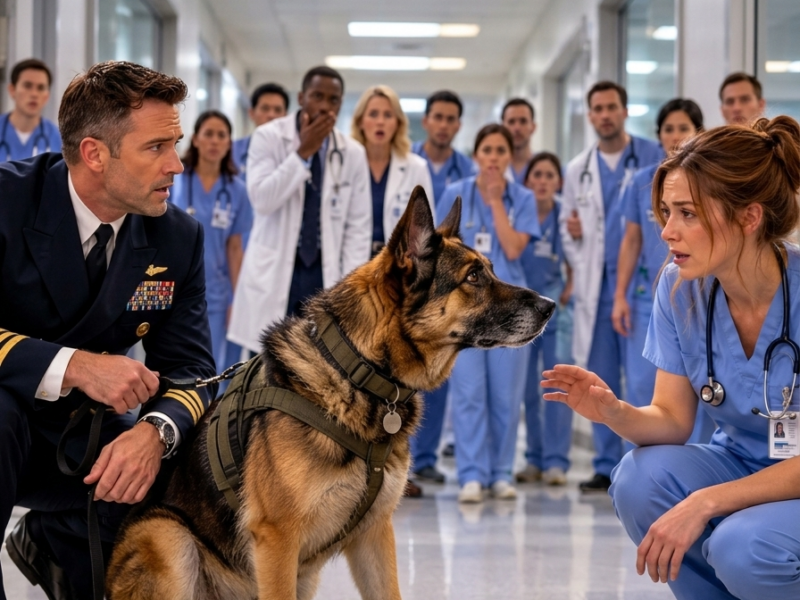
The entire emergency room watched the military K9 lunge toward me while his handler shouted for security, but the moment I whispered a name nobody at that hospital had heard in years
The emergency room of Mercy General Hospital in San Diego was a maze of fluorescent lights, squeaking rubber soles, and the constant, rhythmic beeping of vital monitors. At two in the morning, the harsh white light seemed to strip away everything except raw human exhaustion.
I stood near the central nurses’ station, staring blankly at a row of uncompleted electronic charts. My blue scrubs were stained with cold coffee, and my hands were trembling slightly—not just from the brutal twelve-hour shift, but from the deep, phantom ache that always settled into my bones around this hour. To everyone on the night shift, I was simply Emily Carter: the quiet, reliable nurse who willingly took holiday coverage, ate her lunch alone in the breakroom, and politely dodged any personal questions about her past.
Nobody here knew why my posture instinctively straightened whenever a military helicopter thundered over the hospital helipad toward nearby Camp Pendleton.
Nobody knew why I kept a tarnished, heavy challenge coin with an engraved combat medic insignia locked inside my personal locker downstairs.
And nobody knew why I had repeatedly turned down every single promotion that would require me to sit in front of the hospital’s board of directors or appear in public recruitment materials.
I had spent three years building this wall of anonymity, burying the woman I used to be beneath layers of mundane hospital routine. But in a single split second, that wall shattered completely.
The automatic double doors of the ER slid open with a sharp, pneumatic hiss, letting in the damp ocean air and a sound that froze every doctor and nurse in their tracks: a deep, dangerous, chest-vibrating growl.
Two military policemen rushed into the lobby, supporting a burly handler who was desperately trying to maintain control of a massive, battle-scarred German Shepherd. The dog’s thick, dark coat was bristling along his spine, his teeth were fully bared, and his dark eyes burned with a chaotic mixture of rage and overwhelming panic.
“Get her away from that animal!” Sergeant Mason Reed barked, his voice laced with stress as he wrapped the heavy nylon tactical leash around his fist twice. The dog lunged forward, his heavy paws slipping on the polished linoleum floor, straining against the restraint with terrifying strength.
Two triage nurses scrambled backward, knocking over a tray of sterile bandaging. The security guard behind the desk instinctively unclipped his holster strap, his eyes wide with fear.
“Clear the aisle!” Reed shouted again, his face slick with sweat. “He’s a retired multi-purpose K9 unit in transit to the base vet! He’s off-balance, aggressive, and unpredictable! Clear out!”
I stood completely frozen beside the charting desk. My heart slammed against my ribs with the violence of an artillery shell. My breath caught in my throat, choking me.
The dog wasn’t unpredictable. He wasn’t wild.
Running beneath his left eye was a thick, pale scar—a jagged line of hairless tissue that curved down toward his snout. It was a scar I knew better than my own face. I had stitched that exact wound with my own hands three years ago, working frantically inside the burning, twisted metal of an overturned armored transport vehicle while enemy mortar rounds cratered the earth outside.
His name was Ranger.
Three years ago, I hadn’t been Emily Carter, the quiet night-shift nurse. I had been Captain Emily Carter, a combat medic assigned to an elite Special Operations search-and-rescue team deployed in the mountains of Eastern Europe. Ranger had been our point dog, our guardian angel, the brave soul who sniffed out IEDs and pulled wounded operators out of kill zones.
During our final disaster of a mission, a secondary blast had blown open our staging point, separating Ranger from his primary handler and trapping six critically wounded soldiers inside the collapsing basement of a reinforced bunker. Over the radio, the battalion commander had issued a clear, cold order: Immediate retreat. The structure is falling. Evacuate the medic.
I had disobeyed that direct order. I disarmed my comms, grabbed my trauma kit, and ran into the fire.
I managed to pull five men out of the rubble, dragging them through dust and flame to the waiting evacuation choppers. But the structure collapsed completely before I could make it back for the sixth man.
The sixth man was my twenty-two-year-old brother, First Lieutenant Daniel Carter.
I had left my own brother behind in the dark.
After the official investigation, crushed by an unbearable weight of guilt that I couldn’t articulate without admitting I had chosen which soldiers lived and which died, I resigned my military commission, walked away from my rank, and vanished into the anonymity of civilian healthcare.
Now, Ranger was standing less than ten feet away from me. The dog was trembling so violently that his heavy metal tactical harness was rattling against his chest.
Sergeant Reed noticed my fixed gaze and took a sharp step forward, placing himself between me and the dog. “Ma’am! Step back! Have you ever worked with high-drive military working dogs?”
I swallowed hard, forcing my hands to stop shaking as I shoved them deep into the pockets of my scrubs. “No,” I lied. It was the first lie I had told anyone at Mercy General that night, and the word tasted like copper in my mouth.
Ranger didn’t accept the lie.
The moment the word left my lips, the dog let out a sharp, high-pitched yelp—a sound so humanly desperate it made my soul ache. With an explosive burst of energy, Ranger twisted his head, snapped his jaws near Reed’s wrist, and ripped the leash completely out of the sergeant’s grip.
People screamed. A nurse shrieked into her phone for hospital security.
Ranger didn’t attack. He charged across the polished floor, his claws clicking furiously, and threw his massive 85-pound body straight into me. But instead of tearing into my throat, he buried his large, scarred head directly into my chest, sinking his weight into my lap as he whined like a terrified, heartbroken puppy.
The force of his impact brought me down to my knees. The cold tile shocked my legs, but I barely felt it. Tears stung my eyes as I wrapped my arms around his broad, muscular neck, burying my face in his thick fur. The familiar scent of gun oil, pine, and leather rushed back to me, dragging three years of buried memories to the surface.
“Easy, Ranger,” I whispered into his upright ear, my voice cracking. “Easy, sweet boy. I’ve got you.”
I rested my forehead against his wet nose and spoke the eight quiet words that our squad had used during the darkest, coldest nights in the frontline trenches:
“Steel holds. Hearts remember.”
The transformation was absolute. Ranger went completely still. His aggressive posture melted away instantly. He dropped his belly to the floor, let out a long, shuddering sigh, and placed one massive, warm paw gently over my knee, as if anchoring me to the earth.
The entire emergency room fell into a stunned, dead silence. Sergeant Reed stood with his hands outstretched, his jaw dropped in utter disbelief.
Before anyone could speak, the heavy metallic chime of the main glass elevators echoed through the lobby. The doors slid open.
Stepping out into the bright light was a tall, stern man in an immaculate dress uniform. Four silver stars glinted on his collar. He was flanked by two armed military police captains and a man in a tailored dark suit.
General Arthur Vance—the Vice Chief of Staff of the Army, and the commander who had signed my discharge papers three years ago—walked into the lobby. He stopped dead in his tracks the moment his eyes caught the image of the dangerous combat dog curled submissively around a nurse in blue scrubs.
“Captain Carter?” the General whispered, his voice carrying clearly across the silent room.
A collective gasp rippled through the hospital staff. My colleagues stared at me as if I had suddenly transformed into a stranger.
“I’m not a captain anymore, sir,” I said quietly, remaining on my knees, my hand still resting on Ranger’s back.
General Vance approached slowly. His weathered face was a complex canvas of profound relief, deep regret, and something far more dangerous—a subtle, calculated fear.
“Your resignation was never officially processed, Emily,” Vance said, lowering his voice as he reached my side.
My stomach dropped into a bottomless pit. “What are you talking about? I submitted my papers three years ago. I walked away.”
“Because you believed you failed your mission,” Vance said softly, leaning down slightly. “Because you believed your brother died because you were too slow.”
“He did die,” I choked out, a fresh wave of grief searing my chest. “I left him in that bunker, General!”
“Your brother’s mission report was altered, Emily,” Vance whispered, his eyes darting briefly toward the hospital entrance. “The structural collapse wasn’t what killed those men. And the classified intelligence files you thought were destroyed in the fire… were never recovered by our team.”
My head reeled. “Daniel is dead,” I repeated, my voice rising in panic. “I saw the MIA declaration! I signed the paperwork!”
The General didn’t answer with words. Instead, he reached inside his formal jacket, pulled out a thick, wax-sealed Manila envelope, and placed it directly into my trembling hand.
Across the front of the envelope, written in dark, hasty blue ink, was my name. I would have recognized that slanting, messy handwriting anywhere in the world.
It was Daniel’s handwriting.
My lungs locked up. I couldn’t breathe. My fingers hovered over the red wax seal, ready to tear it open.
SNAP.
A hand suddenly clamped down onto my wrist with bruising force.
I looked up. Sergeant Reed was kneeling beside me. His face was ghostly pale, his eyes wide with absolute terror as he stared down at the envelope in my hands.
“Don’t open that, Captain,” Reed whispered, his voice trembling so hard I could barely hear him over the hum of the ER.
“Let go of me, Sergeant,” I demanded, trying to pull my hand back.
“Look at the bottom of the seal,” Reed pleaded, his grip tightening. “Because if that letter contains the extraction codes from Sector 4… then the person who ordered your brother abandoned in that bunker isn’t three thousand miles away in Washington.”
Reed leaned closer, his eyes flicking toward the shadow of the General, who was already stepping backward toward the exit.
“He’s standing right behind you.”
I turned my head slowly. General Vance had retreated through the glass doors into the darkness of the street.
Beside me, Ranger suddenly stood up. The dog didn’t bark. He lowered his head, a low, murderous rumble echoing from deep inside his chest as his eyes locked onto a man in a black wool coat who had just stepped through the side entrance of the hospital.
The man stood under the streetlamp, looking directly through the glass at me. He didn’t look angry. He smiled faintly, raised two fingers to his temple in a mock salute, and silently mouthed two words through the thick glass:
“Welcome back.”
The world seemed to spin on a dangerous, tilted axis. The fluorescent lights of the emergency room flickered overhead, casting long, sharp shadows across the floor.
“Emily! Emily, who is that man?!” my head nurse, Sarah, shouted from behind the desk, her voice breaking the stunned silence of the lobby. “Do we need to call the police? What is happening?!”
I didn’t answer her. My eyes were locked on the man in the black wool coat standing on the rain-slicked pavement outside. He had dark hair silvered at the temples, a sharp, angular jaw, and a posture that screamed high-level military intelligence. I knew that face. God help me, I knew that face.
Colonel Victor Vance. General Vance’s younger brother, and the former Chief of Intelligence for our deployment task force in Eastern Europe. He was the man who had drawn the red tactical lines on the map the night Daniel vanished.
Outside, Colonel Vance slowly turned, popped the collar of his coat against the damp wind, and melted seamlessly into the dark shadows of the parking structure.
Ranger let out a sharp, ear-splitting bark, lunging against his harness so hard that Sergeant Reed was nearly yanked off his feet again.
“Hold him! Reed, hold the dog!” I commanded, my old officer’s authority barking out instinctively before I could stop myself.
“Ma’am, yes ma’am!” Reed grunted, digging his boots into the floor and pulling Ranger back into a heel position. The dog panted heavily, his tail rigid, his dark eyes still fixed on the glass doors.
My hands were shaking uncontrollably as I looked down at the wax-sealed envelope in my lap. The red wax bore the pressed imprint of a combat eagle—the official seal of the 75th Ranger Regiment’s covert reconnaissance division.
“Captain Carter,” Sergeant Reed whispered, dropping down to one knee beside me, his tactical radio crackling with static on his shoulder. “We need to get off the open floor. Now. If Colonel Vance is here in San Diego, this entire facility is compromised. He doesn’t travel without an escort.”
“Where is General Vance going?” I asked, my voice tight as I forced myself to stand up. My legs felt like lead.
“The General is playing both sides,” Reed said grimly, looking around the crowded ER. “He brought you that letter because his conscience is eating him alive, but he’s too terrified of his brother to stand his ground. You need to read that document somewhere safe.”
Dr. Miller, the chief attending physician on duty, rushed out from the trauma bay, his face red with confusion and irritation. “Emily! What in the hell is going on out here? Who are these military men? Why is there an unsanitized attack dog in my lobby?!”
“Dr. Miller, I am taking an emergency leave of absence,” I said, my tone flat, leaving no room for argument. I stepped toward the nursing station, snatched my personal jacket and car keys from the hook, and stuffed the heavy envelope deep into my inner pocket.
“You can’t just leave mid-shift!” Miller yelled, following me. “We have three trauma arrivals coming in from Interstate 5!”
“Call in call-duty,” I replied without looking back. “If anyone asks for me… tell them I transferred out three years ago.”
I turned to Sergeant Reed. “Where is your transport?”
“Parked in the ambulance bay, rear entrance,” Reed said, grabbing Ranger’s short leash. “Unmarked military SUV. Blacked-out glass.”
“Let’s go.”
We moved swiftly through the rear supply corridors, away from the staring eyes of the hospital staff. Ranger trotted perfectly at my left hip, his body pressed against my leg, serving as a physical shield. The dog’s presence was a grounding anchor in the middle of a nightmare that was rapidly pulling me back into the dark world I had tried so hard to escape.
We burst through the rear crash doors into the cool, salty ocean air of the bay. A heavy black Ford Expedition was idling under the shadow of the overhang, its engine rumbling softly.
Reed unlocked the doors with his remote. “In the back, Captain. Quickly.”
I climbed into the spacious back seat, and Ranger immediately scrambled in beside me, resting his heavy head across my thighs. Reed jumped into the driver’s seat, slammed the vehicle into drive, and tore out of the hospital complex, his tires screeched against the wet pavement as we merged into the quiet night traffic of San Diego.
“Where are we going?” I asked, leaning my head against the cool glass of the window, staring out at the passing streetlights.
“My safehouse near Coronado,” Reed said, watching his rear-view mirrors like a hawk. “Off the grid. No digital signatures, no smart devices. It’s the only place within fifty miles where Colonel Vance’s surveillance network can’t reach us.”
I pulled the Manila envelope out of my jacket. The heavy paper felt like a lead weight in my hands. The wax seal was cold to the touch.
“Reed,” I said quietly, staring at my brother’s handwriting across the front. “What did you mean back there? What did you mean when you said the evidence was never destroyed?”
Reed sighed, his knuckles turning white on the steering wheel. “Three years ago, after your unit took those heavy losses in Sector 4, the official Pentagon report stated that Lieutenant Daniel Carter had been killed when an enemy artillery shell detonated inside the bunker basement, collapsing the structure and incinerating all tactical assets inside.”
“I know the official report,” I snapped, my heart aching. “I read it a thousand times! I memorized every word of it while I sat in my apartment crying myself to sleep!”
“The report was a lie, Emily,” Reed said softly, his eyes meeting mine in the mirror. “There was no enemy artillery shell.”
I froze. “What?”
“The explosives that brought down that bunker were laid from the inside,” Reed revealed, his voice dripping with venom. “It was a thermite charges detonation—standard issue for US Army demolition teams. Someone ordered that bunker dropped to destroy a physical server bank hidden beneath the floorboards. A server bank containing raw digital logs of illegal arms sales flowing from elite command structures directly to black-market PMC contractors.”
My breath hitched. The air inside the SUV suddenly felt thin, impossible to inhale. “Daniel… Daniel was an intelligence communications specialist…”
“Exactly,” Reed nodded. “Your brother didn’t die in a tragedy, Captain. He was trapped down there because he found the server. He downloaded the primary drive onto a hardened tactical flash unit before the demolition charges were set off. Colonel Victor Vance ordered the charges detonated to bury your brother—and the proof—under fifty tons of concrete.”
Tears spilled over my eyelids, burning my cheeks. “And General Vance?”
“General Vance found out about his brother’s treason twenty-four hours after the incident,” Reed explained. “Instead of turning his own brother in, he covered it up to protect the family name and his four-star rank. He classified the entire incident under highest national security clearance and let you take the blame for ‘abandoning’ your post.”
I looked down at the envelope. My fingers hooked beneath the heavy red wax seal. With a sharp CRACK, I tore the paper open.
Inside was a thick sheaf of official military parchment, stained with old mud and dry, dark copper spots that could only be blood. And clipped to the top of the papers was a small, military-grade titanium USB drive.
I unfolded the top letter. The handwriting was unmistakable.
Emily,
If you are reading this, it means Ranger found you, and it means I am either dead or trapped somewhere worse than hell. Do not come back for me through normal channels. Victor Vance has compromised the entire chain of command from Battalion level up to the Pentagon.
The files on this drive contain the full biometric logs of the men who set the charges. I didn’t die in the collapse, Em. I made it out through the drainage tunnels under the east wall before the roof fell. But they captured me at the rally point.
They are holding me at the naval brig facility in Sector 9 under an unregistered prisoner code. They think I haven’t hidden the master decryption key. They think I’m going to break.
Tell Mom I’m sorry. Tell Ranger he’s a good boy.
Don’t trust anyone wearing a gold star.
Love,
Daniel.
A low, guttural sob ripped from my throat. I pressed the paper against my face, smelling the faint, lingering scent of metallic dust and my brother’s familiar scent beneath the passage of time.
He was alive.
My brother wasn’t a memory buried under foreign soil. He was alive, suffering in a dark cell less than thirty miles from where I sat, being tortured by the very officers who wore the uniform of the country he had sworn to protect.
Ranger lifted his head, whining softly, and licked the tears from my jaw.
Suddenly, a loud, violent CRASH echoed through the SUV.
A massive, heavy-duty black pickup truck slammed directly into our rear bumper, sending the Expedition skidding sideways across three lanes of the empty highway.
“BRACE!” Sergeant Reed screamed, battling the steering wheel as the tires squealed in protest.
Through the rear window, bathed in the harsh, blinding high beams of the chasing vehicle, I saw two dark figures leaning out of the truck’s windows, raising suppressed automatic rifles directly at our tires.
The world dissolved into a chaotic nightmare of screeching rubber, shattering glass, and the sharp, rhythmic THUMP-THUMP-THUMP of suppressed gunfire striking the rear armored frame of our SUV.
“Get down!” Sergeant Reed roared, stomping his foot onto the accelerator.
I grabbed Ranger by his heavy harness, pulling his massive body down onto the floorboards between the seats as three high-velocity rounds shattered the heavy glass of the rear liftgate, showering us in tiny, glittering cubes of safety glass. Ranger let out a fierce, defensive growl, his paws digging into the carpet as he tried to protect me with his own body.
“Are they Vance’s men?!” I screamed over the deafening roar of the wind rushing through the shattered window.
“Mercenaries!” Reed yelled, pulling a tactical Sig Sauer 9mm handgun from his hip holster and kicking the Expedition into a hard left turn, sending us sliding onto an industrial access road alongside the San Diego bayfront. “Private security contractors working under Colonel Vance’s off-the-books budget! They don’t care about collateral damage!”
Behind us, the black pickup truck tore around the corner, its massive bull-bars grinding against the asphalt, sparks flying into the night air. The truck was faster, heavier, and built like a battering ram. It surged forward, slamming into our passenger-side rear quarter panel with sickening force.
The Expedition spun violently out of control. I slammed shoulder-first into the door frame, pain exploding down my side, but I kept my arms locked tightly around Ranger. The SUV mounted the curb, crashed through a chain-link security fence, and slammed into the side of an abandoned shipping warehouse before coming to a dead stop in a cloud of steaming radiator fluid and tire smoke.
Silence descended for three agonizing seconds, punctuated only by the hiss of broken cooling lines and the pounding of my own heart.
“Captain! Are you okay?!” Reed wheezed, his forehead bleeding from where it had struck the steering wheel.
“I’m alive!” I gasped, kicking my jammed door open with both feet. “Ranger, move!”
The dog scrambled out of the ruined vehicle first, taking up a low, deadly defensive guard near the rear tire. I tumbled out after him, clutching the Manila envelope and the titanium USB drive tightly against my ribs.
Across the dark lot, the black pickup truck ground to a halt near the ruined fence. Four men dressed in dark tactical gear, night-vision goggles, and suppressed submachine guns stepped out, spreading into a lethal tactical sweep.
“Leave the vehicle! Into the warehouse!” Reed ordered, raising his handgun and firing four quick shots toward the mercenaries, forcing them to duck behind their truck doors for cover.
I didn’t hesitate. I sprinted toward the narrow loading dock door of the corrugated steel warehouse, Ranger bounding at my side like an arrow shot from a bow. Reed backed up behind us, providing suppressive fire until his slide locked back on an empty magazine. He slammed the heavy steel security door shut behind us, dropping a heavy iron bar across the brackets just as a hail of bullets rattled against the outside metal like heavy hail.
Inside, the warehouse was pitch-black, filled with the dusty scent of old timber, rusted iron, and salt water. High windows near the roof let in pale moonlight, casting long, geometric shadows across stacks of wooden crates and abandoned machinery.
“They’re going to breach that door in less than two minutes,” Reed panted, reloading his sidearm with his last spare magazine. “We’re cornered, Captain.”
“No, we’re not,” I said, my voice dropping into the cold, calculated rhythm of a combat operator. The fear that had paralyzed me for three years was gone, replaced by a surging tide of adrenaline and furious clarity. “This is an old naval storage facility. These docks always have secondary access tunnels leading to the drainage canals.”
I looked down at Ranger. The dog was panting quietly, his ears pricked, his nose catching the faint drafts of air moving through the massive room.
“Ranger,” I whispered, kneeling beside him. “Find the exit, boy. Find the wind.”
Ranger raised his snout, sniffed the air sharply three times, and then bolted down the central aisle between the wooden crates without making a sound.
“Follow him!” I shouted to Reed.
We ran through the gloom, our boots echoing off the concrete floor. Outside, the dull THUD-THUD of breaching charges echoed against the steel doors. A second later, a brilliant flash of light and a deafening explosion shattered the rear of the warehouse, sending a shockwave through the air.
“Breach! They’re inside!” Reed shouted, turning to aim his gun down the dark aisle.
“Keep moving!” I ordered.
At the far end of the warehouse, Ranger was standing beside a heavy iron storm grate set into the floorboards. The dog was scratching frantically at the rusty latch, letting out low, urgent whimpers.
“Good boy!” I praised, dropping to my hands and knees. The latch was frozen with decades of rust and salt corrosion. I yanked on it with all my strength, but it wouldn’t budge. “Reed! I need leverage!”
Reed sprinted over, slammed the butt of his heavy tactical flashlight into the iron latch mechanism three times, and then joined me in pulling the heavy handle. With a loud, metallic SCREECH, the iron grate popped open, revealing a dark, concrete drainage ladder leading fifteen feet down into a black subterranean tunnel filled with two feet of slow-moving water.
“In! Go, go, go!” Reed yelled.
“Ranger, down!” I commanded.
Without a second of hesitation, the brave German Shepherd leaped straight into the dark opening, landing with a heavy SPLASH in the water below. I scrambled down the rusty rungs after him, the cold water soaking through my scrubs up to my knees. Reed dropped down last, pulling the heavy iron grate back over the opening just as laser sights cut through the shadows of the warehouse floor above us.
THUD-THUD-THUD.
Heavy boots paced across the iron grate directly over our heads. The red beam of a tactical laser swept through the gaps in the metal, brushing across the shoulder of my jacket. I held my breath, pressing my hand firmly over Ranger’s snout. The dog stayed perfectly motionless, not even twitching a muscle in the dark, freezing water.
“Target vanished,” a harsh, synthesized voice radioed from above. “Searching the lower perimeter. Spread out.”
The boots moved away, their footsteps fading into the distance.
I let out a slow, quiet breath, releasing Ranger’s snout. The dog licked my fingers softly in the pitch-black tunnel.
“Where does this channel lead?” Reed whispered, switching his flashlight to a low, red tactical beam that wouldn’t reflect through the surface grates.
“It empties into the San Diego Bay commercial harbor, right near the edge of the Naval Amphibious Base,” I said, pulling the titanium USB drive from my pocket and staring at its tiny metal casing. “Right near Sector 9.”
Reed looked at me in shock. “Captain… you aren’t actually thinking about breaching a high-security military brig with one handgun and an off-duty K9, are you?”
I looked up at him, my eyes burning in the dim red light.
“My brother spent three years in the dark because I was too afraid to face the truth,” I said, my voice as hard as cold iron. “I’m not leaving him in that cell for another hour. We’re going to use this drive to open the front gates, Sergeant. And if Colonel Vance stands in my way… he’s going to find out why they called me the Reaper of Sector 4.”
The subterranean drainage network emptied out into a dense patch of coastal reeds near the southern edge of San Diego Bay. The rain had cleared, leaving behind a sharp, freezing fog that rolled off the dark water, obscuring the distant skyline of the city.
In the distance, towering over a restricted peninsula surrounded by double-layered chain-link fencing, barbed wire, and powerful rotating floodlights, stood the dark silhouette of Facility 9—a decommissioned naval holding center that officially didn’t exist on public maps.
We crouched low in the wet grass at the edge of the perimeter fence line. Ranger lay flat on his stomach beside me, his dark coat blending seamlessly into the mud, his eyes fixed on the armed guards pacing along the elevated catwalks above the main gate.
“Security is tight,” Reed whispered, holding a pair of compact military binoculars to his eyes. “Private security force on the outer perimeter, active biometric scanners at the main portal, heavy vehicle barricades. Colonel Vance converted this place into his personal off-grid black site. If we try to cut through that fence, the silent alarms will trigger a lockdown before we make it fifty yards.”
“We aren’t cutting the fence,” I said quietly, unzipping my wet jacket. “Look at the main entry point. They’re using an automated military grid system. That means the outer gates are powered by a localized tactical server.”
I pulled out the titanium USB drive and held it up in the moonlight. “Daniel’s letter said this drive contains the master biometric logs and encryption keys for Vance’s entire operation. If I can plug this into the secondary junction box at the utility station near the water intake, we can override the perimeter controls and cycle the security grid into a false maintenance loop.”
“That will cut the floodlights and lock down their internal comms for about six minutes,” Reed observed, a grim smile tugging at his lips. “Six minutes of total darkness inside a black site.”
“Six minutes is all I need,” I said, looking down at Ranger. “Ranger, ready to work?”
The dog raised his head, his tail giving two soft, silent thumps against the damp earth.
We moved like ghosts through the thick fog, hugging the outer concrete retaining wall until we reached the small, steel-reinforced utility shed housing the facility’s primary power junction. Reed took up a sniper-watch position behind a stack of concrete barriers, his Sig Sauer pointed at the catwalks, while I used a heavy screwdriver from Reed’s tactical kit to pry open the maintenance panel on the back of the junction box.
Inside, green status lights blinked softly alongside a row of heavy fiber-optic cables. In the center of the main circuit board was a single, illuminated blue USB port.
My hands were surprisingly steady as I inserted the titanium drive into the slot.
A small LED screen above the port flickered to life, scrolling through lines of rapid, green military code:
DECRYPTION KEY ACCEPTED.
USER IDENT: LIEUTENANT DANIEL CARTER.
OVERRIDING FACILITY 9 PROTOCOLS…
INITIATING BLACKOUT PROTOCOL IN 3… 2… 1…
CLACK-CLACK-CLACK!
Every single floodlight across the entire compound went dead simultaneously. The loud, buzzing hum of the high-voltage perimeter fence abruptly silenced. The bright, sterile facility was instantly plunged into deep, suffocating darkness, broken only by the dim red glow of emergency battery lights inside the main courtyard.
Shouts of confusion echoed from the catwalks as guards scrambled for their tactical flashlights.
“Grid is down! Go!” Reed yelled.
We sprinted through the disabled main gate, crossing the open courtyard with terrifying speed. Ranger took the lead, his nostrils flaring as he caught a familiar, lingering scent drift through the heavy night air. He didn’t hesitate; he bypassed the main administrative offices and bolted toward a heavy steel blast door set into the concrete hillside leading to the subterranean holding cells.
The electronic lock on the blast door was dead, its red light unpowered by the grid override. Reed slammed his shoulder into the manual release bar, pushing the heavy steel door open just enough for us to slip through into the dark corridor beyond.
The interior smelled of old concrete, rust, and damp misery. Long rows of windowless steel doors stretched out down a narrow, dimly lit hallway.
“Ranger! Find him!” I commanded in an urgent whisper.
The dog sprinted down the hall, sniffing frantically at the base of every steel door. Cell 101… Cell 104… Cell 108…
At the very end of the corridor, in front of a heavily reinforced door marked ISOLATION 12, Ranger suddenly stopped dead in his tracks. He threw his front paws against the iron frame, scratching desperately at the metal, and let out a loud, joyfully frantic bark that echoed through the subterranean complex.
My heart leaped into my throat. “Reed! The keycard override!”
Reed stepped up, using a manual bypass tool from his kit to pop the mechanical latch on the lock housing. With a heavy, metallic THUD, the locking bolts retracted, and the heavy door slowly swung outward.
Inside the small, windowless concrete cell, illuminated only by the faint red glow of an emergency lamp, a man was chained to a heavy iron frame set into the floor. He was thin, his clothes tattered, his face covered in a dark beard and bruised from years of captivity. His left arm was wrapped in old bandages.
He blinked against the sudden intrusion, raising a hand to shield his eyes from the flashlight beam.
“Daniel?” I choked out, my voice breaking as tears flooded my eyes.
The man froze. He lowered his hand slowly. His hollow, exhausted eyes widened as they locked onto my face.
“Em…?” he rasped, his voice rough and dry like dry sand paper. “Emily…?”
Ranger scrambled into the cell, leaping up onto the iron frame and smothering the man’s face in frantic, loving licks, whining loudly as he buried his nose into his master’s chest.
Daniel wrapped his frail, chained arms around the dog’s neck, sobbing quietly against his fur. “Ranger… oh god, Ranger… you brought her… you found her…”
I dropped to my knees beside him, throwing my arms around both of them, pulling my brother tightly into my chest. I buried my face in his shoulder, crying uncontrollably as the dark, heavy phantom of three years of grief finally shattered into a million pieces.
“I’m sorry, Daniel,” I sobbed into his jacket. “I’m so sorry I left you in that bunker… I’m so sorry…”
“You didn’t leave me, Em,” Daniel whispered through his tears, pressing his forehead against mine. “You saved five men that night… you did your job… I never blamed you… not for one second…”
“We have to get you out of here,” Reed said urgently, stepping into the cell and using a heavy pair of tactical bolt cutters to snap the iron chains binding Daniel’s wrists to the frame. “We have about two minutes before their auxiliary generators kick in!”
CLANK-CLANK!
The iron chains fell away, freeing Daniel’s hands. He collapsed forward into my arms, his body weak from long-term confinement, but his spirit burning brightly.
“Did you… did you get the drive?” Daniel gasped, clutching my arm tightly.
“I have it,” I said, showing him the drive. “It worked. It brought down the grid.”
“Good,” Daniel rasped, a fierce, cold smile breaking through his bruised face. “Because that drive doesn’t just contain the clearance codes… it contains the live stream coordinates of Colonel Vance’s off-shore financial accounts. It’s the bullet that buries him.”
Suddenly, the overhead emergency lights flickered violently, changing from dull red to a harsh, blinding, flashing white.
WHIRRRRRRR!
A deafening, automated security siren began to wail throughout the facility.
ATTENTION ALL PERSONNEL. AUXILIARY POWER RESTORED. AUTOMATIC LOCKDOWN INITIATED.
Behind us, at the end of the long subterranean corridor, the heavy steel blast doors began to slowly grind shut, their massive hydraulic arms extending to seal us inside the lower level forever.
And standing in the middle of the hallway, flanked by six heavily armed private contractors carrying assault rifles, was Colonel Victor Vance. He held a sleek, silver control unit in his hand, a cold, merciless smile twisting his sharp features.
“Reunion over, Captain Carter,” Colonel Vance’s voice echoed through the speaker system, sounding smooth, cold, and utterly lethal. “Did you really think I would let you walk out of my house with my life’s work?”
The heavy hydraulic blast doors grumbled as they slowly descended, reducing the exit at the end of the corridor to a narrow five-foot gap. The flashing white strobe lights painted the narrow hallway in violent, disorienting flashes of light and shadow.
“Cover!” Sergeant Reed yelled, pushing Daniel behind a concrete pillar near the cell door as he raised his Sig Sauer and fired three shots down the corridor, driving Colonel Vance’s mercenaries back behind the doorframes.
Bullets slammed into the concrete around us with deafening CRACKS, showering us with powder and stone chips.
“We can’t stay here!” Reed shouted, his slide locking back as he expended his absolute last round of ammunition. “I’m dry!”
I looked at Daniel, who was leaning heavily against the wall, too weak to run. I looked at Reed, whose hands were empty. And I looked down at Ranger, who was standing in front of my brother, his back arched, his lips drawn back over sharp, pearly teeth, his body emitting a roar so loud it echoed above the security sirens.
I pulled the titanium USB drive from my pocket and slammed it into Sergeant Reed’s hand.
“Take Daniel,” I commanded, my voice dropping into an absolute, unshakeable tone of leadership.
Reed stared at me in shock. “What?!”
“There’s an emergency ventilation shaft behind Cell 110 that leads directly out to the drainage channel!” I shouted over the gunfire. “You take Daniel and the drive, get to the water, and don’t stop until you reach the Federal Courthouse in downtown San Diego!”
“I’m not leaving you behind again, Emily!” Daniel screamed from behind the pillar, trying to push himself up. “No! We go together!”
“You aren’t leaving me, Daniel,” I said, turning to look my brother in the eyes, a fierce, tearful smile breaking across my face. “I’m covering your extraction. Like a medic is supposed to do.”
I grabbed a discarded heavy steel riot shield from the cell floor, pulled a flashbang grenade from Reed’s tactical vest, and looked down at Ranger.
“Ranger,” I whispered softly.
The dog turned his head, his dark eyes locking onto mine with an intensity that transcended human understanding. He knew what was coming. He knew the cost.
“Guard Daniel,” I commanded softly. “Take him home, boy.”
Ranger let out a low, mournful whimper, but he obeyed instantly. He spun around, grabbed the collar of Daniel’s ragged jacket gently between his jaws, and began firmly pulling my weak brother backward toward the ventilation access near Cell 110.
“Emily! NO!” Daniel sobbed as Reed hoisted him up, dragging him into the narrow access shaft behind the dog.
“Go!” I screamed.
I stepped out into the center of the subterranean corridor, holding the heavy steel riot shield in front of my body.
Colonel Vance stepped out from behind his guards, raising a sleek submachine gun. “Lower the shield, Emily! It’s over! Give me the drive!”
“You want the drive, Victor?” I shouted back, my voice echoing off the concrete walls like a battle horn. “Come and take it!”
I pulled the pin on the flashbang grenade, held it for two terrifying seconds, and threw it with all my strength straight down the narrow corridor toward Vance and his men.
“FLASHBANG!” a mercenary screamed.
BOOM!
A blinding, sun-bright explosion of white light and thunderous pressure erupted in the narrow hallway, blowing out the remaining lights and throwing Vance and his mercenaries backward into the shadows, clutching their ears and eyes in agony.
Taking advantage of the total chaos, I charged forward under the cover of the heavy shield, slamming it directly into the chest of the lead mercenary as he stumbled blind through the smoke, knocking him out cold. I grabbed his dropped assault rifle, racked the bolt, and fired a rapid volley into the electronic control panel on the wall, destroying the hydraulic override entirely.
SPARK! BANG!
The heavy hydraulic blast doors malfunctioned, crashing down with an absolute, permanent THUD, sealing the hallway completely shut and trapping Colonel Vance and his men on the far side of the barrier.
Through the reinforced glass viewing port in the blast door, Colonel Vance slammed his fists against the glass, his face twisted in a silent, furious scream of defeat.
I tossed the rifle aside, leaning my back against the cold steel door as the deafening silence of the sealed corridor settled over me. I closed my eyes, taking my first deep, clear breath in three long years.
Behind me, the quiet scraping of boots sounded near the ventilation shaft.
I turned around.
Sergeant Reed and Daniel were gone—safely through the tunnel and out into the night.
Standing at the opening of the dark shaft, his body coated in mud, his eyes shining in the dim red emergency light, was Ranger. He hadn’t left. He had ensured Daniel was safe with Reed, and then he had returned for his captain.
He trotted slowly down the corridor, stopped in front of me, and pressed his broad, scarred head gently against my chest, letting out a soft, rhythmic purr.
I fell to my knees, wrapping my arms around his broad shoulders, burying my face in his neck as clean, healing tears washed the blood and dust from my skin.
“Good boy, Ranger,” I whispered, my heart lighter than it had been in years. “Good boy.”
TWO WEEKS LATER
The morning sun washed over the brilliant blue waters of the Pacific Ocean, casting a warm, golden light across the manicured lawns of the Veterans Memorial Park on Point Loma.
A cool, crisp sea breeze rustled the leaves of the palm trees surrounding the open-air pavilion.
Standing on the raised wooden platform, dressed in a sharp, pristine Army Service Uniform adorned with a combat medic badge and a Silver Star medal, was First Lieutenant Daniel Carter. He leaned lightly on a polished wooden cane, but his posture was straight, proud, and unbroken.
Beside him stood General Arthur Vance—no longer in uniform, but in a quiet civilian suit, having officially tendered his resignation from the Army three days prior following the public release of the decrypted files to the Department of Justice. Colonel Victor Vance and eighteen senior contractors were currently awaiting trial in federal custody, facing charges of high treason, kidnapping, and murder.
Standing at the center of the stage, flanked by a full military honor guard, was Lieutenant Colonel Sarah Jenkins from the Medical Corps.
“For extraordinary heroism in the line of duty, for courage under fire, and for an unyielding commitment to the sacred oath of leaving no soldier behind,” Colonel Jenkins announced into the microphone, her voice echoing clearly across the gathered crowd of hundreds of soldiers, nurses, and civilians. “The President of the United States takes pleasure in restoring the active commission and presenting the Distinguished Service Cross to Captain Emily Carter.”
The crowd erupted into thunderous applause.
I stood on the platform, wearing my crisp captain’s dress blues, the sun warm on my face. I stepped forward as the heavy, bronze medal was pinned over my heart.
I didn’t look at the cameras. I didn’t look at the military brass sitting in the front row.
I looked down at the side of the stage.
Sitting proudly beside my brother, wearing a matching gold-trimmed military dress harness featuring an officially engraved unit badge, was Ranger. The battle-scarred German Shepherd sat at absolute attention, his tail giving one heavy, proud thump against the grass as his dark eyes stayed locked onto mine.
When the official ceremony concluded, Daniel walked slowly over to me, wrapping his arm tightly around my waist as the crowd began to disperse.
“How does it feel, Captain?” Daniel asked, a bright, genuine smile breaking across his face.
I looked down at the shiny bronze medal on my chest, then looked out over the endless blue horizon of the ocean, feeling the heavy, suffocating weight of three years of guilt finally vanish into the salt air.
“It feels like I’m finally breathing, Daniel,” I said softly.
I knelt on the grass, opening my arms wide. Ranger didn’t hesitate; he trotted forward, thrusting his nose straight into my neck, letting out a soft, happy whimper that warmed my very soul.
I reached up, touching the jagged scar beneath his eye, and whispered the eight words that had brought us all back from the dark:
“Steel holds. Hearts remember.”
And as the ocean breeze carried the sound of our laughter across the sunlit coast, I knew that the long, dark night was finally over. We were home.
The end.









