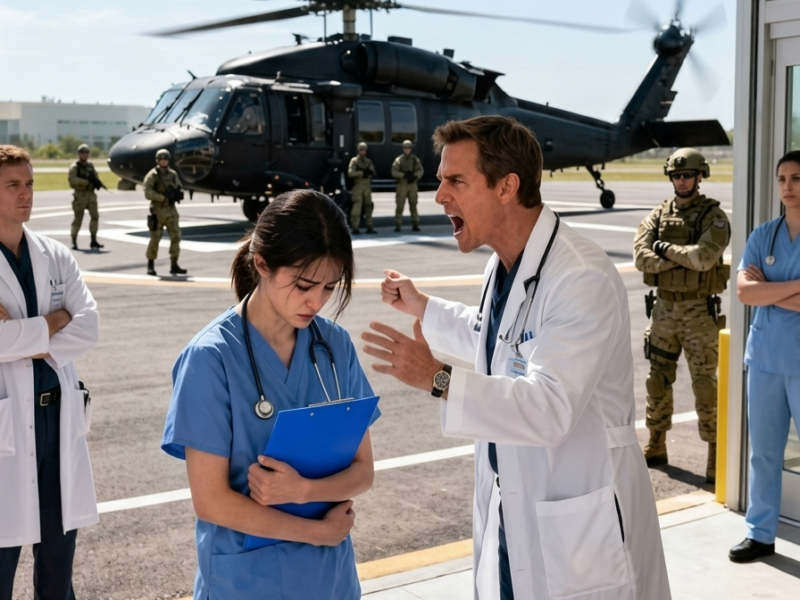
The entire emergency room laughed when the new nurse was ordered to clean blood off the floor, and the chief surgeon sneered that she should be grateful to have a job
I had been working at Mercy General Hospital in Chicago for eleven days when Dr. Richard Hayes decided I was his favorite joke.
I was quiet, kept my head down, and never argued when senior nurses dumped their worst assignments on me. But that morning, after a wealthy patient’s family complained about my plain uniform and old shoes, Hayes made sure the entire emergency room heard him.
“Maybe nursing school should have taught you how to look professional,” he said, tossing a stack of charts onto my station with a loud, echoey thud.
Several nurses and residents laughed. Hayes sneered, leaning against the counter as if enjoying his own performance. “Look at this floor, nurse. Somebody spilled blood in Bay 3 ten minutes ago. Get a mop and clean it up. Be grateful you even have a job here.”
I picked up the charts without answering, my knuckles turning white. His words struck a place inside me that had never completely healed, but I swallowed the burning pride in my throat. Nobody in this brightly lit, sterile building knew why I avoided attention. Nobody knew why I flinched every time a helicopter passed overhead, or why my hands shook whenever I saw news broadcasts about overseas deployments. They didn’t know why I sometimes disappeared into the supply room just to take slow, controlled breaths until my heart stopped hammering against my ribs.
To them, I was just Emily—a meek, awkward float nurse who never fought back.
Then, at 10:17 a.m., the heavy emergency doors burst open.
A frantic paramedic shouted that a military aircraft was landing on the hospital’s rooftop pad without prior clearance. Within seconds, security officers hurried through the corridor, followed closely by the hospital administrator, who looked utterly terrified.
Dr. Hayes straightened his white coat, scowling with exaggerated authority. “Who approved a military landing here? This is an outrage! I’m going to report this—”
He never finished his sentence.
The double doors swung open again, and a tall, heavily decorated general entered the emergency room, accompanied by two armed military police officers. The air in the room instantly turned cold. The general’s sharp, weathered eyes swept across the chaotic room, passing over Hayes, passing over the administrator, until they locked onto me.
He stopped in his tracks.
For the first time since I had met him, Dr. Hayes looked genuinely afraid, stepping back into the shadow of the reception desk.
The general walked directly toward me, ignored the staring crowd, removed his dress cap, and held it against his chest. “Captain Morgan,” he said, his voice deep and echoing in the dead silence. “We’ve been looking for you for fourteen months.”
The entire emergency room became so quiet I could hear the rhythmic beep of a heart monitor three bays away. Nurse Sarah dropped a box of medical tape; Hayes stood frozen, his mouth slightly open. I felt my fingers go numb against the counter.
“General, please,” I whispered, my voice barely audible. “Not here.”
His rigid expression softened with genuine sorrow, but his voice trembled with urgency. “I’m sorry, Emily, but another soldier is dying. And he specifically asked for you.”
Dr. Hayes stared at me, blinking as if he had misheard. “Captain?” he muttered beneath his breath.
I looked down at my faded blue scrubs. Fourteen months earlier, I hadn’t been a quiet float nurse in Chicago. I had been Captain Emily Morgan, a lead combat medic serving with a special operations task force in the Arghandab Valley. I had spent nineteen impossible hours trapped inside a crumbling brick outpost, working under continuous heavy mortar fire to save seven wounded men.
I had succeeded with six of them.
The seventh was Lieutenant Daniel Brooks—my closest friend, my brother in arms, and the man who had thrown himself over my body to block a spray of shrapnel. Before he succumbed to his injuries in the dusty, smoke-filled chaos, Daniel had pressed a bloodstained military identification tag into my palm. “Live, Em,” he had whispered through bloody lips. “Promise me you’ll leave this war behind and just live.”
I had kept that promise. After burying what was left of him, I resigned my commission, walked away from my awards, and moved to Chicago. I took a low-level nursing job at Mercy General because I naively believed that fixing ordinary sprains and broken bones might finally quiet the screams that haunted my nights.
Now, my past had broken through the doors.
“Where is the soldier?” I asked, setting down the paper charts. The timid nurse was gone; my voice was firm, precise, and authoritative.
“He’s at the regional airfield,” the general said. “He’s conscious, but barely. His vitals are crashing.”
I reached for my coat, my heart pounding violently against my chest. But before I could take a step, the general stepped closer, lowering his voice so only I could hear.
“Emily, there’s something else you need to know.”
I froze, my hand hovering over my jacket. “What?”
“The soldier we’re bringing in claims Daniel Brooks never died.”
A cold sensation washed over my entire body. My breath caught in my throat, cutting off all air. For fourteen agonizing months, I had carried the crushing weight of leaving Daniel behind. I had cried myself to sleep hundreds of times, convinced that if I had only been faster, better, or stronger, he would still be breathing. Now, a total stranger was claiming the impossible.
“Who is this man?” I whispered, staring at the rooftop exit where the distant thrum of rotor blades vibrated through the ceiling.
The general looked at me with a haunted, incomprehensible expression. “He says he’s your brother.”
“That’s impossible,” I breathed. “I was raised in foster care. I don’t have a brother.”
The general pulled a thick, sealed olive-drab envelope from his jacket and placed it into my trembling hands. “He gave us this. He said you would know the writing.”
I looked down. Across the front of the envelope, written in dark black ink, was a distinct, slanted handwriting I would recognize anywhere in the world. It wasn’t just Daniel’s handwriting. It was a specific code phrase Daniel and I had used during our deployment to verify secure radio transmissions: “The sparrow flies at dawn.”
My knees nearly buckled. I looked up at the general, my chest heaving. Before I could pull open the wax seal, the emergency room doors slammed open a second time. Another officer rushed in, his face pale and drenched in sweat.
“General! Sir!” the officer shouted. “The transport from the airfield just landed! But the patient isn’t in the ambulance—he’s being moved directly to the roof! He’s bleeding out, and he’s holding a detonator!”
The silence in the emergency room shattered into utter chaos.
Nurses screamed, and Dr. Hayes stumbled backward, knocking over a tray of stainless steel instruments that crashed loudly onto the floor. The security officers instantly drew their sidearms, stepping into defensive positions around the hospital staff.
“Nobody moves!” the general ordered, his command cutting through the panic like a blade. He turned his intense gaze back to me. “Emily. You’re the only one he agreed to talk to without pulling that trigger.”
I didn’t hesitate. The quiet, submissive persona I had worn for eleven days dissolved entirely. I grabbed a trauma kit from the nearest crash cart, slung it over my shoulder, and looked straight into the eyes of the general.
“Lead the way,” I said.
As I marched past Dr. Hayes, the surgeon reached out a trembling hand, his face pale as chalk. “Emily—Captain—what is happening? You can’t just go up there! It’s dangerous!”
I stopped, turning my head slightly to glare at him. The cold, unyielding authority in my eyes made him instantly drop his arm and step back. “Get this ER prepared for massive physical trauma,” I commanded smoothly. “Clear Bays 1 through 4. Have six units of O-negative on standby. If you aren’t ready when I bring him down, Hayes, I will personally see to it that you never hold a scalpel again. Do you understand me?”
“Y-yes, Captain,” Hayes stammered, bowing his head in total submission.
Without another word, I followed the general and his armed escort down the service corridor toward the express elevator. The heavy steel doors slammed shut, and the elevator began its rapid ascent to the rooftop helipad. With every floor we passed, the deep, rhythmic thumping of the Black Hawk’s rotor blades grew louder, vibrating through the metal walls and rattling inside my teeth.
My heart was hammering against my ribs. I looked down at the olive-drab envelope still clutched in my left hand. The sparrow flies at dawn. It was Daniel’s handwriting. There was no mistaking the precise curvature of the letters. But how? I had held Daniel’s cold wrist. I had checked his carotid artery. I had watched the life leave his eyes in that dark, dusty shelter in Afghanistan. I had personally signed his field casualty report.
“General,” I said over the roar of the elevator motor. “Who is the man on the roof?”
“He carries a military ID under the name Marcus Vance,” the general replied, his eyes fixed on the illuminated floor numbers. “Ex-Special Forces. He was reported missing in action three years ago in the same sector where your unit was deployed. We intercepted a rogue military transport carrying him into the city an hour ago. When we surrounded the aircraft, he pulled a military-grade pressure detonator connected to a vest packed with C4. He told us he wouldn’t talk to intelligence officers, diplomats, or commanders. He said, ‘Bring me Captain Emily Morgan, or this entire block becomes a crater.'”
Ding.
The elevator doors slid open, revealing the bitter, cold Chicago wind sweeping across the rooftop helipad.
The scene was terrifying. A massive black military helicopter sat in the center of the concrete pad, its rotors slowly spinning down, casting long, menacing shadows under the gray morning sky. Half a dozen tactical officers had their rifles trained on a man slumped against the landing gear of the aircraft.
He was drenched in blood. A dark pool was spreading beneath his left leg, and his tactical vest was visibly rigged with wires and a heavy block of gray explosive compound. In his right hand, his thumb was pinned down on a small metallic cylinder—a dead man’s switch. If his thumb slipped, or if his heart stopped beating, the circuit would complete.
“Keep your distance!” one of the tactical snipers yelled into his comms. “He’s pale, he’s losing consciousness!”
“Stand down!” I barked, stepping past the line of armed guards without an ounce of fear. “All of you, lower your weapons! Now!”
The snipers looked at the general, who gave a sharp nod. Slowly, the rifles were lowered.
I stepped onto the cold concrete, my scrub top whipping in the freezing wind. I walked slowly, deliberately, holding my hands out where he could see them. As I got closer, the smell of copper and burning fuel filled my lungs.
The man leaned his head back against the helicopter tire. His face was covered in dirt, dried blood, and deep scars, but his dark eyes were wide, desperate, and burning with an intense fever.
“Marcus?” I called out softly, stopping six feet away from him. “I’m Emily. I’m here. Take a breath.”
He coughed, a spray of dark red speckling his lips. His chest was heaving erratically. “Emily…” he rasped, his voice raspy and choked with pain. “You… you came.”
“I came,” I said, slowly dropping to my knees in front of him, ignoring the blood soaking into the knees of my scrubs. “You’re bleeding out from a femoral artery laceration, Marcus. If I don’t apply a tourniquet right now, you’re going to die in less than three minutes.”
He let out a weak, bitter laugh that turned into a wet cough. “It doesn’t matter… if I die… they win. Daniel… Daniel dies for real.”
My entire body went rigid. “What are you talking about? Daniel died fourteen months ago. I was there!”
Marcus shook his head weakly, his thumb trembling against the metal pin of the detonator. “That wasn’t Daniel… you buried in the sand, Captain. That was a body double… planted by the contractor firm… Vanguard Security.”
My mind raced, struggling to comprehend his words. “Vanguard? The private military contractor?”
“They kidnapped Daniel… before the mortar strike,” Marcus whispered, his eyelids drooping as he began to lose the battle against blood loss. “He had the encryption keys… to their illegal arms network. They kept him alive… in an underground facility… in Eastern Europe. He’s been there… for a year.”
Tears blurred my vision, stinging my eyes in the icy wind. “Why should I believe you?” I demanded, my voice cracking with overwhelming emotion. “Give me a reason!”
Marcus weakly lifted his left hand, which had been pressed tightly against his waist. He reached into his pocket and dropped a small, metallic object onto the bloody concrete between us.
It was a silver dog tag.
I reached out with a trembling hand and picked it up. I wiped away the dark blood covering the surface. Engraved on the metal was Daniel’s service number, but beneath it was a small, hand-scratched inscription that only two people in the world knew about: “Saved by the Sparrow.”
It was the exact phrase I had carved into his pocket knife on the night before our final mission.
“He’s alive…” I sobbed, the realization crashing over me like a tidal wave. “Oh God, he’s alive.”
“He… he wrote that letter… in your hands,” Marcus gasped, his eyes rolling toward the back of his head as his body went limp. His grip on the detonator began to slip. “He said… tell her… the key… is inside the envelope…”
Marcus’s hand relaxed. The dead man’s switch began to slide from his blood-covered fingers.
“He’s slipping! The switch!” a sniper screamed from behind me.
Time seemed to slow down to a absolute crawl.
I didn’t run away. I didn’t dive for cover. Instead, using the lightning-fast combat instincts that had been drilled into my muscle memory through years of warfare, I lunged forward. My right hand shot out like a striking cobra, slamming over Marcus’s hand and pinning his thumb down hard against the metallic cylinder of the detonator just a fraction of a second before the spring could release.
With my left hand, I ripped a secondary mechanical safety pin from my own trauma kit’s medical shears sheath and jammed it violently into the side bypass slot of the detonator device.
CLICK.
The tiny red LED light on the C4 vest blinked once, twice, and then flipped from a frantic red to a solid, harmless green. The circuit was disarmed.
“Bomb is clear!” I yelled over my shoulder, my voice commanding and absolute. “Medic team, get up here now! He’s in hypovolemic shock!”
The military officers and paramedics rushed forward, staring at me in absolute shock and awe. Within seconds, we loaded Marcus’s limp, bleeding body onto a gurney. I applied a arterial tourniquet to his thigh, cranked it tight until the bleeding stopped, and ran alongside the gurney as we pushed him back into the elevator.
When the doors opened back on the emergency floor, the entire hospital staff was waiting in terrified anticipation.
Dr. Hayes stepped forward, his hands shaking. “Is the… is the explosive active?”
“It’s disarmed,” I said coldly, pushing past him. “Bay 1. Right now. I need a central line, two bags of plasma, and a surgical tray. Hayes, you’re assisting me.”
“Me? Assisting you?” Hayes stammered, caught completely off guard.
“Did I stutter, Doctor?” I snapped, turning my gaze onto him with terrifying intensity. “Move!”
“Yes, Ma’am—I mean, Captain!” Hayes practically leaped into action, barking orders at the other nurses like a frightened resident.
For the next forty-five minutes, the emergency room became a high-stakes battlefield. I operated with terrifying speed and surgical precision, clamping severed blood vessels, cleaning contaminated wounds, and stabilizing Marcus Vance’s crashing vitals. The nurses who had mocked me hours earlier watched in complete, speechless astonishment as I directed the trauma room like a seasoned battle commander. Hayes barely managed to keep up with my rapid requests for instruments, sweating profusely through his surgical mask.
By 11:30 a.m., Marcus’s heart rate had stabilized. The monitors hummed with a steady, reassuring rhythm. He was out of immediate danger.
I stepped away from the operating table, pulled off my blood-soaked rubber gloves, and threw them into the biohazard bin. The adrenaline that had kept my body moving finally began to ebb away, leaving a heavy, bone-deep exhaustion in its place.
I walked out of the surgical bay and stood in the quiet hallway. The general was standing near the wall, flanked by his two officers. He handed me a clean paper towel and a bottle of water.
“You haven’t lost your edge, Captain,” the general said quietly.
“I never had the luxury of losing it, General,” I replied, wiping my blood-stained hands.
I reached into my pocket and pulled out the sealed olive-drab envelope Marcus had brought. My hands were still shaking slightly. With careful, deliberate movements, I tore open the top seal and pulled out a single sheet of heavy paper.
Written on the page was a complex series of alphanumeric codes, coordinates, and military grid references. But at the very bottom, beneath the mountain of cold data, was a handwritten note in Daniel’s unmistakable handwriting:
“Emily,
If you are reading this, it means Marcus made it to you. I am being held in a black site facility codenamed ‘Aegis-9’ near the border of Poland and Ukraine. Vanguard Security is planning to sell the operational files of our old unit to the highest bidder in 48 hours. They think I’m broken. They think I forgot who I am. But I remembered what you told me under the stars in Kandahar. The sparrow flies at dawn. Don’t come for me alone. Trust no one in Washington.
— D.”
My breath hitched. Aegis-9. It was a secret, unregistered black site facility that had officially been decommissioned five years ago.
“What does it say?” the general asked, stepping closer, his eyes fixed on the paper.
I narrowed my eyes, a cold suspicion creeping into my mind. I remembered Daniel’s warning clear as day: Trust no one in Washington. The general was a high-ranking official based directly out of the Pentagon. How had he known where to find me in Chicago so quickly when I had intentionally erased my digital footprint fourteen months ago?
“It’s just random logistics data,” I lied smoothly, folding the paper and slipping it into my pocket. “Looks like old supply routes.”
The general’s eyes darkened slightly, a subtle shift in his expression that lasted for only a fraction of a second. “Emily, that document is classified military intelligence. I must ask you to hand it over to me immediately.”
“With all due respect, General,” I said, stepping back and folding my arms across my chest, “this envelope was addressed specifically to me. Until I verify its contents with military intelligence channels, it stays with me.”
Before the general could respond, the silence of the corridor was shattered by a sharp electronic chime.
The general reached into his uniform coat and pulled out a secure satellite phone. He glanced at the caller ID, his face turning rigid. He stepped a few feet away and answered in a low, hushed voice.
“Speak,” he muttered. He listened for three seconds, his jaw tightening. “Are you sure? … Understood. Execute protocol Delta.”
He ended the call, turned around, and looked at me. His warm, concerned demeanor was completely gone, replaced by a cold, calculating stare that chilled me to the bone.
“I’m sorry, Captain Morgan,” the general said softly, waving his hand toward his two armed officers. “Hand over the envelope. You’re coming with us.”
The two armed officers instantly unholstered their sidearms, stepping forward to block both ends of the hallway.
Dr. Hayes happened to walk out of the breakroom with a cup of coffee at that exact moment. Seeing two high-ranking military officers pointing guns at me, he gasped, dropping his mug. It shattered loudly on the tiled floor, splashing hot coffee across his polished shoes.
“G-General?” Hayes whimpered, backing away into the breakroom and closing the door.
I didn’t move an inch. My eyes remained locked on the general’s face. The puzzle pieces were suddenly falling into place with sickening clarity. The rapid arrival, the landing on the roof, the insistence on getting the envelope before anyone else could read it.
“You’re not here to save Daniel,” I said, my voice dangerously low. “You’re working with Vanguard Security.”
The general let out a cold, humorless sigh. “Vanguard is a multi-billion-dollar contractor, Emily. They control assets and information that protect this nation’s strategic interests. Lieutenant Brooks found something he shouldn’t have seen. He was supposed to die quietly in Afghanistan, but your heroic little intervention forced our hand.”
“You staged his death,” I whispered, disgust rising in my chest. “You let me believe for over a year that my best friend died in my arms while you kept him locked in a cage!”
“He was an acceptable sacrifice for the greater good,” the general said coldly, holding out his right hand. “Give me the envelope, Captain. You were a brilliant medic, but you are drastically outnumbered. Don’t make this messy.”
“I’ve survived mortar shells, sniper fire, and ambushes in the desert, General,” I said, lowering my posture slightly into a defensive stance. “You really think two security guards scare me?”
“Take her,” the general ordered coldly.
The officer on the right lunged forward, reaching for my shoulder with a heavy hand.
I didn’t step back. I stepped into his guard.
With blinding speed, I grabbed his wrist, twisted it violently outward to break his grip, and slammed my palm hard into the side of his neck, striking his carotid artery. He gasped, his eyes rolling back as his legs caved beneath him. As he fell, I snatched his sidearm straight out of his holster, spun around, and leveled the weapon directly at the second officer’s forehead before he could even raise his barrel.
“Freeze!” I commanded, my voice echoing through the corridor like a thunderclap.
The second officer froze instantly, his finger hovering over his trigger, sweat dripping down his temple.
“Drop your weapon,” I ordered, my sightline dead steady on his eyes. “Drop it now!”
The officer slowly lowered his gun and dropped it onto the floor.
The general stood rooted to the spot, his face pale with sudden disbelief. He had clearly forgotten that before I was a nurse, before I was a combat medic, I had trained alongside the most elite special operations units in the military.
“Emily,” the general said, his voice dropping an octave as he tried to sound soothing. “Think about what you’re doing. If you shoot us, you become a fugitive. You will lose your license, your life, everything you built here.”
“I lost my life fourteen months ago when you lied to me,” I hissed.
Without breaking eye contact, I stepped over the unconscious officer, picked up the dropped sidearm, and tossed it into an open biohazard disposal chute. I stepped up to the general, pulled the radio unit from his tactical belt, and smashed it against the wall, shattering it into pieces.
“If anything happens to Marcus Vance while I’m gone, I will come for you personally,” I whispered into his ear, my voice dripping with lethal promise.
I delivered a swift, precise blow with the butt of the handgun to the base of the general’s neck. He slumped forward, unconscious, falling heavily onto the polished floor.
I turned on my heel and sprinted down the back emergency stairwell, taking the steps four at a time. My mind was racing at a thousand miles an hour. I burst through the ground-floor exit doors into the alleyway behind the hospital, the crisp Chicago autumn air hitting my face like a cold shock.
I pulled out the paper from my pocket and unfolded it again under the dim alley light.
Aegis-9.
I needed transport, weapons, and money. I needed to get to Eastern Europe before Vanguard Security realized their general had failed his mission. But as I pulled out my personal cell phone to burn my SIM card, the screen lit up with an incoming text message from an unknown, encrypted satellite number.
My heart stopped as I read the single line on the screen:
“They know you have the letter. Don’t go to the airport. Look up.”
I snapped my head upward, my eyes scanning the high-rise roofs surrounding the hospital alleyway.
Standing on the edge of a five-story parking garage across the street was a lone figure wearing a heavy black tactical jacket and a dark cap. The figure raised a hand and flashed a small, specialized infrared signaling light twice—a specific, tactical signal our unit had used during night operations in Kandahar.
It was a sign. I wasn’t alone.
I shoved my phone into my pocket, gripped the captured sidearm tightly inside my jacket, and sprinted across the street into the dark, echoing stairwell of the parking structure. I took the steps silently, taking three at a time, my lungs burning, my senses locked into maximum awareness.
When I burst through the heavy roof door, the figure was standing near an unmarked black SUV with tinted windows. The engine was idling quietly.
The person turned around and pulled off the tactical cap. Long brown hair tumbled down her shoulders.
“Sarah?” I gasped, stopping in my tracks.
It was Nurse Sarah—the same young float nurse who had dropped her medical tape in fear when the general walked into the ER earlier that morning. But she wasn’t wearing her loose hospital scrubs anymore. She was wearing tactical boots, a Kevlar body armor vest, and a holster strapped across her chest.
“You’re a terrible actor, Emily,” Sarah said, a small, confident grin spreading across her face. “Or should I say, Captain Morgan?”
“Who are you?” I demanded, bringing the pistol up, leveling it straight at her chest. “Are you working for Vanguard too?”
Sarah slowly raised her hands, showing her open palms. “Put the gun down, Em. If I wanted you dead, I would have taken the shot from the roof three minutes ago. I’m with Task Force Blackwood—Joint Special Operations Command.”
“JSOC?” I squinted, my eyes searching her face for any sign of betrayal. “Why were you working as a float nurse at Mercy General?”
“Because we’ve been monitoring General Vance’s illegal offshore accounts for six months,” Sarah explained quickly, stepping closer. “We knew Vanguard was operating inside the homeland, but we didn’t know who their high-ranking military handler was until General Vance showed up today. We placed me at Mercy General to guard you. We knew if Marcus Vance survived his escape, he would make a run straight for you.”
I slowly lowered the handgun, letting out a long, shaky breath I felt like I had been holding for fourteen months. “Is Daniel really alive, Sarah? Tell me the truth. No military games. Is he alive?”
Sarah’s expression softened, her professional coldness melting into genuine empathy. “Yes, Emily. He’s alive. We intercepted a drone feed of the Aegis-9 compound forty-eight hours ago. He’s being held in the lower sub-level. Vanguard is using his biometrics to access a multi-billion-dollar black market weapons vault.”
Tears spilled over my eyelashes, running hot down my cold cheeks. All the guilt, all the nightmares, all the painful, sleepless nights that had haunted me in my small Chicago apartment suddenly washed away, replaced by an overwhelming, unstoppable fire.
He was alive. And he was waiting for me.
“How long do we have before Vanguard moves him?” I asked, wiping my tears with the back of my hand.
“They’re liquidating the facility at 0600 hours tomorrow,” Sarah replied, pulling open the heavy side door of the black SUV. Inside, rows of tactical gear, assault rifles, satellite communications gear, and medical field kits were securely strapped to the walls. “Which means we have less than twenty hours to fly to Poland, cross the border, breach a fortified black site, and extract him.”
I looked down at my blood-stained nurse scrubs, then looked at the sleek tactical gear inside the SUV.
Eleven days ago, I thought I was running away from the war. I thought I could hide beneath a blue cotton uniform and pretend to be someone quiet, someone harmless, someone who let arrogant doctors like Hayes talk down to her. But you can never truly bury who you are. The war had followed me, and now, it was time to finish it.
I reached out, grabbed a tactical jacket from the rack, and pulled it over my shoulders.
“Sarah,” I said, my voice cold, sharp, and lethal.
“Yeah, Captain?”
“Get this vehicle moving,” I said, racking the slide of my sidearm with a sharp, metallic clack. “The sparrow flies at dawn.”
The end.









