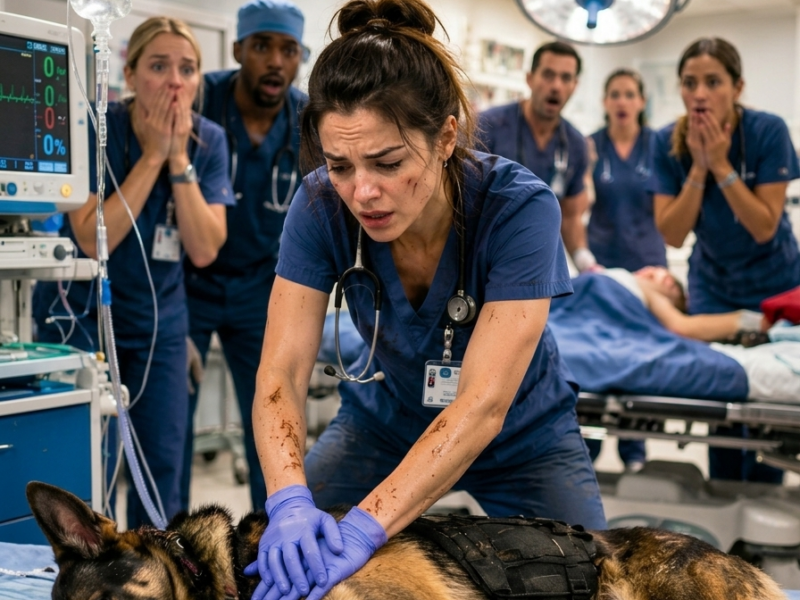
The entire emergency room laughed when the chief surgeon ordered me to leave after my service K9 collapsed beside a dying veteran, but the laughter died the moment I dropped to my knees
The fluorescent lights of Trauma Bay 1 buzzed with an unbearable, rhythmic hum that echoed the chaotic pounding in my chest. To everyone working the graveyard shift at St. Mary’s Hospital, I was just Emily Carter: a quiet, unassuming trauma nurse who worked seventy-hour weeks, took every holiday shift without complaint, and wore scrub tops two sizes too big to hide the faint line of burn scars creeping up my neck. For six years, I had built a fortress out of routine, silence, and cheap coffee. I was a ghost inhabiting a world of clean linen, intravenous bags, and quiet recovery rooms.
Until the automatic doors of the ambulance bay blew open with a violent rush of midnight cold air.
“Trauma incoming! Male, sixty-eight, severe penetrating thoracic trauma, profound hemorrhagic shock!” the paramedic screamed over the blare of sirens still echoing outside.
The stretcher hit the linoleum with a heavy metallic clatter. On it lay Thomas Walker, a decorated retired Marine whose weathered face was drained of all color, his chest rising in shallow, agonizing gasps. Beside him walked a young man in civilian clothes—broad-shouldered, rigid, with the distinct low-slung posture and hyper-vigilant gaze of an active-duty Navy SEAL on high alert.
At my side, Duke gave a sharp, sudden intake of breath.
Duke wasn’t just a hospital therapy animal. To the staff, he was the giant, calm German Shepherd who sat under my desk and offered quiet comfort to frightened pediatric patients. But to me, he was my last surviving teammate. He was the multi-purpose canine who had dragged my broken body through sixty yards of burning wreckage in the Hindu Kush while machine-gun fire chewed through the dirt around us.
Suddenly, Duke staggered. His heavy paws slid on the polished floor. A terrible, wet wheeze tore from his chest, and without a sound, his nine-pound frame collapsed hard onto his side right beside Thomas Walker’s stretcher. His dark eyes rolled back, and his back legs convulsed in violent, unnatural spasms.
“Duke!” The word tore from my throat before I could stop it. I dropped to my knees, throwing my clipboard aside. My hands slammed onto his broad ribcage, feeling for the faint, thready pulse at his femoral artery. It was erratic, failing, dropping dangerously fast. “No, no, no, boy, look at me!”
“What is going on here?”
The sharp, arrogant voice cut through the chaos. Dr. Richard Hayes, the Chief of Surgery, stepped into the bay, snapping on a pair of sterile gloves with a loud pop. He took one look at me on the floor, stepped directly over Duke’s tail, and sneered down at us.
“Carter, what are you doing on the ground? Get up. We have a critically unstable patient on the table, and you’re crying over a mutt. Get the central line tray now.”
“He’s not responding, Dr. Hayes,” I said, my voice shaking with an agonizing blend of panic and rising fury. “His airway is compromised. He’s going into acute anaphylactic or neurotoxic shock. I need an airway kit and atropine, right now!”
A couple of younger nurses halted in their tracks, looking nervously between me and the department head. Hayes let out a dry, condescending laugh that rang hollow against the sterile tile walls.
“Are you insane?” Hayes scoffed, gesturing broadly to the trauma bay where two technicians were desperately pumping air into Thomas Walker’s lungs. “This is an emergency room for human beings, not a veterinary clinic! The entire ER is watching you lose your mind over a dog. Leave the dog! Get out of the bay and do your job, or I will have security escort you out of this building and terminate your license by morning!”
A few junior residents chuckled nervously, eager to curry favor with the chief. The humiliation was meant to crush me, to bend me back into the obedient, invisible nurse I had pretended to be for six long years.
I didn’t blink. I didn’t get up.
Instead, I leaned down until my lips were inches from Duke’s twitching ear. The room, the noise, the condescending laughter—it all faded into background radiation. I closed my eyes, took a deep breath, and released the voice I had buried deep within my chest six years ago. I gave a single, quiet command in Pashto, layered with ancient military dialect—a specialized tactical verbal cue used exclusively by top-tier Tier-1 Joint Special Operations Task Forces.
“Kala-na-meya, sheryan-zma, tsht-da!” (Hold the line, my blood, stand firm!)
The sentence was low, guttural, and carried a chilling, undeniable weight of absolute command.
The laughter in the room died instantly. It didn’t just fade; it evaporated into a suffocating, dead silence.
In the far corner of the bay, the young, broad-shouldered man accompanying the Marine froze mid-step. His eyes widened in sheer, unadulterated terror. He slowly turned his head toward me, his gaze dropping from my face to the faint, jagged trident tattoo barely visible beneath the pushed-up sleeve of my navy blue scrub top.
His jaw went slack. He backed up a half-step, slamming his back against the crash cart, his breath catching sharply in his throat.
“Oh my God…” the young SEAL whispered, his voice trembling so violently it vibrated across the quiet room. “Oh my God… she’s one of them. She’s Commander Carter… the Phantom of Red Squadron…”
Hayes frowned, visible confusion breaking through his arrogant posture. “What are you talking about? She’s a floor nurse!”
I ignored Hayes entirely. My hands were planted firmly on Duke’s chest, applying precise, rhythmic cardiac compressions calibrated for a high-intensity working dog. “Nurse Sarah,” I snapped, my voice no longer that of Emily the timid nurse, but of Commander Emily Carter, former operative lead of Task Force Black. “Get me a 14-gauge needle and a 50cc syringe, now. Nurse John, draw 0.5 milligrams of epinephrine and bring the portable suction unit. Move!”
Sarah and John didn’t look at Dr. Hayes. They didn’t hesitate. The absolute authority radiating from my posture terrified them far more than any administrative threat from the Chief of Surgery. They bolted to execute the orders.
“You don’t give orders in my trauma bay!” Hayes roared, his face flushing deep crimson as he took a step toward me.
I stood up.
I didn’t raise my hands, but the moment I straightened my spine, my posture transformed completely. The hunch was gone. The soft, deflected eye contact was gone. I looked Dr. Hayes dead in the eyes with a gaze that had stared down warlords, corrupt politicians, and heavily armed insurgents across three continents.
“Then explain to the hospital board, the Department of Defense, and the media why you allowed a decorated military asset and a critical human patient to die because you were busy defending your fragile ego,” I said, my voice dropping to an icy, deadly whisper.
Hayes stepped back involuntarily, his mouth opening and closing like a landed fish.
I turned back to Duke. With surgical precision, I slid the large-gauge needle directly into his chest cavity, relieving the sudden tension pneumothorax that had begun building in his lungs. A long hiss of trapped air escaped the syringe. Duke gave a sudden, shuddering gasp. His dark eyes flickered open, finding mine, and his front legs stretched out as his chest began to rise and fall in a steady, natural rhythm.
“Good boy,” I whispered, pressing my forehead against his wet nose, my tears soaking into his dark fur. “Good boy. Stay with me.”
A heavy hand suddenly grabbed my wrist.
I turned instantly, my body automatically shifting into a defensive strike posture before I realized it was Thomas Walker, the dying Marine on the stretcher. His hands were covered in blood, but his grip was surprisingly fierce. He was staring at me with glassy, feverish eyes.
“Carter…” he rasped, coughing up a trickle of dark blood. “They… they found you…”
My stomach plummeted. “Who found me, Thomas? What happened to you?”
“They didn’t… come for me…” Thomas whispered, his breathing growing dangerously shallow as his heart monitor began to beep frantically. “They… they came… for the dog…”
“What?” I demanded, leaning in closer. “What are you talking about?”
With his last remaining strength, Thomas slid a crumpled, blood-stained manila envelope from inside his jacket into my hands.
Inside was a single high-resolution photograph. It showed Duke, standing beside a black military SUV in an unmarked hanger in Kabul—a photo taken three days before Operation Fallen Eagle, the disastrous ambush six years ago that had wiped out my entire six-man SEAL team, left me permanently scarred, and forced me into hiding.
On the back of the photograph, six words were written in bold, jagged black ink:
YOUR DOG KNOWS WHO KILLED YOUR TEAM.
Before I could process the cold dread flooding my veins, the phone in my pocket vibrated with a long, violent buzz. I pulled it out with trembling fingers. It was an unknown, encrypted number. A single text message sat on the screen:
WE KNOW YOU’RE BACK, COMMANDER. AND THIS TIME, WE WON’T MISS.
The silence that followed the text message was heavier than the air in an unventilated vault. The rhythmic beep-beep-beep of Thomas Walker’s heart monitor seemed to slow down, echoing like a death knell inside my head.
“Commander?”
The voice belonged to the young Navy SEAL standing near the crash cart. He stepped forward, his eyes glued to me with a mix of awe and deep, profound concern. He dropped his gaze respectably, bringing his right hand up into a crisp, sharp military salute right there in the middle of the trauma bay. “Petty Officer Second Class Lucas Vance, SEAL Team 2. Ma’am… we were told you died in the Kunar Province six years ago. We were told Task Force Black was entirely wiped out.”
“Put your hand down, Petty Officer,” I said quietly, my voice hollow as I thrust the envelope into my scrub pocket. “I’m not a Commander anymore. I’m just a nurse who works the night shift.”
“The hell you are!” Dr. Hayes interjected, his initial shock finally wearing off, replaced by an aggressive, red-faced outrage. “I don’t care what kind of secret military games you played in the past, Carter! You just breached four separate hospital protocols, commandeered medical supplies for an animal, and disrupted a critical trauma procedure! I am calling security right now, and I’m having you removed from this building in handcuffs!”
Hayes reached for the wall-mounted emergency intercom.
Before his finger could touch the button, Lucas Vance moved. In a blur of tactical muscle, the young SEAL grabbed Hayes by the collar of his pristine lab coat, slammed him against the stainless-steel supply cabinet, and pinned him there with an arm pressed hard against his windpipe.
“You touch that button, doctor,” Vance whispered, his voice dangerously low and lethal, “and I will personally ensure you spend the next six months eating your meals through a straw. You are speaking to a Navy Cross recipient who spent a decade hunting the worst monsters on this planet. Show some damn respect.”
“Vance! Let him go,” I ordered firmly.
Vance hesitated for a fraction of a second, then released Hayes, who stumbled backward, gasping for air and clutching his throat, his face pale with utter terror.
“Everyone out,” I commanded, turning to the rest of the medical staff. “Transfer Mr. Walker to ICU Bed 4 immediately. Put him on a continuous fentanyl drip and monitor his intracranial pressure. Nurse Sarah, take Duke to the private breakroom in the basement. Lock the door from the inside and do not open it for anyone except me.”
Sarah nodded rapidly, too frightened to argue. She gently unhooked Duke from the makeshift oxygen line. Duke, though still weak and unsteady on his legs, stood up on his own power, his eyes fixed on me, tail giving one low, loyal wag before he let Sarah lead him down the hallway.
I walked over to Thomas Walker’s bed. The old Marine’s eyes were fluttering shut as the sedatives took hold, but he reached out, his calloused fingers catching the hem of my shirt.
“The radio… in the truck…” Thomas choked out, his chest heaving. “Frequency 142.8… they’re… they’re listening, Emily… the betrayal… didn’t start in Kabul… it started… in Washington…”
His head fell back against the pillow, his breathing stabilizing into a deep, drug-induced sleep.
“What did he mean by that?” Vance asked, stepping up beside me, his hand resting on the concealed sidearm under his jacket. “Commander, what’s going on? Who sent that text?”
I pulled out my phone again, looking at the black screen and the ominous six-word message. Six years ago, Task Force Black was sent into a mountain valley near the Afghan-Pakistan border to recover a high-value intelligence asset. We were told it was a green-light mission, backed by top-level Pentagon authorization. But when we landed, we walked directly into an absolute meat grinder. Three of my team members—men I had trained, eaten with, and bled with—were executed within forty-five seconds of exiting the chopper.
I was shot twice, blown through a brick wall by an RPG, and left for dead. The only reason I survived was because Duke had grabbed my tactical vest by his teeth and dragged my unconscious body three miles through enemy-controlled territory until a rogue reconnaissance unit found us.
When I finally woke up in a secret field hospital two weeks later, I was told the mission had never officially existed. Task Force Black was erased from all records. We were labeled as rogues who had gone AWOL. I realized then that someone high up in the chain of command had deliberately set us up to be slaughtered to cover up a massive intelligence leak.
I had spent six years hiding in plain sight, assuming the ghosts of my past were buried in the dirt of Kunar.
I was wrong. They hadn’t just found me; they had been watching me.
“Vance,” I said, my voice turning to steel as I looked at the young SEAL. “Where is Thomas Walker’s vehicle?”
“Parked in the lower parking garage, Level B2,” Vance replied instantly. “He drove us here himself after he started coughing up blood at the safehouse.”
“Show me,” I said.
We moved quickly, avoiding the main elevators and taking the heavy concrete stairwell down to the dark, cavernous depths of the hospital basement. The air grew colder with every flight of stairs we descended, smelling faintly of damp concrete, exhaust fumes, and old engine oil.
Level B2 was dimly lit, most of the overhead fluorescent tubes flickering or completely burnt out. Shadows stretched long across the lines of parked vehicles.
“Over there,” Vance pointed toward a battered, dark blue Ford F-150 parked in a far corner, hidden behind a massive concrete support pillar.
We approached the truck cautiously. My heart was pounding against my ribs like a trapped bird, but my mind was ice-cold, entering the razor-sharp tactical focus that I thought had died six years ago. I scanned the dark windows, the space beneath the chassis, and the surrounding pillars.
“Clear,” Vance murmured, drawing a sleek Glock 19 from his holster and holding it at low-ready.
I walked up to the driver’s side door. The window was slightly cracked. Leaning inside, I looked at the dashboard. The radio dial was set precisely to frequency 142.8.
I reached through the crack, turned the key to the accessory position, and flipped the radio receiver on.
At first, there was only static—a high-pitched, white-noise hum that echoed softly in the quiet garage. Then, a low, mechanical click sounded through the speakers, followed by the faint, distinct sound of heavy breathing.
“I knew you couldn’t resist checking the radio, Commander,” a voice rasped through the speaker. It was heavily distorted through a voice-scrambler, sounding like dry leaves rustling over metal. “Six years is a long time to play house in a hospital. You almost looked like a real civilian.”
“Who is this?” I demanded, my hands clenching into tight fists at my sides.
“Someone who thought they burned all the trash in Kunar,” the voice chuckled softly—a cold, heartless sound that sent a shiver down my spine. “Your dog was never meant to leave that valley, Emily. He carries something inside his microchip that doesn’t belong to you. Something that could tear down four three-star generals and a Deputy Director of National Intelligence.”
My eyes widened. The medical microchip.
When Duke was assigned to my unit, he was fitted with an experimental military-grade biometric and location tracker implanted near his shoulder blade. I had assumed it was deactivated after the mission was scrubbed.
“You set up my team,” I whispered, the rage rising in my throat like hot acid. “You killed Mark, David, and Jackson.”
“They were collateral damage in a much larger transaction,” the voice replied casually. “And now, you have ten minutes to bring that dog to the roof of St. Mary’s Hospital. Come alone, or we start turning off the power to the Intensive Care Unit. Let’s see how many of your human patients survive when the ventilators stop working.”
The line went dead with a loud, absolute click.
The static humming from the truck’s speakers sounded like an execution sentence.
“Commander…” Vance swallowed hard, his face pale under the harsh yellow lights of the parking garage. “What do we do? Should I call in backup from the local precinct? I have contacts at SEAL Team 2—”
“No,” I cut him off sharply, my mind racing through tactical schematics and layout maps of St. Mary’s Hospital. “Local police will just create a perimeter, give them hostages, and turn this into a slaughterhouse. If these people have the authority to pull off an ambush in Afghanistan and scrub Task Force Black from Department of Defense servers, they likely have people inside local law enforcement. We handle this ourselves.”
“Just the two of us?” Vance asked, a nervous bead of sweat rolling down his temple.
“Three of us,” I corrected him, looking back toward the concrete stairwell.
Five minutes later, we were standing in the locked basement breakroom. Duke was resting on a blanket in the corner, but the moment I stepped through the door, he stood up. His tail gave a single, firm wag, and his ears pinned back in absolute readiness. The lethargy from the neurotoxin had receded; the adrenaline was coursing through his veins just as it was in mine.
I knelt beside him, placing my hand over his left shoulder blade. Feeling carefully through his thick coat, I pressed down on the firm skin above his scapula. Right there, buried beneath a pale surgical scar, was a hard, coin-sized lump. It wasn’t a standard pet microchip. It was a hardened, military-spec encrypted storage drive—implanted under the guise of biometric telemetry during our final deployment.
“They didn’t just want us dead,” I whispered, looking at Duke’s bright, intelligent eyes. “They used you as a black box.”
I walked over to the emergency supply locker in the corner of the breakroom. Using a heavy pair of trauma shears, I snapped the padlock. Inside were emergency tactical supplies left behind by the hospital’s security detail—heavy-duty flashlights, zip-ties, high-decibel emergency alarms, and a pair of tactical radios.
From my own locker in the nurse’s lounge, I retrieved a locked metal case I hadn’t opened in six years. Inside lay my old service weapon—a custom SIG Sauer P226 with a tritium night sight and three fully loaded magazines, wrapped in oiled cloth.
Vance watched in silence as I checked the action, slapped a magazine into the magwell, and racked the slide with a crisp, metallic clack. The sound was as familiar to me as the beat of my own heart.
“You kept your sidearm?” Vance asked softly.
“Old habits,” I said, tucking the weapon into the waistband of my scrubs and covering it with a dark navy fleece jacket. “Vance, here’s the plan. The tactical team targeting us expects a broken, retired veteran who’s going to blindly follow orders to protect her hospital. They think they hold all the cards because they threatened the power grid.”
“How are they going to cut the power?” Vance frowned. “The main transformer sub-station is on the ground level, behind locked doors.”
“They’ve already infiltrated the building,” I replied grimly. “They wouldn’t make a threat like that unless they had a man on the inside controlling the basement circuit breakers. That’s your objective.”
“Me?” Vance blinked. “What about you?”
“I’m taking Duke to the roof,” I said, looking him dead in the eyes. “I’m going to draw their primary strike team into the open. You find the operative in the electrical room, neutralize him, and secure the emergency generators. Once the building is safe, you get Thomas Walker out of ICU.”
“Commander, that’s a suicide run,” Vance argued, stepping forward. “If they have a full strike team on the roof, you’re walking into a fatal funnel!”
“I’ve been in fatal funnels my entire life, Petty Officer,” I said, slipping a high-intensity tactical flashlight into my pocket. “And I don’t intend to die tonight.”
I turned to Duke. “Kala-na-meya,” I whispered in Pashto. He immediately fell into a perfectly heel-aligned posture at my left side, his dark eyes locked on the door, his chest vibrating with a low, silent growl.
We split up at the main service corridor. Vance took the stairwell down toward the sub-basement electrical vaults, while Duke and I took the secondary maintenance elevator to the top floor.
The elevator climbed slowly, the floor indicators ticking up with an agonizing, mechanical clunk. 4… 5… 6… 7… 8.
When the doors slid open on the 8th floor, the hallway leading to the roof access door was completely dark. The emergency lights were flickering, casting long, eerie shadows down the narrow concrete corridor. The air smelled of cold rain and industrial grease.
Duke nudged my knee, his nose lifting toward the ceiling. His ears were locked forward, rigid as steel.
Hostiles ahead.
I pulled my P226 from my waist, keeping it at a low-ready position, thumbs indexed along the frame. I stepped quietly down the corridor, my rubber-soled nursing shoes making zero sound against the concrete. Duke walked in exact synchronization with my footsteps, his claws retracted slightly, moving like a phantom.
We reached the heavy steel door labeled ROOF ACCESS – AUTHORIZED PERSONNEL ONLY.
The door was slightly ajar, resting on a heavy rubber doorstop. Outside, the rain was coming down in a relentless, icy sheet, howling through the metal scaffolding of the rooftop HVAC units.
I leaned close to the crack, peering through the darkness.
Stationed across the wide, rain-slicked gravel roof were four figures. They weren’t common criminals or low-level thugs. They moved with strict military discipline—wearing dark, unmarked tactical gear, night-vision goggles, and suppressed short-barreled carbines held in high-ready positions.
Standing in the center of the roof, shielded from the rain beneath an overhang, was a tall man in an expensive tailored coat, holding a satellite phone to his ear.
Even through the darkness and the rain, I recognized the silhouette immediately.
It was Colonel Arthur Vance—no relation to Lucas—the former logistics chief of Joint Special Operations Command in Kabul. The man who had personally briefed Task Force Black before our final, doomed deployment.
“Are the perimeter teams in place?” Colonel Vance said into his phone, his voice cold and arrogant. “Once the nurse brings the dog, eliminate both of them. We burn the body in the incinerator downstairs and dump the animal in the bay. Make sure nothing ties this back to the Department.”
My blood ran like liquid ice.
I looked down at Duke. I raised my hand, giving him three distinct hand signals: Flank right. Silent approach. Hold until my breach.
Duke didn’t hesitate. He melted into the shadows near the base of the door, sliding through the small crack with silent, terrifying efficiency, disappearing into the dark rain on the roof.
I stepped out onto the roof, bringing my weapon up, the tritium night sights glowing faint green against the backdrop of the storm.
“Colonel Vance!” I shouted over the roar of the wind and rain.
The four tactical operatives snapped their weapons toward me instantly. Red laser sights danced across my chest and forehead like a swarm of angry hornets.
Colonel Vance slowly lowered his satellite phone, turning to face me with a sickening, triumphant smile.
“Emily Carter,” Vance sneered, taking a step toward me. “Look at you. From the grand hero of Task Force Black to a pathetic little nurse scrubbing floors. You should have stayed dead in Afghanistan, Emily.”
“Where is the rest of your team, Arthur?” I asked, my voice deadly steady despite four laser sights fixed on my body. “You brought four men to kill a nurse? You’re losing your touch.”
“I brought enough men to ensure history doesn’t repeat itself,” Vance sneered. “Now, hand over the dog and the microchip, and maybe I’ll let you jump off this roof instead of putting a bullet in your spine.”
I smiled—a cold, terrifying expression that made Vance’s smile instantly vanish.
“You forgot one thing, Colonel,” I said softly.
“What’s that?”
“You didn’t check the perimeter.”
I snapped my fingers twice.
From the dark shadow of a massive industrial HVAC unit, a ninety-pound streak of fur, teeth, and muscle exploded into the night.
Duke lunged through the freezing rain, closing a twenty-foot gap in less than two seconds. He slammed his full body weight into the chest of the lead tactical operative on the left. The man let out a choked scream as Duke’s jaws locked onto his tactical vest arm-hole, dragging him off his feet and slamming his head violently against the iron support frame of the air handler. The operative’s rifle skittered uselessly across the wet gravel.
“Tango left! Open fire!” Vance screamed, his calm demeanor instantly shattering into sheer panic.
Before the remaining three operatives could adjust their aim, I fired.
DOUBLE TAP.
The deafening cracks of my unsuppressed SIG Sauer P226 shattered the night storm. Two 9mm rounds punched clean through the chest plate of the operative on the right, dropping him instantly to his knees before he collapsed onto the soaked gravel.
I didn’t stop moving. The moment I pulled the trigger, I dove to my right, sliding behind a heavy concrete elevator housing just as a hail of suppressed 5.56mm rounds tore through the air where I had been standing, spraying sharp concrete splinters into the rain.
“Kill her! Kill the dog!” Vance roared, retreating toward the door leading back into the building.
Over the roaring wind, I heard the heavy thud of Duke clearing another obstacle. A second operative let out a agonizing yell as Duke dragged him down by the leg, thrashing with ferocious, relentless force.
I rounded the concrete corner at a low crouch, acquiring the third operative in my night sights. He was frantically trying to aim at Duke.
CRACK. CRACK.
My shots were precise, lethal, and absolute. The third man went limp, falling backward into the pooling rainwater.
That left one operative standing beside Colonel Vance. The operative swung his weapon toward me, but before he could squeeze the trigger, a loud metallic explosion echoed from the stairwell door behind him.
The heavy steel door blew open with violent force.
Petty Officer Lucas Vance burst onto the roof, covered in sweat and water, wielding a tactical shotgun he had taken from the basement operative.
“DROP YOUR WEAPON!” Lucas bellowed over the storm.
The final operative froze, caught in a deadly crossfire between my P226 and Lucas’s shotgun, with a snarling, blood-stained German Shepherd crouched five feet away, ready to tear his throat out.
The operative slowly dropped his carbine to the ground and raised his hands into the air.
Colonel Vance backed away, his face pale as chalk, his slicked-back hair plastering against his forehead in the pouring rain. He reached into his coat pocket, his hand trembling uncontrollably.
“Don’t do it, Arthur,” I said, stepping forward out of the darkness, the rain washing the dirt from my face. My gun was locked dead on his forehead. “You move that hand an inch, and I’ll end this right here.”
Vance stopped, his fingers freezing inside his pocket. He looked at me, then at Lucas, and finally down at Duke, who was standing beside me, his fur dripping with rain, his dark eyes glowing with an ancient, untamed fury.
“You think this changes anything, Emily?” Vance spat, coughing violently into the wind. “You think you can just bring down the men behind this? I’m a small piece of a very large machine! The men who ordered the hit in Kunar are sitting in air-conditioned offices in Langley and the Pentagon! They have infinite resources! You’re just a broken soldier with a dog!”
“You’re right,” I said quietly, stepping right up to him until the cold steel barrel of my P226 was resting directly against his sternum. “I am a broken soldier. And that makes me the most dangerous thing you will ever face. Because I have nothing left to lose.”
I reached into his coat pocket and pulled out his hand—he was clutching an encrypted data drive designed to wipe remote servers. I shoved him hard against the brick wall, pulling a pair of heavy flex-cuffs from my jacket and snapping them around his wrists with brutal efficiency.
“Lucas,” I called out over the wind.
“Ma’am!” Lucas responded, standing at attention despite the chaos around us.
“Is the basement clear?”
“Sub-basement operative neutralized, Commander. The electrical grid is secure, and I’ve already notified a clean tactical team from SEAL Team 2’s quick reaction force. They’re ten minutes out, using an off-grid secure channel. No corrupt local channels.”
“Good,” I nodded.
I knelt down on the wet roof, unzipping my fleece jacket. Duke immediately stepped into my space, pressing his wet snout firm against my cheek. I wrapped my arms around his broad neck, burying my face in his thick, wet fur as the adrenaline finally began to ebb, leaving my muscles trembling with sheer exhaustion.
“We did it, boy,” I whispered into his ear. “We finished the mission.”
Duke gave a soft, deep huff against my neck, his tail thumping against the gravel roof.
Ten minutes later, the dark sky above St. Mary’s Hospital was filled with the heavy, rhythmic thump-thump-thump of incoming MH-60 Black Hawk helicopters. Dark, unmarked shapes descended through the rain clouds, searchlights cutting through the mist as full tactical squads poured down fast-ropes onto the roof, securing the perimeter and taking Vance and his surviving operatives into federal custody.
I stood near the roof access door, watching the tactical teams work with mechanical efficiency.
Dr. Richard Hayes had stumbled onto the roof behind the military personnel, his lab coat drenched, his eyes wide with utter shock and disbelief as he watched black-ops military units taking orders from the nurse he had tried to fire three hours ago.
He looked at me, his jaw trembling, unable to utter a single word.
I didn’t say a word to him either. I simply wiped the rain from my face, turned my back on him, and walked down the stairs with Duke heel-aligned at my side.
Two days later.
The morning sun broke over the rolling green hills of northern Virginia, casting a bright, golden light across the quiet courtyard of a secure military medical facility near Fort Meade. The air was crisp, smelling of morning pine and fresh earth.
I sat on a wooden bench in the sun, dressed in clean, comfortable civilian clothes—a dark jacket and jeans. Beside me, Duke lay stretches out in the grass, resting his chin on his front paws, soaking in the warm sunlight. The surgical scar on his shoulder was neatly bandaged, where military surgeons had carefully extracted the encrypted microchip under my direct supervision.
The data on that chip was catastrophic.
It contained complete audio logs, financial transaction records, and classified communication transcripts proving that Colonel Vance and a network of high-ranking military officials had been selling military intelligence to foreign syndicates—and had deliberately orchestrated the destruction of Task Force Black to cover their tracks. Within forty-eight hours of the chip’s extraction, federal warrants were executed across three states. Arrests were made at the highest levels of government.
The ghosts of Kunar were finally laid to rest.
The heavy glass doors of the courtyard opened, and two figures walked out toward the bench.
The first was Thomas Walker. He was walking slowly, using a wooden cane, but his color had returned, and his eyes were bright and clear. Beside him walked Petty Officer Lucas Vance, dressed in his crisp Navy Service Dress Blue uniform.
“Commander,” Thomas said, stopping in front of the bench and giving me a warm, genuine smile. “Or should I call you Nurse Emily?”
“Emily is fine, Thomas,” I smiled, standing up to shake his hand. “How’s the chest feeling?”
“Like I got hit by an F-15,” Thomas chuckled softly, reaching down to pat Duke’s broad head. Duke thumped his tail lazy against the grass. “But the doctors say I’ll make a full recovery. Thanks to you. And this legend right here.”
“You saved my life, Thomas,” I said quietly. “If you hadn’t brought that photo and passed that frequency, we never would have seen them coming.”
“We protect our own, Commander,” Thomas said softly. “Always have. Always will.”
Lucas stepped forward, taking a crisp white envelope from his inner jacket pocket and handing it to me.
“What’s this?” I asked, looking at the heavy gold seal of the Department of the Navy stamped on the front.
“Orders straight from the Secretary of the Navy and the Commander of Naval Special Warfare,” Lucas replied, his voice filled with deep pride. “Your service record has been completely restored, Commander. Full back-pay, full restoration of rank, and a personal commendation from the President. Task Force Black’s true history is being entered into the official archives today.”
I held the envelope in my hands, feeling the weight of the paper. For six years, I had believed my identity was gone forever—that I was condemned to live in the shadows, hiding from a lie created by corrupt men.
“There’s more,” Lucas added, a small grin breaking across his face. “The Department is establishing a new joint canine-tactical research and training unit at Dam Neck. They want you to lead it, Commander. Full authority to design the program from the ground up.”
I looked down at the envelope, then at Thomas, and finally at Duke.
Duke stood up, brushing against my leg, lifting his head to look up at me with those bright, intelligent eyes that had seen me through the darkest nights of my life. He didn’t look like a weapon or a military asset. He looked like my partner. My family.
I slowly slid the envelope into my jacket pocket.
“Tell the Secretary I appreciate the offer,” I said softly, a genuine sense of peace washing over me for the first time in six years. “But my time in the shadows is over.”
Lucas looked surprised. “You’re declining the command, ma’am?”
“I’m not leaving the fight, Petty Officer,” I smiled, reaching down to hook Duke’s leash onto his collar. “I’m just choosing a different battlefield. The emergency room at St. Mary’s needs a good trauma nurse. And the patients there need a good dog.”
Thomas let out a rich, booming laugh that echoed across the sunny courtyard. “Dr. Hayes is going to have a heart attack when he sees you walk back through those doors.”
“Dr. Hayes submitted his resignation yesterday morning,” Lucas noted with a smirk. “Apparent sudden career change.”
We all laughed—a light, warm sound that dissolved the lingering shadows of the past six years.
I turned and walked toward the facility exit, the crisp autumn wind carrying the fallen leaves across the path. Duke walked right at my side, his shoulder gently pressing against my leg, his tail held high.
I had entered St. Mary’s Hospital six years ago as a broken phantom hiding from her past.
Today, I was walking back into the world as Commander Emily Carter—not because I wore a uniform or carried a weapon, but because I had fought for the truth, saved the ones I loved, and finally found my way back home.
Beside me, Duke gave a soft, happy bark that echoed into the clear blue sky.
The end.









