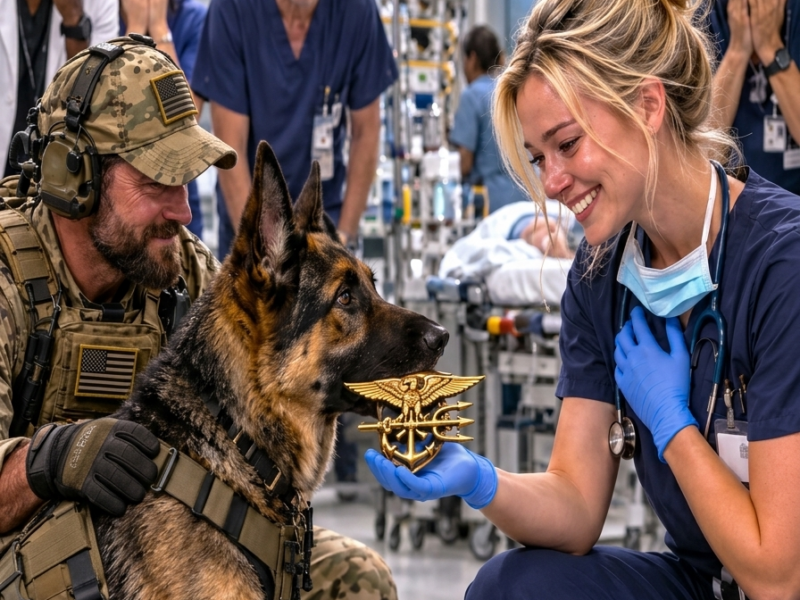
The entire emergency room laughed when a battle-scarred K9 suddenly broke away from two Navy SEALs and dropped a faded insignia at the feet of the quiet new nurse
The emergency room at Norfolk General Hospital was usually chaotic, but on that damp Tuesday afternoon, it had degenerated into a pressure cooker. An offshore training exercise involving a Navy SEAL team had gone sideways three miles off the coast of Virginia. Ambulances were backing into the bay with lights flashing, paramedics were shouting over the roar of engines, and the sterile tile floors were already marked with dark, smeared boot prints.
I stood at the central triage desk, quietly stocking supply carts and updating patient intake boards. I was three days into my new job, still learning where the trauma kits were kept, and most of the senior nursing staff barely remembered my name. To them, I was just Emily Carter: the reserved, pale nurse who spoke in a soft, measured cadence, avoided the breakroom gossip, and never offered a single detail about her life before arriving in Norfolk.
“Emily, move those saline crates to Bay 4,” the charge nurse, Brenda, snapped as she brushed past me with a handful of blood tubes. “And try to move a little faster. This isn’t a walk in the park.”
“Yes, ma’am,” I whispered, keeping my eyes fixed on the floor.
I was used to being invisible. In fact, I had spent three excruciating years perfecting the art of invisibility. I wore oversized scrubs that hid the thick, jagged surgical scars running up my left shoulder and collarbone. I wore my dark hair pulled tightly back into a plain bun, and I kept my chin tucked down whenever active-duty military personnel passed through the doors. Norfolk was a navy town, saturated with uniforms, brass, and tactical gear. Every time I heard the thump of combat boots, my stomach clenched into a tight, icy knot. But I needed a quiet job, a modest paycheck, and a place where no one looked closely at old records.
Then the automatic double doors of the ambulance bay burst open with a heavy pneumatic hiss.
“Clear the corridor! Make room!” a harsh, breathless voice shouted.
Two Navy SEALs in wet, saltwater-soaked utility fatigues surged through the entryway. They were supporting a stretcher between them, but what immediately caught the attention of everyone in the ER was the massive creature flanking their left side. It was a Belgian Malinois-German Shepherd cross wearing a frayed, faded tactical harness with heavy iron D-rings.
The dog was covered in mud and sea foam, his chest heaving violently with ragged breaths. He wasn’t on a standard leash; the younger SEAL had a heavy lead wrapped three times around his gloved hand, trying desperately to control the animal’s powerful, erratic movements.
“Get a trauma team to Bay 1!” the older SEAL bellowed, his face streaked with sweat and carbon scoring. “We’ve got two hypothermic divers and a blast-concussion casualty coming behind us!”
A few junior nurses rushed forward with gurneys, but as the crowd surged toward the entrance, the massive war dog suddenly halted in his tracks. His ears pricked straight up. His dark, intelligent eyes scanned the frantic room, passing over the doctors, the paramedics, and the security guards, until his gaze locked directly onto me.
“Ranger, heel!” the younger operator barked, jerking the lead tension tight. “Ranger, pull it together!”
The dog ignored the command entirely. A low, desperate whine escaped his chest—a sound so filled with raw, human-like longing that it cut straight through the blare of heart monitors and shouted orders.
Before anyone could react, Ranger lunged. He tore the heavy leather lead straight out of the younger SEAL’s gloved grip with a violent snap.
“Watch out!” a paramedic screamed.
Women shrieked and several doctors scrambled backward, mistaking the animal’s sudden surge for an attack. The dog bounded across the slick linoleum floor, his claws clicking like frantic gunfire. He didn’t slow down as he reached the triage desk. He pulled up inches from my white clinical shoes, dropped his front shoulders low to the floor, and lowered his dark snout until his whiskers brushed the top of my foot.
The entire emergency room went dead silent.
Ranger’s mouth opened slightly, and something small, metallic, and heavy slipped from his jaws, landing on the floor with a soft, distinct clink.
It was a worn, tarnished Trident—the elite insignia of the Navy SEALs. The silver finish was chipped at the edges, and across the eagle’s left wing was a deep, jagged diagonal scratch.
My breath caught in my chest. The world around me seemed to tilt, the noise of the hospital dissolving into a terrifying, hollow roar. My hands went deathly cold. I recognized that scratch because three years ago, sitting in the cramped, metal hull of an insertion craft under a pitch-black Balkan sky, I had carved that mark myself using the serrated edge of a combat knife.
“Ranger! Heel, damn it!” the younger SEAL yelled, striding forward with his hand reaching for the dog’s tactical harness.
The moment the operator’s fingers neared his collar, Ranger spun his head and let out a guttural, earth-shaking growl that echoed off the high ceiling. His upper lip pulled back, exposing sharp, terrifying white canines. The young SEAL froze, taking an involuntary step back, his hands raised in shock.
“What the hell is wrong with him?” the operator muttered. “He’s never snapped at a teammate.”
Ranger didn’t attack. Instead, he swung his massive body around, pressing his wet, trembling flanks firmly against my knees. He leaned into me with all his weight, positioning himself like a living shield between me and the rest of the room. He raised his head, looking straight up into my eyes, his dark tail striking the floor once, twice, in a heavy, tentative rhythm.
Nurse Brenda stepped forward, her face flushed with anger and confusion as she stared at me. “Emily! What on earth did you do? Why is that animal acting like that?”
I stood frozen, incapable of speaking. My mind was spinning through a whirlwind of fire, smoke, and screaming metal.
Because Ranger wasn’t supposed to be alive.
Three years ago, during a covert intelligence extraction operation deep within a non-permissible zone in Eastern Europe—an operation that officially never existed—I hadn’t been Nurse Emily Carter. I had been Lieutenant Emily Carter, an embedded operational medic attached to a Special Warfare Development Group unit. Ranger had been our point tracking dog, a fearless animal who could smell explosive residue and hidden tripwires from fifty yards away.
When our extraction compound was betrayed and hit by heavy mortar fire, the structure had begun to collapse around us. I remembered the blinding flash, the suffocating cloud of concrete dust, and the heat that scorched my skin. I remembered pushing Ranger’s bleeding body through a narrow drainage gap in the rear foundation wall just seconds before the reinforced ceiling caved in.
I had been buried beneath three tons of rubble. The official military report, compiled by higher command, listed my entire unit as compromised, and listed me as Missing in Action, Presumed Dead.
I had survived—rescued weeks later by a clandestine partisan network, rebuilt through four agonizing, unregistered surgeries in private clinics, and haunted by the knowledge that our team had been walked straight into a kill box by someone on the inside. When I finally made it back to American soil, battered and broken, I discovered my service records had been sealed, my identity erased, and my existence quietly swept into the dark drawers of military intelligence.
Exhausted, terrified, and hunted by shadows, I had walked away. I changed my name, took my mother’s maiden identity, and buried Lieutenant Carter six feet deep in my memory.
Until now.
Ranger let out another low, trembling whine. He raised his snout and gently nudged my hand, resting the cold tip of his nose against my palm.
Slowly, almost mechanically, I sank to my knees on the cold floor. Tears blurred my vision as I reached out with trembling fingers, brushing aside the thick, coarse fur beneath his left ear. There, concealed by his hair, was the star-shaped entry scar from a shrapnel fragment I had sutured by torchlight in a mud-filled trench three years ago.
“Hey, buddy…” I whispered, my voice breaking on the second word. “Hey, sweet boy…”
Ranger let out a long, shuddering breath, pressing his face into the crook of my neck, licking the tears as they ran down my cheek.
The older SEAL walked over slowly, his combat boots thudding against the floor. He stopped three feet away, his bloodshot eyes staring down at me with an expression of profound, terrifying shock. His face drained of every drop of color.
“Ma’am…” the senior operator said, his voice dropping into a raspy whisper that cut through the silence of the room. “How do you know that dog? Ranger hasn’t let anyone touch him since Operation Iron Veil.”
I slowly picked up the tarnished silver Trident from the floor, my thumb running over the jagged scratch on the eagle’s wing. I looked up into the operator’s weathered, scarred face.
“Because I brought him home,” I said quietly, “from a mission none of you were ever supposed to remember.”
The silence in the emergency hallway was absolute.
Doctors who had been charging toward the bay stood frozen with medical charts in their hands. Nurse Brenda opened her mouth to say something, but the sheer, deadly gravity hanging in the air made her shut it instantly.
The older SEAL took another step closer, his eyes narrowing as he scrutinized every detail of my face. He took in the subtle shape of my jaw, the deep line of a surgical scar running behind my ear, and the steady, unbreakable gaze that only comes from someone who has looked into the abyss of a war zone.
“My God…” the commander whispered, his hand trembling slightly as he reached toward his vest. “Lieutenant… Lieutenant Carter?”
“Don’t call me that,” I said sharply, my voice dropping an octave. “That rank died three years ago in a collapsed cellar in Kosovo.”
The younger SEAL looked between his commander and me, his eyes wide with utter bewilderment. “Captain Hayes… what is going on? Who is she? The file on Iron Veil said the medic was killed when the compound collapsed.”
“We were told you died saving the team, Lieutenant,” Captain Hayes said, ignoring his junior operator entirely. He looked down at me with a mix of awe and profound guilt. “We were told the secondary explosion vaporized the basement level. Command issued death certificates for the whole vanguard element.”
“I was told the same thing about the rest of the team,” I replied coldly, rising to my feet. Ranger immediately stood beside me, his shoulder pressed firmly against my hip, his dark eyes guarding the hallway. “I was told no one got out. I was told the extraction team was wiped out forty seconds after the mortar strike.”
Hayes swallowed hard, his jaw clenching tightly. “What do you mean? We were extracted. But the orders came from top brass to treat the entire deployment as a classified zero-trace event. When we got back to base, your name was already wiped from the roster. They told us you didn’t make it out of the rubble.”
“Someone lied to you, Captain,” I said, my heart hammering against my ribs like a trapped bird. “And someone spent three years making sure I stayed dead.”
Before Hayes could ask another question, Ranger’s body suddenly went rigid.
The dog didn’t just growl—he let out a sharp, violent bark that tore through the hospital, his ears pinning flat back against his skull. He whirled toward the glass double doors leading out to the ambulance bay, his rear legs coiling like steel springs. He pulled against his harness so forcefully that he dragged me half a foot across the slick floor before I caught my balance.
“Ranger! Quiet!” Hayes commanded, but the dog was beyond hearing. He was snarling, his hackles raised in a stiff ridge down his back, staring intently through the double glass doors.
Outside in the overcast afternoon light, a heavy black SUV with dark tinted windows pulled to a quiet stop right in the red emergency lane.
The driver’s door opened, and a tall, broad-shouldered man in a charcoal-gray civilian suit stepped out onto the damp pavement. He had short, iron-gray hair, a sharp, angular jaw, and carried himself with the rigid, unmistakable posture of a senior military officer. In his right hand, he carried an old, scuffed olive-drab tactical duffel bag with reinforced brass zippers.
My blood turned to pure ice.
I knew that duffel bag. I had packed it myself three years ago. It contained the hard-drive backups of our unit’s tactical communications, our field logs, and the classified biometric files of the high-value target we had been sent to extract. I had watched that very bag disappear into the flames of the burning compound when our commanding officer took it into the upper staging area just minutes before the mortar strike.
The man in the suit raised his head, staring directly through the clear hospital glass doors.
It was Colonel Richard Vance.
He had been our operational commander during Iron Veil—the man who had given the green light for our team to enter the compound, the man who had monitored our radios from the tactical operations center, and the man whose signature appeared on my official casualty report.
The older SEAL, Captain Hayes, followed my line of sight. His brow furrowed in confusion. “Is that… Colonel Vance? What is he doing in Norfolk?”
I couldn’t breathe. I couldn’t move. The world seemed to narrow down to the glass doors separating me from the ghost who had destroyed my life.
Colonel Vance stood beside the open door of his SUV, his cold blue eyes locking onto mine through the glass. He didn’t look surprised to see me standing there in nurse’s scrubs. He didn’t look shocked that Lieutenant Emily Carter was alive.
Instead, his expression remained perfectly calm, utterly devoid of emotion. Slowly, deliberately, Vance raised his right hand, lifted a single index finger to his lips, and made a silent, chilling motion.
Shh.
It was a warning. A lethal, absolute promise of silence.
Ranger let out a deafening bark, slamming his front paws against the glass door, leaving smeared prints on the clean surface.
Vance didn’t flinch. He casually tossed the olive-drab duffel bag back into the rear seat of the SUV, turned around, and climbed back into the driver’s seat. The black vehicle accelerated smoothly out of the ambulance bay, disappearing into the gray Virginia rain.
“Lieutenant,” Captain Hayes said, stepping in front of me, his hand resting instinctively on the side of his tactical belt. “What is Vance doing with your unit’s old gear? What happened on that mission?”
I pulled my gaze away from the empty driveway, looking down at the silver Trident resting in my hand, then at the war dog who had sacrificed everything to protect me.
“That mission wasn’t an intelligence extraction, Captain,” I whispered, my voice trembling with cold, focused rage. “It was an ambush designed to eliminate our unit. We discovered that Vance was selling advanced tactical tracking algorithms to private defense contractors. He didn’t leave us behind because of an unexpected mortar strike. He fired those mortars himself to cover his tracks.”
Hayes’s face turned pale, his jaw dropping in shock. “That’s… that’s treason. He’s a decorated three-star intelligence director.”
“And he just realized that his dead medic is standing in the middle of Norfolk General Hospital,” I said, looking up into Hayes’s eyes. “He didn’t come here to check on wounded divers, Captain. He came here to confirm a sighting. And now that he knows I’m alive… he’s not going to stop until he finishes what he started three years ago.”
Within ten minutes, the atmosphere inside the emergency room shifted from medical chaos to a quiet, high-stakes military lockdown.
Captain Hayes acted with lethal efficiency. He used his command authority to clear out Trauma Bay 1, ordering his junior operator, Sergeant Miller, to guard the curtained entryway with Ranger at his side. Nurse Brenda and the civilian staff were quietly ordered to clear the hallway, confused and terrified by the sudden military presence, but too intimidated by Hayes’s uniform to ask questions.
Inside Trauma Bay 1, the air was cold and heavy with the smell of antiseptic and wet tactical gear. I sat on the edge of a stainless-steel examination table, wrapping a strip of white athletic tape around my knuckles to keep my hands from shaking. Ranger sat right between my feet, his heavy head resting on my knee, his dark eyes never leaving the curtained entrance.
“We need to get you out of here right now, Lieutenant,” Hayes said, pacing back and forth across the small bay, his satellite phone held in his right hand. “If Vance knows you’re alive and in this facility, he can have a federal team or a private security contractors here in fifteen minutes under the guise of an official military detainment.”
“I’m not running again, Captain,” I said, my voice quiet but hard as iron. “I spent three years hiding in the shadows, jumping every time a black car drove down my street. I buried my career, my name, and my life because I thought I was the only survivor. But if Vance is here, and if he still has that duffel bag, it means the evidence is still intact.”
“What evidence?” Sergeant Miller asked from the doorway, keeping his hand near his holstered sidearm.
I looked at Hayes. “Before the compound collapsed, I managed to pull the encrypted master drive out of the central server stack in the cellar. I knew we were being betrayed because the mortar coordinates were coming from our own tactical frequency. I hid that drive inside the lining of my tactical vest.”
Hayes froze, staring at me. “Your vest? Where is it?”
“It was taken off me by the partisan medical team that pulled me out of the rubble,” I explained. “When I was healthy enough to travel, I buried the vest and the drive in a waterproof case inside a private storage locker near the naval shipyards—less than four miles from this hospital. I didn’t dare retrieve it back then because every military database was monitored. But that drive contains the raw telemetry files showing Vance’s personal clearance code authorizing the mortar strike on our own team.”
Hayes let out a low curse, dragging his hand across his face. “My God… if that drive gets to the Naval Criminal Investigative Service or the Senate Intelligence Committee, Vance won’t just go to prison; he’ll face execution for high treason.”
“Which is exactly why he’ll kill anyone in this hospital to get to me first,” I replied.
Suddenly, the overhead fluorescent lights in the trauma bay flickered twice, then died completely, plunging the entire hospital wing into murky, shadow-filled twilight. A second later, the deep, mechanical hum of the main ventilation system ground to a halt.
Out in the main hallway, emergency red backup lights kicked on with a dull, eerie glow.
“Hostile action,” Sergeant Miller barked, instantly drawing his suppressed Sig Sauer pistol from his holster. “They’ve killed the primary power grid to the west wing.”
Ranger stood up instantly, his teeth bared, a low growl vibrating deep in his throat.
“Miller, cover the rear corridor,” Hayes ordered smoothly, drawing his own weapon. “Lieutenant, stay behind me.”
“I don’t need to be protected, Captain,” I said, reaching down to the emergency supply cart beside the bed. I snapped open a sterile surgical tray, grabbed a ten-inch stainless steel orthopedic scalpel and a heavy tactical flashlight, testing the weight in my grip. “I was an operational medic attached to DEVGRU. I know how to clear a room.”
Hayes looked at the scalpel in my hand, then at the cold determination in my eyes, and gave me a single, sharp nod of respect. “Fair enough. Move on my left.”
We stepped out of Trauma Bay 1 into the red-lit corridor. The emergency room was filled with panicked shouts as nurses and civilian patients scrambled toward the main lobby. But the west corridor—the hallway leading toward the loading docks and secure staff exits—was eerily empty.
“They’re cut off the exits,” Hayes whispered, scanning the shadows ahead. “Vance isn’t using official military personnel for this. He’s using a private security company—contractors who don’t show up on official rosters.”
As if on cue, two tall figures dressed in dark tactical jackets, civilian jeans, and wearing night-vision goggles stepped into the far end of the red-lit hallway. They carried short-barreled, suppressed carbines, moving with synchronized, lethal precision.
“Contact!” Hayes shouted, raising his pistol.
Pfft! Pfft! Pfft!
The suppressed cracks of gunfire echoed down the narrow hallway, the rounds tearing through the drywall above our heads in a spray of white plaster dust.
Hayes returned fire, driving the two contractors back behind the heavy steel doors of the radiology department.
“Ranger, flank left!” I barked, using the old tactical command language from three years ago.
The war dog responded instantly. He blurred into motion, sprinting low along the wall, disappearing through an open side door into the dark pharmacy storage room.
“Move! To the loading dock!” Hayes yelled, grabbing my shoulder and pushing me down a secondary hallway toward the rear service exits.
We sprinted through the double doors leading into the hospital’s central laundry facility. The massive room was filled with towering commercial washers, steam pipes, and rows of heavy rolling linen carts.
Before we could reach the exterior exit, a heavy iron door to our right was kicked off its hinges with a deafening bang. A third contractor lunged out from the shadows, grabbing Hayes’s weapon arm and slamming him hard against a stainless-steel washing machine. The captain’s pistol clattered across the floor, disappearing beneath a row of machinery.
The contractor raised a tactical knife, aiming a lethal strike directly at Hayes’s exposed throat.
I didn’t hesitate. I lunged forward, driving the orthopedic scalpel directly into the contractor’s right shoulder muscle with all my weight. The man let out a sharp, choked cry of pain, dropping the knife as his arm went numb.
Before he could recover, a dark shape launched itself through the air from the top of a linen cart.
Ranger slammed into the contractor’s chest with terrifying force, bringing all two hundred pounds of momentum down upon him. The dog’s jaws locked onto the contractor’s tactical vest, thrashing violently until the man slammed his head against the concrete floor, going limp instantly.
“Good boy, Ranger!” I gasped, pulling the dog back as Hayes scrambled to his feet, retrieving the contractor’s fallen sidearm.
“The storage locker,” Hayes panted, checking the weapon’s magazine. “We get to your drive right now. Once we have that file in our hands, Vance loses his leverage.”
“My car is in the staff lot,” I said, wiping a streak of drywall dust from my face. “Let’s go take down a General.”
The Virginia rain was falling in thick, heavy sheets as my worn silver sedan tore through the industrial gates of the Norfolk Naval Shipyard district.
Captain Hayes sat in the passenger seat, his dark eyes constantly scanning the side mirrors for tailing vehicles. Sergeant Miller was in the back, holding a tactical radio scanner, while Ranger sat beside him, his snout resting on the center console, breathing heavily into the quiet interior of the car.
“We’ve got two dark SUVs trailing three blocks behind us,” Miller reported, his voice calm despite the adrenaline surging through his veins. “They’re holding back, waiting for us to lead them straight to the objective.”
“Let them follow,” I said, stepping hard on the accelerator as the sedan splashed through deep puddles along the rusted perimeter fence. “They think they’re hunting a scared nurse and two isolated operators. They have no idea what’s waiting for them in Locker 42.”
Two minutes later, I pulled the sedan into the dark, gravel parking lot of a dilapidated, self-storage facility near the river. The area was surrounded by chain-link fences topped with barbed wire, illuminated only by a single flickering security light above the main office.
I killed the car’s headlights and engine, pulling a heavy brass key from beneath my scrub top where it had hung on a silver chain next to my old dog tags for three years.
“Locker 42 is at the far end of the third aisle,” I whispered, opening my door into the cold rain. “Hayes, cover the entrance. Miller, watch the river side.”
We moved quickly through the narrow, dark corridors between the corrugated steel storage units. The smell of salt air, rust, and old concrete hung heavy in the damp night. Ranger trotted right at my hip, his ears twitching at every thump of thunder in the distance.
We reached Locker 42. The blue rolling steel door was covered in a layer of grime and spiderwebs.
I slid the heavy key into the rusted padlock, turned it until it clicked open with a sharp metallic snap, and hauled the steel door upward.
The interior of the locker was small, dark, and dry. Stacked in the back corner, beneath an old canvas tarp, was my past.
I pulled back the tarp, revealing a heavy, pelican-style waterproof tactical case. I knelt down, flipped the four heavy plastic latches, and opened the lid.
Inside lay my old black operational medical vest, stiffened with dried mud and stained with grease. Tucked securely inside the internal armor plate pocket was a small, military-grade encrypted hard drive wrapped in thick static-shielded foil.
“Is that it?” Hayes asked, stepping inside the unit to shine his flashlight down into the case.
“That’s the entire record of Operation Iron Veil,” I said, reaching down to lift the hard drive from its resting place. “Every radio transmission, every telemetry log, and every medical file from that night.”
Suddenly, a bright, blinding beam of white light cut through the dark aisle outside the storage unit, illuminating us in a harsh, artificial glare.
“Don’t move,” a cold, amplified voice boomed through a loudspeaker, echoing off the corrugated steel walls. “Drop the case, Lieutenant Carter. Or your two SEAL friends die right where they stand.”
I slowly stood up, holding the hard drive tightly against my chest as Hayes and Miller raised their weapons, stepping in front of me to form a defensive wall.
Standing at the end of the narrow storage aisle, illuminated by the headlights of three heavy black SUVs, was Colonel Richard Vance. He was flanked by six heavily armed private contractors wearing tactical armor and holding assault rifles.
In Vance’s left hand was a remote detonation pad with a flashing red LED light.
“Colonel Vance,” Captain Hayes spat, his voice laced with pure disgust. “You’re standing on American soil, threatening active-duty operators and a decorated veteran. You’ve lost your mind.”
“I haven’t lost anything, Captain,” Vance said smoothly, taking a slow step forward into the gravel aisle. “What I have is a multi-million-dollar defense intelligence contract that was almost ruined three years ago because a stubborn young medic decided to pull a server drive out of a burning cellar.”
Vance turned his icy blue eyes toward me, a cruel, mocking smile touching his lips. “I must admit, Lieutenant Carter… I was genuinely surprised when my contacts at Norfolk General reported a nurse matching your physical profile working in the ER. I thought the Balkan partisan network had buried you years ago.”
“You murdered our team, Vance,” I said, my voice cutting through the sound of falling rain like a steel blade. “You called in a mortar strike on your own men just to protect your offshore bank accounts.”
“They were casualties of war, Lieutenant,” Vance replied without a trace of remorse. “Acceptable collateral damage in the grand scheme of national security. Now… hand over the drive, and I might allow you to spend the rest of your life in a federal medical facility instead of a shallow grave beside the river.”
Ranger stepped out from behind me, his body lowered, his dark fur dripping with rain. He let out a deep, terrifying growl that rattled through the narrow metal aisle.
Vance looked down at the war dog, his smile fading slightly. “Shoot the dog first,” he ordered his head contractor.
“Not today, Colonel,” I whispered.
I didn’t hand over the drive. Instead, I raised my right hand, exposing a small, heavy silver transceiver unit I had pulled from the tactical case alongside the hard drive—a military beacon device linked directly to the Naval Special Warfare Command tactical network.
I pressed the red emergency toggle switch on the side of the unit.
A high-pitched, warbling distress signal instantly burst through the airwaves, illuminating the transceiver with a bright, pulse-green light.
Vance’s head contractor looked down at his wrist radio, his face suddenly draining of color. “Sir! Emergency broadcast signal detected! It’s a priority-one Officer Down beacon routed directly to NAS Norfolk tactical air command!”
Before Vance could scream an order, the dark night sky above the storage facility exploded with the deafening, thunderous roar of twin turbine engines.
Two massive MH-60M Black Hawk helicopters plunged out of the low cloud cover, their heavy searchlights cutting through the rain in blinding columns of blue-white light. The air pressure dropped violently as the rotor wash slammed into the gravel parking lot, sending dust, water, and debris flying in every direction.
“NAVAL SPECIAL WARFARE! DROP YOUR WEAPONS IMMEDIATELY!” a voice roared through a heavy helicopter PA system.
Fast-ropes dropped from the open doors of both Black Hawks, and within seconds, a dozen elite Navy SEALs in full tactical assault gear slid down to the gravel, their weapons trained directly on Vance’s contractors.
The scene in the gravel parking lot devolved into absolute chaos within seconds.
Vance’s contractors, realizing they were completely outgunned and surrounded by an entire active-duty SEAL element, dropped their rifles to the ground, raising their hands in surrender.
“Stand down! Stand down!” Sergeant Miller shouted, moving forward with his weapon raised to secure the contractors.
Colonel Vance, his face twisted in a silent rage, spun around and lunged toward the open door of his SUV, reaching for a heavy sidearm tucked inside his jacket pocket.
“Vance! Don’t do it!” Captain Hayes roared, raising his pistol.
Before Hayes could fire, Ranger launched himself through the rain like a dark missile. The dog cleared six feet of open gravel in a single bound, slamming his massive forepaws into Vance’s back. The Colonel let out a harsh, winded yell as he was slammed face-first into the mud, his sidearm skidding across the gravel out of reach.
Ranger stood over the disgraced officer, his massive jaws pinned inches from Vance’s neck, his growl so deep it vibrated through the ground.
“Hold! Ranger, hold!” I called out, stepping out of the storage locker into the pounding rain.
The war dog instantly held his position, his chest heaving, keeping Vance completely pinned to the muddy ground without delivering a lethal bite.
Two assault operators rushed forward, pulling Vance’s arms behind his back and snapping heavy steel flex-cuffs around his wrists. They dragged the former Colonel to his feet, wiping the mud from his face.
Vance glared at me, his cold eyes filled with pure hatred as I walked up to him, holding the encrypted hard drive in my hand.
“This is over, Colonel,” I said, my voice steady and unwavering in the storm. “Your records, your offshore accounts, and your treason are on this drive. You spent three years pretending I was dead… but the truth survived.”
Vance opened his mouth to utter a final threat, but Captain Hayes stepped forward, grabbing the Colonel by the collar and forcing him toward the waiting tactical vehicles. “Save it for the court-martial, Vance. You’re going away for the rest of your life.”
As the military police secured the perimeter and loaded the prisoners into transport vans, the commander of the Black Hawk element—a tall Commander wearing full operational gear—walked over to Hayes and me.
He looked at my clinical scrubs, then at the silver Trident I still held tightly in my left hand.
“Lieutenant Emily Carter?” the Commander asked, stepping forward and offering a crisp, respectful salute. “We received your distress beacon. Naval Special Warfare Command has been investigating Vance’s private intelligence network for six months, but we lacked the hard telemetry data to move against him. What you did tonight just saved this entire command.”
I slowly raised my hand, returning the salute with perfect precision for the first time in three years.
“I just finished the mission, Commander,” I said quietly.
EPILOGUE: A NEW DAY
Three months later, the early morning sun rose over the quiet, sparkling waters of the Chesapeake Bay.
The air was crisp and warm, carrying the sweet scent of blooming salt-marsh grass and fresh ocean breeze. At the Naval Amphibious Base Little Creek, a small, private ceremony was taking place on the green parade grounds overlooking the water.
Stand-down orders had officially cleared my name. The military court-martial of former Colonel Vance and his conspirators had concluded with full convictions across all counts of high treason, embezzlement, and war crimes. My service records were unsealed, my back pay restored, and my medical discharge formally reclassified as an Honorable Separation with full distinction.
I stood near the edge of the water, wearing a dark blue civilian dress, my hair resting softly over my shoulders. Standing beside me was Captain Hayes and Sergeant Miller, both dressed in their crisp Navy Service Dress White uniforms.
And sitting right at my side, his coat brushed until it shone like spun gold in the sunlight, was Ranger. He wore a brand-new, official military retirement harness, complete with a gleaming gold medal pinned to his left breast strap—the Medal of Military Valor.
“You sure you don’t want to come back to active duty, Lieutenant?” Hayes asked with a faint, warm smile as we watched a naval patrol boat cruise across the bay. “The intelligence wing offered you a senior tactical instruction post last week.”
I looked down at Ranger, who raised his head and gave my hand a warm, wet lick.
“No, Captain,” I said softly, feeling a deep, profound peace resting in my chest for the first time in my adult life. “Lieutenant Carter did her job. She brought her team home, and she brought the truth to light. Now… it’s time for Emily to live.”
I took the old, worn silver Trident with the scratch on its wing from my pocket and gently attached it to Ranger’s new retirement harness, locking it securely in place.
“We’re going to buy a small house near the mountains,” I said, looking out at the endless blue horizon. “A house with a big yard, lots of trees, and no dark shadows.”
Ranger let out a soft, happy bark, pressing his head against my hip as the warm Virginia sun broke through the clouds, illuminating a future that was finally, truly ours.
The end.









