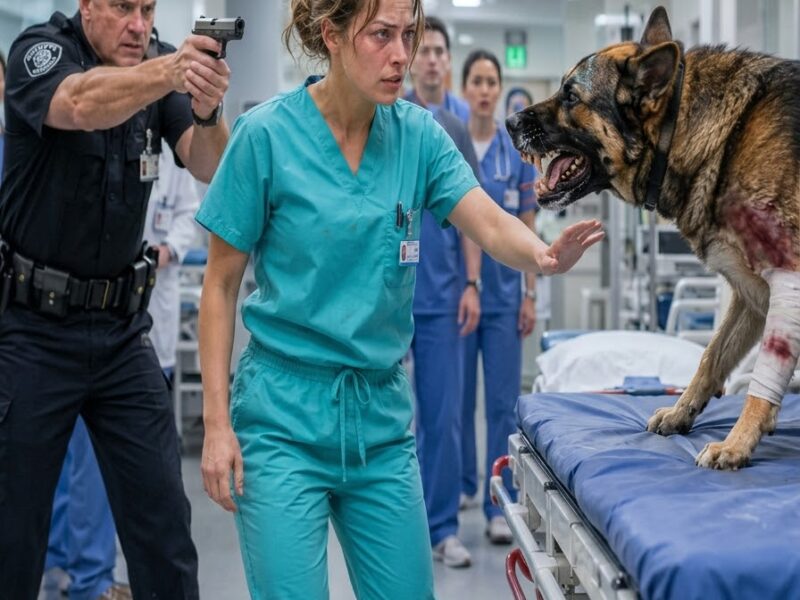
The entire Dallas VA hospital fell silent when a rookie nurse whispered one sentence into a battle-scarred military K9’s ear
The high-ceilinged atrium of the Dallas VA Hospital was built to absorb sound, but on that humid Thursday afternoon, a heavy, suffocating silence fell over the main corridor. The usual hum of rolling IV poles, squeaking rubber-soled shoes, and low television chatter from the waiting area seemed to vanish into thin air.
At the center of everyone’s attention was a corner room on the first floor. Inside lay a massive Belgian Malinois named Ghost. His dark coat was scarred from old shrapnel wounds, his right ear was notched, and his eyes carried the glazed, hollow look of a soldier who had seen the sky fall too many times.
For three days, Ghost had refused to stand. He wouldn’t drink water. He wouldn’t touch hand-fed strips of cooked beef brought in by concerned staff. He simply lay motionless on the linoleum floor, his heavy chin pressed flat against the cool tiles.
Beside him sat Sergeant Mason Reed. Mason was a tall, lean man in his late twenties with sharp features, dark circles carved deep beneath his eyes, and a heavily bandaged right leg stretched out awkwardly beneath a standard-issue hospital blanket. He was holding Ghost’s thick leather leash, his knuckles ghostly white from tension.
“Come on, Ghost,” Mason whispered, his voice cracking with a mixture of raw grief and helplessness. “Just one more time, buddy. Please. Stand up for me.”
The dog didn’t even twitch an ear.
I stood in the doorway, clutching a plastic clipboard tightly against my chest. I was twenty-four years old, a rookie nurse only three weeks into my first official assignment at the Dallas facility. My badge was brand new, the blue uniform fabric still stiff from the factory. I knew the unwritten rule of the VA: Mind your business, do your rounds, and don’t poke at the trauma buried under a veteran’s skin.
Doctors had examined Ghost, assuming he had an undiagnosed internal hemorrhage or terminal canine dementia. Experienced handlers from the local police K9 unit had tried every vocal trigger and operational gesture in their books. Nothing worked.
I was about to turn my cart around and head toward the oncology wing when Mason leaned down, resting his forehead against the dog’s ribcage.
“He lost everyone that day,” Mason whispered softly to the empty room. “He thinks he’s the only one left.”
Those seven words stopped me dead in my tracks. Cold electricity shot down my spine, making the breath freeze in my throat.
Ghost wasn’t sick. He was waiting. He was trapped inside a tactical protocol designed to keep him hidden until a specific safety key was delivered.
I stepped slowly inside the room, letting the heavy door swing closed behind me to cut off the glaring eyes of the corridor staff.
“Can I try something, Sergeant?” I asked, keeping my voice low and flat.
Mason looked up, his eyes bloodshot and guarded. He glanced at my fresh name tag—SARAH BENNETT, RN—and let out a short, cynical sigh. “Don’t bother, nurse. The chief of veterinary surgery couldn’t move him. Nobody’s gotten through to him.”
“Just let me try,” I insisted quietly.
I didn’t wait for his permission. I lowered myself onto my knees several feet away from the dog. I didn’t reach out my hand. I didn’t make eye contact—military working dogs trained in high-threat reconnaissance view direct eye contact from strangers as a threat projection.
Instead, I closed my eyes and allowed my mind to drift back six years.
Before the nursing degree. Before the quiet civilian life in Texas. I remembered a sun-bleached, wind-scoured compound in the mountains of Eastern Afghanistan. I remembered the smell of burning diesel fuel, hot copper, and dust. I remembered Lieutenant Daniel Hayes—my tactical partner, my closest friend, and the man whose loss had shattered my life into a thousand jagged pieces.
Daniel had handled a Malinois from the exact same special operations pipeline. And whenever artillery rounds rained down or night-vision optics caught enemy movement near the perimeter, Daniel would lean down and deliver a hyper-specific, reverse-conditioned command meant to tell the animal to conceal his silhouette and lock his body down completely.
I opened my eyes, leaned toward Ghost’s ear, and whispered:
“Ghost, the lights are off.”
The effect was instantaneous and terrifying.
Ghost’s ears snapped straight back. His chest expanded with a sharp, ragged gasp of air. The empty, vacant look in his dark brown eyes vanished, replaced by an intense, searing awareness. He stared directly into my eyes.
Mason stopped breathing entirely.
Slowly, methodically, Ghost folded both of his front legs beneath his chest, lowered his stomach to the floor, and dropped to his knees, tucking his head into a defensive tactical posture.
A choked, broken sound escaped Mason’s throat. “No…”
He let go of the leash, scrambling forward on his hands and knees, dragging his bandaged leg behind him as tears began sliding down his dust-streaked face.
“That command… that was a classified unit trigger,” Mason stammered, his body shaking wildly. “Where did you hear that? Who taught you that?”
I swallowed hard around the lump in my throat. “Daniel taught it to me.”
Mason froze, his mouth slightly open. “Daniel Hayes?”
I nodded once.
“He’s dead,” Mason said, his voice dropping to a terrified whisper. “He died six years ago during the Ridge Collapse in Sector Four. The whole compound was flattened.”
“I know,” I whispered back. “I was there.”
Before Mason could process my words, Ghost pushed himself up from his defensive crouch. He didn’t attack. He stepped toward me, thrusting his snout directly into the open palm of my right hand, trembling violently.
Then, the dog turned away from us. He walked directly toward the locked stainless-steel supply cabinet mounted beside the hospital bed. He dropped his nose to the floor gap beneath the cabinet and began scratching frantically at the wood trim.
“What is he doing?” Mason asked, wiping his eyes with the back of his sleeve. “There’s nothing in there but sterile saline and surplus bandages.”
I walked over to the dog. Suspended from Ghost’s heavy tactical collar was a tarnished, circular aluminum tag. I reached down and turned it over. Scratched into the back was a ten-digit serial number: 7709-DELTA-4.
My heart slammed against my ribs like a sledgehammer. That wasn’t a dog registration number. It was the classified unit tracking code for Daniel’s personal survival kit.
“Where did you get this tag, Mason?”
“It was on his collar when the recovery team brought him out of the valley,” Mason answered, his voice unsteady. “They said it was garbage. I kept it on him because it was the only thing from his old gear that hadn’t burned.”
Ghost let out a long, broken whimper—a low, mechanical sound that sounded eerily human. It was the exact sound he had made six years ago when the extraction helicopter pulled out, leaving Daniel behind in the dust.
Driven by an instinct I couldn’t explain, I dropped to my stomach and reached deep into the dusty narrow gap beneath the lower frame of the hospital bed. My fingers brushed against something stiff and metallic.
It was a heavy, waterproof document envelope taped securely to the iron bed frame.
Written across the front in dark, thick marker was my name: SARAH BENNETT.
My hands shook so violently I could barely peel the heavy industrial tape away. I tore the envelope open. Inside was a high-resolution, glossy photograph.
It showed Daniel Hayes. He wasn’t dead. He was standing in front of a concrete barrier, holding a radio unit, with Ghost sitting proudly at his side. The timestamp at the bottom of the photograph read: THREE WEEKS AGO.
On the back of the photo, written in Daniel’s unmistakable, angled handwriting, were twelve words:
If she comes back, tell her the mission was never what they said.
Mason stood up abruptly, leaning heavily on the bedside table for support, his face completely drained of color. “How is that possible? I buried his empty casket myself!”
Before I could answer, the fluorescent light fixtures overhead flickered rapidly, humming with a high-pitched electrical whine before dying completely, plunging the room into shadow.
Ghost turned his head toward the heavy corridor door, his lip curling back to reveal rows of sharp white teeth, a deep growl rumbling in his chest.
Suddenly, the hospital intercom speaker on the wall crackled to life with a blast of static. A cold, flat, digitized man’s voice echoed through the speaker:
“Nurse Sarah Bennett. Report to Basement Sector Three immediately. You have five minutes.”
Mason reached out, grabbing my wrist with a firm, protective grip. “Don’t go down there, Sarah. That floor’s been condemned for two years.”
Then Ghost did something he hadn’t done in three long days. He stood up completely, his legs solid, his chest broad, his body blocking the doorway like an iron shield.
And from inside the locked supply cabinet behind us, an old military radio handset began to ring.
The ringing from inside the locked supply cabinet was sharp, rhythmic, and utterly unnatural in a modern hospital room. It was the harsh, mechanical chime of a tactical satellite communications rig—the kind used exclusively by clandestine reconnaissance elements operating deep behind enemy lines.
Mason stared at the cabinet, his grip on my arm tightening. “That cabinet has been locked since I was admitted on Monday. The head nurse keeps the key at the main station.”
I didn’t wait for a key. The instinct that had kept me alive as a combat medic took over. I grabbed a heavy iron IV pole from the corner, jammed the foot-bracket into the gap between the cabinet doors, and leveraged my full body weight against it. With a loud, screeching pop of tearing metal, the lock snapped off, spilling the doors open.
Inside, resting on top of stacked boxes of surgical sponges, was a portable tactical transit case. The LED indicator light on the side was flashing a steady, bright amber.
INCOMING ENCRYPTED RELAY – PROTOCOL 9.
I reached into the box and lifted the heavy rubberized receiver to my ear.
“Sarah,” the voice came through the static. It was faint, distorted by vocal scrambling software, but the cadence was unmistakable. It was Daniel.
“Daniel?” I choked out, tears instantly blinding my vision. “Where are you? They told me you died six years ago! They held a memorial!”
“Listen to me very carefully, Sarah,” Daniel rasped, his breathing shallow and rapid. “You don’t have much time. The men running the Dallas VA aren’t hospital administrators. The facility was built over a cold-war communications bunker. They’ve been using the basement to house the survivors of Operation Blackout.”
“Operation Blackout?” Mason interrupted, stepping up beside me, his eyes wide. “That was the mission where my squad was wiped out! We were told it was an ambush by local insurgents!”
“It wasn’t an ambush, Mason,” Daniel’s voice cut through the speaker, cold and deadly. “It was a cleanup operation. Our own command structure ordered the strike to bury the intelligence data we recovered from the facility. They couldn’t risk any of us returning to civilian life and talking.”
My stomach churned. “Daniel, why did Ghost react to me? Why was that tag on his collar?”
“Because Ghost was carrying the decryption key,” Daniel explained. “When they captured me six years ago, I managed to hide the primary data drive inside his tactical harness before he escaped into the valley. He was trained to lock down and feign terminal depression until he smelled your scent signature. You’re the only one whose biometric profile can unlock the files.”
Suddenly, a loud, metallic thud echoed through the floorboards beneath our feet, followed by the distant sound of heavy boots sprinting up the western stairwell.
“They know you triggered the receiver,” Daniel warned, his voice rising in urgency. “Director Vance just authorized a perimeter lockdown. They’re going to scrub the room. Sarah, you have to get to the basement terminal before Vance wipes the server mainframes!”
“Who is Director Vance?” I asked, looking at Mason.
Mason’s face went ghastly white. “Dr. Arthur Vance. He’s the Regional Director of Veteran Services. He’s the one who signed off on my squad’s casualty reports.”
The intercom on the wall crackled back to life, the digitized voice replaced by a smooth, cultured, and terrifyingly calm tone.
“Nurse Bennett, Sergeant Reed. You are currently in possession of classified Department of Defense material. Remain in your room. Security personnel are en route to assist you. Do not resist.”
“He’s lying,” Mason growled. He turned to the bedside table, pulled open the top drawer, and retrieved a heavy steel surgical scalpel and his tactical belt. “Sarah, take the dog. Get to the basement.”
“I’m not leaving you here, Mason!” I shouted over the sound of rising sirens outside the window.
“I can still shoot, nurse,” Mason said, a dark, fierce smile breaking across his pale face. He reached into his jacket pocket and pulled out a compact 9mm sidearm he had kept hidden in his personal effects. “I lost my whole squad six years ago because I believed Vance’s lies. I’m not letting them take Daniel, too.”
Ghost let out a sharp bark, stepping between me and the door. He looked back at me, then thrust his head against my hip, pushing me toward the rear emergency exit door that led to the service elevator corridor.
“Go, Sarah!” Mason ordered, leveling his pistol toward the main entrance door as heavy footsteps kicked against the outer frame. “Save him!”
I gripped the strap of my medical bag, grabbed the satellite receiver, and bolted through the side door with Ghost right at my heels.
Behind us, the main room door shattered off its hinges, followed immediately by the deafening crack of Mason’s 9mm opening fire.
I sprinted down the narrow, dimly lit service hallway, the walls lined with exposed copper pipes and yellow electrical conduits. Ghost ran smoothly beside me, his nose low, his body moving with total tactical purpose. The three days of lethargy were completely gone—the dog was alive, focused, and operating at peak lethality.
We reached the end of the hall to find the service elevator. The digital display above the door was frozen on red text: LOCKDOWN – LEVEL 1.
“Dead end,” I panted, slamming my hand against the call button.
Ghost didn’t hesitate. He thrust his head into a narrow opening beside the elevator frame where an old laundry chute door sat unlatched. It was a metal slide dropping straight down into the sub-basement levels.
“You want me to go down there?” I asked the dog, staring into the pitch-black metal shaft.
Ghost let out a low bark, grabbed the strap of my medical bag in his teeth, and yanked me forward.
Before I could second-guess the insanity of what I was doing, I sat on the polished steel lip, held my breath, and slid down into the absolute dark.
The descent was a violent, terrifying blur of cold metal, rust dust, and shrieking friction. I hit the padded canvas laundry cart at the bottom of the shaft with enough force to knock the wind completely out of my lungs, tumbling onto a wet concrete floor in a shower of forgotten linens and dust.
A second later, Ghost landed beside me with a light, agile thud, dropping gracefully to all four paws without making a sound.
I lay there for a moment, gasping for air, rubbing my bruised shoulder. The temperature down here was freezing—at least twenty degrees colder than the clinical floors above. The air smelled thick with damp concrete, ozone, and stagnant water.
I pulled my small penlight from my nurse scrub pocket and clicked it on.
The narrow beam of light cut through a dense cloud of suspended dust, illuminating a massive, arched concrete tunnel lined with heavy rusted pipes and thick bundles of black fiber-optic cables. Painted on the damp wall in faded yellow military stenciling were the words: US ARMY STRATEGIC COMMUNICATIONS BUNKER – SECTOR 3 (RESTRICTED).
“We made it,” I whispered, my breath forming pale clouds in the cold air.
Ghost didn’t celebrate. He immediately assumed a point-man position, stepping six feet ahead of me, his tail held low and flat, his ears sweeping back and forth to catch the faintest echo in the dark.
We moved silently down the corridor, passing heavy steel blast doors secured with rusted chains and massive padlocks. Through the reinforced glass slits of the doors, I caught glimpses of abandoned control rooms: rows of retro green-screen computer terminals, heavy reel-to-reel tape recorders, and desks strewn with yellowed papers dated from the late 1980s.
This wasn’t just a hospital basement. It was a decommissioned military command node that had been secretly retrofitted with modern server racks. I could hear the distinct, steady hum of cooling fans echoing from deep within the complex.
Suddenly, my penlight flickered and died.
“Damn it,” I muttered, shaking the plastic flashlight.
Before panic could set in, a soft blue glow flickered on at the far end of the tunnel. A set of double doors made of frosted glass stood slightly ajar, spilling light onto the wet concrete.
Ghost slowed his pace, his shoulder muscles tightening. He let out a low, barely audible growl.
I crept up to the glass doors and peered through the gap.
The room beyond was massive, sterile, and illuminated by dozens of blue server racks stacked floor to ceiling. In the center of the room sat a high-tech terminal station surrounded by glowing monitors displaying live security feeds from every floor of the Dallas VA Hospital above.
Sitting in a mechanical wheelchair in front of the primary console was a man wearing a ragged tactical jacket. His left arm was missing below the elbow, his face was scarred with deep white chemical burns, and his legs were strapped into supportive leg braces.
Despite the terrible injuries, I recognized his silhouette instantly.
“Daniel,” I breathed, my voice breaking.
I pushed the glass doors open and stepped into the room.
The man in the wheelchair spun around rapidly, his single good right hand bringing a suppressed pistol up with terrifying speed, aiming it straight at my heart.
“Stop right there!” he barked, his voice hoarse and raw.
Ghost sprinted past me, but he didn’t attack. He leaped onto the console desk beside the wheelchair, letting out a joyful, frantic whine, resting his big head right against the man’s neck.
Daniel’s hand froze on the weapon. His hard, battle-hardened expression shattered into a look of absolute, overwhelming disbelief. His blue eyes filled with tears as he slowly lowered the gun.
“Sarah…” he whispered, his voice shaking violently. “It’s really you.”
I dropped my bag and ran across the room, falling to my knees beside his wheelchair, throwing my arms around his shoulders. He smelled of salt, antiseptic, and familiar leather. He was real. He wasn’t a memory. He was alive.
“I thought I lost you,” I sobbed, pressing my face into his shoulder. “Six years, Daniel. I spent six years believing I left you to die in that valley!”
“I know, Sarah… I’m so sorry,” Daniel wept, pressing his forehead against mine, his good hand cupping the back of my head. “They held me in a medical dark site in San Diego for four years before Vance transferred me here. They couldn’t kill me because my neural signature was hardcoded into the Project Chimera database. Every time they tried to bypass it, the system locked them out.”
I pulled back slightly, looking at his scarred face. “What is Project Chimera, Daniel? Mason said Vance used it to scrub your squad.”
Daniel turned his wheelchair toward the central monitor screen. “Look.”
He tapped a key with his knuckle. The screen shifted, displaying a vast organizational chart containing hundreds of names, dates, and bank account numbers.
“For twenty years,” Daniel explained, his tone turning ice-cold, “a syndicate within the Department of Veterans Affairs and private defense contractors has been skimming billions of dollars from military medical research funds. But it wasn’t just money. They were using wounded veterans—men and women who had no surviving family—as off-the-books test subjects for advanced combat pharmaceuticals and neurological control systems.”
My blood ran cold as I read the names scrolling across the screen. Dozens of soldiers I had personally treated in Afghanistan were listed as DECEASED – SUBJECT TERMINATED.
“They didn’t die in combat,” I whispered, horror suffocating me. “They were brought here.”
“Vance ran the entire regional network,” Daniel said. “When my squad discovered the entry logs six years ago, Vance ordered the airstrike on our compound to erase us. I survived because Ghost dragged me into a drainage tunnel before the roof fell.”
Suddenly, the heavy glass doors behind us slammed shut with a sharp, pneumatic hiss. The electronic locks engaged with a heavy, metallic clunk.
Through the frosted glass, a figure stepped into view.
It was Dr. Arthur Vance. He was wearing a tailored charcoal suit, his gray hair neatly combed, holding a small digital detonator in his right hand. Beside him stood four heavily armed private security guards carrying submachine guns.
“Impressive, Lieutenant Hayes,” Vance’s voice came through the room’s intercom system, cold and entirely devoid of humanity. “I must admit, I didn’t think Nurse Bennett would make it down the laundry chute alive. But it seems your little reunions always prove surprisingly resilient.”
Daniel pulled his pistol, firing three rounds straight into the glass, but the heavy bulletproof material barely pitted under the impact.
“Don’t waste your ammunition, Daniel,” Vance chuckled softly through the speaker. “That glass is three-inch reinforced polycarbonate. In three minutes, the server room’s automated halon gas fire-suppression system will activate. The oxygen in that room will be completely displaced. You, Nurse Bennett, and your dog will simply go to sleep.”
Vance raised the digital detonator, a cruel, triumphant smile touching his lips.
“And the best part?” Vance added. “With both of your biometric signatures inside the room, the database will consider the master override complete. Once you’re dead, Project Chimera belongs to me forever.”
The terrifying hiss of high-pressure gas nozzles echoed from the ceiling corners. Dense, white clouds of cold Halon 1301 gas began pouring into the server room, creating a thick, swirling fog that settled rapidly over the polished floor.
Halon didn’t just smother fire—it replaced the oxygen in the air instantly. Within ninety seconds, the room would become an absolute vacuum for human lungs.
“Sarah! Cover your mouth!” Daniel yelled, turning his wheelchair frantically toward the main terminal interface.
I pulled my nurse scrub top up over my nose and mouth, but I knew it was useless. Halon wasn’t a chemical smoke; it was a gas that rendered human beings unconscious in less than four breaths.
Outside the bulletproof glass, Dr. Vance stood calmly with his arms crossed over his chest, watching us like specimens in a laboratory jar. His four armed guards held their positions, their submachine guns aimed at the glass, ensuring we couldn’t break out.
Ghost let out a sharp bark, coughing as the heavy gas began to pool around his paws. His ears flattened, and he looked up at me with wide, panicked eyes.
“Daniel, can you override the gas system from the console?!” I shouted, my voice muffled by the fabric of my scrubs.
“No!” Daniel rasped, his hand flying across the keyboard, his face red from strain. “Vance locked the environmental controls from the exterior terminal! The only way to stop the gas is to trigger a primary hard-reset of the bunker’s power grid!”
“Where is the breaker?!”
“Behind Vance!” Daniel pointed through the glass toward a massive, yellow steel junction box mounted on the concrete wall of the outer corridor. “If someone drops that lever, the whole bunker loses power, the magnetic door locks will disengage, and the gas valves will slam shut!”
“We can’t reach it!” I cried, dizziness suddenly washing over my brain as the oxygen levels in the room began to drop precipitously. My knees felt weak, my vision fraying around the edges into dark, static rings.
Daniel grabbed the biometric scanner module from the console and slammed it into my hand. “Sarah… listen to me! Press your thumb to the glass!”
“What?” I gasped, struggling to draw air into my lungs.
“The system needs a dual live-biometric confirmation to initiate an emergency security purge!” Daniel yelled, his own voice growing thin as he gasped for air. “If we purge the system now, every classified file on Vance’s network will be broadcast to the Department of Justice mainframe!”
I didn’t hesitate. I pressed my right thumb flat against the cold glass scanner while Daniel pressed his right hand against the secondary plate.
A high-pitched electronic chime echoed through the room:
BIOMETRIC MATCH CONFIRMED: LIEUTENANT HAYES / NURSE BENNETT.
INITIATING DATA BROADCAST… 10%… 20%…
Outside the room, Vance saw the progress bar flashing across the main corridor monitors. His calm demeanor vanished instantly, replaced by sheer, unadulterated rage.
“Kill the broadcast!” Vance screamed at his guards, pointing at the glass. “Shoot out the server racks! Destroy the terminals!”
The guards raised their weapons, preparing to riddle the server banks with heavy automatic fire.
Suddenly, a loud, thunderous roar echoed from the dark corridor behind Vance.
Before the guards could turn around, a heavy iron medical cart came flying out of the darkness like a battering ram, slamming straight into two of the guards with bone-crushing force, throwing them violently against the concrete wall.
Out of the shadow stepped Sergeant Mason Reed.
His uniform was soaked in blood from his open leg wound, his face smudged with soot and grease, but his dark eyes were burning with absolute, lethal fury. In his right hand, he held an iron pipe; in his left, he held a captured submachine gun.
“Mason!” I tried to scream through the glass, but my voice was barely a whisper as the Halon gas filled my lungs.
Vance spun around, pulling a small handgun from his jacket. “You were supposed to be dead on the first floor!”
“I don’t die easily, Director,” Mason growled, swinging the submachine gun up and opening fire.
A hail of bullets tore through the corridor. The remaining two guards went down instantly. Vance scrambled backward, screaming in terror, dropping his detonator as he ducked behind a steel pillar.
Mason didn’t chase Vance. He saw us through the glass—Daniel slumped over the console, me on my knees on the floor, and Ghost gasping for air beside the door.
Mason looked at the yellow steel junction box on the wall.
“Mason! The lever!” I mouthed through the glass, pointing my hand weakly toward the yellow box.
Mason understood instantly. He sprinted toward the wall, but as he reached out his hand, Vance stepped out from behind the pillar and fired two shots.
The first bullet struck Mason square in the shoulder. The second caught him in the side.
Mason gasped, falling heavily against the yellow box, blood spraying across the painted steel. Vance stepped closer, raising his gun to deliver a final shot to Mason’s head.
“For my squad…” Mason choked out, a bloody smile spreading across his lips.
With the last reserve of physical strength in his body, Mason reached up, grabbed the heavy iron handle of the power breaker, and dragged his full body weight downward.
CLANG!
A massive blue electrical arc erupted from the box.
The entire bunker went pitch black. The cooling fans died instantly. The loud, screaming sirens cut off.
And with a heavy, pressurized pneumatic click, the magnetic locks on the glass doors disengaged, spilling the heavy doors wide open.
Fresh, cold air swept into the server room.
I collapsed onto my hands and knees, drawing huge, desperate gulps of oxygen into my burning lungs, coughing wildly. Beside me, Daniel let out a loud gasp, dragging himself up from the floor, while Ghost bounded through the open door like an enraged demon.
Vance didn’t even have time to turn around.
Ghost slammed into Vance’s chest at forty miles an hour, driving the director backward onto the wet concrete floor, his heavy jaws locking down onto Vance’s gun arm with crushing force. Vance let out a high-pitched, terrifying scream of pain as the handgun clattered uselessly across the floor.
“Ghost! Hold!” Daniel commanded, his voice weak but clear.
The Belgian Malinois froze, keeping his crushing grip on Vance’s arm, his dark eyes fixed on the man’s throat, waiting for the slightest movement.
I scrambled across the wet floor to where Mason lay against the wall. His breathing was rapid and shallow, blood pooling beneath his jacket.
“Mason! Stay with me!” I cried, ripping open my medical bag and jamming heavy sterile gauze pads directly into his shoulder wound. “Look at me! Keep your eyes open!”
Mason looked up at me, his vision swimming, but a faint, proud smile touched his lips. “Did… did we get him, nurse?”
“We got him, Sergeant,” I wept, applying hard pressure to his chest. “We got him.”
Behind us, the primary console screens flickered back to life as emergency battery backup kicked in. A bright green text block filled every monitor in the room:
DATA BROADCAST 100% COMPLETE.
RECIPIENTS: US DEPARTMENT OF JUSTICE / FEDERAL BUREAU OF INVESTIGATION / SENATE ARMED SERVICES COMMITTEE.
EVIDENCE TRANSMITTED SUCCESSFULLY.
Daniel rolled his wheelchair up beside me, reaching down to place his hand over Mason’s trembling fingers.
In the distance, echoing down through the laundry chute and the concrete stairwells, came the true, real sound of emergency sirens—federal law enforcement units flooding the Dallas VA Hospital above.
The six-year nightmare was finally over.
Three months later, the morning sun broke over the wide, open plains of San Angelo, Texas. The sky was an endless expanse of brilliant cobalt blue, washed clean by a gentle breeze that carried the sweet scent of dry grass and wild sage.
I stood on the wide wooden porch of a small, white-painted ranch house, wearing an oversized flannel shirt, blue jeans, and comfortable boots. In my hand was a steaming mug of black coffee.
For the first time in six years, I wasn’t looking over my shoulder. I wasn’t checking the lock on my door three times before sleeping. I wasn’t living as a ghost.
The news of the Dallas VA Hospital scandal had rocked the nation to its absolute core. Dr. Arthur Vance and twenty-seven high-ranking officials within Project Chimera had been indicted on federal charges ranging from treason and high-level embezzlement to kidnapping and murder. The black-budget program had been completely dismantled by Congress, and every surviving veteran who had been hidden away in those dark facilities was receiving full medical care, rehabilitation, and public exoneration.
Mason Reed had survived his wounds. After two weeks in intensive care and three months of rigorous physical therapy, he had been honorably discharged with full retirement benefits. He was currently living in Austin, working as the head safety coordinator for a national veteran support organization.
A soft crunch of gravel drew my attention toward the yard.
Daniel was walking across the grass. He didn’t need the wheelchair anymore. Using a modern carbon-fiber prosthetic leg and a wooden walking stick, he moved slowly but steadily through the morning light. His face was filled out, his pale skin bronzed by the Texas sun, his blue eyes clear and full of life.
Beside him walked Ghost. The old Belgian Malinois walked with a proud, effortless stride, his nose sniffing the warm morning air, his tail wagging lazily. He was no longer a broken military asset waiting for a lost signal. He was home.
“You’re up early,” Daniel said, stepping onto the porch stairs, his crooked, handsome smile breaking across his face.
“Couldn’t sleep,” I smiled back, stepping down to meet him. “It’s too quiet out here. I’m used to the hospital monitors.”
“You’ll get used to it,” Daniel said softly. He reached out with his right hand, gently tucking a strand of hair behind my ear, his fingers warm against my skin.
Ghost walked up between us, leaning his heavy body against my legs, letting out a long, contented sigh before dropping onto his side in a patch of warm sunlight on the porch deck.
I looked down at the dog, then up into Daniel’s clear blue eyes.
“What are you going to do now, Lieutenant?” I asked softly.
Daniel looked out across the open prairie, taking a deep, long breath of the clean air.
“I spent six years locked in the dark, Sarah,” he said quietly, his voice filled with deep, unwavering peace. “I spent six years fighting just to remember your name. Now… I think I’m just going to enjoy the sunlight.”
He reached out, slipping his fingers through mine, holding my hand tightly.
We stood together on the porch as the golden light of the new day filled the sky, watching the sunrise over a world that was finally safe, whole, and free.
The end.









