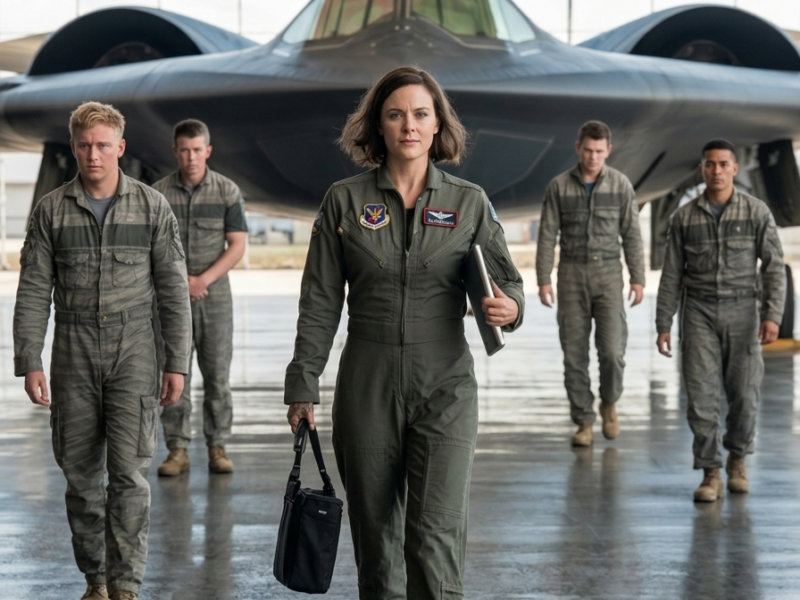
The entire control tower at Nellis Air Force Base went silent when I walked into the briefing room wearing a dead pilot’s identification badge
The cold desert air blew across the tarmac as I walked out of the briefing room, my boots striking the reinforced concrete with a hollow, rhythmic thud. The entire control tower at Nellis Air Force Base had fallen completely silent when I walked into the room wearing a dead pilot’s identification badge, but the commanding general had ordered security to arrest me before I could even explain why the aircraft only I could fly had just received a distress signal from a mission officially erased five years earlier. I had recognized the sheer terror in their eyes before anyone even dared to utter my name: Captain Emily Carter.
I was the pilot who had supposedly perished in a classified training accident—the ghost whose mother had sat through a solemn military funeral beside an empty coffin, the name permanently etched into the black marble memorial wall outside the main gate. General Marcus Reed had whispered, “You’re supposed to be dead,” and I had simply replied, “I know.” I had spent five years hiding under an assumed name, living in a quiet, lonely town in Montana where nobody asked why I woke up screaming every time thunder shook the cabin windows. I had buried my uniform, my medals, and every single photograph of the woman I used to be.
Yet, twenty minutes ago, an emergency transmission had breached the base’s secure network. A special operations team was trapped behind enemy lines after their transport suffered catastrophic damage during a covert night evacuation. Their position was surrounded, their communications were dying, and hostile forces were rapidly closing in. The only available aircraft capable of reaching the narrow mountain extraction zone in time was the XF-33—an experimental stealth fighter with an advanced thrust-vectoring control system that I had helped test before my disappearance. The aircraft had a notoriously lethal flight-control flaw at low altitudes, a quirk so dangerous that every other pilot on base had refused to take it into the storm tonight.
Everyone except me.
I had placed a tarnished metal identification tag on the briefing table, revealing it belonged to my former wingman, Daniel Brooks. Daniel had supposedly died in the exact same crash that erased me. But I had received his dog tag under my front door in Montana, accompanied by a photograph of Daniel standing beside the XF-33, alive, noticeably older, and holding a newspaper dated just three days ago. On the back, handwritten in dark ink, were seven chilling words: They’re sending you back to finish what they started.
General Reed had dismissed his staff, locked the briefing room door, and handed me the flight authorization. He had admitted that our crash five years ago was no mechanical accident, but an intentional execution order. As I reached for the door, Reed had dropped a final bomb: the distress signal hadn’t originated from the stranded rescue team at all—it had come from Daniel himself. Then, my tactical headset crackled to life, and Daniel’s unmistakable voice whispered through the static, “Welcome back, Ghost Six… Don’t trust the man flying beside you.”
The weight of those words chilled me to the bone as I stepped out into the blinding glare of the hangar floodlights. The dark silhouette of the XF-33 sat in the center of the tarmac, glowing like a malevolent specter that had waited five long years for its master to return. The jet’s sleek, radar-absorbent skin looked almost organic under the harsh halogen lamps, its twin engines humming with a low, predatory vibration that reverberated straight through my chest.
A tall figure stepped out from the shadows near the ladder, holding a flight helmet under his arm. He wore the rank of Major, his flight suit pristine, his jaw set in a hard, uncompromising line.
“Captain Carter,” the man said, his voice flat and devoid of warmth. “I’m Major Nathan Cross. I’ll be flying your wing tonight in the secondary strike fighter.”
I stopped dead in my tracks, Daniel’s warning echoing violently in my ears: Don’t trust the man flying beside you.
“I didn’t request a wingman, Major,” I said, my voice cutting through the jet engine whine. “The extraction corridor in the Khratov Mountains is too narrow for two birds. A second aircraft just increases our radar signature.”
“General Reed’s orders, Captain,” Cross replied smoothly, stepping closer. His eyes were cold, calculating, and entirely unblinking. “The airspace over the target zone is heavily contested. You need air superiority cover, whether you want it or not. Besides, the General felt it best you don’t fly solo on your first day back from the grave.”
I stared at him, trying to read the intent behind his calm demeanor. Was Cross the man Daniel had warned me about? Or was Reed playing a far more sinister game, sending Cross to ensure I never made it back from this mission either?
“If you fall behind in those mountains, Major, I won’t come back for you,” I warned, stepping past him toward the crew ladder.
“I don’t expect you to, Ghost Six,” Cross murmured softly.
The nickname sent a cold shiver down my spine. Only my old squadron knew that callsign. I hadn’t revealed it to anyone tonight, and it wasn’t listed on any official flight manifest. I turned sharply to look at him, but Cross was already putting on his helmet, his face obscured behind the dark gold visor.
I climbed the ladder and swung myself into the cramped, familiar cockpit of the XF-33. The scent of jet fuel, ozone, and weathered leather instantly flooded my senses, pulling me back into a reality I had tried so desperately to forget. My fingers moved across the control panels on pure muscle memory, toggling switches, engaging power systems, and powering up the multi-function displays. The jet roared to life around me, a multi-million-dollar war machine responding to my touch like a long-lost extension of my own body.
“Ghost Six, this is Nellis Control,” the dispatcher’s voice cracked through my helmet headset. “You are cleared for taxi to runway two-seven right. Thunderstorms reported along your flight path over the Pacific sector. Godspeed.”
“Roger, Control. Ghost Six rolling,” I replied.
I throttled forward, steering the jet out of the hangar and onto the dark taxiway. Behind me, Major Cross’s F-22 Raptor fell into formation, its twin engine glows burning bright orange against the black desert night.
As I lined up on the runway, I adjusted my tactical frequency, bypassing the official base channels and entering an encrypted frequency I hadn’t used in five years—the private channel Daniel and I had created during our covert ops days.
“Ghost Leader, this is Ghost Six,” I spoke quietly into the mic, my heart hammering against my ribs. “I’m airborne. If you can hear me, give me a sign.”
For several long seconds, there was only the steady hum of static. The jet accelerated down the runway, tires screaming as the speed reached rotation threshold. I pulled back on the stick, and the XF-33 leaped into the sky, cutting through the low-hanging cloud cover like a razor blade.
Then, through the static, a rhythmic series of double-clicks sounded over the radio. Two clicks. Pause. Two clicks. It was our old emergency acknowledgment code.
“Emily…” Daniel’s voice came through, strained, raspy, and accompanied by the heavy sound of gunfire in the background. “You shouldn’t have come.”
“You sent me your dog tags, Daniel!” I shouted into the mask, banking the jet sharply toward the northern flight corridor. “You sent me the photo!”
“I didn’t send you anything,” Daniel gasped, coughing violently. “It was a trap to pull you out of hiding. Reed needed the XF-33 in the air tonight… because the black box inside your cockpit holds the decryption keys to the entire five-year-old Blackout Operation.”
My breath caught in my throat. I looked down at the main display. Beneath the radar avionics, a hidden sub-routine was executing in the background, copying data from the flight recorder.
“Emily, listen to me,” Daniel urged, his voice growing fainter as hostile jamming intensified. “They aren’t trying to rescue anyone in the Khratov Mountains. The distress signal… it’s coming from inside your own flight system. Cross is going to—”
Before Daniel could finish his sentence, a loud screech of radio interference blew out the channel. At the same instant, my cockpit warning system flashed bright red, alarm klaxons screaming inside my ears.
MISSILE LOCK. MISSILE LOCK.
I glanced at my rear radar screen. Major Cross had dropped back two miles behind me, his weapons bay doors open, and his targeting radar locked firmly onto my tailpipes.
The cockpit of the XF-33 exploded into a chaotic symphony of flashing red lights and shrill warning tones.
WARNING: INCOMING MISSILE. DISTANCE: 1.5 MILES.
There was no time to process the betrayal, no time to grieve the truth. Instinct took over. I slammed the throttle into full military afterburner, dumping fuel straight into the exhaust turbines. The experimental jet surged forward with violent force, pinning my body back against the ejection seat as the g-force built rapidly.
I yanked the flight stick hard left and slammed the rudder pedal down, triggering the XF-33’s unstable thrust-vectoring nozzles. The aircraft didn’t just bank—it literally spun sideways in mid-air, defying conventional physics. Behind me, a white thermal streak cut through the black cloud cover right where my cockpit had been a fraction of a second earlier. Cross’s AIM-120 missile detonated harmlessly in the empty sky, its warhead bursting into a blinding flash of orange fire.
“Cross, what the hell are you doing?!” I roared into the tactical frequency, fighting the extreme g-forces to keep the jet from stalling in the pitch-black night.
“Executing primary protocol, Captain,” Cross’s voice returned over the radio, eerie, cold, and entirely unbothered. “You were declared dead five years ago. It’s time we made that official.”
He came barreling through the clouds after me, his Raptor’s high-tech radar locking on once again. Cross was an elite pilot, maneuvering with precise military efficiency, but he was flying a standard production aircraft. I was flying a black-budget phantom designed specifically to break every rule of aerodynamics.
I yanked the stick back, pulling the nose of the XF-33 straight up into a steep vertical climb. The jet shot toward the upper atmosphere like a rocket, piercing through the thick storm clouds and bursting out into the calm, moonlight-drenched stratosphere. Cross followed me up, his engines screaming as he fought to maintain target lock.
“You can’t outrun me, Carter!” Cross shouted over the comms. “Reed built this entire operation to retrieve the black box data from your crash! Five years ago, you survived when you were supposed to die with the evidence. We couldn’t extract the encrypted codes without your biological telemetry key—your handprint on the stick!”
The pieces finally began to fall into place with horrifying clarity. The accident five years ago hadn’t been meant to kill just Daniel and me; it was designed to hide a massive cover-up within the highest ranks of military intelligence. Reed had staged our deaths to cover up a rogue black-ops division that was selling experimental military tech on the global black market. I had survived, escaped into the wilderness, and taken the encryption keys with me in my memory. Tonight, by tricking me back into the cockpit of the XF-33, they had finally gotten my hand on the flight stick, unlocking the dormant data vault inside the aircraft’s computer system.
And now that the data was downloading to Reed’s ground server via satellite… I was completely expendable once again.
“You took everything from me!” I growled, setting my teeth as my vision began to narrow into a dark tunnel from the mounting pressure. “My life, my name, my family!”
“Nothing personal, Captain,” Cross sneered. “Just casualty management.”
Cross launched a second missile.
I waited until the proximity alarm went from a steady pulse to a solid, deafening scream. Three hundred feet. Two hundred feet. At the absolute last microsecond, I disengaged the automated flight-control computer—the very system that had killed previous test pilots—and took completely manual control of the thrust-vectoring actuators.
I kicked the left rudder and yanked the throttle back to idle. The XF-33 performed a radical, dangerous maneuver known as a Cobra pitch, standing entirely on its tail while traveling forward at six hundred miles per hour. The sudden air resistance slammed the jet to a near standstill.
Cross’s missile shot harmlessly beneath my belly, and an instant later, Cross’s F-22 overshot me, zooming right past my canopy like a gray shadow.
“What the—?!” Cross gasped over the comms, his voice cracking with shock.
“My turn,” I hissed.
I slammed the throttles back to full afterburner, the engines roaring back to life with a deafening boom. Dropping the nose of the XF-33, I rolled into a diving turn, placing myself directly behind Cross’s tailpipes. My targeting reticle swept across his aircraft, turning from amber to solid red.
LOCK CONFIRMED.
I squeezed the trigger on the flight stick. The 20mm cannon mounted on the starboard wing spat a stream of high-explosive armor-piercing rounds. Tracers lit up the dark sky, ripping through Cross’s left wing and destroying his hydraulic control lines. Black smoke and fiery sparks spewed out of his aircraft as it went into an uncontrollable downward spiral.
“Ejecting! Ejecting!” Cross screamed.
A second later, a bright flash erupted from his cockpit as his ejection seat shot out into the stormy night, his crippled fighter plunging downward to disintegrate against the rocky desert floor below.
I leveled the XF-33, my heart hammering like a war drum in my chest, my breathing heavy and ragged inside the oxygen mask. I had survived Cross, but the danger was far from over. On my primary tactical display, the data upload bar reached 85%. Reed’s servers were seconds away from acquiring the stolen files.
Worse yet, another transmission flickered onto my radio screen. It was an automated distress beacon, but this one wasn’t fake. It carried Daniel’s authentic military frequency signature, broadcasting from a remote, abandoned radar station deep within a jagged canyon fifty miles to the north.
“Emily…” Daniel’s voice drifted back in through the heavy static, sounding weaker than before. “Reed… Reed knows you defeated Cross. He’s initiated the base self-destruct sequence at the radar station to erase all physical records… including me. You have… less than ten minutes…”
“Hold on, Daniel!” I shouted, slamming the throttle forward to max speed. “I’m coming for you!”
“No… don’t,” Daniel rasped, coughing blood into his comm mask. “The station is heavily guarded by Reed’s private mercenary contractors. It’s a death trap… Emily… save yourself…”
“I left you behind once because I thought you were dead,” I said, my voice shaking with raw emotion as I banked the jet toward the dark mountains ahead. “I’m not leaving you again.”
As the XF-33 streaked through the storm clouds toward the desolate mountain canyon, the primary display flashed a new warning: DATA TRANSFER COMPLETE: 100%.
And instantly, the jet’s central computer system locked up. The main display screens went completely dark, the engine controls froze at 90% power, and the hydraulic stick went entirely dead in my hands. General Reed had remotely overridden the flight control system from Nellis Air Force Base, locking me inside a runaway jet heading straight for the mountain wall.
The pitch-black canyon walls loomed ahead like towering, sharp-edged giants rising out of the desert mist. The XF-33 was screaming through the night air at over seven hundred miles per hour, locked on an unalterable collision course with the solid granite cliff face.
“Nellis Control, this is Ghost Six!” I yelled into the radio, furiously resetting breaker switches along the cockpit side panels. “Override protocol Alpha-Nine-Zero! Release manual control!”
General Reed’s voice cut through the cabin speakers, cold, detached, and devoid of any humanity. “I’m sorry, Emily. You were always our finest pilot. But dead heroes are far more useful than living witnesses. The narrative remains intact: Captain Emily Carter died five years ago. Tonight, her legacy is finally laid to rest.”
“You traitor!” I snapped, my fingers working frantically under the dim red emergency lights of the cockpit. “You sold out your own team! You murdered those men!”
“I preserved national security,” Reed replied coldly. “The technology on that jet belongs to those who fund our future. Goodbye, Captain.”
The radio line died with a harsh click.
On the heads-up display, the digital altimeter was dropping rapidly: 5,000 feet… 4,000 feet… 3,000 feet. The jagged rocks of the canyon floor were visible through the rain-streaked canopy glass. I had less than fifteen seconds before impact.
I stopped fighting the primary computer and reached down between my knees, tearing open the maintenance hatch near the floorboards. Five years ago, during the experimental testing phase of the XF-33, I had personally helped engineer a hidden analog bypass switch—a physical wire cut that isolated the flight surfaces from the main computer in the event of a total cyber-hijack. The engineers had called it unnecessary, but I had insisted on keeping it.
My gloved fingers felt around in the dark, greasy compartment, searching frantically among the bundle of wires.
2,000 feet.
I found the thick red mechanical lever, wrapped my hand around it, and pulled down with all my strength.
A loud mechanical clunk echoed through the airframe. The cockpit displays flickered and died completely, plunging the cabin into near darkness, but the heavy hydraulic resistance returned to the flight stick. The manual linkages were re-engaged.
I grabbed the stick with both hands, planted my feet on the rudders, and pulled back hard.
G-forces slammed into my body like a freight train. The bottom of the XF-33 scraped against the treetops at the lip of the canyon, tearing off a portion of the lower ventral fin in a shower of brilliant sparks. But the jet held together, roaring upward over the crest of the mountain ridge and leveling off into the darkness just feet above the tree line.
Gasping for air, my heart pounding in my ears, I turned the jet back toward the deep canyon floor. Below, hidden inside a hollowed-out cavern along the cliffside, sat the forgotten Cold War-era radar base. Searchlights swept across the rain-slicked concrete pad outside, and heavily armed men in unmarked tactical gear were frantically loading crates onto an unmarked transport helicopter.
I flipped the manual weapons selector to unguided rockets. Without computer targeting, I had to aim using only visual sight lines and sheer pilot intuition.
I rolled the XF-33 into a steep dive, aiming the nose straight at the radar facility’s security perimeter.
“This is for five years of hell,” I muttered under my breath.
I slammed the firing button. A barrage of unguided rockets roared from the wing pods, trails of orange fire lighting up the rain-soaked canyon walls. The rockets struck the facility’s defense towers and fuel depots, triggering a sequence of massive explosions that tore through the mercenary compound. Fireballs billowed into the night sky, throwing the mercenaries below into complete chaos.
I brought the XF-33 down fast, deploying the airbrakes and tail hook. The jet touched down roughly on the short, crumbling concrete runway outside the cavern entrance, tires smoking as I fought to keep the heavy fighter from sliding off the cliff edge. The aircraft slammed to a halt just inches from the sheer drop-off.
Popping the canopy, I unbuckled my harness, grabbed the sidearm pistol from my flight suit holster, and leapt down onto the tarmac into the cold, pouring rain.
The air was thick with the acrid smell of burning aviation fuel and cordite. Mercenary gunfire echoed inside the dark concrete tunnel leading into the mountain facility. Holding my pistol in a two-handed grip, I moved silently along the wet wall, stepping over burning debris and broken glass.
I cleared the entrance corridor, my eyes scanning the shadows. Deep inside the bunker, strapped to a metal chair beneath a flickering fluorescent bulb, was a man in torn, blood-stained military fatigue pants. His face was bruised and drawn, his hair streaked with gray, but his piercing blue eyes were instantly recognizable.
“Daniel,” I breathed, stepping out from the shadows.
He looked up slowly, his eyes widening in disbelief as he saw me standing there in my black flight suit.
“Emily…?” he rasped, his voice trembling with emotion. “You… you actually made it…”
I rushed forward, drawing my tactical knife to slash the heavy heavy-duty zip ties binding his wrists and ankles. “I’m getting you out of here. We’re both going home.”
“There is no home left for us, Em,” Daniel coughed, leaning against me as I helped him stand. “Reed’s men… they aren’t just selling tech. They’re preparing to launch a false-flag strike using the XF-33’s automated drone capabilities. They’re going to make it look like an enemy attack to force a war.”
Before I could answer, a heavy iron security door at the far end of the bunker slammed shut with a deafening boom.
Red emergency lights began flashing across the ceiling, accompanied by a cold, automated female voice over the intercom system:
WARNING: SELF-DESTRUCT SEQUENCE INITIATED. DETONATION IN THREE MINUTES. LEAVE THE PREMISES IMMEDIATELY.
From the darkness near the far catwalk, a tall, heavily armed mercenary commander stepped forward, holding an assault rifle aimed directly at my chest, a cruel, cold smile spreading across his scar-covered face.
“Captain Carter,” the mercenary commander purred, his voice amplified by the metallic acoustics of the underground bunker. “General Reed sent his regards. He said if the crash didn’t finish you, this facility certainly would.”
I immediately pushed Daniel behind me, raising my sidearm and aligning the iron sights directly with the commander’s visor. “Step aside. You’re working for a traitor who will eliminate you the second you walk out that door.”
“Reed pays very well for loose ends to be tied,” the commander sneered, raising his rifle.
Before he could pull the trigger, Daniel reached into his jacket, pulled out a concealed flashbang grenade he had stolen from a guard, pulled the pin with his teeth, and tossed it straight down the catwalk.
BANG!
A blinding white light and a concussive shockwave exploded between us. The commander cried out, blinded and disoriented, spraying bullets aimlessly into the ceiling.
“Move!” Daniel yelled.
I fired three quick shots into the commander’s chest armor, knocking him backward off the catwalk into the burning pit below. Grabbing Daniel’s arm, I dragged him back toward the blast-tunnel exit as structural concrete began crumbling from the ceiling.
WARNING: SELF-DESTRUCT IN TWO MINUTES.
Dust and smoke blinded us as we stumbled out of the cavern into the pouring rain. The runway was ablaze, and in the distance, the unmarked transport helicopter was attempting to take off to escape the impending blast. Standing in the open side door of the chopper, holding a satellite uplink terminal, was General Marcus Reed himself. He had come to oversee the final destruction of the base personally.
“He’s escaping with the primary server data!” Daniel shouted over the roar of the wind and rain. “If he gets that helicopter into international airspace, he’s untouchable!”
I looked at the XF-33 sitting on the runway. The jet had sustained minor shrapnel damage, its lower fin was missing, and the fuel gauges were hovering precariously close to empty. But the manual controls were functional, and the twin engines were still humming with deadly power.
“Get in the rear instructor seat!” I ordered Daniel, pointing toward the two-seater cockpit variant of the experimental jet.
“Emily, that bird barely survived the landing!” Daniel protested, even as he scrambled up the ladder. “If you push those engines again, the whole airframe will tear apart!”
“Then we’ll go down fighting!” I shouted back.
We strapped ourselves into the tandem cockpits. I slammed the canopy down, sealing out the roaring storm, and jammed the throttles into emergency afterburner. The crippled XF-33 screamed forward down the shortened, burning runway, its tires leaving the ground at the very last inch of concrete before the cliff dropped off into a dark abyss.
The jet plunged down into the canyon for a terrifying second before the thrust vectoring caught the air, lifting us up into the raging storm clouds.
Ahead of us, Reed’s transport helicopter was climbing rapidly, attempting to reach the safety of the heavy cloud deck.
“I have no computer tracking, no guided missiles, and less than three hundred gallons of fuel!” I called out to Daniel over the internal comms.
“You don’t need computers, Em,” Daniel’s voice came back, calm and steady despite the chaos. “You’re the best stick-and-rudder pilot the Air Force ever produced. Bring us alongside him!”
I banked the fighter hard, cutting through the turbulence and coming up on the helicopter’s flank. Reed saw us through the cabin window, his face pale with absolute shock and horror as he realized we had survived the bunker explosion. He shouted at his door gunner, who opened fire with a heavy machine gun. Bright tracer rounds stitched across our starboard wing, puncturing the fuel tank. Aviation fuel began spraying out behind us in a mist.
WARNING: CRITICAL FUEL LEAK. ENGINE FAILURE IMMINENT.
“Emily, the fuel is going to ignite if it hits the afterburner!” Daniel warned.
“Then I’m taking one shot!” I replied.
I lined up the nose of the XF-33 manually, using the helicopter’s rotor mast as my point of aim. I squeezed the cannon trigger. The last remaining rounds of 20mm ammunition erupted from the wing gun, tearing through the helicopter’s main transmission gearbox.
Black smoke erupted from the helicopter’s rotors. The aircraft spun out of control, tumbling down through the clouds and crashing violently into the uninhabited ridge below, exploding in a massive column of fire that illuminated the night sky.
A heavy silence filled our cockpit, broken only by the steady, dying whine of our own jet engine.
“Target destroyed,” Daniel breathed heavily from the back seat. “It’s over, Em. It’s finally over.”
Just then, our own starboard engine gave a violent shudder and cut out completely. Fuel starvation. Seconds later, the port engine sputtered and died. The cockpit screens went dark one by one, leaving us gliding silently through the storm in a dead iron bird.
“Engine flameout,” I said quietly, looking out at the vast, dark desert stretch ahead. “We’re out of fuel, Daniel.”
“Can we make Nellis?”
I looked down at the altitude display before it faded out entirely. “No. But there’s a salt flat five miles ahead. We’re gliding this ghost in for a dead-stick landing.”
The silence inside the glided cockpit was eerie, almost peaceful compared to the violence of the last hour. The wind hissed against the canopy glass as the XF-33 glided smoothly down through the rain clouds, leaving behind the dark, burning mountains.
Without engine power, I had only one chance to align the aircraft with the flat, white salt basin visible under the pale moonlight below. There were no landing lights, no radar altitude warnings, and no computer assistance. Just my hands on the stick, my eyes on the horizon, and five years of suppressed instincts guiding the machine down.
“Hold on back there,” I whispered into the dead intercom. “It’s going to be rough.”
The salt flat rushed up to meet us. I flared the nose at the absolute last second, holding the heavy jet off the ground until the main gear touched down with a sharp screech. The XF-33 bounced violently, skidding across the slippery, wet salt surface at over one hundred and fifty miles per hour. I kicked the rudder pedals back and forth, fighting to keep the aircraft from flipping as a wingtip dug into the dirt, spinning us around in a full three-hundred-and-sixty-degree circle before finally grinding to a halt in a cloud of white dust and steam.
Then, absolute silence settled over the desert.
I sat in the dark cockpit for a long moment, my hands trembling violently as the adrenaline slowly drained from my veins. The storm was clearing above us, revealing a vast, dark sky filled with brilliant, cold stars.
I popped the canopy latch and pushed the heavy glass open. The fresh, cool desert air filled my lungs—clean, cold, and free from the smell of burning oil or fear.
From the back seat, Daniel groaned, pushing himself up and looking out at the open landscape. He unbuckled his harness, climbed over the cockpit sill, and lowered himself down to the salt ground, dropping onto his knees and letting the rain wash the dirt and blood from his tired face.
I climbed down beside him, collapsing into the soft salt bed, staring up at the night sky.
“We made it,” Daniel choked out, tears cutting clean paths through the grime on his cheeks. “We actually made it out.”
“We’re alive, Daniel,” I said, my voice barely a whisper. “We’re really alive.”
An hour later, the quiet night air was broken by the distant, rhythmic thrumming of approaching rotors. Multiple search-and-rescue helicopters from neighboring military sectors descended upon the salt flats, their bright white spotlights sweeping across the battered, wing-damaged XF-33. Tactical ground teams poured out of the transports, weapons lowered, led by federal intelligence officers who had intercepted the satellite data logs Reed had attempted to leak before his death.
The cover-up had completely unraveled. The evidence recovered from the XF-33’s black box, combined with the encrypted files Daniel had preserved, laid bare the entire corrupt network. The dead were cleared of all false charges, and those who had profited from our destruction were brought into the harsh light of justice.
Three weeks later.
The morning sun rose warmly over the quiet hills of Arlington National Cemetery. The sky was a brilliant, cloudless blue.
I stood near the edge of a grassy hill, wearing my restored Air Force dress uniform, the gold pilot wings pinned neatly over my heart. Beside me stood Daniel, his arm in a sling, his eyes fixed on the pristine white headstones lining the rolling landscape.
A small crowd of military personnel, family members, and news reporters had gathered around a newly erected marble monument. Among them was my mother, her face tear-stained, holding my hand so tightly it felt as though she feared I might vanish into thin air again if she let go.
The chaplain spoke words of honor, bravery, and sacrifice, officially correcting the public record. The names of Captain Emily Carter and Major Daniel Brooks were formally restored to active service, their reputations cleared, their long ghost story finally brought to an honorable end.
As seven riflemen stepped forward to fire a twenty-one gun salute into the clear morning air, a flight of four F-22 Raptors roared low overhead in a tight diamond formation. As they passed over the cemetery, the lead aircraft pulled sharply upward, climbing straight into the sun in the solemn “Missing Man” formation.
I looked up, watching the lone jet disappear into the infinite blue sky.
“What happens now, Ghost Six?” Daniel asked quietly, stepping up beside me.
I smiled softly, feeling the warmth of the morning sun on my face for the first time in five years—no longer a phantom hiding in the dark shadows of Montana, no longer a dead pilot on a classified wall, but a survivor ready to reclaim her life.
“Now, Daniel,” I replied, taking a deep, peaceful breath, “we stop running.”
The end.









