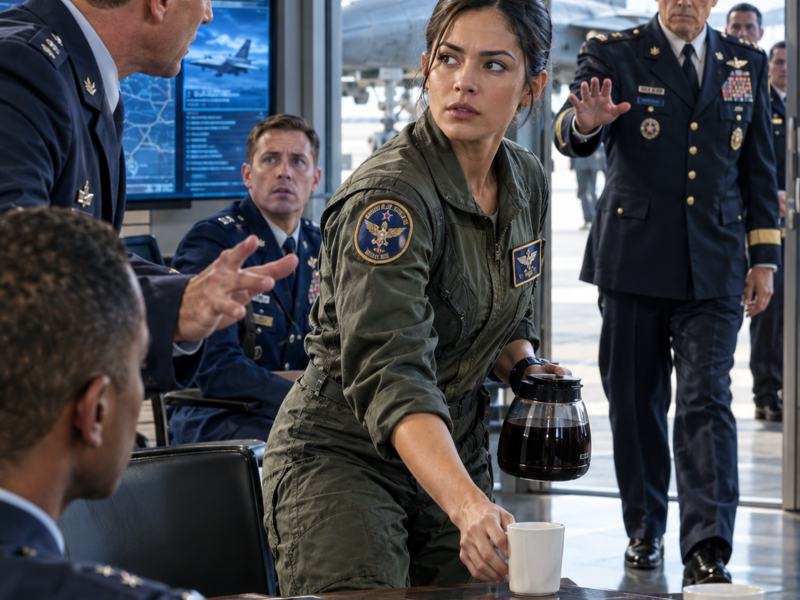
The entire briefing room went silent when Colonel Richard Hayes shouted that the pilot inside the missing fighter was Captain Morgan’s father
The entire briefing room went silent when Colonel Richard Hayes shouted that the pilot inside the missing fighter was Captain Morgan’s father.
For three seconds, I forgot how to breathe.
My father had been declared dead eleven years ago.
His funeral had been held at Arlington National Cemetery. His medals had been presented to my mother in a black velvet box. The Air Force had given us a folded American flag and a carefully worded explanation about a training accident that had supposedly taken his life.
I had been twenty-two years old when I watched his coffin lowered into the ground.
And now, standing in a conference room at Langley Air Force Base, I was being told that he might be alive.
“Repeat that,” I said.
Colonel Hayes stood near the doorway, his face pale beneath the fluorescent lights.
“You heard me.”
General Mitchell turned toward the security officers.
“Colonel Hayes is to remain here. Nobody leaves this room until I authorize it.”
Two officers moved immediately.
Hayes raised both hands.
“General, you’re making a mistake. You have no idea what this operation involves.”
“Then you’re going to explain it,” Mitchell replied.
Hayes looked at me.
For the first time since I had entered the room, he wasn’t looking at my plain flight suit or the absence of rank insignia.
He was looking at me as if I were a threat.
“Captain Morgan,” he said quietly, “whatever you think you know about your father, you need to forget it.”
I stepped away from the conference table.
“You don’t get to tell me what to forget.”
“Your father wasn’t the man you thought he was.”
I felt something cold settle in my chest.
“Neither were you, apparently.”
The colonel’s jaw tightened.
Before he could respond, General Mitchell’s secure telephone rang again.
He answered, listened for several seconds, and then asked a question that made the room even quieter.
“Is the pilot conscious?”
A pause.
“Can he identify himself?”
Another pause.
Mitchell’s eyes shifted toward me.
“Understood. Keep the aircraft secured. Nobody approaches the cockpit until our team arrives.”
He ended the call.
I moved toward him.
“General, I need to know what they found.”
Mitchell hesitated.
It was only a fraction of a second, but I noticed it.
“Your aircraft recovery team located the missing fighter approximately ninety miles east of its last recorded position. The aircraft is damaged, but the cockpit remains pressurized.”
“Who’s inside?”
“We don’t know for certain.”
“Then why did Hayes say it was my father?”
Mitchell looked at the colonel.
Hayes said nothing.
The general lowered his voice.
“Because the aircraft transmitted a voice-authentication sequence associated with your father’s classified flight credentials.”
My heart hammered against my ribs.
“That sequence was retired eleven years ago.”
“Correct.”
“Then somebody is using his credentials.”
“That is one possibility.”
“And the other?”
Mitchell didn’t answer.
He didn’t have to.
I turned toward the intelligence officers standing near the wall.
“I want the original telemetry, the cockpit authentication recording, and every maintenance entry associated with that aircraft. Not the summary. Not the sanitized report. The raw files.”
One of the officers glanced at Mitchell.
The general nodded.
“Give her access.”
Hayes suddenly stepped forward.
“You can’t authorize that.”
Mitchell turned slowly.
“Would you like to explain why not?”
“Because those records contain operationally sensitive information.”
“So does a missing fighter containing a potentially living American pilot.”
“General, with respect, this is bigger than a missing aircraft.”
Mitchell’s expression hardened.
“Then you should have thought about that before your credentials appeared on the software modification that disabled its emergency beacon.”
Hayes stared at him.
I watched the colonel’s face carefully.
There it was again.
Not surprise.
Recognition.
He knew exactly what the general was talking about.
And whatever had happened to the missing fighter, Hayes was afraid of what the investigation might uncover.
I had spent years learning to read people under pressure. In combat, a pilot’s hesitation could reveal more than a hundred pages of intelligence reports.
Hayes wasn’t frightened of being blamed for a technical failure.
He was frightened that someone would discover why the aircraft had disappeared.
“Captain Morgan,” he said, “you should consider stepping away from this investigation.”
“Why?”
“Because if that pilot is who you think he is, finding him might be the worst thing you can do.”
I stared at him.
“Are you threatening me?”
“No.”
He swallowed.
“I’m warning you.”
I walked past him toward the door.
“Then here’s my warning, Colonel. If my father is inside that aircraft, I will bring him home. And if someone put him there deliberately, I will find out who.”
For the first time, Hayes looked genuinely afraid.
Not of me.
Of what I might discover.
And that frightened me more than anything he had said.
### Eleven Years Earlier
My father, Major Jonathan Morgan, had been one of the Air Force’s most respected experimental test pilots.
He flew aircraft that most pilots would never see outside a classified hangar. He tested flight-control systems at the edge of their operating limits and evaluated experimental technologies designed to give American fighter pilots an advantage in the next generation of aerial combat.
He rarely talked about his work.
When I was a child, I used to sit on the floor of our living room while he repaired old radios at the kitchen table.
He taught me how to recognize a faulty connection by listening to the static.
He taught me how to read a compass before I learned to drive.
And when I was old enough to understand what he did for a living, he taught me one rule that I never forgot.
“Rebecca, an aircraft can lie to you.”
He would tap the side of an old radio.
“Your instruments can lie. Your computer can lie. Even the people giving you instructions can lie. When something doesn’t make sense, you don’t ignore it just because someone with more rank tells you to.”
I had laughed at him then.
“Does that happen often?”
He looked at me for a long moment.
“More often than you’d like to believe.”
Three months later, he disappeared during a classified test flight over the Atlantic.
The official investigation concluded that a catastrophic flight-control failure had caused his aircraft to break apart before the recovery team could reach the crash site.
No wreckage was recovered.
No body was found.
But the Air Force declared him dead anyway.
When I questioned the investigation, the officers assigned to brief my family gave me the same answer.
The evidence was classified.
The decision was final.
And my father was gone.
I eventually became a fighter pilot myself.
I trained harder than anyone expected. I earned my wings, qualified on advanced tactical aircraft, and built a record that opened doors normally reserved for pilots with decades of experience.
I also learned to stop asking questions about my father’s death.
At least, that was what everyone believed.
For eleven years, I kept a copy of his final flight report hidden inside a locked drawer.
And for eleven years, one detail bothered me.
The report stated that his aircraft had transmitted an emergency signal for forty-seven seconds after the supposed mechanical failure.
But the official timeline showed that the aircraft’s electrical system had failed completely before the signal was transmitted.
The sequence was impossible.
Someone had either made a serious mistake or deliberately falsified the report.
I had never been able to prove which.
Until today.
### The First Recording
Twenty minutes after the briefing, I entered a secure intelligence room with General Mitchell and two specialists from the Air Force Office of Special Investigations.
The room contained no windows, no personal devices, and no equipment connected to the base’s ordinary network.
A specialist named Major Collins sat behind a console.
“Captain, we’ve isolated the authentication transmission from the recovered aircraft.”
“Play it.”
Collins hesitated.
“There’s something you should know first. The signal contains two separate authentication layers. The first matches the missing fighter’s assigned test profile. The second matches a legacy military identity that was removed from the active system eleven years ago.”
“My father’s.”
“Yes, ma’am.”
“Play it.”
He pressed a key.
Static filled the room.
Then came the low mechanical hum of an aircraft cockpit.
A man’s voice emerged through the speakers.
“Falcon Control, this is Raven One. Flight-control response is degrading. I have no authority over the left-side actuators.”
My entire body went still.
I knew that voice.
I had heard it in childhood recordings, old family videos, and the last voicemail my father had left before his final flight.
The recording continued.
“Repeat, I have no authority over the left-side actuators. This is not a system failure. Somebody has changed the control architecture.”
A burst of static interrupted him.
Then he spoke again.
“I’m requesting immediate recovery. Authenticate the override using Morgan-Seven.”
Major Collins paused the recording.
“Captain, the next portion contains an identity verification response. We believe the pilot was attempting to establish that he was the authorized operator.”
“Continue.”
The recording resumed.
A series of electronic tones sounded.
Then a second voice spoke over the radio.
It was distorted, but unmistakably human.
“Authentication rejected. Your credentials have been revoked.”
My father’s voice returned.
“That’s impossible. I designed the original system.”
The second voice answered immediately.
“Not anymore.”
Then the transmission ended.
Nobody spoke.
I stared at the console, struggling to process what I had heard.
My father hadn’t simply vanished during an accident.
He had reported deliberate interference.
Someone had changed the aircraft’s controls.
Someone had rejected his credentials.
And someone had known exactly how to keep him from calling for help.
I turned toward General Mitchell.
“Who had access to that system?”
“Only a small group of engineers, test pilots, and senior officers.”
“Names?”
“We’re compiling the list.”
“No.” I leaned over the console. “I want the access log from the original software installation. Every modification, every approval, every credential used. If somebody changed the system, there will be a trace.”
Major Collins looked uncomfortable.
“There’s a problem with that.”
“What problem?”
“The original access log was deleted.”
“Deleted when?”
He checked the screen.
“Eleven years ago. Approximately six hours before your father’s aircraft disappeared.”
My mouth went dry.
“Can it be recovered?”
“Not from the primary server.”
“Then find another copy.”
Collins exchanged a glance with the general.
“We found one.”
He opened a separate file.
A list of authorization records appeared on the screen. Most of the entries were incomplete, their identifying information replaced with blocks of classified text.
One entry, however, remained intact.
SYSTEM OVERRIDE AUTHORIZATION
APPROVING OFFICER: COLONEL RICHARD HAYES
ACCESS TIME: 04:17:33 ZULU
I stared at the name.
Hayes had been a lieutenant colonel eleven years ago.
He had been assigned to the experimental flight division.
And according to the records, he had authorized a change to my father’s aircraft less than six hours before the flight.
“That’s enough to bring him in for questioning,” I said.
General Mitchell nodded.
“Already underway.”
I looked at the timestamp again.
Something didn’t fit.
“Major, what time did my father’s aircraft lose contact?”
“Approximately 10:21 Zulu.”
“And what time did the emergency signal begin?”
“10:24.”
I pointed at the screen.
“Then why was Hayes’s authorization entered at 04:17? That’s more than six hours earlier.”
Collins nodded.
“Because the override was scheduled in advance.”
I felt the room grow colder.
This wasn’t a last-minute decision made during a test flight.
Someone had planned the modification before my father ever entered the cockpit.
“Can you identify the person who entered the authorization?”
“The credentials belong to Colonel Hayes.”
“That wasn’t my question.”
Collins leaned back.
“The terminal was located inside the restricted development facility. According to the access log, the person who entered the authorization used Hayes’s identity and his biometric verification.”
“Could someone have copied his credentials?”
“Yes, ma’am. But the biometric match makes that considerably harder.”
“Not impossible.”
“No.”
I stared at the record.
My father had once told me that systems could be manipulated, but people were often the easiest part to fool.
A copied identity.
A forged authorization.
A flight that never returned.
And now, eleven years later, the same credentials had appeared in a new missing-aircraft investigation.
I suddenly understood why General Mitchell had been waiting for me.
This wasn’t merely a case involving a missing experimental fighter.
Someone had brought my father’s name back into an active military system.
And they had done it deliberately.
### The General’s Warning
General Mitchell waited until the intelligence officers had left before speaking.
“Captain, there’s something else.”
I folded my arms.
“I’m listening.”
“Your assignment here was approved at the highest level. But your orders were intentionally vague. You were supposed to observe the squadron, identify irregularities, and report directly to me.”
“Why wasn’t I told about the connection to my father?”
“Because we didn’t know it existed until the aircraft transmitted that authentication sequence.”
I studied his face.
“Then why did you let Hayes humiliate me in front of his squadron?”
Mitchell didn’t answer immediately.
“Because you were operating under an assumed role, and I wanted to see how the officers behaved when they believed they were dealing with someone who had no influence over them.”
I thought about Hayes pushing the coffee tray into my hands.
The jokes.
The smirks.
The way several pilots had looked away rather than challenge their commanding officer.
“That’s a dangerous way to test people,” I said.
“Yes.”
“Especially when one of them may be involved in a classified aircraft sabotage.”
Mitchell’s expression hardened.
“Which is why you need to understand something. Hayes isn’t the only person who could have authorized that modification. His credentials may have been used to cover someone else’s involvement.”
“Then we need to determine whether he acted alone.”
“We do. But there’s another concern.”
He slid a thin folder across the table.
Inside was a photograph of a middle-aged man standing beside a hangar. He wore civilian clothes, and his face was partially obscured by the shadow of a baseball cap.
I looked up.
“Who is this?”
“Dr. Samuel Mercer. He was the lead software architect on your father’s experimental aircraft.”
“Was?”
“He disappeared from the defense industry three years ago. His security clearance was suspended after an internal investigation.”
“What did he do?”
“We don’t know. The investigation was sealed.”
I looked at the photograph again.
“Why show me this now?”
“Because Mercer contacted our intelligence office forty-eight hours before the missing fighter vanished.”
My eyes narrowed.
“What did he say?”
“He claimed someone had reactivated the software architecture used in your father’s aircraft. He said it was being installed on a new platform without authorization.”
“And then?”
“His contact disappeared. His apartment was found empty. No signs of forced entry, no travel records, no reliable trace of where he went.”
I closed the folder.
“Do you believe he’s connected to the missing fighter?”
“I believe too many things that should be unrelated are happening at the same time.”
I stood.
“Then I’m going to speak to Hayes.”
“Not alone.”
“General, if he knows something about my father—”
“Captain Morgan.” Mitchell’s voice sharpened. “This is not a personal investigation anymore. Someone has manipulated a classified aircraft, compromised military credentials, and possibly concealed the survival of an American pilot for eleven years. If you let your emotions make your decisions, you may become the next person they disappear.”
I held his gaze.
“My emotions aren’t making my decisions, sir.”
“Then tell me what is.”
I thought about the recording.
My father’s voice.
The impossible emergency transmission.
The authorization signed under Hayes’s name.
And the words that had haunted me since childhood.
When something doesn’t make sense, don’t ignore it just because someone with more rank tells you to.
“Evidence,” I said.
Mitchell watched me for a moment, then nodded.
“Good. Keep following it.”
He moved toward the door, then stopped.
“One more thing. The aircraft recovery team has established a visual connection with the cockpit. The pilot is alive, but he hasn’t responded to their attempts to communicate.”
I felt my pulse quicken.
“Have they identified him?”
“Not yet.”
“Then I’m going to the recovery center.”
Mitchell opened the door.
“Your transport is waiting.”
As I followed him into the corridor, a young intelligence officer hurried toward us carrying a tablet.
“General, we’ve received an update from the recovery team.”
Mitchell stopped.
“What is it?”
The officer swallowed.
“They managed to access the pilot’s emergency medical profile.”
“Name?”
The officer looked at me.
Then he turned the tablet around.
A photograph appeared on the screen.
Older.
Thinner.
His face marked by scars I had never seen before.
But the eyes were unmistakable.
My father.
Below the photograph, a single line of text appeared.
IDENTITY CONFIRMED: MAJOR JONATHAN MORGAN.
I gripped the edge of the tablet.
For eleven years, I had believed that man was dead.
Now I was looking at proof that he had survived.
And beneath his identity confirmation was a second notification, timestamped less than thirty seconds earlier.
WARNING: COCKPIT LIFE-SUPPORT SYSTEM ENTERING CRITICAL FAILURE.
I looked at General Mitchell.
“How long does he have?”
The intelligence officer answered before the general could.
“Based on the current oxygen level, Captain, less than twenty minutes.”
I turned and ran.
Because whatever had happened eleven years ago, whatever secrets the Air Force had buried, and whatever Colonel Hayes was trying to hide—
I wasn’t going to lose my father twice.
The transport helicopter was already spinning up when I reached the flight line.
Cold Atlantic wind swept across Langley Air Force Base, carrying the smell of jet fuel and rain. Beyond the hangars, emergency vehicles flashed red and blue against the darkening sky.
General Mitchell followed me onto the tarmac.
“Captain Morgan, you’re not going out there alone.”
“Then don’t slow me down, sir.”
He gave me a sharp look, but there was no time to argue.
Two intelligence officers climbed aboard behind us. A flight medic secured a medical case beside the door, while the pilot shouted that we were cleared for departure.
As the helicopter lifted, I strapped myself into the nearest seat and stared at the tablet in my hands.
My father’s photograph remained on the screen.
Eleven years older than the man I remembered. A scar across his left cheek. Deep lines around his eyes. His hair almost entirely gray.
But alive.
I touched the screen with my thumb.
“Hang on, Dad.”
General Mitchell sat opposite me.
“Captain, I need you to understand that we don’t know what condition he’ll be in when we reach the aircraft.”
“I understand.”
“We also don’t know whether the cockpit can be opened safely.”
“I understand that too.”
He studied me.
“Then why do you look as though you’re preparing to fly into combat?”
I looked up.
“Because someone has spent eleven years making sure my father never came home.”
I tightened the straps across my chest.
“And now I’ve got twenty minutes to find out whether they’re going to succeed.”
The general said nothing more.
The helicopter banked toward the Atlantic.
Below us, the coastline disappeared beneath a layer of low cloud. The recovery team had located the experimental fighter floating near a remote naval training area, its right wing partially submerged and its nose tilted toward the dark water.
A rescue vessel was already approaching.
The aircraft’s emergency beacon had activated for only a few seconds before shutting down again.
Someone had designed the system to fail.
And I was beginning to suspect that the failure had never been accidental.
### The Aircraft in the Water
We reached the recovery zone twelve minutes later.
The fighter was barely visible beneath the helicopter’s searchlight.
Its upper fuselage rose above the waves, but the rear section had sustained significant damage. A rescue diver surfaced near the cockpit and waved both arms toward the vessel.
The pilot was still inside.
As the helicopter hovered over the recovery ship, I caught sight of the aircraft’s designation painted beneath its damaged wing.
XF-47 NIGHTHAWK.
I had seen that designation once before.
It appeared in a restricted appendix attached to my father’s final flight report. Every page containing technical details had been classified, but the appendix described an experimental control architecture designed to allow a fighter to operate even after its primary flight systems had been compromised.
The program had supposedly been canceled after his disappearance.
Apparently, someone had restarted it.
The helicopter touched down on the ship’s landing deck.
I unfastened my harness before the crew had finished securing the aircraft.
“Captain, wait!” the medic shouted.
I was already running.
The recovery team had attached a safety line to the damaged fighter. A pair of technicians were preparing a specialized cutting tool beside the cockpit.
One of them turned toward me.
“Captain Morgan?”
“Yes. What’s his condition?”
“We’ve got intermittent readings from the cockpit monitor. Heart rate is elevated, oxygen is falling, and the internal pressure is unstable.”
“Can you open the canopy?”
“Not with the standard release. The electrical system is dead, and the emergency mechanism appears to have been mechanically locked.”
“Mechanically locked?”
The technician nodded.
“Someone installed a secondary locking assembly. It’s not part of the original aircraft design.”
I stared at the canopy.
“Can you cut through it?”
“We can, but if the cockpit pressure drops too quickly, we could injure the pilot.”
“Then find a way to equalize the pressure first.”
“We’re working on it.”
I crouched beside the aircraft and pressed my gloved hand against the canopy.
Through the scratched transparent material, I could make out a figure slumped in the pilot’s seat.
His head was tilted forward.
One arm hung beside the console.
The oxygen mask covered most of his face.
“Dad?”
There was no response.
I tapped the canopy.
“Dad, can you hear me?”
Nothing.
I looked toward the technician.
“Is the cockpit audio system functioning?”
“Only intermittently.”
“Try the external communications channel.”
He connected a portable unit and signaled for me to speak.
I leaned toward the microphone.
“Major Jonathan Morgan, this is Captain Rebecca Morgan. Can you hear me?”
Static crackled through the speaker.
I tried again.
“Dad, it’s Rebecca.”
A faint click came from inside the cockpit.
Then a distorted voice emerged.
“…Becky?”
My knees nearly gave way.
Nobody had called me that since I was a little girl.
I pressed the microphone closer.
“I’m here, Dad. We’re getting you out.”
His breathing sounded shallow through the transmission.
“Don’t… open… the canopy.”
I looked at the technician.
“Why not?”
My father’s voice returned, weaker this time.
“It’s… rigged.”
A warning tone sounded from the cockpit monitor.
The technician swore under his breath.
“Pressure is dropping faster than before.”
I gripped the edge of the fuselage.
“Dad, listen to me. We’re going to get you out, but I need to know what’s happening.”
His voice crackled through the speaker.
“Not… safe.”
“What’s not safe?”
A burst of static swallowed his answer.
Then he spoke again.
“Rebecca… the flight computer…”
The transmission cut out.
The monitor showed another sharp drop in oxygen saturation.
The medic moved closer.
“We’re running out of time.”
I looked at the canopy’s locking assembly.
Something about it bothered me.
The additional mechanism wasn’t merely designed to prevent an emergency release. Its wiring ran directly into a small compartment beside the cockpit’s environmental control panel.
I recognized the configuration from the technical schematics I had reviewed years earlier.
It was connected to the aircraft’s emergency purge system.
If we cut the canopy without isolating that circuit, the system could vent the remaining cockpit pressure.
The technician had been right.
Opening the canopy the wrong way could kill my father.
“Get me the original Nighthawk emergency procedures,” I ordered.
One of the officers looked confused.
“Captain?”
“Now.”
He hurried toward the communications station.
I studied the damaged aircraft again.
My father had spent his career testing systems that other pilots considered too dangerous to fly.
If anyone knew how to bypass a deliberately modified emergency mechanism, it was him.
But he was barely conscious.
And whoever had rigged the canopy had anticipated that someone might try to rescue him.
This wasn’t simply an aircraft designed to fail.
It was an aircraft designed to keep its pilot trapped.
### The Hidden Switch
The original emergency procedures arrived on a ruggedized tablet.
I scrolled through the diagrams, comparing the standard cockpit layout with the damaged aircraft in front of me.
The added locking assembly did not appear anywhere in the original documentation.
Neither did the additional wiring.
I zoomed in on the environmental control panel.
There.
A small maintenance access point was positioned beneath the left-side console, partially hidden by a removable protective cover.
The original schematics showed a manual isolation switch behind it.
If the system had been installed according to the original design, the switch would disconnect the emergency purge circuit before the canopy was opened.
But the modified aircraft had been rebuilt by people who understood the original system.
They could have moved the switch.
Or removed it entirely.
“Do we have a way to access the cockpit from underneath?” I asked.
The technician shook his head.
“The lower service panel is submerged. We can reach it, but the current is too strong to work safely.”
I looked toward the rescue diver.
“How long would it take?”
“Several minutes, if the panel isn’t damaged.”
Several minutes we didn’t have.
I leaned closer to the canopy.
“Dad, I need you to listen to me.”
His head moved slightly.
“Can you hear me?”
A faint thumbs-up appeared beside the console.
Relief surged through me.
“There’s a manual isolation switch beneath the left-side panel. Do you remember where it is?”
His hand trembled.
He slowly lifted it and pointed toward the lower left corner of the cockpit.
The technician checked the diagram.
“That’s the right location.”
I looked back at my father.
“Can you reach it?”
He shook his head.
His hand dropped.
The monitor alarm accelerated.
The medic glanced at the readings.
“Captain, we need to make a decision.”
I stared at the modified locking assembly.
Then I noticed something else.
The additional wiring entered the panel through a narrow opening near the canopy hinge. Whoever installed the mechanism had left a maintenance access point exposed, probably because the modification required frequent inspection.
It was a mistake.
A small one.
But potentially enough.
“Bring me the narrow inspection camera,” I said.
The technician handed it over.
I carefully guided the flexible probe into the access opening, watching the live image appear on the tablet.
The camera passed through the wiring compartment and revealed a small metal housing.
Inside it sat a manual disconnect lever.
“There’s the switch.”
The technician leaned over my shoulder.
“We can reach it with a hooked tool.”
“Can you operate it without disturbing the pressure system?”
“If we move slowly.”
“Then do it.”
He selected a narrow insulated tool and guided it into the compartment.
For several seconds, nothing happened.
Then the lever moved.
A green indicator illuminated on the portable diagnostic screen.
PURGE CIRCUIT ISOLATED.
The medic exhaled.
“Pressure is stabilizing.”
I closed my eyes for one brief moment.
Then I opened them.
“Release the canopy.”
The technician activated the emergency mechanism.
A heavy metallic click sounded from the cockpit.
The canopy lifted several centimeters before stopping against the damaged hinge.
The recovery crew moved in with padded supports, carefully raising it just enough for the medic to reach my father.
“Major Morgan, can you hear me?”
No response.
The medic checked his pulse.
“He’s alive.”
Two crew members secured a rescue harness around my father’s shoulders. Slowly, carefully, they lifted him from the seat.
His flight suit was torn at the shoulder. Blood had dried along one side of his face. A medical sensor remained attached to his wrist, its display flashing erratically.
As they lowered him onto a stretcher, his eyes opened.
For a moment, he stared at the rescue team as though he didn’t recognize where he was.
Then his gaze found me.
“Becky?”
I dropped beside him.
“I’m here.”
He reached for my hand with trembling fingers.
I held it tightly.
“You came,” he whispered.
A laugh escaped me, mixed with tears I hadn’t realized were there.
“Of course I came.”
He tried to lift his head.
“No. You shouldn’t have.”
I felt my smile disappear.
“Why?”
His eyes moved toward General Mitchell, who had arrived at the recovery area.
Then my father looked back at me.
“Because they know you’re here now.”
Before I could ask who he meant, his body stiffened.
The medic called for immediate evacuation.
My father closed his eyes.
And as the team lifted the stretcher, something slipped from inside his flight suit and landed on the deck.
A small metal object.
I picked it up.
It was an old military identification tag, worn smooth along the edges.
My father’s name was engraved on one side.
On the other were six characters.
N-17-04.
I had never seen the code before.
But General Mitchell had.
The moment he read it, the color drained from his face.
“Where did he get that?” he demanded.
“It fell from his suit.”
Mitchell reached for the tag, but I closed my fingers around it.
“Tell me what it means.”
He looked toward the medical team carrying my father away.
Then he lowered his voice.
“Captain, that code belongs to a program that officially never existed.”
“What program?”
Mitchell stared at me.
“Nightglass.”
The name meant nothing to me.
Not yet.
But the expression on the general’s face told me it was connected to something far worse than a falsified flight report.
“What’s Nightglass?” I demanded.
He glanced toward the aircraft.
“It’s the reason your father was declared dead.”
### The Man Who Knew Too Much
My father was transferred to the medical compartment aboard the recovery vessel.
The doctors stabilized his breathing and began treating his injuries. They estimated that he had been trapped inside the cockpit for several hours, although the aircraft’s internal records suggested something stranger.
The environmental system had been running on reserve power for far longer than the aircraft’s battery should have allowed.
Someone had installed an independent power source.
Someone had intended to keep the cockpit functioning.
At least for a while.
That raised a question I couldn’t ignore.
If the aircraft’s systems had been deliberately sabotaged, why had the saboteur left enough power to keep my father alive?
Unless keeping him alive was part of the plan.
I stood outside the medical compartment while a doctor examined the monitor readings.
General Mitchell approached carrying my father’s identification tag in a sealed evidence pouch.
“You need to tell me everything you know about Nightglass,” I said.
He looked exhausted.
“Nightglass was a classified aerospace research initiative developed more than a decade ago. Its purpose was to test whether experimental flight-control software could continue operating after an aircraft’s primary systems had been compromised.”
“That sounds like my father’s work.”
“Your father was one of its original test pilots.”
“Why wasn’t it in his official record?”
“Because the program was transferred to a restricted compartment after a security incident.”
“What kind of incident?”
Mitchell looked at the floor.
“An aircraft disappeared during a test. The investigation concluded that the system was unstable. The program was suspended, and its technical records were sealed.”
“My father’s aircraft.”
“Yes.”
I stared at him.
“You knew about the program.”
“I knew it existed. I wasn’t involved in the original investigation.”
“But you knew the official report was incomplete.”
He didn’t answer.
That was answer enough.
I stepped closer.
“General, my father spent eleven years being treated as a dead man. My family buried an empty coffin. I built a life around the belief that he wasn’t coming back. Now I find out that the program he worked on was never properly shut down, and you expect me to accept that nobody knows what happened?”
“No, Captain. I expect you to help me discover the truth.”
“Then stop deciding which parts of it I’m allowed to see.”
Mitchell’s expression softened slightly.
“Your father may have information that could compromise people at the highest levels of the defense establishment. If he is who we believe he is, there are individuals who will do anything to keep him from speaking.”
I looked through the medical compartment window.
My father lay motionless on the bed, connected to monitoring equipment.
Eleven years of unanswered questions stood between us.
And now someone wanted to keep those questions unanswered.
“Then we’d better make sure he gets the chance to talk.”
A security officer hurried down the corridor.
“General, we have a situation.”
Mitchell turned.
“What happened?”
“The Langley command center has lost access to the recovered aircraft’s telemetry files. Someone initiated a remote deletion command.”
“From where?”
“The command was authenticated through the base’s internal network.”
I felt my stomach tighten.
“Can you identify the credentials?”
The officer nodded reluctantly.
“Yes, ma’am.”
He turned the tablet toward us.
The screen displayed a user account and an authorization timestamp.
ACCOUNT: CAPT R. MORGAN
AUTHORIZATION: TELEMETRY PURGE
STATUS: COMPLETED
For several seconds, I couldn’t speak.
The account belonged to me.
But I hadn’t accessed the system.
I hadn’t even been connected to the base network since leaving the briefing room.
Someone had used my credentials to erase the aircraft’s records.
General Mitchell looked at me.
“Captain, did you initiate this command?”
“No.”
“Are you certain?”
I stared at him.
“General, I was standing beside you when it happened.”
He nodded to the security officer.
“Lock down the network. Preserve every authentication record. Nobody touches the system until our investigators arrive.”
The officer hurried away.
I looked at the screen again.
Someone had planned the original sabotage.
Someone had trapped my father inside an experimental fighter.
And now someone was using my identity to erase the evidence.
I had spent the entire day believing I was investigating Colonel Hayes.
But Hayes might only be one piece of a much larger operation.
And whoever was behind it knew exactly where I was.
### The Message on His Wrist
A doctor emerged from the medical compartment.
“Captain Morgan?”
I turned immediately.
“Is he conscious?”
“Briefly. He’s exhausted and severely dehydrated, but his vital signs are improving. We’ve administered oxygen and started treatment. He needs rest before we attempt a detailed interview.”
“Can I see him?”
“For a few minutes. Keep him calm.”
I entered the compartment.
The steady rhythm of the monitor filled the quiet room.
My father opened his eyes as I approached.
For a long moment, neither of us spoke.
Then he gave me a faint smile.
“You got your wings.”
I laughed softly, unable to stop the tears gathering in my eyes.
“Eleven years ago.”
“I know.”
The words struck me harder than I expected.
“You know?”
He looked away.
“I watched your first combat deployment.”
I pulled a chair beside his bed.
“How?”
“Records. Briefings. A few things I shouldn’t have been able to access.”
“Dad, where have you been?”
He closed his eyes.
For a moment, I thought he was too weak to answer.
Then he whispered, “Not here.”
I reached for his hand.
“I need more than that.”
“I know.”
“Why didn’t you come home?”
His fingers tightened around mine.
“Because I thought they would kill you.”
The room seemed to shrink around us.
“Who?”
He looked toward the door.
“Not yet.”
“Dad—”
“Rebecca, listen to me. The aircraft wasn’t carrying a test system. It was carrying evidence.”
“What evidence?”
He took a shallow breath.
“Proof that Nightglass never ended.”
I leaned closer.
“What did they do with it?”
“They changed it. They made it capable of overriding an aircraft’s flight controls remotely. They could alter a flight plan, disable emergency systems, and make an accident look like a mechanical failure.”
My mind returned to the original transmission.
Somebody has changed the control architecture.
“You were trying to expose them.”
He nodded weakly.
“I found out what they were building. I tried to report it. They told me the project had been canceled.”
“But it hadn’t.”
“No.”
“Who was responsible?”
He opened his mouth, but no sound emerged.
The monitor beside his bed began to beep more rapidly.
The doctor entered immediately.
“Captain, I need you to step back.”
I stood, frightened that I might lose him again before he could tell me the truth.
My father suddenly seized my wrist.
His grip was surprisingly strong.
“Rebecca.”
I bent toward him.
“What is it?”
He looked directly into my eyes.
“Find the original flight recorder.”
“Where is it?”
“Not in the aircraft.”
“Then where?”
He swallowed.
“Hayes knows.”
I stared at him.
“Colonel Hayes?”
My father nodded once.
Then he pulled me closer and whispered something that made the blood drain from my face.
“Don’t trust Mitchell.”
I froze.
Behind me, the medical compartment door opened.
General Mitchell stood in the doorway.
His expression was unreadable.
My father’s fingers released my wrist.
The monitor continued its steady rhythm.
Mitchell looked from my father to me.
“Captain,” he said quietly, “we need to talk.”
I stepped between him and the bed.
“About what, General?”
His eyes dropped to the identification tag in my hand.
“About the fact that your father has just made an accusation that could put every person aboard this vessel in danger.”
I held his gaze.
“Then you won’t mind answering one question.”
“Ask it.”
I pointed at the tag.
“Why does Nightglass have a code that matches an operation classified as nonexistent?”
For the first time since I had met him, General Mitchell looked genuinely uncertain.
Then a voice came over the ship’s internal speakers.
“Security alert. Unauthorized access detected in the communications compartment.”
A second voice followed.
“Emergency message received from Langley command.”
The officer at the doorway raised his radio.
“General, the message is marked priority black.”
Mitchell took the device.
He listened.
His expression changed.
“What is it?” I demanded.
He lowered the radio slowly.
“The command center has received a transmission from the missing aircraft.”
I stared at him.
“The aircraft is here. Its systems are disabled.”
“I know.”
“Then how is it transmitting?”
Mitchell looked at my father.
“Because the message didn’t come from the aircraft we recovered.”
He handed me the radio.
A distorted voice crackled through the speaker.
“Nightglass control, this is Raven Two. Package recovered. Morgan is alive.”
A pause followed.
Then the voice continued.
“Prepare the second phase.”
The transmission ended.
I stood motionless, listening to the silence that followed.
My father was alive.
But apparently, someone had known exactly where to find him.
And somewhere out over the Atlantic, another aircraft was still operating under the name of a program that officially didn’t exist.
I turned toward General Mitchell.
“What is Raven Two?”
He didn’t answer.
He didn’t need to.
Because outside the medical compartment, an alarm began to sound.
The ship’s radar operator shouted over the speakers.
“Unidentified aircraft approaching from the east! No transponder signal! Bearing zero-eight-five!”
I looked through the small window toward the dark ocean.
A set of navigation lights appeared in the distance.
Then vanished.
And on the monitor beside my father’s bed, a new message appeared.
CAPTAIN REBECCA MORGAN — AUTHORIZATION ACCEPTED.
NIGHTGLASS PHASE TWO INITIATED.
I had never authorized anything called Nightglass.
But the system believed I had.
And whatever was coming toward our ship knew my name.
The alarm continued screaming as the unidentified aircraft approached the recovery vessel.
“Radar contact, range twelve miles!” the operator shouted over the ship’s internal communications system. “No transponder. No flight plan. Speed approximately four hundred knots.”
General Mitchell grabbed the radio.
“Contact the aircraft on the emergency frequency. Identify this vessel and order it to maintain distance.”
The communications officer transmitted the message twice.
No response.
Then the radar operator spoke again.
“Contact has changed course. It’s descending toward us.”
I looked through the small window beside my father’s bed.
The aircraft’s navigation lights appeared for a moment, illuminating a dark silhouette against the clouds. It was fast, low, and moving with a precision that suggested the pilot knew exactly where we were.
“That’s no search aircraft,” I said.
Mitchell turned toward me.
“What makes you say that?”
“It’s approaching without a transponder, ignoring radio calls, and descending toward a military vessel carrying classified evidence. Either the pilot is dangerously incompetent or knows precisely what he’s doing.”
“And which do you believe?”
I looked at the disappearing lights.
“The second.”
A sharp voice came over the speaker.
“General, the aircraft has activated an encrypted data link.”
Mitchell’s expression changed.
“Can you identify the protocol?”
The communications officer stared at his console.
“It’s using an authentication sequence associated with the Nightglass program.”
I felt my stomach tighten.
“Can you trace the source?”
“We’re trying.”
My father stirred on the bed.
“Rebecca.”
I rushed to his side.
“I’m here.”
His eyes were open, and his breathing had become faster.
“Don’t let them connect.”
“Connect to what?”
He struggled to raise his head.
“The aircraft… it’s looking for the recovery system.”
I glanced toward Mitchell.
“What recovery system?”
The general didn’t answer.
My father grabbed my wrist.
“It’s not coming for me,” he whispered. “It’s coming for what you brought aboard.”
I looked at the evidence pouch containing the identification tag.
Then at the medical monitor.
Then back at him.
“Dad, I haven’t brought anything aboard except you.”
His eyes filled with a terrible urgency.
“No. Your credentials.”
The communications officer suddenly shouted.
“Unauthorized handshake detected!”
Every screen in the compartment flickered.
A red warning appeared on the main display.
NIGHTGLASS PHASE TWO — REMOTE AUTHENTICATION REQUESTED.
AUTHORIZATION SOURCE: CAPTAIN REBECCA MORGAN.
I stared at the screen.
“That’s impossible.”
Mitchell stepped toward the console.
“Disconnect the external link.”
“We can’t, sir. The request is coming through the ship’s secure network.”
“Then isolate the network.”
The officer began entering commands.
Another warning appeared.
ISOLATION FAILED.
The lights flickered once.
Then the entire medical compartment went dark.
For several seconds, the only illumination came from the emergency strips along the floor.
Somewhere above us, metal doors slammed shut.
A voice sounded over the ship’s public-address system.
“Security lockdown initiated. All personnel remain at their assigned stations.”
My father began breathing rapidly.
I leaned toward him.
“Dad, what is Nightglass trying to do?”
He looked at me through the dim red emergency lighting.
“It’s trying to identify the person who can shut it down.”
I swallowed.
“And that’s me?”
“No.”
He closed his eyes briefly.
“That’s what they want you to believe.”
### The Second Pilot
The emergency lighting returned thirty seconds later.
The radar operator’s voice came through the speakers.
“Unidentified aircraft has passed overhead. No weapons release detected. It is circling the vessel.”
General Mitchell moved toward the door.
“Captain, stay with your father.”
“Absolutely not.”
“That’s an order.”
“And someone just used my credentials to initiate a classified system that I didn’t know existed. If you want me to believe you’re protecting this investigation, start answering questions.”
For a moment, neither of us moved.
Then Mitchell said something I hadn’t expected.
“You’re right.”
He turned to the communications officer.
“Give us the compartment.”
The officer hesitated.
“Sir?”
“Now.”
Within seconds, everyone except Mitchell, my father, and me had left the room.
The general closed the door.
“Eleven years ago, after your father’s aircraft disappeared, an intelligence review discovered evidence that the Nightglass program had been compromised. The review was led by a small group of officers. I was one of them.”
I folded my arms.
“You told me you weren’t involved in the original investigation.”
“I wasn’t involved in the flight investigation. I was brought in afterward.”
“That’s a distinction without much comfort.”
“I understand.”
“Then tell me why my father says I shouldn’t trust you.”
Mitchell looked at the man lying on the bed.
“Because I signed the order that officially closed the case.”
The admission hit harder than I expected.
“You signed the order declaring him dead?”
“I signed the final administrative determination after the recovery team failed to locate wreckage or a surviving pilot.”
“You knew there was no body.”
“Yes.”
“And you approved a death declaration anyway?”
“The intelligence assessment concluded that your father could not have survived the aircraft’s destruction.”
“But he did survive.”
“Yes.”
I stepped closer.
“Then either your assessment was wrong or someone gave you false information.”
Mitchell didn’t hesitate.
“Both are possible.”
I stared at him.
“Did you know he was alive?”
“No.”
“Did you ever receive evidence suggesting he had survived?”
The general paused.
It was brief, but I saw it.
“General.”
“Six months after the disappearance, we intercepted a message containing your father’s authentication phrase. We couldn’t establish its source.”
My heart pounded.
“What did the message say?”
“Three words.”
He looked directly at me.
“THEY CHANGED EVERYTHING.”
I felt the room tilt around me.
Those were the exact words my father had spoken in the cockpit recording before his transmission was cut off.
“What did you do?”
“We reopened the investigation. Two weeks later, the lead intelligence analyst died in what was ruled a vehicle accident. The message disappeared from the archive. My superiors ordered me to suspend further inquiries.”
“And you obeyed?”
Mitchell’s face tightened.
“I was told the source had been compromised and that continuing the investigation would endanger other personnel.”
“So you stopped.”
“Yes.”
I looked away.
For eleven years, I had believed my father’s disappearance was a tragedy.
Now I was beginning to understand that it had become a decision—a decision made by people who had decided that the truth was too dangerous to pursue.
“Why are you telling me this now?”
“Because I believe someone has reactivated Nightglass. And because your credentials are being used to gain access to it.”
He opened a secure case and removed a small data module.
“Before the aircraft disappeared today, I received an anonymous transmission. It contained a fragment of the original Nightglass access log.”
“Who sent it?”
“I don’t know.”
“What did it show?”
Mitchell placed the module on the bedside table.
“Three authorization identities. Colonel Hayes. Dr. Samuel Mercer. And a third identity whose name had been deleted.”
I looked at my father.
“Do you know who the third person was?”
His eyes opened.
For a moment, I thought he might answer.
Instead, he whispered, “The second pilot.”
Mitchell turned sharply.
“What second pilot?”
My father struggled to breathe.
“The one they told you never existed.”
### A Name from the Dead
A doctor returned to check my father’s condition, forcing us to pause the conversation.
His oxygen levels had stabilized, but he remained weak. The doctor warned that further questioning could worsen his condition.
I agreed to give him time.
I didn’t agree to stop investigating.
Outside the medical compartment, the ship’s crew had established a temporary command post. Technicians worked to isolate the compromised network, while security personnel checked every access point aboard the vessel.
The unidentified aircraft continued circling.
No one could establish its identity.
No one could communicate with its pilot.
And every few minutes, our systems registered another failed attempt to access the Nightglass authentication network.
Major Collins approached carrying a tablet.
“Captain, we recovered part of the deleted telemetry.”
“How?”
“The purge command didn’t remove everything. It deleted the primary files, but several diagnostic packets were mirrored to a maintenance cache.”
“Can you identify who initiated the purge?”
Collins nodded.
“The command used your credentials, but the device fingerprint doesn’t match any equipment assigned to you.”
“So someone spoofed my account.”
“Yes, ma’am.”
“Where did the command originate?”
He hesitated.
“That’s the problem. It originated inside the restricted command network at Langley.”
I stared at him.
“Then whoever did this has access to the base.”
“Or access to someone who does.”
He swiped to another screen.
“We also recovered a fragment from the aircraft’s flight-control system. It appears the pilot attempted to upload a file before the aircraft lost contact.”
“Can you open it?”
“It’s encrypted.”
“By whom?”
Collins looked uncomfortable.
“The encryption certificate is associated with a legacy identity belonging to Major Jonathan Morgan.”
My father’s identity.
“Can you decrypt it?”
“We need a second authentication factor. The original certificate requires a biometric confirmation and a six-character recovery code.”
I remembered the metal tag.
N-17-04.
I took the evidence pouch from my pocket and placed it on the table.
“Try this code.”
Collins examined the tag.
“Where did you find it?”
“It fell from my father’s flight suit.”
He entered the code.
The screen displayed a verification prompt.
LEGACY IDENTITY CONFIRMED.
A second prompt appeared.
SECONDARY AUTHORIZATION REQUIRED.
Below it was a list of possible authentication methods.
One option caught my attention.
FAMILY RECOVERY KEY.
“What is that?” I asked.
Collins shook his head.
“I’ve never seen that protocol before.”
“Can you access the associated records?”
“Not without another authorization.”
I leaned over the tablet.
“Then use the family recovery key.”
“Captain, I don’t know what that means.”
I stared at the screen.
My father had designed parts of the original system. He had always believed that no single person should control a critical system without a backup.
When I was a child, he had built a simple radio with two switches. One activated the receiver; the other completed the circuit only when both of us pressed our switches at the same time.
He called it the two-person rule.
The memory returned so clearly that I could almost hear his voice.
Never make one person the only key to a locked door.
I looked at the screen.
“Does the system allow a secondary identity?”
Collins examined the menu.
“Yes. It requires a designated family recovery key.”
“Try my service identity.”
He entered my credentials.
The screen went black.
Then a new message appeared.
FAMILY RECOVERY KEY ACCEPTED.
Collins stared at it.
“Captain, your identity was registered as the recovery key eleven years ago.”
I couldn’t speak.
My father had added me to a classified system before his disappearance.
But why?
The encrypted file opened.
A video appeared on the screen.
My father was sitting in a small room, wearing the same flight suit he had worn on the day of his final flight.
He looked younger.
His face was unmarked.
And he was speaking directly to the camera.
“If you’re watching this recording, the Nightglass program has been reactivated, and I have failed to stop it.”
I felt my chest tighten.
My father’s recorded image looked from side to side before continuing.
“Rebecca, if you’re the one watching this, then I’m sorry. I never wanted you involved.”
The recording paused briefly.
Then he spoke again.
“The person responsible for Nightglass isn’t the person you think. Hayes is involved, but he isn’t in control. Mercer knows the technical architecture, but he doesn’t have the authority to activate the system.”
He leaned closer to the camera.
“There’s someone else. Someone who has access to the highest levels of command.”
The image distorted.
A warning appeared across the screen.
FILE CORRUPTION DETECTED.
Collins tried to stabilize the recording.
My father’s voice continued through the interference.
“Rebecca, find the second pilot. His name is—”
The screen went black.
“No!” I shouted.
Collins attempted to restore the file, but the system rejected the command.
“It’s gone,” he said. “The remaining data has been corrupted.”
I gripped the edge of the table.
“Can you recover the name?”
“Not from this fragment.”
I stared at the blank screen.
My father had recorded that message before his disappearance.
He had known that someone might reactivate Nightglass.
He had prepared a way for me to access the evidence.
And he had deliberately withheld the identity of the second pilot.
Unless the file had been altered.
Unless someone had removed the name.
I turned toward Major Collins.
“Find every reference to the second pilot. Search the original test records, the flight manifests, the maintenance files—everything.”
“Yes, ma’am.”
“And don’t use the base network.”
He nodded.
“I’ll run the search from the vessel’s isolated system.”
As he walked away, my tablet vibrated.
A new message had appeared on the screen.
No sender.
No routing information.
Just one sentence.
YOU’RE ASKING THE WRONG QUESTION, CAPTAIN.
Another message followed.
ASK YOUR FATHER WHY HE LEFT YOU.
### The Second Phase
I returned to the medical compartment.
My father was awake, staring at the ceiling.
I pulled the chair beside his bed closer.
“Dad, I found your recording.”
He closed his eyes.
“I’m sorry.”
“You registered me as the family recovery key.”
“Yes.”
“Why?”
“Because I knew one day someone might need to access the original records.”
“Did you know Nightglass would be reactivated?”
“I suspected it.”
“Did you know someone would use my credentials?”
He shook his head.
“No.”
I showed him the message.
His expression changed the moment he read it.
“Who sent this?” he whispered.
“I don’t know.”
He looked toward the door.
“Did you tell Mitchell about the recording?”
“Yes.”
“Did you show him the part about the second pilot?”
“He was there when we opened it.”
My father tried to sit up.
The monitor alarmed, and I pressed him gently back against the pillow.
“Easy.”
“Rebecca, listen to me. You need to find the original flight recorder.”
“You already told me that. Hayes knows where it is.”
“Hayes knows where it was supposed to be.”
“What does that mean?”
He looked directly at me.
“The recorder contains the original Nightglass authorization sequence. If someone altered the flight-control software, that sequence will identify the person who approved the change.”
“Then why didn’t you send it to the authorities?”
“Because the recorder was never recovered.”
“Where is it?”
He swallowed.
“I don’t know anymore.”
I stared at him.
“Dad, you just told me to find it.”
“Because someone else knows where it is.”
“Who?”
My father looked toward the door again.
Then he whispered a name.
“Daniel Cross.”
I had never heard of Daniel Cross.
“Who is he?”
“The second pilot.”
My pulse quickened.
“What happened to him?”
My father didn’t answer immediately.
“He was my wingman during the final Nightglass test. When the system failed, I tried to bring him home.”
“And?”
He looked at me with a pain I couldn’t begin to understand.
“I was told he died.”
“You were told?”
“I never saw his body.”
I sat back slowly.
Two pilots.
One missing aircraft.
One classified program.
And an official record that claimed a man was dead without producing a body.
“Could Cross still be alive?”
My father closed his eyes.
“I don’t know.”
A warning tone sounded from the corridor.
Then the ship’s communications system came alive.
“General Mitchell, report to the command center immediately. We have a new transmission from the unidentified aircraft.”
I stood.
My father caught my hand.
“Rebecca.”
I leaned closer.
“If you find Daniel Cross, don’t let him tell you the whole story.”
I frowned.
“Why?”
My father’s eyes were filled with fear.
“Because he was the one who switched off my emergency beacon.”
I stared at him.
The words made no sense.
“Dad, you said the system was sabotaged.”
“It was.”
“Then Cross was working with them?”
My father shook his head slowly.
“I thought so. For eleven years, I believed he had betrayed me.”
He squeezed my hand.
“But the recording you found… the original authorization sequence… it will tell you who really gave the order.”
The medical compartment door opened.
General Mitchell stood there, pale and tense.
“Captain, we have a problem.”
I stepped away from the bed.
“What happened?”
He held out a tablet.
The unidentified aircraft had transmitted a new message.
This time, the transmission included a video.
A man sat inside a dark cockpit, wearing a flight helmet. His face was partially obscured, but his voice came through clearly.
“General Mitchell. I know you’re listening.”
The man paused.
“I’m requesting immediate authorization to recover the original Nightglass flight recorder.”
Mitchell’s hand tightened around the tablet.
The pilot continued.
“Captain Rebecca Morgan is not to be informed of my identity until the recovery is complete.”
I felt a chill run down my spine.
The man leaned toward the camera.
Then he removed his helmet.
I stared at the screen.
He looked older than the photograph in my father’s files, but I recognized the face from the personnel archive Collins had opened minutes earlier.
CAPTAIN DANIEL CROSS.
The second pilot.
The man my father believed had betrayed him.
Cross looked directly into the camera.
“General, if Rebecca is already there, then we have less time than I thought.”
He took a breath.
“Tell her the truth about her father.”
The transmission crackled.
Then Cross delivered the words that changed everything.
“Major Morgan wasn’t the only pilot who survived the Nightglass incident.”
The screen went black.
I turned toward my father.
He had gone completely still.
“Dad?”
He stared at the blank screen.
Then, in a voice barely louder than a whisper, he said:
“Daniel is alive.”
I swallowed.
“You said you never saw his body.”
“I know.”
“Then why did you believe he betrayed you?”
My father looked at me.
“Because I heard him give the order to shut down my beacon.”
He paused.
“But I never knew who was standing beside him when he gave it.”
Outside, the unidentified aircraft began another approach toward the recovery vessel.
The radar operator’s voice erupted over the speakers.
“Unidentified aircraft requesting landing clearance!”
General Mitchell reached for the radio.
I watched my father.
He looked terrified.
Not because Daniel Cross was coming aboard.
But because he knew that when the second pilot finally stepped onto our ship, someone would have to explain what really happened eleven years ago.
And I had a feeling the truth would destroy everything I thought I knew about my father.
The unidentified aircraft touched down on the recovery vessel at 0217 hours.
Every security officer on deck had a weapon ready.
I stood beside General Mitchell as the aircraft’s canopy opened. A man climbed out slowly, removed his helmet, and looked directly at me.
Captain Daniel Cross.
The pilot my father had accused of abandoning him eleven years ago.
The man who had just requested permission to recover evidence that could expose a conspiracy buried inside the Air Force.
Cross walked toward us with his hands visible.
“General Mitchell.”
“Captain Cross,” Mitchell replied coldly. “You’re going to explain why you’ve been flying an unregistered aircraft without authorization.”
Cross glanced at me.
“Not until I speak with Captain Morgan.”
“You can speak to her after we establish who you are and why you approached this vessel.”
Cross reached into his flight suit.
Three security officers immediately raised their weapons.
“Slowly,” Mitchell ordered.
Cross withdrew a military identification card and held it between two fingers.
“Check the biometric record.”
An intelligence officer scanned the card, compared the photograph, and checked the authentication results.
His expression changed.
“General, the identity is valid.”
Mitchell didn’t lower his guard.
“Valid identities can be stolen.”
“Then check the original flight records,” Cross said. “You’ll find that I was declared dead eleven years ago.”
I stared at him.
“You were declared dead?”
Cross nodded.
“So was your father.”
Behind us, the medical compartment door opened.
My father stood in the doorway, supported by a medic.
His face had gone white.
“Daniel.”
Cross turned.
For several seconds, neither man spoke.
Then Cross lowered his head.
“Jonathan.”
My father gripped the doorframe.
“You left me in that aircraft.”
Cross’s jaw tightened.
“I know what you believe happened.”
“I heard your voice. You ordered the beacon disabled.”
“Yes.”
My father’s expression hardened.
“Then don’t stand there and pretend you didn’t betray me.”
Cross took one step forward.
“I disabled the beacon because someone was using it to target your aircraft.”
Silence fell over the deck.
I looked from one man to the other.
“Explain. Both of you. Now.”
Cross glanced at Mitchell.
“Not here. The ship’s communication systems have been compromised.”
Mitchell’s eyes narrowed.
“How do you know that?”
“Because I sent the first Nightglass authentication request.”
I felt my stomach tighten.
“You used my credentials.”
“No,” Cross said. “Someone used your credentials. I sent a request designed to identify the person controlling the system.”
He reached into his flight suit again, this time removing a small encrypted data module.
“This contains the original flight recorder’s location and the authorization sequence from the night Jonathan disappeared.”
My father stared at the module.
“Where did you get that?”
“From the person who helped me survive.”
“Who?”
Cross looked at me.
“Your father wasn’t the only pilot who escaped the Nightglass program.”
He paused.
“There was a third.”
Before anyone could respond, the ship’s alarm sounded.
A security officer rushed onto the deck.
“General! We’ve lost contact with Langley command. Someone has initiated a remote lockdown of the restricted development facility.”
Mitchell turned toward Cross.
“What did you bring aboard this ship?”
Cross held up the module.
“The truth.”
The general’s face darkened.
“Then we’d better make sure it doesn’t disappear again.”
### The Original Flight Recorder
We moved into an isolated operations room deep inside the vessel.
Cross placed the data module on the table but refused to connect it to the ship’s network.
“Eleven years ago, the Nightglass system was designed to test experimental flight-control software,” he explained. “The official objective was to improve aircraft stability after catastrophic system failures.”
“And the real objective?” I asked.
“Remote control.”
My father sat opposite him, his hands trembling from exhaustion.
Cross continued.
“Someone wanted the ability to override a fighter’s controls without the pilot’s consent. Change its destination. Disable its emergency systems. Make it disappear without leaving evidence of an attack.”
I remembered the transmission from my father’s cockpit.
Somebody has changed the control architecture.
“You discovered the modification during the final test,” I said.
Cross nodded.
“Jonathan recognized it first. He tried to abort the flight, but the system rejected his command. I was flying the second aircraft. I saw his flight-control responses begin to fail.”
My father leaned forward.
“You told me the recovery channel was secure.”
“I believed it was.”
“You gave the beacon shutdown order.”
“Because someone had locked onto your signal. Every time your emergency beacon transmitted, another system used it to calculate your position.”
My father stared at him.
“You could have warned me.”
“I tried. The channel had been compromised.”
Cross’s voice broke slightly.
“I had three seconds to make a decision. If I left your beacon active, they would have found you before you reached the recovery zone.”
“And instead, you made me disappear.”
“Yes.”
The answer hung between them.
Cross didn’t defend himself.
He didn’t pretend the decision had been easy.
“I thought I could recover you after the operation ended,” he said. “But when I returned to base, my flight records had been erased. My identity had been flagged as compromised. I was told that you had died and that I was under investigation for abandoning you.”
“Who told you that?” I asked.
Cross looked at General Mitchell.
“The officer who signed the Nightglass closure order.”
Mitchell’s expression changed.
“You’re accusing me?”
“I’m telling you what the records show.”
Cross activated the module using an isolated reader.
A list of encrypted files appeared.
One was labeled FLIGHT RECORDER — ORIGINAL AUTHORIZATION.
Another was labeled NIGHTGLASS PERSONNEL — RESTRICTED.
The third file had no title at all.
Cross selected the first.
A recording appeared on the screen, showing the inside of an experimental aircraft hangar eleven years earlier.
Three officers stood beside a flight-control console.
One was Colonel Hayes.
The second was Dr. Samuel Mercer.
The third figure had their back to the camera.
A voice came through the recording.
“Once the test begins, the aircraft must remain isolated. No emergency transmission leaves the designated corridor.”
Hayes responded.
“And if the pilot refuses to continue?”
The unknown figure turned slightly.
“Then make sure he cannot return.”
The recording ended.
I felt cold all over.
“That was an order to kill my father.”
“Yes,” Cross said.
“Can you identify the third person?”
“Not from that recording.”
“Then what good is it?”
Cross opened the second file.
A personnel authorization appeared.
The approving officer’s name had been partially redacted, but the digital signature remained intact.
Major Collins, who had joined us by secure line, examined the signature.
“Captain, this authorization uses a command certificate reserved for senior Air Force leadership.”
“Whose certificate?” I asked.
Collins hesitated.
“General Mitchell’s.”
Every eye turned toward the general.
Mitchell remained motionless.
Then he placed both hands on the table.
“That certificate was stolen.”
Cross shook his head.
“Perhaps. But the authorization was signed using a valid biometric confirmation.”
Mitchell’s voice became dangerously quiet.
“Are you suggesting I ordered the operation?”
“I’m suggesting someone wanted the evidence to point to you.”
I looked at the general.
He had brought me into this investigation. He had given me access to the records. He had helped recover my father.
But he had also admitted signing the closure order eleven years earlier.
And now his identity was attached to an authorization connected to the operation that nearly killed my father.
I couldn’t afford to trust him.
Not yet.
### The Name Behind the Order
Major Collins worked through the personnel file while the rest of us watched.
At last, the redacted name appeared.
AUTHORIZATION REVIEWER: GENERAL THOMAS WHITAKER.
Mitchell stared at the screen.
“That is impossible.”
“Why?” I asked.
“Whitaker wasn’t assigned to the Nightglass program.”
Cross leaned forward.
“According to this record, he reviewed the final authorization six hours before the flight.”
My father closed his eyes.
“Whitaker was the one who told me the program had been canceled.”
I looked at him.
“You knew him?”
“He briefed me personally. He said the system was too dangerous to continue and ordered me to return the prototype for decommissioning.”
“Then why did you fly that night?”
“Because the mission orders were reinstated after I received the cancellation notice.”
Cross tapped the screen.
“Those orders were issued under Whitaker’s authority.”
I stared at the two conflicting records.
One order canceled the program.
Another ordered my father to test it.
Both carried the credentials of senior officers.
Someone had built a trap using the chain of command itself.
“Where is Whitaker now?” I asked.
Mitchell answered.
“Retired. Living under protective security.”
“Can we contact him?”
“I can try.”
He reached for the secure telephone.
Before he could dial, the screen flashed.
A new message had arrived through the isolated system.
No sender.
No routing information.
Just a photograph.
It showed General Whitaker standing beside a black sedan outside a private residence.
The timestamp was from twenty minutes earlier.
Beneath it were six words.
STOP LOOKING FOR THE THIRD PILOT.
A second message appeared.
HE IS ALREADY WITH YOU.
I looked around the room.
My father sat beside Cross.
Mitchell stood at the table.
Collins remained on the screen.
Nobody moved.
Then I noticed the expression on my father’s face.
He wasn’t looking at the message.
He was looking at General Mitchell.
“Jonathan?” Mitchell asked.
My father slowly stood.
“Tell her,” he whispered.
Mitchell frowned.
“Tell her what?”
My father looked at me, and I saw something in his eyes I had never seen before.
Shame.
“Rebecca, eleven years ago, the third pilot was assigned to the final Nightglass test.”
My throat tightened.
“Who was it?”
My father swallowed.
“Someone who was supposed to have died before the program ever began.”
He turned toward Mitchell.
“Someone whose death you personally confirmed.”
The general’s face drained of color.
Cross took a step back from the table.
I looked between them.
“Who?”
My father finally spoke the name.
“Your mother.”
For a moment, the world seemed to stop.
My mother had died when I was fourteen. A medical emergency, according to the official report. I remembered the funeral, the folded flag, the officers who stood outside our house and offered condolences.
But my mother had never been a pilot.
She had never worked in classified aviation.
At least, that was what I had always been told.
I shook my head.
“No. That’s impossible.”
My father reached for my hand.
“Your mother wasn’t the person you were told she was.”
The room fell silent.
Then General Mitchell’s secure telephone rang.
He answered it.
A woman’s voice came through the speaker.
Calm.
Familiar.
Impossible.
“Thomas, it’s time to stop protecting the past.”
I stopped breathing.
I knew that voice.
I had heard it in childhood recordings. In old family videos. In the last voicemail my mother had left before she died.
General Mitchell slowly lowered the telephone.
The voice continued through the speaker.
“Rebecca, if you’re listening, your father has told you only half the truth.”
A pause.
Then the woman spoke again.
“And Daniel Cross is not the man who betrayed him.”
The call disconnected.
I stared at the telephone.
My father had survived eleven years in hiding.
Cross had been declared dead.
And now my mother’s voice had returned from the grave.
General Mitchell looked at me.
“Captain Morgan, we need to move. Immediately.”
I didn’t answer.
Because on the screen, beneath the photograph of General Whitaker, a final message had appeared.
NIGHTGLASS PHASE THREE: FAMILY AUTHENTICATION REQUIRED.
AUTHORIZED PARTICIPANTS: JONATHAN MORGAN. REBECCA MORGAN. ELEANOR MORGAN.
My mother’s name.
And a countdown had already begun.
“I’m sorry, Captain.”
Colonel Richard Hayes stood behind me, a pistol in his hand.
The operations room was almost completely dark. Emergency lights flashed along the walls, illuminating General Mitchell’s stunned face and my father’s clenched fists.
I slowly turned toward Hayes.
“You told me you wanted to expose Nightglass.”
“I do.”
“Then put the gun down.”
Hayes shook his head. “You still don’t understand. If you activate the original network, every classified record will be transmitted to the people who built this program. They’ll destroy the evidence before anyone can stop them.”
“Then why did you let me authenticate?”
“Because you’re the only person who can access the final archive.”
He stepped toward the console.
“And now that you’ve opened it, I need the last authorization.”
My father moved between us.
“You’re not touching her.”
Hayes raised his pistol.
“Jonathan, step aside.”
“No.”
For a moment, I thought Hayes would shoot him.
Instead, he lowered the weapon slightly and revealed the exhaustion behind his anger.
“You think I wanted any of this? Eleven years ago, I watched your aircraft disappear from radar. I knew the official report was false. I knew the system had been altered. But every time I tried to investigate, another witness vanished.”
“Then why did you order me to serve coffee when I walked into your office?” I asked.
Hayes looked at me.
“Because I recognized your name. I needed to know whether you were working for Whitaker.”
“So you humiliated me to test me?”
“I wanted you angry enough to show me who you really were.”
I stared at him in disbelief.
“You could have simply asked.”
“Would you have trusted me?”
I had no answer.
Then the console chimed.
A new message appeared across the main display.
**FINAL AUTHORIZATION REQUIRED.**
**EXECUTIVE COMMANDER: GENERAL THOMAS WHITAKER.**
General Mitchell went pale.
“Whitaker retired three years ago.”
“Officially,” Hayes replied. “Unofficially, he’s been running Nightglass through a hidden command network.”
My father looked at the screen.
“He ordered my aircraft sabotaged.”
“Yes,” Hayes said. “And he ordered Eleanor’s death.”
My heart stopped.
“My mother?”
Hayes nodded.
“She discovered that Nightglass could remotely seize control of combat aircraft. Whitaker wanted to sell the technology to an undisclosed defense contractor. Your mother refused to cooperate.”
I remembered the voice from the video.
*Your father has told you only half the truth.*
“Where is she?” I demanded.
Hayes glanced at the console.
“Alive. Somewhere Whitaker can’t reach her.”
Before I could ask another question, a secure video connection opened.
An older man appeared on-screen, dressed in a dark suit. His silver hair was neatly combed, and his expression carried the confidence of someone accustomed to giving orders without being questioned.
General Thomas Whitaker.
“Captain Morgan,” he said calmly. “You’ve caused a remarkable amount of trouble.”
“You tried to kill my father.”
“I protected a national security program.”
“You falsified his death.”
“Your father was a liability.”
My father lunged forward, but Cross caught his arm.
Whitaker continued.
“Now I suggest you enter the final authorization and allow the system to reset. Your family can return to its life, and everyone can forget this unfortunate incident.”
“And the seven pilots connected to Nightglass?”
“Acceptable operational risk.”
Something inside me went cold.
Seven pilots.
Seven families who could receive the same lie I had lived with for eleven years.
“No,” I said.
Whitaker sighed.
“I was hoping you’d be more sensible.”
He tapped something outside the camera’s view.
The seven aircraft icons on our screen turned red.
**REMOTE FLIGHT CONTROL OVERRIDE INITIATED.**
Major Collins’s voice erupted from the speaker.
“Captain! All seven aircraft are losing manual control!”
Cross rushed to the console.
“Whitaker has activated the remote override!”
My father gripped the edge of the table.
“Rebecca, you have to shut down the network!”
“How?”
“Your mother designed the original failsafe. It should be inside the archive.”
I scanned the display. Hundreds of encrypted files appeared, but only one was labeled with my mother’s initials.
**E.M. — ORIGINAL SAFETY PROTOCOL.**
I opened it.
A warning flashed.
**WARNING: EXECUTING THIS PROTOCOL WILL PERMANENTLY DESTROY THE NIGHTGLASS COMMAND NETWORK. ALL ACTIVE AUTHORIZATIONS WILL BE REVOKED.**
A second line appeared.
**CONFIRMATION REQUIRED FROM TWO ORIGINAL OPERATORS.**
My father’s identity was already verified.
The second operator was Eleanor Morgan.
But she was nowhere near the console.
“Can we use her recording?” I asked.
Cross shook his head. “The system requires a live biometric confirmation.”
Whitaker smiled from the screen.
“Your mother is not coming back, Captain. Neither is your career. Choose wisely.”
Then a woman’s voice came through the speakers.
“That’s where you’re wrong, Thomas.”
Everyone froze.
A new video feed opened.
My mother sat in a small, windowless room, wearing a gray jacket. Her hair was streaked with silver, but her eyes were unmistakable.
“Rebecca?”
My knees nearly gave way.
“Mom?”
“I wish we could have met under different circumstances.”
Tears blurred my vision.
“You’re alive.”
“Yes, sweetheart. And I’m sorry you had to discover the truth this way.”
Whitaker slammed his hand against his desk.
“Eleanor, disconnect immediately!”
She ignored him.
For the first time, I saw fear in his expression.
My mother placed her hand against a biometric scanner.
“Jonathan, are you there?”
My father stepped toward the screen.
“I’m here.”
“I need you to trust me one more time.”
He closed his eyes.
“Always.”
Two green indicators appeared.
**OPERATOR ONE VERIFIED.**
**OPERATOR TWO VERIFIED.**
My mother looked directly at me.
“Rebecca, this is your decision now. Once you execute the failsafe, Nightglass will never be usable again. But every record will be preserved on the independent evidence channel.”
“Will it expose Whitaker?”
“It will expose everyone who authorized the program.”
I looked at General Mitchell. His face was tense, but he nodded.
Then I looked at Hayes.
He lowered his weapon completely.
“Finish it, Captain.”
I placed my hand on the console.
**TERMINATE NIGHTGLASS?**
I pressed **YES**.
The screens went black.
For three agonizing seconds, nothing happened.
Then the aircraft icons began turning green.
One.
Two.
Three.
All seven pilots regained manual control.
Major Collins shouted over the speaker, “Flight controls restored! The command network is offline!”
On the video feed, Whitaker stared at his dead console.
“You have no idea what you’ve done,” he whispered.
My mother leaned toward her camera.
“No, Thomas. For the first time, we know exactly what we’ve done.”
The transmission ended.
But Whitaker’s words no longer mattered.
The evidence had already been transmitted to the President’s independent oversight team, along with the original flight records, command authorizations, and proof of the cover-up.
Within an hour, military police arrested Whitaker at his private residence.
Hayes surrendered his weapon and agreed to testify. Mitchell admitted his part in concealing the original disappearance and accepted responsibility for the years of silence.
Nobody escaped accountability.
Not even the people who claimed they had been following orders.
And Nightglass was finally dead.
—
### THREE WEEKS LATER
I stood on the runway as a transport aircraft descended toward the airbase.
My father stood beside me, wearing his old flight jacket.
The aircraft landed, taxied to a stop, and opened its door.
My mother stepped onto the stairs.
For a moment, none of us moved.
Then I ran.
She caught me in her arms, and I held her as if letting go might make her disappear again.
“You missed eleven years,” I whispered.
“I know.”
“I don’t know if I can forgive you for that.”
She held me tighter.
“You don’t have to forgive me today.”
That answer broke through the anger I had carried for weeks.
We would not repair our family in a single afternoon. There would be difficult conversations, investigations, and years of learning how to trust each other again.
But we were alive.
And for the first time in eleven years, nobody was asking us to pretend otherwise.
Later that afternoon, I returned to the briefing room where this nightmare had begun.
A young lieutenant approached me with a tray of coffee.
“Captain Morgan, I was asked to bring this for the briefing.”
I accepted a cup.
“Thank you, Lieutenant.”
He hesitated.
“Ma’am, is it true that you exposed an entire secret military program?”
I glanced through the window at the runway.
“No,” I replied. “I asked questions. Other people finally found the courage to answer them.”
Across the room, my father smiled.
I took a sip of coffee and set the cup down.
Eleven years earlier, a powerful colonel had mistaken my quiet entrance for weakness. He had ordered me to serve coffee because he believed a woman in a plain flight suit could never be the most important person in the room.
He had been wrong.
The general’s salute had not made me powerful.
My uniform had not made me brave.
And exposing Nightglass had not made me a hero.
What mattered was that I refused to accept a convenient lie when seven lives—and my own family—depended on the truth.
I walked toward the hangar doors as the evening sun spread across the airfield.
Behind me, the computers that once controlled Nightglass sat dark and silent.
Ahead of me, the runway stretched into the open sky.
My father joined me at the entrance.
“Ready to fly again, Captain?”
I smiled.
“Only if you’re ready to keep up, Major.”
He laughed for the first time since I had found him.
Together, we walked toward the aircraft.
The conspiracy was over. The truth was public. The people responsible would face justice.
And my family, though scarred, had finally come home.
The end









