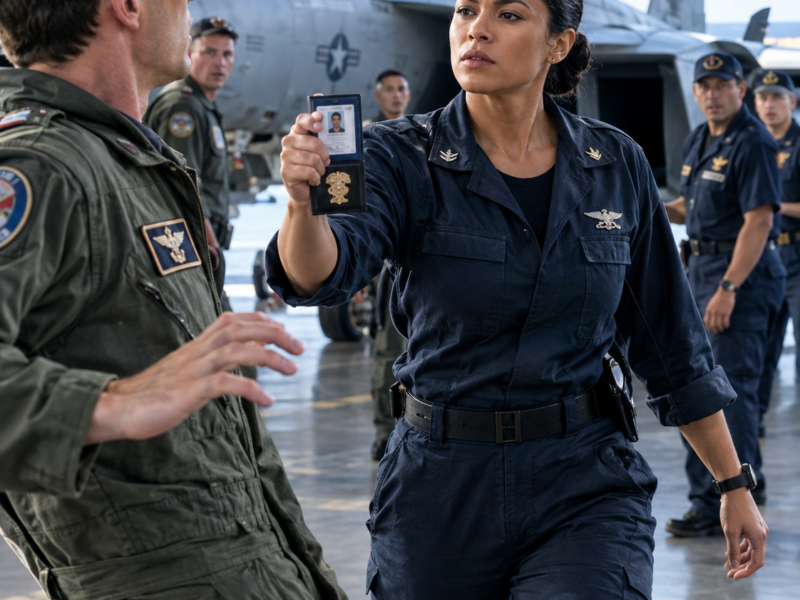
The entire briefing room went silent when Admiral Thomas Whitaker reached inside his jacke
The entire briefing room went silent when Admiral Thomas Whitaker reached inside his jacket.
Twenty armed officers watched him. Lieutenant Commander Blake Turner stood beside the conference table, his face drained of color. And I remained where I was, one hand resting on the black folder that contained enough evidence to destroy careers across the Navy.
My phone still displayed the anonymous message.
COMMANDER MORGAN, YOUR COVER IS BLOWN. CHECK THE ADMIRAL’S LEFT HAND.
I looked at Whitaker’s hand.
A silver ring caught the fluorescent light.
It bore no insignia I recognized, no name, and no visible serial number. But when the admiral withdrew his hand, I noticed a narrow strip of black material wrapped around his wrist.
My stomach tightened.
I’d seen that material before.
Three nights earlier, in a surveillance image taken outside a secure hangar shortly before an American reconnaissance aircraft disappeared over hostile waters.
The man in that image had worn the same black wristband.
I kept my expression neutral.
“Admiral, may I see your left hand?”
Whitaker stopped moving.
Blake stared at me as if I’d just committed professional suicide.
“Commander Morgan,” Whitaker said carefully, “is there a reason you’re asking?”
“Yes, sir. But I’d prefer to explain it after everyone has secured their phones and verified their identities.”
A murmur traveled around the table.
One officer shifted his chair. Another glanced toward the door.
Whitaker studied me for several seconds. Then, without protest, he placed both hands on the table.
“Everyone, power down your devices. Security personnel will collect them until this briefing is complete.”
Nobody moved.
His voice sharpened.
“That was an order.”
Chairs scraped against the floor. Phones were switched off and placed into a collection tray. Two security officers stationed outside the room entered and secured the door.
Blake remained standing.
“Admiral, surely we aren’t taking instructions from someone who hasn’t even explained why she’s here.”
I turned toward him.
“You’re right, Lieutenant Commander. I haven’t explained everything.”
I opened the black folder.
“But you haven’t explained why your credentials accessed a restricted maintenance terminal seventeen minutes before that aircraft disappeared.”
His face changed.
Only slightly.
A tightening around the eyes. A shallow breath. The kind of reaction most people missed because they were too busy listening to the words.
I didn’t miss it.
“That’s impossible,” he said.
“Then the access logs should clear you.”
“They will.”
“Excellent.”
I removed a printed report and placed it beside the photographs.
“Because the terminal recorded three attempts to disable the aircraft’s emergency beacon. The first two were rejected. The third used a valid authorization code.”
Blake looked down.
I watched his eyes move across the page.
“That code belonged to a senior systems officer,” I continued. “But the officer’s credentials were never physically presented at the terminal.”
Admiral Whitaker leaned forward.
“Are you suggesting someone cloned the authorization?”
“I’m suggesting we don’t know yet whether the code was stolen, duplicated, or deliberately issued. That’s why I need the original records preserved.”
Blake let out a strained laugh.
“This is ridiculous. We have enemy forces operating in those waters, and you’re accusing our own personnel because of a computer log?”
“No,” I said. “I’m investigating the possibility that someone inside our organization helped the enemy locate an American aircraft.”
The room fell quiet again.
I turned to the admiral.
“Sir, I’d also like to know why the original mission report classified the disappearance as hostile interference before the recovery team had examined the available evidence.”
Whitaker’s expression hardened.
“That decision came from intelligence assessments I received at the time.”
“From whom?”
He didn’t answer immediately.
That hesitation mattered more than any denial.
Before he could speak, one of the security officers approached the table.
“Admiral, we have a problem.”
Whitaker turned.
“What kind of problem?”
“The building’s internal access-control system has just registered an administrative override. Several restricted doors have been unlocked remotely.”
“Who authorized it?”
“We’re checking, sir.”
“Lock them down.”
“We attempted to. The system rejected the command.”
For the first time since entering the room, Whitaker looked genuinely unsettled.
I closed the folder.
“That’s why we need to stop treating this as a simple security breach.”
Blake looked from the admiral to me.
“Who are you, exactly?”
It was the question he’d asked himself when I first entered the room. Back then, he’d assumed my plain uniform, unmarked cap, and lack of visible insignia meant I was a cleaner who had wandered into a restricted briefing.
Now he seemed to understand that the answer might be considerably more dangerous to his career.
I met his eyes.
“Commander Rebecca Morgan. Naval Special Warfare.”
He scoffed, but the sound lacked conviction.
“That doesn’t explain why an admiral is taking orders from you.”
“No,” I replied. “It doesn’t.”
I glanced at Whitaker.
“Would you like to explain it, sir?”
The admiral stood.
Every officer in the room straightened instinctively.
“Commander Morgan has been assigned to a compartmented counterintelligence investigation under direct authorization from the Chief of Naval Operations. Her operational history and current mission details are restricted. You will not request, discuss, or attempt to obtain information beyond your clearance.”
He paused, allowing the words to settle.
“She is leading this investigation. I am supporting it.”
Blake’s face turned red.
“But she walked in here dressed like—”
“Finish that sentence,” Whitaker said, his voice suddenly cold, “and explain to me why you believe a person’s appearance determines their authority.”
Blake fell silent.
I could have reminded him that he’d threatened to have me escorted out. I could have repeated his remark about cleaning coffee that had never existed.
But humiliating him wasn’t the objective.
Finding the missing aircraft was.
“Admiral, we need to discuss the second photograph.”
I slid it toward Whitaker.
He looked down.
For a moment, nothing happened.
Then his fingers stopped against the paper.
The photograph showed Blake standing beside a man whose face was partially obscured by a baseball cap. The two were outside a restricted hangar, and the man held a small black case.
Whitaker studied the image longer than he should have needed to.
“You said this was taken three nights ago?”
“Yes, sir.”
“Where did you obtain it?”
“From a surveillance source whose identity I can’t disclose in this room.”
He looked up.
“And the person in the photograph?”
“We believe he has access to restricted military facilities. We haven’t confirmed his identity.”
Whitaker’s jaw tightened.
“Lieutenant Commander Turner, do you recognize him?”
Blake shook his head.
“No, sir.”
This time, he answered more slowly.
I placed a third image on the table.
It was a close-up of the man’s wrist.
The black band was unmistakable.
Whitaker’s left hand moved beneath the table.
I noticed.
So did the security officer standing behind him.
“Admiral,” I said quietly, “please keep your hands where we can see them.”
Whitaker looked at me.
For several seconds, neither of us spoke.
Then he raised his left hand and turned his wrist toward the light.
The black material was gone.
In its place was a pale indentation around his skin.
My pulse remained steady, but every instinct I’d developed over twelve years of high-risk assignments began sounding an alarm.
“Where is the wristband, sir?” I asked.
Whitaker didn’t answer.
Blake took one step backward.
“Admiral, I swear I didn’t know—”
“Didn’t know what?” I asked.
He looked at me with naked fear.
“That you were the one they’d sent.”
The words landed harder than he could have intended.
I turned toward him.
“Who sent me?”
He opened his mouth.
Then every light in the briefing room went out.
Someone shouted.
A chair crashed against the floor, and the emergency lighting flickered on, bathing the room in red.
From the corridor came the heavy sound of running boots.
The security officer nearest the door reached for his radio.
“Control, this is security. We have a power failure in the briefing wing. Confirm status.”
Static answered.
He tried again.
Nothing.
I pulled the black folder against my chest and moved away from the windows.
“Nobody opens that door,” I ordered. “Security, establish visual confirmation of everyone inside. No one leaves until we know what’s happening.”
One officer protested.
“Commander, with respect, we should evacuate.”
“Not until we know whether the emergency is real or a diversion.”
I looked at Whitaker.
He stood beneath the red light, motionless.
Then his expression changed.
Not fear.
Recognition.
He looked directly at me and whispered five words.
“You’re not supposed to survive.”
Before I could respond, the door handle began turning from the other side.
Slowly.
Deliberately.
Then a voice came through the intercom.
“Commander Morgan, stand away from the door. We’re here to take you into custody.”
I raised my eyes toward the speaker.
“Identify yourself.”
A pause.
Then the reply came.
“Special Investigations Unit. We have orders signed by Admiral Thomas Whitaker.”
Every face in the room turned toward the admiral.
Whitaker didn’t move.
I looked at the document tray, the darkened monitors, and the man who had welcomed me back with a salute.
Then I noticed something else.
The silver ring on his left hand was gone, too.
Someone had removed it while the room was dark.
And whoever stood outside that door had my name, my classified assignment, and an arrest order bearing the admiral’s authority.
My phone vibrated once inside my pocket.
Although every device in the room had supposedly been secured, mine had somehow received a message.
I glanced at the screen.
THE MAN BESIDE YOU IS NOT THOMAS WHITAKER.
A second message appeared beneath it.
YOUR REAL ADMIRAL WAS MURDERED SIX HOURS AGO.
I slowly lifted my eyes.
The man standing across from me smiled.
And for the first time that night, I understood that the most dangerous person in the briefing room might not be the one holding the gun.
It might be the one wearing the uniform.
The man wearing Admiral Thomas Whitaker’s uniform stood beneath the emergency lights, smiling as if the room belonged to him.
I kept my phone low beside the black folder.
YOUR REAL ADMIRAL WAS MURDERED SIX HOURS AGO.
The message offered no name, no evidence, and no explanation.
It could have been a warning.
It could have been bait.
Either way, I wasn’t going to let an anonymous text decide whom I trusted.
“Commander Morgan,” the voice outside the door repeated, “open this door immediately.”
The supposed admiral turned toward me.
“You heard them. Cooperate.”
I studied his face.
The haircut was right. The uniform fit. His voice carried the same measured authority I had heard during our earlier conversation.
But the real Whitaker had a habit of rubbing his thumb against his wedding ring whenever he was weighing a difficult decision.
This man had no ring.
And when he had raised his left hand earlier, the skin beneath his wrist had shown the faint indentation of something recently removed.
That alone proved nothing.
Together, however, the details demanded caution.
“Sir,” I said, “I’d like to verify the arrest order through an independent command channel.”
His smile disappeared.
“Are you refusing a direct order?”
“I’m requesting authentication before surrendering classified material.”
“You’re exceeding your authority.”
“Then the verification should clear everything up.”
The officers around the table watched us in absolute silence.
Lieutenant Commander Blake Turner looked as though he wanted to disappear into the floor.
The supposed admiral took a step toward me.
“Give me the folder, Commander.”
“No.”
His eyes narrowed.
I continued before he could answer.
“The folder contains evidence relating to a missing American aircraft, a potentially compromised maintenance system, and unauthorized access to restricted facilities. I won’t transfer it to an unverified individual.”
For one second, his expression revealed something beneath the polished military demeanor.
Hatred.
Then it vanished.
“Security will remove you.”
A heavy impact shook the door.
One of the officers flinched.
The security specialist inside the room raised a hand, signaling everyone to remain still.
“Commander, someone has disabled our internal communications,” he whispered. “I’m getting no response from the control station.”
I nodded.
“Keep everyone away from the door. Don’t engage anyone unless there’s an immediate threat.”
He acknowledged the instruction.
The man in the admiral’s uniform watched me with growing impatience.
“You seem to believe you’re untouchable.”
“No, sir.”
I held his gaze.
“I believe you want me to make a mistake.”
That struck a nerve.
He moved toward the conference table and reached for the black folder.
I pulled it away.
“Don’t touch that.”
His hand stopped inches from mine.
For the first time, the officers saw him hesitate.
And that hesitation changed the room.
Blake slowly straightened.
“Admiral,” he said, “perhaps we should wait for confirmation from headquarters.”
The man turned on him.
“You will remain silent.”
Blake swallowed.
“Yes, sir.”
But the doubt had already begun spreading.
I opened the folder and removed the original access report.
“Lieutenant Commander Turner, you said earlier that your credentials couldn’t have been used to access the maintenance terminal.”
“That’s correct.”
“Then tell everyone why the terminal recorded a successful authentication under your credentials seventeen minutes before the aircraft disappeared.”
He stared at the report.
“I don’t know.”
“Did you give anyone your access code?”
“No.”
“Did you authorize anyone to use your credentials?”
“No.”
“Then someone either obtained them without your permission or falsified the record. Both possibilities require an investigation.”
He looked up at me.
“Commander, I didn’t disable that beacon.”
I believed he was frightened.
I didn’t yet know whether he was innocent.
“Then help me establish what happened.”
The supposed admiral struck the table with his palm.
“Enough!”
The sound echoed through the room.
“This briefing is terminated. Commander Morgan will surrender the folder and accompany the investigators. Anyone interfering will face disciplinary action.”
Nobody moved.
That was the first real victory of the night.
Not because anyone had openly challenged him, but because trained officers had begun to understand that authority without verification was simply a demand for obedience.
The intercom crackled.
“Commander Morgan, you have thirty seconds to open the door.”
I looked toward the security specialist.
“Can you establish who is outside?”
“Not through the building system.”
“Then don’t open it.”
The supposed admiral reached inside his jacket.
Several officers shifted instinctively.
I raised one hand.
“Nobody move.”
He withdrew a small electronic device and placed it on the table.
A red indicator blinked steadily.
“Do you know what this is?” he asked.
I didn’t answer.
“It’s a security override. Every locked door in this wing can be opened with it.”
“Then why hasn’t the door opened?”
His smile returned.
“Because I’m giving you a chance to make the sensible decision.”
I looked at the device, then at the door.
He wanted the folder. He wanted me isolated. And he wanted the officers to believe that his authority was unquestionable.
I had seen this pattern before, in places where uniforms concealed loyalties and a single compromised person could endanger an entire team.
The important question wasn’t whether he could open the door.
It was why he needed me to surrender willingly.
I turned toward Blake.
“Who gave you the black case in that photograph?”
He shook his head.
“I can’t tell you.”
“Can’t or won’t?”
His eyes flicked toward the supposed admiral.
That was enough to tell me he was afraid of someone in the room.
“Blake,” I said, lowering my voice, “two men are already dead because someone compromised this operation. If you know something that could help us find the missing aircraft, now is the time to say it.”
He looked down at his hands.
Then he whispered, “The case contained a drive.”
“What was on it?”
“I don’t know. I was told it held updated flight data.”
“Who told you?”
He hesitated.
The supposed admiral began moving toward us.
Blake spoke quickly.
“A civilian contractor. He said the original mission plan had been changed and the aircraft needed a revised data package.”
“Name?”
“Marcus Vale.”
The name meant nothing to most people in that room.
To me, it meant everything.
Marcus Vale had appeared in a classified intelligence summary connected to a covert network suspected of selling military information. His name had been flagged months earlier, then inexplicably removed from the active investigation.
I looked at Blake.
“Did you report the contact?”
“No.”
“Why?”
“Because he showed me an authorization signed by the admiral.”
The room went silent.
Slowly, I turned toward the man in Whitaker’s uniform.
“Was that your signature?”
He stared at Blake.
Then he laughed.
It was a small, cold sound.
“You see, Commander? This is why investigations fail. People become frightened, they invent stories, and suddenly every routine decision becomes a conspiracy.”
He extended his hand toward me.
“Give me the folder.”
I didn’t move.
He leaned closer.
“You have no idea how many people have died because of this investigation.”
“Then perhaps you should tell me what happened to them.”
His expression hardened.
For a brief moment, the mask slipped completely.
“You were supposed to remain off the board.”
The words hung between us.
I felt the room react.
An officer near the wall looked at another officer. Blake lifted his head. The security specialist stopped watching the door and turned toward the admiral.
The man realized his mistake a second too late.
“Explain what you mean,” I said.
He straightened his uniform.
“I meant that your assignment should have remained confidential.”
“No. You said I was supposed to remain off the board. Who put me there?”
He said nothing.
I took one step closer.
“And how did you know about my assignment before the official briefing began?”
His eyes moved toward the door.
That was when the intercom crackled again.
A different voice came through.
Calm. Authoritative. Familiar.
“Commander Morgan, this is Rear Admiral Elena Shaw, Naval Intelligence. Do not surrender your documents. The individual claiming to be Admiral Whitaker is not authorized to command this facility.”
The room erupted in overlapping questions.
The supposed admiral went pale.
I raised my voice.
“Admiral Shaw, authenticate your identity and provide the current challenge response through an independent channel.”
A pause followed.
Then she supplied the correct response.
I recognized it.
So did the security specialist.
“Authentication confirmed,” he said.
I looked directly at the impostor.
“You’re relieved of authority pending verification. Step away from the table.”
For a moment, I thought he might comply.
Instead, he snatched the electronic override device from the table and pressed its central button.
The lights went out again.
A sharp electronic tone sounded.
The door locks disengaged.
And from the corridor came the unmistakable sound of multiple footsteps entering the briefing wing.
“Everyone stay where you are!” someone shouted.
The security specialist moved to protect the officers near the door.
I secured the folder beneath my arm and stepped away from the table, keeping the other personnel clear of the entrance.
When the emergency lights returned, the impostor was gone.
So was the override device.
The door stood open.
Two security officers entered, weapons lowered but ready. Behind them stood Rear Admiral Elena Shaw, her expression hard and focused.
She looked directly at me.
“Commander Morgan?”
“Yes, ma’am.”
“Is everyone accounted for?”
“Everyone in this room is accounted for. The individual impersonating Admiral Whitaker has left through the corridor.”
Shaw signaled to her security team.
“Seal the building. Preserve the access logs. Nobody enters or exits without verification.”
Then she turned toward the conference table.
“Commander, I need to see the evidence.”
I placed the folder in front of her.
She opened it, studied the photographs, and stopped at the image of Blake Turner beside Marcus Vale.
Her face changed.
“You’ve seen him before?” I asked.
She didn’t answer immediately.
Instead, she closed the folder and looked at the officers.
“This briefing room is now part of an active counterintelligence investigation. Everyone will be interviewed separately. Until further notice, no one discusses what happened here outside authorized channels.”
Then she motioned for me to follow her into the corridor.
I went with her, carrying nothing but my phone and the knowledge that someone had infiltrated a secure military facility using the identity of a dead or missing admiral.
We stopped outside an office guarded by two armed personnel.
Shaw waited until the door was closed before speaking.
“The real Admiral Whitaker was found dead in his residence six hours ago.”
The anonymous message had been true.
I felt the words settle heavily in my chest.
“How?”
“We don’t have a confirmed cause of death. The investigation is ongoing.”
“Who identified him?”
“His security detail.”
“Has the identification been independently verified?”
Shaw studied me.
“You’re asking the right questions.”
“Then you understand why I won’t accept an official conclusion without seeing the supporting evidence.”
She nodded once.
“That’s why I requested you for this assignment.”
I stared at her.
“You requested me?”
“Yes.”
“Then you knew Whitaker was in danger.”
“I knew there was a credible threat against senior personnel. I did not know he had already been killed.”
“Who else knew?”
Shaw glanced toward the office door.
“That’s what we’re trying to establish.”
She opened a secure cabinet and removed a sealed evidence pouch. Inside was a photograph of the missing reconnaissance aircraft, taken from a surveillance camera shortly before its final transmission.
The aircraft stood on the tarmac beneath the hangar lights.
A figure was visible beside the nose.
I leaned closer.
“Who is that?”
“We don’t know. The camera failed before we could obtain a clearer image.”
I studied the figure’s posture, the angle of the shoulders, and the distinctive watch on the person’s wrist.
Then I looked up.
“Admiral, I need you to check something for me.”
“What?”
“Whether Admiral Whitaker wore a watch with a dark face and a broken silver clasp.”
Shaw’s expression shifted.
“Why?”
I pointed to the photograph.
“Because the person standing beside that aircraft is wearing one.”
She examined the image again.
Then she reached for her phone.
Before she could make the call, my own phone vibrated.
Another message.
No number. No sender.
Just a photograph.
It showed a man lying on a hospital bed, his face pale, a bandage crossing his forehead.
I knew him.
Captain Daniel Morgan.
My older brother had disappeared during a classified maritime operation seven years earlier. The Navy had declared him dead after an unsuccessful search.
I had never believed the official account.
Beneath the photograph were twelve words:
YOUR BROTHER IS ALIVE. ASK SHAW WHY SHE ORDERED HIS TRANSFER TONIGHT.
I looked up slowly.
Rear Admiral Shaw was watching me.
And from the expression on her face, I knew she had seen the message before I had.
For seven years, I had carried the memory of my brother’s final phone call.
Daniel had called me two nights before his operation, sounding tired but strangely cheerful. He asked whether I was still planning to take leave that summer. I told him I hadn’t decided.
He laughed.
“You always wait until the last possible second, Rebecca.”
“Someone has to make sure you don’t get yourself killed.”
“That’s my job, little sister.”
It was the last time I heard his voice.
Three days later, the Navy informed our family that his team had vanished during a classified maritime operation. Weeks passed without a recovery. Eventually, the official report declared him dead.
Now I was standing in a secure office at Norfolk, looking at a photograph of a man who appeared to be my brother.
And the admiral beside me knew something about it.
“How long have you known Daniel was alive?” I asked.
Rear Admiral Elena Shaw didn’t look away.
“I can’t confirm that the person in the photograph is your brother.”
“That wasn’t my question.”
“Commander, I understand this is personal.”
“No, ma’am. Personal is what happens when a family spends seven years grieving someone the Navy says is dead. This is an investigation.”
She studied me in silence.
I placed my phone on the desk, displaying the anonymous message.
“Someone knows about my assignment, the death of Admiral Whitaker, and a supposedly dead officer’s location. They also know which records to manipulate to make those deaths appear legitimate.”
Shaw folded her arms.
“You’re suggesting the same network is responsible for all three cases.”
“I’m suggesting we stop assuming they’re unrelated.”
She moved to the office door and checked the corridor before returning.
“Daniel Morgan was assigned to a special maritime intelligence operation seven years ago. The mission was classified at the highest level. When his team failed to report, the Navy initiated a recovery effort.”
“I know the official version.”
“The official version may not contain the whole story.”
“Then give me the rest.”
She hesitated.
“Two weeks after the operation, an intelligence analyst reported irregularities in the mission’s communications records. Several transmissions had been altered. The analyst requested an investigation, but the request was withdrawn before it reached the review board.”
“Who withdrew it?”
“The authorization came from a senior command office.”
“Whose office?”
“I don’t know.”
I stared at her.
“You’re asking me to investigate a compromised command structure while withholding the names of the people who may have compromised it.”
“I’m trying to keep you alive long enough to finish the investigation.”
The words were quiet, but they carried a weight I couldn’t ignore.
Before I could respond, Shaw’s secure phone rang.
She answered, listened briefly, and turned toward me.
“Security has recovered the corridor footage from the briefing wing.”
“Did they identify the impostor?”
“Not yet. The cameras recorded the individual entering the building, but his access credentials belonged to Admiral Whitaker.”
“His real credentials?”
“Apparently.”
I shook my head.
“Then either the system has been compromised or someone authorized the access before Whitaker died.”
Shaw ended the call.
“There’s something else. The impersonator left the facility through a restricted passage that should have been inaccessible without a physical security key.”
“Did he use one?”
“The access log says yes.”
“Whose key?”
She looked at me.
“Yours.”
For a moment, I said nothing.
My credentials had been issued under strict controls. I had not entered that passage, and I had never authorized anyone to use my key.
Someone had either duplicated my credentials or deliberately placed them in the system to implicate me.
“Preserve the log,” I said. “And make sure nobody modifies the original.”
“Already done.”
“Then we need the physical access records, the camera footage, and the maintenance history for that passage.”
Shaw nodded.
“I’ve requested all three.”
A knock interrupted us.
A young intelligence officer entered carrying a sealed tablet.
“Admiral, we recovered a message from the aircraft’s maintenance network. It was transmitted shortly before the disappearance.”
Shaw took the tablet.
“Was the sender identified?”
“No, ma’am. The transmission originated from a terminal inside the base, but the account used to authenticate it was inactive.”
“Inactive since when?”
The officer checked his notes.
“Seven years ago.”
I felt a chill travel through me.
“Whose account?”
He looked at me.
“Captain Daniel Morgan’s.”
Nobody spoke.
The officer placed the tablet on the desk and withdrew.
I read the transmission.
It contained only a short instruction directing personnel to replace a data package before the aircraft’s scheduled departure. No name. No explanation. Just a reference number tied to a restricted operational file.
The timestamp was clear.
The account had been used hours before the aircraft vanished.
“Someone is using Daniel’s credentials,” I said.
Shaw nodded.
“Or someone has kept his account active without authorization.”
“Can we trace the terminal?”
“We’re working on it.”
“Then I want the original device isolated and preserved.”
She gave me a measured look.
“You don’t waste time.”
“Time is what the people responsible are counting on us to lose.”
For the first time, Shaw almost smiled.
Then the expression disappeared.
“Commander, there’s another reason I requested you for this assignment.”
She opened a second cabinet and removed a thin paper file.
The cover bore a classification marking and a single reference number.
OPERATION NIGHT HARBOR.
I recognized the name.
It had appeared in Daniel’s last mission briefing, buried in a list of unrelated operational references. At the time, I had assumed it was a routine administrative designation.
Shaw placed the file in front of me.
“Night Harbor was the operation your brother was supporting when his team disappeared.”
I opened it.
Most of the pages had been redacted. Several documents were missing entirely. But one page contained a list of personnel authorized to access the operation’s communications system.
The final name made my fingers go still.
THOMAS WHITAKER.
Below it was a handwritten note.
AUTHORIZATION SUSPENDED — PENDING REVIEW.
The date was seven years old.
“Why was Whitaker’s authorization suspended?” I asked.
Shaw shook her head.
“The supporting report is missing.”
“Who removed it?”
“We don’t know.”
I turned another page.
A second handwritten note appeared beside an access entry.
DO NOT RESTORE UNTIL MERCER IS LOCATED.
I read it twice.
“Who is Mercer?”
Shaw’s expression changed.
“That name was not included in the original personnel roster.”
“Then why is it here?”
“I was hoping you could help us find out.”
Before I could answer, the office lights flickered.
The tablet on the desk emitted a brief alert.
Then the screen went black.
Shaw reached for her phone.
“No signal.”
I checked mine.
Nothing.
A moment later, a loud announcement echoed through the building.
“Security lockdown in effect. All personnel remain in their current locations. This is not a drill.”
Shaw moved toward the door.
I caught her arm.
“Wait.”
She looked at me.
“What’s wrong?”
“The announcement came through the building’s emergency system, but the lights haven’t switched to the independent backup circuit. If this were a genuine facility-wide power failure, we should have seen the change already.”
She stopped.
“You think it’s a false alarm?”
“I think we need confirmation before moving.”
We waited.
Seconds passed.
Then the announcement repeated, word for word, in exactly the same tone.
I exchanged a glance with Shaw.
A genuine emergency announcement could repeat. But the timing, the loss of communications, and the sudden blackout were becoming difficult to dismiss as coincidence.
“Admiral,” I said, “we need to verify the lockdown through an independent channel.”
She nodded and reached for a secure handset mounted inside the cabinet.
Before she could use it, a voice sounded through the office intercom.
“Rear Admiral Shaw, report to the east security checkpoint immediately. Commander Morgan is to remain in custody.”
Shaw froze.
“That order didn’t come from my command.”
The intercom crackled.
Then another voice spoke.
This one was unmistakably familiar.
“Rebecca?”
My heart stopped.
It was Daniel.
Older, perhaps. Weaker. But unmistakably my brother.
“Rebecca, if you can hear me, listen carefully. You have to get out of that building.”
I stepped toward the intercom.
“Daniel? Where are you?”
Static swallowed the channel.
Then his voice returned.
“Don’t trust the woman standing beside you.”
I turned toward Shaw.
Her face had gone pale.
The intercom clicked.
Daniel spoke one last time.
“She knows what happened at Night Harbor. She knows why Whitaker died. And she knows why they sent you here.”
The transmission ended.
I stared at Shaw.
She didn’t attempt to deny it.
Instead, she reached into her jacket and placed a small brass key on the desk.
“Your brother gave me this six hours ago,” she said.
I looked at the key.
“What does it open?”
“A room beneath the old maritime operations building.”
“Why didn’t you tell me?”
“Because Daniel told me not to trust anyone until I could verify who was controlling the investigation.”
“Then why should I trust you now?”
She pushed the key toward me.
“You shouldn’t. Not yet.”
For several seconds, neither of us moved.
Then she added, almost in a whisper:
“But if you want to know who ordered your brother’s death, you need to see what’s inside that room.”
A heavy impact sounded somewhere down the corridor.
Then another.
Someone was trying to force open a secured door.
Shaw looked toward the office entrance.
“We have to move.”
I took the key.
Not because I trusted her.
Because every lead we had was pointing toward the same hidden operation, and the people trying to stop us were becoming increasingly desperate.
As we reached the door, my phone vibrated.
The signal had returned.
One new message waited on the screen.
NIGHT HARBOR WAS NEVER A RESCUE MISSION.
A second message appeared.
IT WAS A LIST OF EVERYONE WHO NEEDED TO DISAPPEAR.
Below it was a photograph of the old maritime operations building.
Someone had circled a door on the lowest level.
And beneath the image were three words that turned my blood cold.
YOUR NAME IS NEXT.
I slipped the phone into my pocket and tightened my grip on the brass key.
Whatever waited beneath that building, it had been hidden for seven years.
And now someone was willing to kill again to keep it buried.
The old maritime operations building had been closed for six years.
Officially, the structure was awaiting renovation. Its outdated communications equipment had been removed, its offices reassigned, and its underground levels sealed after a water leak damaged part of the electrical system.
But when Rear Admiral Elena Shaw and I reached the service corridor behind the building, I saw fresh scratches around the access panel.
Someone had opened it recently.
Shaw checked the corridor behind us.
“We have approximately ten minutes before the security team reaches this section.”
“Your security team?”
“I hope so.”
That answer told me everything I needed to know about how little control either of us had over the situation.
I took out the brass key.
“What’s behind this door?”
“An archive room. Your brother discovered it shortly before he disappeared.”
“And you left it sealed for seven years?”
“I tried to access it twice. Both attempts triggered alerts inside a system I wasn’t supposed to know existed.”
“Who stopped you?”
“I never identified the person. Each time, I received a direct order from a senior command office telling me to discontinue the investigation.”
I looked at her.
“And you obeyed?”
Her expression tightened.
“Yes.”
It wasn’t the answer I wanted. But at least it was honest.
I inserted the key.
The lock turned with a heavy metallic click.
Beyond the door, a narrow stairwell descended into darkness. The air smelled of damp concrete, old wiring, and stagnant water. I switched on my flashlight and started down.
Shaw followed.
At the bottom, we found a steel door with a keypad and a small biometric reader. The keypad was dark, but the reader still had power.
I examined the panel without touching it.
“Someone maintained this system.”
Shaw nodded.
“Which means this room was never truly abandoned.”
I tried the brass key in a secondary lock beneath the reader.
It turned.
The door opened.
Inside stood rows of locked cabinets, a desk covered with dust, and several computer terminals that should have been obsolete. One monitor glowed faintly in the far corner.
A single file lay in the center of the desk.
My name was printed across its cover.
COMMANDER REBECCA MORGAN — NIGHT HARBOR CONTINGENCY FILE.
I felt my throat tighten.
“How long has this been here?”
Shaw looked at the file.
“I don’t know.”
I opened it.
The first page contained my service history. The second contained a summary of my special operations assignments. The third included a photograph of my family taken outside our home when Daniel and I were teenagers.
Someone had marked my face with a red circle.
Beneath it, a typed sentence read:
SUBJECT MAY BECOME A LIABILITY IF EXPOSED TO ORIGINAL OPERATIONAL RECORDS.
I turned the page.
A list of names followed.
Some belonged to officers I recognized. Others were unfamiliar. Several entries had been crossed out in black ink.
At the bottom of the list were two names.
CAPTAIN DANIEL MORGAN — STATUS: UNRESOLVED.
ADMIRAL THOMAS WHITAKER — STATUS: TERMINATED.
I stared at the second entry.
The file had been prepared before Whitaker’s death was publicly confirmed.
“Admiral,” I said, “someone anticipated Whitaker’s death.”
Shaw leaned over my shoulder.
“Or someone wanted us to believe they did.”
I looked at the date printed in the corner.
The file had been updated less than twenty-four hours earlier.
A sound came from the corridor.
Footsteps.
Shaw killed her flashlight.
We stood in darkness, listening as the footsteps approached the door, stopped, and then continued past it.
Only when they faded did she speak.
“We need to copy the contents and leave.”
I nodded.
The glowing monitor flickered as I approached. Its screen displayed a directory of archived mission records. Most files were locked, but one folder was open.
NIGHT HARBOR — ORIGINAL RECORDINGS.
I selected it.
A video appeared.
The image showed a room I didn’t recognize, with a long table, several uniformed officers, and a man standing beside a wall-mounted display.
Then the camera angle shifted.
Daniel entered the room.
He looked younger than he did in the photograph on my phone. His uniform was immaculate, his expression serious.
An officer at the table spoke.
“Captain Morgan, are you certain the mission data was altered?”
Daniel nodded.
“I compared the original transmission with the version uploaded to the operational archive. The changes were deliberate.”
“Could they have resulted from a technical error?”
“No, sir. The discrepancies affect the aircraft’s route, the timing of its departure, and the emergency communication settings.”
The officer leaned back.
“Who had access to the original plan?”
Daniel hesitated.
“Several people. But only a handful had the authority to approve the changes.”
“Names.”
Daniel looked directly at the camera.
“Admiral Whitaker. Commander Vale. And the officer who signed the final authorization.”
The recording froze.
A new message appeared.
PLAYBACK INTERRUPTED — ACCESS REVOKED.
I stared at the screen.
“Commander Vale,” I murmured. “Marcus Vale.”
Shaw nodded slowly.
“That connects him to both the missing aircraft and Night Harbor.”
“But not necessarily to the person impersonating Whitaker.”
“Correct.”
The monitor flickered again.
A second video opened automatically.
This time, Daniel was alone.
His face was bruised. His collar was torn. He looked directly into the camera with the exhausted expression of a man who had been awake for far too long.
“Rebecca, if this recording reaches you, I need you to understand something.”
I stopped breathing.
“Don’t trust the official story. Night Harbor wasn’t a failed operation. It was a controlled disappearance designed to remove personnel who had discovered a compromised intelligence network.”
Daniel glanced over his shoulder.
“They used false mission orders, manipulated communications, and buried the evidence beneath classified reporting procedures. Some people were killed. Others were moved into facilities where their identities could be erased.”
He leaned closer to the camera.
“I found the original authorization list. It contains the names of the people who approved the operation, the people who carried it out, and the people who covered it up afterward.”
He paused.
“One of those names belongs to someone you still trust.”
The recording ended.
For several seconds, I couldn’t move.
Then I replayed the final section.
One of those names belongs to someone you still trust.
I turned toward Shaw.
She was watching me carefully.
“Did Daniel tell you who he meant?”
“No.”
“Did he give you the authorization list?”
“Not directly.”
“Then how did you obtain the key?”
She looked down.
“Daniel contacted me six hours ago through an intermediary. He said the archive would be opened soon, whether I was ready or not.”
“Why tonight?”
“Because he believed someone had discovered that he was alive.”
A sharp metallic bang echoed above us.
Then came the sound of a door slamming.
Shaw pulled her phone from her pocket.
“No signal.”
Mine had none either.
I moved to the monitor and searched the directory for the authorization list. A file appeared beneath the recording.
Its title was simple.
FINAL APPROVAL — NIGHT HARBOR.
I opened it.
The document contained three digital signatures and a final authorization stamp.
The first signature belonged to Marcus Vale.
The second belonged to a senior intelligence official whose name had been redacted.
The third was fully visible.
REAR ADMIRAL ELENA SHAW.
I turned slowly.
Shaw had gone pale.
“I can explain.”
“Then explain.”
“I signed a preliminary authorization for a maritime intelligence operation. I was told the mission was designed to identify a security breach, not eliminate witnesses.”
“You signed the order that sent my brother into that operation.”
“I signed an authorization that was later altered.”
“Do you have proof?”
She looked at the document.
“No. Not yet.”
The answer hurt more than a denial would have.
For seven years, I had imagined countless ways to discover what happened to Daniel. I had expected lies, missing records, and people who would refuse to cooperate.
I hadn’t expected the person helping me investigate to appear on the authorization list.
I stepped away from her.
“Don’t move.”
“Rebecca—”
“Don’t.”
She stopped.
I wanted to believe she had been manipulated. I wanted to believe her signature had been stolen, copied, or attached to a document she had never approved.
But wanting something didn’t make it true.
The monitor emitted a short alert.
A new file had appeared.
LIVE CONNECTION ESTABLISHED.
The speakers crackled.
Then Daniel’s voice filled the archive room.
“Rebecca?”
I moved toward the monitor.
“Daniel, where are you?”
“There’s no time. You found the file.”
“Yes. I found your recording. I need to know whether Shaw was involved.”
Silence.
Then he answered.
“She signed the original authorization. But she didn’t know what it would become.”
Shaw closed her eyes.
Daniel continued.
“Marcus Vale changed the mission parameters after the authorization was issued. He used the approval chain to make the altered orders look legitimate. When I discovered it, they tried to make me disappear.”
“Who are they?”
“The people behind Night Harbor.”
“Names, Daniel. I need names.”
“I can’t give them to you over this connection.”
The monitor flickered.
“They’re inside the base, Rebecca. They’ve been watching you since you arrived. They knew you would find the archive.”
A loud impact shook the steel door.
Someone was trying to open it.
Daniel’s voice grew urgent.
“Listen carefully. There is a second file. It contains the original authorization trail and the identities of everyone who accessed the system after my disappearance.”
I searched the directory.
A folder appeared.
NIGHT HARBOR — ORIGINAL AUTHORIZATION TRAIL.
I clicked it.
The screen demanded a second credential.
“Daniel, I need the access code.”
He hesitated.
“Your service number.”
I entered it.
The file opened.
Names filled the screen.
I scanned the list, looking for Vale, Whitaker, and Shaw.
Then I found the final entry.
The person who had accessed the archive less than an hour before I arrived.
The person who had approved the impersonator’s credentials.
The person who had ordered the building lockdown.
My blood turned cold.
The name belonged to the officer who had personally recommended me for the assignment.
ADMIRAL ELENA SHAW.
I looked up.
Shaw stood motionless beside the desk.
“Tell me that’s a forged record,” I said.
She didn’t answer.
The steel door shook again.
A voice sounded from the other side.
“Commander Morgan, step away from the terminal. You are being detained for unauthorized access to classified military records.”
I kept my eyes on Shaw.
“Did you know they were coming?”
She swallowed.
“Yes.”
The admission landed like a blow.
“Why?”
“Because I received the same order you did.”
“From whom?”
She looked at the monitor.
Daniel’s face appeared briefly through the interference.
Then he spoke.
“Rebecca, get out of there. Shaw isn’t the one controlling the operation.”
The screen went black.
A final message appeared.
PRIMARY AUTHORIZATION HOLDER IDENTIFIED.
Below it was a name I had never expected to see.
COMMANDER REBECCA MORGAN.
Someone had used my credentials to authorize Night Harbor.
Someone had placed my name at the top of the chain of command.
And now, as the steel door began to open, I understood the real purpose of the archive.
It wasn’t simply a record of what had happened to my brother.
It was evidence designed to make me look responsible for everything.
The people outside weren’t coming to arrest me because I had uncovered the truth.
They were coming because someone had already written the story in which I was the villain.
And they intended to make sure I never got the chance to tell my side.
The steel door burst inward.
Three armed security personnel entered the archive room, followed by a man in a black civilian jacket. His identification badge hung backward, concealing its details.
“Commander Rebecca Morgan,” the lead officer announced, “step away from the terminal and place your hands where we can see them.”
I didn’t move toward the computer.
I didn’t reach for anything.
I simply raised my hands and looked at the officer.
“Before I comply, verify your orders through Naval Intelligence. This facility’s access records have been compromised.”
“The orders have already been verified.”
“By whom?”
He glanced at the civilian.
That small movement told me more than his answer would have.
“Step away from the terminal,” he repeated.
Rear Admiral Shaw moved beside me.
“These orders are irregular. I’m requesting confirmation from headquarters.”
The civilian smiled.
“Admiral, your authorization has been suspended pending investigation. You will accompany us as well.”
Shaw stared at him.
“Identify yourself.”
“Special Investigations.”
“That isn’t an identity.”
The man’s smile vanished.
For several seconds, the room became a contest of stillness. The security personnel held their positions, uncertain whether the situation had changed or whether they were simply waiting for someone else to make the first mistake.
I understood what the impostors wanted.
They needed us separated, the archive secured, and the records removed before anyone outside their network could verify them.
I also understood that I couldn’t solve the problem by turning a suspicious situation into an armed confrontation.
“All right,” I said calmly. “We’ll cooperate once the orders are authenticated through an independent channel.”
The civilian shook his head.
“There won’t be an independent channel.”
“Then you have a problem.”
His expression hardened.
“What’s that?”
“You expect me to believe that a legitimate investigation would prohibit independent verification of its own arrest orders.”
He looked toward the lead officer.
“Take her into custody.”
The officer hesitated.
It lasted only a moment, but it was enough.
Then a loudspeaker crackled above us.
“All security personnel, stand down. This is Rear Admiral Elena Shaw. The detention order has not been independently authenticated. Maintain your positions and await verified instructions.”
The civilian turned sharply toward the ceiling.
“Disable that system!”
Nobody moved.
Shaw looked at the lead officer.
“You heard the announcement. Verify my identity through the command channel.”
The officer reached for his radio.
The civilian grabbed his arm.
“Don’t.”
That single word destroyed whatever credibility he had left.
The officer pulled free.
“Sir, I need to confirm the order.”
“You need to follow it.”
“Not without authentication.”
The civilian stepped backward.
I watched him carefully.
He wasn’t frightened of being arrested. He was frightened of losing control of the situation.
And then I recognized him.
Not from his face.
From the photograph in the archive.
He was Marcus Vale.
The man Blake Turner had claimed was carrying the black case. The contractor connected to the altered flight data. The name that had appeared in Daniel’s recording.
“Marcus Vale,” I said.
His eyes snapped toward me.
“You’re making a mistake.”
“No. I’m correcting one.”
He turned toward the door.
Two additional security personnel appeared in the corridor, accompanied by an intelligence officer I recognized from the briefing room.
“Mr. Vale,” the officer said, “please remain where you are.”
Vale looked from one officer to the next.
Then he laughed.
“You think this ends with me?”
Nobody answered.
He slowly raised his hands.
“You have no idea how many people signed those orders.”
“Then we’ll ask them,” I replied.
The officers secured Vale and escorted him from the room. The remaining personnel verified Shaw’s identity and confirmed that the detention order had not been issued through the authorized chain of command.
For the first time that night, we had something stronger than suspicion.
We had a suspect in custody.
But we still didn’t know where Daniel was.
I returned to the terminal.
The screen had gone dark, but the authorization file remained saved on the system. I instructed the technical team to preserve the original records and create verified copies under independent supervision.
Shaw stood beside me.
“Rebecca, I need to tell you something.”
I didn’t look at her.
“Then tell me.”
“When Daniel contacted me six hours ago, he said the network would attempt to frame whoever opened this archive. He believed they had already prepared a false authorization trail.”
“And you let me walk into it.”
“I thought I could protect you.”
“You could have told me the truth.”
“I was afraid the communication was compromised.”
I finally turned toward her.
“Then you should have said that. Trust isn’t built by withholding the information someone needs to make an informed decision.”
She accepted the criticism without protest.
“You’re right.”
It wasn’t enough to erase her signature from the file. It wasn’t enough to restore seven years of Daniel’s life.
But it was a beginning.
A communications officer entered the room carrying a secure handset.
“Commander Morgan, we’ve established a verified connection. There’s an incoming call from a protected location. The caller has passed the authentication checks.”
My heart began pounding.
“Put it through.”
The speaker crackled.
Then I heard the voice I’d spent seven years trying not to forget.
“Rebecca?”
I gripped the edge of the desk.
“Daniel.”
For a moment, neither of us could speak.
Then he laughed softly, a tired, broken sound that made my eyes sting.
“You always did take your time answering the phone.”
I closed my eyes.
“And you always did choose the worst possible moments to make jokes.”
“Some things don’t change.”
“Where are you?”
“I can’t give you the exact location yet. The people who held me may still have access to the tracking system.”
“Are you safe?”
A pause.
“I’m alive. That’s the best answer I can give you right now.”
I pressed my lips together, trying to keep my voice steady.
“Daniel, I found the authorization file. Your name, Whitaker’s name, Shaw’s name. Everything.”
“Then you know Night Harbor wasn’t a rescue mission.”
“I know it was designed to erase people.”
“And I know who ordered it.”
The room seemed to grow quieter.
“Who?”
“Marcus Vale was only the courier. He moved information, manipulated records, and helped maintain the false trail. But he wasn’t the person at the top.”
“Then give me the name.”
“I will. But first, you need to understand something. The operation didn’t end seven years ago. It changed names. The same network has been using the Navy’s security systems to control mission records, bury investigations, and remove anyone who gets too close.”
I looked toward Shaw.
She was listening, her expression grave.
“Why was I assigned to this investigation?” I asked.
“Because you were one of the few people they couldn’t easily control. You had the operational experience, the security clearance, and the reputation to challenge the official story.”
“Then why frame me?”
“Because they knew you’d find the archive. They wanted your credentials attached to the evidence before anyone could verify it.”
I stared at the authorization trail on the screen.
“And the person at the top?”
Daniel’s breathing changed.
“Rebecca, the person who signed the final authorization is—”
The line went dead.
“Daniel?”
Nothing.
“Daniel, can you hear me?”
The communications officer checked the handset.
“We’ve lost the connection.”
I looked at Shaw.
“Restore it.”
“We’re trying.”
“Try another route.”
The officer shook his head.
“The protected location has gone offline.”
I felt the familiar coldness settle into my chest.
Not again.
I had found my brother only to lose his voice a second time.
But there was one difference now.
This time, I had evidence.
And I had witnesses.
Within the hour, independent investigators had secured the archive, taken custody of Vale, and begun examining the altered records. Blake Turner was placed under investigation, but his cooperation and the evidence against him would be evaluated separately. No one would be declared guilty simply because their name appeared in a compromised file.
Admiral Whitaker’s death investigation was reopened. The suspicious access logs, false credentials, and unauthorized detention order were preserved for review.
Shaw submitted herself for questioning about her signature on the original Night Harbor authorization.
She did not ask for special treatment.
Neither did I.
By sunrise, the storm had passed over Norfolk.
I stood outside the operations building, watching pale light spread across the wet pavement. The base was waking up around me. Vehicles moved between buildings. Sailors crossed the roadway with coffee cups in their hands. Somewhere beyond the hangars, aircraft engines began their morning routines.
The world looked ordinary again.
It wasn’t.
My phone vibrated.
One new message had arrived from an unknown number.
This time, it contained no photograph.
Only a short sentence.
YOU HAVE THE WRONG MAN. LOOK AT THE FINAL SIGNATURE.
I opened the authorization file again.
The document displayed three signatures and a digital approval stamp. Vale’s name was there. Shaw’s name was there. My own credentials had been inserted into the chain.
But the final signature had been obscured by a corrupted data block.
The investigators had been unable to recover it.
I enlarged the section.
At first, I saw nothing.
Then I noticed a faint line beneath the corrupted block. It was a reference to an older authorization document, filed under a separate classification number.
I entered the reference into the authorized search system.
A result appeared.
NIGHT HARBOR — ORIGINAL COMMAND AUTHORIZATION.
The document opened.
The first page listed the operation’s objectives. The second contained the original approval chain.
I scrolled to the final signature.
And stopped.
The authorization had been signed by a person who had supposedly died during a training accident eleven years earlier.
A person whose death had been investigated, certified, and recorded by the same military office that had declared my brother dead.
The name on the screen was unmistakable.
ADMIRAL THOMAS WHITAKER.
But this was not the signature from the document that had been used to frame me.
It was the original.
And beneath it was a handwritten note, dated two days before Night Harbor began.
IF THIS OPERATION FAILS, DO NOT TRUST THE PERSON WHO RETURNS.
I read the sentence again.
Then my phone rang.
The caller identification displayed a blocked number.
I answered.
A man’s voice spoke quietly.
“Commander Morgan?”
“Who is this?”
“You’ve done well.”
“Give me your name.”
A brief silence followed.
Then he said, “You want to know who ordered Night Harbor. You want to know who kept your brother alive. And you want to know why the Navy buried the truth.”
“Yes.”
“Then stop looking at the people who signed the documents.”
I stared at Whitaker’s original signature.
“Where should I look?”
The man gave a quiet, humorless laugh.
“Look at the person who taught you how to recognize a forged order.”
My breath caught.
There was only one person who had taught me that lesson.
My father.
Before I could speak, the caller added one final sentence.
“Your brother isn’t the only Morgan who survived Night Harbor.”
The line went dead.
I stood motionless in the morning light, the phone pressed against my ear.
For seven years, I had believed my family had been reduced to memories, unanswered questions, and a photograph of a missing brother.
Now I had reason to believe the official record had lied about all of us.
And somewhere beyond the walls of Norfolk Naval Station, someone knew the truth.
Someone who had been waiting for me to find it.
THE END — FOR NOW.









