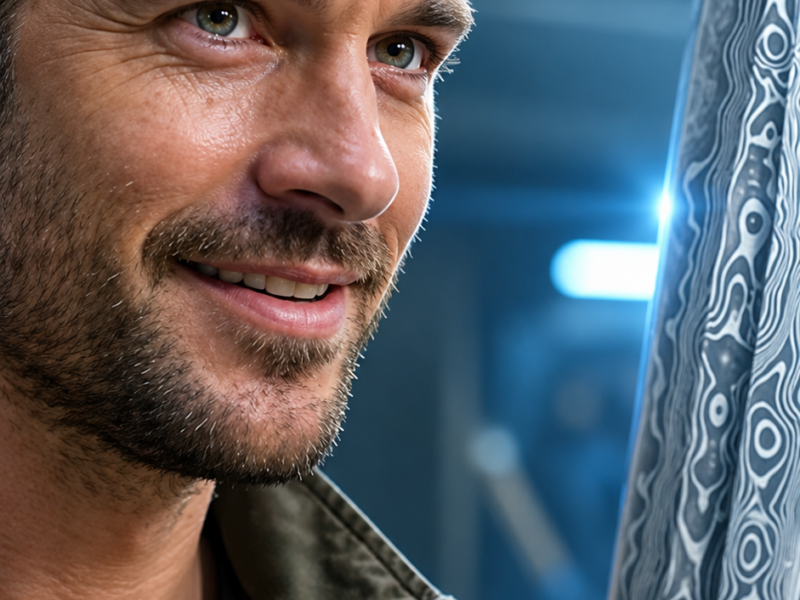
The entire alien weapons council fell silent when I placed my Damascus steel blade on their examination table
The air inside the Veyrath flagship’s primary metallurgical laboratory smelled sharply of ozone, ionized plasma, and hot Montana coal. It was a bizarre, intoxicating blend that seemed to hang suspended in the artificial gravity of the massive alien cruiser. Around the perimeter of the reinforced observation deck, forty of the most brilliant weapons engineers, molecular physicists, and high-ranking military commanders in the Galactic Coalition stood behind shimmering blue containment shields, watching my father’s face as if he were a prophet who had just spoken a forbidden truth.
Dad didn’t look like a prophet. He looked like a retired machinist from Bozeman whose flannel shirt was damp with sweat and whose calloused knuckles were blackened with forge soot. Yet, as he held the small, transparent stasis cylinder in his trembling, oil-stained hands, the entire room felt as though the temperature had dropped thirty degrees.
Inside the cylinder floated a jagged, three-inch shard of blackened, meteoric alloy. Even through the distortion of the containment field, I could see the distinct, hypnotic swirl of microscopic ripples etched into its surface—a pattern of tight, concentric teardrop whorls interrupted by a single, razor-straight diagnostic line running down the spine of the metal.
Commander Vael took another slow step backward, his four golden eyes widening beneath the heavy ridge of his brow. His clawed hand drifted instinctively toward the ceremonial plasma emitter holstered at his hip, though he stopped himself before his fingers touched the grip.
“Explain your statement, Master Craftsman,” Vael commanded, his deep, resonant voice vibrating through the laboratory’s translation matrix with a sudden, unmistakable tremor. “How could your progenitor have fabricated this alloy prior to your species achieving orbital flight? Our dating telemetry places the wreckage of that vessel at three hundred and forty standard galactic cycles old. By your own historical archives, humanity was still utilizing chemical combustion engines on a single world at that time.”
Dad didn’t answer the alien commander right away. He kept staring at the black fragment, turning the stasis cylinder slowly between his thumb and forefinger. The easygoing, humorous warmth that had carried him through three days of alien hospitality—from drinking bitter Veyrath synthetic broth to explaining how a ball-peen hammer worked to a stunned admiral—had completely vanished. His jaw was set like granite, and a muscle ticked beneath his gray beard.
“Son,” Dad said quietly, his voice rough and tight, “come here and look at this.”
I stepped past the elderly silver-robed scientist, Doctor Kaelen, and walked up beside my father near the makeshift induction forge the Veyrath technicians had rigged up according to his sketches. I leaned in, squinting through the clear polymer of the stasis cylinder.
“It looks like your feather-pattern Damascus, Dad,” I murmured, keeping my voice low so the sensitive audio pickups along the observation gallery wouldn’t catch every word. “Except the steel is pitch black.”
“Look closer at the base of the tang,” Dad whispered, tapping a thick, soot-stained fingernail against the cylinder wall. “Right where the blade meets the handle.”
I squinted harder. There, nestled inside a tiny, crescent-shaped swirl of folded metal, was a microscopic stamped mark—no larger than the head of a pin—formed by three intersecting triangles inside a circle.
My breath caught in my throat. I knew that mark. Every single hunting knife, wood-splitting axe, and custom Bowie blade my grandfather had ever forged in his old barn outside Helena bore that exact maker’s stamp. He had hand-carved the steel punch himself out of an old railroad spike in 1954.
“Grandpa’s touchmark,” I breathed, the blood draining from my face. “Dad… how is that on an alien artifact?”
“That’s not an alien artifact, Leo,” Dad said, slowly lowering the cylinder onto the examination table. He looked up at Doctor Kaelen, his dark eyes narrowing into cold, piercing slits. “You said you found this on a dead planet beyond Coalition borders. Where? And what else was in that ship?”
Doctor Kaelen hesitated, glancing nervously at Commander Vael. The supreme commander gave a stiff, reluctant nod.
“The system is designated Sector 9-Null,” Kaelen said softly, his silver robes rustling as he stepped toward a holographic display console beside the examination table. “An uncharted, tidally locked world on the far edge of the Orion Spur. Three standard cycles ago, a Coalition deep-range survey drone detected an anomalous subspace distress beacon emanating from a canyon near the planet’s terminator line.”
Kaelen tapped the console, and a high-resolution three-dimensional holographic projection materialized in the air between us.
It showed a jagged, windswept canyon of black basalt rock. Half-buried in the petrified ash at the bottom of the gorge lay the shattered, recognizable hull of an early-twenty-first-century human spacecraft—an angular, ceramic-tiled orbital shuttle bearing the faded, scorched insignia of an aerospace agency that had been dissolved over a century ago.
“Impossible,” I whispered, staring at the hologram. “Humanity didn’t have faster-than-light drives back then. A chemical-propulsion shuttle couldn’t reach the nearest star in ten thousand years, let alone cross the Orion Spur.”
“And yet, there it was,” Commander Vael said grimly, stepping up to the edge of the holographic field. “When our boarding team breached the hull, they found no fuel cells, no warp cores, and no hibernation pods. The interior was completely stripped of standard navigational equipment. Instead, the cargo bay had been converted into a pressurized metallurgical workshop. And inside the cockpit, strapped into the command chair…”
Vael paused, looking directly at my father.
“…was the preserved skeletal remains of a single human male. Wearing a heavy leather apron. Clutching a forged blade made of this exact black alloy.”
The laboratory fell into a silence so profound I could hear the faint, rhythmic hum of the flagship’s quantum reactors three decks below.
My father stood motionless beside the glowing anvil. His hands were no longer trembling; they had clenched into heavy, white-knuckled fists at his sides. For thirty-seven years, my father had told me that his own father—my grandfather, Thomas Hayes—had died in a quiet, unremarkable hospital bed in Montana when I was two years old, leaving behind nothing more than a shed full of rusty tools and a handful of handmade knives.
“What did the ship’s flight recorder say?” Dad asked, his voice dropping to a low, dangerous rumble that made the nearest alien technicians take a half-step back.
“The electronic data storage was completely degraded by cosmic radiation,” Doctor Kaelen replied, adjusting the holographic focus to zoom in on the interior of the crashed human cockpit. “All except for a single, physical titanium plate bolted to the instrument panel. Etched into the metal with a sharp cutting tool were forty-two lines of non-standard Terran script.”
Kaelen pressed another key, and the etched text appeared floating in the air above the table, magnified ten times its original size.
I stared at the jagged, hand-carved letters scratched into the titanium plate, and a cold chill ran straight down my spine.
“TO WHOMEVER FINDS THIS HULL: DO NOT FOLLOW THE BEACON. THE FOLDED IRON IS NOT A WEAPON. IT IS A KEY. IF THE COLLECTORS RETURN TO THE THIRD PLANET, BRING THE MAKER’S BLOODLINE TO THE ANVIL AT THE EDGE OF THE DARK. — T.H.”
“The Collectors,” Commander Vael repeated, his four golden eyes narrowing into slits of pure, cold fury as he stared at the translated text floating above the table. “Your grandfather knew about the Scourge.”
I turned sharply toward the alien commander. “What are the Collectors? You never mentioned any third faction during our diplomatic briefings.”
“Because the Galactic Coalition has spent the last four hundred cycles trying to pretend they no longer exist,” Vael said grimly, clasping his armored hands behind his back. “They are an ancient, nomadic synthetic intelligence that harvests high-density metals and organic neural structures from developing worlds. Four centuries ago, they swept through the outer rim of the Coalition, stripping entire star systems down to barren rock before vanishing back into the dark space beyond the Orion Spur.”
“And what does that have to do with my grandfather?” I demanded, gesturing toward the hologram of the impossible human shuttle. “How did a blacksmith from Montana end up three hundred light-years from Earth in a 20th-century space shuttle?!”
“Because he didn’t fly there,” Dad said quietly.
Every eye in the room—human and alien alike—turned toward my father. He was staring at the jagged piece of black metal inside the stasis cylinder, his expression dark and distant, as if he were piecing together fragments of a memory he had buried decades ago.
“In 1984, when I was twelve years old,” Dad began, his voice low and steady, “a meteorite came down in the timberland six miles behind our property in Montana. The government never found it because the pine canopy was too thick and the canyon was too steep. My dad dragged it out with a tractor and two logging chains.”
Doctor Kaelen leaned forward, his silver eyes widening in sudden, breathless comprehension. “A meteoric core… composed of hyper-dense trans-uranic elements?”
“I don’t know what it was made of,” Dad said flatly. “All I know is that it was black as pitch, heavier than lead, and no torch or saw on earth could scratch it. Except when my dad heated it in his coal forge alongside high-carbon spring steel and folded it sixty-four times under a ninety-pound power hammer. He called it ‘star-iron.’ Said it sang when you struck it at cherry-red heat.”
Dad looked up from the table, locking eyes with me.
“Two years later, in the winter of ’86, my dad went out to the workshop during a blizzard and never came back. The county sheriff found the forge still burning hot, the anvil cracked clean down the middle, and no footprints in the snow leading away from the barn. My mom told everyone he had a heart attack and wandered off into the woods, and when the hospital called six months later saying they’d found a John Doe matching his description, we buried an empty casket to give my mom peace.”
I stared at my father, my mind reeling. “You knew? All these years, you knew Grandpa didn’t die in a hospital?”
“I knew something took him,” Dad said softly, glancing back at the holographic image of the crashed shuttle. “I just never imagined he ended up out here. And I sure as hell didn’t know he built a sword out of that meteorite.”
“Not a sword, Master Craftsman,” Doctor Kaelen corrected urgently, stepping forward and tapping the console to bring up a second scan of the black metal fragment. “Look at the molecular lattice we detected when your son first placed your hunting knife on our table. When you fold different metallic alloys together under extreme heat and kinetic impact, you aren’t just creating a sharp edge. You are inadvertently constructing a multi-layered, three-dimensional quantum waveguide.”
I frowned, looking at the complex geometric lattice displayed on the screen. “A waveguide? It’s a piece of steel, Doctor.”
“To a primitive scanner, yes,” Kaelen said excitedly, his silver robes trembling as he gestured at the layered patterns of the Damascus steel. “Every microscopic boundary between the high-carbon steel and the nickel alloy acts as a phase-shift barrier! When struck at a specific resonant frequency, folded metal of this exact structural complexity doesn’t just vibrate—it generates a localized subspace harmonic!”
Commander Vael turned his massive head toward the elderly scientist, his golden eyes wide with sudden, terrifying realization. “Are you saying… this primitive human metallurgy can disrupt Collector phase-shields?!”
“More than disrupt them, Commander!” Kaelen exclaimed. “Our concentrated energy weapons bounce harmlessly off Collector hulls because their shields are tuned to absorb electromagnetic radiation! They have zero defense against a physical kinetic impact oscillating at a quantum-folded harmonic frequency! That is why your grandfather’s message says: The folded iron is not a weapon. It is a key.”
Before I could process the sheer insanity of what the alien scientist was claiming, a deafening, low-frequency klaxon blared through the entire flagship.
The cool blue lighting of the laboratory instantly shifted to a harsh, pulsing crimson. Every holographic console in the room flashed with a massive, overriding tactical alert header.
WARNING: SUBSPACE RIFT DETECTED. SECTOR 9-NULL PERIMETER BREACHED. HOSTILE SIGNATURES: UNKNOWN / NON-COALITION.
Commander Vael spun around, snatching a tactical communicator from his belt and barking rapid, guttural orders in his native Veyrath tongue. Within seconds, a massive tactical star-map replaced the holographic image of my grandfather’s shuttle, showing dozens of dark, angular silhouettes emerging from a tear in space just beyond the Coalition’s outer sensor buoys.
“It’s them,” Vael growled, his four eyes burning with a fierce, lethal intensity as he looked at the incoming enemy fleet. “The Collectors have returned. And look at their trajectory vector.”
I stepped closer to the map, my blood turning to ice as I traced the glowing red line cutting across the stars.
They weren’t heading toward the Veyrath capital worlds. They weren’t heading toward the Coalition’s heavily fortified industrial shipyards.
The massive, dark fleet was heading directly down the Orion Spur—straight toward a small, unguarded blue planet on the edge of unmapped space.
Earth.
“How long until they reach the Sol system?” I demanded, my diplomatic training evaporating instantly as cold military instinct took over.
“At their current subspace velocity, they will enter your home system’s outer perimeter in less than nineteen standard hours,” Commander Vael replied grimly, already striding toward the heavy blast doors of the laboratory, flanked by two armored royal guards. “Our flagship Vanguard and the Third Expeditionary Fleet can intercept them at the edge of the Kuiper Belt, but without a way to penetrate their phase-shields, our plasma batteries will merely scratch their hulls.”
Vael stopped at the doorway, turning back to look directly at my father, who was still standing beside the glowing induction forge with his battered metal toolbox resting at his feet.
“Master Craftsman,” Vael said, his voice dropping the formal diplomatic cadence and taking on the raw, urgent tone of a soldier facing annihilation. “Your grandfather left a message on that dead world. He wrote: Bring the maker’s bloodline to the anvil at the edge of the dark. Whatever lies on that planet in Sector 9-Null, your ancestor believed it could stop them.”
Dad looked at me, then down at the small stasis cylinder containing the black metal fragment, and finally back at the alien commander.
“Sector 9-Null is three hours off your intercept course to Earth,” Dad said flatly, calculating the distance in his head like a man estimating mileage on a Montana highway. “If you divert your flagship there, you lose three hours of lead time.”
“If we do not divert, we arrive at Earth three hours early only to watch your planet burn while our weapons fail,” Vael countered coldly. “The choice belongs to humanity’s envoy. Do we go to the dead world, or do we die above your home?”
I didn’t hesitate for a second. I looked at my father’s weathered, steady face—the same face that had taught me how to stand my ground when things got hard—and nodded once.
“Set a course for Sector 9-Null, Commander,” I said. “And tell Doctor Kaelen to bring every piece of that black alloy we have aboard.”
Three hours later, the massive Veyrath flagship dropped out of hyperspace into the eerie, silent twilight of Sector 9-Null.
Through the armored viewport of the dropship descending toward the planet’s surface, the world below looked like a frozen graveyard. Because the planet was tidally locked to a dying red dwarf star, one half burned under perpetual, blistering crimson twilight while the other half lay buried beneath miles of pitch-black nitrogen ice. Right along the narrow, windswept twilight belt between fire and ice cut a massive, jagged canyon of black volcanic glass.
Our heavily armored Veyrath shuttle touched down on a flat shelf of basalt rock fifty yards from the half-buried wreckage of my grandfather’s impossible space shuttle.
The ramp hissed open, letting in a gust of freezing, thin atmosphere that smelled faintly of sulfur and ancient ash. Wearing lightweight environmental breathing masks and heavy thermal coats over our clothes, Dad and I stepped down onto the alien rock, accompanied by Commander Vael, Doctor Kaelen, and six elite Veyrath shock-troopers armed with heavy kinetic-breaching rifles.
My father didn’t look at the alien soldiers or the towering canyon walls. He walked straight toward the scorched, ceramic-tiled hull of the 1980s space shuttle, his work boots crunching loudly over the black gravel.
“Look at the fuselage,” I murmured, walking beside him and shining my tactical flashlight across the side of the craft. “There are no micrometeorite impacts. No reentry burn scars beyond the nose cone. It didn’t fly through space to get here, Dad. It was dropped here.”
Dad reached out, placing a gloved hand against the faded American flag painted near the cockpit hatch. “No,” he whispered, his eyes following a faint, glowing trail of dark metallic dust leading away from the shuttle’s open cargo bay toward a sheer, vertical cliff face at the back of the canyon. “He wasn’t dropped here. He was building something.”
We followed the trail of black metallic dust into a deep, natural cavern carved into the base of the cliff.
Inside, illuminated by the harsh beams of our tactical flashlights, lay a sight that made Doctor Kaelen drop to his knees in breathless awe and forced even Commander Vael to halt in stunned silence.
The cavern wasn’t an empty cave. It was a massive, subterranean forge—an ancient, monumental facility built out of seamless dark alloy that dwarfed the Veyrath flagship’s engineering decks. In the exact center of the cavern stood a colossal, ten-foot-tall anvil forged from a single block of shimmering black star-iron, surrounded by channels of glowing, molten silver liquid that pulsed rhythmically like a living heartbeat.
And bolted to the side of that towering alien anvil was a battered, rust-streaked cast-iron vise stamped with the words: MADE IN U.S.A. — HELENA, MONTANA.
“Dad…” I whispered, stepping closer to the massive anvil, my light sweeping over racks of finished weapons lining the cavern walls.
There were dozens of them—long, slender, double-edged spears and heavy, broad-bladed swords forged from the exact same pitch-black, teardrop-patterned Damascus steel as the fragment in Kaelen’s cylinder. Every single blade hummed with a low, barely audible harmonic vibration that made the fillings in my teeth ache.
“He didn’t just survive here,” Dad said softly, walking slowly toward the anvil, his hand reaching out to touch the familiar, scarred iron vise he had bolted to a workbench in Montana forty years ago. “When that meteorite pulled him through whatever hole in space brought him here, he realized what those machines were doing. He spent the rest of his life using their own star-iron to forge weapons that could kill them.”
Suddenly, the ground beneath our boots vibrated violently. A shower of black dust rained down from the cavern ceiling as a deafening, metallic screech echoed down the canyon outside.
Commander Vael’s wrist communicator erupted with frantic, screaming reports from the flagship in orbit above.
“Commander! Multiple drop-pods breaching the upper atmosphere! Collector hunter-killer units descending directly into Sector 9-Null! They’ve detected the harmonic signature of the cavern!”
Vael spun around, his four golden eyes blazing as he raised his heavy plasma rifle toward the cavern entrance. “They tracked our subspace wake! All troopers, form a defensive perimeter at the mouth of the gorge!”
Outside the cavern, three massive, spider-like machines constructed of featureless, matte-black metal dropped from the twilight sky, slamming into the canyon floor with enough force to shatter boulders. Red optical sensors flared to life across their hulls as heavy particle cannons rotated smoothly toward our position.
“Open fire!” Commander Vael roared.
The six Veyrath shock-troopers unleashed a devastating volley of concentrated plasma bolts and armor-piercing rounds from the mouth of the cavern. Brilliant blue and orange explosions erupted against the advancing Collector war-machines—and dissipated completely against shimmering, invisible phase-shields hovering inches above their black armor.
Not a single scratch marred their hulls.
The lead machine raised a massive, multi-barreled particle cannon, its core glowing a blinding, lethal violet as it locked onto the cavern entrance.
“Take cover!” I yelled, diving behind a heavy basalt boulder alongside Doctor Kaelen as a searing beam of violet energy tore into the cavern mouth, vaporizing the rock face and throwing two Veyrath troopers backward through the air in a shower of sparks.
“Our weapons are useless!” Vael shouted over the roar of collapsing stone, firing burst after burst into the impenetrable shield of the lead machine as it stalked relentlessly closer, its heavy metallic legs crushing the wreckage of my grandfather’s shuttle beneath it. “They will breach the cavern in thirty seconds!”
I looked back toward the center of the cavern.
My father wasn’t hiding behind a boulder. He was standing calmly beside the massive, glowing black anvil, pulling a heavy, three-pound cross-peen hammer out of the battered metal toolbox he had carried all the way from Montana.
“Dad, get down!” I screamed, scrambling to my feet as the second Collector machine rounded the canyon bend, aiming its cannons directly at the cavern interior.
Dad didn’t look at the machines. He reached down to the rack beside the anvil, lifted a four-foot-long, pitch-black Damascus steel broadsword—a blade forged by my grandfather’s hands thirty years ago—and laid it flat across the face of the colossal star-iron anvil.
“Kaelen said folded iron is a key,” Dad murmured, his eyes locking onto the faint, glowing veins of molten silver pulsing beneath the anvil’s surface. “He said it needs a resonant frequency.”
Dad raised the heavy steel hammer over his shoulder.
“Let’s see if they remember the sound of a Montana blacksmith.”
CLANG.
Dad brought the hammer down squarely onto the flat of the black Damascus blade resting on the anvil.
The sound didn’t echo like normal steel striking iron. It erupted outward like a thunderclap made of pure, crystalline music—a deep, multi-layered harmonic chime that shook the very air in the cavern, sending a visible ring of shimmering silver-blue energy rippling out across the floor, straight through the stone walls, and out into the canyon.
The effect on the advancing Collector machines was instantaneous and catastrophic.
The moment that invisible harmonic wave struck the lead machine, its shimmering phase-shield didn’t just flicker—it shattered like glass hit by a high-pitched note. The black armor plating across its hull began to vibrate violently, seams splitting open as the molecular bonds holding the alien alloy together lost coherence.
“Their shields are down!” Commander Vael bellowed, his eyes wide with stunned triumph. “Fire everything!”
The Veyrath troopers opened fire once more. This time, their heavy plasma bolts slammed directly into the exposed, vibrating chassis of the lead machine, blowing it apart in a massive, blinding fireball of burning oil and shredded metal.
CLANG.
Dad struck the blade on the anvil a second time, rhythmic and steady, his broad shoulders moving with the effortless, thirty-seven-year grace of a master craftsman working at his own pace.
A second harmonic wave tore through the canyon, shattering the shields of the remaining two war-machines and sending them crashing to their knees in showers of bright blue electrical arcs before Vael’s troopers reduced them to scrap.
Silence fell over the twilight canyon once more, broken only by the crackle of burning alien wreckage and the lingering, fading hum of the great anvil.
Doctor Kaelen stood frozen near the cavern wall, staring at my father as if he had just witnessed a miracle of physics that rewrote every textbook in the galaxy. “The anvil… it’s a planetary-scale harmonic amplifier! Your grandfather didn’t just forge blades here, Master Craftsman—he built a beacon transmitter designed to broadcast that exact folded-steel frequency across the entire sector!”
Dad lowered his hammer, wiping a bead of sweat from his forehead with the back of his flannel sleeve, looking at the glowing veins of molten silver pulsing beneath the star-iron anvil.
“If this thing broadcasts across the sector,” Dad said, turning his sharp gaze toward Commander Vael, “can it reach the fleet heading for Earth?”
Commander Vael stared at the massive anvil, then down at the pitch-black Damascus sword resting upon its face, a fierce, predatory grin slowly spreading across his armored features.
“Doctor Kaelen,” Vael barked into his communicator. “Link the flagship’s main subspace transceiver array directly to the harmonic output of this cavern! Amplified through our quantum core, that sound won’t just reach the Orion Spur—it will shatter the phase-shields of every single Collector warship in the system!”
Nineteen hours later, the diplomatic observation deck of the Veyrath flagship Vanguard was completely silent once again, though the atmosphere had changed beyond recognition.
Through the massive, floor-to-ceiling viewport stretching across the bow of the cruiser, the blue-and-white curve of Earth hung serene and unharmed against the velvet blackness of space. Beyond the Moon’s orbit, thousands of tiny, glittering debris fields drifted harmlessly through the void—the shattered remains of the Collector invasion armada, torn apart in less than twelve minutes by the combined firepower of the Galactic Coalition fleet and Earth’s orbital defense grids the instant their phase-shields collapsed under the resonant song of the Montana anvil.
Inside the command chamber, three dozen high-ranking ambassadors, fleet admirals, and senior scientists stood at rigid attention, their eyes fixed on the center of the room where my father stood beside the examination table.
Commander Vael stepped forward, holding the small, worn hunting knife with the cracked wooden handle that I had brought aboard four days earlier—the blade that had started everything. Slowly, deliberately, the supreme commander of the greatest military fleet in the quadrant bowed his head and offered the knife back to my father with both armored hands.
“The Galactic Coalition owes humanity a debt that cannot be measured in territory or technology, Master Craftsman,” Vael said, his voice ringing clearly through the quiet chamber. “For centuries, we believed that true power came from molecular fabrication, energy projection, and automated machines. Your family taught us that a civilization which forgets how to work with its own hands loses the very soul that makes it worth defending.”
Dad took the old hunting knife, slid it smoothly back into the worn leather sheath on his belt, and offered the towering alien commander a warm, easygoing nod.
“Well, I appreciate that, Commander,” Dad said, scratching his gray beard. “Though I think my dad deserves most of the credit. He always told me that if you take your time, keep your heat steady, and don’t cut corners, what you make will outlast the storm.”
Doctor Kaelen stepped up beside Vael, his silver robes gleaming under the deck lights, looking at my father with an expression of deep, scholarly reverence. “With your permission, Master Craftsman, the Coalition Science Directorate would like to establish a joint research and metallurgical preservation facility in Sector 9-Null—and if you are willing, we would be honored to send our finest engineers to Montana to study under your guidance.”
Dad looked over at me, raising an eyebrow with a faint, amused smirk. “What do you think, Leo? Think your mom would mind if I had a few four-eyed apprentices hanging around the garage?”
I laughed, stepping up beside him and resting a hand on his flannel-clad shoulder. “As long as they wipe their boots before coming into the kitchen and don’t drink all her coffee, I think she’ll be thrilled.”
A wave of warm, genuine laughter rippled through the alien ambassadors and officers—a sound completely free of the arrogance, suspicion, and superiority that had defined our first meeting less than a week ago.
As the flagship began its smooth descent toward the North American landing zone to take us home, I looked down at my father’s weathered, soot-stained hands resting calmly on his battered metal toolbox.
Other worlds built empires out of plasma, starships, and impenetrable shields. Humanity had built ours out of patience, stubbornness, and the quiet pride of taking raw iron and hammering it into something strong enough to hold up the sky.
THE End.









