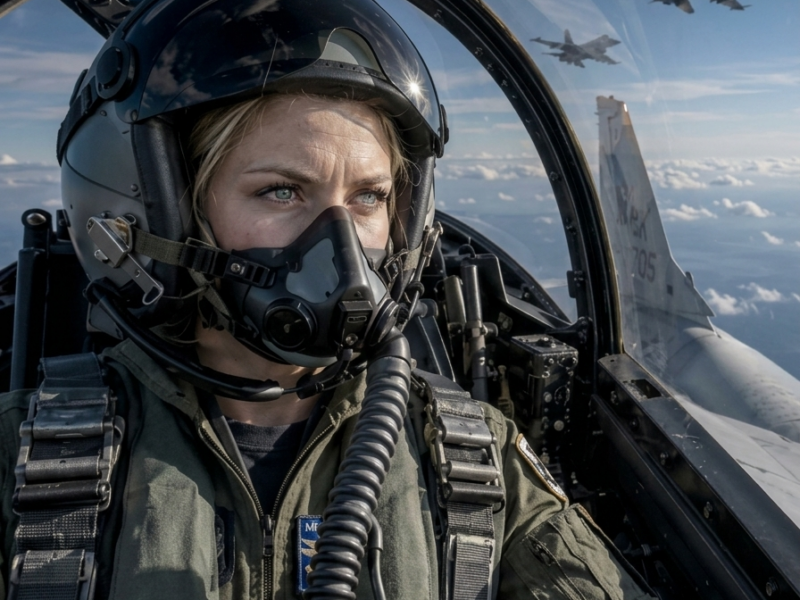
The enemy squadron laughed over the Persian Gulf when I appeared alone on their radar in my battered F-16, and their commander transmitted, “You’re flying straight into your grave,”
The enemy squadron laughed over the Persian Gulf when I appeared alone on their radar in my battered F-16, and their commander transmitted, “You’re flying straight into your grave,” but his voice changed the moment I answered with the call sign they had spent years believing belonged to a dead pilot.
The cockpit of my F-16C Viper smelled of electrical ozone, sweat, and the sharp metallic tang of liquid oxygen. Outside, the night sky over the Gulf was a vast sheet of obsidian, seamlessly merging with the black waters four thousand feet below. My HUD glowed with a sickly yellow hue, flicking frantically as six green diamond icons formed a lethal circle around my single, isolated vector.
“Ghost Widow, break off,” Command’s voice crackled into my helmet, laced with distance and severe radio jamming. “You are outnumbered six to one. Turn south to the carrier strike group immediately. That is a direct order.”
I stared at the empty space beside my canopy—at the vacant wing station where my lead aircraft should have been flying. I checked my fuel flow indicator. Thirty-two minutes of usable jet fuel left in the internal tanks. My wingman was gone. Command was telling me to run.
I didn’t turn back. My thumb hovered over the radio transmit switch, my flight glove leather stretched tight across my knuckles.
“Ghost Widow, acknowledge!” Command shouted again, their voice cutting through the static.
“Negative, Darkstar,” I said, my voice dead, smooth, and devoid of fear. “I am remaining on station.”
“You don’t have the fuel or the ordnance, Captain Vance!” Command argued, the tactical coordinator’s voice tight with panic. “Break off!”
I ignored them. I let my eyes drift down to the auxiliary canopy frame on my right. Taped to the grey composite panel was a worn, grease-stained photograph of Major Daniel “Ghost Widow” Vance—my husband, my flight lead, and the finest tactical pilot the Air Force had seen in a decade.
Three months earlier, Daniel had vanished during an unassigned, black-budget recon mission over the Strait of Hormuz—a mission that High Command had systematically erased from every official server within two hours of his disappearance. His F-16 was never recovered from the deep trenches of the Gulf. His emergency locator transmitter never activated. Neither was his body ever found.
The official Air Force Casualty Report had been delivered to my quarters forty-eight hours later by a cold, stone-faced chaplain. Two words were stamped across the top in red ink: Catastrophic Mechanical Failure.
I had never believed a single word of it. Daniel didn’t suffer mechanical failures. He knew every bolt, wire, and hydraulic line of his Viper better than the engineers who built it. He had been taken down—or worse, betrayed.
A sharp, mocking voice broke through the international emergency radio frequency, dragging me out of the memory. The accent was thick, heavily accented, and brimming with supreme confidence.
“Look at the single bird,” the enemy flight leader taunted, his fighter sliding into a high-perch position above my left wingtip. “You are lost, little American. You are flying straight into your grave.”
The five other jets in his element chuckled over the open frequency—a low, predatory murmur of pilots who knew they held every tactical advantage. They were flying modern, vector-thrust Su-35s equipped with long-range radar-guided missiles and active jamming pods. My F-16 was a thirty-year-old airframe with a coughing Pratt & Whitney engine, a cracked radar display, and only two AIM-120 AMRAAM missiles left on the wingtips.
I didn’t dive. I didn’t execute a defensive break. I simply clicked my transmitter switch and spoke one phrase into the cold dark.
“This is Ghost Widow. Say again, bandit.”
The open channel instantly went dead. The laughter stopped so fast it felt like a door slamming shut in a storm.
For five long, agonizing seconds, the only sound over the radio was the heavy breathing of six foreign pilots and the faint static hum of the Persian Gulf airspace.
“Repeat… repeat your call sign,” the enemy commander whispered, his voice stripped of every drop of arrogance, replaced by an edge of sheer disbelief.
“You heard me,” I said, my hands steady on the throttle and stick.
“That… that is impossible,” the enemy leader stammered, his flight line wavering slightly as his aircraft drifted ten feet wider in the formation. “Ghost Widow was killed three months ago in Sector Four. The report was verified!”
“Who verified it?” I demanded, my heart hammering like a trapped bird against my ribs. “Who told you he was dead?”
Silence stretched over the sky. The six Su-35s hovered around me like massive, dark specters, their engines burning hot against the night air.
Then, the enemy commander let out a dry, chilling chuckle that sent a wave of icy dread cascading down my spine.
“Your own people,” he whispered softly over the frequency. “Your own command structure, Captain.”
Before I could process the words, my Radar Warning Receiver shrieked a high-pitched, continuous tone—a hard missile lock.
“Missile launch! Missile launch!” my automated voice system barked.
A flash of bright rocket fire illuminated the dark clouds below as a radar-guided missile tore up from the sea toward my tail.
I slammed the throttle into full afterburner, dumping three bundles of chaff and flare into the slipstream, and pulled the flight stick hard into my stomach. The G-forces smashed my body into the ejection seat with brutal force, graying out the edges of my vision as the F-16 rolled upside down and plunged into a thick bank of sea fog.
The missile streaked past my canopy by less than fifty feet, its fiery exhaust washing over my glass with blinding heat before detonating harmlessly in the clouds above.
I leveled the jet out at three hundred feet off the black water, hiding my radar signature beneath the heavy cloud deck. My cockpit fell into total, suffocating silence. The enemy fighters were sweeping the upper sky, searching for my thermal bloom, but down here in the dark, I was a ghost.
Then, a low-power, encrypted radio signal pulsed through my helmet—a direct point-to-point transmission on an obsolete tactical frequency that hadn’t been used since the Gulf War.
A voice came through the static. It was raspy, exhausted, and trembling with pain, but it cut straight through my heart like a red-hot blade.
“You’re not supposed to be alive, Clara,” the voice whispered.
My breath caught in my throat. My hands locked on the flight controls.
“Daniel?” I breathed, my voice cracking. “Daniel, is that you?!”
“Don’t trust Command,” the voice gritted out through heavy static. “Don’t go back to the base, Clara. They sold the mission data. Fly to Grid Delta-Nine… the abandoned fuel shelter on Qeshm Island… hurry…”
The transmission snapped off into dead static.
I stared into the pitch-black horizon, my cockpit glowing with emergency lights, my mind reeling.
I turned the F-16 north, descending to fifty feet above the dark, churning waves, and flew straight into the heart of the enemy’s shadow.
The salt spray from the Persian Gulf washed over my radome as I skimmed the water at four hundred knots, flying blind beneath the radar ceiling of both NATO and foreign air defense networks.
Qeshm Island loomed out of the dark haze like a jagged spine of limestone and dead coral. It was a desolate strip of land, riddled with abandoned Cold War-era subterranean naval docks and crumbling concrete fuel depots that had been abandoned for decades.
According to my tactical map, Grid Delta-Nine was nothing more than a rusted, semi-submerged aircraft shelter built into the base of a towering sea cliff.
As I crested the outer reef, I saw it: a single, low-power green strobe light pulsing rhythmically from the crumbling roof of the reinforced bunker.
My fuel gauge was bouncing erratically on the red empty mark. I had less than five minutes of engine life remaining. I dropped the gear, extended the airbrakes, and brought the battered Viper down onto a narrow, cracked strip of asphalt that served as an ancient emergency runway.
The landing was brutal. The nose wheel slammed hard against an uneven expansion joint, sending a violent shockwave through the airframe that blew out the starboard tire. Sparks showered into the dark as I fought the rudder pedals, wrestling the heavy aircraft to a halt just twenty yards from the mouth of the cavernous bunker.
I cut the throttle. The single GE engine spooled down with a mournful, dying whine, leaving the night consumed by the sounds of crashing waves and the rhythmic clicking of hot metal cooling in the damp salt air.
I popped the canopy latch. The heavy acrylic bubble lifted, letting in the heavy, humid heat of the Gulf, smelling of dead sea life, jet fuel, and wet stone.
I unbuckled my harness, unholstered my sidearm, and climbed out onto the hot composite wing.
“Daniel!” I shouted into the shadows of the bunker. “Daniel!”
A figure stepped out from the darkness of the concrete archway.
He was leaning heavily against a rusted iron support beam, wearing a torn, oil-stained green flight suit with the patches stripped off. His face was thin, gaunt, and covered in a thick layer of dark stubble. A massive, faded purple scar stretched from his temple down to his jawline, and his left arm was tightly bound in a makeshift sling made of paracord and green canvas.
I froze on the wing of my plane. The gun in my hand suddenly felt impossibly heavy.
“You always did land too fast on blown tires, Clara,” he said softly, a faint, exhausted smile breaking through his bruised face.
The M9 pistol slipped from my glove, clattering against the aluminum skin of the wing. I scrambled off the jet, my boots hitting the wet gravel, and sprinted across the gap between us, throwing my arms around his neck with a force that made him groan in pain.
He was real. He was warm. His heart was beating rapidly against my chest.
“You’re alive,” I sobbed, burying my face into the rough fabric of his shoulder, the tears burning hot against my sun-chapped skin. “You’re alive… they said you went into the sea… they gave me a folded flag, Daniel!”
“I know,” he whispered, holding me tightly with his good arm, resting his forehead against mine. “I’m sorry, Clara. I’m so sorry. I couldn’t risk sending a signal. They were watching every channel.”
“Who?” I demanded, pulling back to look into his sunken, bloodshot eyes. “Who did this to you?”
Daniel turned his head, looking back into the dark interior of the bunker, where a makeshift tactical communications rig sat powered by a humming diesel generator. Monitored screens flickered with real-time satellite telemetry, flight schedules, and encrypted NATO data feeds.
“Three months ago, my flight was diverted over the Strait,” Daniel said, his voice dropping to a gravelly whisper. “It wasn’t a routine patrol. I was sent to intercept a non-existent threat. When I reached the grid, my flight computer locked up. My navigation array was overridden by a remote signal sent from our own Command ship, the USS Enterprise.”
My blood turned to ice water. “A remote override?”
“They jammed my controls, cut my tactical link, and fed my exact GPS coordinates straight to an enemy surface-to-air missile battery on the coast,” Daniel continued, his jaw tightening with rage. “I barely ejected before the bird disintegrated. I spent four days drifting on an emergency raft before I washed up on this rock.”
“Why?” I asked, my hands trembling as I held his arm. “Why would our own Command want to murder their top flight lead?”
Daniel reached into his flight suit pocket and pulled out a heavy, military-grade solid-state drive wrapped in waterproof electrical tape.
“Because I found the ledger,” Daniel said softly. “High Command isn’t just leaking operational data, Clara. They’re selling full tactical packages—flight vectors, stealth signatures, target lists—to private defense syndicates operating in the Gulf. They’ve been using our missions to manufacture artificial tension, driving up multi-billion-dollar defense contracts while feeding our pilots into carefully staged ambushes.”
I stood there in the damp gloom of the shelter, the reality of his words crashing over me like a tidal wave. The ambushes over the past year… the sudden surge in pilot casualties… the unexplained losses of high-value stealth assets…
It wasn’t enemy superiority. It was high-level treason.
“They thought I died in the crash,” Daniel said, looking down at the drive in his hand. “When they realized you weren’t letting the investigation go—that you kept flying out to Sector Four looking for answers—they decided to close the loop. They assigned you to this suicide patrol tonight so those Su-35s could finish what they started three months ago.”
Before I could speak, the tactical radio on the table behind us let out a sharp, high-pitched squawk.
The voice of General Thomas—the commander of the regional Air Task Force back at base—cut through the speaker, crisp, commanding, and smooth as polished silk.
“Captain Clara Vance,” the General’s voice echoed off the concrete walls. “We have tracked your transponder anomaly to Qeshm Island. You are currently in unauthorized airspace in close proximity to a known hostile installation. Return to base immediately for debriefing.”
Daniel looked at me and shook his head slowly. “Don’t answer him. The moment you transmit, they lock the signal.”
I stepped over to the radio console, staring at the glowing frequency display.
For months, I had trusted that voice. I had taken orders from that man. I had stood in his office while he told me how deeply he regretted the “loss” of my husband.
“He’s not waiting for an answer, Daniel,” I said quietly, pointing my finger at the tactical radar screen hooked into the receiver.
Six bright red diamond icons had just broken out of their high-altitude holding pattern over the Gulf. They had grouped into a strike formation and were diving at supersonic speed straight toward Qeshm Island.
And right behind them, trailing twenty miles back, were two unmarked American F-22 Raptors, flying silent and dark.
Daniel gritted his teeth, looking out toward the mouth of the shelter where my battered F-16 sat dripping oil onto the asphalt.
“They aren’t coming to rescue you, Clara,” Daniel whispered softly. “They’re coming to erase the island.”
The high-pitched whine of jet engines in the distance began to rumble through the stone foundations of the bunker like a localized earthquake.
“We have less than three minutes before those Su-35s drop thermobaric munitions on this entire ridgeline,” Daniel said, his voice dropping into the precise, rhythmic tone he used during high-stress combat briefings.
“My F-16 is out of fuel, Daniel,” I said, pointing out at the dark tarmac. “The starboard tire is shredded, the radar glass is cracked, and I’ve only got two wingtip missiles left. We can’t fight eight aircraft in a broken bird.”
Daniel walked past me, pulling a heavy canvas tarpaulin off a large object sitting in the deep shadow at the rear of the shelter.
Underneath the canvas sat an F-16D—the two-seat, dual-cockpit variant of the Fighting Falcon. It was painted in an unmarked, matte-black radar-absorbent coating. Extra fuel tanks were mounted beneath the thick delta wings, and its weapons pylons were loaded with six heavy long-range missiles and an active electronic warfare pod.
I stared at the pristine, menacing black aircraft in absolute astonishment.
“Where… where did you get this?” I stammered.
“This was the secondary black-site recon bird assigned to my original squad,” Daniel said, stepping up the yellow crew ladder attached to the fuselage. “I’ve spent the last ninety days scavenging parts from crashed airframes across the island chain, fixing the avionics, hand-wiring the weapon systems, and siphoning aviation fuel from abandoned Iranian storage tanks.”
He turned back to look at me, his eyes burning with a dark, fierce determination.
“She’s fully fueled, fully armed, and her flight computer is entirely air-gapped from the NATO command network. They can’t override this bird, Clara. They can’t shut us down.”
“You can’t fly, Daniel,” I said, pointing at his shattered left arm bound in the canvas sling. “You can’t handle the throttle G-forces with one hand.”
“I don’t need to handle the throttle,” Daniel said, reaching down and offering me his good right hand. “I’ll operate the radar, the electronic jammers, and the weapons release from the rear pit. You fly the airplane.”
I looked from his extended hand up to the two-seat cockpit of the black Viper.
For three years, before he was taken from me, we had flown as the most lethal pilot-RISO team in the Pacific theater. We knew each other’s instincts before a word was ever spoken over the intercom. We were two halves of a single weapon system.
I grabbed his hand, pulled myself up the ladder, and dropped into the front pilot’s seat.
The smell of fresh hydraulic fluid, leather, and system coolant filled my senses as I strapped into the tight ejection harness. I flipped the battery master switch home.
The dual-cockpit glass displays instantly burst into brilliant green and blue life. The engine starter switch clicked, and behind us, the massive Pratt & Whitney F100 turbofan engine roared into a powerful, steady, deep-throated howl that shook the dust from the concrete roof above.
“Canopy coming down,” I shouted over the engine roar.
The heavy black canopy dropped smoothly, sealing us inside a pressurized bubble of air.
In my helmet speakers, Daniel’s voice came through on the internal intercom—clear, crisp, and closer than it had been in three long, agonizing months.
“Flight controls check,” Daniel said from the rear seat. “Weapons online. Jamming pod active. How does she feel, Captain?”
I rested my glove on the side-stick controller, feeling the raw, unchecked power of thirty thousand pounds of thrust straining against the wheel brakes.
“She feels like revenge, Major,” I answered.
“Hostiles at fifteen miles and closing fast,” Daniel reported, his fingers flying across the rear weapons management screens. “The six Su-35s are dropping into a low-level bombing run. The two unidentified F-22s are staying high at thirty thousand feet, acting as overwatch.”
“They think we’re dead in that shelter,” I said, releasing the parking brake and slamming the throttle forward.
The black F-16 shot out of the dark bunker like a cannon shell, its afterburner blasting a brilliant fifty-foot tongue of blue fire into the wet air of the shelter. We accelerated down the cracked asphalt, lifting off the ground just feet before the runway collapsed into the sea.
I pulled the nose up hard into a vertical climb, Banking eighty degrees into the dark cloud layer just as the first wave of enemy thermobaric bombs struck Qeshm Island behind us.
A massive, blinding wall of orange flame and shockwaves shattered the old bunker into millions of tons of flying stone, lighting up the Gulf for ten miles in every direction.
“They missed,” Daniel gritted out over the intercom as he brought the long-range active radar online. “Target lock established on Bandit One and Bandit Two! Shoot, Clara! Shoot!”
I didn’t hesitate. I squeezed the red trigger on the flight stick twice.
WHOOSH! WHOOSH!
Two AIM-120 AMRAAM missiles detached from our underwing hardpoints, their rocket motors igniting with a deafening roar as they streaked through the cloud deck toward the unsuspecting enemy bombers below.
Ten seconds later, two brilliant orange fireballs lit up the dark surface of the sea as the lead Su-35s disintegrated mid-air before their pilots even knew a black aircraft had cleared the island.
“Bandit One and Two destroyed!” Daniel shouted. “The remaining four Su-35s are breaking hard to the west! They’re scattering!”
“Don’t let them clear the area,” I growled, rolling the F-16 upside down and plunging straight back down through the clouds after them. “They don’t get to run.”
The dark sky over the Gulf turned into a frantic, violent canvas of tracer fire, burning metal, and screaming engines.
Deprived of their target data and utterly stunned by the sudden appearance of an unmarked black fighter emerging from a burning island, the remaining four Su-35 pilots panicked. They broke their tight formation, diving low over the water in a desperate effort to escape our active radar lock.
“Bandit Three is turning left!” Daniel called out, his voice calm, precise, and completely focused despite the violent 7-G turn I was pulling. “I’m locking his thermal signature with the AIM-9X!”
“Fox Two!” I shouted, pressing the weapon release.
The sidewinder missile leapt from our left wingtip, carving a razor-sharp smoke trail through the night before slamming directly into the left engine intake of the third enemy jet. The fighter flipped violently three times before exploding against the dark water below.
“Bandit Four and Five are crossing paths ahead of us!” Daniel warned. “They’re trying to draw us into a scissor trap!”
“Let them try!”
I pulled the throttles back to flight idle, extended the speed brakes, and let the F-16 drop fifty knots in a heartbeat. The two pursuing Su-35s overshot our nose, their massive twin engines glowing bright orange in the dark directly in front of my HUD.
I slammed the throttle back to war-power and squeezed the cannon trigger.
The Vulcan 20mm rotary cannon mounted in the left wing-root roared to life, spitting a dense stream of high-explosive incendiary rounds at six thousand rounds per minute. The lead fighter’s wing section folded like wet cardboard under the impact, tearing the aircraft apart in a cascade of flying debris. The second jet swerved hard to avoid the wreckage, lost control in the low-altitude turbulence, and plunged belly-first into the ocean.
Five down. One left.
The last Su-35 pilot didn’t stay to fight. He threw his engines into full afterburner and fled at Mach 1.5 toward the safety of the foreign coastline.
“Let him go,” Daniel said quietly from the rear seat. “He’s not the target.”
I pulled the nose up, leveling the black Viper at twelve thousand feet, watching the single enemy contact fade from our tactical radar display.
The air around us was suddenly quiet again. Below, the sea was dotted with five burning patches of jet fuel, casting a eerie red glow across the dark water.
“What about the two Raptors at thirty thousand feet?” I asked, eyeing the top edge of our radar screen where two high-altitude contacts were hovering like silent vultures.
“They aren’t foreign jets, Clara,” Daniel said, his tone dropping into an icy register. “Those are the two rogue aircraft from our own black-ops squadron. They were sent by General Thomas to make sure nobody walked away from Qeshm Island.”
As if answering his words, a cold, mechanical voice broadcasted directly onto our private, air-gapped frequency.
“Unidentified black airframe,” the voice said—it was the leader of the high-altitude Raptor flight, speaking with absolute, detached professionalism. “You are operating an non-sanctioned combat asset in a restricted theater. You are ordered to power down weapons, yield flight control, and land at Air Base Al Dhafra immediately.”
“And if we refuse, Cobra One?” I answered, my finger resting lightly on the missile selector switch.
A long, chilling pause hung on the line.
“If you refuse, Captain Vance,” Cobra One replied softly, “we will terminate your flight path over deep water. You have ten seconds to comply.”
Daniel laughed softly in my headset—a dry, humorless sound that chilled me to the bone.
“They think they have the high ground because they’re flying stealth, Clara,” Daniel whispered. “They don’t know I spent three months rewiring this bird’s passive infrared search sensors. I can see their heat blooms like candles in a dark room.”
“How do we play it, Major?” I asked, my hands gripping the stick as I felt the black jet respond beneath me.
“They expect us to run for the coast or turn south,” Daniel said, his fingers tapping out a rapid sequence on his weapons panel. “So we’re going to fly straight up their exhaust pipes. On my mark, push the stick full forward, execute a split-S, and climb vertical into their blind spot.”
“Standing by,” I said, my teeth clenched tight against my flight lip.
“Three… two… one… MARK!”
I slammed the stick forward, pitching the nose down until we were flying upside down, dropped two thousand feet in a split second, and then pulled back hard, launching the black F-16 straight up toward the stars like a dark, screaming arrow.
The two F-22 pilots, expecting a low-level egress, lost our radar track as we passed directly beneath their belly radar shadows.
“I’ve got heat signatures on both of them!” Daniel yelled in my ears. “Cobra One and Cobra Two are locked! Shoot both AMRAAMs now!”
I squeezed the trigger twice.
The last two long-range missiles detached from our wings, streaking straight up into the high-altitude clouds.
Eight seconds later, two bright flashes of light illuminated the upper stratosphere as both stealth fighters took direct hits to their engine nozzles. Their control surfaces failed instantly, sending both million-dollar aircraft tumbling down toward the Gulf in flat, unrecoverable spins.
“Both hostiles neutralized!” Daniel shouted, a rare note of triumph breaking through his exhausted voice. “Their pilots are ejecting over international waters!”
I leveled the jet out at thirty-five thousand feet, the black curvature of the earth stretching out beneath us under a canopy of endless stars.
Our weapons pylons were empty. Our fuel tanks were down to twenty percent. But the sky above the Persian Gulf was entirely ours.
“Where to now, Captain?” Daniel asked softly from the rear seat.
I looked down at the solid-state drive mounted on his tactical console—the drive containing the names, bank accounts, and voice logs of every traitor inside High Command.
I banked the black F-16 west, setting a direct vector for the European Air Command headquarters in Ramstein, Germany.
“We’re going to finish the delivery, Daniel,” I answered. “And then we’re going to clean the house.”
The sunrise over the Bavarian Alps three hours later was a brilliant, blinding sheet of gold and amber, burning away the cold morning mists that clung to the valleys below.
The black F-16 descended quietly through the cloud layer, its single turbofan engine humming at a smooth, low idle as we crossed into German airspace under an emergency diplomatic clearance code that Daniel had broadcast directly to the Supreme Allied Commander in Europe.
Below us lay the massive, sprawling concrete runways of Ramstein Air Base.
Dozens of emergency vehicles, armored transport trucks, and military police sedans lined the tarmac, their flashing lights creating a silent sea of red, white, and blue across the apron. But these weren’t General Thomas’s men. They were the personal security detail of the Inspector General of the Armed Forces.
I dropped the landing gear. The three wheels locked into place with a firm, reassuring mechanical thud.
“Nice and easy, Clara,” Daniel said softly through the intercom. “We’ve got the whole world watching us now.”
The tires touched down on the damp concrete with a soft chirp of rubber. The black jet rolled smoothly down the center line, bringing thirty thousand pounds of stealth metal and heavy history to a complete, peaceful halt in front of the main terminal building.
I cut the engine. The silence that followed was absolute, heavy, and profound.
For two full minutes, neither of us moved. We just sat there in the quiet cockpit, watching the morning sun illuminate the gold visor of my helmet and reflected off the black skin of our wing panels.
I unlatched the canopy and let it lift into the cool, crisp German air.
A four-star General, flanked by two dozen federal investigators and heavily armed Security Forces personnel, stepped up to the side of the ladder. He looked at the scorched, bullet-scarred black airframe, then looked up into the open dual cockpit.
“Major Vance… Captain Vance,” the General said, his voice quiet, solemn, and filled with deep respect. “We received your data package two hours ago while you were over the Mediterranean. General Thomas and seven high-ranking officers at Task Force Command have already been taken into custody. The network is completely dismantled.”
Daniel pulled off his flight helmet, resting his hand on the canopy sill, his gaunt face bathed in the morning light.
“The evidence is complete, sir,” Daniel said quietly. “Every transcript, every payment, every target package.”
The General nodded slowly, stepping back and raising his right hand in a sharp, crisp, formal salute. Behind him, every officer and military policeman on the tarmac stood at attention, saluting the two pilots sitting in the black jet.
“Welcome back from the dead, Major,” the General said.
I unbuckled my shoulder harness, reached back over my head, and squeezed Daniel’s good hand. His fingers wrapped tightly around mine, warm, strong, and unwavering.
The story that High Command had tried to write for us—a story of tragic mechanical failures, lost bodies, and quiet, erased pilot records—was gone. Written over by the roar of an air-gapped engine and the unyielding willpower of two people who refused to let each other be left behind in the dark.
I looked up at the vast, endless blue sky stretching out above the airfield, where the first morning contrails of Allied patrols were carving clean, white lines across the horizon.
The sky was quiet now. Clean. Safe.
I looked back at Daniel, a real, unburdened smile finally breaking across my face for the first time in three months.
“Flight’s over, Major,” I whispered softly.
Daniel smiled back, his bloodshot eyes shining with light as he squeezed my hand one last time.
“Flight’s over, Clara,” he agreed. “Let’s go home.”
The end.









