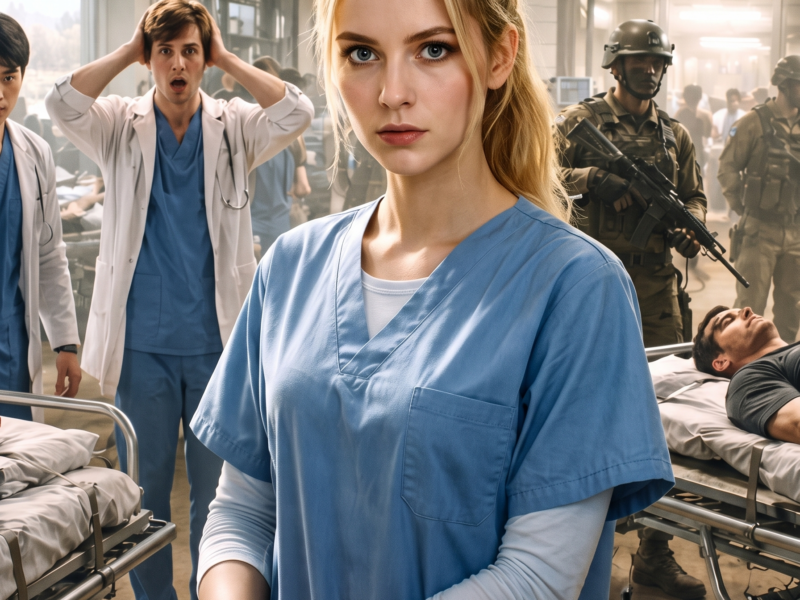
The emergency room doors slammed open as I stood alone between twelve dying patients, and when the exhausted SEAL admiral finally arrived
The heavy double doors of Trauma Bay 4 swung inward with a metallic clash, exposing a cavernous room plunged into near-total darkness. Outside, torrential rain lashed against the reinforced glass windows, echoing like distant gunfire. Just after midnight, the primary power grid for Saint Jude Regional Hospital had suffered a cataclysmic failure. When the auxiliary generators kicked in, they groaned in mechanical agony, flickered twice, and died, leaving the upper medical floors shrouded in an suffocating blackness. Smoke, thick and chemically acrid, had begun creeping up through the ventilation shafts from a fire in the sub-basement.
The sound of panicking footsteps and muffled sirens had faded twenty minutes ago. Orderlies and floor nurses had evacuated the lower wards, guiding the ambulatory patients into the stormy night. I stayed.
I stood alone in the absolute center of the trauma bay, illuminated only by the thin, sharp beam of a heavy aluminum tactical flashlight held between my teeth. Around me lay twelve critical patients, trapped on high-dependency stretchers and mechanical beds that no longer possessed the power to lift or tilt. Three of them were pediatric victims from a highway multi-car pileup; one was a high-ranking Navy officer whose abdominal chest tube was leaking vital fluid into a plastic canister; the remaining eight were trauma cases stabilized only by my hands, my instinct, and the fragile promises I kept whispering into the dark.
“Stay with me,” I murmured to a ten-year-old girl whose pulse was a thready, chaotic flutter beneath my trembling fingers. I reached down, adjusted her manual bag-valve mask, and squeezed it rhythmically. One, two, squeeze. One, two, squeeze. My scrub top was soaked through—partially with sweat, partially with dark, arterial blood that was cooling against my skin.
My hands were shaking, a physiological response my brain refused to acknowledge. I had spent nearly four hours in this isolation, moving from bed to bed with no monitor beeps, no automated oxygen pumps, and no backup support. I had cut through leather jackets, improvised tourniquets from bedsheets, cleared airways with handheld manual suction pumps, and started IV lines entirely by touch in the dim amber glow of glowsticks snapped and scattered across the floor. I was no longer Nurse Clara Vance. I was an automaton operating on deep muscle memory, fighting a war against time in a flooded, smoke-filled graveyard.
Then, the heavy hydraulic elevator at the end of the dark corridor let out a violent, mechanical screech.
The floorboards vibrated. The elevator had not been functional since the outage, yet its emergency doors were being forcibly pried apart from the inside. Steel groaned against steel. A tall, broad-shouldered man in a drenched, dark blue Navy dress uniform stepped through the gap, stepping over the threshold into the dark hallway. Behind him, two tactical operatives in full, unflagged assault gear, holding muted combat rifles, stepped out in tight formation.
The man in the center moved with absolute, predatory efficiency. Water dripped from the brim of his cap and the silver stars pinned to his collar. He did not look around at the smoke, nor did he check the empty nurses’ station. His dark, piercing eyes swept the room and locked instantly onto mine.
He froze.
For five agonizing seconds, the storm outside seemed to mute. The only sound was the synchronized huff of breathing from the tactical gear and the rhythmic drip of water onto the linoleum floor.
The commander stepped forward, his boots crunching on shattered glass. He raised his eyes, fixed them squarely on my blood-stained face, and spoke a single word that shattered the quiet like a high-caliber round.
“Phoenix.”
The nickname hit my chest with physical force, stealing the oxygen right out of my lungs. The flashlight slipped from my teeth, dropping into my palm. My breath hitched.
Nobody had called me that in eleven years. Not since the scorching sands of the Helmand Province. Not since the fires, the screaming, and the official casualty list that had wiped my identity from the face of the earth.
I dropped the bloodied gauze I was holding. It hit the floor with a soft, wet slap. “Who are you?” My voice was raspy, stripped raw by the smoke and eleven years of silence.
The man slowly reached up, unbuttoned his tactical gloves, and pulled them off finger by finger. “Admiral Cole. Naval Special Warfare Development Group.”
My heart pounded against my ribs like a trapped bird. I had never met Admiral Cole. I had never seen his face on a personnel roster. Yet he spoke that code name with absolute, terrifying familiarity—the name of an operative who belonged to a black-ops surgical extraction unit that officially never existed. A unit that had been entirely wiped out in an ambush on November 14th, 2015.
“You weren’t supposed to survive,” Cole said softly. His tone was not one of malice, but of a man confronting a ghost that had walked out of a nightmare.
The trauma room seemed to shrink around me. The smell of copper, smoke, and antiseptic faded into the background as the memories I had painstakingly buried for over a decade surged back to the surface. I had spent eleven years believing I was the sole survivor of a tragic tactical disaster. I had changed my name, forged civilian credentials, abandoned my military pension, and deliberately lived an invisible life as a graveyard-shift nurse in a small coastal city.
“How do you know that name?” I demanded, stepping between him and the pediatric gurney. “Who gave you that clearance?”
Cole glanced past me, taking in the sight of the twelve patients, the hand-pumped ventilators, and the meticulously organized triage setup amidst the total blackout. “Because I was the one who authorized the operation,” he whispered. He took two steps closer, lowering his voice so the operatives behind him wouldn’t catch the nuance. “And because your unit wasn’t attacked by insurgents, Phoenix. Your team was executed.”
I stared at him, my blood running colder than the rain outside. “What are you saying?”
Before Cole could answer, the operative on his left snapped his head toward the stairwell. “Admiral! We found something downstairs in the secondary electrical room. It wasn’t an accidental fire. It was a targeted thermal charge.”
Cole’s expression did not change, but his jaw hardened into iron. He reached inside his rain-soaked trench coat and pulled out a small, rectangular metal case covered in dark, heavy soot. The hinges were warped by heat, but the lock had been freshly cut.
He held it out to me.
My fingers went completely numb as I took it. Scratched deeply into the charred steel lid were two letters I recognized instantly: C.M.
Captain Christopher Miller. My former commanding officer. The man I had personally watched get pulled down by the blast wave inside our forward operating base eleven years ago. The man whose death I had mourned every single day of my altered life.
“Open it,” Cole commanded softly.
With hands that felt entirely detached from my body, I pried the warped metal lid open. Inside lay a single, laminated tactical photograph. It showed our seven-person team standing in front of an unmarked transport helicopter in Kandahar. Every single face in the picture had been violently crossed out with thick, red waterproof marker—Miller, Vance, Vance’s corpsman, the radio operator, the scouts.
Every face was crossed out except mine.
My face remained pristine, unblemished by the red ink. I flipped the photograph over. On the white reverse side, four words were written in precise, handwriting that I recognized all too well:
Phoenix was never the target.
I looked up at Cole, my chest heaving. “What is this? What did you bring to my hospital?”
Cole was no longer looking at me. His gaze had shifted toward the pitch-black corridor behind me, his hand instinctively sliding down toward the sidearm holstered beneath his coat.
“I didn’t bring them here,” Cole murmured, his voice dripping with grim certainty. “They followed you.”
At that exact second, with a deafening pop, the overhead emergency floodlights burst back to life, flooding the trauma ward with blinding, harsh white light. The sudden brightness made us all flinch.
And then, from the nurse’s station at the far end of the hallway, a landline phone began to ring.
Ring.
Ring.
The sound was loud, mechanical, and horrifyingly out of place.
Cole drew his weapon with a smooth, silent motion and looked me dead in the eyes. “They’re here.”
The phone rang three more times before the line went completely silent. The harsh fluorescent lighting flickered above us, casting long, jittery shadows across the blood-splattered walls of Trauma Bay 4.
“Cover the entry points,” Cole ordered in a low, clipped tone. The two SEALs instantly fanned out, taking positions behind the heavy concrete doorframes of the hallway, their weapons raised, scanning the darkness beyond the lit perimeter.
I stared down at the small metal case in my hands. The photograph felt like a piece of burning coal against my skin. Phoenix was never the target. If my unit had been targeted, and if I was intentionally left alive, then everything I had believed about the last eleven years was a carefully orchestrated lie. My escape, my altered identity, my quiet life in this hospital—none of it was an accident. I wasn’t a survivor hiding in the shadows; I was an asset left on ice.
“Cole,” I said, my voice dropping an octave as the old military discipline kicked back in, overriding the panic. “I need answers now. My patients are dying. This room has no secondary power, and if those generators go down again, three people on those cots won’t survive twenty minutes.”
Cole didn’t look at me; his eyes were fixed on the stairwell door down the hall. “Eleven years ago, your unit discovered a classified intelligence manifest in the Helmand Province. It contained a list of active military officials who were siphoning black-budget funds into private security networks. Captain Miller tried to report it up the chain of command. He didn’t know the chain was already corrupted.”
I felt a cold sensation creep up my spine. “The raid on our outpost…”
“It wasn’t a insurgent mortar strike,” Cole confirmed, his voice cold and flat. “It was a air-to-ground strike authorized by a rogue division within our own intelligence apparatus. The entire team was scrubbed to keep the manifest secret. But you… you were the lead medical analyst. You had the decryption keys backed up in your head.”
“I was a trauma surgeon!” I snapped, stepping into his line of sight. “I patched up soldiers! I didn’t care about their damn financial logs!”
“You didn’t have to care,” Cole replied, finally looking at me. “You just had to possess them. They thought you died in the collapse of the command bunker. When you resurfaced three years ago under the name Clara Vance, an algorithm flagged your medical license application in this district. They didn’t strike immediately because they wanted to see who you were contacting. But tonight… tonight someone triggered the burn protocol.”
A sharp metallic click echoed from the far end of the hall.
“Contact,” whispered the SEAL on the left.
Before anyone could react, the heavy glass doors of the emergency room entrance downstairs shattered in a sharp cascade of noise. The sound was immediately followed by the rhythmic, suppressed thump-thump-thump of automatic weapons fire.
“They’ve breached the ground floor,” the SEAL reported calmly, adjusted his posture. “Four hostiles, heavy tactical gear, no uniforms. Moving toward the central stairwell.”
“They aren’t here to capture,” Cole said, racking the slide of his Sig Sauer. “They cut the power to draw out the emergency crews and isolate this floor. They’re cleaning up the loose end.”
“Not in my ward,” I said through gritted teeth.
I turned back to the twelve patients. The ten-year-old girl was beginning to turn blue around her lips. Her oxygen saturation was dropping rapidly without active ventilation. I grabbed two extra manual resuscitation bags, hooked them to portable oxygen tanks, and turned to the oldest patient in the room—a retired navy veteran who was conscious despite a shattered hip.
“Mr. Davis,” I said, placing his hands on the squeeze bag. “I need you to pump this every two seconds. Don’t stop. No matter what you hear outside this door, keep pumping.”
The old man looked into my eyes, saw the cold, murderous focus that had suddenly replaced the tired nurse, and nodded grimly. “Got it, Doc.”
I turned back to Cole. “Give me a sidearm.”
Cole looked at me for a fraction of a second, evaluating the woman in bloodied scrubs. He didn’t hesitate. He unstrapped a secondary compact pistol from his chest rig and handed it to me along with two spare magazines. “Remember how to use it, Phoenix?”
“I never forgot,” I said, slamming the magazine into the grip with the heel of my palm until it locked with a satisfying snap.
Suddenly, the lights flickered and died again. Darkness reclaimed the hallway.
A flashbang grenade bounced through the darkness, rolling past the nurse’s station and coming to a stop ten feet from our position.
“Cover!” Cole roared.
The flashbang exploded with a blinding burst of white light and a concussive shockwave that rattled the metal gurneys and shattered the remaining windows along the corridor. The deafening roar left a high-pitched ringing in my ears, but my military training kicked in before my vision even cleared.
I dropped to one knee behind a heavy stainless-steel crash cart, pointing my weapon toward the double doors.
Through the haze of smoke and white flash-dust, three armed figures clad in black tactical gear burst into the hallway. They moved with precise, military discipline, their weapons fitted with night-vision optics and suppressors. They weren’t street thugs or private mercenaries; these were high-tier operators trained by the same system that had trained me.
“Suppressing fire!” Cole yelled, firing three rapid shots down the hall.
The two SEALs returned fire, their weapons barking in controlled bursts. The narrow hallway became a kill zone of crossfire. Sparks flew as bullets ricocheted off steel doorframes and medical equipment.
I saw one of the hostiles push past the primary doorway, maneuvering toward the side entrance of Trauma Bay 4 where my patients lay helpless. He raised his suppressed rifle, aiming directly at the doorway. He wasn’t aiming at Cole or the SEALs—he was aiming into the patient room to eliminate all witnesses.
“No!” I screamed.
I lunged out from behind the crash cart, clearing the angle, and fired four rounds in rapid succession. The heavy 9mm rounds hit him squarely in the side of his tactical vest, staggering him backward. Before he could regain his footing, I closed the distance, grabbed the barrel of his rifle, drove it upward, and slammed my elbow into his tactical helmet’s visor. The glass cracked. I pulled my sidearm up under his chin and pulled the trigger.
The operative collapsed in a heavy heap at my feet.
I grabbed his rifle, cleared the chamber, and pulled two fresh magazines from his vest. I was breathing heavily, my heart hammering against my ribs like a sledgehammer, but my hands were completely steady. The nurse was gone. Phoenix had taken over.
“Phoenix! Fall back!” Cole called out, firing past my shoulder to pin down a second intruder attempting to flank us from the utility closet.
“We can’t hold this hallway!” I yelled back, crouching behind a concrete pillar as bullets chewed through the drywall above my head. “There are more coming up the fire escape!”
“Where does that stairwell lead?” Cole demanded, swapping out his empty magazine.
“It leads directly to the sub-basement parking garage,” I replied. “If they have control of the basement, they have us boxed in on the fourth floor.”
“Then we make our stand here,” Cole said grimly.
Just then, the comms unit on the fallen operative’s vest clicked to life. A static-laced voice came through the small speaker attached to the shoulder pad.
“Team Alpha, status report. Has the target been neutralized?”
Cole and I both looked down at the radio. The voice was cold, calm, and unmistakably familiar. It was a voice I had listened to over tactical radios for three years in Afghanistan. A voice that belonged to a man who was supposed to be six feet under the burnt soil of Kandahar.
My breath hitched in my throat. “Miller…” I whispered, horror washing over me. “That’s Captain Miller.”
Cole’s eyes narrowed into dark slits. “Miller didn’t die eleven years ago, Phoenix. He was the one who sold out your unit. He faked his death, collected the payment, and took over the private defense network that orchestrated the cover-up.”
The reality of the last decade crashed down on me with terrifying weight. The man I had grieved, the commander I had trusted with my life, was the architect of my destruction. He had slaughtered my friends, destroyed my life, and left me to live like a rat in the dark while he built an empire on our corpses.
I stepped over the fallen operative, picked up the radio, pressed the push-to-talk button, and spoke with a voice dripping with icy venom.
“Miller.”
The line went completely dead for two long seconds. Then, a low, cruel laugh rasped through the speaker.
“Well, well,” Miller’s voice chuckled. “Look who finally woke up. Hello, Phoenix. I was wondering how long it would take you to figure out the game.”
“You should have stayed dead, Clara,” Miller’s voice echoed through the tinny radio speaker, laced with a terrifying, calm arrogance. “You had a nice, quiet life here. Cleaning bedpans, playing the heroic nurse. Why couldn’t you just let it go?”
I held the radio tight, my knuckles turning white. Cole signaled his two SEALs to hold their positions at the end of the hall while he moved up beside me, his weapon raised, scanning the dark ceiling vents.
“You killed them all, Chris,” I said, my voice dangerously soft. “Jackson, Sarah, Doc Miller… you sold them out for a payout.”
“They were collateral damage, Clara,” Miller responded without a shred of hesitation or remorse. “The world was changing. The war was ending, and men like us were going to be discarded like broken tools. I found an exit strategy. The intelligence package your team recovered was worth ninety million dollars to the right buyers. All I had to do was erase the witnesses.”
“Except me,” I said.
“You were a mistake,” Miller admitted. “You weren’t supposed to survive the structural collapse of the bunker. But by the time I realized you were alive, you had vanished into the civilian system under a dead woman’s social security number. You were quiet. You were harmless. So I left you on the shelf… until Admiral Cole started digging through old casualty reports three weeks ago.”
Cole took the radio from my hand, his face a mask of cold fury. “Miller, this is Admiral Cole. You are surrounded by federal response units arriving at this perimeter in less than five minutes. Stand down.”
Miller laughed again, a harsh, mechanical sound. “Check your perimeter, Admiral. Your response units aren’t coming. I control the local dispatch grid tonight. The local police think this building is undergoing a routine hazmat drill. You are entirely on your own up there.”
The connection went dead.
“He’s coming up himself,” Cole said, looking at me. “He won’t leave this to his men anymore. He needs to confirm our deaths personally before the military district realizes what’s happening.”
“Let him come,” I said, a dark, terrifying clarity settling into my mind. I reached down into my scrub pocket and pulled out a small surgical scalpel alongside my secondary firearm. “He thinks I’m the same scared corpsman he left in the dirt eleven years ago. He has no idea who I’ve become.”
“Listen to me, Phoenix,” Cole said, laying a heavy hand on my shoulder. “There is something else you need to know about that night in Kandahar.”
I looked at him, my eyes hard. “What else could there possibly be?”
“The intelligence package wasn’t just bank accounts,” Cole said, his voice dropping low. “It contained the locations of three dark-site facilities operating on American soil. Facilities that are currently holding former military personnel who ‘disappeared’ overseas. Miller hasn’t just been selling information—he’s been selling people.”
The horror of his words sank in. The scope of Miller’s betrayal was far larger than a single wiped-out unit. It was an entire underground network built on the blood of soldiers who had trusted their commanders.
Suddenly, a loud explosion rocked the floor below us. Dust and plaster rained down from the ceiling as the heavy fire-exit doors at the end of the hall were blown off their hinges.
Heavy footfalls echoed through the dust cloud. Through the haze, four heavily armed men emerged, led by a tall figure wearing a dark tactical trench coat and holding a customized assault rifle. His face was scarred along the jawline—a permanent souvenir from the day his bunker exploded eleven years ago.
Captain Christopher Miller had finally returned to finish his mission.
“Cole! Phoenix!” Miller’s voice boomed down the corridor as his men formed a line behind him. “End of the line!”
“Take the left side!” Cole barked, diving behind a concrete pillar as Miller’s team opened fire.
The corridor erupted into chaos. The roaring of automatic weapons shook the entire floor, shattering fluorescent light fixtures and punching holes through the drywall. The two SEALs engaged Miller’s vanguard, their suppressed weapons spitting controlled fire in a desperate attempt to keep the heavily armed squad pinned in the hallway.
I didn’t stay behind the pillar.
I knew this hospital floor better than anyone. I knew every service door, every supply closet, and every maintenance hatch hidden behind the drywall. I dropped low, crawling through a breach in the side wall into the adjoining pediatric storage room, bypassing the main kill zone entirely.
Sweat poured into my eyes, mixing with dust and dried blood. My lungs burned from the smoke filling the room, but my mind was operating with crystalline clarity. Miller was moving down the main hall toward Trauma Bay 4, firing methodically, pushing Cole and his men back toward the rear window exit.
“He wants the patients,” I realized with a sudden, chilling jolt. Miller knew that if he killed the civilians, Cole would be forced to retreat or risk total mass casualty.
I moved silently through the dark utility corridor that ran parallel to the main hallway. I reached the service panel directly behind the nurse’s station—where Miller was currently advancing.
Through the narrow slat in the wooden door, I could see Miller. He was standing just ten feet away, his back partially turned to me, pointing his rifle into Trauma Bay 4 where ten-year-old girl and Mr. Davis were huddled in the dark.
“Goodbye, Phoenix,” Miller muttered under his breath, raising his rifle to clear the room.
“Look at me, Chris,” I called out from the shadows of the utility door.
Miller spun around, his weapon swinging toward the sound of my voice.
Before he could pull the trigger, I kicked the thin utility door off its frame, slamming it directly into the barrel of his rifle. The gun went off, sending a burst of rounds harmlessly into the ceiling.
I lunged forward, closing the distance before he could recover. I jammed my hand into his wrist, twisting his forearm to displace his grip on the weapon. He snarled, using his superior weight to slam me back against the concrete wall, but I didn’t break. I drew the surgical scalpel from my pocket with my left hand and drove it straight into the exposed gap between his tactical vest and his neck.
Miller gasped, a choked, wet sound escaping his lips as he dropped his rifle and stumbled backward, clutching his neck. Blood welled between his gloved fingers.
“You… you crazy bitch…” Miller rasped, his eyes wide with shock and disbelief as he looked at me.
“I died eleven years ago in Kandahar,” I said, stepping toward him with my sidearm raised, pointing it directly between his eyes. “You’re just catching up.”
Cole and the surviving SEAL burst out from the far hallway, having neutralized the remaining hostiles. Cole stopped in his tracks, watching as I stood over my former commander, my finger hovering over the trigger.
“Clara…” Miller wheezed, falling onto his knees, his hands soaked in his own blood. “Wait… the decryption keys… we can share it… millions…”
“My name isn’t Clara,” I whispered. “And it’s not Phoenix anymore either.”
Click.
Before I could pull the trigger, the heavy double doors at the end of the floor were kicked open again. But this time, it wasn’t mercenaries. Red and blue emergency lights flashed through the shattered windows as a squad of heavily armed Federal Marshals and local SWAT officers flooded the floor, their weapons trained on the room.
“Federal agents! Put the weapons down! Drop your weapons now!”
Cole immediately held up his hands, showing his credentials. “Stand down! I am Admiral Cole, Naval Special Warfare! We have the primary suspect secured!”
The room dissolved into a flurry of shouting, flashing lights, and medical personnel rushing in behind the tactical teams to secure the remaining patients. Paramedics flooded Trauma Bay 4, taking over the manual resuscitation bags and providing immediate medical aid to the twelve survivors.
Miller was tackled to the floor by two marshals, heavy plastic cuffs ratcheting around his wrists as paramedics rushed to plug the bleeding in his neck. He looked up at me through the sea of tactical boots, his eyes filled with pure hatred, but he was alive—and he was going to spend the rest of his life in a supermax military prison, answering for every single life he had traded.
Cole walked over to me as an EMT draped an orange emergency blanket over my blood-stained shoulders.
“It’s over, Phoenix,” Cole said softly, looking at the chaotic room that was finally being brought back under control. “The manifest is secure. Miller’s entire network is being dismantled as we speak. You saved these people tonight.”
I looked down at my hands. They were covered in dirt, soot, and blood, but for the first time in eleven years, they weren’t shaking.
“They aren’t going to let me stay here, are they?” I asked, looking at the damaged hospital wing. “Nurse Clara Vance doesn’t exist anymore.”
Cole looked at me for a long moment, then reached into his jacket and pulled out a fresh, unblemished folder.
“Clara Vance is gone,” Cole agreed quietly. “But the Department of Defense needs someone who knows how to fight ghosts. There’s a task force being assembled to bring home the men and women Miller sold off. I need a lead medical officer who isn’t afraid of the dark.”
I looked out the window at the morning sun beginning to break through the storm clouds over the city. The rain was stopping. The fire downstairs was finally out.
I took a deep breath, dropped the empty sidearm onto the steel tray, and turned back to Admiral Cole.
“When do we start?”
The end.









