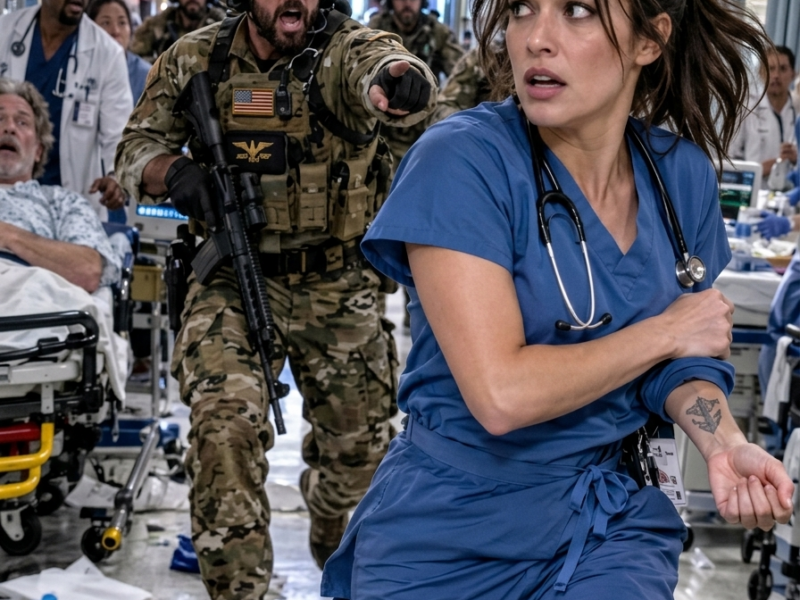
The emergency room doors exploded open just before midnight, and three Navy SEALs demanded to see “Angel 6”
The emergency room doors exploded open just before midnight. The harsh fluorescent lights flickered for a fraction of a second as the cold winter wind rushed into the trauma center, carrying the scent of freezing rain and exhaust. Three men stepped through the sliding glass doors. They were not paramedics. They were not patients. They moved with a predatory, coordinated silence that I recognized instantly. Navy SEALs.
I stood behind the nurses’ station, sorting through a stack of patient charts. My heart performed a slow, heavy thud against my ribs. I kept my head down, my posture relaxed, playing the part of a tired graveyard-shift nurse. I instinctively tugged the cuffs of my navy blue scrubs down to my knuckles. I had spent twelve years making sure nobody saw the tattoo on my right wrist. At work, I kept my sleeves pulled low. At home, I avoided mirrors when changing clothes. It was easier that way. It was the only way to survive.
The tallest of the three men walked straight to the reception desk. He wore a dark tactical jacket, his eyes scanning the room with terrifying efficiency, registering the exits, the security cameras, the blind spots. He slammed a manila folder onto the desk. The sound cracked through the quiet waiting room like a gunshot.
“We need Angel 6,” he demanded. His voice was low, rough, and used to being obeyed.
The charge nurse, a seasoned woman named Brenda who had seen everything from gunshot wounds to psychotic breaks, merely blinked at him over her reading glasses. “Excuse me? Who?”
His eyes swept across the room, landing briefly on the security guard near the vending machines, then moving past the triage doors. “Don’t play games with me. We know she is here.”
My stomach tightened into a cold knot. I knew that tone. Not the specific man, but the training behind it. The absolute certainty. I quietly stepped backward, moving into the shadows near the medication room. My wrist began to itch, then burn, as if the ink beneath my skin was reacting to their presence. Six black wings surrounding a tiny number six. A symbol I had promised myself would never see daylight again.
One of the SEALs, the one guarding the left flank, suddenly turned his head. His gaze locked onto me, piercing through the dimly lit corridor. His expression shifted from blank observation to sharp focus.
“Wait,” he said.
I froze. My breathing stopped. Twelve years of careful civilian life shattered in an instant.
He pointed a gloved finger directly at my wrist. “Show me your arm.”
The ambient noise of the emergency room—the rhythmic beeping of heart monitors, the low hum of the ventilation system, the distant wail of an ambulance siren—seemed to fade into absolute silence. The room disappeared. It was just me and the three men standing between me and the exit.
I slowly pulled up my right sleeve. The fabric slipped over my skin, revealing the dark, jagged lines of the six wings. The tallest man’s face went completely pale. The aggressive posture dissolved into something resembling shock.
“Angel 6,” he breathed.
Nobody spoke. Brenda looked back and forth between us, entirely lost.
I stepped fully out from the shadows. My voice was a hollow whisper. “You shouldn’t have come here.”
The leader took one step toward me, his hands raising slightly in a gesture of surrender, though his eyes remained calculated. “We thought you were dead.”
I almost laughed. A bitter, empty sound scraped the back of my throat. “That’s what I was supposed to be.”
Years earlier, I hadn’t been a nurse dealing with late-night drunks and broken bones. I had been the only woman assigned to a highly classified Navy rescue and recovery team known only by our numerical call signs. Angel 6 was mine. Our job was to extract American personnel from deep within hostile territories where official rescue teams simply could not go. We did not exist on any roster.
Then came the night that destroyed everything. Our helicopter went down during a black-site operation overseas. The heat, the screaming metal, the smell of aviation fuel soaking into the desert sand. Six people survived the initial crash. Only one of us made it home. Me. But before I slipped away into the shadows, I learned the truth: someone had betrayed our location. The others were captured by local warlords. I was told by command that they had been executed. I was told there were no survivors. I believed it.
Until tonight.
The SEAL opened the manila folder with shaking hands. He pulled out a grainy, satellite-printed photograph and slid it across the counter. I moved forward, my eyes locking onto the image.
Three men stood behind a rusted chain-link fence. The background was a barren, rocky landscape. One man was leaning heavily against the wire, badly injured. Another stood beside him, a jagged scar cutting across his face. And the third was standing in the center, looking directly into the lens of the camera.
I knew him instantly. Even older, even broken, his posture was unmistakable. My breath caught in my throat.
“That’s impossible,” I whispered.
The SEAL swallowed hard. “His name is Daniel Hayes.”
Daniel. My team leader. The man who had physically shoved me through the burning fuselage of the helicopter before it collapsed. The man I had watched disappear into the suffocating black smoke as I was forced to run.
“He sent one message,” the SEAL said, his voice tight.
“To whom?” I asked, my eyes never leaving the photograph.
The man looked directly at me. “To you.”
He reached out and turned the photograph over. There were six words written across the back in black marker.
Angel 6, you left us alive.
My hands began to shake. A wave of guilt and adrenaline washed over me. But as I stared at the back of the photograph, my eyes caught something else. Beneath those six words, pressed hard into the paper without ink, was a faint indentation. It was a second message, written in the precise, blocky handwriting I hadn’t seen in twelve years. I tilted the paper toward the light.
Don’t trust the men who found you.
I stopped breathing. I looked slowly up from the photograph, past the tall SEAL, toward the hospital doors. I noticed the way the third man’s hand was resting casually near his waist, right over a concealed weapon. I noticed the leader shifting his weight, blocking the corridor.
Suddenly, I realized the absolute truth. These SEALs hadn’t come to rescue me, and they weren’t here to ask for my help in finding Daniel. They had come because someone had realized Daniel was trying to contact me. They had come to tie up the final loose end.
The tallest man reached into his jacket.
“I’m sorry, Angel,” he said.
I didn’t wait to see the gun. I grabbed the heavy metal clipboard on the desk and swung it with all my strength.
The heavy metal clipboard smashed directly into the tallest man’s face with a sickening crunch. His head snapped back, a spray of blood hitting the white tiles, and he staggered into the reception desk.
Before the other two could draw their weapons, I vaulted over the counter, kicking the rolling chair into the legs of the second man. He went down hard, cursing as his knee hit the linoleum floor.
“Gun!” Brenda screamed, finally registering the chaos as the third man pulled a suppressed pistol from his jacket.
“Get down, Brenda!” I yelled, diving toward the double doors leading into the trauma bay. A sharp hiss cut through the air, and a bullet shattered the glass casing of the fire extinguisher on the wall just inches from my head. A thick cloud of white chemical powder erupted into the corridor, instantly blinding the room.
I hit the floor and rolled, my body instinctively remembering the tactical movements I had buried for over a decade. The hospital was suddenly a warzone. The alarms began to blare, a shrill, deafening wail that masked the sound of my footsteps as I scrambled into the trauma unit.
The emergency room was a maze of curtained beds, medical carts, and diagnostic machines. Patients were screaming in confusion. I needed to draw the men away from the civilians.
I grabbed a heavy oxygen tank from an empty bed, unhooked it, and dragged it toward the far exit leading to the stairwell. I could hear them shouting behind me, coughing through the fire extinguisher dust.
“Spread out! Secure the exits! Don’t let her reach the stairs!” the leader barked. His voice sounded nasal and broken from the clipboard strike.
I pushed through the swinging doors of the back hallway, leaving the main ER behind. I was unarmed, wearing flimsy scrubs, and wearing soft-soled nursing shoes. They had body armor, suppressed weapons, and the element of surprise. But this was my hospital. I knew every blind corner, every locked door, and every shadow.
I reached the heavy fire door of the north stairwell. Instead of opening it and going inside, I opened it, jammed a wedge of medical gauze into the hinge to keep it slightly open, and then ran the opposite direction down the hall toward the laundry chute.
I heard the heavy thud of tactical boots rounding the corner. It was the man I had tripped with the chair. He saw the cracked door of the stairwell, raised his weapon, and approached it carefully. He thought I was going down.
I waited behind a row of linen carts. As he pushed the stairwell door open and stepped through, I lunged.
I wrapped my right arm around his neck from behind, sinking a chokehold deep into his carotid artery, while my left hand slammed down on his wrist, trapping the gun against his side. He was massive, built like a tank, and he thrashed violently. He threw his elbow back, catching me hard in the ribs. Pain flared through my chest, but I held on, tightening my grip, wrapping my legs around his waist, and dragging him backward.
“Go to sleep,” I whispered in his ear, applying maximum pressure. “Go to sleep.”
He fought for another ten seconds, his boots scrambling for traction on the polished floor, before his eyes rolled back and his body went entirely limp. I lowered him quietly to the ground.
I quickly patted him down. I took his suppressed pistol, two spare magazines, and a tactical folding knife. The cold steel of the gun in my hand felt heavy, terrifying, and devastatingly familiar. I checked the chamber. One round loaded. Full magazine.
“Target is not in the stairwell. I repeat, stairwell is clear. Where is Miller?” a voice cracked over the earpiece on the unconscious man’s shoulder.
I pulled the earpiece from his radio and crushed it under the heel of my shoe. I had to keep moving. The basement was my best option. It connected to the old maintenance tunnels that led out to the parking garage.
I sprinted toward the service elevator, bypassing it to take the maintenance stairs used by the janitorial staff. I took the steps three at a time, the pistol held tight to my chest.
At the bottom, the basement was dark, illuminated only by the dim emergency lighting. The air was cold and smelled of bleach and damp concrete. I moved silently past the massive boilers and the hospital morgue. I was fifty feet from the exit door when a shadow detached itself from the wall ahead.
The third man. He had anticipated my route.
He didn’t speak. He just raised his weapon. I dove behind a stack of industrial washing machines just as three bullets sparked off the metal casing, deafening in the enclosed space.
“You’re making this difficult, Angel,” his voice echoed in the cavernous basement. “We have orders to bring you in. Dead or alive makes no difference to the people paying us.”
“Who sent you?” I shouted back, checking my angle. I had no clear shot.
“The same people who left you and your team to die in that desert. The people Daniel Hayes is threatening to expose. He survived, Angel. And he found proof of the treason. That’s why they need you gone. You’re the only person he trusts enough to pass the data to.”
My heart pounded furiously. Daniel had proof. He was trying to expose the conspiracy that killed our friends.
The man’s footsteps advanced slowly. He was trying to flank me. “It’s over,” he said calmly.
I noticed a high-pressure steam pipe running along the ceiling, directly above the path he was taking. I raised the suppressed pistol, aimed into the darkness, and pulled the trigger twice.
I didn’t aim at him. I aimed at the valve of the pipe.
The bullets sheared the rusty metal valve clean off. A massive, roaring jet of scalding white steam exploded downward. The man screamed as the boiling vapor hit his face and chest, dropping his gun and falling to his knees.
I didn’t look back. I bolted for the metal exit door, shoved the crash bar open, and burst out into the freezing, pouring rain of the city night.
I was alive. But my past had finally caught up to me. And if I wanted to save Daniel, I had to stop running.
I had to go to war.
The freezing rain felt like needles against my skin as I vanished into the maze of dark alleys behind the hospital. The adrenaline was a wild fire burning in my veins, masking the sharp pain in my ribs where the SEAL had struck me. I kept my head down, moving with rapid, calculated steps, checking my corners.
I didn’t stop moving for two hours. I crossed the city using underground subway tunnels, switching trains three times, walking through deserted industrial parks, and avoiding main roads where police cruisers were already flashing their lights, responding to the chaos at the hospital.
My destination was an old, abandoned commercial garage on the outskirts of the port district. I had rented it under a fake name eleven years ago. I paid the rent in cash, six months in advance, through a dummy corporation. I had never visited it. Until tonight.
I approached the rusted metal roll-up door from the blind side, sliding the stolen tactical knife into the padlock. It took me less than thirty seconds to pick it. I hauled the heavy metal door up just enough to slide underneath, then pulled it shut behind me.
Inside, it was pitch black and smelled of motor oil and dust. I found the electrical panel on the wall by memory and flipped a single breaker. A low-wattage work light flickered on, casting long, harsh shadows across the concrete floor.
In the center of the room sat an old, tarp-covered sedan. Against the far wall was a heavy steel workbench, and beneath it, a military-grade Pelican case locked with a biometric scanner.
I knelt beside the case. I placed my right thumb on the scanner. The machine hummed, read my print, and the heavy latches clicked open with a satisfying clack.
I threw the lid open. Inside lay the ghosts of Angel 6.
Custom-fitted body armor. A SIG Sauer MCX rifle. Several Glock 19 sidearms. Boxes of ammunition. A tactical combat knife. Encrypted communication gear. Stacks of untraceable currency. Passports with different names and faces.
I stripped off my soaked, bloody hospital scrubs. The cold air hit my bare skin, making me shiver, but I didn’t care. I pulled on a set of dark tactical clothing—cargo pants, a moisture-wicking combat shirt, and a lightweight Kevlar vest. As I strapped the holster to my thigh and checked the action on the Glock, a memory slammed into me with the force of a physical blow.
The sound of the helicopter rotors screaming. The smell of burning wire. Daniel, his face covered in soot and blood, grabbing me by the harness. “You have to jump, Angel! They sold us out! The extraction coordinates were a trap! Go!” He shoved me out of the open side door into the darkness just before the RPG hit the tail rotor.
I squeezed my eyes shut, forcing the memory back into the dark corner of my mind. I was breathing hard.
“They sold us out,” I whispered to the empty room.
I reached into the pocket of my discarded scrubs and pulled out the crumpled photograph the SEAL had left behind. I laid it flat on the workbench under the harsh work light. I traced the scarred face of Daniel Hayes with my finger. He looked older, hardened by twelve years of hell.
Don’t trust the men who found you.
I looked closer at the photograph. The background was dark, but the chain-link fence and the specific shape of a rusted crane in the distance caught my attention. I had spent years memorizing architectural and industrial structures for operations. It wasn’t a desert prison camp. It was a shipyard.
I grabbed a magnifying glass from the toolbox on the bench and hovered it over the bottom right corner of the photograph, where Daniel’s hand was resting against the fence. His fingers were splayed in an awkward, deliberate pattern.
Tap code. A prisoner of war communication method.
His index and middle fingers were pressed together. A gap. Then three fingers.
I grabbed a notebook and a pen. I translated the subtle finger placements he had managed to sneak into the frame.
Pier. 4. Midnight.
I looked at my watch. It was 1:45 AM. If the photograph was recent, and the SEALs had moved on me tonight, it meant they were cleaning house. They were moving Daniel tonight.
Suddenly, the motion sensor light outside the garage flickered on.
I froze. I killed the interior work light instantly, plunging the garage back into darkness. I grabbed the MCX rifle from the case, chambered a round, and moved silently toward the front of the garage.
They had tracked me. Perhaps a tracker in the stolen gun, or maybe they just knew about the safehouse.
I peered through a small, grimy window near the door. Two black SUVs had just rolled to a silent stop in the alleyway. Doors opened quietly. Five men stepped out, heavily armed, moving in a tactical formation toward the garage. The leader from the hospital was not among them, meaning these were reinforcements.
I was outnumbered. I was outgunned.
I smiled in the darkness. They thought they were hunting a terrified nurse. They had forgotten they were walking into the den of Angel 6.
I backed away from the door, grabbing a block of C4 explosive from the Pelican case, and began wiring it to the main support beam near the entrance. I wasn’t going to hide anymore. I was going to burn this place to the ground and walk right through the flames.
I set the timer on the detonator for forty-five seconds.
Outside, I heard the faint scraping of a breaching tool against the metal roll-up door. They were preparing to blow the lock. I slung the rifle over my shoulder, grabbed my gear bag, and moved rapidly to the back of the garage. There was an old ventilation shaft I had previously cleared of grating for exactly this scenario.
“Breaching in three, two, one,” a muffled voice commanded through the steel door.
A shaped charge blew the lock off the door with a sharp crack, and the heavy metal rattled upward. Flashbangs were immediately tossed into the dark garage.
Bang! Bang!
Blinding white light and deafening sound filled the space, disorienting the room. The five operatives flooded inside, weapons raised, sweeping their flashlights across the empty sedan and the open Pelican case.
“Clear left! Clear right!”
“Where is she?”
From my position in the back ventilation shaft, I watched them cluster near the center of the room. I looked at the remote detonator in my hand.
“She left her gear,” one of the men called out, approaching the workbench.
“No, she didn’t,” I whispered to myself.
I squeezed the trigger on the detonator.
The C4 attached to the front support beam detonated with a catastrophic roar. A massive fireball erupted, instantly consuming the front half of the garage. The shockwave threw three of the men off their feet, shattering the windows of their SUVs outside. The roof groaned violently as the structural integrity of the building failed, debris raining down into the flames.
I didn’t stay to watch the aftermath. I scrambled up through the shaft, pushing open the rusted grate, and emerged onto the roof of the adjacent warehouse. The rain was still coming down in sheets, cooling the heat radiating from the burning garage below.
I ran across the rooftops, leaping over gaps between the buildings, my boots splashing through deep puddles of standing water. I reached the fire escape at the end of the block and slid down the ladder to street level.
I needed transportation. I found a rusted but functional pickup truck idling behind a diner two blocks away, the driver stepping inside to grab a coffee. I slipped into the cab, dropped the gear into drive, and sped off into the night.
The dashboard clock read 2:15 AM. Pier 4.
I drove relentlessly through the industrial district. The city was a blur of neon lights reflecting on wet asphalt. My mind was racing, piecing together the fragments.
Twelve years ago, our team had uncovered evidence of black-market weapons trading facilitated by top US military brass. Before we could report it, our extraction coordinates were altered. We were fed to the wolves to keep the secret buried. Daniel had somehow survived, gathered the proof over a decade of captivity, and smuggled a message out. The men hunting me weren’t government agents; they were private mercenaries hired by the architects of our downfall.
I pulled the truck to a stop three blocks away from the sprawling complex of the port authority. Massive steel shipping containers were stacked like metallic mountains against the night sky. Giant cranes loomed like skeletons in the fog.
I secured the rifle across my chest, pulled a black balaclava over my face to conceal the bright tone of my skin in the darkness, and moved on foot.
The perimeter was heavily guarded. Private security contractors patrolled the chain-link fence with attack dogs. I waited for a patrol to pass, then scaled the fence in seconds, dropping silently into the mud on the other side.
I navigated the labyrinth of shipping containers. The rain masked the sound of my footsteps. As I neared Pier 4, I saw it.
A massive, rusted cargo freighter was docked at the pier. Armed men were patrolling the deck, their flashlights cutting through the driving rain. At the base of the ramp, two black SUVs identical to the ones at the garage were parked.
They were preparing to move him.
I crouched behind a blue Maersk container, observing the patterns. There were six men on the ground, four on the deck. I couldn’t go in loud. Not yet.
I drew my combat knife. I crept up behind a lone guard stationed near the rear of the convoy. I clamped my hand over his mouth and drove the blade up under his ribs, piercing his heart. He died without a sound. I lowered him to the ground and dragged his body behind the tires of the SUV.
I moved to the ramp. Two guards were standing there, smoking cigarettes and complaining about the cold.
I holstered the knife and drew my suppressed pistol. I took a slow breath, steadying my heart rate. I stepped out from the shadows.
Pfft. Pfft.
Two suppressed shots. Two men dropped instantly, their bodies hitting the wet metal ramp with heavy thuds.
I moved up the ramp like a ghost. I was no longer a nurse hiding in a hospital. I was Angel 6, operating in my element.
I reached the main deck of the freighter. A heavy iron door leading down into the hull stood slightly ajar. Faint, harsh voices echoed from below.
“Get him on his feet. The boss wants him at the bottom of the ocean before sunrise,” a voice growled.
“He can’t walk. His leg is shattered.”
“Then drag him.”
I gripped my rifle tight, my finger resting gently on the trigger guard. I stepped through the iron door and descended into the belly of the ship. The air grew thick with the smell of rust, salt, and stale blood. I was coming, Daniel. Twelve years late, but I was coming.
The corridor in the lower hull was narrow, dimly lit by caged bulbs that swung slightly with the motion of the water against the ship. I moved heel-to-toe, perfectly silent.
At the end of the hallway, a heavy bulkhead door was wide open. Inside what looked like an old storage hold, three mercenaries stood over a figure slumped in a metal chair.
I peered around the rusted doorframe.
It was Daniel.
He looked infinitely worse than in the photograph. His face was bruised and bleeding, his clothes practically rags. A crude, heavy brace was strapped to his left leg. But even battered and broken, his eyes were defiant. He stared up at the mercenary leader—a scarred, broad-shouldered man holding a metal pipe.
“Where is the data drive, Hayes?” the leader demanded, tapping the pipe against his open palm. “You didn’t send it to the nurse. We tore her hospital apart and blew up her safehouse. She’s dead. You’ve got nothing left.”
Daniel spat a mouthful of blood onto the floor. He smiled a slow, crooked smile. “If you think you killed Angel 6, you’re stupider than you look. She’s not a nurse. She’s a nightmare.”
I didn’t wait another second.
I stepped fully into the doorway, raising the MCX rifle. “He’s right.”
The three men spun around, their eyes widening in shock.
I fired. A rapid, controlled burst.
The two men flanking the leader dropped instantly, armor-piercing rounds shattering their chest plates. The leader lunged for his sidearm, but I fired a single shot that blew the gun out of his hand, severing two of his fingers. He screamed, collapsing to his knees.
I walked into the room, keeping the barrel aimed directly at his forehead.
“Who gave the order?” I demanded, my voice cold as ice.
The leader clamped his good hand over his bleeding stump, staring at me with pure hatred. “You’re dead. The Admiral… he’ll wipe you off the map…”
“Admiral Vance,” Daniel rasped from the chair. “It was Vance. He sold us out to protect his weapons cartel.”
I looked at the mercenary on the floor. “Thank you for the confirmation.” I pulled the trigger once. He slumped sideways, dead.
I immediately dropped the rifle so it hung on its sling and rushed to Daniel’s side. I pulled out my knife and began slicing through the thick zip-ties binding his wrists and ankles.
“You took your time,” Daniel said, his voice weak but laced with the old, familiar arrogance.
“Traffic was terrible,” I replied, a tight knot of emotion suddenly rising in my throat. I hauled him up, wrapping his arm over my shoulder to support his weight. “Can you walk?”
“For you? I’d run a marathon.” He hissed in pain as he put pressure on his bad leg. “I have the drive, Angel. It’s surgically implanted under the skin of my left forearm. Ten years of evidence against Vance and the whole network. We just need to get it to the press.”
“First, we have to get off this boat.”
Suddenly, the ship’s alarm system shrieked to life. Red lights began to flash in the corridor. The gunshots had been heard. Heavy boots thundered on the metal staircases above us.
“They’re coming,” Daniel said, his grip tightening on my shoulder. “Leave me. Take the drive. You can move faster alone.”
“Shut up, Daniel,” I snapped, hauling him toward the bulkhead door. “I left you behind twelve years ago. I am never doing it again.”
I handed him my Glock 19. “Cover our six. I’ve got the front.”
We moved back into the narrow corridor. At the top of the stairs, four mercenaries appeared, weapons raised.
I brought the MCX rifle up and unleashed suppressive fire, forcing them back behind the heavy steel frame of the stairwell. Sparks flew as bullets ricocheted wildly in the confined space. Daniel fired blindly over my shoulder, keeping their heads down.
“There’s a maintenance hatch at the end of the hall!” Daniel shouted over the deafening roar of gunfire. “It leads out to the anchor chain housing! We can drop straight into the water!”
“Go!” I yelled, firing another burst to keep the mercenaries pinned.
We staggered down the corridor. I pulled a flashbang from my vest, pulled the pin, and hurled it up the stairwell.
“Fire in the hole!”
The explosive detonated with a blinding flash and a concussive boom that rattled my teeth. The gunfire from above stopped instantly, replaced by screams of pain and disorientation.
We reached the maintenance hatch. I kicked the rusted latch loose and shoved the heavy iron door open. The freezing night air and the roar of the ocean rushed in. We were hanging directly over the black, churning water, fifty feet below.
“Can you swim?” I asked, looking at his shattered leg.
“I’m Navy, aren’t I?” he smirked.
“Hold your breath.”
We jumped.
The fall seemed to last an eternity before the freezing water hit us like a concrete wall. The cold stole the breath from my lungs. I sank deep into the darkness, the heavy tactical gear dragging me down. I fought against the weight, kicking hard, grabbing hold of Daniel’s collar, and pulling him toward the surface.
We broke the surface, gasping for air, hidden in the pitch-black shadow of the massive freighter. Above us, the ship was swarming with armed men, flashlights sweeping the water frantically.
“They won’t see us in the dark,” I whispered, treading water and supporting Daniel. “The current will take us to the commercial docks.”
We drifted away into the storm, the chaotic lights of the freighter shrinking into the distance. The cold was agonizing, but I felt more alive than I had in twelve years.
By dawn, we dragged ourselves onto a deserted rocky beach miles down the coast. Exhausted, freezing, and bleeding, we collapsed into the sand.
Daniel lay on his back, looking up at the gray morning sky. He reached over and weakly grasped my hand.
“We survived, Angel,” he whispered.
I looked at the rising sun, the dark ink of my tattoo stark against my pale skin. We had the evidence. We had each other. And Admiral Vance had no idea the storm that was coming for him.
“No, Daniel,” I said softly, my eyes narrowing as I looked back toward the city. “We didn’t just survive. We’re going to war.”
The end









