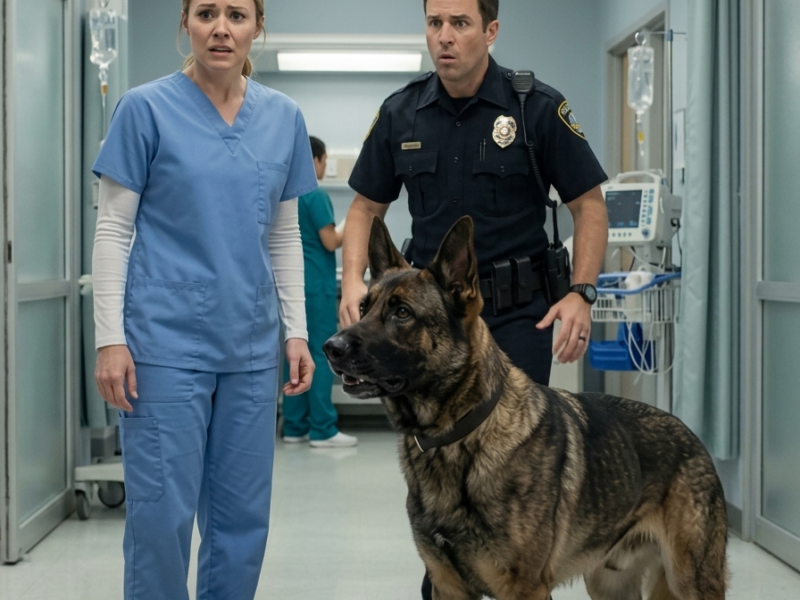
The emergency room doors burst open as a military K9 charged inside, knocking over a supply cart while a security guard shouted, “Get that dog out of here,”
The sterile smell of rubbing alcohol and industrial disinfectant always seemed to coat the back of my throat during night shifts at St. Jude’s Memorial Hospital. It was 2:14 a.m. in the emergency room, the quietest window of the night, when the heavy automatic double doors at the main entrance were violently shoved open from the outside.
A loud, metallic crash echoed down the main concourse as a heavy-duty supply cart was flipped onto its side. Bandages, antiseptic bottles, and plastic saline bags rained down onto the polished linoleum floor.
“Get that animal out of here! Security, step in!” a guard yelled from the triage desk.
Dragging a young, frantic-looking military handler whose boots were hopelessly skidding across the slippery floor, a massive German Shepherd came tearing down the ER hallway. The dog’s dark sable coat was matted, his tactical harness hung slightly askew, and his chest rose and fell with heavy, ragged breaths. He wasn’t acting aggressive out of malice; his amber eyes darted from face to face with a desperate, frantic hunger, as if searching through the crowded room for a face that shouldn’t exist.
I was halfway through changing a saline drip on an elderly patient’s IV pole when the commotion reached my station. I turned around, holding a fresh bag of saline, and froze.
The shepherd stopped so abruptly that his handler lost his grip on the heavy Kevlar leash, stumbling forward three paces before regaining his balance.
For several agonizing seconds, nobody in the hallway moved. The ambient hum of heart monitors and the soft hiss of oxygen valves seemed to vanish into a vacuum of dead silence.
I had never seen that dog before in my life. At least, that was the defensive lie I instantly recited to myself to keep my heart from leaping out of my chest.
The K9 lowered his heavy head, his ears trembling slightly as he took one slow, deliberate step toward me. His breathing was uneven, carrying a faint, high-pitched whimper deep in his throat. He crossed the ten feet of open floor separating us, completely ignoring the security guards and doctors, and gently pressed his wet nose against my trembling left hand.
My stomach dropped into a bottomless pit. A sudden, ice-cold chill shot through my veins, making my knees feel dangerously weak.
“Ma’am, step away from him slowly,” the handler warned sharply, reaching for the handle of his sidearm.
The shepherd’s response was instantaneous. He didn’t turn around, but a deep, dangerous growl rumbled through his broad chest. He wasn’t growling at me. His bared teeth and pinned ears were directed straight at the handler.
“It’s okay… it’s okay,” I whispered softly. I wasn’t sure whether I was trying to soothe the dog or keep my own mind from fracturing.
The dog lowered his muscular body to the floor, placing his heavy paws over my shoes, effectively locking himself beside my legs. He refused to budge. A ring of four security officers slowly encircled us, but the shepherd never broke eye contact with me. His gaze carried a raw, painful desperation—a silent plea for someone to finally understand.
The handler pulled out a encrypted tactical smartphone, his fingers flying across the screen. He read the readout, looked up at me, and his face drained of all color.
“His name is Ranger,” the handler whispered, his voice shaking. “He’s an active military working dog… but he’s been listed as missing in action for eighteen months.”
My breath caught in my throat. The name Ranger struck my chest like a physical blow.
I didn’t know that name from a military bulletin or a missing dog poster. I knew it from a worn, glossy photograph tucked inside my nightstand drawer at home. A photograph that had mysteriously vanished from my family’s house shortly after my younger brother, Caleb, was declared dead in a remote valley in Syria.
Ranger had been Caleb’s assigned K9 partner in the Special Operations K9 Unit. I had met the animal only once, three weeks before my brother was deployed overseas. I remembered that rainy evening so vividly—Caleb holding me in a tight, unusually long embrace on my front porch, his voice dropping into an urgent whisper: “Maya, if anything happens over there… if you get a official letter… don’t believe everything they tell you.”
For eighteen agonizing months, I had forced myself to accept the cold, official narrative. The military liaison had visited our house, handed my crying mother a folded flag and a sealed box, and told us Caleb had been killed instantly in an accidental munitions explosion during a routine patrol. There had been no body to see. No final goodbye. Just a cold stone marker in the veterans’ cemetery.
Now, Caleb’s dog was kneeling over my feet in an emergency room in Chicago, looking at me as if he carried a secret buried under his skin.
I dropped to my knees beside him, uncaring of the hospital floor, tears hot and bitter in my eyes. “Where have you been, boy?” I whispered, my voice breaking.
The handler quickly looked away, avoiding my gaze.
That was when the harsh lighting of the ER illuminated the dog’s left shoulder. Running across his muscular frame was a jagged, crescent-shaped white scar where fur refused to grow. It was shaped exactly like the shrapnel wound Caleb had detailed in his final handwritten letter—a letter he had managed to mail through a civilian post office three days before his disappearance.
My hands shook uncontrollably as I buried my fingers into Ranger’s thick coat.
Suddenly, Ranger bolted upright. He broke away from my side, sprinted ten yards down the corridor toward the central nurses’ station, and stopped dead in front of an old, stainless-steel record cabinet that had been locked since the hospital renovated its digital archive system five years ago.
Ranger raised his front paw and scratched the metal door once. Then twice. He let out a sharp, commanding bark that echoed off the high ceiling.
The handler went completely pale, stepping back against the wall. “I’ve never seen him do that… that’s a passive alert sequence for encrypted material.”
My mind raced. I reached for the master key card hanging from the lanyard around my neck—a key that gave me access to old physical archives.
Before I could insert the key into the cabinet lock, my phone in my scrub pocket vibrated with a sharp, double-pulse chime.
I pulled out the screen with a trembling hand. An unknown, untraceable text message appeared on the display:
Your brother didn’t die that night. Open the cabinet.
I raised my head slowly. Ranger was already turned toward me, his amber eyes fixed on mine, as if he had been waiting eighteen long months for someone to finally listen to the truth.
The vibration of my phone seemed to linger in the palm of my hand like an electric current. Around us, the emergency room was frozen in a strange, suspended animation. The security guards, sensing the sudden shift from a rogue animal call to something far darker, stood back, their hands resting uncomfortably on their belts.
“Nurse Maya,” the charge nurse called out from behind the counter, her voice laced with deep concern. “What is going on? Do you know this dog?”
“I’m opening the cabinet,” I said, ignoring her question entirely. My voice sounded distant to my own ears, hollowed out by a surge of pure adrenaline.
“Ma’am, don’t touch that lock!” the handler yelled, taking a step forward. “This dog was attached to a classified special operations unit. Whatever he is keying on is a matter of federal security—”
Ranger spun around, his chest swelling as a low, guttural roar burst from his throat. The sheer ferocity in the dog’s posture forced the handler to freeze mid-step. Ranger stepped back, positioning his heavy body directly between the handler and me, granting me a clear path to the stainless-steel doors.
My hand was shaking so badly I missed the keyhole twice. The brass key scraped against the steel plate before finally sliding home. I turned it with a heavy, mechanical CLICK.
The cabinet door swung open with a soft creak.
Inside, the shelves were mostly barren, covered in a light layer of gray dust and abandoned paper files from a decade ago. But resting right in the middle of the bottom shelf, completely free of dust, was a dark gray tactical hard-case secured with a heavy combination padlock.
Sitting right on top of the case was a small, tarnished silver dog tag.
I reached inside with a trembling hand and pulled the dog tag into the light. Engraved on the metal face was my brother’s name: CALEB V. LINWOOD, followed by his blood type, service number, and a single handwritten line etched into the back with the tip of a knife:
TRUST RANGER. HE HAS THE DRIVE.
“Oh, God, Caleb…” A sob tore from my throat.
Ranger let out a soft whimper, stepping closer to press his head against my hip, his warm breath soaking through my scrubs.
“Step away from the cabinet immediately!” a hard, unfamiliar voice shouted from the far end of the hallway.
Two men dressed in sharp, dark suit jackets with high collars stepped through the automatic ER doors. They didn’t wear hospital badges or military uniforms, but their rigid posture, military-style haircuts, and the subtle bulges beneath their left armpits made their identity instantly clear.
The lead man pulled a silver badge from his coat pocket, holding it out briefly. “I am Agent Vance, Department of Defense Inspector General’s Office. This facility is now an active federal crime scene. Nurse Linwood, step away from that container and keep your hands visible.”
“How do you know my last name?” I asked, backing away slowly, pulling the tarnished dog tag tight into my fist. “I don’t wear my surname on my hospital badge. Who are you?”
“We’ve been tracking this asset for seventy-two hours,” Vance said calmly, taking smooth, deliberate steps toward us. His partner moved along the wall, cutting off the exit toward the ambulance bay. “Your brother was involved in a high-level breach of military intelligence before his location was compromised in Syria. The animal was weaponized to retrieve stolen government property. Give us the case, Maya.”
“He said my brother didn’t die,” I said, my voice hardening as anger began to override my terror. “The military gave my mother an empty box! You lied to us!”
“Your brother was a traitor who abandoned his post during an active deployment,” Agent Vance replied coldly, his face completely devoid of emotion. “He died a fugitive. Now hand over the container before you become an accessory to high treason.”
At the word traitor, Ranger let out a roar of absolute fury. The dog didn’t just growl; he launched himself two feet forward, his powerful jaws snapping inches from Vance’s chest, forcing the agent to stumble backward into a row of plastic waiting-room chairs.
“Ranger, heel!” the handler shouted.
The dog ignored the command completely. He looked back at me, let out a sharp, urgent bark, and shoved his snout violently against the side of my leg, pushing me toward the double doors of the rear service corridor.
“He wants you to run!” a young paramedic yelled from behind the desk. “Maya, go!”
In a split second of pure instinct, I snatched the small tactical hard-case from the bottom shelf, shoved it under my arm, and sprinted toward the double doors of the service corridor.
“Stop her!” Vance screamed.
BANG!
The sharp, deafening sound of a suppressed gunshot shattered the air. A high-velocity round punched a clean, round hole through the glass panel of the service doors just inches above my head, spraying sharp shards of glass across my shoulders.
Security guards screamed, patients ducked for cover, and absolute chaos erupted across the ER.
I didn’t look back. I slammed my body against the emergency crash bar of the service doors, bursting into the dimly lit, cool air of the hospital’s lower supply corridor. Ranger was right beside me, his nails digging into the linoleum as he kept pace, a dark, unstoppable phantom protecting my flank.
Behind us, heavy footsteps thundered against the floor as the two agents gave chase, their suppressed weapons drawn in the dark.
The lower service corridor smelled of damp laundry, motor oil, and old concrete. It was a maze of dimly lit subterranean hallways that ran beneath the main hospital wings, connecting the boiler rooms, maintenance bays, and the underground loading docks.
My lungs burned as I sprinted through the dark, holding the heavy tactical case securely against my ribs. My nursing shoes slapped loudly against the concrete floor, echoing off the low pipes running along the ceiling.
Behind us, thirty yards back, heavy iron doors slammed open.
“Split up!” Agent Vance’s voice echoed down the concrete tunnel. “Check the boiler rooms! She can’t get out through the perimeter without a security clearance card!”
Ranger didn’t panic. He pulled ahead of me, his body low to the ground, taking a sharp left turn into a narrow, unlit utility access space marked CAUTION: HIGH VOLTAGE.
I followed him into the pitch-black room, slamming the heavy iron door shut behind us. I threw the manual lock latch into place just as heavy footsteps ran past in the main corridor outside.
I sank to my knees on the cold concrete floor, trying to muffle my ragged breathing with my hand. Darkness swallowed us completely, save for the faint red glow of a digital transformer box on the far wall.
Ranger pressed his warm, massive body against my side. He didn’t make a sound. He raised his snout, resting his chin gently over my shoulder, keeping a protective guard in the pitch-black room.
My heart was beating like a trapped bird inside my chest. I reached down in the dark, feeling the surface of the tactical hard-case I had pulled from the cabinet. The heavy brass padlock was rusted around the shackle, but the reinforced plastic body of the case was completely intact.
“Caleb…” I whispered into the dark, tears streaming down my cheeks. “What did you get yourself into?”
Ranger let out a soft, low whimper. He nudged his nose against my right scrub pocket, where my cell phone was resting.
I pulled out the phone. The screen’s bright white light illuminated the dark room, making both of us blink.
There was a second unread text message from the unknown number:
The combination to the case is the date Caleb took you to the lake before his boot camp. Look inside the lining of Ranger’s harness.
My mind raced back through years of memories, sifting through the grief I had carefully packed away. July 14. 0-7-1-4.
With trembling fingers, I brought the tactical case up into the blue light of the phone screen. I turned the brass dials of the combination lock: 0… 7… 1… 4.
CLICK.
The shackle popped open.
I lifted the heavy plastic latches and pulled open the lid of the case. Resting inside, set securely into a custom-cut foam insert, was a ruggedized, military-grade encrypted hard drive, a small satellite tracking device, and a thick, hand-written notebook bound in dark leather.
I picked up the notebook. The handwriting on the first page made my breath catch in my throat. It was Caleb’s handwriting—messy, rushed, and unmistakable.
I turned to the final page, dated three days before his supposed death:
If you are reading this, Maya, it means Ranger brought you the key. I stumbled onto a black-market operation inside our own logistics command in Syria. High-ranking officers in the Inspector General’s office—including Agent Vance—were selling seized military ordnance to private contractors and staging ‘fatal accidents’ to cover the missing inventory. They realized I knew. They tried to execute me in the valley, but Ranger fought them off and gave me time to break out. I am alive, but I am in hiding. They think Ranger was destroyed in the blast. If you have this drive, broadcast the files on the open emergency military network. Clear my name, sister. I’m coming home.
Fresh tears fell onto the paper, smudging the dark blue ink. He was alive. My brother was alive, hiding in the dark somewhere in the world, waiting for someone to light the flare that would bring him out of the cold.
Suddenly, a loud CLANG rattled the iron door of the utility room.
“She’s in here!” Vance’s voice barked from the other side of the heavy door. “Get the breaching tool!”
Ranger stood up instantly, his dark sable hair standing on end along his spine. A chilling, vibrating snarl filled the small room.
“Maya,” a soft, raspy voice suddenly spoke from my phone’s speaker.
I looked down at the screen. The unknown caller was dialing me. I answered, pressing the phone to my ear.
“Caleb?” I choked out, my voice cracking.
“Maya… listen to me,” my brother’s voice rasped through a wall of heavy radio static. He sounded exhausted, bruised, but fiercely alive. “I’m in the parking garage beneath the south wing. I have the secondary receiver. I just need you to get Ranger and that drive out to the loading bay!”
“Caleb, they’re right outside the door!” I cried, backing away as the iron door shook violently under the impact of a heavy sledgehammer.
“Trust Ranger, Maya!” Caleb pleaded through the static. “He knows the facility! He brought me through those tunnels when we surveyed the hospital security three years ago! Let him lead!”
BOOM!
The iron door frame buckled under a second massive blow. Dust and concrete chips rained down from the ceiling.
I grabbed the encrypted hard drive, shoved it into my scrub pocket, and snapped the notebook back into my waistband. I looked down at the massive shepherd standing beside me in the dim red light.
“Alright, Ranger,” I whispered, my voice steadying with a sudden, unshakeable courage. “Take us to my brother.”
The heavy iron door tore away from its hinges with a deafening screech of rending metal.
As the door fell inward, spraying concrete dust into the air, Agent Vance and his armed partner stepped into the doorway, their tactical flashlights slicing through the dark room.
“Don’t move!” Vance roared, leveling his suppressed pistol toward my chest.
“Ranger, ATTACK!” I screamed.
The German Shepherd didn’t hesitate. He didn’t bark or hesitate; he launched his ninety-pound body straight through the dust cloud like a dark projectile. His powerful jaws locked onto Vance’s right forearm before the agent could line up a shot.
Vance screamed in pain as the force of the dog’s impact slammed him hard against the concrete doorframe. His pistol flew from his grip, spinning across the floor until it bumped against my boot.
The second partner tried to raise his weapon, but I reacted on pure instinct—an instinct forged from years of working high-stress ER trauma rooms where hesitation meant death. I grabbed a heavy brass fire extinguisher mounted to the wall beside me and swung it with all my strength.
CLANG!
The heavy cylinder struck the second agent across his tactical vest, knocking the wind out of him and sending him stumbling backward into the corridor.
“Go, Ranger! Go!” I yelled.
Ranger released Vance’s bloody arm, executed a sharp turn, and sprinted down the corridor toward the heavy rubber doors marked LOADING BAY 3.
We burst through the double rubber doors into the vast, echoing space of the underground loading bay. The space was filled with parked laundry trucks, rows of industrial trash compactors, and the cold, damp night air rushing in from the open roll-up bay doors that led out to the lower parking ramp.
Standing near the back of an idling civilian delivery van at the edge of the ramp was a tall, lean figure wrapped in a dark oilskin coat. He walked with a slight limp, his face partially hidden beneath a low-slung baseball cap.
As we burst into the light, the man pulled off his cap, revealing a face covered in a rough beard, marked by a deep, pink shrapnel scar along his left jawline.
“Caleb!” I shrieked.
“Maya!”
My brother took three fast, limping steps forward. I threw myself into his arms, the force of our collision nearly knocking both of us to the ground. He wrapped his strong arms around me, burying his face into my shoulder, holding me with a fierce, desperate strength that shook his entire frame.
“I’m sorry… I’m so sorry, Maya,” Caleb choked out, his voice thick with raw emotion. “I couldn’t come back until I knew you were safe…”
Ranger leaped up between us, resting his heavy paws against Caleb’s chest, letting out a series of joyful, high-pitched barks that echoed off the high concrete ceiling of the bay. Caleb pulled the dog’s head close, pressing his forehead against Ranger’s snout, tears slipping freely down his scarred cheeks.
“You brought her home, boy,” Caleb whispered softly to the dog. “Good boy… good soldier.”
“Caleb, they’re right behind us!” I urged, pulling the encrypted hard drive from my pocket and pressing it into his hands. “Vance has the entire federal team sweeping the building!”
“Not anymore,” Caleb said, a hard, tactical glint flashing in his amber eyes—eyes that were identical to my own.
He reached inside his coat, pulled out a ruggedized military field tablet, and plugged the hard drive directly into its side port. “I’ve been sitting on the encrypted upload node for twelve hours waiting for the physical key you just brought me. The moment this drive connects, the entire archive of Vance’s black-market network gets broadcast to the FBI Special Crimes Division, the Pentagon Inspector General, and three national news networks simultaneously.”
“Do it,” I said, holding his arm.
Caleb’s fingers flew across the glass screen. A blue progress bar appeared on the display, rapidly filling from left to right: 40%… 70%… 90%…
“COVER THE BAY!” a harsh voice screamed from the service doors.
Agent Vance, his right arm dripping blood, stepped into the loading bay, holding a secondary sidearm in his left hand. Behind him, three armed security guards from the hospital—completely misled about the nature of the situation—flooded the bay with their weapons drawn.
“Caleb Linwood!” Vance yelled, his voice echoing menacingly. “Step away from that terminal! You are a dead man!”
“You’re too late, Vance,” Caleb said calmly, holding up the tablet screen as the progress bar hit 100%.
A sharp green chime echoed from the device: TRANSMISSION COMPLETE. RECEIPT CONFIRMED BY US-DOJ-CYBER-COMMAND.
Vance’s face drained of every drop of color. “What did you do?”
“I gave the world your receipts, Colonel,” Caleb said coldly, stepping in front of me and Ranger. “Every bank account. Every stolen crate. Every staged accident. It’s all over.”
In the distance, rising over the sound of the rain outside, the loud, wailing sirens of dozens of federal police cruisers began to echo down the street, rapidly closing in on the hospital’s lower parking structure.
The heavy, flashing red-and-blue lights of twenty federal vehicles painted the rain-soaked concrete of the hospital driveway in vibrant, pulsing colors. The rain had softened into a gentle, cool mist that washed away the stale, sterile smell of the emergency room.
Agents from the Federal Bureau of Investigation, accompanied by heavily armed U.S. Marshals, flooded the loading bay. Agent Vance and his partner were stripped of their weapons, forced to their knees, and snapped into heavy steel handcuffs before being dragged away toward dark, unmarked sedans.
A senior federal prosecutor walked up to Caleb and me, holding a encrypted tablet showing the verified transmission log.
“Sergeant Linwood,” the prosecutor said gravely, offering his hand to my brother. “Your military record has been officially restored. The Department of Justice is taking immediate custody of all materials. You and your sister are under full federal protection as of this moment.”
Caleb shook the man’s hand firmly. “Thank you, sir. Just make sure the men who died in that valley get their names cleared too.”
“They will,” the officer promised. “You have my word.”
As the federal vehicles cleared the bay and the chaos slowly dissolved into the calm of early morning, Caleb, Ranger, and I walked out onto the elevated pedestrian overlook behind the hospital.
The storm clouds that had hung over Chicago all night were breaking apart. To the east, over the dark horizon of Lake Michigan, a brilliant golden sunrise broke through the gray sky, casting warm, radiant light across the city skyline.
I stood beside my brother, resting my head against his shoulder. His arm was wrapped tightly around my waist, holding me close against the cold lake breeze. Ranger sat proudly beside our feet, his broad head resting against my knee, his amber eyes watching the golden light spread across the water.
For eighteen long, dark months, I had lived in a cold, hollow world of grief, believing that my brother was nothing more than ash and a name carved into a stone marker. I had walked through life with a fractured heart, believing the official lies forced upon my family.
Now, standing in the warm golden light of a new day, holding the living, breathing brother I thought I had lost forever, the shadow was finally gone.
Caleb looked down at me, a soft, genuine smile touching his scarred face—the same warm smile I remembered from our childhood.
“I told you not to believe everything they said, Maya,” he whispered softly, his voice thick with emotion.
“I know,” I said, tears of pure joy slipping down my cheeks as I laughed through the emotion. “I just needed a stubborn dog to remind me.”
Ranger let out a loud, happy bark that carried clearly across the quiet water of the lake—a proud, victorious sound that declared the long nightmare was over.
Caleb reached down, burying his hand into Ranger’s thick fur, while I took my brother’s hand in mine. Together, standing under the bright golden sky of a fresh morning, we finally took a deep, full breath of air, knowing that we were whole again, and that we were finally, truly home.
The end.









