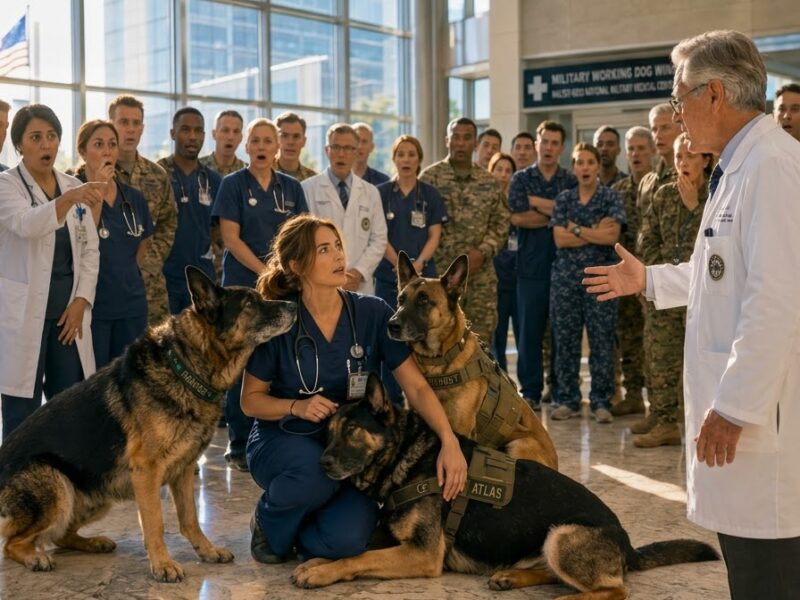
The emergency room at Fort Liberty went silent when I treated three dying military dogs in under two hours
The fluorescent lights of the Fort Liberty Emergency Room hummed with a low, relentless vibration that usually got buried under the chaos of trauma calls. But tonight, at two in the morning, the silence was heavy. The air smelled of industrial disinfectant, dried blood, and the metallic tang of fresh rain leaking through the ambulance bay doors.
I was in the corner of the trauma bay, wiping down a stainless-steel tray of surgical instruments. For three years, that was my universe: cleaning trays, stocking IV bags, and staying invisible. As an ER nurse at one of the busiest military installations in the country, invisibility was a survival skill. If you kept your head down, nobody asked about your past. Nobody asked why your file had no military medical history prior to 2018, or why you flinched every time a Chinook helicopter rattled the windows.
The double doors burst open with a loud, hydraulic slam.
“Clear the bay! We’ve got a critical!” a young corporal screamed, his voice cracking with panic. He wasn’t pushing a gurney. He was carrying fifty pounds of bleeding muscle in his arms.
It was a German Shepherd. The dog’s tactical vest was soaked through with dark, venous blood, his tongue lolling uselessly over the corporal’s arm.
“Where is the duty vet?” Dr. Mitchell shouted, stepping out of the scrub room while snapping on a pair of nitrile gloves. Mitchell was a senior surgeon, a man whose hair had gone gray from twenty years of repairing broken soldiers. He was brilliant, cold, and entirely unaccustomed to canine anatomy.
“Vet Corps is tied up at the K-9 kennels on the south ridge, sir!” the corporal panted, his eyes wide, blood staining the front of his uniform. “Ranger collapsed during a live-fire night exercise. Shrapnel or a stray round—we don’t know! He’s dying, Doc!”
“We don’t treat animals here, Corporal,” Mitchell said, his voice hard, though his eyes betrayed his hesitation. “Call the emergency vet clinic off-base. I can’t risk human medical supplies on a—”
“Let me see him,” I said.
The words left my mouth before my conscious mind could filter them. I dropped the sterilization towel onto the tray and stepped into the bright white circle of the surgical lights.
Mitchell turned, a deep scowl forming between his brows. “Sarah, back off. You’re a triage nurse, not a veterinarian. We have protocols.”
I ignored him. I knelt beside the stainless-steel examination table where the corporal had laid the Shepherd. Ranger’s pupils were dilated, his gums pale—nearly white. Hypovolemic shock. His chest was rising in shallow, desperate spasms.
“He’s not just bleeding from the flank,” I murmured, my fingers moving automatically through his dense fur, pressing into the soft tissue of his abdomen. “Feel that? Subcutaneous emphysema. His lungs are clear, but his abdominal wall has been breached. He’s bleeding internally into the peritoneal cavity.”
Mitchell frowned, stepping closer despite himself. “How could you possibly tell that through all that fur without an ultrasound?”
Before he could finish the sentence, Ranger’s chest went still. The low, erratic rhythm of his heart gave one final, weak flutter and stopped.
“Flatline,” a technician called out. “No pulse.”
“Give me the emergency kit!” I barked. My voice didn’t sound like the quiet, submissive nurse who spent her shifts sanitizing scalpels. It sounded like a field surgeon running a forward surgical team under artillery fire.
Mitchell opened his mouth to order me away, but something in my posture made him freeze.
I didn’t wait for permission. I grabbed a scalpel from the tray, made a swift, two-inch incision through the fascia, and thrust two fingers directly into the bleeding wound cavity. My hands knew the terrain without my eyes needing to see it. Canine vascular anatomy was different from human, but the femoral branches and internal hemorrhages obeyed the same physics of pressure.
My thumb clamped down on a severed arterial branch deep near the pelvis.
Fifteen years ago.
The scent of burning JP-8 jet fuel filled my nose, replacing the sterile smell of the ER. I was back in the dirt of a remote village near the Afghan border. I could hear the roar of flames, the crackle of burning timbers, and the agonized whimper of a dog trapped beneath a collapsed mud-brick wall. A dog named Ghost. Ghost had dragged my bleeding body out of a burning command tent before a second mortar hit. He had saved my life. And when I tried to stop his bleeding with my bare hands in the dark, I had failed. He had died in my arms, his blood soaking through my sleeves while I begged him to hold on.
I wasn’t going to let this one die. Not tonight.
“Suction, now!” I snapped at Mitchell.
The surgeon, stunned into submission by the sheer authority in my voice, handed me the suction tube. The machine whirred, clearing the dark pool. With a lightning-fast movement, I slid a vascular clamp into the incision and locked it around the bleeding vessel.
A long, ragged breath tore through Ranger’s throat. His tail gave a weak, involuntary twitch against the stainless steel.
“Pulse is returning,” the technician whispered, staring at the monitor in absolute disbelief. “110 bpm. Gums are color-returning.”
The room was dead silent. The corporal collapsed into a chair, buried his face in his hands, and began to sob quietly.
Mitchell stood across the table from me, his hands suspended in mid-air. He looked at the dog, then looked down at my hands—still covered in blood, perfectly steady, resting on the animal’s flank.
“Where did you learn to do an emergency vascular clamp on a working dog, Sarah?” Mitchell asked softly. His voice was no longer harsh; it was dangerous. It was the tone of a man who had spent his life reading classified personnel files.
“I read a lot,” I said, pulling my hands back and stepping away toward the sink.
“No,” Mitchell said, his eyes tracking my every movement. “Reading doesn’t give you muscle memory like that. You didn’t hesitate for a microsecond.”
Before I could turn on the faucet to wash the blood from my skin, the ER doors swung open again.
The second dog was brought in on a canvas stretcher by two Military Police officers. It was a Belgian Malinois, lean, muscular, and thrashing wildly in a terrifying, rhythmic seizure. White foam bubbled violently from his jaws, spattering against the floor.
“Name’s Atlas!” one of the MPs shouted above the noise of the dog’s thrashing. “K-9 patrol found him like this near the perimeter fence! He was fine twenty minutes ago, then he just went into convulsions!”
Dr. Mitchell rushed over, but he kept his distance. A two-hundred-pound bite force attached to a malinois in the middle of a neurotoxic seizure was a lethal hazard. “Is it rabies? Canine distemper?”
“No,” I said, stepping between Mitchell and the animal. I snatched a thick towel from the warming cabinet, wrapped it around my left forearm for protection, and pinned the dog’s head with precise, gentle leverage against the gurney.
Atlas’s eyes were rolled back, showing only the whites. His limbs were rigid, locking up in severe tetanic contractions.
“Look at his pupils,” I pointed out, holding his upper eyelid open with one finger. “Pinpoint. Combined with hypersalivation and muscle fasciculations. This isn’t disease. It’s an organophosphate inhibitor. He’s been poisoned.”
“Poisoned?” the MP gasped. “With what?”
“Pesticide. Old-school rat poison or agricultural nerve toxin,” I said, my brain racing through chemical profiles I hadn’t used in a decade. “He swallowed it or inhaled a concentrated powder within the last thirty minutes.”
“We don’t have specialized veterinary nerve agents in the human bay,” Mitchell said, his eyes narrowing as he watched me handle the violent Malinois with unnatural calm. “Atropine works on humans, but the dosage for a sixty-pound Belgian Malinois—”
“Two milligrams of Atropine IV, followed immediately by activated charcoal and a lipid emulsion,” I interrupted, without looking at him. “Do it now, or his diaphragm will paralyze in three minutes.”
“Nurse Miller,” Mitchell said, his voice dropping an octave, heavy with warning. “If I administer a human narcotic-class drug to a military working dog on your unverified word, and that dog dies, we both face a court-martial.”
I turned my head and looked Mitchell straight in the eye. I didn’t back down. “If you don’t give him that Atropine right now, Doctor, you will be burying a seventy-thousand-dollar strategic military asset before the sun comes up. Give me the syringe.”
Something in my eyes broke his resistance. Mitchell turned to the crash cart, grabbed an ampoule of Atropine, and handed it to me.
I didn’t need to feel for the vein. I slid the needle into Atlas’s cephalic vein on the first push. Within ninety seconds, the violent shivering began to subside. The foam at his mouth thinned out. The rigid stiffness in his legs relaxed, and the dog let out a deep, shuddering sigh, his eyes slowly coming back into focus.
“Unbelievable,” the MP breathed, sinking back against the wall. “You just saved Atlas.”
I didn’t feel relieved. A cold, knotting fear was settling deep in my stomach.
Two military dogs in under two hours. One with a precise puncture wound that simulated shrapnel, another poisoned by an organophosphate toxin on a secure military installation. This wasn’t a series of unfortunate accidents. Fort Liberty was under a breach. Someone was intentionally disabling the perimeter’s first line of defense—the K-9 units.
“Sarah,” Mitchell’s voice sliced through the silence. He was standing by the central nurses’ station, holding a black leather-bound binder. He wasn’t looking at Atlas. He was looking at me. “Come here.”
I slowly walked over, washing my hands at the sink along the way. “We need to keep Atlas on an IV drip for the next four hours to clear the remaining toxins.”
“The dog is fine,” Mitchell said quietly. He leaned against the counter, blocking the exit from the station. “What’s not fine is your file.”
“My file?”
“I just called up your employment record from the Department of the Army civilian database,” Mitchell whispered, his eyes locked on mine like a hawk. “You entered the system five years ago as a lateral transfer from a civilian hospital in Chicago. But when I run your social security number through the cross-reference system for federal service…” He paused, letting the silence stretch between us. “It comes up with a red flag. A security hold.”
“There must be a system error,” I said, keeping my voice completely flat, devoid of emotion.
“I don’t think it’s an error,” Mitchell replied softly. “In my twenty-five years in the military, I’ve only seen three people handle military working dogs with that kind of tactical muscle memory. All three of them were operators from the 75th Ranger Regiment’s Special Operations Canine Regiment. And all of them were men.”
He leaned closer. “Who are you, Sarah? Because no civilian nurse knows how to do a blind vascular clamp on a dog while diagnosing organophosphate poisoning in the dark.”
Before I could formulate a lie convincing enough to satisfy him, the ambulance bay doors flew open for the third time.
This time, there were no sirens. No screaming corporals.
A single soldier stepped through the doors. He was wearing the dark grey uniform of a Special Forces Operator, his face smeared with camouflage paint, his eyes rimmed with exhaustion and dust. In his arms, he carried a dog wrapped in a heavy tactical blanket.
The dog wasn’t thrashing. He wasn’t whimpering. He was an aging Black Labrador, his muzzle heavily frosted with grey fur. His eyes were half-closed, dull, and fixed on nothing.
“Help,” the soldier said. His voice wasn’t an order; it was a plea. A strong, combat-hardened man broken down to his core. “Please. Someone help him.”
I stepped past Mitchell before the doctor could say a word.
“What happened?” I asked, kneeling beside the gurney as the operator laid the heavy Labrador down.
“He collapsed during the perimeter sweep near Sector 4,” the soldier said, his hands trembling as he brushed the grey fur away from the dog’s forehead. “No sound. No trauma. He just… his legs gave out. He’s been my partner for nine years. He’s all I have left from the deployment in the valley.”
I placed my palm against the dog’s ribs. His breathing was dangerously slow, his skin clammy. Hypothermia and systemic organ fatigue. But as I ran my hands over his body, feeling his chest, his neck, his legs, my fingers stopped at his left ear.
There, tucked just beneath the outer flap of his left ear, was a jagged, V-shaped scar.
My breath caught in my throat. My vision blurred for a fraction of a second, the walls of the Fort Liberty ER dissolving into the dirt wall of a compound in the Korengal Valley.
I knew that scar.
Fifteen years ago, in a secret facility in North Carolina, I had personally stitched that exact V-shaped tear on a young, wild-eyed Belgian-Labrador cross named Ghost. Ghost had torn his ear on a barbed-wire fence during night-navigation training. I was the young veterinary officer who had held his head, whispered to him, and sewed the tissue back together with fine nylon thread.
Ghost had died in the mountains of Afghanistan. But before he died, before that final, catastrophic ambush that erased my team from the face of the earth, Ghost had fathered a single litter of working pups under a classified breeding initiative known as Project Aegis.
I looked down at the old black dog lying motionless on the table.
“Bear,” I whispered unconsciously.
The soldier’s head snapped toward me, his eyes wide with shock. “How do you know his name? His name tag isn’t on his collar. He’s wearing his slick harness.”
I froze. My heart hammered against my ribs like a trapped bird.
“I… I read his microchip scanner log,” I lied desperately, pointing to the electronic reader sitting on the side table.
“The scanner isn’t turned on,” Dr. Mitchell said from behind me. His voice was deathly quiet.
I didn’t turn around. I couldn’t. My eyes were fixed on Bear. Ghost’s son. The last living piece of the dog that had pulled my broken body out of the rubble when my entire unit was wiped out. The dog that had given his life so I could breathe.
Bear’s tail gave one slow, faint thump against the metal table. He recognized my voice. Dogs never forget a voice, even after fifteen years. Even when that voice belongs to a ghost.
“He’s suffering from acute cardiac arrhythmia brought on by an ultra-low frequency sonic inhibitor,” I said, my voice dropping into a razor-sharp tone of clinical authority that left no room for question. “Someone is using localized acoustic weaponry near the perimeter. It’s causing cardiac arrest in working dogs because their auditory range amplifies the resonant frequency.”
The Special Forces operator stared at me, his mouth slightly open. “We… we heard a high-pitched whine right before he collapsed. The human ear could barely register it.”
“Sarah,” Dr. Mitchell’s voice cut through the air like a blade. “Step away from the table.”
“He needs an epinephrine micro-dose directly into the pericardial space,” I said, reaching for a spinal needle from the emergency tray. “If I don’t vent the fluid around his heart right now, his cardiac sac will fill with blood and he will die.”
“I said step away, Nurse Miller!” Mitchell shouted, pulling a silver object from his lab coat pocket.
It wasn’t a weapon. It was an old, faded, laminated photograph.
He held it out in front of my face.
The photograph showed a young woman in desert camouflage, kneeling in the dust of an Afghan compound. Her arm was wrapped around the neck of a massive, dark-coated dog. Her face was half-covered in soot and blood, but her eyes—piercing, fierce, and grey—were unmistakable.
It was me.
“Captain Sarah Vance,” Mitchell read slowly from a document attached to the back of the photo. “Lead Veterinary Surgeon, 75th Ranger Tactical K-9 Division. Declared Killed in Action fifteen years ago during Operation Dark Winter in the Korengal Valley.”
The room went completely, terrifyingly still. The Special Forces operator looked from the photograph to my face, his eyes wide with disbelief.
“You were dead,” Mitchell whispered. “Your entire unit was wiped out. The Department of Defense closed the file. So tell me, Captain… why is a dead Special Operations surgeon working night shifts as a sanitation nurse in North Carolina?”
I stood frozen beside the operating table, the long spinal needle balanced perfectly between my fingers. The secret I had guarded with my life for fifteen years—the identity I had buried under forged papers, quiet living, and a endless stream of night shifts—had unraveled in less than two hours.
“If you don’t let me push this needle into his heart right now, Doctor,” I said, my voice dangerously calm, “Ghost’s son dies. And if he dies, you will never find out who is standing on the outer fence of Fort Liberty right now with a military-grade acoustic weapon.”
Mitchell stared at me for three agonizing seconds. Then he slowly stepped back. “Do it.”
I leaned over Bear. My hands didn’t shake. I slid the long needle precisely between his fourth and fifth ribs, angling it toward the pericardial sac. A thin stream of dark fluid rushed up into the syringe, relieving the pressure on his failing heart.
Bear let out a long, shuddering gasp. His eyes opened fully, bright and clear. He lifted his heavy head and pressed his wet nose firmly into the palm of my hand, leaning his weight against me just like his father used to do when a mission was over.
“He’s stabilized,” I said, pulling the needle clear and bandaging the site with a single, practiced motion.
“Now,” Mitchell said, stepping between me and the exit doors. “Talk.”
I looked at the Special Forces operator, then at Mitchell. “Fifteen years ago, Operation Dark Winter wasn’t an ambush by enemy insurgents. It was a test.”
The operator’s expression hardened. “A test of what?”
“A bio-technological tracking system,” I replied, my voice cold as ice. “Project Aegis. We were developing a new class of military working dogs—genetically selected, trained to detect electromagnetic signatures and high-frequency communications that radar couldn’t catch. Ghost was the prototype. But the tech wasn’t meant for foreign battlefields. It was designed to be turned inward. To monitor domestic infrastructure.”
I took a deep breath, feeling the ghost of the Afghan dust in my lungs. “When my unit realized what the contractor—a private defense firm called Aegis Dynamics—was actually building, we refused to hand over the research logs. That night, our forward operating base wasn’t attacked by the Taliban. It was hit by a targeted air strike from an unmarked drone. They erased the team to erase the paper trail.”
“Except for you,” Mitchell murmured.
“Ghost dragged me out of the burning command bunker,” I said, touching the scar behind Bear’s ear. “He hid me under the debris of a collapsed wall. He took the blast from the second missile himself. When the recovery team arrived, they assumed I was incinerated along with the rest of the surgical unit. I let them believe it. If Aegis Dynamics knew I was alive, they would have hunted me down to get the encryption keys to the original Aegis neural network.”
“And where are those keys?” the Special Forces operator asked softly.
I pointed to Bear.
“They aren’t on a flash drive. They aren’t in a cloud server. When I realized the base was going to be destroyed, I encoded the original network security protocols into the identification microchips implanted in Ghost’s line. Bear isn’t just a dog. He is the physical decryption key to a rogue contractor’s black-budget surveillance system.”
The room seemed to drop ten degrees. The implications were staggering.
“The three dogs tonight,” Mitchell realized, his face turning pale. “Ranger was cut with a high-precision blade disguised as shrapnel to force him out of commission. Atlas was poisoned with a localized neurotoxin. And Bear was targeted with an acoustic weapon calibrated specifically to his neural frequency.”
“Someone isn’t trying to breach the base,” I said, turning toward the window that faced the dark pine forests surrounding Fort Liberty. “Someone is scanning the K-9 units. They realized Ghost’s bloodline was still active here. They are hunting Bear.”
At that exact moment, the emergency lights in the hospital flickered, buzzed violently, and died.
The entire ER was plunged into pitch-black darkness.
The backup generators failed to kick in. That meant one thing: the power grid for the entire medical quadrant had been hard-severed from the outside.
Red emergency exit signs cast a bloody, eerie glow over the silent trauma bay.
“Stay down!” the Special Forces operator barked, drawing his sidearm in a single fluid motion and moving toward the double doors.
“They’re already inside,” I said quietly, reaching into the drawer beneath the surgical bay and pulling out a heavy steel bone-saw and a tactical flashlight.
Through the dark glass of the ER entrance, three shadows moved with terrifying speed. They weren’t dressed in military uniforms. They wore slick, non-reflective tactical gear, equipped with night-vision goggles and silenced submachine guns. Aegis Dynamics clean-up contractors.
“Dr. Mitchell, get behind the desk with the corporal,” I ordered. “Operator, cover the left flank. They want the dog alive if possible, but they’ll kill anyone in this room to keep this quiet.”
A soft click echoed through the dark hallway. The double doors swung open.
A tall man in a dark tactical jacket stepped into the light of the red emergency sign. His face was covered by a balaclava, but his eyes were cold and calculating.
“Captain Vance,” the man said, his voice modulated by a synthetic vocal scramble. “Fifteen years is a long time to hide in the trash. Hand over the Labrador, and we’ll leave the civilians breathing.”
“You killed my entire team in Korengal,” I said, stepping in front of Bear’s gurney, shield him with my body. “You destroyed Ghost.”
“Ghost was company property,” the contractor replied coldly, raising his silenced weapon. “And so is his offspring.”
Before the man could pull the trigger, a low, guttural growl vibrated through the floorboards.
It didn’t come from Ranger. It didn’t come from Atlas.
It came from Bear.
The old Labrador, who moments ago had been near death from cardiac arrest, was standing upright on the stainless-steel table. His teeth were bared, his lips pulled back in a silent, predatory snarl. His eyes weren’t dull anymore; they reflected the dark red emergency light with a terrifying, ancient intelligence.
Bear didn’t bark. He launched himself off the surgical table like a missile.
Two hundred pounds of momentum slammed directly into the lead contractor’s chest. The man screamed as Bear’s jaws locked around his forearm, crushing the tactical armor and forcing the submachine gun to fire wildly into the acoustic ceiling tiles.
“Fire!” the second contractor shouted, raising his weapon.
The Special Forces operator stepped from the shadows and fired twice, dropping the second man instantly. The third contractor turned to run back into the corridor, but Ranger—the German Shepherd I had saved two hours earlier—came tearing out of the side recovery room, dragging his IV line behind him, and tackled the runner to the floor.
The hospital corridor descended into chaos. The sounds of struggle, shattered glass, and shouts echoed through the dark halls.
Within ninety seconds, it was over.
The three contractors lay disarmed and secured on the floor. Mitchell, his hands shaking slightly, was already on the landline radio calling the base Provost Marshal and the Special Forces Quick Reaction Force.
I knelt beside Bear, who was standing over the lead contractor, panting heavily. The dog turned his head, looked at me, and gently licked the blood from my knuckles.
“Good boy,” I whispered, my voice cracking for the first time all night. “Good boy, Bear.”
The base sirens began to wail in the distance as military police vehicles flooded the hospital parking lot. Red and blue lights flashed through the blinds, painting the walls of the trauma bay in pulsing color.
Mitchell walked over, holding the old photograph he had pulled from his pocket earlier. He looked at the picture, then looked down at me, kneeling beside the dog in the dim light.
“What happens now, Captain?” Mitchell asked softly. “The base commander is going to be here in five minutes. The Department of Defense is going to want answers about Project Aegis, about the contractors, and about you.”
I stood up, wiping my hands on my apron. I looked down at Bear’s collar.
Attached to the heavy nylon strap was a small, tarnished silver tag that had been tucked under his neck fur the entire time. I picked it up and turned it over under the flashing red light.
Engraved on the back were three simple words:
GHOST NEVER FORGOT.
And beneath them was a date: October 14, 2011. The day I had buried my identity in the dirt of the Korengal Valley. The day Ghost had saved my life.
I looked at Dr. Mitchell, then down at Bear, who stepped up beside me, his shoulder pressed firmly against my leg.
“Now,” I said, a faint, dark smile touching my lips as the doors were kicked open by the arriving Military Police, “we finish the job Ghost started.”
The end.









