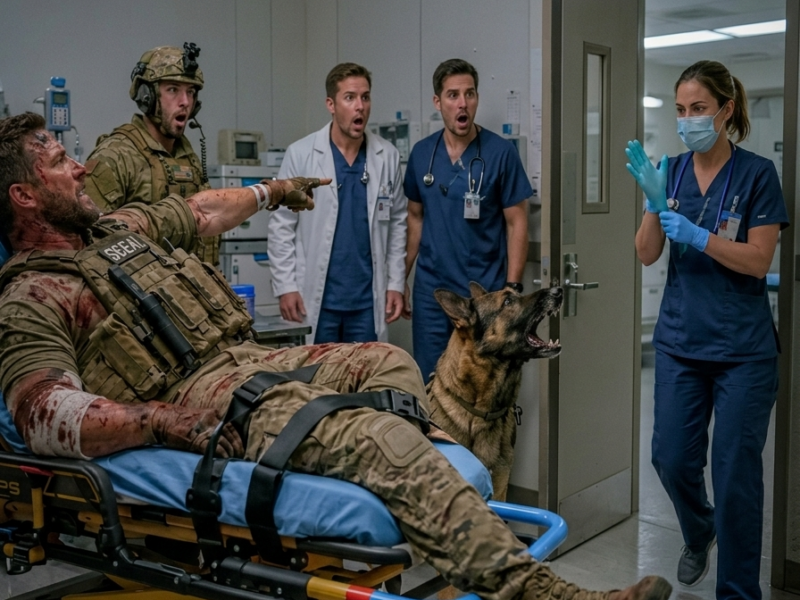
The dying Navy SEAL knocked three doctors away in the middle of the ICU, his blood-soaked hands gripping the bedrails as he screamed that nobody was allowed to touch him
The air in ICU Bay 4 smelled of ozone, copper, and sterile alcohol. It was 3:14 AM on a rainy Tuesday at St. Mary’s Medical Center in Virginia, a hour when the rest of the world was asleep, and the only proof of life was the steady, rhythmic chirping of cardiac monitors.
I was Emily Carter. To the doctors, the charge nurses, and the janitorial staff, I was just the quiet night-shift nurse who wore oversized scrubs, kept her dark hair tied back in a messy bun, and never took more than ten minutes for lunch. I didn’t gossip in the breakroom. I didn’t talk about my family. I had worked at St. Mary’s for nearly four years, earning a reputation as a ghost—efficient, invisible, and completely unbothered by the chaos of trauma medicine.
That reputation died at 3:18 AM.
The double doors of the trauma bay burst open with a violent slam, the sound echoing like a gunshot down the quiet hallway. Two paramedics were sprinting, their boots slipping on the wet linoleum, shoving a gurney coated in smeared, drying blood.
“Trauma incoming! Unidentified male, gunshot wound to the upper left chest, massive internal bleeding!” the lead paramedic shouted, his voice hoarse from adrenaline. “BP is crashing! 70 over 40 and dropping! He’s fightin’ us, doc—he won’t let us touch the dressing!”
Dr. Reynolds, the attending trauma physician on duty, rushed out of the glass-walled nurses’ station, snapping on a pair of blue nitrile gloves. “Get him into Bay 4! Emily, prepare two milligrams of Ativan and get four units of O-negative on the rapid infuser now!”
I moved instantly, my hands operating on pure, muscle-memory instinct. I stepped over to the crash cart, unlocked the drawer, and withdrew a sterile syringe and a vial of sedative. My fingers were steady. They were always steady.
Then, the gurney crashed into the bay.
The man lying on the mattress was massive, his chest torn open by a jagged entrance wound just below his left clavicle. Blood surged over his torn tactical pants and soaked through the white hospital sheets. But despite the lethal blood loss, despite a pulse that was racing toward cardiac arrest, he was not unconscious.
He was fighting.
With a gutteral, primal roar, the dying man threw his arm out. His fist caught a resident doctor across the jaw, sending him stumbling back into an IV pole. The pole crashed to the floor, sending bags of saline rupturing across the tiles.
“Get off me!” the man screamed. His voice was ragged, torn apart by smoke and gravel, carrying a terrifying, guttural resonance that didn’t belong in a civilian hospital. “Don’t touch me! Keep your hands off!”
“Hold him down!” Dr. Reynolds yelled, waving over two security guards who were rushing down the hall. “He’s delirious from hypoxia! Secure his wrists!”
Three medical staff members lunged forward to pin his limbs. The patient surged upward, his blood-soaked hands gripping the metal bedrails with enough brute force to bend the aluminum. He threw off two male nurses as if they were children. Blood sprayed from his open chest wound, painting the clear plastic curtains crimson.
I turned around from the medication cart, syringe drawn, preparing to administer the sedative into his IV line.
I stepped into the light of the overhead surgical lamps.
The patient turned his head sharply. His face was a map of old scars, smeared with oil, sweat, and fresh blood. His eyes—a piercing, storm-gray color—were wildly searching the room like a cornered animal.
His eyes locked onto mine.
The violent rage in his chest vanished in a fraction of a second. His pupils dilated. His breath hitched in his throat, choking back a gasp of air that sounded like dry leaves scraping over concrete.
The syringe slipped from my fingers. It hit the floor with a tiny, sharp plastic clack.
My knees went weak. The quiet, sterile reality of St. Mary’s Medical Center dissolved, replaced instantly by the deafening roar of a twin-rotor Chinook helicopter, the smell of burning diesel fuel, and the bitter taste of dirt and iron in my mouth.
“Angel…” he whispered.
The word was barely louder than a breath, but in the chaotic room, it sounded like a thunderclap.
Nobody had called me that in seven years.
To the world, I was Nurse Emily Carter. But seven years ago, in the rock-strewn valleys of the Korengal in Afghanistan, I was Sergeant Emily Vance. Flight Medic. Call sign: Angel.
“Get security in here now!” Dr. Reynolds shouted, entirely oblivious to the change in the air. He stepped forward with a pair of trauma shears to cut away the rest of the man’s torn shirt. “He’s hemorrhaging, and we’re running out of time! Emily, pick up that syringe!”
The patient, whose admission paper identified him as Chief Petty Officer Mason Reed, didn’t look at Dr. Reynolds. As the surgeon reached for his chest, Mason seized the doctor’s wrist in a vise-like grip. The force was so sudden and absolute that Dr. Reynolds let out a sharp cry of pain.
“I said… no,” Mason growled. His chest heaved, dark venous blood bubbling at the edges of his wound.
Then his gray eyes found mine again, pleading, desperate, burning with a terrifying mix of agony and recognition.
“Angel,” he whispered, his voice trembling now. “Please.”
The room fell deathly silent. The security guards froze at the doorway. The resident doctor holding his jaw stared at me.
I felt as though I was floating outside my own body. I stepped over the spilled saline and the dropped syringe, walking toward the bed slowly, ignoring the rapid questions fired at me from behind.
“Emily, what are you doing? Stand back!” Dr. Reynolds commanded, clutching his bruised wrist.
I ignored him. I reached the side of the bed and looked down into the face of a ghost.
“Mason… look at me,” I said softly, my voice cracking slightly before I found my footing. “Look at me. You’re safe.”
His rapid, shallow breathing hitched. The wild, lethal tension in his massive shoulders began to melt away. For the first time since he had been wheeled into the building, he stopped fighting.
I reached out and placed my hand gently over his blood-smeared, trembling fingers where they clutched the bedrail. His hand instantly flipped over, his long fingers wrapping around mine, holding on with a desperate, crushing strength—as if I were the only anchor tethering him to the living world.
“Tell them to leave…” he murmured, his eyelids fluttering as his blood pressure took another dangerous dip. “They can’t… they can’t touch me…”
Dr. Reynolds stepped between us, his face flushed with anger and stress. “Emily, this is a critical trauma patient! He has a penetrating chest wound! You cannot let personal feelings or whatever this is interfere with medical treatment! Step back!”
“Look at his monitor, Doctor,” I said coldly, a voice coming out of me that I hadn’t used since 2019—the tone of a combat medic commanding a casualty collection point. “If you push him right now, his heart will go into V-fib. Give me thirty seconds.”
I looked down at Mason’s bare, bloodied chest. Resting in the center of his sternum, half-hidden beneath a silver chain slick with sweat, was a small, bent piece of metal.
It was a battered military identification tag.
My breath caught in my chest. The tag wasn’t standard military issue. It had been salvaged from the wreckage of an armored vehicle, its edges jagged and scorched black. And scrawled deeply into the back of the metal, scratched into the steel with the tip of a combat knife, were five words:
NEVER FORGET THE GIRL.
A cold wave of horror washed down my spine.
Seven years ago, I had been part of a Joint Special Operations casualty evacuation team. On our final deployment, our three-vehicle convoy was ambushed in a narrow mountain pass outside Jalalabad. A roadside IED detonated directly beneath the lead vehicle.
I remembered the blinding flash. I remembered the metallic taste of blood filling my mouth as our vehicle flipped. I remembered crawling through thick, suffocating black smoke while rocket-propelled grenades rained down from the cliffs, trying desperately to reach two trapped, screaming soldiers inside the burning wreckage.
I had refused to retreat. I had refused to leave them behind.
And then, through the fire, a young Navy SEAL had materialized. He had taken two rounds to his body armor, yet he had pulled me out of the inferno, throwing his own body over mine as a mortar shell detonated ten feet away. He had carried me three hundred yards down a rocky ridge under heavy fire, his own blood dripping onto my face, until we reached the evacuation helicopter.
When I woke up three days later at Bagram Airfield, military investigators told me the truth. They told me the SEAL who saved me—Chief Petty Officer Mason Reed—had run back into the burning kill zone to recover the remaining men. They told me the vehicle’s fuel tank exploded. They told me his body was never recovered.
They told me he was dead.
For seven long years, I had carried the suffocating weight of survival guilt. I had quit the military. I had changed my name’s common usage. I had hidden in a quiet hospital in Virginia, believing that a brave man had burned to ash because I wasn’t fast enough.
Now, he was lying right in front of me. Alive. Dying. With a bullet lodged dangerously close to his heart.
“Emily!” Dr. Reynolds snapped, reaching out to pull my shoulder. “That’s enough! Security, clear the room!”
Mason’s hand suddenly tightened on my wrist with terrifying force. He pulled me down until my ear was inches from his bloody lips. His breath was ragged, smelling faintly of iron and gunpowder.
“Don’t let them move me…” he whispered, his eyes rolling back slightly as shock took hold. “The man… the man who ordered the ambush… he’s here…”
A chill ran down my neck. I looked at him. “What man? Mason, what are you talking about?”
Mason’s trembling hand didn’t point at Dr. Reynolds or the security guards. His blood-stained index finger rose slowly, pointing toward the large glass observation window that separated Bay 4 from the hallway.
Behind the glass stood a tall, distinguished man in his early sixties. He wore a crisp, tailored suit beneath a pristine white physician’s coat. Silver hair was combed neatly back from his forehead. He was watching us with an expression of cold, utter detachment—not a single trace of urgency, worry, or emotion on his face.
Dr. Reynolds followed my gaze. When he saw the man standing behind the glass, the anger instantly drained from his face. He went dead pale.
“That…” Mason whispered, his voice failing as dark blood trickled from the corner of his mouth, “…is the man who told the world I was dead.”
My heart hammered against my ribs like a trapped bird. I recognized the silver-haired doctor. He was Dr. Arthur Vance—the Chief of Surgery at St. Mary’s, a former Department of Defense medical consultant, and a man who held immense power in this hospital.
Dr. Vance stood motionless behind the double-paned glass. Then, slowly, deliberately, he raised his right hand.
He tapped his middle finger twice against the glass. Click. Click.
The moment his finger hit the pane, the fluorescent lights overhead flickered once and violently extinguished.
In the same second, every cardiac monitor, ventilator, and IV pump in Bay 4 went dead black. The rhythmic chirping vanished, replaced by a suffocating, pitch-black silence.
Through the darkness of the ruined bay, from the unlit hallway outside, I heard the soft, methodical squeak of rubber soles approaching the door.
And then, a smooth, refined voice spoke through the dark, calling the name I hadn’t heard in seven years.
“Angel… we need to talk.”
The darkness in the ICU was absolute, swallowed only by the faint, eerie glow of red emergency exit signs at the end of the corridor.
“What happened to the backup generators?” Dr. Reynolds shouted, his voice laced with panic as he fumbled for his cell phone. “The emergency power should have kicked in instantly!”
“Quiet!” I hissed.
My combat instincts, dormant for nearly a decade, flooded back into my bloodstream like ice water. The sudden blackout wasn’t an accident. It was a tactical override. In military operations, cutting the power was step one of an isolation protocol.
I reached down into the dark, feeling for Mason’s throat. His neck was cold and sticky with sweat, but under my fingers, I felt the weak, thready flutter of his carotid pulse. He was slipping deep into hemorrhagic shock. Without immediate light, pressure, and blood transfusions, he would be dead in less than five minutes.
“Emily…” Mason choked out in the dark, his hand feebly reaching for my scrub top. “They… they aren’t going to let me leave this room.”
“Shut up and save your breath,” I whispered furiously.
I reached into my pocket, grabbed my small penlight, and clicked it on. A narrow beam of stark white light pierced the gloom. I shone it directly on his chest wound. The bright red arterial blood was no longer spurting; it was oozing slowly, a sign that his blood pressure was collapsing completely.
From the doorway, heavy footsteps sounded.
The tall figure of Dr. Arthur Vance stepped into the beam of my light. Behind him stood two men I had never seen before. They weren’t hospital security guards. They wore dark, tactical civilian clothing, their hands resting loosely near their jackets in a posture I recognized all too well.
Covert operators.
“Dr. Reynolds,” Dr. Vance said, his tone shockingly calm, as if he were discussing a minor administrative delay. “Take the resident and the nurses and step out into the hallway. The military has assumed jurisdiction over this patient.”
“Dr. Vance?” Reynolds stammered, blinking in the glare of my penlight. “What is going on? The power is out! This man is actively bleeding out on my table!”
“I said, leave,” Vance repeated. The edge in his voice was like shattered glass. “Now, Doctor.”
Reynolds hesitated, looked at the shadow of the two armed men behind Vance, and then looked at me. “Emily…”
“Go, Reynolds,” I said, my voice eerily flat. “Get out of here.”
Reynolds didn’t need to be told twice. He and the traumatized resident scrambled out of the bay, slipping past Vance’s men into the dark corridor.
Now, it was just me, Mason, and Dr. Arthur Vance.
Vance stepped fully into the room, stepping over the spilled saline without looking down. He stared at Mason with an expression of mild annoyance, like a scientist looking at a lab experiment that refused to die on schedule.
“I must admit, Chief Reed,” Vance said softly, “you possess a truly irritating level of resilience. Seven years ago in the Korengal, you should have died in that fire. Three days ago in Berlin, my men put a round through your chest at point-blank range. And yet, here you are… bleeding across my clean floor.”
My hand trembled around my penlight. “You… you were the medical director for Operation Silent Arch,” I realized, the pieces suddenly locking together in my mind. “You signed his death certificate. You told the Department of Defense his body was incinerated!”
Vance turned his cool, blue eyes toward me. For a moment, a faint, condescending smile touched his lips.
“Ah, Sergeant Emily Vance,” he said softly. “Or should I call you Nurse Carter? You know, when you resigned your commission and changed your name, I considered having you eliminated just to clean up the paperwork. But you were so thoroughly broken by guilt… you buried yourself in this meaningless night shift. You were harmless. So I let you live.”
“Why?” I demanded, moving my body slightly to block Mason from Vance’s line of sight. “Why forge his death? Why keep him off the books for seven years?”
“Because Chief Reed saw something he wasn’t supposed to see,” Vance replied smoothly. He reached inside his lab coat and withdrew a small, sleek silver cylinder—a high-tech pneumatic syringe used for lethal injections. “Operation Silent Arch wasn’t an enemy ambush, Emily. It was a retrieval mission. We were clearing the area of… unwanted witnesses. But Chief Reed survived the blast. And worse, he took something from the crash site.”
Mason let out a wet, raspy cough. “The… the hard drive…” he wheezed, his fingers digging into my arm. “The black ledger… Vance… he was selling military biological research to… private contractors…”
“And you spent seven years running across Europe with it,” Vance interrupted, taking a step forward. “Until tonight. You brought it back to Virginia because you thought you could trade it for asylum. A foolish mistake.”
Vance gestured to one of his men. “Hold her.”
One of the tactical operatives stepped forward, his heavy hand reaching out to grab my shoulder.
In that fraction of a second, seven years of domestic tranquility violently vanished.
I didn’t think; my combat medic training took over. I jammed the high-intensity beam of my penlight directly into the operative’s eyes. As he winced and leaned back, I swung my hand upward, driving the heel of my palm hard into his nose.
CRACK.
The man groaned, blood exploding from his nostrils as he stumbled backward. Before the second operative could draw a suppressed sidearm from beneath his jacket, I reached onto the crash cart, grabbed a heavy metal tray of surgical instruments, and hurled it violently at his face.
The stainless steel tray struck him across the bridge of his nose and eyes. Scalpels, clamps, and forceps rained down in a sharp, metallic din.
“Emily!” Mason rasped.
I didn’t hesitate. I grabbed the heavy, iron-based IV pole beside the bed and swung it like a baseball bat. The solid metal bar slammed into the chest of the second operative, knocking him off his feet and sending him crashing through the glass partition of Bay 4.
Glass shattered into a thousand glittering shards.
Dr. Vance took a fast step back, his eyes widening in brief shock. He hadn’t expected a quiet night-shift nurse to move with the lethal efficiency of a trained soldier.
“You’re insane, Emily!” Vance hissed, backing toward the hallway. “You can’t save him! The entire hospital is locked down! Security is compromised, and my men are at every exit!”
“Then you better start running,” I growled, picking up a heavy stainless steel scalpels handle from the floor and holding it like a combat knife. “Because if he dies in this room, Vance, I’m coming for you first.”
Vance sneered, stepped out into the dark hallway, and pulled the heavy double doors shut, locking the electronic access latch from the outside. A loud, mechanical CLACK echoed through the room.
We were trapped.
I turned back to the bed. The penlight was lying on the floor, casting long, frantic shadows across the ceiling.
Mason’s eyes were closing. His breathing had slowed to a terrible, death-rattle gasp.
“Mason!” I fell to my knees beside the gurney, grabbing his face with both blood-soaked hands. “Stay with me! Look at me! You didn’t survive seven years of hell to die in a Virginia emergency room! Look at my eyes!”
“Angel…” his voice was a whisper of smoke. “In… my pocket… tactical knife… blue drive in the hilt…”
I reached into the pocket of his blood-drenched tactical pants. My fingers brushed against a heavy, custom combat knife. I pulled it out. The pommel of the knife had a threaded cap. I unscrewed it with shaking fingers. Inside the hollow handle was a tiny, micro-encrypted flash drive.
The black ledger. The proof of Vance’s treason, the reason an entire unit was slaughtered in Afghanistan, and the reason Mason had lived as a ghost for seven years.
“I have it,” I whispered. “I have it, Mason.”
“Good…” Mason gasped, a faint, bloody smile touching his lips. “Now… leave me. Take it to the Inspector General… save yourself…”
“Shut up!” I snapped, tears finally spilling over my lashes, cutting clear tracks through the dried blood on my cheeks. “I left you behind once because I believed a lie! I am NOT leaving you again!”
Suddenly, from the ceiling above us, the air conditioning vents rattled loudly.
I looked up. The metal grate of the main ventilation shaft directly above Bay 4 was being unscrewed from the inside.
A heavy boot kicked the metal grate out. It crashed onto the linoleum floor.
Through the dark opening of the ceiling vent, a shadowy figure began to lower himself down into the room.
I grabbed the heavy IV pole again, raising it over my shoulder, ready to strike.
“Hold your fire, Angel!” a harsh, familiar voice called out from the darkness of the ceiling. “If you hit me with that damn pole, I’m gonna tell the Commander you lost your mind!”
I froze. My heart leaped into my throat.
The man dropped heavily onto the floor, landing in a low crouch. He stood up, turning toward the beam of my light. He wore a dark tactical vest, his face smeared with camouflage paint, a suppressed rifle slung across his back.
I gasped, the IV pole slipping from my numb fingers.
It was Sergeant Marcus Vance—no relation to the doctor—the former radio operator from my old deployment team. A man I had buried in my mind seven years ago.
“Marcus?” I breathed, unable to believe my eyes. “You… you’re alive?”
Marcus grinned, wiping blood from his cheek. “Alive, kicking, and highly illegal, Sergeant. But we don’t have time for a reunion. Vance’s strike team just boarded the service elevators. We have less than ninety seconds before they blow those doors open and kill us all.”
“How are you alive?” I demanded, my mind spinning as I grabbed a roll of heavy medical tape and a stack of sterile gauze pads, slamming them directly onto Mason’s open chest wound to form an emergency occlusive dressing. “They told me the entire squad was wiped out in the Korengal!”
“They lied to you, Emily,” Marcus said rapidly, pulling a compact tactical medical kit from his vest and tossing it onto the bed. “Vance controlled the casualty reports at Bagram. Anyone who wasn’t killed in the blast was reported dead, quietly transferred to black sites, or hunted down. Mason and I have been operating in the shadows for three years trying to expose Vance’s network. Now stop asking questions and help me move him!”
“He can’t be moved!” I yelled, leaning all my weight onto Mason’s chest to staunch the arterial spray. “He’s in profound hemorrhagic shock! If his heart stops while we’re dragging him through a vent, he’s dead!”
“If we stay in this room, we’re ALL dead!” Marcus snapped back. He unclipped a small plastic vial from his tactical vest. “Cardiprim. Military-grade synthetic adrenaline and clotting agent. It’ll buy his heart ten minutes of artificial pressure. Inject it directly into his subclavian line.”
I snatched the vial. My hands didn’t shake. I drove the needle into the central line port on Mason’s neck and slammed the plunger down.
Instantly, Mason’s body convulsed on the bed. His back arched off the mattress with a violent gasp, his gray eyes snapping wide open as the powerful chemical surged through his bloodstream. His cardiac monitor, still dark, was replaced by the sound of his own raw, ragged breathing filling the quiet room.
“Get him up!” Marcus ordered.
Together, Marcus and I hoisted Mason’s massive six-foot-four frame off the surgical gurney. Mason groaned in agony, his boots dragging uselessly on the slippery floor, but the synthetic stimulant was working—his eyes were focused, his teeth gritted against the unbearable pain.
BANG! BANG! BANG!
A series of heavy, metallic thuds echoed from the double doors of Bay 4. The glass window framed in the door cracked into a web of white lines as someone on the outside began battering the lock with a tactical ram.
“They’re coming through!” Marcus grunted, grabbing Mason under his left arm while I supported his right. “Up into the shaft! Move!”
“He can’t climb a vertical air shaft, Marcus!” I cried out.
“We aren’t going up!” Marcus said, pointing toward the far corner of the ICU bay, behind a heavy stainless-steel linen cabinet. “Hospital service duct. Leads directly down to the old sub-basement utility tunnels built in the 1960s. Vance’s team doesn’t have the original blueprints—they think we’re trapped in this sector!”
Marcus shoved the heavy linen cabinet aside with a spray of sparks. Behind it was a low, square maintenance hatch secured by a heavy brass latch. He popped the latch and kicked the iron door open, revealing a dark, vertical drop with an rusted iron ladder sliding down into ink-black depths.
BOOM!
The double doors of Bay 4 exploded inward. Glass and metal splinters rained through the air.
“Go! Go! Go!” Marcus roared, drawing his suppressed sidearm and firing three rapid shots into the doorway to force Vance’s entry team back behind the wall.
I didn’t hesitate. I grabbed Mason around the waist, wrapping his massive arm over my shoulder. “Mason, look at me! You have to climb down! Step by step!”
“I got you… Angel…” Mason gritted out, blood streaming down his chin.
We threw ourselves into the narrow, dark hatch just as a hail of submachine-gun fire chewed through the drywall behind us, filling the air with plaster dust and flying metal.
We fell down the ladder, half-sliding, half-tumbling down fifteen feet of rusted iron rungs until we slammed heavily onto a cold, wet concrete floor. The air down here was thick, smelling of stagnant water, old rust, and decaying steam pipes.
Above us, Marcus dropped down through the hatch, slamming the heavy iron door shut above his head and driving a steel rebar through the handle to lock it from the inside.
THUD! THUD! THUD!
Heavy boots pounded on the iron door above us, followed by muffled curses.
“That rebar won’t hold them for more than two minutes,” Marcus breathed, racking the slide of his pistol. “They’ll use thermite or heavy breaching charges.”
He clicked on a military-grade tactical flashlight, casting a stark, bluish beam down a long, narrow concrete tunnel lined with heavy electrical conduits and sweating water pipes.
“Which way?” I asked, kneeling beside Mason. His skin was dangerously cold to the touch. The synthetic adrenaline was already beginning to wear off, his breathing returning to a shallow, terrifying flutter.
“This tunnel runs three hundred yards east, under the hospital parking garage, and exits into the old city storm drain system,” Marcus said, checking his watch. “I have an armored SUV parked two blocks away. If we reach it, we can get him to a safehouse in Maryland where a military surgeon on our side is waiting.”
“He won’t make it three hundred yards,” I said flatly, my hands covered in Mason’s blood. “His occlusive dressing is leaking. The pressure in his chest is building up—he’s developing a tension pneumothorax. His left lung is collapsing!”
“Emily, we don’t have medical equipment down here!” Marcus barked.
“I don’t need a medical bay,” I said, my voice dripping with cold determination. “I need a pen.”
Marcus stared at me. “What?”
“Give me a ballpoint pen! Now!”
Marcus frantically reached into his tactical chest pouch and pulled out a heavy metal tactical pen.
I grabbed it, unscrewed the ink cartridge with my teeth, and spat it onto the concrete floor, leaving a hollow, rigid metal tube.
I looked down at Mason. His lips were turning blue. His eyes were rolling back into his head. The trapped air and blood in his chest cavity was crushing his heart and remaining healthy lung.
“Mason,” I whispered, resting my hand on his forehead. “This is going to hurt like hell. I’m sorry.”
He couldn’t answer. He was barely conscious.
I found his ribs with my fingers, feeling for the second intercostal space in the mid-clavicular line. I held the metal tube firmly in my right hand, positioned it directly over his chest, and slammed it down with all the force in my body.
PUNCTURE.
A sickening, wet pop echoed through the narrow concrete tunnel.
Instantly, a loud, violent hiss of trapped air and blood sprayed out of the hollow metal tube.
Mason’s eyes snapped wide open. He let out a massive, gasping inhalation of air, his chest expanding fully for the first time in an hour. The blue tint on his lips began to fade, replaced by a flush of returning oxygen.
“Tension relieved,” I breathed, wiping my sweaty forehead with the back of my bloody forearm. “Now, get him up. We move!”
Marcus looked at me with raw respect in his eyes. “You really haven’t lost it, have you, Vance?”
“I never had the luxury of losing it,” I snapped back.
We hauled Mason to his feet once more. Supported between the two of us, we began to hustle down the dark, subterranean tunnel, the sound of our splashing boots echoing off the dripping concrete walls.
Behind us, fifty yards back, a blinding white explosion rocked the tunnel.
BOOM!
The iron maintenance hatch above was blown off its hinges, sending a shower of red-hot sparks and metal fragments cascading down into the corridor.
Through the smoke, the harsh, white beams of tactical weapon lights flickered down the tunnel.
“They’re through!” Marcus yelled. “Move!”
We pushed forward through the darkness, moving as fast as Mason’s failing legs could carry him. The tunnel twisted to the left, entering an older section of brickwork covered in thick moss and slime.
Suddenly, a cold, heavy voice echoed down the tunnel, amplified by a bullhorn.
“Sergeant Vance! Chief Reed!” Dr. Vance’s voice reverberated off the wet bricks, smooth, icy, and completely devoid of humanity. “You are running toward a dead end! The storm drain exit was sealed with reinforced steel grates twenty minutes ago! You have nowhere to go!”
We rounded a sharp corner and froze.
At the end of the tunnel stood a massive, heavy iron security gate, secured by a thick steel chain and a industrial padlock. Beyond the bars, we could see the dark, open air of the city drain system—freedom—just ten feet away. But the gate was impassable.
Marcus lunged forward, throwing his weight against the iron bars. The gate didn’t budge. He shot the padlock three times with his pistol, sparking metal against metal, but the heavy steel lock remained intact.
“It’s reinforced high-carbon steel!” Marcus cursed, kicking the gate in fury. “My rounds won’t breach it!”
Behind us, down the dark brick corridor, the heavy thud of tactical boots was rapidly approaching.
Five dark figures emerged from the shadows, their assault rifles raised, their laser sights cutting through the dark like red needles.
In the center of the line walked Dr. Arthur Vance.
“It’s over, Emily,” Vance said, stepping through his men, holding a small remote detonator in his hand. “Hand over the flash drive, and I will make your death swift. Refuse… and I will make sure you spend what remains of your life in a black site where no one will ever hear you scream.”
I looked at the red laser dots dancing across my chest. I looked at Marcus, who was out of ammunition. I looked down at Mason, who was leaning against the wet brick wall, holding my hand with the tiny remaining strength in his body.
Then, I felt something hard pressing against the small of my back.
It was Mason’s hand. He was pressing something small, heavy, and metallic into my palm.
I looked down covertly. It was a tactical military demolition charge bypass key—a master override for the hospital’s central steam regulation system, which ran directly through the wall behind us.
Mason looked up at me, his eyes burning through the dark.
“Angel…” he whispered, his voice steady for the first time all night. “Pull the lever… blow the steam.”
I didn’t think twice.
I snatched the heavy brass key from Mason’s hand, turned violently to my right, and jammed it into the emergency pressure release valve embedded in the concrete wall beside the iron gate.
“What is she doing?!” Vance yelled, his icy composure instantly breaking into panic. “Shoot her! Shoot her now!”
“Cover!” Marcus screamed, throwing himself over Mason.
I turned the brass key ninety degrees and yanked the heavy iron release lever down with all my weight.
KA-BOOM!
A deafening, shrieking roar tore through the subterranean tunnel.
The main high-pressure steam pipe—carrying superheated 400-degree steam from the hospital’s industrial boilers—ruptured along a twenty-foot seam. A blinding wall of white, scalding, opaque vapor erupted into the corridor, expanding instantly to fill the narrow brick passage.
The tactical operatives screamed as the searing steam engulfed them. Their laser sights vanished in the blinding white cloud. Gunfire erupted wildly, bullets ricocheting uselessly off the concrete ceiling and brick walls, pinging blindly through the dark.
“I can’t see! My eyes!” one of the gunmen shrieked through the roaring fog.
“Retreat! Fall back!” Vance’s voice echoed, choked, terrified, and stripped of all authority.
“Now, Marcus!” I screamed over the roaring jet of steam.
Marcus didn’t waste a second. He grabbed a heavy piece of discarded iron piping from the floor, jammed it between the steam-heated, softening iron bars of the gate, and leveraged his entire body weight against it. With a violent, screaming groan of twisting metal, the rusted hinges gave way.
The gate burst open.
Cool, wet, sweet night air rushed into the tunnel.
Marcus grabbed Mason under his arms, dragging him out of the tunnel and onto the wet concrete bank of the city storm drain channel. I scrambled out right behind them, slamming the heavy iron gate shut and jamming the steel pipe through the handles to lock Vance and his remaining men inside the superheated tunnel.
Rain was pouring down from the dark Virginia sky, washing the blood from my face and clothes as we stumbled into the open drainage canal.
“Over here!” Marcus yelled, pointing toward an unmarked, blacked-out armored SUV parked under the shadow of an overpass fifty yards away.
We dragged Mason through the knee-deep rainwater, hauling him up the muddy bank. Marcus slapped his hand against the SUV’s rear sensor. The heavy tail gate swung open automatically.
We threw Mason onto the flatbed carpeted with tactical medical equipment. I scrambled in beside him, while Marcus jumped into the driver’s seat, slamming the engine into gear.
The heavy V8 engine roared to life with a deep, guttural growl. The SUV surged forward, tires spinning on the wet asphalt as we burst out of the drainage access road and onto the empty city streets.
“We’re clear!” Marcus shouted over his shoulder, hitting a switch on the dash that scrambled our GPS signal and jammed local police frequencies. “We’re invisible!”
I fell to my knees on the floor of the bouncing SUV, immediately turning my attention back to Mason.
“Lighting!” I yelled.
A soft overhead surgical light clicked on.
Mason’s face was deathly white. The makeshift pen chest tube was still bubbling, but dark blood was beginning to pool around his abdomen. The trauma of the escape had torn open his internal injuries.
“Mason… stay with me!” I pleaded, tearing open a fresh package of combat gauze and shoving it deep into his chest wound, applying agonizing pressure. “Look at me! Mason!”
Mason reached up with shiver-racked arms. His hand, slippery with rainwater and his own blood, found my face. He touched my cheek gently, leaving a red streak across my skin.
“I… I searched for you… for seven years…” he rasped, his voice barely a breath over the hum of the SUV’s tires. “Every country… every database… I couldn’t find you…”
“I changed my name, Mason,” I sobbed, tears flowing freely now, mixing with the rain and blood on my skin. “I thought you died in that fire! I thought it was my fault!”
“It was never… your fault…” Mason whispered. He forced a tiny, agonizing smile onto his pale lips. “You saved my life in that valley… Angel. You gave me a reason… to keep breathing…”
He reached into his pocket with trembling fingers, pulling out the battered military tag he had worn around his neck. He pressed it into my blood-covered palm, closing my fingers over it.
“Keep it…” he choked out. “So you… never forget…”
His gray eyes suddenly went blank. His hand slipped from my cheek, dropping heavily onto the floor of the SUV. His chest stopped moving.
“No! No! No!” I screamed.
“Emily! What’s happening?!” Marcus yelled from the driver’s seat, looking in the rearview mirror.
“He’s in cardiac arrest!” I screamed. “No pulse!”
I didn’t pause. I began chest compressions, throwing the full weight of my upper body onto his shattered sternum.
One, two, three, four…
“Come on, Mason!” I screamed, tears blinding my vision. “Breathe! Don’t you dare die on me now!”
Five, six, seven, eight…
“You survived seven years! You survived Vance! You survived the fire!” I slammed my hands down on his chest with brutal, rhythmic precision, pushing past the exhaustion, pushing past the agonizing pain in my own arms. “BREATHE!”
I tilted his head back, pinched his nose, and delivered two deep breaths of artificial respiration, forcing air directly into his failing lungs.
No response. His pulse was gone. The monitor line in my head was a flat, endless pitch.
“Marcus, how far to the safehouse?!” I screamed, resuming frantic compressions.
“Three minutes!” Marcus yelled back, his voice cracking with emotion. “Hold on, Mason! Hold on!”
“I’m not letting you go,” I sobbed, leaning down until my forehead was touching his cold, bloody chest, my hands pumping his heart artificially. “I am NOT letting you go, Mason! LIVE!”
I brought my doubled fist high into the air and delivered a brutal, desperate precordial thump directly over his sternum.
THUD!
For three terrifying, endless seconds, the only sound in the roaring SUV was the heavy patter of rain against the roof.
Then, Mason’s body violently convulsed.
A loud, desperate, gasping roar tore from his throat. His gray eyes snapped open, blazing with life, his hands reflexively reaching up to grab my shoulders.
He took a massive, shuddering breath of air, his chest heaving under my hands.
I fell back against the side of the SUV, letting out a hysterical sob of relief, laughing and crying all at once.
Mason turned his head weakly toward me, his gray eyes shining in the dim light of the cabin.
“You… you hit hard… Sergeant…” he wheezed out, a faint, genuine smirk touching his lips.
“Shut up, Chief,” I laughed through my tears, grabbing his hand and holding it tight against my chest. “Save your breath. You’re going to live.”
Forty-eight hours later.
The rain over northern Virginia had cleared, replaced by the crisp, cool golden air of early autumn. The sun was just beginning to peek over the horizon, painting the sky in deep shades of amber, violet, and soft pink.
I stood on the wraparound wooden porch of an isolated, historic farmhouse tucked deep into the rolling hills of Loudoun County. The farm was a classified safehouse, protected by active-duty Joint Special Operations personnel who owed their lives to Marcus and Mason.
I was wearing a pair of clean jeans and a soft gray sweatshirt—the first time in four years I hadn’t worn hospital scrubs. My hands, scrubbed clean of blood, were wrapped around a steaming mug of black coffee.
The screen door behind me creaked open softly.
I turned. Mason stood in the doorway.
He was dressed in loose civilian clothes, his left arm immobilized in a tactical sling, his chest heavily bandaged beneath his shirt. He was still pale, and his movements were slow and guarded, but he was standing on his own two feet.
He stepped out onto the porch, the cool morning breeze catching his dark, messy hair.
“You shouldn’t be out of bed,” I said softly, though a warm smile touched my lips. “Dr. Harris said you need at least three weeks of absolute bed rest.”
“Dr. Harris is a Navy doctor,” Mason grunted softly, leaning his hip against the wooden porch railing and looking out over the misty green fields. “They always exaggerate.”
He looked at me, his gray eyes clear, steady, and filled with a quiet depth that made my heart skip a beat.
“How is Marcus?” he asked.
“He left for Washington two hours ago,” I replied, taking a sip of my coffee. “Accompanied by four federal marshals and the Inspector General of the Department of Defense. They decrypted the black ledger last night.”
Mason took a slow, deep breath. “And Vance?”
“Dr. Arthur Vance was arrested at Dulles International Airport at 4:00 AM,” I said, my voice carrying a quiet, absolute satisfaction. “He was trying to board a private jet to Dubai under a forged diplomatic passport. When the federal agents surrounded his plane, he tried to shred his files. They recovered everything.”
I set my coffee mug down on the wooden railing and turned fully toward him.
“Operation Silent Arch is officially public,” I continued softly. “The Pentagon released a press statement thirty minutes ago. The military cover-up has been completely dismantled. The families of the men who died in that valley… they finally have the truth. And you… you aren’t a ghost anymore, Mason. Your name has been fully cleared.”
Mason stood silent for a long moment, watching the morning light break across the distant blue ridge mountains. For seven long years, he had lived as a hunted man, moving from shadow to shadow, carrying the weight of a dead squad and a stolen life.
I saw the tension slowly leave his massive shoulders. I saw the deep, painful lines around his eyes soften. For the first time since I had met him, Chief Petty Officer Mason Reed looked like a man who could finally rest.
“It doesn’t feel real,” he murmured, his voice low and thick with emotion. “For seven years… I thought the only thing waiting for me at the end of this road was a grave.”
He turned away from the view and stepped closer to me. The space between us shrank until I could feel the warmth radiating from his body.
He reached into his pocket with his uninjured right hand and pulled out the small, battered metal tag—the scorched piece of steel with the five words carved into the back.
NEVER FORGET THE GIRL.
He held it out toward me.
“I carried this through four continents,” Mason said, looking down into my eyes with an intensity that took my breath away. “When I was freezing in a safehouse in Prague… when I was bleeding in a ditch in Berlin… when I thought I couldn’t take another step… I looked at these words.”
He reached out and gently took my hand, placing the silver tag into my palm, then closing his long, warm fingers over mine.
“I didn’t survive seven years just to clear my name, Emily,” he whispered, his voice trembling slightly. “I survived because I had to make sure you were okay. I had to tell you… that it wasn’t your fault.”
Tears pricked the corners of my eyes, but this time, they weren’t tears of grief, guilt, or fear. They were tears of relief. The heavy, suffocating weight that had rested on my chest since 2019—the invisible armor I had worn every single day—finally crumbled into dust.
“I’m okay, Mason,” I whispered, reaching up with my free hand to softly brush my thumb across his cheekbone, touching the faint white scar beneath his eye. “I’m finally okay.”
Mason leaned down slightly, resting his forehead gently against mine. We stood there together on the quiet wooden porch as the morning sun flooded the valley with bright, golden light, shedding the shadows of the past seven years once and for all.
“So…” Mason murmured softly, a faint, genuine smile gracing his lips as his hand rested gently against the small of my back. “What does Nurse Emily Carter do now that she doesn’t have to hide anymore?”
I looked up at him, meeting his storm-gray eyes, feeling the steady, strong, unyielding beat of his heart right beneath my palm.
“I think,” I said softly, my fingers tightening around his, “it’s time for Angel to finally come home.”
The end









