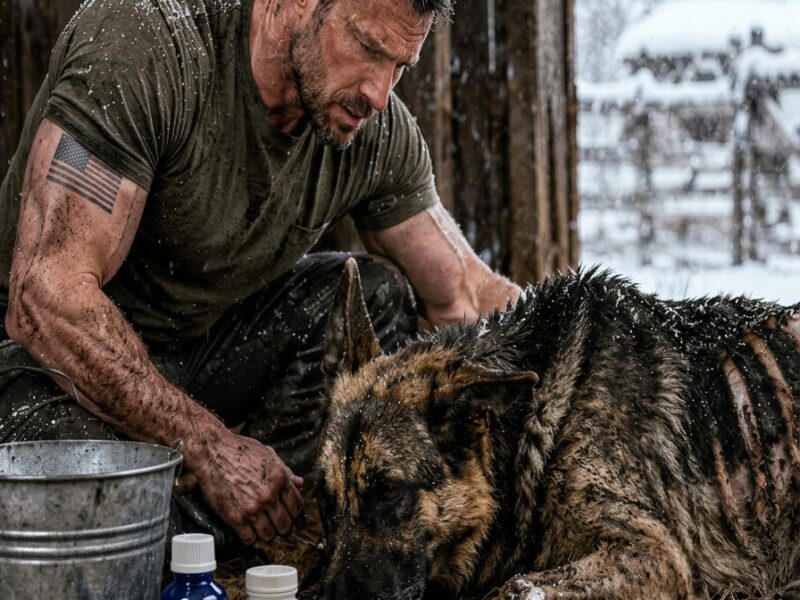
The dying K9 collapsed at a roadside shelter in Virginia, and when I offered $100 to save him, the shelter director laughed at my Navy SEAL uniform
The rain had been falling over the Virginia hills for three straight days, turning the red clay beneath my combat boots into thick, heavy muck. I wasn’t supposed to be at the county animal shelter that afternoon. I was driving back from the naval base in Norfolk, wearing my dress blues after a formal discharge ceremony that felt more like a quiet execution than an honor. After eight years, three deployments, and two dead teammates, my time as a Navy SEAL had officially ended.
Inside the shelter, the smell of damp concrete, bleach, and fear was overpowering. Dogs barked frantically from their steel cages, throwing themselves against the wire walls. But at the very end of the hall, in a corner cage drenched in shadow, there was complete silence.
He was curled into a tight ball, pressed against the wet floor. His ribs protruded sharply beneath matted, dirt-streaked fur. His right ear was torn down the middle, and a thick, jagged scar ran across his shoulder. When I approached the wire mesh, he didn’t bark. He merely raised his head, his dark brown eyes glazed with the kind of hollow, resigned exhaustion I had seen in the eyes of my team leader, Jack, just moments before the compound in Kunduz collapsed around us.
“He’s not going to make it,” a voice said behind me.
I turned to see the shelter director, a heavy-set woman holding a clipboard, leaning against the doorframe. She didn’t look at the dog; she barely looked at me.
“What happened to him?” I asked, my voice dry.
“Animal control picked him up off Route 17 three days ago,” she replied, tapping her pen against the wood. “No microchip, no collar, covered in mud and blood. Vet says his liver is failing and his back leg is shattered. He won’t last forty-eight hours. We’re putting him down at five o’clock.”
“He’s a working dog,” I said, stepping closer to the cage. “Look at the musculature in his chest. Look at the way he holds himself despite the pain. He’s trained.”
The director let out a short, cynical laugh, her eyes sweeping over my crisp Navy SEAL uniform, the ribbons pinned to my chest, and the sharp creases of my trousers. “Look, soldier, I don’t care if he’s the President’s dog. We don’t have the budget to keep a corpse breathing. It takes money we don’t have.”
“Then let me try,” I said.
She paused, crossing her arms. “One hundred dollars. Cash. And you take him off my hands right now, dead or alive.”
Without a word, I pulled out my wallet, slapped a crisp hundred-dollar bill onto her clipboard, and unlocked the cage door myself.
When I reached down, I expected him to growl, to snap out of instinctual self-defense. Instead, as my hand gently rested on his shivering head, his tail gave a single, weak thump against the concrete. I wrapped him carefully in my uniform jacket, ignoring the dirt and blood soaking into the fabric, lifted his heavy frame into my arms, and carried him out into the pouring rain.
That night in my garage, the air was cold and quiet. I laid him down on a stack of old military blankets, setting out a bowl of fresh water and a plate of boiled chicken. He didn’t eat. He lay entirely still, his breath coming in shallow, ragged rasps that rattled in his chest.
I sat cross-legged beside him on the cold floor, pulling my knees to my chest. For the first time in six months, the quiet was intolerable. Ever since the ambush that took Jack and Miller, the silence of civilian life had felt like a physical weight crushing my ribs. I had retreated to this rural home outside Fredericksburg to vanish, to let the guilt consume me in peace.
“Hey,” I murmured softly, reaching out to touch his back. “Stay with me. You hear me? Don’t quit now.”
At the sound of my voice, the dog’s ears twitched. Slowly, with agonizing effort, he shifted his weight and rested his massive, heavy head directly across my knee. His eyes locked onto mine, deep and searching, filled with a silent, desperate plea for survival.
Something inside my chest, a structure of hardened grief I had spent two years building, cracked wide open.
“I’ll name you Atlas,” I whispered, resting my hand over his broad muzzle. “You carry the weight, buddy. Just stay.”
The recovery was a grueling war fought in inches. Over the next six months, my military savings evaporated into a mountain of veterinary bills, specialized surgeries, and physical therapy sessions. There were nights when Atlas woke up screaming—a high-pitched, guttural howl that echoed through the empty house—thrashing wildly as if caught in a net or a nightmare. Every single time, I would drop to the floor beside him, wrap my arms around his trembling body, and whisper the same steady cadence I used in the field until his heart rate slowed.
Slowly, the light returned to his eyes. The matted coat gave way to a dense, shimmering fur of deep black and rich tan. His limping gait smoothed out into a powerful, rhythmic stride.
By the two-year mark, Atlas was no longer a dying stray. He was a force of nature. He ran through the thick pine woods behind my house, chased tennis balls with relentless focus, and slept at the foot of my bed like a vigilant guardian. He became my shadow, my reason to wake up, my anchor to a world I had thought I no longer belonged to.
Then came the rainy afternoon that shattered everything.
It was a Tuesday. Dark clouds hung low over the Virginia pines, casting long, gray shadows across my driveway. Atlas was standing by the living room window, his body suddenly freezing into absolute rigidity. A deep, low rumble started in his chest.
I walked to the window. A sleek, black Ford Explorer with dark tinted windows and no front license plate had slowed to a crawl at the edge of my property. The driver’s side window rolled down slowly.
A man in a dark canvas jacket stepped out into the drizzle. He had short-cropped hair, a square jaw, and an intense, hyper-vigilant posture that instantly screamed military background. He walked up the driveway with deliberate steps, his eyes fixed entirely on Atlas, who was now pressed against the glass.
As the man drew closer, his face drained of all color. His mouth parted in sheer disbelief.
“Where did you get that dog?” the stranger called out, his voice trembling slightly against the sound of the rain.
I opened the front door and stepped onto the porch, instinctively stepping between the man and Atlas, positioning myself in a low, balanced stance.
“Why do you want to know?” I demanded, keeping my voice level and hard.
The man stopped ten feet from the porch. He swallowed hard, his hands trembling as he gestured toward the dog. “His name isn’t yours. His name was Ghost.”
At the sound of that word—Ghost—Atlas reacted instantly. He pushed past my legs and trotted to the edge of the porch steps. But he didn’t bark. He didn’t growl. He let out a strange, high-pitched whining sound, his tail sweeping back and forth in rapid, anxious arcs.
The stranger pulled a worn, laminated photograph from his inner jacket pocket and held it out toward me.
I took the photograph. It was a tactical shot, crisp and clear. It depicted a younger, unscarred Atlas wearing a high-end Kevlar military K9 harness fitted with a night-vision camera rig. Standing beside him was a operator in desert digital camouflage, his face aggressively scratched out with a black permanent marker.
My stomach plummeted into a cold, hollow abyss. The tactical harness in the picture bore a specific unit insignia stamped on the side—a stylized trident wrapped in a coiled serpent.
It was the classified insignia of my former unit, the Black Squadron.
“That dog vanished during a covert operation two years ago,” the stranger whispered, his eyes locked on mine. “Official report said he was killed in action along with his handler.”
I looked down at the date printed in the bottom corner of the photograph. It matched the exact week I had dragged Atlas out of the county shelter in Virginia.
“Who was his handler?” I asked, my heart hammering against my ribs.
The stranger stared down the long, empty road, his jaw clenching. “My brother. Lieutenant David Vance.”
Before I could ask another question, Atlas suddenly spun around. He sprinted off the porch, ran around the side of the house, and lunged into the open garage.
I followed him quickly, the stranger right on my heels. Inside the garage, Atlas was pounding his heavy front paws against a heavy, reinforced steel wall cabinet that I had inherited when I bought the property. It was secured with a heavy digital keypad lock, rusted shut and unused since the day I moved in. Atlas was scratching wildly at the metal seam, barking with a fierce, frantic intensity I had never heard from him before.
The stranger took three quick steps backward, his hand instinctively reaching toward his waist coat. “Don’t open that,” he breathed.
I turned to him, my eyes narrowing. “Why?”
The man looked around the dark garage, his voice dropping to a harsh, terrified whisper. “Because if Ghost remembers what happened that night… if he remembers who left him behind… someone will come looking for both of you. And they won’t leave survivors.”
The stranger didn’t stay to help me open the cabinet. The moment a heavy gust of wind rattled the garage roof, he backed down the driveway, got into his black SUV, and sped off into the sheet of gray rain, leaving deep tire ruts in my lawn.
I stood in the cold garage, listening to the hum of the overhead fluorescent light. Atlas was still pressed against the steel cabinet, his nose pressed tightly against the bottom crack, drawing in long, trembling breaths.
I went to my workbench, grabbed a heavy iron crowbar and an angle grinder, and plugged it into the wall outlet. The high-pitched whine of the blade slicing through the rusted lock echoed off the concrete walls, spraying bright orange sparks into the darkness. Within two minutes, the heavy steel latch gave way with a loud, metallic snap.
I pulled the cabinet door open.
A thick smell of stale dust, engine oil, and old leather rushed out. Sitting on the top shelf was an array of seemingly mundane storage items, but beneath a canvas tarp lay a heavy, military-grade pelican case painted matte black.
I lifted the case onto the workbench and popped the heavy latches.
Inside lay a high-frequency tactical radio unit, a broken satellite phone with its SIM card snapped in half, a bloodstained fabric unit patch, and a sealed plastic file sleeve.
My hands were shaking as I reached for the sleeve. I pulled out a single, high-resolution photograph. It showed three men standing in front of a concrete bunker in an undisclosed desert location. On the left was my old team leader, Jack. On the right was Miller. And standing in the middle, his arm wrapped affectionately around a younger Atlas, was a man whose face had not been scratched out.
It was David Vance.
I turned the photograph over. Written in black permanent ink across the back were four distinct words, written in crisp, block military handwriting:
THE MISSION WAS NEVER OVER.
I felt a cold sweat break out across the back of my neck. Jack and Miller were supposed to have died in Kunduz during a routine recon patrol that went bad. That was the official story fed to me by Naval Special Warfare Command when I was discharged. I was told their bodies were unrecoverable due to structural collapse.
So why was David Vance—a classified K9 operator I had never been told existed—standing beside my dead teammates in a photograph dated three weeks after their official deaths?
Atlas whined softly behind me. He rested his chin on the edge of the workbench, staring intently at the bloodstained unit patch.
“What happened out there, Atlas?” I whispered, my voice thick. “What did you see?”
Suddenly, the dog’s ears snapped back. His entire body went rigid. He turned his head toward the open garage door, his nose twitching violently as he sampled the heavy night air.
From deep within the pine woods bordering my property, half a mile away through the rain, a sharp, distinct sound cut through the silence.
It was a high-frequency tactical dog whistle—two short bursts, followed by one long, descending pitch.
Atlas let out a sharp, breathless bark. He leaped toward the driveway, his claws skidding on the wet concrete.
“Atlas, heel!” I shouted, dropping the photo and lunging forward.
I caught his tactical collar just as he reached the threshold of the garage. He pulled against me with immense strength, whining hysterically, his eyes locked onto the black wall of trees at the edge of the property line.
Through the thick rain, I saw it: a flash of light. Not a flashlight, but the dull, infrared glint of an optical sight reflecting off the rain.
Someone was standing in the tree line. Monitoring the house.
I dragged Atlas back inside, pulled the manual garage door down, and slammed the heavy iron bolt into place. My heart was pounding like a war drum in my chest. The instincts that had laid dormant for two years came rushing back with terrifying clarity.
I ran into the house, unlocked my bedroom gun safe, and pulled out my suppressed SIG Sauer P226 and my tactical vest. I strapped the holster to my thigh and chambered a round with a sharp clack-clack.
If someone had tracked Atlas to my home, it meant the shelter where I bought him wasn’t an accident. It meant he had been running from something—or someone—who couldn’t afford to let a witness live, even if that witness was a four-legged war hero.
I returned to the garage, taking the pelican case and bringing it into my reinforced basement office. I needed to examine the tactical radio. It was an AN/PRC-152, standard issue for special operations, but this one had been modified with an aftermarket encrypted frequency board.
I plugged the radio into a portable battery pack. The digital screen flickered to life, glowing a pale, eerie green.
I turned the frequency dial, skipping past the dead static. Suddenly, a clear, digitized voice cracked through the small speaker, distorted by an encryption scrambled algorithm.
“…Target location confirmed in rural Spotsylvania,” the voice rasped through the static. “Asset ‘Ghost’ has activated primary recall trigger. Recovery team lead, confirm status of the handler.”
A second voice answered, colder and devoid of emotion. “Handler status remains compromised. If the veteran attempts to retain the asset, neutralize both. The files in the secure box cannot reach command.”
The radio went dead.
I sat in the dim basement light, staring at the green screen. The blood ran cold in my veins. They weren’t just looking for the dog. They were looking for whatever was buried in that radio’s encrypted memory board.
Atlas sat down beside my chair, pressing his shoulder against my leg. I looked down at his scars—the torn ear, the jagged line across his shoulder. He hadn’t been struck by a hit-and-run driver on Route 17 two years ago. Those were shrapnel wounds and close-range gunshot grazes.
He was a surviving combatant of a black-ops operation that had gone horribly wrong, and he had spent two years hiding in plain sight in my living room.
“They’re coming for us, boy,” I said softly, loading a second magazine into my vest pouch.
Atlas looked up at me, his deep brown eyes dark and steady. He didn’t look afraid. For the first time since I pulled him out of that cage, he looked ready for a fight.
By midnight, the storm had reached its peak. Thunder shook the wooden beams of the house, and rain lashed against the windowpanes like throw-away gravel.
I had extinguished every light in the house. I sat in the darkness of the second-story hallway, holding my P226, while Atlas lay flat on his stomach beside me, his breathing silent and controlled. We were waiting.
At 0115 hours, the front porch steps creaked. It was a faint, almost imperceptible sound, masked by the thunder, but to a trained ear—and to a military working dog—it was as loud as a gunshot.
Atlas gave a low, sub-audible vibration in his chest. I laid my hand gently on his neck, signaling him to hold.
Downstairs, the lock on the front door clicked softly. The door swung open, allowing a sliver of gray moonlight and wet air to spill into the foyer. Two figures dressed in dark tactical gear, wearing night-vision goggles and carrying suppressed submachine guns, slipped inside with practiced, lethal coordination.
They were professionals. They moved in a low stack, covering the living room and hallway angles with silent efficiency.
They thought they were entering the home of a broken, retired sailor and an old, dying dog.
They were wrong.
I gave Atlas two quick taps on his flank—the tactical command to release.
He moved like a dark phantom. Without a single bark or growl, he launched himself down the wooden staircase.
A muffled shout echoed from the foyer, followed immediately by the sound of a heavy body hitting the floor and a weapon clattering against the hardwood. Atlas had locked his massive jaws onto the lead operative’s forearm, ripping him down into the darkness.
“Target engaged! Target engaged!” the second man yelled, raising his weapon.
I stepped out from the top of the stairs and fired three suppressed rounds down into the entry hall. The second operative collapsed backward out the open front door, his weapon dropping to the porch floor.
I bounded down the stairs, bringing my weapon to bear on the man Atlas was holding down.
“Drop it! Hands on your head!” I roared over the sound of the rain.
The operative, his tactical sleeve shredded and bleeding heavily, raised his hands in surrender. “Don’t shoot! Don’t shoot!”
I kicked his sidearm away, grabbed him by his tactical vest, and dragged him into the kitchen, slamming him down against the island. Atlas stood right beside him, his lips curled back to reveal razor-sharp teeth, a deep, terrifying growl rumbling in his throat.
I pulled off the man’s balaclava and night-vision goggles. He was a young man, no older than twenty-five, his face pale with terror and shock.
“Who sent you?” I barked, pressing the warm barrel of my pistol under his chin. “Who is paying you to hunt a military dog?”
“You don’t understand, man!” the operative gasped, clutching his bleeding arm. “We were told this was a biological recovery! A rogue test animal!”
“Liar!” I slammed him against the counter. “I heard the radio chatter. You mentioned the handler. You mentioned David Vance. Who do you work for?”
The operative swallowed hard, his eyes darting frantically toward the kitchen window. “Private security contractors… Apex Solutions. We were hired by a contractor out of D.C. They said the dog carried a encrypted drive inside his sub-dermal chip. A drive with the raw footage of the Kunduz extraction!”
My mind reeled. A sub-dermal chip.
“What happened at Kunduz?” I demanded, my hands tightening on his vest. “My team died there!”
“Your team was betrayed!” the man screamed, his voice cracking with fear. “It wasn’t an insurgent ambush! It was a friendly-fire cover-up! The command team ordered an airstrike on the wrong coordinates to destroy evidence of a missing weapons shipment, and they left Vance’s unit inside the blast zone! Vance recorded the whole command log onto Ghost’s K9 telemetry unit before he died!”
I felt as though the floor beneath me had dissolved into thin air.
Jack. Miller. David Vance. They hadn’t been killed by the enemy. They had been murdered by their own command structure to cover up a criminal breach, and Atlas was the only surviving witness who carried the physical evidence of their treason.
Before I could ask another question, a high-caliber rifle round shattered the kitchen window, punching a hole straight through the drywall behind me.
I threw myself to the floor, pulling Atlas down with me. “Down!”
A sniper was positioned on the ridge across the driveway. The contractor squad was larger than I thought. They were wiping the slate clean.
“We have to move,” I whispered to Atlas, crawling toward the basement door.
The captured operative tried to scramble toward the back exit, but another rifle shot echoed through the storm, striking him down instantly through the shattered glass. They weren’t leaving any loose ends.
I opened the basement door, slid down the wooden steps with Atlas, and headed straight for the secret emergency exit—a reinforced storm cellar hatch that led directly into the thick woods behind the garage.
I grabbed a medical kit, my tactical pack, and the AN/PRC-152 radio.
As we pushed open the storm hatch and crawled out into the mud and rain of the dark woods, I looked back at the house I had spent two years rebuilding. Flames were already beginning to lick through the broken kitchen windows.
I looked down at Atlas, his coat soaked with mud, his dark eyes burning with fierce, unshakable loyalty.
“They destroyed our teams, Atlas,” I said, my voice cold as ice, pulling him close against my chest in the torrential downpour. “No more running. We finish this.”
We moved through the dark Virginia wilderness like two ghosts moving through a forgotten graveyard. For six hours, we navigated the swollen creeks and dense pine thickets, putting five miles between us and the burning remains of my home.
By dawn, the storm had tapered off into a thick, low-lying fog that blanketed the forest floor. We took shelter inside an abandoned stone hunting cabin hidden deep within a state park reserve.
My body was battered, my clothes soaked to the bone, but my mind was clearer than it had been in years. The brain fog of grief and survivor’s guilt had vanished, replaced by the razor-sharp focus of an operator with a mission.
I sat Atlas down on a dry wooden bench. “Hold steady, boy,” I murmured.
I opened the medical kit and pulled out a sterile scalp blade, a local anesthetic, and a handheld vet scanner I had bought months ago to track his health. I ran the scanner over his shoulder scar.
BEEP.
A high-density signal flashed on the digital screen: DEVICE DETECTED – MIL-SPEC ENCRYPTED STORAGE.
The sub-dermal chip wasn’t just a basic ID tag. It was a custom-engineered, hardened titanium micro-drive implanted deep within his muscle tissue beneath the thick scar line—the very scar I had spent two years treating.
Using my field trauma training, I quickly numbed the surface area and made a precise, minimal incision along the old scar tissue. Atlas didn’t move an inch. He rested his chin on my knee, staring into my eyes with complete, unyielding trust.
Within minutes, I extracted a tiny, blood-covered metallic cylinder no larger than a grain of rice.
I cleaned the drive and inserted it into a USB adapter linked to my hardened tactical laptop—a piece of gear I had kept from my service days.
The screen flashed red: ENCRYPTION KEY REQUIRED.
I stared at the blinking cursor. What was the key? A date? A service number?
I remembered the photograph from the garage cabinet. The four handwritten words on the back: THE MISSION WAS NEVER OVER.
I typed in the phrase: THEMISSIONWASNEVEROVER
The screen turned bright green. ACCESS GRANTED.
A series of encrypted audio logs, GPS telemetry maps, and high-definition video files populated the screen. I clicked on the primary video file dated the night of the Kunduz operation.
The footage was captured from a K9 nose-cam—Atlas’s point of view.
The video showed a dusty, sun-bleached compound in the Afghan mountains. Explosions rocked the camera view, kicking up massive clouds of dirt and debris. Gunfire crackled off the stone walls.
Through the smoke, I saw Lieutenant David Vance. He was bleeding from a massive head wound, crouching behind a fallen wall, holding a tactical radio. Beside him were two men I recognized instantly—Jack and Miller, my teammates. They were alive, fighting furiously to defend a group of Afghan civilians trapped inside a courtyard.
“Base, this is Team Leader Vance!” Vance screamed into the radio. “We have secured the civilian survivors and the missing weapons cache! Requesting immediate air extraction at LZ Gold! I repeat, LZ Gold!”
A calm, cold voice responded over the radio speaker—a voice I recognized instantly. It was Admiral Richard Sterling, the commander of our joint task force, currently sitting on the Armed Services Director Committee in Washington.
“Denied, Team Leader,” Sterling’s voice rasped over the comms. “LZ Gold is compromised. Hold your position. Tactical airstrike inbound on your grid coordinates to sanitize the area.”
“No! Cancel that strike!” Vance roared into the mic. “We have friendly operators and non-combatants in the splash zone! You’re bombing our own position!”
“The shipment cannot be accounted for, Lieutenant,” Sterling replied, his voice dead and devoid of humanity. “We are clearing the board.”
The video recorded the horrifying truth: Vance realizing they were being betrayed. He turned to Atlas, unclipped a micro-drive from his chest harness, and shoved it into the dog’s sub-dermal collar port.
“Go, Ghost! Run!” Vance screamed, shoving the dog away as the roar of an incoming jet engine echoed overhead. “Find someone who can tell the truth! Run!”
The screen exploded into a blinding flash of orange fire and black smoke as the air-to-ground missile struck the compound. The camera spun wildly as Atlas was thrown through the air by the shockwave, tumbling down a rocky ravine before the feed cut to black.
I sat in the dark cabin, tears of rage dripping down my face.
Jack, Miller, David Vance—they hadn’t died as collateral damage in a chaotic war zone. They had been deliberately murdered by a corrupt flag officer to hide a multi-million-dollar illegal weapons trafficking operation that Sterling had been running out of the region.
And Atlas had spent two years carrying the weight of that truth, searching for someone who could finish the mission.
I looked down at the dog. He sat upright, his chest broad, his eyes burning with quiet, lethal understanding.
“We have them, Atlas,” I whispered, my voice trembling with cold rage. “We have them all.”
I pulled out the AN/PRC-152 radio, tapped into an encrypted satellite bridge, and dialed a private emergency number I had memorized six years ago.
It was the direct line to the Inspector General of the Department of Defense—a man who had served with my father and whom Sterling could never buy.
The phone rang twice.
“This is General Bradley,” a firm voice answered.
“General, this is former SEAL Petty Officer Marcus Vance,” I said, my voice as hard as steel. “I am in possession of the raw command logs for Operation Dark Fall. Admiral Sterling murdered my team, and I have the physical evidence to put him in federal prison for the rest of his life.”
There was a long silence on the line.
“Where are you, son?” Bradley asked, his voice dropping an octave.
“I’m in the Virginia woods,” I replied. “And I’m coming to D.C.”
The rain had cleared by the time we reached the outskirts of Washington, D.C., late the following afternoon. The city was bathed in a cold, amber sunset that cast long shadows across the granite monuments and bustling streets.
General Bradley had set up a secure rendezvous point at a disused naval shipyard along the Anacostia River. It was a sprawling complex of rusted cranes, empty warehouses, and overgrown railway tracks—isolated enough to prevent civilian casualties if Sterling tried one last desperate strike.
I parked my stolen pickup truck behind an old brick warehouse. Atlas hopped out of the passenger side, his tactical harness strapped back onto his chest, his eyes scanning the perimeter with razor focus.
We moved silently into Warehouse 4. The massive interior was filled with dusty shipping crates and beams of fading sunlight filtering through broken skylights.
Standing in the center of the concrete floor was General Bradley, dressed in his service uniform, flanked by four heavily armed Federal Marshals.
“Marcus,” Bradley said, stepping forward, his eyes dark with concern.
“General,” I acknowledged, keeping my hand near my sidearm.
I pulled the laptop and the micro-drive from my pack and held them out. “Everything is on this drive. Command audio, GPS telemetry, and full video feed from K9 unit Ghost.”
Bradley took the drive, his hand trembling slightly. He inserted it into a secure military tablet held by one of the Marshals. For three agonizing minutes, the warehouse was dead silent as the General reviewed the footage of the Kunduz air strike and Sterling’s cold-blooded orders.
When the video finished, Bradley looked up, his face pale with fury and profound shame. “God forgive us,” he whispered. “We knew Sterling was dirty, but we never believed he would sacrifice his own operators to cover his tracks.”
“Where is he now?” I demanded.
“He’s currently at his private estate in Northern Virginia, preparing to board a private flight to a non-extradition country,” Bradley said. “Federal warrants are being signed right now, but—”
Before Bradley could finish his sentence, the heavy steel doors of the warehouse blew open with a deafening flashbang explosion.
Blinding white light and shockwaves filled the air. Tactical operators in unmarked black gear poured through the shattered doors, weapons raised, firing full-auto suppressing bursts into the building.
“Ambush!” a Marshal screamed, returning fire before being knocked down by a hit to his vest.
Sterling hadn’t waited for the warrants. He had tracked Bradley’s secure comms network and sent his elite private security team to eliminate everyone in the room.
I hit the deck, grabbing Bradley by his tactical collar and dragging him behind a stack of heavy wooden crates. “Stay down!”
A heavy storm of lead chewed through the wooden crates above our heads, raining splinters down on us. We were pinned, outnumbered four to one, with no clear exit route.
Suddenly, a massive, muscular shadow lunged past me.
Atlas didn’t wait for a command. He knew the enemy. He knew the smell of the men who had hunted him for two years.
He moved through the smoke like a lightning bolt, leaping over a pile of metal debris and slamming his 90-pound frame directly into the lead contractor. The man let out a blood-curdling scream as Atlas tore through his tactical vest, taking him down with brutal, unstoppable force.
The remaining attackers swung their weapons toward the dog.
“No!” I roared.
I stepped out from cover, firing my P226 with lethal precision. Three rounds dropped the second operator instantly. I advanced through the crossfire, moving in absolute sync with Atlas, clearing angles and neutralizing the threat with every step.
It wasn’t a chaotic firefight; it was a masterclass in tactical integration. Man and dog, bound by shared trauma and unbreakable loyalty, dismantling the men who had tried to erase them.
Within two minutes, the gunfire stopped.
The warehouse fell into a silence broken only by the sound of dripping water and heavy breathing. Six contractor operatives lay disarmed and neutralized on the concrete floor.
I reloaded my weapon, my chest heaving, and looked around through the clearing smoke.
Atlas was standing atop a pile of shipping crates near the far exit, his head held high, his chest expanding with deep, powerful breaths. He was bleeding from a minor graze on his flank, but he stood tall, unshakable, and victorious.
Ten minutes later, federal tactical vehicles flooded the shipyard, their red and blue lights flashing against the rusted steel walls. Admiral Sterling was arrested at his private hangar forty minutes later, caught with millions in offshore bearer bonds and fully indicted under the Espionage and Treason Acts.
Two months later.
The sun was shining brightly over the rolling green hills of Arlington National Cemetery. The sky was a brilliant, cloudless blue.
A military honor guard stood beside three freshly dug graves at the top of the hill, overlooking the Potomac River. Three bronze markers gleamed in the sunlight, bearing the names:
LIEUTENANT DAVID VANCE
PETTY OFFICER FIRST CLASS JACK MILLER
PETTY OFFICER SECOND CLASS ROBERT MILLER
A crowd of uniformed officers, family members, and veterans stood in solemn silence as a bugler played “Taps,” the mournful notes floating softly across the white headstones.
I stood at the front of the gathering, wearing my dress blues, my heart at peace for the first time in years. Beside me stood Atlas, wearing an official Navy Special Warfare K9 ceremonial harness, complete with a custom Navy Cross medal pinned proudly to his chest.
General Bradley walked up to us, resting a heavy hand on my shoulder. “Justice was served today, Marcus. Their names are restored to the honor roll. The nation knows what they did.”
“Thank you, General,” I said quietly.
Bradley looked down at Atlas, his eyes softening. “And what about him?”
“He’s coming home,” I said, looking down at my dog. “His deployment is finally over.”
When the ceremony ended and the crowd dispersed, Atlas and I walked down the long, quiet stone path toward the gates of the cemetery. The silence between us was no longer heavy with grief or haunted by ghosts. It was filled with the quiet strength of two survivors who had walked through the valley of the shadow of death and emerged together into the light.
Atlas paused at the top of the ridge, turning his head to look back one last time at the green hills of Arlington. He gave a single, deep bark—a final salute to our fallen brothers.
Then he turned, pressed his head gently against my hip, and walked beside me into the sunshine, home at last.
The end.









