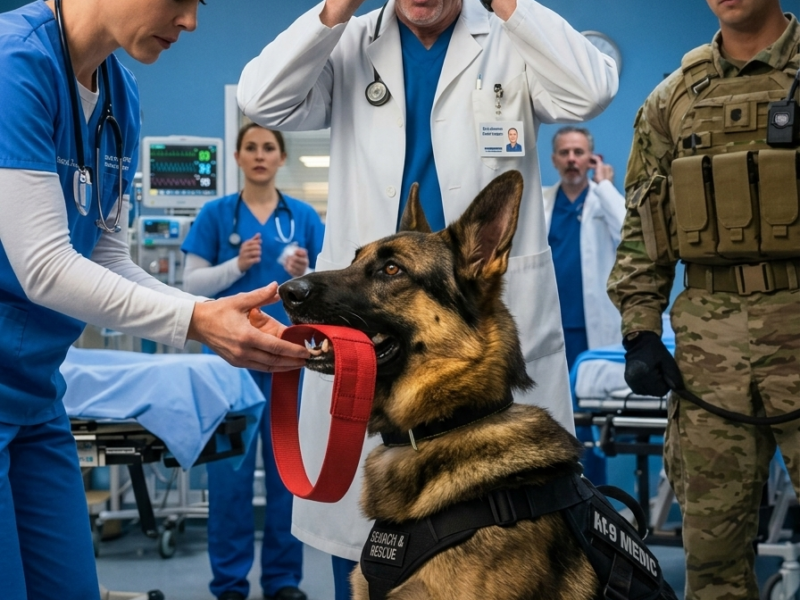
The doctors laughed when the new nurse froze beside a dying patient, but the room went silent
The air inside Trauma Bay 3 at Naval Hospital Jacksonville was thick with the sharp, clinical sting of antiseptic and the low, rhythmic hum of diagnostic monitors. Outside, a late September rain poured over the Florida coast, rattling against the reinforced glass windows. I was九 days into my civilian nursing contract at the facility, an assignment I had chosen specifically for its quiet, routine predictability. After years spent serving in high-intensity operational theaters as a Navy combat corpsman, I wanted nothing more than to slip into the comfortable anonymity of floor care. I wanted to draw routine labs, hang IV fluids, and go home to an empty apartment where nobody asked me about the past.
“BP is fifty over thirty and falling fast! Heart rate ninety-two and thready!” the paramedic yelled as they rammed the gurney through the heavy automatic doors.
The patient on the stretcher was an unidentified male, pulled from a wrecked vehicle along a desolate stretch of Highway A1A near Mayport. His clothing was soaked through with mud and rainwater, his face caked in road grime and dark, drying blood. He had no wallet, no dog tags, and no digital identification. He looked like an empty ghost, his chest rising and falling in shallow, desperate gulps of air.
Dr. Richard Harris, the chief attending physician on the shift, stepped to the foot of the bed, pulling on a pair of latex gloves. Harris was an arrogant, career-driven physician who treated junior staff and nursing personnel like temporary obstacles in his trauma room.
I stepped forward, my hands hovering over the patient’s thorax to begin a rapid physical assessment. As I watched the patient’s chest rise, something in my chest tightened. His right side expanded, but his left ribs remained sunken and rigid—a classic sign of a paradoxically moving flail chest with an impending tension pneumothorax.
“Doctor,” I said softly, my voice calm despite the rising tension in the room. “Check his left thoracic window. His breath sounds are diminished on the left, and the trachea is shifting slightly to the right.”
Harris didn’t even look up from his charting tablet. He let out a loud, theatrical sigh that caused the two resident doctors beside him to chuckle under their breath.
“Nurse Vance,” Harris said, his tone dripping with condescension as he pointed a gloved finger at me. “You’ve been in this department for nine days. You are here to hang bags, prep lines, and follow orders. Let the experienced physicians handle the diagnostic work. Step back.”
The residents smirked. I lowered my eyes, swallowed my pride, and stepped back against the stainless steel supply cabinet. “Understood, Doctor.”
“Thank you,” Harris muttered, reaching for a blood pressure cuff. “Now, let’s get a standard chest X-ray ordered and—”
Before he could finish his sentence, the cardiac monitor attached to the gurney released a high-pitched, continuous scream. The digital heart rate line flattened into a chaotic, erratic rhythm of ventricular fibrillation.
“He’s coding!” a resident yelled, scrambling for the crash cart.
“Start compressions!” Harris shouted, stepping into position.
Before Harris’s hands could touch the patient’s chest, the double doors of Trauma Bay 3 slammed open with an explosive metallic crash.
A massive Belgian Malinois—broad-chested, covered in rain, his dark fur damp and matted—burst into the room. Behind him, a navy tactical handler in soaked combat fatigues sprinted through the hallway, shouting a command in Dutch. But the dog ignored the handler entirely.
The Malinois didn’t bark, nor did he display aimless aggression. In his jaws, he held a dark, heavy strip of fabric. He leaped over a rolling stool, bounded directly toward the head of the gurney, and dropped the object squarely onto my shoes.
The room froze for a fraction of a second.
“Get that animal out of here!” Harris roared, recoiling in shock. “Security! Clear this bay!”
I looked down at my feet. Resting on the white linoleum floor was a faded, water-logged tactical armband made of dark navy canvas. Stitched across its center was a yellow, stylized trident crossed by a silver combat dagger—the unique, unauthorized unit insignia of Task Force Orion, a dark-budget maritime interdiction team that had officially ceased to exist years ago.
My hands began to tremble violently. My throat went bone dry.
I had seen that exact armband eight years ago, pinned to the left sleeve of Commander Daniel Cross—my commanding officer, the man who had led our team into a remote mountain sector in Afghanistan, the man who had ordered me onto an evacuation helicopter while he stayed behind to secure a classified extraction zone. Six months later, the Department of Defense had officially declared him dead in action, his body unrecovered.
Slowly, as if in a trance, I stooped down and picked up the damp canvas band. The faint smell of copper, salt water, and gun oil still clung to the fabric.
The Belgian Malinois dropped his front quarters to the floor, resting his muzzle directly against my knee, releasing a low, mournful whine.
The tactical handler finally reached the doorway, panting heavily, his hand resting on his sidearm holster. He stared at me in disbelief. “He… he broke his leash in the parking lot,” the handler gasped out. “He ran straight for this bay. Do you… do you know what that armband is?”
I couldn’t answer. My breath caught in my chest.
I slowly turned my eyes away from the dog and walked back to the head of the gurney. I reached out with a trembling hand, grabbing a wet gauze pad from the tray, and wiped away the thick layer of mud and dried blood along the left side of the patient’s jawline.
There, nestled just beneath the angle of his jaw, was a small, crescent-shaped scar—a wound caused by a shrapnel fragment during a training exercise in Little Creek, Virginia, a decade ago.
My heart stopped beating in my chest.
“Daniel?” I whispered, my voice breaking.
As if hearing his name across an ocean of darkness, the patient’s eyelids fluttered open. His pupils were pinpoint, cloudy with shock, but for one brief, electric second, his pale blue eyes focused directly on my face. A faint flicker of absolute recognition flashed in his gaze.
Then, the monitor above his head released a solid, terrifying flatline tone. The rhythm was gone entirely. Asystole.
“He’s gone flat!” Harris yelled, shoving his way back to the bed. “Charge the paddles to two hundred! Get out of the way, Vance!”
“No!” I roared, the quiet, submissive nurse persona shattering into a million pieces. The tone of my voice was no longer that of a civilian contract worker—it was the hard, unquestioned command of a Navy battle-ground medic who had pulled dozens of men back from the edge of the grave.
I shoved Harris aside with my shoulder so hard he stumbled into the crash cart. I grabbed the defibrillator handles, slapped the conductive gel onto the pads, and pressed them with crushing force against the man’s chest.
“Clear!” I shouted.
His body jolted violently on the gurney as two hundred joules of electricity surged through his heart. The line remained flat.
“Charge to three hundred!” I commanded the stunned resident, who instinctively slapped the charge button without thinking.
“Clear!”
Thump.
His chest surged upward again. For three agonizing seconds, the monitor hummed with a flatline tone. Then—
Beep… Beep… Beep.
A sinus rhythm returned, slow, weak, but steady. The patient let out a long, ragged gasp of air, his chest rising as the trapped air in his pleural space bled out through the emergency needle chest drain I had jammed into his side with my free hand while holding the paddles.
Harris stood frozen, his mouth open, unable to utter a single word.
The patient’s eyes opened again. He did not look at Harris. He did not look at the residents or the handler. His gaze locked onto mine with a fierce, terrifying intensity. He reached up with a cold, blood-stained hand and clamped his fingers tightly around my wrist.
“You’re alive,” I whispered, tears blurring my vision. “Daniel… how are you alive?”
His lips were dry, cracked, and stained with crimson, but he pulled my ear close to his mouth with the last remaining thread of his strength.
“They… found me,” he rasped, his voice a dry, papery whisper.
“Who?” I leaned in closer, my blood turning to ice. “Who found you, Daniel?”
His fingers tightened around my wrist with a iron grip that left red marks on my skin.
“The people who made sure you believed I was dead,” Daniel whispered, his breath cold against my cheek.
Behind us, at the entrance of Trauma Bay 3, the Belgian Malinois suddenly stood up, his ears flattening against his skull. A deep, chest-rumbling growl vibrated through the dog’s throat. He faced the dark hallway outside the glass doors, where the shadow of a tall figure in a crisp, dark navy officer’s service dress uniform paused for a single second before melting away into the shadows of the hospital corridor.
Daniel pulled my head down one last time, his voice barely audible over the hum of the monitors.
“Don’t trust anyone wearing a Navy uniform.”
The heavy silence inside Trauma Bay 3 was broken only by the steady, rhythmic beep… beep… beep of Commander Daniel Cross’s heart monitor.
Dr. Harris stood frozen near the overturned supply cart, his face pale with humiliation and shock. The two residents looked back and forth between me, the Belgian Malinois, and the broad-shouldered patient who had just returned from the dead.
“Nurse Vance,” Harris stammered, his voice lacking every trace of its former arrogance. “What… what was that? Who is this man?”
“His name is Commander Daniel Cross,” I said, my voice dropping into a hard, clinical tone as I checked his peripheral pulses and verified the flow rate of the IV saline. “He is an active operational officer, and this bay is no longer secure.”
I turned to the tactical K9 handler standing at the door. His name tag read Special Agent Miller, Naval Investigative Service.
“Agent Miller,” I commanded, “lock down these double doors. No one enters or leaves this trauma bay without my explicit authorization. That includes medical personnel.”
“You can’t do that!” Harris protested, taking a step toward me. “I am the chief attending physician of this emergency department! You are a contract nurse! I will have you removed by security!”
I turned around slowly and walked straight up to Harris until I was standing inches from his face. The small, quiet floor nurse he had mocked ten minutes ago was gone. In her place stood Petty Officer Sarah Vance, a decorated combat medic who had treated gunshot wounds in active fire zones while artillery shells detonated three hundred yards away.
“Dr. Harris,” I said softly, my voice as cold as surgical steel. “This man was officially declared dead eight years ago following a classified operation in Central Asia. A high-ranking officer in a Navy service dress uniform was just spying on this bay from the hallway. If you open those doors, or if you attempt to pull rank on me right now, I guarantee you that you will become collateral damage in a federal investigation you are entirely unequipped to understand. Do you want to treat patients, or do you want to answer questions from a Senate intelligence committee?”
Harris swallowed hard. He looked at the massive Belgian Malinois, who was currently standing in front of the glass doors, his dark eyes fixed on the corridor, his lips pulled back to show a line of razor-sharp white teeth.
“Keep… keep him stable,” Harris muttered, backing away toward the corner desk. “I’m… I’m going to my office to review the chart.”
“You’re staying right here where I can see your hands, Doctor,” Miller said, drawing his sidearm and standing beside the door. “The nurse is right. This room is an active tactical site.”
I returned to Daniel’s side. His blood pressure was stabilizing at ninety over sixty, but his body was shivering violently from hypothermia and trauma shock. I pulled two warm blanket wraps from the heating cabinet and laid them over his broad chest, tucking them around his shoulders.
The Belgian Malinois walked over to the side of the bed, resting his massive head against Daniel’s limp hand. Daniel’s fingers twitched faintly, his thumb lightly stroking the dog’s damp snout.
“His name is Jax,” Agent Miller said quietly from the door. “He was Daniel’s working dog during Task Force Orion. When Daniel went missing eight years ago, Jax was retired from active service and assigned to our federal security detachment at Mayport. Tonight, when the call came over the dispatch radio about an unidentified male found on Highway A1A, Jax went crazy in his kennel. He broke through the chain-link fence, ran into the armory storage room, pulled that old armband out of a footlocker, and wouldn’t let anyone touch it.”
“He knew,” I whispered, stroking Jax’s ears. “He knew his commander was back.”
“Vance…” Daniel’s voice rasped from the bed. He was struggling to keep his eyes open, his breathing ragged under the plastic oxygen mask.
“I’m here, Daniel. Save your strength,” I said, checking his chest tube to ensure the dark, trapped blood was draining properly from his lungs. “You’re at Naval Hospital Jacksonville. You’re safe.”
“No…” Daniel gasped, his fingers tightening around my sleeve again. “Not safe… The accident on A1A… wasn’t an accident. They forced my truck off the road… near the tree line.”
“Who, Daniel? Who forced you off the road?”
“Orion… was never disbanded,” Daniel rasped, coughing weakly as a trail of dark blood trickled from the corner of his mouth. “It was… repurposed. Private contractors… operating under senior flag officers in Norfolk. They were… moving classified intelligence and seized assets through military medical transport channels. I found… the paper trail in Germany six months ago.”
My blood ran cold. Task Force Orion had been an elite, off-the-books interdiction unit. If the unit had been taken over by rogue officers and private defense contractors, they would have access to military transport planes, medical supply lines, and federal facilities across the globe—including this very hospital.
“When I tried to bring the evidence to the Inspector General,” Daniel continued, his voice dropping to a thready whisper, “they executed my entire security team in Stuttgart. I’ve been running for six months… trying to get back to Florida… to find you.”
I stared at him in disbelief. “To find me? Why me, Daniel? I’m just a nurse.”
“Because…” Daniel reached into his water-soaked canvas field jacket resting on the lower shelf of the gurney. His fingers fumbled with a small, heavy silver key hanging from a steel chain around his neck. “…you’re the only person in this service whose records… they couldn’t corrupt. You kept… the original mission logs from Afghanistan… on an encrypted hard drive.”
I froze. Eight years ago, before I left active duty, I had backed up all unit medical logs onto a personal, military-grade encrypted drive and placed it in a safety deposit box at a small bank in downtown Jacksonville. I had done it as a precaution to protect my corpsman license if the military ever tried to question our field treatments. I had no idea that those logs contained the original deployment orders signed by the very officers who had betrayed Daniel’s team.
Suddenly, the overhead fluorescent lights in Trauma Bay 3 flickered twice, buzzed loudly, and died completely.
The room plunged into pitch-black darkness.
For three terrifying seconds, the only sound in the dark room was the heavy, rain-slicked wind howling against the windows and the frantic gasps of the medical team.
Then, the emergency red backup lights sputtered to life, casting deep, bloody shadows across the stainless steel equipment and white tile walls. The digital cardiac monitors hummed as their internal backup batteries kicked in, casting a faint green glow across Daniel’s pale face.
“Power grid cut,” Agent Miller reported instantly, stepping in front of the double doors with his weapon raised. “They didn’t just kill the lights; they bypassed the primary building generators. This is a targeted blackout.”
“Dr. Harris, residents, get down on the floor behind the central desk now!” I shouted, grabbing a pair of manual suction pumps and a bag-valve mask from the wall hook.
Jax didn’t bark. He lowered his body into a low, lethal crouch at my side, his dark eyes fixed on the frosted glass doors of the bay. His tail was rigid, his fur standing straight up along his spine.
Outside in the main corridor, the muffled sound of shouting began to echo down the hall, followed by the sudden, chilling thud-thud-thud of suppressed gunfire striking metal doors.
“They’re clearing the hallway,” Miller whispered, his face grim under the red light. “They aren’t here to negotiate. They’re here to erase the target and everyone in this room.”
“How many exits out of this bay?” I asked, kneeling beside Daniel’s gurney and unhooking the heavy brake latches on the wheels.
“Just the main corridor and the laundry chute service elevator in the back,” Harris whimpered from beneath the desk, his hands clasped over his head. “The service elevator requires an administrator keycard!”
I reached out, grabbed Harris by his shirt collar, and yanked him up. “Give me your card. Now!”
Harris hurriedly unclipped his blue administrative access pass from his belt and thrust it into my hand with trembling fingers. “Take it! Just don’t let them in here!”
“Miller,” I said, turning to the NIS agent. “Can you hold the main doors for two minutes while I move Daniel into the service elevator?”
Miller looked at me, then down at Jax, and finally at Daniel—his former commander. A hard, resolute smile touched the agent’s lips. “I’ll hold them for five, Corpsman. Get the Commander out of here. Jax, stay with Vance! Protect!”
Jax gave a single, quiet thud of his tail against the floor, acknowledging the command, but kept his eyes pinned on the main entrance.
Crash!
The glass panel of the double doors shattered inward as a heavy boot kicked through the frame. A flash-bang grenade arced through the broken glass, bouncing across the linoleum floor toward the center of the room.
“COVER!” Miller roared, throwing his body over the central desk to shield the frightened residents.
I grabbed Daniel’s gurney, threw my entire body weight against the headboard, and shoved the heavy steel bed through the narrow swinging doors at the rear of the trauma bay just as the grenade exploded with a deafening CRACK and a flash of blinding white light.
The pressure wave slammed the rear doors shut behind us.
We were in the narrow, dimly lit service corridor that led to the hospital’s subterranean linen and maintenance facilities. Rainwater dripped from overhead pipes, pooling on the concrete floor.
I didn’t stop to look back. I sprinted down the corridor, pushing the heavy gurney with everything I had. Jax ran directly beside me, his shoulder pressed against my hip, his paws sliding slightly on the wet concrete as he kept pace with the wheels.
Behind us, the rapid, suppressed pop-pop-pop of Miller returning fire echoed down the narrow hallway, followed by the heavy thud of tactical boots pursuing us.
“Vance…” Daniel moaned, his chest rising rapidly as his oxygen levels began to drop again without the wall-mounted regulator. “The key… take the key…”
I reached down, unhooked the silver chain from his neck, and shoved it deep into my scrub pocket alongside the faded armband. “I have it, Daniel. Keep breathing. Stay with me!”
We reached the heavy stainless steel doors of the service elevator. I slammed Harris’s administrative keycard against the digital scanner.
The light flashed red. DENIED.
“No, no, no!” I screamed, slamming the card against the sensor again.
DENIED – FACILITY LOCKDOWN ACTIVE.
They had overridden the building’s access codes from the main security console. We were trapped in a dead-end corridor with a dying commander, a single K9, and an armed strike team closing in from behind.
The sound of boots pounding against the concrete floor grew louder by the second. The strike team was less than thirty yards down the service hallway, moving with disciplined, methodical precision.
I looked around frantically. To our right was a heavy, reinforced steel door marked Boiler Room 4 – Authorized Personnel Only. Unlike the digital elevator, this door operated on a heavy, mechanical brass lever lock.
I pulled the small brass key Daniel had given me out of my pocket. It wasn’t just a key for a safety deposit box; its unique, notched design matched the heavy mechanical locks used in old military infrastructure buildings.
I jammed the key into the boiler room lock and twisted it with all my strength.
Click-clack.
The heavy steel deadbolt slid back with a loud metallic groan. I shoved the heavy door open, grabbed the gurney, and hauled Daniel inside, pulling Jax through behind us before slamming the heavy door shut and throwing the manual interior iron latch into place.
The boiler room was deafeningly loud. A massive emergency diesel water pump was roaring in the center of the space, its massive pistons churning as it attempted to clear rainwater from the basement sumps. Thick clouds of white steam hissed from high-pressure relief valves near the ceiling, filling the air with a hot, humid fog that smelled of rust and heavy machinery.
I dropped to my knees beside Daniel’s gurney in the hazy red glow of the pressure gauges. His skin was turning a dangerous shade of mottled gray. The manual bag-valve mask I had brought was keeping his lungs inflated, but without clean oxygen and fresh blood transfusions, his heart would give out within ten minutes.
Jax moved away from the bed, slipping quietly into the steam clouds near the iron door. He didn’t make a sound. He lowered his snout to the floor, his ears twitching as he listened to the heavy impacts hitting the outside of the door.
THUD. THUD.
They were slamming a tactical breaching ram against the iron frame. The heavy door groaned, the iron hinges bending slightly under the immense force, but the manual latch held firm.
“They’re going to breach in thirty seconds,” I muttered to myself, my mind racing through every combat medicine protocol I had ever learned.
I looked around the boiler room. Near the rear wall, a heavy industrial linen chute dropped down into the subterranean laundry facility beneath the hospital parking garage—a slide designed to move hundreds of pounds of soiled sheets directly to the commercial wash bays.
I looked at Daniel. He weighed at least two hundred pounds, and moving him down a vertical chute without causing fatal spinal displacement or tearing out his chest tube seemed impossible.
“Vance…” Daniel rasped, his eyes barely open as he looked up at me through the steam. “Leave me… take the key… get the drive to the press…”
“Shut up, Commander,” I snapped, tears of frustration streaking through the grime on my face as I grabbed a heavy canvas laundry bag from a bin and began wrapping it around his torso to secure his chest tube and IV lines. “I didn’t bring you back from asystole twice today just to leave you in a boiler room. You ordered me onto that chopper eight years ago, and I obeyed. But you’re not my commanding officer anymore. I’m your nurse. And you’re coming with me.”
A faint, tired smile touched the edge of Daniel’s lips despite his agony. “You always… were a terrible sailor, Corpsman…”
BOOM!
The top hinge of the boiler room door blew inward with a shower of sparks and metal shrapnel. A flash of light pierced through the fog as a tactical flashlight beam cut through the steam.
“Clear the left!” a harsh voice shouted through a gas mask from the doorway. “Target is inside! Eliminate on sight!”
Before the first operative could step through the breached doorway, a black-and-tan shadow launched itself through the cloud of white steam.
Jax didn’t bark. He didn’t hesitate. He flew through the air with terrifying speed, his crushing jaws locking onto the lead operative’s arm, ripping the tactical rifle from the man’s grip as they both crashed hard onto the slippery iron floor grating.
The operative shrieked in pain as Jax dragged him deeper into the fog, using his massive weight to pin the man against the vibrating diesel pump.
“Ranger team, engage the dog!” another operative yelled, raising his sidearm into the steam.
“Jax, RETURN!” I screamed, throwing my shoulder against the heavy mechanical lever of the linen chute.
The dog released his grip instantly, turning on a dime, and sprinted back through the fog, leaping cleanly over the edge of the chute just as a hail of suppressed bullets chewed through the metal wall where he had been standing two seconds prior.
I grabbed the head of Daniel’s wrapped gurney, tilted it upward, and slid his body into the slick, canvas-lined chute, jumping in directly behind him as the boiler room door collapsed entirely.
The slide down the industrial linen chute was a terrifying, pitch-black blur of rushing air, cold canvas, and slick metal. I held onto Daniel’s shoulders with both arms, using my own body as a human cushion to protect his head and chest from slamming against the reinforced bends of the chute.
With a heavy, muffled THUD, we burst through the bottom exit flap, crashing into a massive mountain of soft, clean hospital linens inside the subterranean laundry processing facility beneath the parking garage.
Jax landed right beside us, shaking the dust from his wet fur and immediately turning to check the chute entrance above us with a sharp, low growl.
“Daniel!” I gasped, pulling the canvas wrapping away from his face.
His eyes were closed, his pulse barely palpable at his carotid artery. The movement through the chute had dislodged his peripheral IV, and dark blood was beginning to soak through his chest dressings again. He was slipping away rapidly.
I looked around the vast, cavernous laundry facility. The space was lit only by dim yellow emergency exit signs. Massive industrial washing drums stood like silent iron giants in the shadows. Fifty yards away, at the far end of the bay, the heavy rolling steel shutter of the commercial delivery dock stood open six inches, letting in the cool, rain-scented night air.
Parked near the open dock door was a dark blue hospital transport van—a heavy-duty vehicle used to shuttle medical supplies between regional clinics. The keys were hanging from a pegboard near the wall.
“Come on, Daniel,” I grunted, hoisting his arm over my shoulders and dragging his heavy frame off the linen pile. “Just a little further.”
Jax walked right beside us, his shoulder pressed against Daniel’s hip to help support his weight, his dark eyes scanning the dark rafters above.
We made it to the transport van. I shoved the side sliding door open, lifted Daniel onto the flat rear floorboards, and climbed inside after him. I grabbed an emergency trauma bag resting on the van’s rear shelf, spiked a fresh bag of saline, and re-established an IV line in his right arm by the faint glow of my penlight.
I ran to the front, grabbed the keys from the pegboard, jammed them into the ignition, and turned the tumbler.
The heavy V8 engine churned twice—whir-whir—and then roared to life, its exhaust echoing through the hollow laundry room.
SLAM!
At the far end of the laundry bay, the heavy metal door leading from the stairs was kicked open. Three operatives in dark tactical gear stepped into the room, their rifle-mounted flashlights cutting through the darkness.
“There’s the vehicle!” one of them shouted, raising his weapon. “Shoot the tires!”
“Jax, up!” I yelled.
The Belgian Malinois leaped into the passenger seat, his dark eyes fixed on the windshield as I slammed the van into drive, stomped on the accelerator, and drove straight toward the steel rolling shutter of the loading dock.
Bullets slammed into the van’s hood and shattered the top edge of the windshield with deafening cracks, sending safety glass raining down across my lap.
I didn’t turn the wheel. I ducked my head below the dashboard, keeping my foot jammed down to the floorboards.
The heavy steel bumper of the transport van struck the bottom edge of the rolling shutter at forty miles per hour. With a violent crunch of metal, the shutter buckled, snapped from its side tracks, and burst outward into the pouring rain.
The van hit the wet tarmac of the parking lot, skid sideways for a fraction of a second, caught traction, and surged forward into the dark, storm-drenched streets of Jacksonville.
I pulled myself up, wiping blood from a minor glass scratch on my forehead, and looked in the rearview mirror. The lights of Naval Hospital Jacksonville were fading into the thick wall of coastal rain behind us. No vehicles were following us yet.
I looked back into the rear cabin. Daniel was lying on the floorboards, his breathing shallow but stable, the fresh saline line slowly restoring his fluid volume.
Jax climbed back into the rear, laying his massive head across Daniel’s chest, his ears twitching as he listened to the steady, rhythmic sound of his commander’s breathing.
I reached into my pocket and pulled out the heavy silver key and the faded Navy armband.
The morning sun was still two hours away, hidden behind the black storm clouds hanging over the Atlantic Ocean. In my pocket was the key to an encrypted drive that contained the names of the most powerful and corrupt officers in the military medical hierarchy—the men who had tried to murder Daniel Cross twice, and the men who had turned my life into a quiet, fearful lie.
I looked down at the brass key glinting under the dim dashboard lights, then out at the dark highway stretching ahead toward downtown Jacksonville.
My six years of hiding were over. The quiet nurse was gone. And together with a returned commander and a Navy K9 who refused to let the truth die, we were going to finish the war we started eight years ago.
The end.









