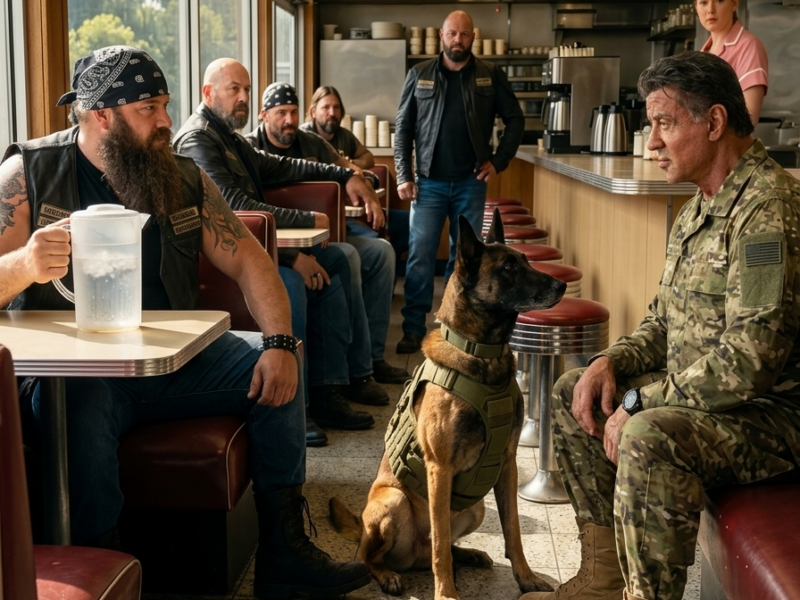
The diner fell silent when three men mocked Rex for struggling to lift his coffee cup, while everyone watched with cruel smiles
The neon sign outside the greasy-spoon diner in upstate New York flickered against the damp, autumn drizzle, casting a cold, buzzing hue over the cracked linoleum floor. It was late afternoon, the hour when the rain usually settled into a dull, unrelenting tempo and the smell of stale coffee and burnt bacon hung heavy in the air.
At the far end of the counter sat Rex.
He was fourteen years old, skinny to the point of fragile, his shoulders hunched deeply beneath an oversized gray hoodie that looked as though it belonged to someone twice his size. He didn’t look at the television mounted above the kitchen door, nor did he look at the laminated menus stacked beside the napkin dispenser. His entire universe had shrunk to the white ceramic coffee cup sitting on the formica surface in front of him.
His hands were trembling. It wasn’t a subtle twitch. It was a violent, involuntary tremor that rattled the small ceramic saucer beneath the cup, sending rhythmic, tiny ripples across the dark liquid inside. He tried to grip the handle, his knuckles turning chalk-white as he concentrated every ounce of his willpower into steadying his arm. He brought the cup half an inch off the counter, but the shuddering in his wrist caused the hot liquid to spill over the rim, splashing onto his hand and the Formica top.
“Look at that,” a voice boomed from a booth three feet away. “Kid can’t even hold a cup. What’d you do, boy? Run a marathon before breakfast?”
The speaker was a thick-necked man in his late fifties wearing a stained canvas work jacket, sitting with two truck drivers. The men around him let out a collective, raspy snicker.
Rex lowered his head further, his eyes locked on the pool of spilled coffee. He didn’t answer. He didn’t draw a breath. He just pulled his hands back into the oversized sleeves of his hoodie, tucking them beneath his arms to hide the shaking.
“Hey, I’m talking to you,” the man continued, leaning over the back of his vinyl booth. “You gotta eat your spinach, son. A gust of wind’s gonna knock you right into next week.”
A few patrons at the surrounding tables smirked, shaking their heads in quiet, cruel amusement. In a small town on a rainy afternoon, public humiliation was as good a entertainment as any. Nobody said a word to stop it. Nobody looked away either.
I was sitting two booths down, my own coffee growing cold, watching the tension build in the boy’s frail shoulders. I could see his chest rising and falling in shallow, panicked hitches. He was fighting back tears, swallowing hard against the lump in his throat, desperate not to give the men the satisfaction of seeing him cry.
The diner door chimed as it swung open, letting in a gust of wet wind.
A man walked in quietly, shaking the rain from the brim of his dark blue baseball cap. He wore a heavy, unbuttoned black field jacket over a dark sweater. He didn’t make a scene. He didn’t look around for recognition. He simply walked to a small, secluded booth in the corner near the jukebox, sat down, and pulled off his cap.
I recognized him instantly. The heavy brow, the sharp, familiar jawline, the weary yet razor-sharp eyes that had graced movie screens across the world for five decades.
It was Sylvester Stallone.
He was in the area shooting a film location scout, completely alone, looking like a man who simply wanted twenty minutes of peace and a hot drink. The waitress, an older woman named Marcie who looked like she hadn’t been surprised by anything since 1984, walked over, poured him a mug of black coffee, and walked away without asking for an autograph.
The three men at the center booth didn’t notice him. Their attention was entirely focused on the boy at the counter.
The leader of the group stood up, wiping his mouth with a napkin. “Tell you what, kid. Let me help you with that.”
He stepped up behind Rex and reached out. With a deliberate, sweeping flick of his heavy hand, he struck the side of the coffee cup.
CRASH.
The heavy white ceramic mug shattered against the hard floor, sending shards of wet porcelain and hot brown liquid spraying across the boy’s worn sneakers and the surrounding floorboards. The sudden, violent sound echoed through the diner like a gunshot.
The entire restaurant went dead silent. The faint hum of the refrigerator in the kitchen was the only remaining sound.
Rex froze, his breath catching violently in his chest. His hands remained pinned under his armpits.
“I… I said I’m sorry,” Rex whispered, his voice so thin it barely carried through the quiet room.
“I didn’t hear you say sorry,” the man sneered, stepping closer, towering over the sitting boy. “And you made a mess. So pick it up.”
“Hey, Don, leave the kid alone,” the waitress called out half-heartedly from behind the register, but she made no move to step between them.
“He’s gotta learn to clean up after himself,” Don snapped, glaring at the boy. “Pick it up, kid.”
Rex hesitated, then slowly slid down from the high counter stool. He dropped to his knees on the cold, wet linoleum, surrounded by jagged shards of glass and pool of scalding liquid. He reached out a hand to grab the largest broken handle piece, but his arm shivered so violently that his fingertips merely knocked the piece away, scraping his skin against the sharp edges.
The three men laughed out loud again, a booming, arrogant sound.
Rex stopped. He stayed on his knees in the mud and spilled coffee, his head bowed, unable to grab a single fragment, completely paralyzed by shame.
Then, from the dark booth in the corner, a figure stood up.
Sylvester Stallone didn’t shout. He didn’t stomp his feet. He moved with a quiet, dense weight, his dark eyes fixed on the scene at the counter. The entire diner watched in stunned, paralyzed silence as the icon walked slowly across the floor, his heavy boots making slow, measured thuds on the linoleum.
He didn’t look at the three men. He stepped right past them, knelt down beside the boy in the spilled coffee, and calmly picked up the jagged porcelain handle with his own large, weathered hands. He gathered two more pieces, held them in his palm, and then reached out a hand toward Rex.
“Here,” Stallone said gently. His voice was a low, gravelly rasp—deep, warm, and entirely devoid of anger.
Rex looked up, his tear-filled eyes widening in absolute disbelief as he recognized the face staring back at him.
Stallone offered his hand, helping the boy stand up off the floor. Then he grabbed the back of the heavy wooden chair beside the counter, pulled it out, and gestured toward it.
“Sit,” Stallone said.
Rex hesitated, his jaw trembling, his mind unable to process what was happening.
“Sit down, kid,” Stallone repeated, his voice softer this time.
The boy sat.
Only then did Stallone turn his body. He stood tall, turning his gaze toward the three men who had been laughing seconds earlier. His posture was totally relaxed, yet he radiated an invisible, dangerous authority that made the lead man, Don, instinctively take half a step back.
Stallone stared into Don’s eyes for five long, agonizing seconds before he spoke.
“You think strength means making someone smaller?” Stallone asked quietly.
Nobody answered. Don swallowed hard, his face turning a dark, mottled red, his previous bravado evaporating into thin air under the weight of Stallone’s intense, unblinking glare.
Stallone didn’t wait for a response. He turned his back on them entirely, pulling up a stool right next to Rex, placing his broad elbows on the counter.
“What’s your name, kid?”
“R-Rex,” the boy squeaked out, wiping his wet cheek with his sleeve.
“Rex,” Stallone nodded slowly, looking at the boy’s trembling hands, which were now resting on his knees. “Tell me something, Rex. What’s the hardest thing you’ve ever done?”
The boy swallowed hard, looking down at his worn shoes, the weight of the entire world pressing down on his small chest.
“Getting out of bed,” Rex whispered.
The diner remained completely, terrifyingly silent. The rain beat harder against the glass windows.
Stallone didn’t smile. He didn’t offer a patronizing pat on the shoulder. He slowly nodded his head, his heavy eyes softening with a deep, unmistakable respect.
“Then you already know something most people in this room will never learn,” Stallone said quietly.
Rex looked up, searching the movie star’s rugged, scarred face. “What?”
“Strength isn’t what you can lift,” Stallone said, pausing as he looked directly into the boy’s eyes. “It’s what you carry without letting it turn you cruel.”
The weight of Stallone’s words seemed to settle into the very floorboards of the diner. Rex stared at the veteran actor, his mouth slightly open, the tears that had been threatening to spill over his cheeks suddenly freezing in place.
The waitress, Marcie, walked out from behind the counter carrying a tray with a dustpan and a fresh, steaming mug of hot chocolate topped with whipped cream. She quietly swept up the broken porcelain at their feet without a word, setting the sweet drink down right in front of Rex. She glanced at Stallone, gave him a faint, respectful nod, and walked back to the kitchen, leaving the two of them in their own private bubble.
Across the room, Don and his two companions sat down in their booth, completely silent. They avoided looking toward the counter, staring intently at their cold food, suddenly deeply embarrassed by their own existence.
“You drink hot chocolate?” Stallone asked, nodding toward the mug.
“Yeah,” Rex said softly. He pulled his right arm out from his hoodie sleeve to reach for the mug.
As the oversized gray fabric pulled back, the sleeve slid past his wrist, exposing his forearm. Wrapped tightly around his pale skin was a bright blue plastic medical identification bracelet, stamped with red text and a hospital barcode. Above the bracelet, running up the inner length of his forearm, was a long, thin, faded surgical scar.
Stallone’s sharp eyes caught it immediately. His expression shifted from quiet intensity to a profound, gentle warmth.
“What’s that for, Rex?” Stallone asked, pointing a blunt finger toward the blue band.
Rex instinctively pulled his sleeve back down, his face flushing red. “Nothing. Just… hospital stuff.”
“I’ve got a few scars myself,” Stallone said, resting his hand on the counter. He pulled back his own sleeve slightly, showing a faint white mark near his wrist from an old stunt injury. “Every scar’s got a story. Some of them mean you were stupid. Some of them mean you survived something that tried to break you. Which one is yours?”
Rex looked at Stallone’s scar, then down at his own covered wrist. The hostility he had felt from the room was gone, replaced by an overwhelming sense of safety in the shadow of the man sitting beside him.
“My heart,” Rex said quietly.
“Your heart?”
“Congenital defect,” Rex murmured, his voice growing steady as he spoke to someone who was actually listening. “I’ve had three surgeries since I was ten. The last one was six months ago. They had to rebuild a valve. They used a bunch of metal and artificial stuff to keep it opening right.”
“That explains the hands,” Stallone noted softly, not as a judgment, but as a statement of fact.
“Yeah,” Rex nodded, looking at his left hand, which was still shivering slightly against his knee. “Nerve damage from the bypass machine. And the meds I take… they make my blood pressure swing around. My hands shake when I get tired or stressed out. The doctors said it might go away eventually. Or it might not.”
Stallone leaned back, taking a slow sip of his own coffee. “How old are you?”
“Fourteen.”
“Fourteen years old and you’ve already fought three battles on an operating table while most kids your age are worrying about video games,” Stallone said. “And those guys over there thought you were weak because you spilled some coffee.” He let out a soft, dismissive grunt. “They don’t know what real fighting looks like.”
Rex looked at his hands, a tiny glint of pride touching his eyes for the first time all day. “I used to play baseball,” he said suddenly, his tone dropping into a deeper sadness. “I was a pitcher. Little League. I was pretty good, too. Fastball had a real bite to it.”
“A pitcher, huh?” Stallone smiled faintly. “Southpaw or righty?”
“Righty,” Rex said. “But after the last surgery, the doctors told my mom I couldn’t play contact sports, and the nerve tremors meant I couldn’t grip the seams right anymore. They said I might never play in a real game again.”
“They said might,” Stallone caught the word instantly.
“Tomorrow morning at eight o’clock is my final evaluation at the county hospital,” Rex confessed, his voice trembling again, this time from pure, unadulterated fear. “If the neurologist says the nerve damage is permanent, the school board revokes my athletic clearance for good. I won’t ever play freshman ball. I won’t ever get on a mound again.”
Rex buried his face in his hands. “I’ve been sitting in this diner for two hours because I was too scared to go home and think about tomorrow. My mom thinks I’m at the library. I just… I couldn’t face it.”
Stallone stayed quiet for a long moment. He didn’t offer empty platitudes. He didn’t tell the boy that everything was going to be fine, because he knew better than anyone that life didn’t always write happy endings on command.
Instead, Stallone reached into the inner pocket of his dark leather jacket. He pulled out a small, ordinary white paper napkin from the dispenser on the counter, along with a thick black pen he used for signing production notes.
He laid the napkin flat on the Formica counter, smoothed out the creases with his thumb, and began to write.
Rex wiped his eyes and watched as the legendary actor caps his pen.
Stallone didn’t write an autograph. He didn’t write “Best wishes” or “To my fan.”
In thick, bold, deliberate black ink, across the center of the soft white paper napkin, he wrote four simple words:
ONE MORE ROUND, REX.
Beneath the words, he signed his name in his distinctive, sprawling script: Sylvester Stallone.
Stallone folded the napkin neatly in half, then in half again, creating a small, sturdy square. He slid it across the counter, placing it directly into Rex’s palm, folding the boy’s trembling fingers over the paper.
“You know what ‘one more round’ means, Rex?” Stallone asked, his voice dropping into that iconic, gritty tone that had moved millions across the globe.
Rex shook his head softly.
“It means that when your legs are shaking so bad you think you’re gonna collapse, and your lungs are burning like they’re on fire, and everybody in the room is telling you to stay down… you get up anyway,” Stallone said, leaning in close so only Rex could hear him. “Going one more round when you don’t think you can—that’s what separates the people who just live from the people who survive.”
Rex held the folded napkin tightly against his chest, his knuckles white, but his hand had stopped trembling entirely.
“The doctors are gonna run their tests tomorrow,” Stallone continued, tapping Rex’s chest right over his heart. “They’re gonna look at charts, they’re gonna look at numbers, and they’re gonna tell you what the machines say. But a machine can’t measure what’s inside here. You go into that room tomorrow, you look those doctors in the eye, and you tell them you aren’t done yet. You got that?”
“I got it,” Rex whispered, his head rising high, his shoulders pulling back out of his defensive slouch.
“Good,” Stallone stood up from the counter stool. He reached into his pocket, pulled out a fifty-dollar bill, and laid it on the counter beside Rex’s hot chocolate. “That covers the coffee, the broken cup, and whatever else the kid wants to eat.”
He turned toward the exit, pulling his baseball cap back down low over his forehead. As he reached the door, he paused, looking over his shoulder at the three men sitting silently in the booth.
“Have a good evening, gentlemen,” Stallone said neutrally.
He walked out into the rain, the chime above the door ringing softly behind him.
The diner fell back into silence, but the atmosphere had shifted completely. The cold, mocking vibe was gone. Don and his friends paid their bill in hushed tones, dropped their money on the table without looking at Marcie, and shuffled out into the wet afternoon like defeated men.
Rex sat at the counter for another twenty minutes, slowly drinking his hot chocolate. He didn’t look like a victim anymore. He looked like a soldier preparing for a long-awaited battle. He placed the folded napkin carefully inside the plastic sleeve of his school notebook, zipped his hoodie up to his chin, thanked Marcie, and walked out into the rain with his chin held high.
The next morning at eight o’clock, the county hospital’s pediatric cardiology wing was cold, sterile, and bright.
Rex sat on the examination table wrapped in a thin paper gown. His mother sat in a vinyl chair in the corner, holding her handbag tightly in her lap, her eyes filled with an unbearable, maternal anxiety.
Dr. Robert Hayes, a senior neurologist with graying hair and half-moon spectacles, walked into the room holding a thick Manila folder filled with heart scans and nerve conduction charts.
“Well, Rex,” Dr. Hayes said, sitting down on his rolling stool, flipping through the pages. “We’ve reviewed the latest MRI and the nerve response tests from last week.”
Rex felt his heart pounding against his ribs—a steady, rhythmic beat, supported by metal and synthetic Dacron, but driven by a spirit that felt entirely new. His right hand rested in his lap. He could feel the tiny square of the napkin tucked inside his sock beneath his sneakers.
“The structural repairs to your valve are fantastic,” Dr. Hayes said, looking up over his glasses. “Dr. Vance did incredible work. However… the motor-nerve conduction in your right forearm is still showing significant delay. The tremors are an indicator that the motor pathway hasn’t fully healed.”
Rex’s mother let out a soft, stifled sob in the corner.
“Because of this,” Dr. Hayes continued, picking up a red clearance stamp, “I cannot give you unrestricted medical clearance for competitive high school athletics. The risk of falls, impact trauma, or inability to control equipment makes it a safety hazard. I’m sorry, son. I know how much baseball meant to you.”
The doctor opened the athletic form, raising the stamp to press DENIED onto the front page.
“Wait,” Rex said.
The doctor stopped, his hand hovering an inch above the paper. He looked up, surprised by the sudden, firm clarity in the boy’s voice.
“Rex?” his mother whispered.
Rex stood up from the examination table. He walked over to his folded clothes lying on a chair, pulled out his right shoe, and reached inside his sock. He pulled out the small, folded napkin, smoothed it out carefully on the doctor’s desk, and pressed his palm flat over it.
“Run the test again,” Rex said, looking Dr. Hayes directly in the eyes without flinching.
“Rex, we ran the nerve test three days ago—”
“Run it again,” Rex repeated, his voice dropping into a register that sounded impossibly mature for a fourteen-year-old boy. “I’m not asking you to cheat the numbers, Doc. I’m asking you to test me today. Right now.”
Dr. Hayes stared at the boy. He looked at the determination etched into Rex’s face, then down at the worn napkin on his desk. He read the four words written in thick black ink: ONE MORE ROUND, REX. He recognized the signature at the bottom instantly.
The doctor sat back, letting out a long, quiet breath. “You know this doesn’t guarantee a different result, son.”
“I don’t need a guarantee,” Rex said, extending his right hand out straight in front of him, keeping it pinned in the air, forcing every muscle in his arm to brace against the strain. “I just need one more round.”
Dr. Hayes agreed to a ninety-day probationary re-evaluation period—a rare, conditional exemption that allowed Rex to participate in non-contact conditioning and individual pitching drills under strict physical therapy supervision, delaying the final school board verdict until the end of the spring semester.
What followed was six months of brutal, excruciating discipline.
While other kids went home after school to play video games or hang out at the mall, Rex spent two hours every afternoon in a dimly lit physical therapy clinic in the basement of the local community college.
His therapist, a retired Navy corpsman named Marcus, didn’t offer sympathy. He offered resistance.
“Hold the weighted ball!” Marcus would shout over the hum of the air conditioner as Rex stood in front of a mirror, holding a three-pound rubber medicine ball in his right hand.
Rex’s arm would shudder violently. Pain flared along the surgical scar on his forearm as damaged nerves fought to reconnect with underused muscle fibers. Sweat poured down his face, dripping off his chin, soaking through his t-shirt.
“It’s shaking, Marcus!” Rex would gasp, his knees buckling under the fatigue. “My fingers are slipping!”
“Let it shake!” Marcus yelled back. “You aren’t trying to make it stop! You’re teaching it who’s boss! Squeeze the rubber! Five more seconds! Five… four… three…”
Rex screamed, his knuckles turning white, holding the ball until the timer beeped, before dropping it onto the padded mat and collapsing to his knees, gasping for air.
Every night, before he went to sleep, Rex laid the folded napkin on his nightstand beside a fresh baseball.
He would lie in the dark, pick up the leather ball, and practice gripping the raised red cotton seams with his thumb and middle finger. At first, he couldn’t feel the seams at all; his fingertips were numb, buzzing like dead radio static. But night after night, he pressed his fingers into the leather until the impression left deep grooves in his skin.
One more round.
By the third month, the violent tremors began to fade into a faint, manageable quiver.
By the fifth month, Rex could hold a cup of hot coffee without spilling a single drop.
By late May, the high school varsity baseball season was reaching its conclusion, and the junior varsity squad was preparing for the county championship game against their long-time rival, Oakridge High.
Rex had spent the entire season sitting on the dugout bench in his uniform. He was the team manager—keeping the scorebook, carrying the bat bags, cleaning the helmets. He was allowed to throw soft toss during warmups, but the school board’s final athletic clearance had remained locked in Dr. Hayes’ office, pending the ultimate real-world stress test.
It was the bottom of the seventh inning in the championship game.
The afternoon sun was scorching, baking the red clay of the high school diamond. The stands were packed with parents, students, and local townsfolk. The score was tied 4-4.
Oakridge had runners on second and third base with two outs.
Our starting pitcher, a tall kid named Miller, walked off the mound holding his shoulder, grimacing in pain. He had thrown over ninety pitches in the humid heat, and his arm had finally given out.
The JV coach, a burly former minor-leaguer named Coach Sullivan, paced the length of the dugout, staring at his remaining roster. His second-string pitcher had already played in the third inning and was ineligible to return.
“Who else is arm-ready?” Sullivan barked, looking down the bench. “Who’s got throw-time left today?”
The dugout was silent. Every kid looked away, intimidated by the pressure of entering a tied championship game with the winning run standing thirty feet from home plate.
From the far end of the bench, Rex stood up.
He unbuttoned his manager’s jacket, revealing his gold and blue team jersey with the number 12 printed on the chest. He pulled his leather glove out of his bag, slipped his left hand inside, and picked up a baseball from the ball bucket.
“I’m ready, Coach,” Rex said.
Coach Sullivan turned, looking at the thin fourteen-year-old boy. “Rex… you haven’t pitched in a live game in over a year. The board clearance—”
“Dr. Hayes signed the papers this morning,” Rex said, reaching into his back pocket and pulling out a folded piece of official hospital stationary, stamped in blue ink: APPROVED FOR FULL ATHLETIC PARTICIPATION.
Beside the clearance form, tucked into the transparent window of his gear bag, was the small, worn square of napkin.
Coach Sullivan looked at the paper, then looked into Rex’s dark, unwavering eyes. He saw no fear. He saw no hesitation. He saw a kid who had spent six months clawing his way out of hell just to stand on six inches of dirt.
“Take the mound, kid,” Sullivan said softly. “Three outs. Bring us home.”
Rex stepped out of the dugout, the metal cleats on his boots crunching loudly against the concrete step as he walked toward the mound.
The home crowd erupted into a mixed chatter of confusion and sudden realization. “Is that the Mercer kid?” someone in the top row asked. “The one who had the heart surgery?”
Rex didn’t hear them. The roaring of the crowd, the heat of the afternoon sun, the heavy pressure of the championship—it all faded into background noise as his feet touched the rough, red clay of the pitcher’s mound.
He turned, facing home plate. The Oakridge batter was their largest hitter, a six-foot sophomore who slammed his aluminum bat against his cleats, grinning with arrogant confidence at the sight of the skinny, pale pitcher taking the rubber.
Rex reached into his pocket, touched the leather ball, and smoothed his fingers over the red cotton seams.
His right arm gave a tiny, subtle shudder. The nerve fluttered. The old memory of the diner, the shattered coffee cup, the mocking laughter of Don, and the cold linoleum floor flashed through his mind for a fraction of a second.
Then he remembered the deep, gravelly voice: It’s what you carry without letting it turn you cruel.
Rex closed his eyes, took a deep, steadying breath through his nose, letting his rebuilt heart pump calm, clean rhythm through his veins. He opened his eyes, locked his gaze onto the catcher’s mitt, brought his glove to his chest, and began his windup.
He kicked his left leg high into the air, drove his back foot hard into the rubber, and whipped his arm forward with everything he had.
WHACK!
The ball exploded into the catcher’s leather mitt like a thunderclap before the batter could even complete his swing.
“STRIKE ONE!” the umpire yelled, his arm snapping down.
The Oakridge batter blinked in utter shock, stepping out of the batter’s box, looking at his coach in disbelief. The pitch had been a eighty-mile-an-hour fastball, painted dead-center over the inside corner of the plate.
Rex didn’t smile. He didn’t celebrate. He caught the return throw from the catcher, stepped back onto the rubber, and adjusted his grip on the seams.
One more round.
Two pitches later, the batter swung wildly at a breaking ball that dipped beneath his knuckles.
“STRIKE THREE! YOU’RE OUT!”
The home stands erupted into a deafening roar. Rex’s teammates sprinted out of the dugout, screaming his name, charging toward the mound to surround him. They lifted him onto their shoulders, cheering as the high school principal handed Coach Sullivan the championship trophy—a gleaming gold cup mounted on a heavy wooden base.
Six months after that rainy afternoon, the autumn rain returned to upstate New York.
The neon sign outside the small town diner flickered against the damp, gray sky, casting its familiar amber glow across the wet parking lot.
I was sitting in my usual booth near the back, nursing a fresh cup of coffee, reading the afternoon paper. The diner was quiet, filled with the usual scattered patrons shielding themselves from the cold drizzle.
The front door chimed as it swung open.
A boy walked into the diner. He was wearing a navy blue high school varsity letterman jacket over a gray hoodie. He walked with a tall, erect posture, his head held high, a sports bag slung over his shoulder.
It was Rex.
He had filled out over the summer; his shoulders were broad, his arms strong, his face carrying a healthy, vibrant color. He walked straight to the counter, sitting down on the exact same stool where he had been humiliated months earlier.
Marcie stepped out from the kitchen, a huge, beaming smile breaking across her tired face. “Hey there, Champ,” she said. “The usual?”
“Double hot chocolate with extra whipped cream, please, Marcie,” Rex smiled.
He unzipped his sports bag and pulled out the county championship trophy. He set it down proudly on the formica counter beside his napkin holder.
The gold cup gleamed under the warm diner lights. And taped neatly to the front of the heavy wooden base, preserved under a thick, clear layer of protective laminate, was the small, yellowed square of a paper napkin bearing four hand-written words:
ONE MORE ROUND, REX.
Sylvester Stallone
A couple of younger kids sitting at a nearby table leaned over, staring at the trophy in awe, pointing at the famous signature. Rex saw them looking, smiled warmly, and nudged the trophy closer to them so they could read it better.
I watched from my booth as Rex reached out with his right hand, picked up his fresh mug of hot chocolate by the handle, and lifted it smoothly to his lips.
His hand was rock steady. Not a single drop spilled.
He took a sip, set the cup back down on the saucer with a quiet, satisfying click, and looked out the rainy window with a peaceful, unbreakable smile.
He didn’t hate the men who had mocked him. He didn’t hate the doctor who had doubted him. He had taken all the pain, all the shame, and all the weakness life had thrown at him, and he had carried it without letting it turn him cruel.
The end.









