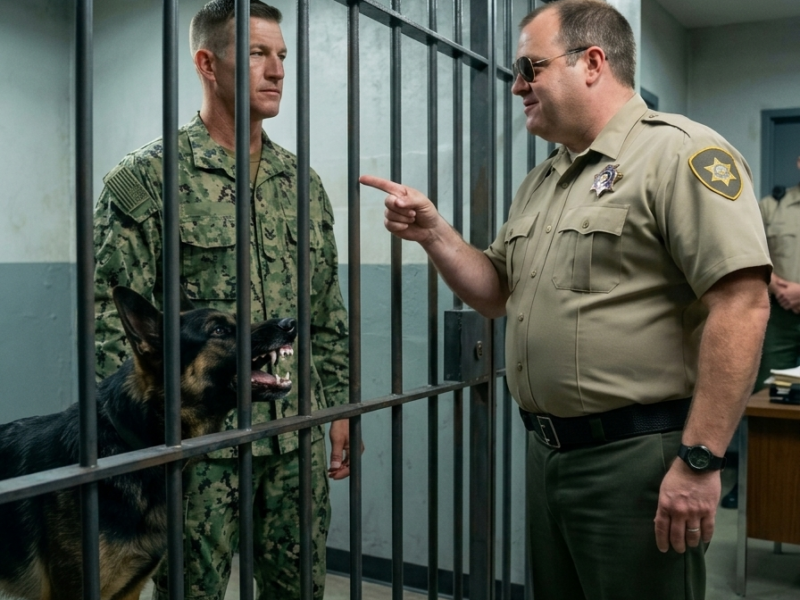
The deputy slammed my face against the hood of my truck outside a crowded Texas gas station while his partner laughed at my old dog
The dust of a West Texas sunset didn’t settle; it hovered like a dry shroud over the asphalt of the Concho County Texaco, burning the throat and stinging the eyes. Deputy Harris liked the glare of the noon sun and the flat orange smear of dusk because they made his mirrored aviator sunglasses look impenetrable. They hid the boredom in his eyes.
My truck was a faded 2004 Ford F-150 with a dented tailgate and a rusted bumper that had seen more logging roads and mountain passes than it had seen pavement. It was reliable, though. It always got me home. Today, however, it had coughed twice coming off the highway, sputtering on bad fuel before dying right by the air pump.
I had popped the hood, wiping grease from my knuckles with an oily rag, when the cruiser pulled up behind me without its lights on. It just drifted into the gravel, crunching the stones with a heavy, deliberate slowness.
Ranger let out a low, vibrating growl from the cab. His head was resting on the rolled-down passenger window, his gray-flecked muzzle tracking the cruiser’s movement with the precision of an old sentinel. Ranger was a Belgian Malinois mix with a chest broad as a barrel and scars across his left flank from shrapnel that had long since healed into silver lines under his coarse fur.
“Shut up, dog,” Harris muttered as he swung his door open. His partner, Deputy Miller—a younger man with acne scars and a nervous trigger finger—stayed in the passenger seat, scrolling through his phone before finally looking up with a half-grin.
Harris didn’t ask what was wrong with the truck. He didn’t ask for my license. He walked straight up to my side, his boots crunching on the dry earth, and planted his hand flat against my shoulder.
“Move away from the vehicle,” Harris said. His voice was thick with the lazy authority of a small-town cop who hadn’t seen a real crime since the county fair brawl in 2012.
“I’m just checking the fuel filter,” I said, keeping my tone flat. I had spent twelve years talking to men who held authority with actual weight; a county deputy with a belt full of plastic gear didn’t register on my internal scale of intimidation. That was my mistake. In places like Concho County, a calm civilian isn’t seen as cooperative—they’re seen as disrespectful.
“I said move away,” Harris repeated, his fingers digging into my muscle through my flannel shirt. He shoved me hard.
My boots skidded on the loose gravel, and my right shoulder clipped the rusted side mirror of my truck. Before I could regain my balance, Harris was behind me, grabbing my wrists and wrenching them upward in a crude, textbook-less compliance hold that nearly dislocated my left rotator cuff.
“Should’ve kept walking when I told you to,” he sneered, tightening the steel cuffs until the cold metal bit raw into the scarred skin of my wrists.
I looked at him through the distorted reflection in my truck’s dusty window. My face looked pale, lined with the deep grooves of too many sleepless nights and too much Texas sun. “I was standing beside my own vehicle.”
That only made him angrier. The veins in his thick neck bulged over his collar.
A few customers had stopped pumping gas, frozen by the sudden escalation. An elderly couple in a Winnebago watched from beneath the harsh fluorescent lights of the convenience store canopy, but nobody moved to help. People in rural Texas minded their own business; they knew that getting involved with the badge usually meant inheriting the trouble.
Harris seemed to enjoy having an audience. He squared his shoulders, playing to the gallery of gas-station patrons. “Now you’re arguing with an officer,” he announced loudly, his voice carrying over the hum of the underground fuel tanks. “That’s resisting.”
Ranger barked once—a sharp, authoritative sound that made Deputy Miller jump in the cruiser.
Harris kicked a cloud of white dust toward my truck’s door, spraying dirt over Ranger’s paws. “Control your mutt, old man, or I’ll put him down right here.”
Something inside me went dangerously, coldly still. It was the same stillness I had felt years ago in the damp caves of the Hindu Kush, right before the world exploded in fire and smoke.
For six years, Ranger had slept beside me through nightmares I never discussed, his warm, heavy body pressing against my side to ground me whenever memories of mortar blasts and burning vehicles dragged me back to places I had tried to forget. He wasn’t just my dog. He was the anchor that kept me tethered to the human race. He was the reason I had survived coming home when so many of my brothers hadn’t.
“Don’t touch him,” I said quietly. My voice didn’t shake. It was too low, too steady.
Harris grinned, showing a row of large, even teeth. “Or what? You gonna write a letter to the mayor?”
I said nothing. There was no point in explaining that the man he was pushing around could field-strip an M240 Bravo machine gun blindfolded in under forty seconds. To Harris, I was just another tired transient in a beat-up truck with out-of-state plates and a raggedy dog.
He dragged me toward his patrol car while Miller finally got out, grabbing Ranger’s leash through the open window, ignoring the dog’s desperate, clawing struggle to stay beside me. Ranger didn’t snarl; he let out a low, mournful whine that tore straight through my ribs—a sound that broke my heart more than any physical blow could have.
Then Harris opened the back door of the cruiser and shoved me inside, slamming the heavy metal frame shut.
“Let’s see how tough you are in a cell,” Harris muttered through the cracked window.
Through the smoked glass, I watched Ranger being pulled toward another vehicle, his dark eyes fixed entirely on mine, refusing to look away even as Miller yanked the leash tight.
I had faced armed insurgents in narrow alleys without feeling the kind of cold, suffocating helplessness that settled over me then. Because I could survive being arrested. I could survive a jail cell, a fine, or a judge’s lecture. But I couldn’t bear the thought of Ranger sitting in a dark, concrete pound somewhere, believing that I had abandoned him to the mercy of men who didn’t know the value of loyalty.
At the station, Harris tossed my worn leather wallet onto the booking desk without opening it or checking its contents.
“Another drifter with a sob story,” he told the bored booking officer behind the high counter, a woman named Brenda who was busy filing her nails with an orange stick.
I swallowed my rising anger, keeping my jaw clenched. “Please call my commanding officer.”
Harris laughed so hard that another deputy at the back of the room glanced over, annoyed by the noise.
“Your commanding officer?” Harris wiped a fake tear from his eye. “What are you, some kind of superhero? Captain America?”
“No,” I answered, my eyes locked on his. “I’m asking you to make one phone call before you regret it.”
He leaned across the desk, his beer belly pressing against the formica edge. “And I’m telling you that you don’t give orders here. You’re in Concho County now, old man. Out here, we’re the law.”
Then he shoved my military-issue identification card and my faded driver’s license into a bottom desk drawer, locking it with a small brass key he dropped into his pocket.
That was his first mistake.
His second was confiscating my phone without checking the emergency contact displayed bright and bold on its shattered lock screen—a direct satellite relay number that didn’t go to the local sheriff, but to a secure terminal in Austin that tracked retired Tier One operatives across the globe.
Twenty minutes later, the heavy glass front doors of the station opened with a dry, mechanical chime.
A gray-haired man in an expensive civilian tweed jacket walked inside, followed by two silent, uniformed state troopers whose handguns were strapped down with tactical thumb-breaks.
The casual laughter in the booking area died instantly, replaced by the heavy, suffocating weight of sudden professional silence.
The gray-haired man didn’t look like a cop, and he certainly didn’t look like a local politician. He moved with the quiet, devastating efficiency of a man who spent his life in government boardrooms where decisions were made with a stroke of a pen that could rewrite borders or erase identities. His name was Arthur Vance, though back when we had shared a dusty briefing room in a forward operating base outside Jalalabad, I had only ever known him as “Director.”
Harris straightened his shirt immediately, his posture shifting from casual bullying to awkward deference as he noticed the state troopers flanking the civilian.
“Can I help you, sir?” Harris asked, his voice losing its earlier swagger, replaced by a defensive edge. “This is a restricted booking area.”
Arthur Vance didn’t answer him. He didn’t even look at Harris. His sharp, pale-blue eyes scanned the room, bypassing Brenda at the desk entirely, before landing directly on me through the reinforced wire glass of the holding alcove.
Then he noticed the dark, ugly purple bruises blooming across my wrists where the cheap cuffs had dug into my skin.
His expression didn’t harden; it went completely, terrifyingly flat—the look a seasoned surgeon gives when he realizes an intern has used an unsterilized scalpel on a patient.
“Who did this?” Vance asked. His voice wasn’t loud, but it cut through the hum of the fluorescent lights like a razor.
Harris stepped forward, puffing out his chest to regain control of his turf. “Sir, this suspect was being uncooperative at a local business. We brought him in for questioning and resisting arrest. Standard procedure.”
The visitor finally turned his head toward Harris. The movement was slow, deliberate, and entirely devoid of warmth.
“Suspect?” Vance repeated the word as if it were a foreign language he found deeply offensive.
Without breaking eye contact, Vance reached inside his tweed jacket and slid a heavy leather folio from his inner pocket, displaying a gold federal credential and an FBI-Department of Defense joint-task-force badge that made Brenda stand up so quickly her metal chair struck the back wall with a loud clatter.
Harris’s face drained of color, the ruddy outdoor flush replaced by a sickly, pasty gray.
“Federal…” Harris stammered, his hand twitching involuntarily toward his empty holster before he caught himself. “We weren’t… we didn’t receive any notification of federal jurisdiction in this sector.”
“You wouldn’t,” Vance said softly. “Because my division operates outside ordinary sectors.”
Vance walked past Harris as if the deputy were nothing more than a coat rack blocking the doorway. He stopped in front of the booking desk, ignored Brenda’s nervous trembling, and reached into the bottom drawer that Harris had just locked. With a small brass key he produced from his own pocket—a universal master for county-level bureaucratic desks—he unlocked the drawer and pulled out my identification card.
He didn’t look at my ID. He already knew who I was. Instead, he placed a single 8×10 glossy photograph down on the scarred wood of the booking desk.
It showed a younger man standing beside me in the blinding dust of a desert valley overseas, both of us wearing tactical vests over our desert-camo uniforms, smiling beneath a cloudless, merciless sky. My arm was slung casually over his shoulder.
I hadn’t seen that face in seven years. Not since the night the world went black in a safehouse basement in Kandahar.
“Marcus,” I whispered, the name catching like dry sand in my throat.
Vance nodded once, his eyes heavy with old grief. “Marcus died on the flight back, Cole. You know that. But his family… his younger brother, Leo… tried to reach out to you three days ago.”
My stomach tightened into a hard, painful knot. “Leo? Why would Leo look for me? I thought he was studying architecture in Chicago.”
“He was,” Vance said, lowering his voice so the other deputies in the room couldn’t catch every word. “Until he inherited his brother’s digital archives. Marcus was meticulous. Before he was killed, he backed up every mission log, every intercept, and every transfer order onto an encrypted drive that he hid inside a personal keepsake—a brass compass he gave to his dog before he shipped out.”
I stared at the photograph, the memory rushing back with the force of a tidal wave. Marcus had loved that brass compass. He had given it to Ranger as a puppy, dangling it from his collar like a talisman.
“Your dog was recognized in security footage from a gas station outside Abilene last night,” Vance continued, his gaze piercing. “Three men in unmarked tactical gear tried to intercept Leo and the dog while they were driving south to meet you.”
“Ranger was with me all night,” I said, my voice dropping an octave. “He hasn’t left my truck since we crossed the state line in New Mexico.”
“I know,” Vance whispered, leaning in close. “Which means those men weren’t after Leo. They were tracking the dog’s microchip signal. They know Marcus’s encrypted drive is hidden inside the titanium capsule attached to Ranger’s collar.”
Before I could process the full weight of what he was saying, a sudden, violent crash echoed from the back holding area of the station.
It sounded like a heavy iron cell door being kicked off its hinges.
Someone shouted an incoherent curse, followed immediately by the unmistakable, furious bark of a Belgian Malinois.
I surged to my feet, rattling the heavy chain around my waist, but Vance grabbed my arm with a grip like a vise.
“Stay here, Cole,” Vance ordered.
But I recognized the acoustic signature of the chaos that followed—the sharp, metallic slide-lock click of a suppressed weapon being drawn in a confined space.
And when I saw Harris turning on his heel, sprinting away from the front desk toward the back exit with panic written across his sweating face, I understood something far worse than local corruption had just landed in this sleepy Texas town.
Someone hadn’t just tracked Ranger to the county station. They had followed us right into the trap. And they weren’t planning on leaving any witnesses behind.
The lights in the booking room flickered once, then died entirely as the main breaker box at the end of the hall emitted a loud, electrical pop, plunging the station into the dim, pulsing amber glow of the battery-powered emergency fluorescents.
Brenda let out a short, terrified scream and dove beneath her desk, pulling a heavy steel knee-guard over her head. The two state troopers who had accompanied Vance didn’t flinch; their hands dropped instantly to their holsters, their bodies shifting into a defensive wedge formation facing the hallway.
“Hold your position,” one of the troopers barked, his voice steady despite the sudden darkness.
“They’re not here for the front entrance,” Vance said, his eyes darting toward the narrow ventilation ducts running along the ceiling. “They bypassed the perimeter sensors. That means they have internal codes.”
I didn’t wait for permission. Years of instinct drilled into muscle memory overrode the handcuffs still biting into my wrists. I slammed my heel down hard against the wooden leg of the booking desk, snapping the cheap pine joint with a sharp crack, and wrenched the heavy desktop sideways until the steel mounting brackets sheared away from the wall.
With the heavy oak barrier out of the way, I jammed my cuffed hands against the wall-mounted fire extinguisher cabinet, shattering the glass panel with my elbow. I didn’t care about the shards slicing into my forearms; I reached inside, grabbed the standard-issue brass key ring dangling from the emergency safety hook, and flipped through them until I found the small silver key marked Holding Cell & Property.
It took me three fumbling seconds to unlock the cuffs, the metal bracelets dropping to the floor with a dull, heavy clink.
“Cole, what the hell are you doing?” Vance hissed, pulling his own Glock 19 from his leather holster. “You’re a civilian now. Let the state detail handle it.”
“They aren’t state detail, Arthur,” I said, rolling my shoulders as the blood rushed back into my numb hands. “State troopers don’t use ceramic-tipped subsonic rounds. Listen to the footing in the back hall. That’s a three-man clearing sweep. Standard Tier One urban stack.”
From the back corridor came the muffled, wet sound of a silenced pistol discharging twice—pfft-pfft—followed by the heavy thud of a body hitting the linoleum floor.
Deputy Miller, who had been hiding behind the snack machine near the coffee maker, dropped to his knees, his face completely bloodless. “Oh god… oh god, that was Harris’s sector.”
“Harris invited wolves into the henhouse because he thought he was shaking down a drifter,” I said coldly, stepping over the splintered wood of the desk. I reached down and lifted Miller’s service pistol—a standard Glock 22 loaded with .40 caliber hollow-points—right out of his trembling holster.
Miller whimpered, too paralyzed by shock to protest. “You can’t take that… that’s department property…”
“It’s mine now,” I muttered, checking the magazine weight. Full clip. Thirteen rounds.
Vance watched me with a mixture of professional respect and deep unease. “You’re out of practice, Cole. It’s been seven years since you wore the colors.”
“Riding a bicycle, Arthur,” I replied, stepping toward the shadow of the hallway. “You never really forget how to pedal when someone’s shooting at your back.”
The hallway was pitch black except for the green exit sign glowing above the back fire escape. The air smelled of ozone, cheap floor wax, and the distinct, coppery tang of fresh blood.
About twenty feet down the corridor, Deputy Harris lay face down near the water cooler, his uniform shirt soaked dark between his shoulder blades. He wasn’t moving.
“Clear left?” the state trooper whispered, moving up behind me with his weapon raised.
“Hold,” I whispered back, raising my hand. “Look at the pattern on the wall.”
Three neat, circular holes were punched through the drywall at chest height, spaced precisely four inches apart. Double-tap center mass, single round to the throat. That wasn’t rural cartel work. That wasn’t local gang violence. That was the signature of the private security contractor group known as Aegis Redux—mercenaries who had operated as our black-ops support unit in the Balkans before going completely rogue and selling their services to the highest bidder on the international black market.
And they were looking for Ranger.
A low, familiar scratch came from behind the steel-reinforced door of the holding kennel at the end of the hall. It was Ranger’s unique double-scratch—the signal he used whenever we were pinned down in a trench or a ruined compound and he needed me to know he was still alive.
“They’ve got him in the short-term holding pen,” I whispered.
“There are two of them by the back exit,” Vance said, peering around the corner with a tactical mirror on an extendable rod. “Wearing civilian-style tactical rigs, no patches, face-scanning comms. They’re waiting for backup to bring an armored transport around the alley.”
I checked the slide on the Glock 22, letting it snap forward with a crisp, reassuring metallic clack.
“They want the titanium drive on the dog’s collar?” I asked.
Vance nodded grimly. “Marcus encrypted those files using a biometric algorithm linked directly to the dog’s microchip pulse and your neural signature from our old comms database. They can’t hack the drive remotely. They have to cut the collar off the animal while it’s still breathing.”
A cold, white-hot fury ignited deep behind my ribs, burning away the last remnants of the tired old man I had pretended to be for the past six years.
“They can try,” I said. “Step aside, Arthur. Let’s see how well these corporate cowboys handle a retired ghost.”
The back exit of the Concho County station wasn’t a heavy security door; it was a standard hollow-core steel fire door with a rusted panic bar that squeaked every time the wind blew off the plains.
I motioned to the two state troopers to hold their position along the interior brick pillar. If Aegis Redux operatives were running this extraction, they wouldn’t just be holding the alley—they’d have thermal sensors sweeping the perimeter fence and directional microphones picking up heartbeats through the drywall.
“Vance,” I murmured without looking back. “When I kick this door, they’re going to throw a flash-bang or a concussion grenade. Don’t look at the light. Drop low and count to two.”
“Cole, we can negotiate this,” Vance whispered, though his hand was already steady on his weapon. “We have federal backup twenty miles out—”
“Twenty miles is twenty minutes too late,” I said. “And these men don’t take prisoners. They take trophies.”
I didn’t wait for his reply. I planted the heel of my heavy work boot squarely against the center panel of the fire door, right beside the cheap deadbolt lock, and drove my full weight forward.
The metal frame groaned, rivets shearing away from the cinderblock wall with a sound like a small cannon shot, and the door swung wide open into the cool, starlit Texas night.
True to form, a cylindrical aluminum canister came spinning through the gap before the dust even settled—a flash-bang designed to blind and disorient anyone within a twenty-foot radius with a blinding 10-million-candlepower burst and a deafening 180-decibel shockwave.
I didn’t hesitate. I dropped flat onto the greasy linoleum floor, burying my face in my arms, and counted silently in my head.
One… two…
FLASH-BOOM!
The hallway lit up like the surface of the sun, the concussion rattling the fillings in my teeth and sending a wave of hot air rolling over my back. Even with my eyes shut tight, the afterimage burned purple and green against my eyelids.
Before the ringing in my ears had even begun to fade, I rolled onto my side, raised the Glock 22 around the doorframe, and squeezed the trigger twice into the shadows of the gravel alleyway.
Bang! Bang!
A sharp cry of surprise echoed from the darkness, followed by the heavy clatter of a tactical rifle dropping onto loose stones.
“Contact left!” a harsh, mechanical voice barked over a digital comms link from behind a row of parked municipal trash dumpsters. “We’ve got active resistance! Terminate target on sight!”
I scrambled through the open doorway, hugging the low brick wall of the station, using the shadows of the air conditioning units to mask my movement. The night air hit my lungs—dry, sharp, and smelling faintly of sagebrush and burnt gunpowder.
Through the dim amber light spilling from a broken security lamp, I saw him: a tall man in a matte-black crye-precision vest, his face half-hidden beneath a tactical balaclava, kneeling beside a reinforced animal transport crate.
Inside the crate, Ranger was throwing his entire sixty-pound weight against the steel mesh door, snarling with a ferocious intensity that made the metal frame rattle violently.
“Shut that damn animal up,” the second operative hissed, stepping out from behind a concrete pillar with an M4 carbine raised toward the doorway. He was swinging his barrel right toward the open door where Vance and the troopers were stationed.
He never finished his swing.
I stepped out from behind the AC unit, closed the distance in three explosive strides, and brought the heavy polymer butt of the Glock down hard against the side of his tactical helmet with a sickening thunk.
The operative staggered sideways, his rifle clattering onto the gravel, before collapsing unconscious into the dust.
The first man—the one I had grazed earlier—spun around, his sidearm already clearing his holster in a smooth, practiced motion that proved he had done this a hundred times in the mountains of the Hindu Kush and the alleyways of Tripoli.
“End of the line, old man,” he snarled, his eyes narrowing above his mask.
He didn’t recognize me. How could he? The last time he had seen me, I was covered in soot, wearing a shredded desert uniform with my call sign taped to my chest, walking out of a burning compound that the world had pretended never existed.
“You’re out of your depth, son,” I said softly, stepping directly into the meager beam of the overhead light so he could see my face clearly.
The man’s finger froze on the trigger. For a fraction of a second, his pupils dilated behind his tinted visor as recognition finally hit him like a physical blow.
“Captain… Cole?” he whispered, his voice trembling beneath the synthetic fabric of his mask. “They said you went down with the bird in Kandahar…”
“The bird went down,” I said, raising my pistol until the front sight lined up squarely between his eyes. “I didn’t.”
Before he could pull his trigger, a deep, earth-shaking roar echoed from the end of the alley, followed by the screech of rubber and the blinding glare of high-beam headlights sweeping across the brick walls.
A heavy black suburban with tinted windows and reinforced steel plating came barreling around the corner, its tires spitting gravel as it slammed to a halt directly blocking the alley exit.
The side door slid open with a violent mechanical hiss, and a man in a tailored grey suit stepped out onto the running board, holding a satellite phone in one hand and a heavy-duty bolt cutter in the other.
“Well, well, well,” a smooth, cultured voice cut through the hum of the idling engine. “I told you, Captain. You can’t outrun your own ghost. Now, hand over the dog, and maybe we let you walk away from this one.”
The man on the running board of the armored Suburban was Arthur Vance’s former superior at the Joint Special Operations Oversight Committee—a man named Director Sterling who had officially retired five years ago to run a private intelligence conglomerate that managed “off-the-books” corporate security for half the defense contractors in North America.
Sterling stepped down onto the gravel, his polished leather shoes looking entirely out of place among the dust and rusted oil drums of a West Texas back alley. He wasn’t carrying a sidearm. Men like Sterling didn’t need to carry guns; they carried pardons, indictments, and bank accounts large enough to buy a small country.
“Put the weapon down, Cole,” Sterling said calmly, gesturing with his satellite phone toward the Glock in my hand. “You’re embarrassing yourself. You’re a retired civilian with a rural assault charge hanging over your head in a county jail that no longer exists on any active federal roster. I can have you erased before sunrise.”
“You’ve been trying to erase my unit for seven years, Sterling,” I said, keeping my stance balanced, my weight evenly distributed over my boots. “Marcus’s drive isn’t a weapon. It’s the audit trail of every illegal off-the-books extraction your private contractors ran behind our backs while our boys were bleeding out in the valleys.”
Sterling smiled, a cold, thin expression that didn’t reach his eyes. “And who do you think is going to believe a tired old man living in a rusted truck with a mangy dog? The moment you step outside this county, local law enforcement has a warrant for your arrest on federal terrorism charges. We own the paperwork, Cole. We are the paperwork.”
From inside the transport crate, Ranger let out another deep, resonant bark—not a snarl of fear, but the sharp, commanding bark of a working dog ready to execute an order.
My hand tightened around the grip of the Glock. I didn’t look at Sterling. I looked past him, down the long stretch of the dark county road where the first pale fingers of dawn were beginning to bleed across the flat horizon.
“You’re right about one thing, Sterling,” I said quietly. “The paperwork is yours.”
Sterling raised an eyebrow, amused. “Oh? And what do you have left?”
“A witness,” I said.
Before Sterling could ask what I meant, a low, rhythmic thrumming sound began to vibrate through the dry desert air—a sound that every veteran in that alley recognized instantly down to their marrow.
It wasn’t a police chopper. It wasn’t a commercial drone.
It was the heavy, twin-turbine downdraft of an MH-47 Chinook heavy-lift helicopter, its massive rotor blades chopping the morning sky into ribbons as it crested the low ridge behind the Texaco station, painting the entire landscape in a blinding wash of white tactical searchlight beams.
The two Aegis Redux operatives who had been holding position near the fence dropped their weapons instantly, their hands flying to their heads as the hurricane-force downdraft flattened the weeds and sent gravel flying like shrapnel against the sides of the Suburban.
Sterling’s face went completely white, the arrogant smile vanishing as he stared up at the giant military transport bearing down on the alley with its ramp already lowering into the dark.
“That’s… that’s impossible,” Sterling stammered, raising his arm to block the blinding glare of the floodlights. “That airspace is restricted by Homeland Security!”
“Homeland Security doesn’t override Joint Special Operations Command Directive 88,” a deep voice boomed from the open ramp of the descending Chinook as a heavily armed team of operators in unbadged tactical gear fast-roped onto the asphalt with military precision.
At their head was a young officer with the rank of Major pinned to his collar—a man who looked so much like Marcus that for one blinding second, I thought I was looking across a table in Kandahar all over again.
It was Leo, Marcus’s younger brother, wearing a crisp uniform and holding a secure military tablet linked directly to the Pentagon’s primary inspector general’s office.
Leo walked straight past the frozen state troopers, ignored Arthur Vance, and stopped two feet in front of Director Sterling.
“Director Sterling,” Leo said, his voice entirely steady, ringing with an authority that didn’t need a badge to back it up. “You are hereby served with an immediate federal arrest warrant for treason, theft of classified military intelligence, and the unlawful detention of a retired service member.”
Sterling tried to straighten his tie, his hands trembling slightly despite his best efforts to maintain his composure. “You have no jurisdiction here, Major. This is a local police matter—”
“This isn’t a local matter anymore,” Leo interrupted, holding out the tablet so the screen flashed a blinking red authorization code signed directly by the Secretary of Defense. “We downloaded the backup from Marcus’s drive twenty minutes ago via satellite relay. Every illegal contract, every off-the-books asset transfer, and every false-flag operation your company ran over the last decade is currently being streamed live to the Senate Select Committee on Intelligence.”
Sterling looked around the alley. His mercenaries were disarmed and pinned against the wall by the Chinook’s tactical team. Harris was still unconscious inside the station. And Arthur Vance was slowly sliding his federal badge back into his tweed jacket, refusing to meet Sterling’s eyes.
The game was over. The books had finally been opened.
Leo didn’t wait for Sterling to answer. He motioned to two of the operators, who stepped forward and secured the director’s wrists with heavy plastic zip-cuffs, walking him up the ramp into the back of the Chinook without a single word spoken.
The heavy roar of the turbines settled into a steady, rhythmic idle as Leo turned away from the transport and walked slowly toward me.
He stopped a few feet away, looking at the faded flannel shirt, the grease stains on my hands, and the scars across my wrists where Harris’s cuffs had bitten deep. Then he looked down at the metal transport crate.
I knelt down, unlatched the heavy steel mesh door, and pulled it open.
Ranger didn’t bolt out. He crawled out slowly, his old joints stiff from the cramped crate, his tail giving one small, hesitant wag before he pressed his heavy head firmly against my knee, letting out a long, shuddering sigh of pure relief.
Leo reached down, his fingers gently touching the small titanium capsule attached to the dog’s collar where the brass compass still hung, catching the first golden rays of the Texas sunrise.
“Thank you, Cole,” Leo said softly, his voice thick with unexpressed emotion. “He kept my brother safe over there. And it looks like he kept you safe over here, too.”
I rested my hand on Ranger’s broad, warm head, feeling the steady, rhythmic beat of his heart against my palm—the only anchor I had ever truly needed.
“We take care of each other,” I said. “That’s the rule.”
Behind us, the heavy ramp of the Chinook began to lift, sealing the past away inside the dark belly of the aircraft as the rotors spun faster, kicking up one final cloud of West Texas dust that slowly cleared away to reveal a wide, open horizon stretching out endlessly before us under a clean, bright, unbroken sky.
The end.









