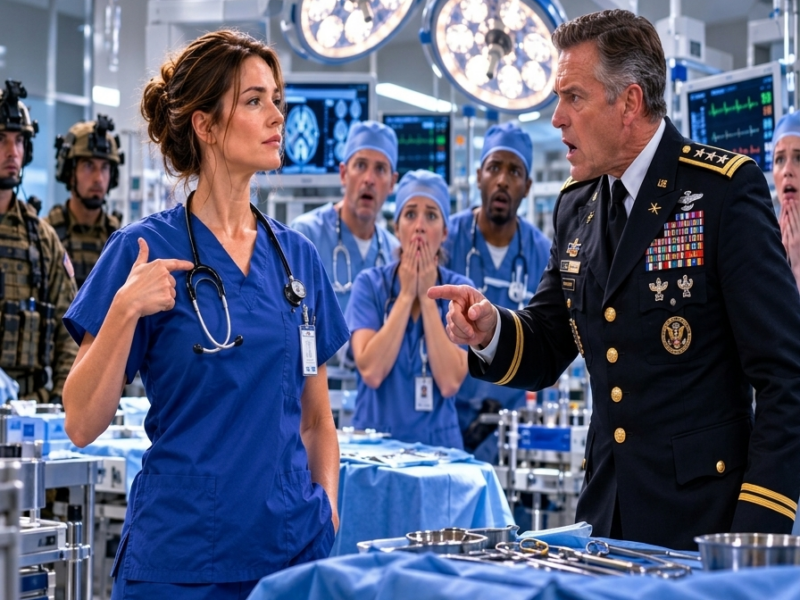
The decorated general slammed his blood-soaked hand against the emergency room counter and demanded the hospital’s best surgeon
The emergency room at St. Vincent’s Medical Center in Atlanta was already drowning in chaos when the military convoy arrived.
Two soldiers rushed through the sliding glass doors carrying a wounded man on a stretcher, his camouflage uniform soaked in fresh, oxygenated blood and his breathing dangerously shallow. Behind them strode General Thomas Walker, his silver hair disheveled and his tactical dress uniform streaked with grime and soot.
“I need your top trauma surgeon!” the general demanded, slamming his blood-stained palm against the reception counter with a force that shook the computer monitors. “Now!”
Dr. Richard Hayes, St. Vincent’s chief of surgery, stepped forward immediately, adjusting his expensive gold watch with practiced smugness. “You have me, General. I’m Chief Surgeon Hayes. Bring him into Bay 1.”
Before Hayes could even cross the floor, a nurse in faded blue scrubs and worn canvas sneakers hurried past him, immediately leaning over the gasping soldier to assess his airway.
I was that nurse.
My name was Emily Carter, and for three years I had worked quietly at St. Vincent’s, accepting the grueling night shifts, actively avoiding attention, and allowing everyone in this building to assume that my medical career began and ended with basic nursing duties. The senior staff knew me as a soft-spoken float nurse who never argued when handed the worst assignments. They didn’t know I had spent six years in active combat zones. They didn’t know why I flinched at sudden loud noises, or why I wore long sleeves even in the dead of summer to hide the deep shrapnel scars on my forearms.
Hayes grabbed my upper arm, wrenching me back with a scowl. “Get away from that patient, Emily! You’re a triage nurse, not a doctor. Go mop the hallway or pull charts.”
I brushed his hand off my arm without breaking my gaze from the wounded soldier’s blue-tinted lips. “His trachea is shifting to the right. Tracheal deviation. His left lung has collapsed and his chest cavity is filling with arterial blood,” I said, my voice dropping into a cold, precise tone that possessed no trace of my usual meekness. “He has a massive hemothorax. He needs an emergency thoracotomy right now, or he will be dead in ninety seconds.”
Hayes scoffed, looking around at the gathering crowd of nurses to share his amusement. “You can’t possibly know that without chest imaging, nurse. Know your place.”
“Then you can explain to his mother why you waited for an X-ray while his heart bled dry,” I replied smoothly.
General Walker turned sharply toward me, his piercing gray eyes locking onto my face. “Who trained you?”
I looked at the soldier’s chest, watching the rapid, erratic fluttering of his neck vein. “Please step aside, General. We’re losing his pressure.”
General Walker’s eyes narrowed, but something in the steady, absolute authority of my voice made him hesitate. When Dr. Hayes tried to push past me again, the general placed a heavy, gloved hand onto Hayes’s shoulder, holding the chief surgeon in place like a statue.
“Let her work,” the general ordered.
“General, this is madness! She’s just an assistant!” Hayes protested, his face turning bright red.
I ignored them both. I ripped off my dirty utility gloves, washed my hands with surgical scrub in five seconds flat, and entered Bay 1. I grabbed a sterile scalpels tray, snapped on surgical gloves, and looked at the frightened resident standing across from me.
“Rib spreader, size four. Suction on maximum. Hang four units of O-negative blood,” I commanded. The resident didn’t even hesitate; my tone compelled instant, military-grade obedience.
For the next forty minutes, the brightly lit trauma bay became a silent, high-stakes battleground. I cut cleanly through the chest wall between the fifth and sixth ribs, inserted the retractor, and suctioned out nearly a liter of pooled blood. Working entirely by tactile memory and instinct in a sea of red, my fingers found the severed intercostal artery, clamped it with surgical precision, and threw a double-knot suture to seal the bleed.
The rapid, screaming beeps of the cardiac monitor slowly settled into a steady, rhythmic pulse. The soldier’s oxygen saturation climbed back to ninety-eight percent.
I stepped back, physically drained, my hands trembling slightly beneath the bloody latex gloves as three years of buried combat medical instincts slowly ebbed away.
Someone behind the observation glass whispered, “She saved him… she actually opened his chest and saved him.”
I stripped off my bloody gown and threw it into the biohazard bin. As I turned to leave, General Walker stepped directly into my path, obstructing the doorway. He studied my face for several long, agonizing seconds before speaking.
“Emily Morgan?” he whispered, his voice cracking with an emotion I hadn’t expected from a three-star general.
I froze. My breath hitched in my throat. I had not heard or used that name since resigning my commission six years ago.
Dr. Hayes looked between us, utterly bewildered. “General, you’re mistaken. She’s Emily Carter. She’s been a low-level nurse here for three years.”
The general ignored Hayes completely, stepping closer to me. “Six years ago, Captain Emily Morgan—chief combat surgeon for the 75th Ranger Regiment—performed emergency open-heart surgery on my son in a dusty tent after an IED explosion in Kandahar. The flight surgeons said he wouldn’t survive twenty minutes on a medevac, but she kept him breathing for eleven hours under heavy mortar fire.”
The entire emergency room fell into a stunned silence. Hayes looked at me as if I had suddenly sprouted wings, his jaw hanging open.
“Your son recovered, sir?” I asked quietly, looking down at my worn sneakers.
“Yes,” General Walker replied softly. “He made a full recovery. And he has spent the last six years trying to find you.”
I looked away, painful memories flooding back into my mind like acid. That mission in Kandahar had cost me everything. I had lost two of my closest teammates in the ambush that followed, suffered a blast injury that damaged my hearing, and watched an official military investigation bury the true story of what happened that night to protect high-ranking brass. Disillusioned and broken, I had faked a quiet discharge, changed my last name, and buried Captain Morgan beneath a pile of blue scrubs at St. Vincent’s.
“Why are you here, General?” I asked, my voice tight. “How did you find me?”
The general reached inside his tactical dress jacket and produced a thick, wax-sealed military envelope. “Because my son woke up yesterday from a coma induced by a recent accident. And the first thing he did was tell me what he remembered from the night of the explosion six years ago.”
My stomach tightened into a knot. “What did he remember?”
General Walker stepped even closer, lowering his voice so only I could hear. “He said the man who ordered the mortar strike on your medical post wasn’t an enemy insurgent. He was standing beside him in an American officer’s uniform when the bomb detonated.”
I stared at the sealed envelope, a cold wave of horror washing over me. “Who?”
The general glanced toward the trauma bay, where the wounded soldier was beginning to stir, his eyelashes fluttering open. General Walker leaned into my ear. “He recognized the officer who officially signed your field casualty report and declared you dead six years ago.”
My blood ran cold. “I was never declared dead, General. I resigned.”
“Not according to the Department of Defense database,” Walker whispered darkly. “Official records say Captain Emily Morgan died of combat wounds in Afghanistan six years ago.”
Before I could process the terrifying reality of what he was saying, the wounded soldier in the bay let out a raspy groan. He weakly turned his head and locked his eyes onto me. With a sudden surge of panicked energy, his hand shot out and clamped tightly around my wrist.
His lips barely moved, his voice a dry, raspy wheeze. “Captain Morgan… they know… they know you survived.”
The heart monitors around him began to beep erratically once again.
With his remaining strength, the soldier pressed a cold, metallic object into my palm and closed my fingers over it.
It was a silver military identification tag, dark with old, dried blood. I recognized the name engraved on the metal instantly. It belonged to Lieutenant Marcus Vance—the man I had watched take a direct hit from a mortar shell six years ago. The man whose death I had mourned every single night since.
And beneath his name, scratched into the silver surface with a pocketknife, were four words that made General Walker stagger back a step:
THE TRAITOR IS HERE.
The silence in the trauma bay was heavy enough to crush a person.
The soldier’s hand slipped from my wrist as his strength failed, his eyelids fluttering shut once again as the sedative took full effect. The steady beep… beep… beep of his heart monitor resumed its calm cadence, but inside my chest, my heart was hammering like a trapped bird.
I stared down at the blood-stained dog tag resting in my palm. Marcus Vance. He had been my closest friend during my tour in Kandahar—the man who guaranteed the security perimeter of our field hospital while I operated on wounded soldiers. I had personally watched his defensive outpost get obliterated by artillery fire. I had been forced to leave his body behind when our medevac helicopter made its forced extraction.
Yet here was his tag, freshly carved, delivered by a dying operative in the middle of Atlanta.
“Emily,” General Walker said, his hand resting on the hilt of his dress sidearm. “We need to leave this building now. The moment this soldier was brought in, a automated alert pinged the Defense Intelligence Agency network.”
“Wait a minute!” Dr. Hayes interjected, finally finding his voice as he stepped between us. “You can’t just take my nurse, General! And who gave her permission to operate on a patient without board certification in this state? If the medical board hears about this—”
I turned my head and looked at Dr. Hayes. The shear intensity and absolute coldness in my eyes made his words instantly freeze in his throat.
“Hayes,” I said softly, my voice laced with lethal authority. “If you say one more word, I will explain to the hospital board how you let three patients go into septic shock last month because you were too arrogant to read their chart notes. Step out of my way.”
Hayes swallowed hard, his face turning pale, and took two fast steps backward, clearing the path.
“General,” I said, turning back to Walker. “Where is your son?”
“He’s being kept under twenty-four-hour heavy guard at a secure military facility twenty miles north of the city,” Walker replied, gesturing for his two armed escorts to flank us. “He has the rest of the decrypted log files from Kandahar. But Emily, if what Marcus Vance carved on that tag is true, the man who tried to kill my son six years ago is currently controlling the intelligence network in this region.”
“Who declared me dead?” I demanded, my knuckles turning white as I gripped the dog tag. “Give me the name on that casualty report.”
General Walker pulled the sealed envelope from his pocket, broke the red wax seal, and pulled out a faded sheet of military stationery. He scanned the bottom line, his jaw tightening so hard I heard his teeth grind.
“Colonel Arthur Vance,” General Walker read aloud. “Director of Special Operations Logistics.”
A cold sensation washed through my stomach. “Vance? Colonel Vance was Marcus’s father!”
“And he was the commander who signed off on your deployment routes,” Walker added darkly. “If Arthur Vance declared you dead six years ago, it means he knew the mortar strike was coming. He sacrificed his own son’s unit to cover up a multi-million-dollar arms smuggling operation.”
Suddenly, the overhead fluorescent lights in the emergency room flickered, buzzed violently, and went completely pitch black.
The backup generators failed to kick in immediately, plunging the vast hospital floor into eerie red emergency lighting. From the main entrance, the sharp, distinct sound of heavy glass doors shattering echoed down the hall, followed by the muffled, rhythmic thud of suppressed automatic weapon fire.
“CONTACT!” one of the general’s escorts screamed, pulling his sidearm.
Before he could raise his weapon, two high-velocity rounds perforated the glass panel behind him, and the soldier collapsed onto the floor.
“Get down!” I yelled, grabbing General Walker by his collar and pulling him down behind the reinforced steel reception counter as a storm of bullets chewed through the plaster walls above our heads.
Nurses were screaming, screaming patients were diving out of their beds, and Dr. Hayes was crawling frantically toward the breakroom on his hands and knees, weeping in absolute terror.
Through the smoke and dust, three figures in black tactical gear with night-vision visors moved with military precision into the hallway. They weren’t common street criminals or gang members; their movement patterns, weapon handling, and tactical spacing were textbook Special Forces.
“They aren’t here for the general,” I whispered, peeking over the counter as I located the wounded soldier in Bay 1. “They’re here to execute the witness!”
“I have five rounds in my sidearm,” General Walker said, pulling his weapon. “Emily, stay behind me!”
“Sir, with all due respect,” I replied, reaching down to the fallen soldier’s tactical belt and unholstering his military-grade sidearm with practiced, lightning-fast speed, “I’m not a civilian anymore.”
I racked the slide of the gun with a sharp clack, my eyes locking onto the tactical operatives advancing down the hall.
“Cover the bay!” I commanded. “I’ll clear the flank!”
I didn’t hesitate. The quiet, timid float nurse who spent three years quietly taking orders was gone, replaced instantly by the battle-tested chief surgeon of the 75th Rangers.
I dropped to my knees, staying low beneath the rising cloud of drywall dust, and slid behind a row of stainless steel supply carts. The black-clad operative closest to Bay 1 raised his suppressed rifle, aiming directly at the chest of the unconscious soldier on the bed.
“Target sighted,” the operative grunted into his radio comms. “Terminating witness.”
“Not in my ER,” I hissed.
I popped up from behind the medical cart and fired three rapid shots. The first round struck his tactical rifle, shattering the receiver. The second and third rounds hit the exposed joint beneath his ballistic vest, dropping him instantly to his knees with a choked groan.
The second operative swung his weapon toward my position, but General Walker leaned out from behind the reception counter and fired two precise shots into his chest plate, driving him back against the wall.
“Emily! Move!” Walker roared.
I sprinted down the narrow corridor toward the pharmacy supply room, taking advantage of my absolute knowledge of the hospital’s floor plan. I knew every emergency exit, every supply closet, and every blind spot in the security camera coverage.
I ducked into the dark pharmacy storage area, pulled a heavy steel oxygen tank from its wall bracket, and placed it on a rolling utility cart. I jammed a surgical scalpels handle between the release valve and the pressure nozzle, kicking the cart out into the hallway directly into the path of the third advancing operative.
“Watch out! Pressurized gas!” the operative yelled, trying to step back.
I aimed my handgun at the brass valve head and pulled the trigger.
BOOM!
The pressurized oxygen tank detonated with a deafening roar, releasing a violent shockwave of white mist and metal fragments that knocked the remaining operative off his feet, crashing violently into the vending machines.
Silence fell over the destroyed emergency room, broken only by the hiss of broken water pipes and the distant, wailing sirens of Atlanta police cars approaching St. Vincent’s.
I walked slowly out of the pharmacy, my gun lowered but ready, my eyes scanning the groaning operatives on the floor. General Walker stepped out from behind the counter, staring at me with absolute awe.
“You haven’t lost a single step, Captain,” Walker said, breathing heavily as he lowered his weapon.
“You never lose it, General,” I replied, checking the magazine of my sidearm. “You just hide it.”
I walked over to the operative I had shot in the shoulder. He was pinned beneath a fallen supply cabinet, blood pooling beneath his black suit. I knelt beside him, grabbed the edge of his tactical helmet, and ripped it off his head.
He was a young man, barely twenty-five, with a military tattoo on his neck.
“Who sent you?” I demanded, pressing the hot barrel of my handgun against his chin. “Was it Colonel Arthur Vance?”
The mercenary coughed up a fleck of blood, sneering through his pain. “You… you’re a ghost, Morgan. You were supposed to die… six years ago in the desert.”
“I get that a lot,” I said coldly. “Answer the question. Where is Arthur Vance?”
“He’s… he’s at the military compound in Marietta,” the mercenary gasped, his strength fading. “He’s liquidating… all evidence tonight… including General Walker’s son. You’re already… too late.”
My heart dropped into my stomach.
I looked up at General Walker. The older man’s face went completely pale, his hands shaking violently as he realized his son was currently in the crosshairs of a military assassin.
“We have to get to Marietta,” Walker said, his voice trembling with panicked fatherly devotion. “My son… he doesn’t know Vance is the traitor!”
“We aren’t taking an official convoy,” I said, standing up and stripping the tactical vest off the unconscious operative on the floor. “Vance controls the DIA communications network. If we use official channels, he’ll know we’re coming before we leave the parking lot.”
I turned around and saw Dr. Hayes peeking out from the breakroom, clutching a paper towel to his bloody forehead.
“Hayes!” I called out.
“Y-yes, Emily—I mean, Captain!” Hayes stammered, trembling uncontrollably.
“Take care of that soldier in Bay 1,” I ordered, tossing him a roll of sterile gauze. “If he dies because you slacked off, I will personally come back here and make your life a living hell. Do you understand me?”
“I’ll guard him with my life, Captain!” Hayes squeaked, frantically running into the trauma bay to monitor the vitals.
I pulled the black tactical jacket over my blue scrubs, zipped it up, and looked at General Walker.
“Let’s go save your son, General,” I said. “It’s time to settle a six-year-old bill.”
The thunderstorm over northern Georgia was relentless, pounding heavy sheets of rain against the windshield of General Walker’s personal, unmarked SUV as we tore down Interstate 75 toward the Marietta Military Reservation.
The digital clock on the dashboard read 02:40 a.m.
I sat in the passenger seat, rapidly stripping down, cleaning, and reassembling two captured tactical sidearms with effortless, instinctual speed. In my lap lay the decrypted operational files that General Walker had managed to download from his secure satellite phone before Vance shut down his clearance.
“Look at this, General,” I said, pointing at a line of red code on the digital screen.
Walker glanced over from the steering wheel. “What is it?”
“Six years ago, during our deployment in Kandahar, Colonel Vance wasn’t just directing logistics,” I explained, my eyes scanning the financial ledgers. “He was using military medical transport flights to traffic stolen foreign artifacts and illegal advanced weaponry out of the combat zone. My medical team wasn’t targeted because of an enemy ambush. We were targeted because Lieutenant Marcus Vance—his own son—accidentally stumbled onto the shipping manifests in our supply tent.”
General Walker let out a breath of pure disgust, his knuckles turning white on the steering wheel. “He ordered an artillery strike on his own son’s unit just to keep his bank account full?”
“He thought he killed us all,” I said, my voice dripping with cold anger. “When he found out I survived, he generated a fake casualty report declaring me dead in the Department of Defense system so I could never resurface without raising red flags. And when Marcus’s dog tag showed up tonight, he knew his entire empire was about to crumble.”
“My son, David, was Marcus’s liaison,” Walker said, his voice breaking slightly. “That’s why David was looking for you. He knew you were the only medical officer who could verify the surgical records from that night.”
The SUV banked hard around a wooded turn, the dark perimeter fences of the Marietta Military Reservation appearing through the fog and rain. High security guard towers stood along the perimeter, but the floodlights were unusually dim, and the main gate bar was raised completely open.
“No guards at the perimeter,” Walker noted, bringing the vehicle to a slow, silent roll. “Vance has already locked down the facility.”
“He’s isolating the medical ward,” I said, checking my weapon’s chamber. “He’s going to make your son’s death look like a sudden cardiac arrest from his coma complications.”
We parked the SUV beneath the heavy foliage of an oak tree near the rear service entrance. I grabbed a tactical flashlight, strapped a holster across my chest, and looked at Walker.
“General, you take the security control room in the basement and restore the base’s landline communications so we can ping the Federal Bureau of Investigation,” I instructed. “I’ll go straight to the Intensive Care Unit and get your son.”
“Emily,” Walker said, reaching across to grip my shoulder with deep gratitude. “Be careful. Vance has a full squad of private contractors in there.”
“They’re contractors, General,” I replied, pulling my hood up against the rain. “I’m a Ranger.”
I slipped out of the SUV into the dark, rain-slick alleyway, moving like a shadow against the brick facade of the medical wing. I reached the service door, used a stolen keycard from the hospital operative to bypass the electronic lock, and stepped into the quiet, sterile hallway.
The scent of rubbing alcohol and fresh floor wax filled the air—a familiar smell that had defined my life for nine years. But beneath it was the distinct, sharp tang of ozone and gun oil.
I moved silently down the corridor, keeping low, my weapon raised. As I rounded the corner toward Room 104—the room where David Walker was being kept—I saw two armed contractors standing guard outside the door, holding suppressed submachine guns.
Inside the room through the glass panel, a tall officer in a crisp dress uniform was standing over the bed of the sleeping patient, holding a syringe filled with a clear, lethal fluid.
It was Colonel Arthur Vance.
“Ending this family headache once and for all,” Vance muttered softly inside the room, raising the syringe toward the patient’s IV line.
“Drop the needle, Arthur!” I shouted, stepping out from the shadows into the hallway, my gun aimed straight between his eyes through the observation window.
The two contractors outside swung their weapons toward me, but I was already moving.
I fired twice through the drywall, hitting the first contractor in the chest. I lunged forward, grabbed the second contractor’s rifle barrel, shoved it upward into the ceiling tiles as he fired a deafening burst, and drove a vicious palm strike straight into his nose, knocking him out cold.
I kicked the heavy oak door of Room 104 wide open, stepping into the room with my gun raised.
Colonel Vance froze, the syringe hovering an inch from the IV port. He slowly turned his head to look at me, his eyes widening in complete, absolute shock as he recognized my face.
“Captain Morgan?” Vance whispered, his face draining of all color as if he were looking at a ghost. “You’re… you’re dead. I signed your report six years ago!”
“Your signatures don’t mean much anymore, Colonel,” I said, my sightline locked onto his forehead. “Step away from General Walker’s son.”
Colonel Vance slowly dropped his hands, setting the syringe down on the stainless steel tray beside the bed. A cruel, bitter smile slowly spread across his weathered face.
“You always were a nuisance, Morgan,” Vance said smoothly, taking a slow step toward the window. “A brilliant surgeon, but an unbearable moralist. You should have stayed buried in Chicago or Atlanta or whatever pathetic little hole you were hiding in.”
“You tried to murder your own son, Vance,” I hissed, my finger trembling slightly against the trigger. “Marcus was your flesh and blood! He died in that desert because of your greed!”
“Marcus was a weak idealist! Just like you!” Vance shouted, his calm facade shattering into rage. “He found my ledgers! He was going to turn me in to the Inspector General! I built an empire that protected this country’s interests, and I wasn’t going to let a twenty-two-year-old lieutenant tear it down!”
“He survived,” I said softly.
Vance froze. “What did you say?”
I reached into my tactical jacket pocket, pulled out the blood-stained silver dog tag, and tossed it onto the floor between us. It clattered loudly against the tiles, the carved words facing up: THE TRAITOR IS HERE.
“Marcus didn’t die six years ago in Kandahar,” I revealed, tears of hot rage stinging my eyes. “He was captured, dragged through black sites, and he spent six years trying to get that tag to me. He’s alive in an Atlanta trauma bay right now, Vance. And he remembers everything.”
Vance stared at the tag on the floor, his entire body shaking with a mix of fury and terror. “No… no, that’s impossible! I saw the casualty report!”
“You believe your own lies, Colonel,” I said coldly.
Suddenly, the base sirens began to wail at maximum volume throughout the building. Red emergency lights flashed along the ceiling. General Walker had successfully restored the base communications—the federal authorities had been alerted.
Vance knew it was over. His eyes went wild. With a sudden, desperate roar, he reached into his jacket for a hidden sidearm.
BANG!
I didn’t hesitate. I pulled the trigger.
The bullet struck Vance squarely in his right shoulder, shattering his collarbone and knocking his gun out of his hand. He crashed heavily against the wall, clutching his shoulder, groaning in agony as he slid down onto the floor, blood pooling beneath his uniform.
The door swung open, and General Walker rushed into the room accompanied by four armed Military Police officers who had just breached the outer gates.
“Emily!” Walker yelled, seeing his son breathing safely on the bed. He looked down at Vance bleeding on the floor, then at me. “Are you okay?”
I lowered my weapon, my hands finally stopping their shakes. “The patient is safe, General. Secure Colonel Vance. He has a lot of questions to answer for the Department of Justice.”
The Military Police officers immediately stepped forward, kicking Vance’s gun away and slamming heavy steel handcuffs onto the disgraced colonel’s wrists, dragging him out of the room as he cursed my name.
General Walker walked over to his son’s bed, tears running down his cheeks as the young man on the bed slowly opened his eyes, recognizing his father.
I stepped back out into the quiet hallway, looking through the high windows as the dark rain clouds began to part over Georgia, revealing the pale, beautiful pink light of dawn breaking across the horizon.
My cell phone buzzed in my pocket. It was a call from St. Vincent’s Medical Center.
I answered it. “This is Emily.”
“Emily! I mean… Captain Morgan!” Dr. Hayes’s voice came through the speaker, breathless and excited. “The wounded soldier… Marcus Vance… he just woke up! The surgery was a complete success! He’s stable! He… he’s asking for you.”
A genuine, warm smile broke across my face for the first time in six years. The heavy, suffocating weight of guilt, nightmares, and hidden identity that I had carried for so long finally lifted from my shoulders, dissolving into the cool morning air.
“Tell him I’m on my way, Hayes,” I said softly, my voice filled with strength and peace.
I walked down the quiet corridor of the military facility, stepping out into the fresh morning air. I was no longer hiding. I was no longer running from the past. I wasn’t just a quiet nurse in worn sneakers, and I wasn’t just a ghost from Afghanistan.
I was Captain Emily Morgan—a surgeon, a survivor, and a defender of those who needed saving.
And my work was just beginning.
The end.









