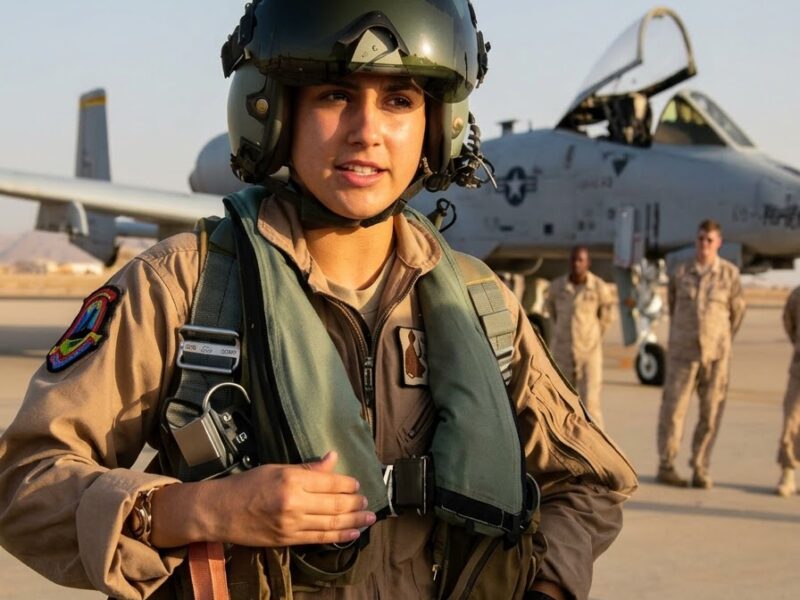
The deck of the USS George Washington erupted in chaos when my F/A-18 slammed onto the carrier with one engine burning and half its wing missing
The deck of the USS George Washington erupted in chaos when my F/A-18 slammed onto the carrier with one engine burning and half its wing missing, while a Navy SEAL shouted, “She’s not going to make it,” unaware that I had already discovered who wanted me dead. I could barely see through the smoke as the carrier rushed beneath me, its landing lights flickering through the darkness like distant stars. My right engine was screaming. The controls were barely responding. And somewhere behind me, three enemy fighters were closing fast.
“Break left!” my wingman shouted over the crackling radio link.
“I can’t!” I yelled back, my voice raw against the roar of metal tearing itself apart.
“Then you’re going down, Sarah!”
I clenched my teeth and pulled the flight stick toward my chest with every ounce of strength remaining in my trembling arms. The Hornet rolled violently. For one terrifying second, the midnight ocean filled my windshield, black and endless, ready to swallow me whole. Then I pushed the nose down and let gravity take over. The fighter dropped like a heavy stone before I leveled it just feet above the churned white foam of the waves.
The SEALs watching from the carrier deck later said the maneuver looked physically impossible. Inside the cockpit, it felt like dying slowly, frame by frame. A warning light flashed bright crimson against the canopy glass. Then another. My main radar went dark with a sickening high-pitched whine. I had no weapons left in my pods. No radar. One engine burning itself into ash. And less than two minutes of fuel left in the secondary reserve tanks.
But I knew something the men chasing me didn’t. They thought I was running out of fear. I wasn’t. I was leading them exactly where I needed them to be. I turned the wounded fighter straight toward the massive silhouette of the aircraft carrier. The hostile fighters took the bait and followed closely on my tail.
“She’s bringing them home!” someone yelled from the flight deck through the open channel.
The SEAL commander standing near the island super-structure suddenly understood the gamble. “Clear the flight deck! Clear it now!” he barked into his headset.
I dropped below the carrier’s radar horizon line, waited until the absolute last possible second, then pulled hard into the empty sky. The sudden pitch change forced extreme G-forces onto my frame. The two enemy fighters overshot my position, unable to bleed off their speed. My wingman, trailing behind, locked on and fired a pair of Sidewinders. One hostile vanished into a ball of orange flame in the pitch-black sky; the other turned away, abandoning the hunt.
I landed thirty seconds later. The arresting cable caught my tailhook so violently that my helmet struck the canopy glass with a loud thud, sending sparks across my vision. Then everything went deathly quiet. I sat there in the cockpit, fingers locked tightly around the controls, too physically and emotionally exhausted to move a single muscle.
When the canopy slowly hissed open, the SEAL commander, Master Chief Eric Vance, climbed up the maintenance ladder. He stared at the ruined aircraft—the missing wing section, the scorched metal, the dripping fuel. Then he looked at me.
“You planned that?” he asked, his voice low and steady.
I shook my head slowly, unstrapping my mask. “No.”
He frowned, wiping sweat from his forehead. “Then what was that?”
“I trusted the aircraft,” I whispered.
He almost smiled, a brief moment of relief breaking through his hardened features. But then his expression changed instantly. Down below the cockpit rim, where the main wiring harness had been shredded by enemy fire, two flight deck mechanics had pulled back a torn inspection panel. They had found something that shouldn’t have been there. A small, black rectangular transmitter. Its tiny red LED light was still blinking steadily in the dark.
It hadn’t come from the enemy aircraft. It had been hardwired directly into my ship’s primary navigation bus before I ever launched from the catapult hours ago. Someone on our own ship had been transmitting my exact GPS coordinates to the hostiles tracking me in the dark.
Commander Vance looked down at the blinking module, then up at me, his eyes narrowing into cold slits. He leaned down into the cockpit and lowered his voice so only I could hear. “Don’t tell anyone about this. Not a soul.”
I stared at the blinking light. For the first time that night, I wasn’t afraid of the hostile jets out in the deep blue sky. I was terrified of the people waiting for me right here inside the belly of the ship.
And then, with a sharp hiss of static, the tiny transmitter’s internal speaker suddenly activated. A distorted, synthesized voice came through: “Pilot, if you’re hearing this, they know you survived. Get out of the hangar before the fire team reaches you.”
My heart hammered against my ribs like a trapped bird. Vance reached down to rip the transmitter out, but before his fingers could touch the casing, the carrier’s primary alarm began to wail across the entire deck. The harsh red emergency lights spun wildly against the tower.
“Condition Red,” the loudspeaker blared. “Security breach in Sector Four. All personnel prepare for immediate lock-down.”
Vance grabbed my shoulder harness, his grip tight as iron. “Lieutenant Sarah Miller, get out of that seat right now. Whatever is happening, it’s already moving faster than us.”
I unlatched my harness and stepped out onto the slick, oil-stained deck. The air smelled of burnt JP-5 jet fuel, copper, and salt water. Around us, sailors were running in every direction, but through the chaos, I spotted three figures in unmarked grey tactical gear marching directly toward my damaged jet. They weren’t standard ship security. They carried compact automatic rifles, and their faces were obscured by dark ballistic masks.
“Vance,” I muttered, backing up toward the shadow of the rear elevator. “Who are those men?”
Vance reached for his sidearm. “They aren’t on my flight manifest.”
The lead operative in grey raised his weapon, not toward the sky, but directly at Vance and me. The betrayal wasn’t coming from afar. It was standing on the flight deck of the world’s most powerful warship, and I was holding the only key to why they wanted us dead.
We ducked behind the heavy steel tractor unit just as a sharp burst of silenced gunfire chewed into the rubber tire inches from my head. Sparks rained down on my flight suit. Vance pulled his Sig Sauer pistol and fired two quick rounds back, forcing the grey-clad men to take cover behind a parked EA-18G Growler.
“Down the ladder well!” Vance ordered, shoving me toward the narrow steel hatch that led into the dark interior of the carrier. “If they take you alive, they’ll make sure whatever you saw out there dies with you!”
I didn’t argue. I slipped through the hatch, my flight boots clattering against the metal rungs as we dropped three decks into the dim, maze-like passages of the ship’s lower levels. The hum of the massive steam turbines vibrated through the steel floorboards beneath my feet. Down here, deep inside the hull, the bright lights of the flight deck were replaced by the dull amber glow of night-operations lighting.
“What did you see out there, Miller?” Vance demanded as we ran down a narrow corridor lined with exposed pipes and heavy electrical conduit. “Why are they burning operational security to put a hit on an F/A-18 pilot?”
“It wasn’t a standard patrol mission, Chief,” I gasped, trying to catch my breath as my lungs burned. “The target coordinates Admiral Hayes gave me before launch… they weren’t for an enemy radar installation. When I broke through the cloud cover over the island, there was no radar dish. It was a private research facility. And there was an American flagged cargo ship docked right beside it, offloading unmarked containers.”
Vance stopped dead in his tracks, pulling me into the shadows beneath an overhead steam line. “Admiral Hayes signed off on those coordinates himself?”
“He gave me the flight plan on an encrypted drive thirty minutes before takeoff,” I said, pulling the tiny metallic drive out from my flight suit’s side pocket. “He told me it was a top-secret strike approved directly by Fleet Command. But as soon as I painted the ship with my target laser, my own ship’s defensive systems jammed my weapons. Then those three unidentified fighters appeared out of nowhere. They weren’t foreign adversaries, Vance. They were flying unmarked black airframes with modern avionics. They knew my radar frequencies before I even turned them on.”
Vance swore under his breath. “Hayes set you up. He sent you into a trap so you would get shot down over deep water, and when you somehow flew that broken jet back home, he sent his clean-up crew to finish the job on the deck.”
Before I could reply, the heavy iron door at the end of the corridor groaned on its hinges. Boots echoed against the deck plates.
“Spread out,” a cold voice echoed through the hallway. “Find Lieutenant Miller. The Admiral wants that flash drive before the ship reaches international waters.”
Vance pressed his back against the bulkhead, holding his pistol ready near his chest. He looked at me, his face grim. “The Admiral controls the ship’s internal security network. Every camera in these hallways is feeding him our location right now. We can’t go up to the bridge, and we can’t go to the Master-at-Arms.”
“Then where do we go?” I whispered, my hand clenching around the drive.
“We go to the one place on this ship that doesn’t exist on the official blueprints,” Vance said, a dark glint in his eye. “The old auxiliary radio room in Deck Six. It was decommissioned during the last retrofit, but the hardwired communications lines are still connected directly to the underwater comms array.”
We moved through the dark underbelly of the supercarrier like ghosts, stepping over steam pipes and navigating the narrow maintenance trunks that only seasoned crew members knew. Every few minutes, the ship’s intercom would echo with distorted announcements, directing security teams to seal off major passageways under the pretense of a “drill.” Hayes was closing the net around us, box by box.
We finally reached a rusted steel hatch deep within the sixth deck, far below the waterline. The air down here was cold, thick with the smell of grease and wet salt. Vance pulled a heavy crowbar from a nearby damage control station and wedged it into the locking mechanism. With a sharp groan of protesting iron, the hatch popped open.
We slipped inside, and Vance pulled the hatch shut behind us, jamming the bar through the inner handle to lock it from the inside.
The room was pitch black until I unclipped a small penlight from my flight suit. The narrow beam illuminated ancient metallic consoles, covered in layers of dust, dial gauges, and CRT monitors from a bygone era. In the center of the desk sat a heavy, military-grade terminal with a glowing mechanical switch labeled EMERGENCY TRANSMIT.
“If I plug this drive into this terminal, can we decode the files without alerting the ship’s mainframe?” I asked, my fingers cold against the metal casing of the drive.
“This terminal runs on an isolated analog circuit,” Vance said, stepping up beside me and clearing away a thick layer of dust from the screen. “It doesn’t talk to the main computer array unless you manually throw that switch. Plug it in.”
I inserted the metallic drive into the adapter port. The ancient monitor flickered to life, green text cascading down the dark green background. Numbers, coordinates, manifest records, and bank transfer routing codes filled the display.
My eyes scanned the lines of code, and my blood ran cold.
“This isn’t just an illegal cargo operation,” I breathed, pointing at the scrolling text. “It’s a hardware transfer. Hayes isn’t just selling military intelligence… he’s selling the complete primary fire-control architecture for our carrier strike group to a private military contractor. The target I was sent to destroy was the exchange hub.”
“Look at the timestamp on the transfer agreement,” Vance said, leaning closer. “It was signed six months ago. But look who the secondary buyer is.”
I scrolled down to the bottom of the digital document. Beneath Admiral Hayes’ digital signature was another name, one that made my chest tighten until I could barely breathe.
It was the signature of Commander Mark Miller—my own father, who had been reported killed in action over the Pacific five years ago.
Before I could utter a word, a loud, metallic slam echoed through the steel hatch behind us. The iron handle shuddered as someone on the outside attempted to turn it. Then came the harsh sound of an angle grinder cutting directly through the heavy locking bolt, casting bright white sparks through the gaps in the doorframe.
“They found us,” Vance said calmly, pulling a tactical knife from his vest and handing it to me while keeping his pistol raised toward the sparks showering from the hatch. “That door won’t hold for more than two minutes.”
“My father’s name is on this document, Vance,” I said, my voice shaking as I stared at the green text glowing on the screen. “They told my family he crashed into the ocean due to mechanical failure. His body was never recovered.”
“Then your father didn’t die five years ago, Sarah,” Vance replied, his eyes locked on the melting metal of the door. “He was part of this from the beginning, or he was the one trying to stop it before they framed him just like they’re framing you right now.”
The realization hit me like a physical blow. The mystery of my father’s death had been the sole reason I joined the Navy, the reason I fought so hard to become a top-tier fighter pilot. Every flight, every carrier landing, every hour spent in the simulator had been driven by the memory of a man who might have been a traitor—or a target of the very men I now served.
“I need to copy these files,” I said, grabbing a portable data module from the old radio rack and plugging it into the auxiliary port. “If we die here, this information dies with us, and Hayes walks away a hero while my father’s memory stays buried in the mud.”
“Work fast,” Vance growled. “Because when that door comes down, I’m not asking for their identification numbers.”
The lock on the hatch gave way with a deafening bang. The heavy steel door swung inward, and a flashbang grenade was tossed into the small room.
“Cover your eyes!” Vance roared.
The grenade exploded with a blinding white light and a thunderous crack that shook my teeth inside my skull. The pressure wave knocked me against the console, sending a sharp pain down my arm. Through the ringing in my ears, I heard Vance firing his weapon—three quick shots, followed by the heavy thud of a body hitting the steel floor.
Smoke filled the small room instantly. I reached out blindly in the haze, my fingers clutching the portable data module as the copy progress bar hit one hundred percent. I ripped the module from the port and jammed it deep inside my inner chest pocket, snapping the zipper shut.
A grey-clad operative lunged through the smoke, his rifle raised. I didn’t think; survival instinct took over. I ducked beneath his extended arm, drove the tactical knife Vance had given me into the soft armor joint beneath his shoulder, and slammed his head against the heavy steel frame of the old radio console. He collapsed into a heap on the deck plates.
Vance grabbed my vest, pulling me toward a small escape trunk in the rear corner of the compartment. “Through there! It leads to the ballast tanks and the lower bilges! Go!”
“What about you?” I yelled over the sound of incoming gunfire splintering the wooden desk behind us.
“I’m right behind you, kid! Move!” Vance yelled, firing his remaining rounds down the dark hallway to keep the rest of the assault team at bay.
I squeezed my body through the narrow circular hatch of the escape trunk and began scrambling down the vertical ladder, descending deep into the darkest, wettest parts of the aircraft carrier. Below deck six lay the ballast spaces—massive steel chambers filled with seawater used to balance the sixty-thousand-ton warship.
The air down here was freezing cold, smelling heavily of rust and stagnant salt water. My boots splashed into ankle-deep water as I hit the bottom of the trunk. Seconds later, Vance dropped down beside me, bleeding from a superficial graze along his temple, but his eyes were wide and filled with intense focus.
“They’ve locked down the ship’s internal ladders,” Vance panted, wiping blood from his eyebrow. “Hayes knows we have the files. He’s placed the carrier on full security containment. Nobody leaves this ship, and no communications get out.”
“Then how do we get this data to Fleet Command?” I asked, looking around the dark chamber. The low frequency rumble of the ship’s massive propellers echoed through the hull walls, a constant reminder of the sheer power carrying us further out into open water.
“We don’t send it from the ship,” Vance said, turning his flashlight toward a heavy yellow emergency pump station mounted on the side of the ballast bulkhead. “We use the submarine escape hatch in the lower bilge deck. There’s a two-person inflatable stealth kayak stored in the emergency survival locker. We eject into the water behind the carrier’s wake.”
I stared at him in disbelief. “Jump into the middle of the ocean in the dead of night? The carrier is moving at twenty-five knots. The wake alone will drag us straight into the screws if we don’t clear the stern!”
“It’s the only card left to play, Lieutenant,” Vance said, his voice dropping to a grim tone. “If we stay on this ship until sunrise, Hayes will have his men sweep every bilge compartment with thermal scopes. We won’t survive until breakfast.”
I touched the hard plastic shape of the data module hidden beneath my flight suit. It contained the truth about my father, about Admiral Hayes, and about the betrayal that had almost cost me my life five miles above the water.
“Show me the hatch,” I said firmly.
Vance led the way deeper into the bilge network, crouching low beneath massive steel support girders. We reached a small, watertight airlock compartment designed for hull repair divers. Inside the storage locker, just as Vance had said, sat a compact black pack containing a tactical inflatable craft, complete with low-profile paddles and emergency locator beacons that operated on encrypted military frequencies.
Vance began prepping the airlock valves, the heavy iron wheels turning with loud, screeching groans. “When this outer hatch opens, the water pressure is going to hit hard. Hold onto the safety line until the chamber fills, then kick out into the slipstream.”
Suddenly, the red emergency speaker mounted above the airlock flickered with static. A voice echoed through the wet chamber—not the synthesized voice from the aircraft transmitter, but the calm, measured, and terrifyingly cold voice of Admiral Hayes himself.
“Lieutenant Miller. Master Chief Vance,” Hayes said, his tone as casual as if he were delivering a morning brief. “I know where you are. And I think before you open that airlock into three thousand feet of freezing water, there is someone who would like to speak with you.”
The audio cut out for a brief second, replaced by the heavy sound of someone breathing heavily into a microphone on the other end of the line.
“Sarah…” a deep, familiar voice rasped through the static. “Sarah, don’t open that hatch.”
My breath caught in my throat. The flashlight in my hand trembled, casting wild shadows across the wet iron walls.
“Dad?” I whispered, my voice breaking.
The voice coming through the metallic speaker sounded older, worn down by years of fatigue, but there was no mistaking the pitch and cadence. It was my father.
“Sarah, listen to me very carefully,” the voice pleaded through the crackling intercom. “Whatever you think you found on that drive… it’s not what you understand. You have to bring that module to the bridge. Stand down, sweetheart. Please.”
My hand gripped the edge of the airlock console so hard my knuckles turned white. Five years of grieving, five years of staring at an empty grave in Arlington National Cemetery, and here he was, speaking to me through the internal comms of an aircraft carrier in the middle of a covert execution order.
“You’re alive,” I breathed, tears welling in my eyes despite my desperate attempt to remain cold. “You let mom die thinking you were dead. You let me grow up alone.”
“I did what I had to do to protect you!” my father’s voice surged with sudden emotion. “The technology on that drive… it wasn’t built for Fleet Command. It was built by us. Admiral Hayes and I… we created it to prevent a war, not start one. If those files leak to the public or to foreign intelligence, it will destroy everything we worked to safeguard.”
Vance stepped up beside me, his hand resting firmly on my shoulder. He looked at the speaker, then down at me, his eyes filled with a painful sympathy. “It’s a psychological trick, Miller. He’s using your emotion to get you to walk back up those ladders right into a firing squad.”
“It’s not a trick, Vance!” my father shouted through the speaker. “Sarah, Hayes isn’t going to harm you if you hand over the core module! I am standing right next to him on the bridge! I gave him my word that you would listen to reason!”
“He sent three unmarked fighters to blow me out of the sky over the Pacific, Dad!” I screamed at the speaker, my voice ringing through the damp steel chamber. “They put a transmitter in my cockpit wiring! They tried to kill me!”
There was a long, heavy silence on the line. For a moment, only the sound of high-pressure steam pipes hissed in the background.
When my father spoke again, his voice lacked the emotional intensity from before. It sounded distant, almost hollow. “There are always collateral risks in operational security, Sarah. You were never meant to survive the approach run. You were supposed to be the tragic accident that justified our counter-strike.”
The words hit me harder than any bullet ever could. The man I had idolized, the hero who had inspired me to strap myself into the cockpit of a fighter jet, hadn’t just abandoned me—he had calculated my death as an acceptable operational cost.
Vance didn’t waste another second. He slammed his hand onto the manual release lever of the airlock door. “We’re out of time, Sarah! Get into the chamber now!”
“Stop them!” Admiral Hayes’ voice cut back in, sharp and urgent. “Security team, breach Sector Eight! Flood the compartment!”
The heavy steel valves in the ceiling groaned violently. High-pressure seawater began pouring into the bilge compartment from the overhead emergency ballast pipes, cascading down like a deafening waterfall. The water level rose rapidly, reaching our knees within seconds.
“In! Get in!” Vance shouted, shoving the folded tactical kayak into the small circular airlock chamber and pulling me inside after it.
We scrambled into the narrow metallic tube of the dive lock. Vance pulled the inner heavy iron door shut, spinning the locking wheel with frantic strength just as the cold ocean water completely submerged the lower bilge room on the other side of the glass viewport.
Inside the small airlock, the air was suffocatingly tight. The outer hatch was all that separated us from the churning black ocean outside, where the massive twin propellers of the USS George Washington were slicing through the water just fifty yards away.
“Hold your breath and grab the line!” Vance ordered, reaching for the manual flood controls inside the tube. “When I trip this lever, the ocean pressure is going to hit us like a freight train. Don’t let go of the line, no matter what happens, or the propeller wash will tear you apart!”
I gripped the thick nylon rope bolted to the inner wall of the tube with both hands. I pulled the waterproof data module from my chest pocket, verified that its sealed casing was intact, and jammed it back deep inside my flight suit, zipping it up tightly against my body.
“Ready?” Vance yelled over the deafening roar of water pressing against the outer steel hull.
“Do it!” I shouted back.
Vance pulled the primary ocean valve.
The heavy outer circular door swung open into the dark abyss. A wall of freezing, pitch-black sea water slammed into the airlock with terrifying force, instantly knocking the air from my lungs. The world turned into a chaotic vortex of freezing cold, roaring noise, and crushing pressure. The sheer momentum of the carrier moving at high speed created a massive vacuum, dragging us out of the tube and throwing us into the violent, frothing wake of the warship.
I tumbled through the dark water, completely disoriented, the freezing temperature sinking into my bones like needles. I couldn’t tell which way was up or down. The deafening thrum of the ship’s massive propellers roared in my ears, a terrifying acoustic monster passing just feet above my head.
I kicked frantically toward the surface, my lungs burning for oxygen, fighting against the powerful undercurrents dragging me down into the deep blue void.
My head broke through the surface of the ocean, and I gasped desperately for air, swallowing cold salt water as heavy waves crashed over my face.
The massive dark silhouette of the USS George Washington was already pulling away into the distance, its rear lights flickering like faint red embers against the pitch-black horizon. The cold Pacific ocean stretched out in every direction, vast, indifferent, and deadly silent save for the sound of crashing waves.
“Vance!” I coughed, treading water frantically as I searched the dark swells around me. “Vance!”
A few yards away, a bright yellow auto-inflating marker light popped open on the surface. The tactical kayak had deployed automatically upon contact with the water, floating on the crest of a heavy swell. Beside it, a arm reached out, grabbing the side handrail.
“I’m here!” Vance’s voice came through the splash of the waves, rough and gasping. “Get… get over here!”
I swam through the icy water, my limbs feeling heavy and unresponsive from the cold, and hauled myself over the rubber pontoon of the stealth kayak. Vance pulled himself up next to me, dragging his breath into his chest in heavy, painful gasps.
We sat there in the tiny, low-profile craft, bobbing up and down in the massive ocean swells, watching the aircraft carrier fade entirely into the night mist. We were miles from the nearest land, floating in open water with nothing but our flight gear and a tiny encrypted drive containing a conspiracy that went to the highest levels of the United States military.
“Are you intact, Lieutenant?” Vance asked, his teeth chattering uncontrollably as he unzipped his water-logged tactical vest to pull out the low-frequency emergency satellite transmitter.
“I’m alive,” I said, my voice trembling from the cold and the crushing emotional weight of what had just happened. I reached into my suit and pulled out the hard plastic casing of the data module. The green power LED on the sealed casing was still glowing weakly. “The data survived.”
“Good,” Vance said, setting the satellite transmitter on the floor of the kayak and turning the frequency dial to an auxiliary channel. “Because we only have one shot at this. This transmitter uses an old direct-to-orbit intelligence frequency. It bypasses Fleet Command’s local repeaters and sends an unencrypted signal directly to the Inspector General’s office at the Pentagon.”
“Will they receive it before Hayes realizes we survived the dive?” I asked, looking back at the empty, dark ocean.
“Hayes thinks we were crushed in the propeller wash,” Vance said grimly. “He’s probably already writing his official report right now, listing us both as casualties of an accident during night operations. But as soon as I hit this uplink button, every secure terminal in Washington will receive the raw video files and financial manifests from your drive.”
I looked down at the glowing drive in my hand. Inside this small piece of plastic was the proof that Admiral Hayes was selling out his country. But it was also the proof that my father was alive—a man who had traded his honor, his family, and his humanity to become a ghost in a machine of corruption.
“Do it,” I said quietly.
Vance connected the data cable from the drive into the satellite transmitter. He flipped open the safety cover over the red transmit button, looked at me one last time, and pressed it down firmly.
A small green light on the transmitter began to pulse steadily, sending a digital beam of light straight up into the dark sky, piercing through the heavy cloud layer toward a communications satellite orbiting miles above the Earth.
For ten long minutes, we sat in complete silence on the rolling waves, listening to the quiet beep of the transmitter completing its upload.
Then, the small speaker on the satellite unit chirped twice. A clear, uncompressed radio signal broke through the static.
“Unidentified station, this is Naval Criminal Investigative Service Headquarters, Washington D.C.,” a firm, authoritative female voice echoed over the small speaker. “We have just received a high-level automated data payload bearing the security clearance of Lieutenant Sarah Miller and Master Chief Eric Vance. Please confirm your status.”
Vance picked up the small waterproof microphone. “NCIS HQ, this is Vance. Lieutenant Miller and I are alive. We are currently in open water, twenty miles off the coast of the operational sector. The files you received are authentic. Admiral Hayes has compromised Fleet operations.”
There was a brief pause on the line, followed by the quiet sound of fast typing in a distant control room thousands of miles away.
“Master Chief, Lieutenant,” the voice returned, urgent and precise. “Stand by. We have verified the payload. Joint Chiefs of Staff have just issued an immediate order relieving Admiral Hayes of his command. Security forces on board the USS George Washington are currently taking Hayes and his staff into custody.”
A profound wave of relief washed over me, so heavy that I slumped back against the rubber frame of the kayak, staring up at the cold stars breaking through the scattered clouds above. The truth was finally out. The lie that had defined my life for five years had finally been shattered.
“Lieutenant Miller,” the voice from Washington continued, her tone softening slightly. “We have dispatched a fast-response search and rescue helicopter from a nearby carrier group to your exact coordinates. ETA to your position is seven minutes. Hold tight.”
“Understood, NCIS,” Vance replied. “We’ll be waiting.”
As Vance lowered the radio, I looked out across the dark horizon. Somewhere out there, on the flight deck of the warship moving through the night, my father was being led away in chains. He was no longer a ghost, and he was no longer a hero. He was just a man who had made his choice—and I had made mine.
The distant, reassuring thrum of a rescue helicopter’s rotor blades began to vibrate through the cool night air, growing louder with every passing second. A bright, white searchlight cut through the darkness above us, illuminating the black ocean waves around our tiny boat.
I closed my eyes for a brief moment, letting the warm light hit my face. The storm was over, the flight was done, and for the first time in five years, I was finally coming home.
The end.









