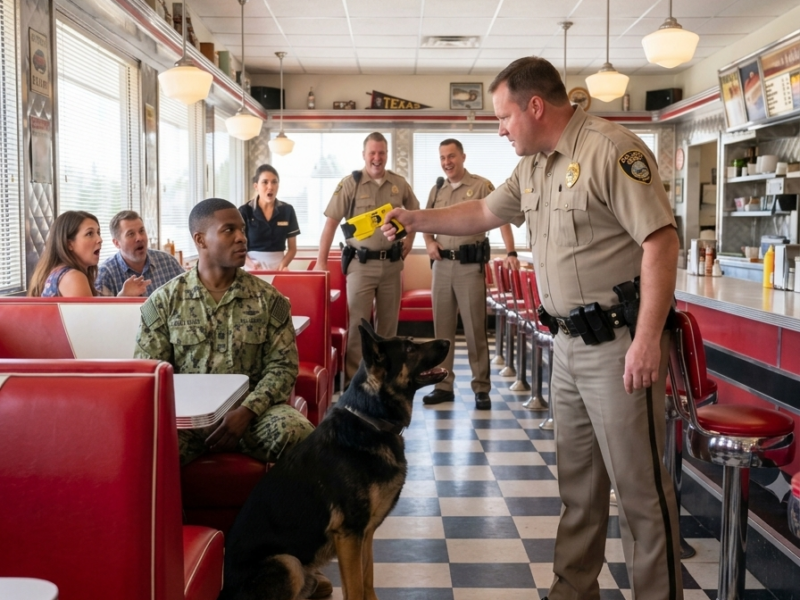
The corrupt cop slammed my face against a patrol car outside a Detroit diner while my German Shepherd watched helplessly, sneering, “Nobody will believe you, stranger,”
The neon sign above the diner buzzed with a low, crackling hum that cut through the damp Detroit mist. It was 2:15 AM on Michigan Avenue. The rain had stopped an hour ago, leaving the cracked asphalt wet and slick, reflecting the dull amber glow of distant streetlights. Inside the vinyl-booth warmth of the 24-hour diner, the smell of burnt coffee and fried onions hung heavy in the air.
I sat near the window, resting my back against the wall, sipping black coffee from a chipped ceramic mug. At my feet, Atlas, my three-year-old German Shepherd service dog, lay motionless. His dark eyes were fixed on the glass front door, his head resting lightly across his paws. After three days of non-stop driving from San Diego, my body ached with a deep, bone-weary fatigue that sleep hadn’t been able to touch for years.
The heavy glass door opened with a sudden chime, letting in a blast of freezing night air.
A Detroit police officer walked in. He was broad-shouldered, pushing forty, with a thick neck, a trimmed mustache, and a duty belt that squeaked rhythmically with every heavy step. He didn’t look like a cop on a routine break. His eyes swept the counter, skipped over the sleepy line cook behind the grill, and locked directly onto me.
“Step outside,” he said. His voice was flat, hard, and clipped.
I didn’t reach for my coffee. I didn’t shift in my seat. “Why?” I asked calmly.
He took two deliberate steps toward my booth, his right hand resting casually over the leather holster at his hip. He leaned down, his face inches from mine. “Because I said so, stranger.”
There was something wrong with his cadence. It wasn’t the calm authority of a man enforcing the law; it was the restless, hyper-alert energy of a man riding a heavy spike of adrenaline. His pupils were dilated, and a thin sheen of cold sweat glistened along his hairline. Fear. Pure, unadulterated fear disguised as bravado.
I tapped Atlas once on his shoulder. The dog rose silently, his nails clicking against the linoleum as he stepped out of the booth beside me.
“Outside. Now,” the cop repeated, turning on his heel and heading for the door.
I followed him out into the freezing air. The moment the diner door swung shut behind us, cutting off the warm light of the interior, the officer turned violently, grabbed the heavy collar of my tactical jacket, and slammed me backward against the cold metal hood of his patrol car.
Atlas let out a sharp, thunderous bark, his body dropping into a low, aggressive stance.
“Control your dog!” the cop yelled, his breath pluming in the dark air. “Hands on the car! Right now!”
I looked directly into his bloodshot eyes, keeping my posture entirely relaxed. I let my hands rest loosely on the cold steel of the hood. “Let go of my jacket,” I said softly.
He sneered, a tight, nervous twitch at the corner of his mouth. “You don’t give orders here, mister. Nobody will believe you anyway. You’re a ghost passing through my city.”
With his free hand, he reached into my front coat pocket, yanked out my leather wallet, and flipped it open under the dim utility light attached to the diner wall. He was looking for cash or a driver’s license. Instead, his eyes landed on the gold Trident emblem embedded into my military identification card—NOAH R. SEAL, CHIEF PETTY OFFICER, US NAVY (RET.).
The officer’s sneer vanished. His face drained of color so quickly it looked as if he’d been struck.
He slammed the wallet shut and shoved it hard against my chest. “You were never here,” he whispered, his voice trembling slightly.
I straightened up, turning my body toward him. “Why?”
He took a step back, his hand falling reflexively to his belt. “Forget what you saw. Get in your truck and drive back to wherever you came from.”
“I haven’t seen anything,” I replied. “Not yet.”
Before he could answer, Atlas whined softly—a high-frequency sound he only made when he detected something specific. He pulled hard against his leash, his nose pointed toward the pitch-black alleyway running along the rear of the diner.
I stepped away from the patrol car and followed my dog’s gaze. Parked deep in the shadows behind a rusted industrial dumpster was a second police cruiser, its engine off, its lights dead. Its trunk was popped open by a few inches.
I took three steps toward the alley. Under the faint beam of a distant alley light, I saw it: a heavy canvas jacket, soaked through with dark, tacky blood, hanging out of the gap in the trunk door.
The officer sprinted around his cruiser, stepping directly between me and the alley. “You didn’t see that either,” he hissed, his hand resting fully on the retention strap of his sidearm.
I stayed silent, my eyes scanning his name tag: OFFICER V. KANE.
He smiled—a hollow, desperate attempt to regain control of the situation. “Smart boy. Walk away, CPO. Go home.”
Atlas suddenly dropped his snout to the damp pavement beneath Kane’s patrol car, uttering a low, vibrating growl. He nudged something small and metallic with his nose.
I crouched down, ignoring Kane’s sudden gasp, and picked up the object from the wet gravel. It was a tiny braided silver bracelet, decorated with a small enamel butterfly charm. The silver was bent, and the clasp was smeared with fresh dirt and blood.
Kane went completely pale. “Give me that,” he demanded, taking a fast step forward.
I closed my fist around the bracelet. “Whose is it?”
He reached for his weapon, unholstering the heavy Glock in one frantic motion.
I didn’t think. Eight years in Navy Special Warfare took over my nervous system before my conscious mind could even process the threat. I stepped inside his reach, my left forearm striking his wrist to deflect the muzzle downward. My right hand slammed into his throat, cutting off his breath, while my foot swept behind his front leg.
Kane crashed hard against the hood of his own car. His weapon skidded across the wet asphalt, landing near Atlas’s paws.
The officer gasped for air, clutching his neck, his eyes wide with utter shock. “Who… who are you?”
I stepped back, keeping my distance, my eyes fixed on him. “Someone who knows you just made a very bad decision.”
The diner door behind us burst open. The elderly waitress who had served my coffee stood on the threshold, clutching a dish towel to her chest, her body trembling violently. She looked from Kane to me, and then her eyes fell on my closed hand.
“That’s…” she gasped, her voice breaking into a sob as she pointed a thin finger at the bracelet in my palm. “That’s Maya’s bracelet. That’s my granddaughter’s.”
Kane’s face collapsed into absolute ruin.
I looked at him, my voice dropping to a dangerous whisper. “Where is the little girl, Kane?”
He didn’t answer. He lay against the hood, staring at the wet ground, his chest heaving.
Suddenly, the dispatch radio pinned to Kane’s shoulder harness crackled to life with a burst of heavy static. A dark, calm, unfamiliar voice whispered through the speaker, cutting through the cold night air:
“Officer down on Michigan Avenue. The SEAL is here. Proceed with Phase Two.”
My blood ran cold. I had never spoken my name. I had never mentioned my background to anyone in Detroit.
I turned slowly and looked deep into the dark alleyway behind the diner. Somewhere in the shadow of the abandoned warehouses, someone had been watching every move we made.
Atlas pulled against his leash toward the darkness, his body taut as a bowstring.
I tightened my grip on the silver bracelet, looked down at the trembling officer, and then turned toward the alley. Whatever trap had been laid in the dark, I was stepping straight into it.
The alley behind the diner opened into an abandoned industrial corridor—a sprawling graveyard of crumbling brick factories, rusted loading docks, and overgrown railway spurs that had once served Detroit’s auto manufacturing plants. The air smelled of old iron, stagnant water, and soot. Rain had begun to fall again, turning into a cold, needle-like sleet that stung my face as Atlas led me deeper into the maze.
“Stay tight, buddy,” I whispered, holding the leash short.
Atlas moved with surgical precision. His nose was low, catching the trail of wet leather and iron from the bloodstained jacket we had seen in the cruiser trunk.
We reached the rear entrance of a four-story brick structure—the old Michigan Axle & Iron building. The heavy steel fire door had been pried open by a crowbar, leaving a dark, jagged gap just wide enough for a man to slip through.
I pulled my tactical flashlight from my belt, holding it extended in my left hand in a high-thumb grip while keeping my captured sidearm low in my right.
Inside, the building was an echoing cavern of shadow. High concrete ceilings were supported by thick iron pillars, and the floor was littered with shattered glass, rusted machinery parts, and discarded tires. Rain leaked through the broken skylights above, creating a steady, rhythmic dripping sound that echoed throughout the vast space.
Atlas stopped near an old supervisor’s office—a raised glass enclosure overlooking the main assembly floor.
He let out a faint, chest-vibrating growl.
I moved up the iron stairs, my soft-soled boots making no sound against the rusted metal. The door to the office was slightly ajar. I pushed it open with the toe of my boot.
The room was illuminated by a single, battery-powered LED floodlight placed on the floor in the corner.
Sitting in a metal folding chair in the center of the room was a man wearing a dark civilian suit. His hands were tied behind his back with heavy plastic flex-cuffs, and a thick strip of silver duct tape covered his mouth. His face was badly bruised, his eyes wide with sheer panic as my flashlight beam swept across him.
He wasn’t a civilian. He wore a high-ranking officer’s dress shirt beneath his jacket—decorated with gold bars and a Detroit Police Department commander’s crest.
I approached him cautiously, checking the corners of the office before stepping into his line of sight. “Commander?” I asked softly.
The man nodded frantically, his breath wheezing loudly through his nose.
I pulled my knife, sliced through the tape across his mouth, and severed the plastic cuffs on his wrists.
The Commander collapsed forward, catching himself on his knees, coughing violently. “You… you shouldn’t have come here, son,” he gasped, rubbing his raw, bleeding wrists.
“Where is the girl?” I demanded, crouching down beside him. “Where is Maya?”
“She’s not here,” the Commander whispered, his voice trembling with a mixture of terror and exhaustion. “They… they moved her twenty minutes ago. Kane was supposed to clear the street. He was supposed to make sure nobody saw the handoff.”
“Who are ‘they’?”
The Commander looked up at me, his eyes hollow under the harsh beam of the floodlight. “A private security syndicate called Ironclad Solutions. They’ve been operating out of the old rail yards for six months. They buy up compromised city officials, officers with heavy gambling debts, precinct chiefs with secrets… and then they use them to clear routes through the city for human trafficking.”
My stomach turned into a hard knot of iron. “And Officer Kane is on their payroll.”
“Kane owes them two hundred thousand dollars,” the Commander said bitterly. “They own him body and soul. Tonight, Maya—the waitress’s granddaughter—saw them loading a shipping container near the river. She saw Kane taking money from an Ironclad contractor. They couldn’t let her leave.”
“Why did the radio dispatcher say my name?” I asked, leaning in close to the officer’s face. “Why did they know I was a SEAL?”
The Commander swallowed hard, staring at the floor. “Because… because the man who runs Ironclad… he knows you, Miller. He was looking for you.”
A cold sensation crept up the back of my neck. “What man?”
Before the Commander could answer, a sharp metallic click echoed from the doorway behind us.
Atlas spun around, a fierce bark tearing from his throat.
Standing on the iron catwalk outside the supervisor’s office were three men in dark tactical gear, carrying suppressed submachine guns. Standing between them was a tall, lean man in a tan canvas field coat, his right eye covered by a thick leather patch, his jawline marked by a deep, star-shaped burn scar.
I recognized him instantly.
Captain Richard Vance. Former Navy SEAL, former commander of Special Reconnaissance Team Two, dishonorably discharged six years ago following an unauthorized interrogation scandal in the Helmand Province. The man whose court-martial testimony I had personally signed.
“Hello, Noah,” Vance said smoothly, his single eye glinting under the dim light. “It’s been a long time since California.”
“Vance,” I said, my voice dropping to a low, lethal pitch. “You’re running human trafficking out of Detroit?”
Vance chuckled—a dry, humorless sound that rattled in his throat. “I run logistics, Noah. Supply and demand. The city is broken, the police department is bankrupt, and the state doesn’t care what happens east of Woodward Avenue. I simply provided an efficient system for people who are willing to pay for discreet transportation.”
“Where is the girl?” I asked, keeping my hand steady on the sidearm at my thigh.
“She’s on a freighter heading out through the St. Clair River in forty minutes,” Vance said calmly. “And you’re going to stay right here in this warehouse until the ship hits international waters.”
Vance raised his left hand and gave a simple, two-finger gesture.
The two tactical operators beside him raised their submachine guns.
“Atlas, strike!” I roared.
The German Shepherd launched himself through the open doorway like a cannonball, taking the lead shooter down to the iron catwalk in a storm of motion, teeth, and gear.
The suppressed submachine guns erupted into a rapid series of dry, coughing pops—thwack-thwack-thwack—the rounds tearing through the plaster walls and glass windows of the supervisor’s office, sending a shower of sharp fragments down into the darkness below.
I grabbed the Commander by his collar, dragging him down behind the heavy iron desk in the corner of the room just as the glass wall shattered into a thousand pieces.
“Stay down!” I ordered, pulling two spare magazines from the vest of the sidearm I had taken from Kane.
On the catwalk outside, Atlas was a blur of lethal kinetic energy. He had locked his jaws around the lead contractor’s forearm, dragging the man over the iron railing. The contractor screamed as he fell twenty feet to the concrete floor of the main assembly room below, his weapon clattering loudly against the iron beams.
“Kill the dog!” the second operator yelled, swinging his weapon toward Atlas.
I leaned out from behind the steel desk, leveled my sidearm, and squeezed the trigger twice.
The two 9mm rounds hit the operator square in the chest plate, knocking him backward into the wall. He stumbled, lost his balance on the wet metal walkway, and collapsed down the iron staircase.
Vance didn’t stay to fight. The moment the firing started, he turned and sprinted toward the rear service elevator at the back of the catwalk, slipping into the dark shaft and slamming the heavy iron gate shut behind him.
“Noah!” the Commander yelled, pointing to the floor beneath us. “The lower level connects to the old rail tunnels under the river! That’s where they load the containers!”
I ran to the catwalk railing, looking down into the dark assembly room. Atlas was standing over the fallen contractor, his coat dripping with rain, his ears pinned back, his eyes locked on the elevator shaft where Vance had disappeared.
“Atlas, heel!” I called out.
The dog trotted swiftly up the iron stairs, returning to my side without a sound, his breath rising in thick white puffs in the cold air. I inspected him quickly—no blood, no bullet grazes. Just pure, focused energy.
“Commander,” I said, turning to the police officer. “Can you get to a secure landline? Call the US Coast Guard sector office in Detroit. Tell them Captain Richard Vance is moving an unregistered vessel down the St. Clair River. Give them my name and tell them to lock down the locks at Port Huron.”
The Commander nodded grimly. “What are you going to do?”
“I’m going down into the tunnels,” I said, checking the action on my sidearm. “I’m not letting that ship leave the dock.”
I opened the service hatch beside the elevator, revealing a narrow, spiral iron ladder that descended into the pitch-black foundations of the factory.
I descended first, my flashlight beam cutting through a thick layer of damp fog that smelled of sulfur and dead fish. Atlas followed directly behind me, stepping carefully down the iron rungs with practiced balance.
At the bottom of the shaft was a massive concrete tunnel—an abandoned underground rail corridor built in the 1920s to move freight between the auto plants and the Detroit River docks. The air here was bone-chillingly cold, and four inches of freezing water covered the gravel floor between the rusted iron train tracks.
Deep down the tunnel, half a mile away, I could hear the heavy, rhythmic thrumming of a marine diesel engine idling in the dark.
“Find her, Atlas,” I whispered, touching the dog’s wet snout. “Find the little girl.”
Atlas dropped his nose to the edge of the iron rail, caught the scent, and began to run through the shallow water, his paws creating small splashes that echoed off the curved concrete ceiling.
We moved silently through the dark for five minutes, passing abandoned ore cars, broken wooden crates, and rusted tools. The sound of the ship’s engine grew louder, vibrating through the concrete walls until the floor beneath my boots began to tremble.
The tunnel opened up into a massive underground dry dock built directly beneath a crumbling pier on the Detroit River.
Moored to the concrete pier was a ninety-foot black-hulled commercial tugboat, its decks lit by small red night-lights. Standing on the pier were four armed men in dark raincoats, watching a large, rusted steel shipping container being lowered onto the deck of the vessel by a hydraulic crane.
Sitting near the edge of the dock, her small legs tied together with thick nylon rope, was Maya.
She was wearing a pink jacket, her face covered in dirt, clutching her knees to her chest as she wept silently into the dark air.
Standing beside her, holding a satellite phone to his ear, was Captain Richard Vance.
“The cargo is secured,” Vance was saying into the phone, his voice echoing across the water. “We clear the river mouth in ten minutes. Make sure the customs clearance at the Canadian border is clean.”
I stayed in the shadow of the tunnel mouth, my heart hammering against my ribs. Four armed men on the dock. Two more on the bridge of the tugboat. One on the crane platform.
Directly between us and the dock was twenty yards of open, flooded concrete with zero cover.
I looked down at the silver bracelet still tucked into my pocket. Then I looked at Atlas.
“Alright, buddy,” I whispered, my voice barely audible over the roar of the diesel engine. “This is what we trained for.”
I pulled my flashlight from my belt and set it to high-frequency strobe mode. I placed it on an iron ledge three feet off the ground, pointing the lens directly at the main lighting rig attached to the crane platform.
“Atlas, stay,” I commanded, pressing his body down against the cold concrete.
I pulled my knife, took two deep breaths, and stepped wide to the left, slipping behind a stack of rusted oil drums that ran along the western edge of the dry dock.
I reached into my pocket, pulled out a heavy steel bolt I had picked up in the rail tunnel, and hurled it with all my strength toward the far side of the dry dock.
The bolt struck a corrugated iron door with a thunderous BANG.
“What was that?” one of the contractors on the pier yelled, raising his rifle. “Check the east wall!”
Two of the guards turned away from the boat, stepping cautiously into the darkness toward the sound of the impact.
At that exact second, I clicked the remote switch on my flashlight.
The strobe light exploded into a blinding, disorienting pulse of ten thousand lumens, reflecting off the damp fog and the wet concrete walls, blinding the remaining guards on the pier.
“Atlas, strike!” I shouted.
The Shepherd burst from the tunnel like a dark storm, his speed incredible as he crossed the open ground. He hit the nearest guard on the pier before the man could even raise his weapon, taking him down into the freezing water of the dry dock basin.
I stepped out from behind the oil drums, firing three precise shots.
The two guards investigating the noise went down instantly, their weapons clattering against the concrete.
“Noah!” Vance roared, dropping his satellite phone and drawing a heavy stainless-steel revolver from his belt.
He didn’t fire at me. He reached down, grabbed seven-year-old Maya by her coat collar, and hauled her up in front of his chest as a human shield.
“Put the gun down, Miller!” Vance screamed, his single eye wide with wild, unhinged fury. “Put it down or I blow her head off right here!”
I stopped fifteen feet away, my weapon held at low-ready, my eyes locked on Vance’s face.
Maya was crying hysterically, her tiny hands clutching at Vance’s massive arm. “Please…” she sobbed. “Please don’t hurt me…”
“You’re out of moves, Vance,” I said, my voice completely steady, completely devoid of emotion. “The Coast Guard is closing the river. The Detroit Police have your warehouse surrounded above. You’re not leaving this dock.”
“I’ve survived worse than you, Miller!” Vance spat, his revolver pressed tightly against the side of the girl’s head. “I built an empire out of this city’s trash! You think a broken SEAL and a dog are going to stop me?”
Behind Vance, standing quietly on the wet deck of the tugboat, Atlas had managed to climb the stern boarding ladder unnoticed during the firefight.
He moved like a phantom across the steel deck, stepping over ropes and iron cleats, his dark eyes fixed entirely on Vance’s back.
He didn’t bark. He didn’t growl. He dropped into a low, muscular crouch on the gunwale directly above Vance’s right shoulder.
I met Atlas’s eyes for a fraction of a second over Vance’s shoulder.
“You’re right, Vance,” I said softly, taking a small step forward to draw his attention entirely to me. “I can’t stop you.”
Vance sneered, raising his chin. “Then drop the gun—”
“But he can,” I said.
Atlas launched himself off the tugboat deck.
Seventy pounds of muscle, teeth, and bone struck Vance squarely in the back of his neck and shoulders. The impact tore the former captain off his feet, sending him crashing face-first onto the wet concrete of the pier.
His revolver skidded across the edge of the dock, splashing into the dark, churning water of the river basin below.
I sprinted forward, scooped Maya up into my left arm, and pulled her behind the heavy iron pillar of the crane platform.
Vance rolled onto his back, screaming in rage, trying to punch the dog off him. But Atlas was relentless—his jaws locked onto Vance’s tactical sleeve, pinning his arm to the concrete while his weight held the larger man down.
“Atlas, off!” I commanded.
The dog released his grip instantly, stepping back two paces, his teeth exposed, a low growl echoing in his chest as he kept Vance pinned under his glare.
Vance lay on the wet concrete, his field coat torn, his face smeared with blood and grease from the pier. He looked up at me as I approached, his chest heaving, his single eye burning with hatred.
“You should have killed me in Afghanistan, Miller,” Vance rasped, coughing up dark blood onto his collar.
“No,” I said, pulling the heavy plastic flex-cuffs from my belt and pinning his wrists behind his back with a sharp zip. “You were never worth a bullet, Vance. You’re just a criminal who forgot what honor meant.”
The first light of dawn was beginning to break over the Detroit skyline—a pale, lavender glow that cut through the gray clouds hovering over the river.
Above the dry dock, the air was filled with the thunderous roar of Coast Guard helicopters and the flashing red and blue lights of dozens of law enforcement vehicles blocking off the entire industrial district.
I sat on the wooden bumper of an emergency response truck parked near the riverbank, wrapped in a heavy wool blanket provided by a paramedic.
Beside me, sitting on the truck bed with a dry towel draped over her shoulders, was Maya. She was sipping hot chocolate from a foam cup, her small hand holding tight to the silver butterfly bracelet I had returned to her twenty minutes ago.
Atlas lay at our feet, eating a thick piece of cooked sausage that one of the responding officers had brought him from a nearby deli. His coat was dry now, brushed clean of the alley mud, his tail thumping softly against the wooden floorboards whenever Maya reached down to pat his head.
A sleek black sedan pulled up to the perimeter line, its doors opening immediately.
The Commander I had rescued from the warehouse stepped out, followed closely by the elderly waitress from the diner.
“Maya!” the grandmother screamed, running past the police tape, her apron still tied around her waist.
“Grandma!” the little girl cried out, dropping her cup and sprinting across the wet pavement into her grandmother’s open arms.
The two of them collapsed together on the asphalt, weeping, holding each other tight as paramedics moved in to check them over.
The Commander walked over to where I sat, stopping beside Atlas. He looked down at the dog, then up at me, his face marked by a deep, exhaustion-born respect.
“Vance and six of his senior contractors are in federal custody,” the Commander said quietly. “The Coast Guard intercepted two more vessels downriver near Wyandotte. They found twelve missing children inside those cargo holds, Miller. Twelve.”
I closed my eyes for a long second, letting out a breath I felt like I had been holding since I stepped into that diner four hours ago. “What about Officer Kane?”
“Kane confessed ten minutes ago,” the Commander replied. “He gave up the names of every corrupt officer on Ironclad’s payroll in the precinct. The State Police are arresting them as we speak. The whole network is falling apart.”
He reached into his jacket, pulled out an official police department badge case, and held it out to me.
“The Mayor wants to give you the Key to the City on Monday,” the Commander said with a faint smile. “He wants a press conference.”
I looked at the badge, then looked out over the quiet, mist-covered water of the Detroit River.
“I’m not a hero, Commander,” I said, standing up and swinging my leg over the tailgate of the truck. “I’m just a guy who stopped for a cup of coffee with his dog.”
“Where will you go?” he asked.
“West,” I said, putting my hand on Atlas’s harness. “There’s still a lot of road left between here and home.”
The Commander watched us for a moment, then nodded slowly, extending his hand. “Thank you, Chief Petty Officer Miller. Detroit owes you a debt it can never repay.”
I shook his hand once, turned, and whistled softly to my dog.
“Come on, Atlas,” I said. “Let me buy you a proper steak.”
The German Shepherd barked once—a clear, sharp tone that echoed across the quiet morning air—and trotted proudly at my side as we walked away from the river, heading back toward the open highway beneath the rising sun.
The end.









