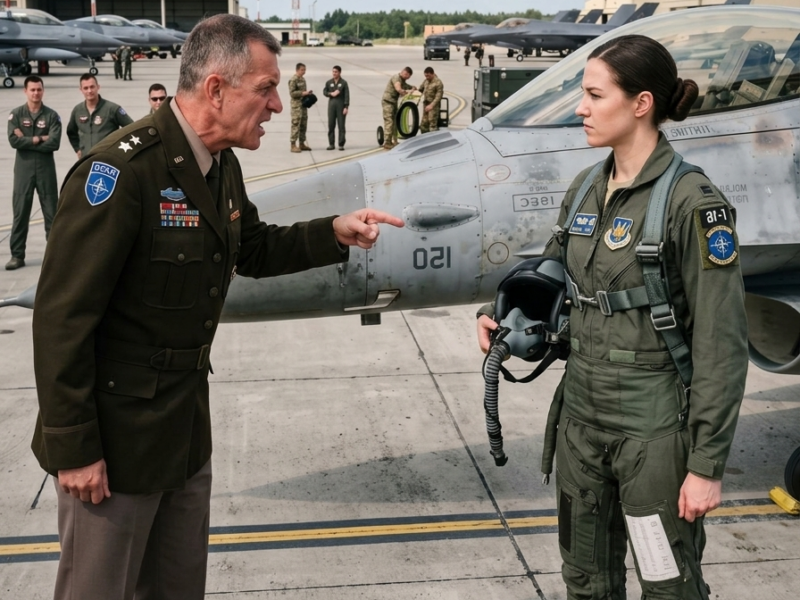
The commander tossed me the oldest fighter on the flight line and laughed when he said, “Bring this wreck back if you can,”
The commander tossed me the oldest fighter on the flight line and laughed when he said, “Bring this wreck back if you can,” but when the hangar doors opened that night, nobody recognized the woman who stepped out of it—or what she had just survived.
The aircraft looked like it belonged in a museum. Its Radar Absorbent Material coating was peeled and faded to a splotchy, dull gray, one maintenance panel beneath the wing root had been patched with mismatched, unpainted sheet metal, and its twin engines carried a legendary reputation across the base for failing at the single worst possible moment.
Captain Reed, standing beside Commander Vance with his arms folded across his chest, pointed a gloved finger at the battered fuselage. “That’s yours, Vance. Try not to embarrass us in front of the regional inspection team.”
The other pilots standing outside the ready room laughed, their voices ringing hollow against the wet asphalt of the apron.
I climbed the rusted boarding ladder without answering a single word. I had learned early in my career that arrogance was loud, but true knowledge was silent. What Reed and the rest of the squadron didn’t know was that I had flown inside that exact cockpit years earlier—back when my father, Major Thomas Vance, was still alive, sitting in the instructor’s seat behind me, teaching me how to read a failing engine not by digital diagnostic displays, but by the subtle, harmonic vibration beneath my boots.
The scheduled mission was supposed to be embarrassingly simple: a routine functional test flight beyond the restricted boundaries of the training range, pushing the restored airframe to its low-altitude limits, and returning to base before midnight. A token assignment given to a disgraced officer’s daughter.
I flipped the legacy toggle switches, engaged the auxiliary fuel pumps, and felt the old airframe shiver as its vintage turbines groaned to life. The canopy glided shut, sealing out the smell of rain and stagnant jet fuel, replacing it with the dry, sterile smell of bottled oxygen and forty-year-old insulation.
As I taxied out onto the dark runway and slammed the mechanical throttles forward into full afterburner, the twin engines roared with a deep, guttural vibration that resonated straight into my chest. The jet vaulted into the cloud-choked midnight sky over the Nevada desert.
Twenty minutes into the flight, ten miles beyond the western edge of the restricted range, my tactical radio suddenly crackled with heavy, artificial static.
“Unidentified aircraft approaching on vector two-seven-zero,” the automated warning system chimed.
My stomach tightened. I flicked the analog radar band to active scanning.
The primary display swept once. A single crimson contact blipped on the screen. Then the sweep returned, and the contact split. Four contacts. Then eight. Then twelve. A dense, low-flying strike formation moving with terrifying speed through the radar blind spots of the mountain canyons.
I clicked my collar mic. “Command, this is Vanguard-6. I have twelve fast-movers crossing the western boundary. Confirm those aren’t ours.”
Static answered. Complete, suffocating radio silence from the base.
I looked down at the battered control stick and the scratched glass of the analog dials. The old jet shook violently as I pushed the throttle levers past the military power detent, forcing maximum fuel into the afterburners. One warning light after another flickered on the caution panel: hydraulic pressure dropping, oil temperature spiking into the red zone.
I almost laughed aloud into my oxygen mask. “Come on, old girl. Show them what you’re made of.”
She answered with a deep, resonant roar that vibrated through the frame, defying the warning lights, surging forward as if the metal itself remembered how to hunt.
I pulled hard on the stick, vaulting the aircraft directly into the dense, rain-heavy cloud deck above. Below me, the unmarked hostile formation sliced through the canyon floor, their radar systems swept forward, completely oblivious to the ancient, non-stealthy fighter hovering in the blind spot directly above their flight path.
For the next forty-five minutes, I used every trick my father had taught me during those late-night flight-line ground schools. I stayed low, scraping the canyon walls, turning off my active radar entirely to become a ghost, letting the terrain mask my engine signature. I maneuvered between radar shadows, letting the supposedly worthless, obsolete fighter vanish into the atmospheric chaos. One by one, confused by the ghost signature echoing through the canyon walls, the hostile aircraft broke away from their vector, unable to acquire a solid missile lock on an airframe that moved like a shadow.
When I finally turned back toward the base, dawn was just touching the eastern horizon, painting the sky in ribbons of bruised gold and crimson. The left engine was sputtering, feeding on fumes and prayer, as the damaged jet rolled slowly down the main taxiway toward Hangar 4.
The runway ground crew stopped their work, staring in absolute silence as the smoking, oil-stained fighter glided to a halt. Captain Reed stood beside Commander Vance near the maintenance bay. Neither spoke. Their faces were pale, paralyzed by shock.
I popped the canopy, unbuckled my flight harness, and climbed down the ladder into the crisp morning air. My flight suit was soaked with sweat, my hands raw from holding the vibrating control stick.
Commander Vance stepped forward, looking at the scorched fuselage, then at me. “How? That airframe was cataloged for scrap next week. How did you evade an active radar sweep in a flying museum?”
Without a word, I reached into my inner pocket, pulled out a faded, plastic-laminated photograph, and handed it to him.
His expression changed instantly. The color drained from his face.
The photograph showed my father standing beside this very same aircraft twenty years earlier, his helmet tucked under his arm, a confident smile on his face. On the back, written in his sharp, distinct handwriting, was a single sentence:
When they give you the worst plane, remember what they don’t know about it.
Commander Vance looked up from the photo, his voice cracking slightly. “Your father… Major Vance flew this exact tail number?”
I nodded slowly, my eyes locked on his. “He didn’t just fly it.” I looked back toward the smoking cockpit. “He disappeared in it.”
Before anyone could respond, before Reed or Vance could ask another question, the legacy HF radio speaker mounted inside the idling cockpit suddenly burst to life with high-voltage static.
A low, gravelly voice whispered my name through the speaker.
“Emily…”
I froze in my tracks. My heart stopped beating. I would know that voice if I heard it through forty years of dead silence. It was my father’s voice.
And then, as the entire hangar crew stood frozen in absolute terror, the radio uttered one final sentence that made the morning air turn to ice:
“Don’t let them take the aircraft back.”
The static dying out from the cockpit radio left a silence so absolute you could hear the oil dripping onto the concrete floor beneath the jet. Commander Vance took an involuntary step back, his eyes darting from the cockpit speaker to my face, his hand resting nervously against his sidearm holster.
“What kind of joke is this, Captain Vance?” Reed snapped, stepping forward, though his trembling hands betrayed his artificial courage. “Did you wire a receiver into that cabin before you took off?”
“Shut up, Reed,” I said softly, not looking at him. My eyes were fixed on the master avionics panel inside the cockpit, where a legacy data lamp was still pulsing in a slow, rhythmic pattern—a three-pulse burst that wasn’t part of any standard Air Force signal protocol.
“Secure the aircraft immediately!” Commander Vance barked to the surrounding security airmen, his voice laced with a sudden, desperate panic. “Nobody touches this airframe! Tow it directly to Storage Hangar 9 and lock it down under Black-Level security!”
“Wait!” I demanded, stepping into his path. “That signal originated from an active military transponder using my father’s private encryption key. That call sign hasn’t been active since his jet vanished over the Nevada range six years ago!”
“Your father died six years ago, Emily!” Vance shouted, his eyes wide, his posture rigid. “His body was never recovered because his plane hit the lake bed at Mach 2! What you just heard was an electronic echo—a delayed relay from a legacy tower or a sick prank by someone who hacked your frequency! Now step aside, Captain! That is a direct order!”
Two armed security guards moved between me and the jet. I watched as a heavy tow tractor backed up to the nose gear, hooked the tow bar, and began dragging the battered fighter away toward the isolated perimeter of the base, where Hangar 9 stood behind double chain-link fences and razor wire.
I didn’t argue further. I knew that pushing Vance now would only end with me in a holding cell. Instead, I turned on my heel and walked toward the personal locker room, my mind racing through every line of flight telemetry I had memorized over the last six years.
Six years ago, my father had taken off in tail number #014 for a high-altitude weapons test over the Groom Lake corridor. Three hours into the flight, his beacon had flickered out, his telemetry had been wiped from the main radar grid, and the Air Force board of inquiry had declared it an catastrophic spatial disorientation accident. Case closed. Sealed under national security classifications.
Yet here was tail number #014—the exact airframe I had just landed—sitting on our tarmac, claimed to have been retrieved from a graveyard facility in Arizona three months ago. But planes don’t come back from Mach 2 crashes on dry lake beds.
The Air Force hadn’t retrieved a wreck from Arizona. They had been hiding the original plane all along.
At midnight, carrying a concealed tactical flashlight and a hand-held frequency scanner I had built during my years as an avionics engineer, I slipped through the shadow of the maintenance buildings toward Hangar 9. The rain had picked up again, washing over the asphalt, masking the sound of my boots.
The perimeter gate to Hangar 9 was locked with a heavy digital keypad. But my father had taught me that military security contractors always left manual overrides in legacy facilities built before the nineties. I bypassed the electronic lock by shorting the secondary junction box beneath the floodlight housing using a simple copper wire jumper.
The steel access door clicked open with a quiet, metallic pop.
I slipped inside, closing the heavy door behind me. The interior of Hangar 9 was pitch black, smelling of rust, hydraulic fluid, and ozone. I clicked my flashlight to its lowest red-light setting and swept the beam across the floor.
Tail number #014 sat in the center of the bay, its dark silhouette looming like an ancient leviathan.
I climbed the boarding ladder, pulled myself into the cockpit, and lowered the canopy slightly to prevent any light bleed. I reached beneath the pilot’s seat, pressing my fingers into the narrow gap behind the ejection rails—a hidden compartment my father used to store his personal flight logs when he flew classified routes.
My fingertips brushed against cold, hard steel.
I pulled out a small, metallic cylinder—a hardened digital flight recorder drive, painted high-visibility orange, but scratched and scorched by intense thermal heat. Stenciled on the side in black enamel were three letters: PROJECT CASSANDRA.
I plugged my hand-held scanner directly into the drive’s diagnostic port. The small LED screen illuminated, flashing blue lines of decrypted text across my eyes:
FLIGHT LOG: TAIL #014
PILOT: MAJOR T. VANCE
STATUS: DISPATCHED TO SITE 4
REASON: SYSTEM SABOTAGE DETECTED. ON-BOARD OVERRIDE ENGAGED BY GROUND COMMAND.
My breath hitched in my throat. My father hadn’t crashed due to pilot error. His flight controls had been remotely hijacked from the ground. He had ridden the plane down, fighting the automated system until the very last second, using a manual hydraulic override to bring the jet down intact in a remote canyon, hiding the airframe before he vanished into the desert.
“Fascinating, isn’t it?” a cold, calm voice spoke from the darkness below the cockpit.
I snapped my flashlight beam down.
Standing at the base of the ladder, holding a silenced pistol pointed directly at my chest, was Commander Vance. Beside him stood Captain Reed, holding a heavy laptop connected to the hangar’s main power distribution grid.
“You really are your father’s daughter, Emily,” Vance said softly, his face illuminated by the harsh glow of Reed’s computer screen. “Curious. Righteous. Completely blind to the reality of command.”
“You hijacked his plane,” I whispered, keeping my hand steady against the hidden drive. “You remote-piloted his jet to kill him because he found out what Project Cassandra was.”
“Project Cassandra is the future of automated warfare, Captain!” Reed interjected sneeringly. “A system that allows ground operators to override any tactical aircraft in real-time if a pilot disobeys orders or attempts to defect. Your father was going to blow the whistle to Congress. We couldn’t allow one man’s moral vanity to destroy a forty-billion-dollar defense contract.”
“And the attack tonight?” I demanded, eyeing the distance between the cockpit sill and the hangar floor. “The twelve hostiles in the canyon?”
Commander Vance smiled—a hollow, terrifying expression. “There were no hostile aircraft, Emily. Those were automated target drones running Cassandra telemetry. You were meant to crash tonight. You were supposed to be the final proof that tail number #014 was structurally unsafe, closing the book on the Vance family forever.”
He raised his pistol, aligning the sights with my forehead. “Now, give me the drive.”
“If you shoot me, Commander, the master encryption key on this drive automatically broadcasts to the NORAD regional server network via the aircraft’s emergency beacon,” I said, lying with every drop of confidence left in my blood.
Commander Vance’s finger paused on the trigger. He glanced briefly at Reed, who was tapping frantically on his laptop keys, trying to verify my claim.
“Is she telling the truth?” Vance demanded under his breath.
“I… I can’t tell, sir!” Reed stammered, sweat glistening on his forehead in the dim light of the screen. “The avionics architecture on this old airframe is entirely analog-hybrid! The system isn’t matching our modern protocols!”
That single second of hesitation was all I needed.
I reached out with my left boot and kicked the heavy steel boarding ladder with all my strength. The ladder slipped off its mounting hooks, crashing down directly onto Commander Vance’s head and shoulder. His pistol discharged with a muffled crack, the bullet ricocheting harmlessly off the cockpit’s reinforced canopy glass.
Vance stumbled backward, roaring in pain, dropping his weapon onto the concrete.
I dropped from the edge of the cockpit frame, landing heavily on Reed. We crashed onto the hangar floor in a tangle of limbs, the laptop flying out of his hands and smashing against the concrete deck, its screen shattering into dark spiderwebs.
I drove my elbow into Reed’s jaw, knocking him half-unconscious, scrambled to my feet, and snatched Vance’s fallen pistol from the floor. I leveled it at Commander Vance as he struggled to stand, holding his bleeding shoulder.
“Don’t move!” I barked, my lungs burning, my heart pounding against my ribs like a trapped bird.
Vance looked at the gun, then up at my eyes, letting out a bloody, bitter laugh. “You think you’ve won, Emily? Look around you! This entire base is under my command! Every security guard, every radar operator, every maintenance crew answers to my operational authority! You’re a rogue pilot standing in a locked hangar with a stolen weapon!”
“Then let’s see how loyal they are when they hear your voice on the emergency channel,” I said.
I grabbed the hardened orange drive from my vest, jammed it into the auxiliary port of the maintenance console on the wall, and smashed the red BASE-WIDE ANNOUNCEMENT button with the butt of the pistol.
The facility’s high-decibel emergency speakers erupted with a loud, warbling tone that echoed across all four square miles of Nellis Air Force Base.
Simultaneously, the raw, unedited audio recording extracted from Project Cassandra’s flight log began to play through every speaker on the base, its high-voltage amplification carrying my father’s voice straight into the night air:
“This is Major Thomas Vance, tail number #014. Ground command has locked my flight controls via Project Cassandra interface. Commander Vance and Captain Reed have compromised the flight control systems for illegal contractor testing. I am executing manual hydraulic override… if I do not survive, this recording serves as sworn testimony of treason…”
Commander Vance’s face turned completely white. The audio was broadcasting live to every ready room, every barracks, and every security post across the entire installation.
Outside Hangar 9, heavy siren alarms began to scream in rhythm with the broadcast. Tires squealed across the wet pavement as multiple Security Forces vehicles rushed toward the perimeter fence, their red and blue strobe lights flashing through the frosted glass of the hangar doors.
“You’ve destroyed us,” Reed whimpered from the floor, clutching his broken jaw.
“No,” I said, keeping the pistol trained on Vance as the heavy steel hangar doors were suddenly smashed open from the outside by a tactical security vehicle. “You destroyed yourselves six years ago. I just brought the truth back to the light.”
A dozen heavily armed Security Forces airmen poured into the bay, their rifles raised, led by the base Security Chief—a Master Sergeant who took one look at the bleeding Commander, listened to the voice still echoing over the base speakers, and immediately turned his weapon toward Vance.
“Commander Vance, Captain Reed,” the Sergeant ordered, his voice cold and unwavering. “Step away from the officer. Place your hands behind your head immediately.”
Vance slowly raised his hands, his eyes fixed on mine with a quiet, burning hatred as the airmen handcuffed him and dragged him out into the rain.
As the hangar cleared, I leaned heavily against the cold wing of tail number #014, letting out a long, shuddering breath. The orange drive on the console was still glowing steady blue, its transmission complete.
Suddenly, the legacy radio inside the cockpit gave a quiet, singular click.
A soft, low hum filled the frequency—not static, but the clear, clean sound of an open cockpit microphone flying through a calm, high-altitude sky.
I walked back to the cockpit, my hands trembling, and put the headset to my ear.
“Good flying, kiddo,” a soft, distant voice whispered through the receiver, light and warm as a summer breeze over the mountains. “I knew you’d find it.”
The frequency died completely, returning to clean, empty silence.
I stood in the quiet hangar, looking out through the open doors at the storm clouds breaking above the runway, revealing the first bright stars of the morning sky. My father was finally at peace. And for the first time in six years, so was I.
By noon the following day, Nellis Air Force Base was under the total lockdown of the Air Force Office of Special Investigations and federal prosecutors from the Department of Justice. Black sedans lined the administrative parking lots, and armed guards from outside units had taken over every access control point on the flight line.
Commander Vance and Captain Reed had been transferred under heavy escort to a federal military detention facility in California, facing charges of high treason, murder, and illegal weapons proliferation.
I sat alone in the small briefing room inside the main operations center, a warm cup of coffee resting untouched on the polished oak table before me. The door clicked open, and a tall, grey-haired officer wearing the three-star insignia of a Lieutenant General stepped inside, closing the door behind him.
General Marcus Sterling—Head of Air Force Global Strike Command—looked at me with quiet, searching eyes before taking a seat across the table.
“Captain Vance,” Sterling began, his voice deep and measured. “I’ve spent the last six hours reviewing the recovered flight data from Project Cassandra, as well as the audio files retrieved from tail number #014. What happened to your father six years ago was an absolute tragedy… and a dark stain on the integrity of this institution.”
“It was murder, General,” I said quietly, looking him straight in the eye.
Sterling nodded slowly. “Yes. It was. Vance and his conspirators weaponized an experimental system for personal profit, using black-budget defense funds to build an untraceable backdoor into our operational fleet. Your father tried to stop them, and he paid the ultimate price.”
He opened a thick leather folder on the table and pushed a official document toward me.
“The Secretary of the Air Force has officially cleared your father’s record,” Sterling continued. “Major Thomas Vance has been posthumously awarded the Air Force Cross for extraordinary heroism. His name will be enshrined at the Academy tomorrow morning.”
I looked at the document, feeling a lump form in my throat. Six years of disgrace, six years of whispering behind my back in every ready room across the country, wiped clean by a single sheet of official parchment.
“And what about tail number #014?” I asked.
Sterling smiled slightly, a glint of genuine admiration in his eyes. “That aircraft is a piece of living history, Captain. Technically, it should be dismantled for technical evaluation… but after what you did in those canyons last night, proving that an analog-hybrid system can bypass modern autonomous warfare hacking, the Pentagon wants to preserve it.”
He tapped a second document inside the folder.
“We are forming a specialized flight-testing detachment at Edwards Air Force Base—the Tactical Legacy Evaluation Squadron,” Sterling explained. “Our mission will be testing manual, un-hackable flight control architectures to protect our future fleet against systems like Cassandra. And I want you to command it.”
I looked down at the document. Stamped at the top in gold lettering was my name, beside my new rank: MAJOR EMILY VANCE.
“You’re offering me a squadron?” I asked, looking up in surprise.
“I’m offering you the squadron your father should have commanded,” Sterling corrected gently. “And tail number #014 will be your personal flagship.”
I sat back in my chair, looking out the double-pane windows toward the tarmac where the old fighter was parked under the bright afternoon sun, its battered frame glistening like silver against the desert horizon.
I thought about the dark canyons, the roaring engines, and the quiet voice that had called to me through forty years of dead static. I knew what my answer had to be.
“I accept, General,” I said, standing up and executing a crisp, perfect salute. “On one condition.”
Sterling stood and returned the salute. “Name it, Major.”
“Nobody touches the paint on #014,” I said with a faint smile. “She earned every scratch.”
Three months later, the morning sun over Edwards Air Force Base burned bright and golden across the vast, brilliant white expanse of the Rogers Dry Lake bed.
I stood on the concrete apron outside Hangar 1, wearing a brand-new flight suit with the Major’s insignia pinned to my collar and the newly minted patch of the Tactical Legacy Squadron sewn onto my right shoulder.
Behind me, tail number #014 sat polished and pristine, its mismatched panel still proudly visible beneath the left wing root, its twin engines fully restored by a team of master mechanics who treated the ancient jet with the reverence given to a sacred relic.
“All systems checked and green, Major Vance,” my new chief crew inspector reported, stepping down from the ladder with a broad smile. “She’s purring like a kitten.”
“Thanks, Chief,” I said, putting on my flight helmet and clicking the chin strap shut.
I climbed up the ladder, pulling myself into the familiar, comfortable sanctuary of the cockpit. The smell of old leather and ozone welcomed me like an old friend. As I settled into the ejection seat, I looked at the small brass plaque I had installed on the starboard side of the instrument panel, engraved with my father’s quote:
When they give you the worst plane, remember what they don’t know about it.
I flipped the battery switches, engaged the starters, and listened as the twin turbines roared into life, their deep, resonant vibration shaking the airframe, surging straight into my boots.
I taxied out onto the long, endless strip of dry lake bed concrete—the very same dry lake where flight pioneers had broken the sound barrier decades ago, where my father had learned to fly, and where the sky stretched out wide, clean, and infinite.
“Edwards Tower, Vanguard-1 ready for departure,” I reported into my collar mic, my voice calm, steady, and clear.
“Vanguard-1, Edwards Tower. You are cleared for takeoff on runway zero-nine. Skies are clear, Major. Have a great flight.”
I slammed the throttles forward into full afterburner.
The old jet surged forward with violent, beautiful acceleration, its tires screaming against the lake bed before lifting cleanly into the air. I pulled hard on the flight stick, rocketing straight up toward the heavens in a near-vertical climb, banking hard toward the endless blue horizon.
As I leveled off at thirty thousand feet, floating weightless above the clouds, the sun illuminated the cockpit with blinding, brilliant gold light.
I reached out and clicked the HF radio selector switch once, opening the legacy channel to the quiet, empty sky.
“Vanguard-1 to Raven-12,” I whispered into the oxygen mask, looking up at the wide, peaceful expanse above me. “The sky is clear, Dad. We’re flying clean.”
There was no static. No warnings. No shadow in the cockpit.
Only the smooth, powerful hum of the engines, the rush of the wind against the canopy, and the quiet, absolute peace of a promise kept.
The end.









