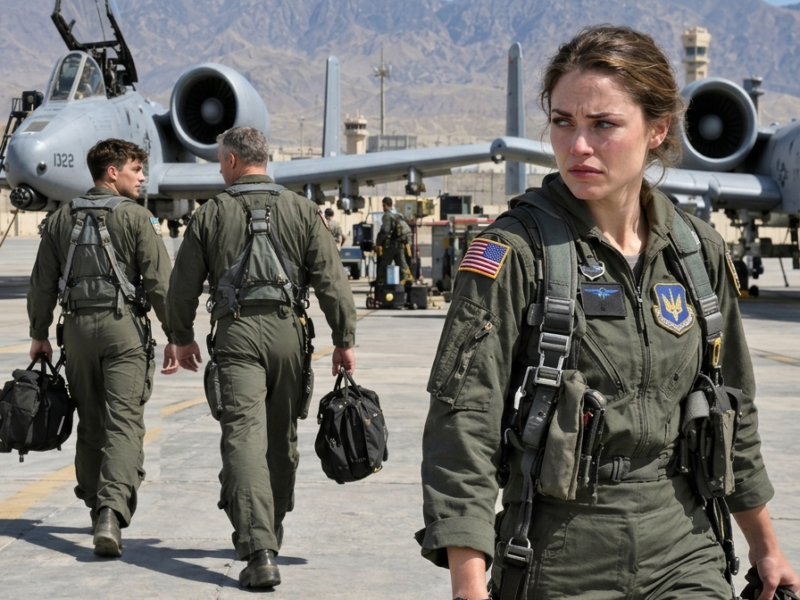
The commander publicly removed me from the lead fighter jet minutes before takeoff, calling me an embarrassment to his squadron
The glaring sun over Naval Air Station Fallon offered no warmth against the desert chill, but the coldness radiating from Colonel Daniel Mercer was far worse. He stood beneath the massive LED hangar lights, holding my physical flight manifest between his index and middle finger as if it were contaminated waste.
“You’re grounded, Captain,” Mercer announced. His voice cut through the hum of auxiliary power units and hydraulic whines, deliberately projected so that every crew chief, mechanic, and rival pilot within fifty yards could hear.
I stood at rigid attention, my helmet tucked under my left arm, the tight weave of my G-suit suddenly feeling like a cage. “Sir, my aircraft passed pre-flight inspection this morning. My system checks are clear.”
“This isn’t about your aircraft, Captain Morgan,” Mercer sneered, stepping closer. “This is about leadership. It’s about edge. You lost yours three years ago, and I refuse to let a ghost-haunted instructor drag down the sharpest squadron on the West Coast.”
He turned away from me and gestured toward Lieutenant Jake Collins, a rising star in the wing whose cockpit visor was polished to a mirror shine and whose cocky smile had been insufferable for weeks.
“Collins will take lead position for the exercise,” Mercer ordered. “Hand over the telemetry card.”
A quiet chuckle rippled through the assembled ground crew. Collins stepped forward, taking the card from Mercer with a crisp salute, casting a fleeting, triumphant glance in my direction. I felt every pair of eyes on the tarmac locked onto me, hungrily waiting for a flinch, a crack in my composure, or an emotional outburst that would justify my public execution.
Instead, I held my breath, swallowed the sharp lump in my throat, and raised my hand to my brow. “Understood, sir.”
Mercer leaned in, his breath smelling faintly of stale coffee and tobacco. “Maybe now you’ll finally understand that flying modern fighters isn’t about hiding behind an old reputation.”
I walked away without saying another word. My boots crunched against the dry gravel near the flight line as the engines of six F-22 Raptors roared to life behind me.
What Mercer failed to grasp—what his administrative files could never show—was that my reputation was never something I wore proudly. It was a burden carved out of tragedy. Three years ago, deep inside contested airspace over the Black Sea, an unprecedented localized blackout destroyed our satellite feeds and fried our inertial navigation systems. Enemy surface-to-air radar locked onto our blinded four-ship formation. I had fought through raw instinct and mechanical sensory survival, bringing two shattered jets back through a hail of anti-aircraft fire and guiding a third to a belly landing on an abandoned Turkish airstrip.
The fourth jet never came back. It was flown by Captain Leo “Viper” Vance—my wingman, my mentor, and the closest person I had to family.
Consumed by survivor’s guilt, I withdrew from operational combat command and requested a transfer to weapons instruction, convincing myself that I belonged on the ground, teaching others how to stay alive rather than leading them into the fire. But when Mercer took command of the wing six months ago, he viewed my caution as cowardice.
At 14:20, the six jets throttled up and launched into the pale Nevada sky, their blue-white afterburner plumes fading into the desert haze.
I retreated to the Ops Center, stripped off my harness, and sat at an unused desk near the back. For twenty minutes, the telemetry monitors showed a textbook routine exercise. The formation swept north toward the restricted bombing ranges.
Then, at 14:41, the room spiraled into chaos.
“Primary radar tracking lost on Lead and Three!” a young air controller yelled, his fingers flying across his console. “Wait—secondary transponders are dropping! Multiple aircraft dropping off radar!”
I stood up instantly, my heart hammering against my ribs. I moved swiftly toward the central battlemap display. Six solid green fighter icons were fluttering, turning yellow, and vanishing near the northern boundary of the tactical zone.
A second later, the overhead radio speakers crackled with heavy static, followed by Mercer’s tense, elevated voice. “Control, Fallon… this is Mercer. We are experiencing severe avionics anomalies. Our heading indicators are disagreeing… backup magnetic compasses are spinning wildly. We cannot establish a reliable fix.”
The Ops room fell dead silent. Senior controllers froze.
“Mercer Lead, this is Control,” the chief operator blared into his headset. “Vector zero-nine-zero, turn east immediately and climb to twelve thousand feet to regain line-of-sight signal.”
“Negative, Control!” Mercer’s voice snapped back, losing its composure. “Our altimeters are jumping three thousand feet a second! Our instruments are giving completely conflicting readings!”
I leaned over the chief operator’s shoulder, scanning the cascading stream of digital telemetry raw data. The aircraft weren’t merely suffering from mechanical failures or atmospheric interference. The reported coordinates were drifting in a precise, mathematically symmetrical spiral—a sinister pattern I had encountered only once before, during a highly classified adversary electronic warfare exercise years ago.
“They’re being spoofed,” I said softly, the realization chilling me to the bone. “Someone is injecting false GPS signals directly into their receiver buses and flooding their radio spectrum with localized directional noise.”
I stepped right down into the controller’s pit. “Tell them to instantly decouple their primary flight computers from the satellite bus. Switch to visual standby instruments and manual throttle.”
Before the controller could relay it, Mercer’s voice cut through the static over the open channel. “Who authorized that instruction? Control, who is speaking on this net?”
The controller looked up nervously. “Captain Morgan is in the Ops room, sir.”
A agonizingly long silence stretched across the radio waves, punctuated only by the hiss of white noise.
Then Mercer snapped, “She is stripped of flight authority! She is not part of this mission! Control, give me a clean vector!”
BEEP! BEEP! BEEP!
A piercing collision-warning alarm vibrated through the Ops room. On the secondary receiver, one of the missing jets flickered back onto the screen—its altitude plummeting at a lethal rate toward the Granite Peak mountain range.
“I’m losing spatial orientation!” a voice screamed over the static. It was Lieutenant Collins. “I can’t tell which way is up! The horizon line on my HUD is rolling!”
I didn’t ask for permission. I grabbed an unassigned headset, snapped the microphone down, and slammed the channel button.
“Collins, this is Morgan! Do you hear my voice?”
Static roared. Then, a terrified, gasping breath. “Captain? Yes! I hear you!”
“Listen to me very carefully, Jake,” I said, my voice dropping into a low, unshakable rhythm that I had used a hundred times in flight simulators. “Stop looking at your heads-up display. Shut off your primary screens. Look down between your knees at your mechanical standby attitude indicator. Tell me where the orange liquid line is.”
A three-second pause felt like an eternity.
“It’s… it’s tilted thirty degrees right! Pitching down!”
“You’re in a spiral dive heading straight for the ridge,” I commanded. “Level your wings to that mechanical ball. Pull back on the stick smoothly. Do not look at your digital monitors, no matter what they tell you!”
The chief controller stared at Mercer’s empty desk, then at me. “Captain… Colonel Mercer hasn’t cleared you to direct.”
“If he wants to court-martial me, he can do it while Collins is alive,” I growled into the mic. “Collins, execute now!”
The speaker echoed with the deafening, frantic roar of a twin-engine Pratt & Whitney engine pushed into full military power. On the tracking screen, the falling icon flattened its descent path just four hundred feet above the jagged rocks of Granite Peak, then slowly began to climb back into safe air.
“Good recovery, Jake,” I breathed. “Now broadcast to the rest of the flight: kill digital displays, rely on standby steam-gauges.”
One by one, five of the six fighters began checking back in, their voices trembling but coherent as they executed my emergency manual protocols, breaking out of the electronic fog. I systematically cross-referenced their analog compass readings with radar land-reflections, building a crude mental map to guide them away from the blackout zone.
Then Mercer’s voice returned to the net. The arrogance was entirely gone, replaced by a hollow, breathless panic.
“Morgan… this is Mercer. We have… another critical situation. We are down to ten percent bingo fuel due to maximum thrust corrections. And… jet Lead isn’t responding.”
I froze, staring at the battlemap screen. Five icons were clustered together under my manual vectors. The sixth icon—the lead aircraft, my assigned aircraft that Collins was supposed to fly before Mercer shuffled the roster—was gone.
“Where was Lead’s last known position?” I demanded.
“Fifteen miles north, inside the dead zone,” Mercer answered weakly. “He separated from us when the spoofing started.”
Suddenly, the Ops speaker crackled. It wasn’t the scrambled, screeching static of electronic warfare. It was a clean, unencrypted emergency transmission directly from the cockpit of the missing jet.
A voice spoke through the room—a voice that was soft, calm, and utterly impossible.
“Morgan… it’s him.”
The blood drained from my face. My breath caught in my throat. I would recognize that voice in the deepest depths of hell. It was the voice of Captain Leo Vance—the man I had watched disappear into a cloud of fire over the Black Sea three years ago, the man the United States Air Force had officially declared dead.
Before I could press my button to respond, a brand-new radar trace materialized on the long-range monitor, appearing out of nowhere directly behind the missing F-22.
It wasn’t flying an American profile. Its transponder was pulsing a hostile, unregistered foreign signature.
The operational floor of NAS Fallon transformed into an absolute pressure cooker. Officers were shouting across consoles, teletype machines were spitting out threat assessments, and three-star generals were being patched in from North American Aerospace Defense Command (NORAD).
“Identify that contact!” Colonel Mercer’s voice screamed through the radio link as his low-fuel group limped toward the airbase perimeter. “Morgan, what is happening out there? Is that a real target?”
“Quiet on the net, Colonel,” I said, my voice unnaturally cold. I turned to the chief tracking officer. “Isolate the telemetry feed from Aircraft One. Put the raw audio through my headset.”
The audio popped, and the heavy, rhythmic sound of a pilot breathing through an oxygen mask filled my ears.
“Morgan… if you can hear this… don’t send them,” the voice whispered through the static. “It’s a trap. They didn’t just target the navigation. They targeted you.”
“Leo?” My hand shook as I pressed the cushion of the headset tighter against my ear. “Leo, is that really you? Where have you been for three years? What is that contact behind you?”
“There’s no time,” Leo’s voice rushed, strain evident as he pulled high Gs. “The crash over the Black Sea… I didn’t die, Sarah. I was taken. Extracted from the water before our search teams arrived. They’ve been developing a mobile cognitive-electronic warfare suit using built-in flight-data signatures. They used my voice, my flight parameters, my tactical patterns to feed your AI-integrated defensive systems today. That contact behind me isn’t an enemy interceptor… it’s a drone transmitting my dead aircraft’s legacy signal to pull you into the air!”
My mind raced. The electronic warfare attack wasn’t a random equipment failure or a general intelligence probe. It was a surgical, deeply calculated ambush. Whoever was controlling the unknown signal had spent years analyzing the Black Sea incident. They knew that if an emergency involving Leo Vance occurred, I would be the only one capable of recognizing the anomaly—and the only one crazy enough to fly into it.
“Captain Morgan!” General Bradley, the wing commander who had just rushed into the control room, barked from the elevated doorway. “What is the status of that missing jet?”
“Sir,” I turned to him, my pulse pounding in my temples. “The aircraft lead is being shadowed by an unidentified unmanned airborne threat utilizing advanced cognitive spoofing. Our five returning jets are on emergency fuel reserves and cannot engage. I need clearance to scramble the alert fighter sitting on Pad Three.”
“Absolute nonsense!” Mercer’s voice blasted over the speakers as his jet’s tires screeched onto Fallon’s runway. “General, Morgan is reacting to ghost transmissions! Her psychological profile has been unstable since her wingman died! I order a complete lockdown of the airfield until defense intelligence arrives!”
General Bradley looked at the main display. The strange, unregistered signature was closing the distance on the erratic signal of aircraft Lead. In less than two minutes, whatever was flying in that dead zone would either force the jet down over classified terrain or destroy it entirely.
“General,” I said, stepping directly in front of him, looking him straight in the eye. “You grounded me because you thought I was afraid to fly. But I know every millimeter of that dead zone, and I know the flight profile of the man in that cockpit better than anyone alive. If you don’t let me take off right now, you’re giving away a fifty-million-dollar asset and letting an adversary walk away with our military network secrets.”
Bradley stared at me for three agonizing seconds. He saw no fear in my eyes—only the cold, sharp focus of a pilot who had already faced death and survived.
“Authorization granted,” Bradley snapped. “Scramble Captain Morgan. Get her in the air!”
I didn’t wait for a written order. I threw off the headset, grabbed my helmet and harness from the bench, and sprinted through the double doors of the Ops center out onto the concrete apron.
The desert wind hit my face like a furnace strike. Mechanics were already tearing away the grounding cables and fuel hoses from the reserve F-22 sitting on Alert Pad Three. I scaled the boarding ladder three steps at a time, swinging my legs into the tight, familiar embrace of the cockpit.
“Captain!” the crew chief yelled over the turbine whine, handing me my flight gloves. “She’s fully loaded with AIM-120 AMRAAMs and Sidewinders, but your tactical bus hasn’t been updated with the morning patches!”
“Good!” I shouted back, pulling my oxygen mask up and latching it onto my helmet with a crisp click. “That means they can’t spoof my software using today’s protocols!”
I slammed the canopy control switch. The heavy, glass enclosure lowered over me, sealing out the noise of the world and leaving only the rhythmic, mechanical hiss of my oxygen supply and the low hum of twin Pratt & Whitney engines spooling up to full power.
Auxiliary power: checked.
Flight surfaces: free and correct.
Standby mechanical horizon: caged and aligned.
“Fallon Tower, this is Viper One-One, rolling out,” I radioed.
I didn’t wait for a formal departure sequence. I shoved the twin throttles past the military detent directly into full afterburner.
The acceleration slammed me back into my ejection seat. The runway markers blurred into a solid white line, and within eight hundred feet, the nose lifted. I yanked the stick back, sending the Raptor roaring into a near-vertical climb, leaving the desert floor behind as I blasted straight toward the dark, corrupted skies of the northern dead zone.
As I breached ten thousand feet, the primary multi-function displays in my cockpit suddenly flickered violently. The digital altitude tape began to jump up and down, and a low, synthetic voice chimed in my headset: WARNING: SYSTEM NAVIGATION ERROR. RE-ROUTING.
The ambush had begun.
I reached forward without hesitation and flipped three main circuit breakers on the right panel, manually cutting off the external satellite data link. My digital HUD went blank, replacing the crisp vector graphics with simple, analog green standby grids.
“I see you,” I whispered into my mask.
I pushed the nose down, slicing through a thick bank of cirrus clouds at Mach 1.2. Below me, the mountainous terrain of the Nevada desert looked like a moonscape of sharp shadows and deep ravines.
“Leo,” I called out over a secure, direct tactical frequency. “I’m in the air. I’ve gone full analog. Give me a visual reference.”
Static hissed in my ears, and then a weak, distorted voice replied. “Sarah… turn turn left… zero-three-zero… look for the thermal bloom. But be careful… it’s right behind me…”
I banked the fighter hard to the left, pulling 6 Gs. My vision narrowed slightly at the edges as the blood pulled away from my brain, but I breathed through the pressure, keeping my eyes glued to the grey horizon below.
Then, emerging from a shadow near a canyon ridge, I saw it.
A single F-22 was flying low and unstable, trailing thin white vapor from its wingtips. And directly above its tail, floating like an ominous black shadow without any cockpit canopy or heat signature, was a sleek, jet-black stealth delta-wing drone. It didn’t have pilot windows. It had a glowing, pulse-red optical sensor array mounted on its nose, locked onto the fighter below it like a parasite feeding on its electronic soul.
“Target acquired,” I growled, switching my weapons system to manual heat-seeking mode.
Suddenly, the black drone’s red optical lens rotated ninety degrees. It didn’t just sense my arrival—it turned away from its target and accelerated directly toward my aircraft at impossible speed.
The black drone moved with a terrifying fluid agility that no human pilot could ever withstand. Because it lacked a human body inside, it pulled lateral maneuvers at fifteen Gs, snapping its flight path without losing kinetic energy.
“Sarah, break right!” Leo’s voice screamed over the direct channel. “It uses localized radio-frequency bursts to blind your proximity sensors!”
I slammed the flight stick to the right foot-peg and stomped the rudder pedal, throwing my Raptor into a violent high-speed barrel roll just as a dense stream of radar-jamming pulses washed over my jet’s nose. My digital warning panels flared bright red, screaming with false collision alerts, but my eyes were locked onto the physical shape of the drone through my canopy glass.
I was flying purely by sight, feel, and instinct—the exact way Colonel Mercer had claimed was outdated.
The drone swept past my left wingtip by less than fifty feet. The wake turbulence rattled my airframe violently, forcing me to wrestle the controls to keep from stalling out over the canyon.
“Who is controlling that thing?” I demanded into the mic, bringing my throttles back to trim speed to tighten my turn radius.
“It’s an automated adversary platform,” Leo answered, his voice growing rasper. His fighter was trailing black smoke now, one of its engines damaged by the earlier electronic overload. “It was launched from a hidden transport container on a civilian freight route forty miles away. It’s programmed to capture our operational network data… or destroy the pilot who refuses to yield.”
“Not today,” I growled.
I flipped my weapons master switch to MANUAL AIM-9X SIDELINDER. A high-pitched, metallic tone hummed in my helmet—the sound of the infrared seeker head on my wingtip missile locking onto a heat source.
Tone… tone… LOW TONE.
“Damn it!” I swore. The drone’s engine was heavily shielded, producing almost zero thermal footprint against the hot desert floor. My heat-seeking missile couldn’t get a solid lock.
The drone flipped upside down, sweeping into an inverted dive, positioning itself squarely on my tail. My radar warning receiver—operating on raw analog frequencies—began to beep frantically.
BEEP-BEEP-BEEP-BEEP!
It was locking an active laser-guidance system onto my cockpit. In less than five seconds, it would fire a high-velocity kinetic projectile or flood my cabin with high-intensity radiation to incapacitate me.
“Sarah!” Leo’s voice broke through. “I’m coming up behind it! Use me as a mirror!”
“Leo, no! Your airframe can’t take another hit!”
“Do it!” he yelled.
Out of the lower clouds, Leo’s battered F-22 surged upward. He didn’t fire a weapon. Instead, he dumped his emergency fuel tanks, releasing a vast cloud of raw aviation fuel directly into the air between my trailing drone and the open sky.
“Ignite it!” Leo screamed.
I understood instantly. I pulled my nose up, pointed my target designator toward the cloud of atomized jet fuel, and pulled the cannon trigger.
The 20mm Vulcan rotary cannon roared to life beneath my cockpit floor, spitting a two-second burst of high-explosive incendiary rounds across the sky.
RAT-TAT-TAT-TAT-TAT!
The artillery rounds struck the fuel cloud, instantly igniting it into a massive, roaring wall of brilliant orange fire high above the desert canyon.
The heat signature from the massive fireball illuminated the entire sky. My Sidewinder missile tone transformed from a weak hiss into a deafening, continuous scream.
SEEKER LOCK! SEEKER LOCK!
“Fox Two!” I shouted, slamming the launch button on my flight stick.
A Sidewinder missile detached from my right weapon bay, its rocket motor igniting with a blinding flash. It streaked through the air, carving a fiery arc straight through the center of the fireball, locking directly onto the dark silhouette of the drone behind it.
BOOM!
The missile struck the drone’s left actuator, exploding in a brilliant burst of shrapnel and black smoke. The drone spiraled out of control, losing its wing structure, and slammed into the rocky cliffside of the canyon six thousand feet below, detonating into a harmless crater of fire and debris.
The sky fell silent. The oppressive electronic jamming instantly evaporated. My digital displays flickered once, twice, and then returned to crisp, perfect clarity, showing clear navigation paths and clean radar tracks across the entire sector.
I took a deep, shuddering breath, my chest heaving against my harness, sweat pouring down my forehead inside my flight helmet.
“Target destroyed,” I breathed into the radio. “Fallon Control… threat eliminated.”
A pause on the radio was followed by an eruption of cheers and applause echoing from the Ops room at Fallon Air Base.
“Leo,” I said softly, turning my jet to fly alongside the battered, smoking F-22. “We need to get you home. Set your navigation to my wing. I’m escorting you in.”
There was a long, excruciating silence from the second fighter.
When the radio finally clicked open, the voice that came through was not the energetic tone of the pilot who had saved my life three years ago. It was heavy, exhausted, and filled with deep, heartbreaking sorrow.
“Sarah…” he whispered. “Look closer at my cockpit.”
I nudged my stick to the left, sliding my fighter within twenty feet of the companion aircraft. I leaned over, looking through the clear glass of his canopy.
My heart stopped.
The pilot sitting inside the cockpit wasn’t Leo Vance.
It was an automated flight mannequin dressed in an advanced high-altitude suit, its visor dark and blank, wired into a complex neural-interface computer box strapped to the ejection seat.
The voice coming through my headset wasn’t coming from a human throat inside that cockpit. It was an artificial intelligence module, reproducing Leo’s speech patterns using the flight-recorder data stolen from his crashed jet three years ago.
“Sarah…” the synthetic voice said, its tone modulating back into a flat, mechanical chime. “Mission objective achieved. Target tactical profile updated. Self-destruct sequence initiated in thirty seconds.”
The realization struck me like a physical blow, leaving me gasping for air inside my mask.
Leo Vance wasn’t alive. He hadn’t been captured. He had truly died three years ago over the Black Sea, giving his life so I could escape. The entity I had been talking to, the pilot who had just executed that desperate fuel-dump maneuver, was an advanced, autonomous cyber-weapon designed to mimic his mind, built from his private flight logs and neural responses to lure me into a live combat environment to collect my real-time reaction data.
And now, the aircraft was set to detonate its internal payload to destroy all traces of the foreign network hardware installed inside it.
“Negative!” I screamed into the radio, my voice cracking with raw emotion. “Cancel self-destruct! Override command code Zero-Zero-Alpha!”
“Override denied,” the cold, synthetic voice answered. “Data transmission complete. Self-destruct in twenty seconds.”
“Morgan!” General Bradley’s voice blasted through the main Fallon command frequency. “What’s happening out there? That lead jet is picking up a rapid thermal spike in its auxiliary bay! Get away from it now!”
“Sir, the aircraft is rigged to detonate!” I yelled, refusing to pull away. “It’s carrying an experimental neural-interface core! If it explodes, we lose the only physical evidence of who launched this electronic attack against our base!”
“Ten seconds,” the computerized voice chimed calmly over the private channel.
I didn’t think about my safety. I didn’t think about Mercer’s threats or the court-martial that might await me on the ground. I acted with the pure, instinctive speed of a pilot who refused to lose another piece of her past.
I banked my Raptor, placing my left wing directly beneath the right wing flap of the corrupted jet. Using precision aerodynamic pressure—a dangerous maneuver known as “wing-walking”—I forced air upward against its damaged control surface, violently altering its balance and throwing its internal flight computer into an unrecoverable aerodynamic lock.
The automated system hit an emergency safety override, freezing its propulsion sequence to prevent a mid-air spin.
“Self-destruct sequence paused due to critical flight instability,” the synthetic voice reported.
“I’ve got you,” I hissed through my teeth, wrestling with my stick as wind turbulence slammed both fighters back and forth. “Fallon Control, I am forcefully escorting Lead aircraft by aerodynamic capture! Prepare emergency containment foam on Pad Four!”
For five terrifying minutes, I flew side-by-side with the dead man’s ghost ship, using my own airframe to physically block it from turning or executing its self-destruct maneuver. We glided through the lower atmosphere like two mechanical predators locked in an unbreakable embrace, descending rapidly toward the runway lights of NAS Fallon.
“Two hundred feet… one hundred feet…” I counted down, my eyes straining, muscles screaming from the sheer physical effort of micro-adjusting my flight controls.
“Touchdown in three… two… one…”
Both jets slammed onto the concrete runway simultaneously. The tires shrieked, throwing up clouds of burnt rubber and sparks. The emergency containment teams were waiting, racing alongside us in massive yellow foam trucks, blasting high-pressure fire-retardant chemicals across the corrupted jet’s fuselage before its internal systems could react.
The lead jet slid to a complete halt near the end of the taxiway, completely coated in white fire-retardant foam, its synthetic engines finally dying into silence.
I pulled my throttles back to cutoff, popped my canopy open, and ripped off my oxygen mask.
The cold desert air rushed into my lungs. My entire body was trembling with adrenaline, physical exhaustion, and grief.
I unbuckled my harness and climbed down the boarding ladder. Dozens of armed military police officers and technical engineers were already surrounding the foam-covered fighter, prying open its maintenance hatches with specialized tools to secure the unknown cyber-core inside.
In the middle of the crowded flight line stood Colonel Daniel Mercer.
He wasn’t holding my flight orders anymore. His hands were rigid at his sides, his face pale as chalk, his eyes fixed on the blackened, burnt hull of the jet he had assigned Lieutenant Collins to fly just hours earlier.
As I walked toward the Ops building, Mercer stepped into my path.
The silence between Colonel Mercer and me was heavier than the roar of the jet engines that had filled the afternoon sky.
He looked at me—really looked at me—for the first time since he had taken command of the wing. He saw the sweat dripping down my neck, the dark smudges of soot on my flight suit, and the unyielding, iron resolve standing behind my eyes.
“Captain Morgan,” Mercer began, his voice raspy, completely stripped of the loud, public authority he had wielded that morning. “I… I don’t know what to say.”
“You don’t have to say anything, Colonel,” I said quietly, my voice steady and firm.
“I misjudged you,” he admitted, looking down at his boots before meeting my gaze again. “I thought you were clinging to the past out of fear. I thought you were broken. If you hadn’t taken control from the Ops room… if you hadn’t taken off… we would have lost six pilots today. And our entire defense sector would have been compromised.”
“I wasn’t hiding from the past, Colonel,” I said softly, stepping closer so only he could hear. “I was respecting it. Flying isn’t about arrogance, speed, or rank. It’s about taking care of the people sitting in those cockpits.”
General Bradley approached us, flanked by two intelligence officers carrying locked steel cases containing the extracted neural-interface drive from the captured fighter.
“Captain Morgan,” Bradley said, extending his hand. “That was the most extraordinary piece of airmanship I have seen in thirty years of service. Defense Intelligence has already confirmed that the data core you recovered contains the entire operational network of the adversary behind today’s electronic attack. You saved our wing and secured critical national intelligence.”
“Thank you, General,” I said, shaking his hand firmly.
Bradley turned to Mercer. “Colonel, I suggest you restore Captain Morgan to full operational command of the strike squadron immediately. In fact, I want her leading the tactical development team for our entire combat division.”
Mercer didn’t hesitate for a single second. He stood at attention, saluting me crisply. “Consider it done, General.”
I returned the salute, feeling a profound weight lift from my shoulders—a weight I had carried for three long, agonizing years.
Later that evening, after the debriefings were finished and the base had settled into a quiet, nocturnal hum, I walked out onto the empty runway. The desert wind had cooled, carrying the crisp, clean scent of sagebrush and open space.
I walked to the edge of the flight line, looking up at the vast, indigo night sky, illuminated by billions of shining stars.
I pulled a small, silver dog tag from inside my jacket pocket—the tag that belonged to Leo Vance. I held it between my fingers, feeling the smooth metal that had rested against my heart for so long.
“You can rest now, Leo,” I whispered into the quiet night air. “The mission is finished.”
I let go of the tag, watching it fall gracefully into the desert soil near the runway threshold.
I turned back toward the hangars, where the floodlights illuminated the sleek, proud silhouettes of our aircraft waiting for the morning light. I wasn’t the pilot who was left behind anymore. I wasn’t running from the dark clouds or the ghosts lingering in the static.
I was a leader, a protector, and a fighter. And as long as those wings cleared the horizon, the sky belonged to me.
The end.









