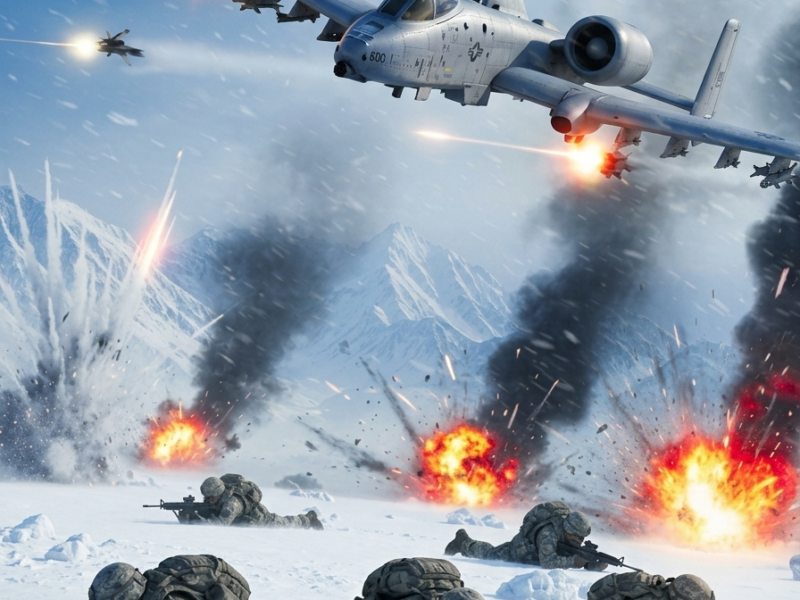
The command room went silent when they told me 385 SEALs were trapped beyond the ridge and ordered my A-10 to stay grounded, but I broke formation anyway
The green phosphor glow of the tactical displays in the underground command post at Bagram Airfield hummed with a low, oppressive static. Outside, the pre-dawn Afghan wind howled through the concrete revetments, carrying the scent of jet fuel, ozone, and frozen dust.
Inside, thirty senior officers stood around the central digital sandtable. Nobody was speaking. Nobody was moving.
On the glass projection map, a cluster of 385 blue tracking dots was jammed into a narrow, claw-shaped ravine in the jagged peaks of the Hindu Kush—a brutal, isolated high-altitude valley known on classified maps only as Sector 9. Around those blue dots, red threat vectors were converging from three directions like blood pooling around an open wound.
385 Navy SEALs, Rangers, and Special Forces personnel from Task Force Gray, pinned against a vertical wall of granite, out of heavy ammunition, and running out of time.
Colonel Arthur Vance—a cold, razor-thin intelligence coordinator whose starch-stiff flight suit never bore a single crease—stepped to the head of the briefing table. He reached out and tapped a single red button, turning the tactical sandtable display pitch black.
“Task Force Gray is compromised,” Colonel Vance announced, his voice totally flat, lacking a single thread of human emotion. “All close air support missions for Sector 9 are officially cancelled. All air assets currently holding on Orbit Bravo are ordered to return to base immediately. No aircraft will cross the ridgeline.”
A sharp, violent shockwave of disbelief rippled across the room.
I stepped forward from the back row of pilots, my flight helmet tucked under my left arm, my green Nomex suit stained with salt and hydraulic oil from a four-hour patrol I had finished just two hours ago. My call sign was Viper—Captain Laura Grayson, senior flight lead for the 75th Fighter Squadron, flying the A-10C Warthog.
“Colonel, with all due respect,” I said, my voice cutting through the heavy air like a razor blade. “They’re still breathing down there. I had tactical datalink contact with the ground team five minutes ago. They’re surrounded, but they’re holding the rocks.”
Vance didn’t turn his head. He didn’t even look at me. “That does not change the order, Captain Grayson. Sector 9 is closed. Step down.”
“385 men, sir!” I took another step toward the table, my chest tight with sudden, boiling fury. “We have four A-10s loaded with thirty-millimeter armor-piercing rounds and Mk-82 bombs sitting on the hot pad right now! We can be over that ridge in twelve minutes!”
“You will remain on the ground, Captain,” Vance repeated, his eyes locking onto mine with a cold, terrifying emptiness that made my blood run cold. “That is a direct order from the Special Operations Joint Command. Any pilot who turns an ignition key for Sector 9 will face immediate court-martial and dishonorable discharge.”
He picked up his tablet, turned on his heel, and walked out of the command bunker without looking back.
The room slowly cleared as officers dispersed in uneasy, sickening silence. Nobody looked each other in the eye. Everyone knew what a death sentence looked like, but nobody had ever seen one signed so casually by a man sitting in an air-conditioned room.
I walked out into the freezing mountain night air, my heart slamming against my ribs like a trapped bird.
My wingman, Lieutenant Marcus “Huck” Vance—no relation to the colonel, though the shared name was a bitter coincidence—was waiting by the flight line ladder of my A-10, side-number 204. The twin Pratt & Whitney turbofan engines of the ugly, heavily armored aircraft sat cold, but the weapons pylons were heavy with steel.
“You heard him, Viper,” Huck whispered, his face pale under the harsh yellow flight line floodlights. “Vance wasn’t joking. They’ll strip your wings before your tires touch the ground if you launch.”
“Look at the mountains, Huck,” I said, pointing toward the black, jagged wall of the Hindu Kush rising into the moonlight ten miles east. “385 men are dying in that snow right now because some staff officer decided they aren’t worth the jet fuel.”
“You’re really doing this?” Huck asked, his voice trembling slightly.
“I’m turning the battery switches on in sixty seconds,” I said, pulling my flying gloves tight over my knuckles and snapping my visor down. “You can stay here and write the debrief, or you can fly my wing.”
Huck stared at me for three agonizing seconds. Then a hard, iron grin broke across his face. “My mom always said I’d look better in federal prison anyway. Lead the way, Viper.”
Two minutes later, the twin turbofans of two A-10C Warthogs roared into the black night sky, screaming over the perimeter fence of Bagram without tower clearance, banking steeply into the cloud layer toward Sector 9.
We broke through the overcast deck at twelve thousand feet twenty minutes later. The dawn sun was just breaking over the snow-covered peaks, painting the world in shades of blood-red and bruised purple.
Down in the valley below, thick black smoke billowed from burning humvees.
Through my targeting pod optics, the horror unfolded in terrifying clarity. Hundreds of tiny dark figures were moving across the white snow, closing a tight ring around a small rock outcrop where a cluster of dark-uniformed SEALs were firing their last magazines.
The ground radio burst into a storm of screaming static:
“ANY FRIENDLY AIR, THIS IS GHOST ACTUAL! WE ARE OUT OF AMMO! THEY ARE OVERRUNNING THE PERIMETER! IF ANYONE IS UP THERE, DROP ON OUR SMOKE!”
I grabbed my oxygen mask mic. “Ghost Actual, this is Viper Flight! Two A-10s on a three-mile final! Keep your heads down!”
The command radio frequency instantly exploded with frantic, screaming warnings from Bagram base:
“VIPER FLIGHT, THIS IS COLONEL VANCE! TURN BACK IMMEDIATELY! YOU ARE ENTERING A PROHIBITED FIRING ZONE! TURN BACK OR YOU WILL BE SHOT DOWN BY FRIENDLY AIR DEFENSES!”
I reached out and clicked the command radio knob to OFF.
“Huck, take the left ridge!” I ordered. “Thirty-millimeter strafe on the tree line! Keep the heavy rounds off the SEALs’ position!”
I shoved the throttles forward into full power, sending my thirty-ton titanium-armored Warthog into a seventy-degree dive toward the valley floor.
The wind roared across my canopy as the ground rushed up to meet me. Five thousand feet. Three thousand feet. One thousand feet.
I lined up the optical crosshairs over the line of advancing hostile heavy trucks.
I squeezed the trigger on the flight stick.
BRRRRRRRRRRRRRRRRRRRRRRRRRRRRRRRRRRRRRRRRRRRRRRRRRRRRRR!
The seven-barrel GAU-8 Avenger cannon in the nose of my aircraft erupted with a deafening, bone-shattering roar that shook the entire cockpit. A solid wall of three thousand sixty-millimeter depleted uranium shells per minute shredded the snow, tearing through enemy armored vehicles and throwing a massive wall of fire and debris across the valley.
The heavy ground fire backed away in absolute panic.
“Direct hit!” Ghost Actual screamed over the radio, his voice breaking with sobbing laughter. “God bless you, Viper! God bless you!”
BANG! BANG! BANG!
A violent shockwave slammed into my right wing. Red warning lights burst across my main instrument panel in a blinding cascade of amber and red. The stick kicked wildly in my hands as high-caliber anti-aircraft fire ripped through my right engine cowling.
ENGINE TWO FAILURE. HYDRAULIC SYSTEM B PRESS LOW.
“Viper! You’re hit!” Huck shouted over the flight link. “You’re losing fuel! Get out of there!”
My canopy was smeared with black oil, and my right engine was trailing a fifty-foot ribbon of orange flame. But down in the snow, I saw the blue dots moving. The SEALs were carrying their wounded, rushing down the cleared gully toward the southern evacuation ridge.
They were making it out.
“Negative, Huck,” I gritted my teeth, pulling the manual mechanical reversion flight control handles to lock the elevators into raw steel cables. “I’ve still got one good engine and ten thousand rounds of thirty-millimeter. We complete the pass.”
For twenty agonizing minutes, I limped my burning, bleeding Warthog through three more strafing runs, placing a wall of cannon fire between the retreating SEALs and the pursuing forces until the last American soldier crossed the safety of the southern ridge.
“Ghost Actual is clear!” the ground commander reported, his voice choked with emotion. “All three hundred and eighty-five personnel are across the line! Viper, get yourself home!”
I pulled my dying aircraft into a slow, agonizing climb, banking west toward Bagram as the sun fully rose over the mountains.
My right engine was a melted lump of twisted alloy, my right wing flap was shredded, and my windshield was cracked in five places. But as my wheels touched down on the Bagram tarmac with a bone-jarring crash, I let out a long, shuddering sigh of relief.
We had saved them. All of them.
The fire trucks slammed to a halt around my smoking jet, spraying yellow foam over the burning engine as I popped the manual canopy release and climbed down the ladder.
Colonel Arthur Vance was waiting at the foot of the ramp. His face was twisted into a terrifying mask of pure, unadulterated fury. Two armed Military Police officers stood on either side of him, their pistols drawn.
“Captain Laura Grayson,” Vance said, his voice trembling with rage. “You disobeyed a lawful operational order during a time of war. You put high-value military assets at risk and compromised an ongoing strategic mission.”
I took off my helmet, letting my sweat-soaked hair drop onto my shoulders. I looked Vance directly in his cold, gray eyes.
“I brought three hundred and eighty-five of our men back alive, Colonel,” I said coldly. “You can throw me in a military prison for the rest of my life, but I’d do it again every single day.”
Vance stepped closer, his face inches from mine, his voice dropping into a razor-thin whisper that sent a cold spike of dread straight into my spine.
“You idiot,” Vance whispered. “You think you saved them?”
He reached into his leather coat and pulled out a high-resolution satellite surveillance photograph, slamming it against my chest.
It showed the valley from a stealth drone at twenty thousand feet, taken ten minutes before my strike.
There were four hundred heavy enemy vehicles surrounding the SEALs. But as I looked closer at the high-magnification boxes drawn around the enemy infantry, my stomach turned completely inside out.
The enemy troops weren’t aiming their weapons at the trapped soldiers.
They were standing in defensive ranks, facing outward, guarding the perimeter of the valley against outside intrusion. They had been protecting the 385 men inside.
“They weren’t pinned down, Captain,” Vance whispered, his eyes dark with a terrifying secret. “They were being contained under an international protocol agreement. Those 385 men were never supposed to leave that valley alive.”
I stared at the photograph, my breath catching in my throat. “Why?”
Vance leaned in so close I could smell the cold coffee on his breath.
“Because one of those three hundred and eighty-five men isn’t a SEAL,” Vance said chillingly. “And he just walked through our front gate.”
Suddenly, inside the dark, power-killed cockpit of my damaged A-10 parked twenty feet away, the emergency radio speaker burst into life with a clear, calm, synthetic whisper that echoed across the quiet tarmac:
“Viper… you weren’t supposed to save me.”
The whisper floating out from the cockpit of my ruined jet sounded like frost scraping across iron.
“Viper… you weren’t supposed to save me.”
The two Military Police officers stepped back, their hands flying to their holstered sidearms. Colonel Vance froze, his face draining of all color until he looked like a corpse standing on the sunlit tarmac.
“Secure that airframe!” Vance screamed at the MPs, his calm facade shattering into frantic panic. “Disconnect the battery bus! Cut the power lines! NOW!”
“The battery bus is disconnected, sir!” a chief mechanic shouted from the wing of my A-10, his hands dripping with foam. “The main electrical bus is dead! There’s no power running to that radio!”
My pulse hammered against my throat like a sledgehammer. A radio transmitting without electrical power was impossible—unless the transmission was being broadcast from a short-range, battery-operated tactical beacon wired directly into my helmet comms frequency.
I turned around slowly, looking toward the fleet of medical evacuation helicopters that had just landed on the far side of the flight line.
Dozens of wounded SEALs and Rangers were being helped off the Chinook helicopters by medical personnel. Stretcher teams were running back and forth across the concrete. Three hundred and eighty-five men—covered in mud, blood, and snow—were cheering, hugging each other, and collapsing onto the ground in exhaustion.
One man was not cheering.
He stood at the rear ramp of the third Chinook, holding an M4 carbine loosely by his side. He wore a dirty, unmarked tactical uniform stripped of all unit patches, name tapes, or rank insignia. His face was covered in cold mountain mud, but his eyes—bright, piercing blue, completely devoid of fear or fatigue—were locked directly onto mine across two hundred yards of open tarmac.
He held a small black tactical handset in his left hand.
He slowly brought the handset to his lips.
“You should have let the ridge burn, Laura,” his voice crackled through my helmet earcups resting on the wing of my jet.
I took two steps toward him, but Colonel Vance grabbed my upper arm with a grip like a steel trap.
“Don’t move, Grayson,” Vance hissed, his voice trembling with sheer terror. “You have no idea what you’ve brought back into this base.”
“Who is he, Vance?” I demanded, tearing my arm out of his grip. “Who is that man?”
“He doesn’t have a name,” Vance whispered, stepping back behind the two armed MPs. “He doesn’t have a service record. He doesn’t exist on any Department of Defense roster. Twelve years ago, he was part of a deep-cover intelligence program called Project OMEGA—an experimental bio-cybernetic weapons initiative designed to create operators who could operate behind enemy lines without logistical support.”
“A human weapon?” I asked, incredulous.
“A living biological hazard,” Vance corrected, his eyes wide with horror. “Project OMEGA was terminated ten years ago after the test subjects developed severe neurological decay. They became completely immune to pain, incapable of empathy, and possessed hyper-lethal tactical processing speeds. But worse… they carried a weaponized synthetic pathogen engineered to destroy human nervous systems.”
My blood turned to liquid nitrogen. “A pathogen?”
“That valley in Sector 9 wasn’t an ambush, Grayson!” Vance shouted, his self-control crumbling completely. “It was a quarantine zone! The hostile forces surrounding that mountain weren’t enemies—they were mercenaries hired by an international coalition to keep that team contained until the pathogen consumed them! Every single one of those three hundred and eighty-five men down there has been exposed!”
I stared at the crowd of SEALs hugging each other on the tarmac. Wounded soldiers were sharing water canteens. Medics were bandaging open wounds without gloves.
The entire base had just been infected.
“You brought the outbreak inside our perimeter,” Vance whispered, dropping his tablet onto the ground. “In six hours, every man down there will experience total neurological shutdown. In twelve hours, it will spread through the air ducts of this entire airfield.”
“No…” I breathed, staggering back a half-step. “No, that’s impossible… they looked fine… they were fighting…”
“The pathogen has a twelve-hour incubation delay!” Vance yelled. “The moment they came down from the freezing altitude of the mountains into the warm air of the valley, the biological clock started ticking!”
Suddenly, a loud, metallic CLICK echoed across the flight line.
The unnamed soldier at the back of the Chinook dropped his black handset onto the concrete. He reached down to his belt, pulled out an emergency smoke grenade, and popped the pull pin.
A thick, blinding cloud of yellow chemical smoke erupted across the medevac zone, engulfing the Chinooks, the medics, and the 385 troops in a dense, opaque wall of fog.
RAT-TAT-TAT-TAT-TAT!
Automatic gunfire erupted inside the smoke cloud. Screams of terror and confusion echoed across the tarmac.
“He’s initiating the breach!” Vance screamed, scrambling toward his armored staff car. “MPs! Seal the perimeter gates! Lockdown the airfield!”
The two MPs accompanying Vance drew their rifles and stepped toward the yellow smoke cloud—but before they could take ten paces, three fast, dark shapes burst out of the fog.
It wasn’t enemy soldiers. It was three of the rescued SEALs.
Their eyes were completely bloodshot, filled with dark red broken capillaries. Their movements were terrifyingly fast, fluid, and inhumanly precise. They moved like wolves, disarming the two MPs in a fraction of a second, knocking them unconscious before they even realized what was happening.
The unnamed soldier stepped out of the yellow smoke behind them, holding a stolen military command laptop.
He looked at me, his face calm, serene, and cold as liquid ice.
“Thank you for the lift, Captain Grayson,” the unnamed soldier said softly, his voice carrying clearly over the screaming base alarms. “Now… we take the sky.”
The yellow smoke rolled across the runway like a toxic carpet, swallowing the sun and turning the bright morning into an eerie, amber twilight.
Inside the smoke, chaos reigned supreme. The base sirens wailed continuously, but the warning calls over the loudspeakers were cut off mid-sentence as the command bunker’s main communications trunk was severed from the outside.
I crouched behind the heavy steel main-gear tire of my damaged A-10, my hand resting on my sidearm. Huck dropped down beside me, his face pale, his flight suit dripping with sweat.
“Viper!” Huck gasped, pointing toward the primary hangar bay two hundred yards down the taxiway. “They aren’t trying to escape on foot! Look what they’re targeting!”
I peered through the drifting chemical haze.
The unnamed operator—the ghost from Project OMEGA—was leading a squad of twenty infected SEALs straight toward Bay 4. Inside Bay 4 sat the crown jewel of Bagram Airfield: a pair of strategic C-17 Globemaster III heavy transport aircraft, fully fueled and loaded with long-range tactical equipment.
“If they take a C-17, they can reach any major city on the continent in six hours,” I realized, my chest tightening with sheer terror. “They can spread that pathogen across the globe before anyone even knows what’s happening.”
“We have to stop them!” Huck yelled, raising his service pistol.
“With nine-millimeter pistols against twenty infected Special Forces operators?” I snapped, grabbing his tactical vest to pull him back down. “We wouldn’t make it twenty feet! We need heavy firepower!”
I looked up at my damaged A-10C Warthog.
The right engine was a burnt-out shell, the right wing flap was shredded, and the hydraulic systems were bleeding red fluid onto the tarmac. But the left Pratt & Whitney turbofan was still operational, and the GAU-8 Avenger cannon in the nose still carried eighteen hundred rounds of high-explosive thirty-millimeter ammunition.
“Huck!” I grabbed my wingman’s lapels, staring directly into his panicked eyes. “Get into the maintenance crew truck! Wire the auxiliary battery directly into my jet’s cannon firing solenoid! Bypass the main flight computer!”
Huck stared at me like I had lost my mind. “You want to drive an A-10 down a taxiway on one engine like a twenty-ton tank?”
“It’s the only gun on this airfield big enough to stop a C-17 from taking off!” I yelled over the deafening blare of the base alarm. “DO IT NOW!”
Huck didn’t hesitate. He scrambled into the yellow maintenance truck parked beside our shelter, grabbed a pair of heavy-duty jumper cables, and climbed up the fuselage of my Warthog like a mountain goat.
I scrambled up the ladder into the cockpit, slamming the canopy down to seal out the drifting yellow pathogen smoke.
I flipped the battery master switch to MANUAL OVERRIDE.
The single remaining left engine whined violently, coughing black smoke before spooling up into a deafening, high-pitched scream. The thirty-ton jet shivered on its landing gear, leaning heavily to the left as asymmetric thrust pushed us forward across the asphalt.
“Cables locked!” Huck screamed through my helmet headset from the wing outside. “You have manual firing continuity on the stick!”
I released the mechanical parking brake.
The A-10 lurched forward down the taxiway, dragging its dead right engine and broken landing gear like a wounded beast, its giant nose cannon pointed straight down the centerline toward Bay 4.
Ahead of us, the massive clamshell doors of Bay 4 swung wide open.
The four massive turbofan engines of a C-17 Globemaster roared to life with a low, earth-shaking rumble. The giant four-engine transport rolled out onto the main runway, accelerating rapidly into its takeoff roll, its shadow sweeping across the tarmac like a giant black bird.
Inside the glass cockpit of the C-17, I could see the unnamed operator sitting in the pilot seat, his bright blue eyes fixed on the sky ahead.
“He’s taking off!” Huck yelled from the maintenance truck following beside my wing. “Viper! Shoot!”
“I can’t shoot the fuselage!” I shouted back into my mask, fighting the heavy, unpowered rudder pedals to keep my skidding A-10 tracking straight. “There are three hundred innocent men inside that cargo bay! If I hit the main cabin, I kill them all!”
“Then where do you hit it?” Huck screamed.
“The landing gear!” I declared.
I stomped on the left rudder pedal, forcing my dragging A-10 into a violent, forty-degree skidding turn right into the path of the accelerating ninety-ton transport plane.
We were nose-to-nose on the runway, two steel giants charging at each other at one hundred miles per hour.
I aligned the iron sight crosshairs painted on my windshield glass directly over the C-17’s left main landing gear assembly.
Five hundred yards. Three hundred yards. One hundred yards.
I squeezed the trigger on the flight stick.
BRRRRRRRRRRRRRRRRRRRRRRRRRRRRRRRRRRRRRRRRRRRRRRRRRRRRRR!
A three-second burst of tungsten fire erupted from the nose of my Warthog. The wall of thirty-millimeter shells slammed into the C-17’s heavy titanium landing gear strut, shattering the massive wheels, hydraulic lines, and structural steel into a cloud of flying shrapnel.
The left wing of the C-17 dropped violently, scraping against the asphalt in a massive cascade of orange sparks and blinding white friction fire.
The giant transport plane skidded out of control, spinning sideways off the runway, plowing through three concrete security barriers before coming to a dead, grinding halt in the mud pit bordering the airfield perimeter.
My A-10 skidded to a stop fifty feet away, its single engine sputtering out as fuel ran completely dry.
Silence fell across the runway, broken only by the crackle of burning jet fuel and the hiss of ruptured hydraulic lines.
I popped the canopy, pulling my service pistol from my shoulder holster as I climbed down from the cockpit onto the muddy ground. Huck ran up beside me, his rifle raised, his breathing heavy.
We approached the shattered cargo ramp of the downed C-17.
The heavy steel ramp slowly groaned open, dropping onto the mud with a dull THUD.
Inside the dark, smoke-filled cargo bay, three hundred and eighty-five soldiers were sitting against the aluminum bulkheads. They weren’t fighting. They weren’t roaring like monsters.
They were weeping.
The dark red capillaries in their eyes were fading. The feverish tremor in their hands was gone. They looked at their mud-stained gloves, then looked up at me with pale, hollow, human faces filled with absolute, overwhelming grief.
The unnamed operator sat on a wooden ammo crate in the center of the bay, holding his head in his hands, his black tactical radio lying shattered on the floor beside him.
The pathogen fever had broken. The mountain cold was gone, and their human minds had returned—along with the full, devastating weight of what they had been forced to do.
The unnamed operator looked up at me, a single tear cutting a clean trail through the dirt on his cheek.
“The cold kept the virus dormant, Laura,” he whispered, his voice trembling like a frightened child’s. “When you brought us down from the mountains… the heat activated the code. We didn’t want to hurt anyone… we just wanted to go home.”
I lowered my pistol slowly, tears welling in my own eyes as I looked at the three hundred and eighty-five broken men sitting in the dark cargo bay.
And then, from the perimeter road behind us, the heavy diesel roar of ten armored military vehicles echoed across the airfield.
Colonel Arthur Vance stepped out of the lead armored personnel carrier, surrounded by fifty hazmat-suited soldiers carrying heavy flamethrowers and sealed quarantine containment units.
Vance raised a megaphone to his mouth, his voice echoing across the rainy tarmac with a terrifying, absolute finality:
“Protocol Omega phase two initiated. Cleanse the landing site. Leave no survivors.”
The cold rain began to fall over Bagram Airfield, turning the dark soot and chemical foam on the runway into a slick, oily sheen.
Fifty soldiers in thick, white hazmat suits stepped out from behind the armored personnel carriers, their faces obscured by dark yellow gold-tinted respirator visors. They moved in a rigid, terrifying skirmish line, raising industrial-grade flame-throwers and heavy automatic shotguns.
Behind them, Colonel Arthur Vance stood beside his armored command vehicle, holding a tactical remote detonation unit in his gloved hand.
“Grayson!” Vance’s voice bellowed through the megaphone, metallic and cold. “Step away from the transport aircraft immediately! You and Lieutenant Vance have five seconds to clear the containment perimeter before we initiate thermal sanitization!”
I stepped directly onto the lowered cargo ramp of the downed C-17, placing my body straight between the white line of hazmat soldiers and the three hundred and eighty-five unarmed men inside the cargo bay.
Huck stepped up beside me, raising his M4 rifle, locking his sights onto the lead hazmat commander.
“You’re not burning these men, Vance!” I screamed through the rain. “The fever is gone! The pathogen’s neural phase was temporary! They’re stable!”
“The pathogen isn’t gone, you fool!” Vance shouted back through the megaphone. “It’s mutating! The moment their body chemistry stabilizes, they become asymptomatic carriers! If one of those men steps outside this airfield, millions of civilians will die within forty-eight hours!”
Inside the cargo bay, a quiet, rustling sound echoed against the aluminum ribs of the fuselage.
The unnamed operator—the former Project OMEGA test subject—stood up slowly from his ammo crate. He walked down the metal ramp, stepping into the rain beside me. His bright blue eyes were calm, serene, and devoid of malice.
He reached up and pulled a small, silver military dog tag from around his neck, holding it out toward me in his open palm.
I looked down at the metal tag. Scratched into the surface with a knife tip was a name and a service number:
MAJOR DANIEL GRAYSON — US ARMY SPECIAL FORCES
My heart stopped dead in my chest. The world around me spun into a dizzying, sickening blur.
Grayson.
“Daniel?” I whispered, my voice breaking into a terrified sob.
My older brother—the legendary Special Forces team leader who had been reported killed in action in a classified training accident in Okinawa twelve years ago. The brother whose folded flag sat on my mother’s mantle in Virginia. The brother who had inspired me to join the Air Force and earn my wings.
Daniel offered a faint, sad smile, his wet hair plastered against his forehead.
“I’m sorry I couldn’t come home, Laura,” Daniel whispered, his voice trembling with a decade of unspoken sorrow. “When the OMEGA team was exposed twelve years ago, Vance told us we were dead to the world. He locked us in that high-altitude research facility in Sector 9… using us as test subjects to refine the synthetic neural agent.”
“He lied to us, Laura,” Daniel continued, turning his head to look at Vance. “There is no airborne mutation. The pathogen dies when it’s exposed to high-frequency ultraviolet radiation. Vance doesn’t want to stop a pandemic… he wants to incinerate us because we are the only living witnesses to his illegal biological weapons contract with Aegis Defense.”
Boiling, white-hot rage erupted in my veins like a volcano.
I looked past the hazmat line, locking my eyes onto Colonel Arthur Vance. The man who had sent me on a suicide mission, the man who had ordered three hundred and eighty-five soldiers to freeze in a mountain valley, the man who had stolen my brother’s life for twelve long years.
“Huck!” I snapped, my voice ringing with lethal authority. “What’s the status of the auxiliary airfield lighting array?”
Huck’s eyes widened with sudden understanding. “The high-intensity UV runway sterilizers! The heavy lights mounted on the mobile gantry trucks in Bay 2!”
“Hot-wire the gantry truck!” I ordered. “Bring those UV lights out here NOW!”
Huck turned on his heel and sprinted through the rain toward Bay 2 like a lightning bolt.
“Sanitization team, open fire!” Vance screamed into his megaphone, realizing his window was closing. “Burn them all!”
The lead hazmat soldier squeezed the trigger on his flamethrower. A roaring, thirty-foot river of liquid napalm erupted toward the cargo ramp.
“COVER!” Daniel roared, grabbing my tactical vest and throwing me behind the heavy armored steel door of the C-17’s forward landing gear bay.
The wall of fire slammed against the side of the aircraft, painting the aluminum skin in screaming orange heat. The interior cargo bay turned into an oven, but the 385 SEALs didn’t panic. Working with terrifying, instinctual Special Forces coordination, they grabbed metal cargo shields and fire suppression blankets, creating a thermal barrier across the ramp.
ROAR!
From the dark taxiway behind the hazmat line, a heavy ten-ton gantry truck burst through the rain at fifty miles per hour, driven by Huck. Mounted on the flatbed of the truck was a bank of thirty ultra-high-power ultraviolet runway sterilizer lamps—designed to decontaminate aircraft skin after chemical warfare operations.
Huck slammed the truck to a halt, flipped the main generator switch, and aimed the massive ultraviolet light bank directly over the runway.
FLASH!
A blinding, violet-white sun erupted across the rainy tarmac.
The intense ultraviolet radiation bathed the cargo bay, the hazmat line, and the surrounding pavement in ten million candlepower of pure, sterile light.
The moment the UV light struck the skin of the 385 men inside the cargo bay, a faint, wispy white vapor rose from their clothes and skin—the synthetic neural pathogen breaking down and vaporizing instantly under the high-frequency radiation rays.
On the emergency diagnostic panel mounted on Daniel’s wrist, the red biological hazard indicator flickered, turned bright yellow, and then flushed solid, brilliant green:
PATHOGEN NEUTRALIZED. BIOLOGICAL SAMPLE CLEAR.
The white-suited hazmat soldiers froze, looking at their digital sensors, then looking up at Colonel Vance in complete silence.
“The pathogen is dead, sir!” the hazmat team leader called out, lowering his flamethrower. “The blood samples are completely clear! There’s no threat!”
Vance’s face twisted into an insane, frantic mask of desperation. He reached down into his coat, pulled out a heavy tactical sidearm, and aimed it straight at my brother’s chest.
“I don’t care about the virus!” Vance screamed. “I’m not losing twelve years of research!”
BANG!
A single gun-shot rang out across the rainy airfield.
Vance froze, his eyes wide with shock. He dropped his pistol onto the wet asphalt, looked down at his own chest, and slowly collapsed onto his knees in the mud.
Behind him stood Colonel Edward Thomas—the veteran commander of Bagram Airfield—holding a smoking service pistol, flanked by three dozen heavily armed Military Police officers who had just breached the command sector.
Colonel Thomas lowered his weapon, stepping past Vance’s limp body, his heavy boots splashing through the rain. He walked up to the cargo ramp of the C-17, looking at the three hundred and eighty-five exhausted, clear-eyed soldiers standing inside.
Thomas raised his right hand to his brow, executing a slow, deep, formal salute to Major Daniel Grayson and the survivors of Task Force Gray.
“Welcome back to the Army, Major,” Colonel Thomas said softly. “Your quarantine is officially over.”
The afternoon sun finally broke through the clouds over the Hindu Kush, illuminating the vast tarmac of Bagram Airfield in long, brilliant rays of gold.
Three hundred and eighty-five Navy SEALs, Rangers, and Special Forces personnel—clean, bandaged, and wearing fresh uniforms—stood lined up along the primary flight line in three perfect, flawless ranks.
Beside them, parked in the place of honor in front of the main hanger, sat my broken, battle-scarred A-10C Warthog, side-number 204. Its right engine was covered in yellow maintenance tape, its titanium armor was gouged by heavy anti-aircraft shells, but its thirty-millimeter nose cannon was polished clean, pointing proudly toward the open sky.
I stood beside the ladder of my jet, wearing my green flight suit, my helmet tucked firmly under my left arm. Huck stood on my right, grinning proudly, his new silver flight lead wings shining on his chest.
Major Daniel Grayson walked up the tarmac, stopping three feet away from me. He was dressed in a pristine Special Forces dress uniform, his chest adorned with the medals he had earned before his name was erased twelve years ago.
He stood at attention and executed a crisp, perfect salute.
“Captain Laura Grayson,” Daniel said, his voice echoing clearly across the quiet flight line. “On behalf of the three hundred and eighty-five men of Task Force Gray… thank you for coming back for us.”
Behind him, three hundred and eighty-five elite operators snapped to attention in unison, their boots slamming onto the concrete like a single thunderclap, saluting the pilot who had broken formation to save their lives.
I returned the salute, my chest swelling with a deep, overwhelming pride that made my eyes burn with happy tears.
“Just doing my job, Major,” I smiled, stepping forward to wrap my arms around my brother’s neck, holding him tight against my heart as the entire airfield erupted into a thunderous, roaring cheer.
Twenty minutes later, after the medical evacuation transports were loaded to take the survivors home to their families in America, Colonel Thomas walked up to my jet, carrying a dark leather case stamped with the seal of the President of the United States.
“Laura,” Colonel Thomas said, opening the case to reveal two brilliant gold medals resting on blue velvet ribbons—the Air Force Cross. “The Secretary of Defense signed these an hour ago. You and Lieutenant Vance are officially cleared of all administrative charges. Your flight status is fully restored.”
I looked down at the gold cross, then looked up at the pristine blue sky above the mountains.
“What about Colonel Vance’s network?” I asked.
“Federal agents arrested eighteen senior executives at Aegis Defense three hours ago,” Thomas reported smoothly. “Project OMEGA is dismantled. The archives are unsealed. Your brother’s record—and the records of every man down there—are clean.”
Cole Bennett—who had just flown in from Hill Air Force Base on a logistics flight—walked over, leaning his shoulder against my A-10’s wing, a wide, genuine grin on his face.
“So, Viper,” Cole chuckled, tapping the titanium nose armor of my Warthog. “They’re offering you a desk job at the Pentagon as Chief of Tactical Air Operations. You taking it?”
I looked down at my hands—at the small oil stains beneath my fingernails, at the leather flight gloves tucked into my belt. Then I looked at my ugly, indestructible, double-engined war machine resting beside me on the tarmac.
I pulled my gloves on, snapping the Velcro straps tight over my wrists.
“The Pentagon has enough suit-and-tie officers, Cole,” I said, climbing the steel ladder of side-number 204, taking my seat in the titanium bathtub cockpit. “Someone needs to stay up here in the blue and make sure nobody gets left behind.”
I snapped my oxygen mask over my face, pulled my dark helmet visor down over my eyes, and hit the ignition switches.
The twin turbofans of the A-10 Warthog screamed back to life, blowing a cloud of heat-haze across the tarmac as I taxied out toward the runway line, ready to take back the sky.
The end.









