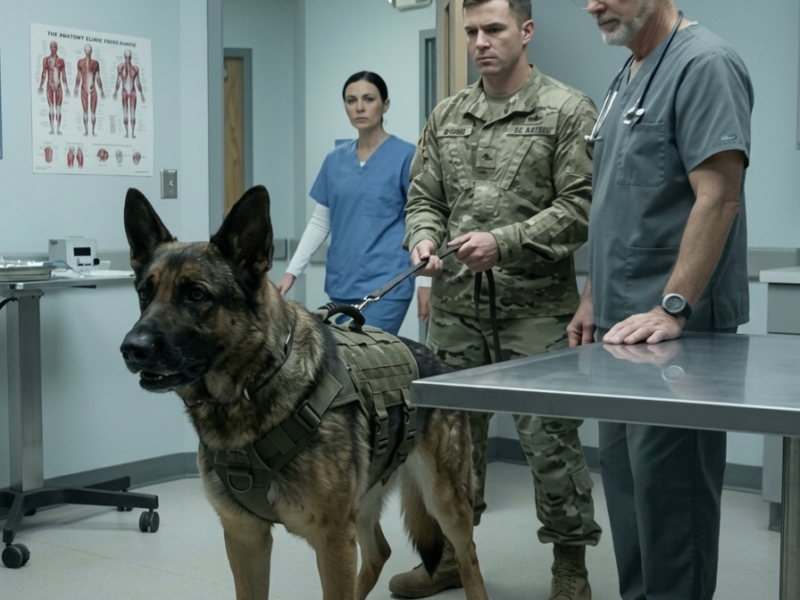
The combat K9 was already trembling on the cold steel table at a Virginia military clinic
The sub-basement of the Fort Belvoir Veterinary Treatment Facility smelled permanently of hospital-grade pine cleaner, drying blood, and fear. It was an institutional cellar, cut off from the pale Virginia daylight, where the concrete walls had been painted a nauseating pale green that chipped away near the baseboards. I had taken the civilian nursing post six months ago, seeking a quiet routine after years in chaotic urban emergency rooms. For the most part, my duties involved inventorying surgical packs, processing routine blood panels for base personnel’s domestic pets, and updating vaccination logs.
We were strictly forbidden from entering Sector C.
Sector C was the tactical holding wing, secured by a heavy magnetic-lock door and monitored by armed military police. It was where working dogs returning from overseas deployments were quarantined, evaluated, and categorized. Most moved on to specialized rehabilitation centers or handlers’ homes. A few—the ones broken beyond repair by blast waves, shrapnel, or neurological trauma—were quietly decommissioned.
At 4:15 on a Tuesday afternoon, the sirens were silent, but the acoustic tiles above my head vibrated with a sound that tore through the floorboards.
It was barking. But anyone who has spent a week around working animals knows the difference between territorial aggression and panic. This was neither. It was a high, jagged, continuous cadence of sheer desperation—the sound of an animal screaming into a void, expecting no answer.
The hallway outside my prep station was deserted. Dr. Robert Gable, the chief veterinary officer on duty, had left his clipboard on the counter, its red plastic border indicating a Level-4 hazardous intake.
I didn’t plan to violate base protocol. My feet moved on pure instinct, guided by an ache in my chest that had existed, dormant and raw, for twelve years. I swiped my temporary administrative lanyard against the Sector C keypad. The heavy steel door released with a hydraulic hiss.
The air inside was cold. In the center of Examination Room 3, illuminated by the harsh, buzzing glare of two fluorescent tubes, lay a full-grown German Shepherd.
He was strapped to a surgical steel table with heavy, three-inch nylon tie-downs crossed over his withers and flanks. A reinforced leather basket muzzle was cinched so tightly around his jaws that his lips were pinned against his teeth, flecks of bloody foam bubbling around the air slits. His left hind leg was swathed in thick, crusty field dressings that had soaked through with a dark, oxidized brown. His coat—a dense, sable-black mantle grizzled with iron-gray along the spine—was matted with red mud that looked distinctly like the iron-rich soil of foreign river valleys.
Beside the table, a twenty-two-year-old Army veterinary specialist was crying, his surgical mask hanging loose around his chin, pressing a wad of gauze against a deep, tearing puncture wound on his forearm.
Dr. Gable stood at the dog’s flank. He was an older man with thin, colorless hair and the stoic, exhausted posture of an officer who had processed too many casualties. In his gloved right hand, he held a 60cc syringe filled with a thick, clear solution of sodium pentobarbital—the pink death, the final sleep.
“Stand clear, Miller,” Gable ordered the young medic, his voice flat, devoid of malice but hardened into absolute finality. “He bit through two Kevlar sleeves in transport. He tore open Miller’s arm the second we tried to redress that compound fracture. His neurological workup is completely blown. Extreme post-traumatic aggression. Non-rehabilitative. The disposition order came down from Directorate level two hours ago.”
“He’s not aggressive,” I heard myself say.
My voice sounded small, alien, bouncing off the glazed tile walls.
Gable’s head snapped toward the door. His eyes narrowed behind his wire-rimmed glasses. “Nurse Vance? What are you doing in this ward? This is a restricted surgical theater. Get back to the civilian clinic immediately.”
I didn’t step back. I stepped forward.
The dog’s head jerked upward against the leather straps. His eyes were wide, the pupils blown so large that the golden amber of his irises was reduced to thin, frantic rings. He had stopped barking the moment the heavy door hissed shut. Now, a low, wet, rattling growl began in the deep cavities of his chest. His neck muscles bunched like steel cables as he fought the restraints, the metal examination table ringing like a struck anvil under the frantic drumming of his paws.
“Look at him, Gable,” I said, my voice dropping lower, finding a calm I did not feel. “He isn’t defending territory. Look at his tail. Look at his ears. He isn’t trying to kill you. He thinks he’s being executed by the enemy. He’s terrified.”
“He’s a five-year-old combat asset with irreversible behavioral collapse,” Gable snapped, stepping toward the table, thumbing the air bubble out of the long needle. “I have my orders, Clara. Step outside, or I will have the MP at the desk escort you off the installation.”
The dog’s growl rose in pitch, a desperate, warning thrum that vibrated through the steel frame. He lunged sideways, trying to snap through the leather basket, his claws scrabbling frantically against the polished metal.
I took two deliberate steps, closing the distance until I was standing twelve inches from the dog’s foaming muzzle.
“Don’t touch him!” Miller yelled, his hand clutching his bleeding wrist. “He’ll break your fingers through the leather!”
I looked directly into the dog’s eyes. They were burning with an animal fury, but beneath the panic was an unmistakable, haunting intelligence—a mind trapped inside a body that the world had decided was disposable.
Twelve years ago, on an icy gravel driveway in western Pennsylvania, a nineteen-year-old boy in a crisp Marine Corps uniform had knelt before a seven-year-old girl. He had taken her trembling hands in his calloused palms, pressed his silver dog tags into her fingers, and whispered a phrase that our grandfather had brought home from the Atlantic convoys—words meant for ships taking heavy water in total darkness.
I leaned down until my lips were inches from the Shepherd’s scarred, notched ear.
“Hold fast, brother,” I whispered.
The room ceased to breathe.
The growl didn’t taper off; it vanished instantly, cut off as if by a surgical strike.
The dog’s ears, which had been pinned flat against his skull in a gesture of pure, cornered hostility, slowly swiveled forward. The rigid, tremulous tension in his massive neck softened. His ribs gave one massive, shuddering expansion, and then, with agonizing slowness, he lowered his heavy head flat against the cold steel of the table.
He didn’t move. He didn’t twitch. He simply stared into my face, his amber eyes softening, a single, high-pitched, mourning whine escaping through the leather slats of the muzzle.
Miller lowered his arm, his mouth hanging open. Gable’s hand froze mid-air, the long needle of the syringe hovering two inches above the dog’s cephalic vein.
“What did you just say to him?” Gable whispered, his clinical detachment cracking down the center. “What was that?”
I didn’t answer. My hands were shaking so hard I had to lock my elbows against my sides.
“Take the muzzle off,” I said.
“Are you insane?” Gable said, his voice rising. “He’ll take your throat out—”
“Take it off, Robert. Look at him.”
The dog was completely still. He had turned his muzzle toward my hand, his tongue licking faintly at the air, begging for contact. Slowly, with terrified deliberation, Gable reached out with a pair of surgical shears, hooked the leather strap behind the dog’s ears, and sliced the buckle free.
The basket muzzle dropped to the floor with a dull thud.
The Shepherd didn’t snap. He didn’t lunge. He extended his neck, reached across the remaining inches of the cold table, and pressed his broad, scarred forehead firmly into the hollow of my palm. His skin was burning with fever, his fur coarse and caked with dried mud, but the weight of his skull against my bones was absolute.
“Good boy,” I choked out, tears finally breaking past my eyelashes, scalding my cheeks. “I have you. Hold fast.”
Gable slowly lowered the syringe onto the stainless-steel tray. The sharp clinking of the plastic against the metal sounded like an explosion in the dead room.
“This doesn’t make any sense,” Gable muttered, pulling his glasses off and rubbing the bridge of his nose. “This dog arrived forty-eight hours ago on an unmarked C-17 transport out of Ramstein. No kennel jacket. No operational history. Just a red-line quarantine order and a directive to terminate based on neurological unfitness. He hasn’t let a human being within five feet of him without attempting to kill them.”
I didn’t hear him. My fingers had drifted beneath the dog’s thick neck fur, tracing the heavy, worn webbing of an old tactical collar that the handlers had neglected to cut away.
Beneath the buckle, pinned between two layers of Kevlar weave, was a circular piece of blackened, stamped aluminum. It wasn’t a standard Department of Defense property tag. It was thin, hand-filed around the edges, and darkened by soot.
I worked it loose with my fingernails and turned it over under the glare of the fluorescent lights.
Two letters had been hand-stamped into the soft metal using an armorer’s punch. The lines were uneven, deep, and familiar.
E.R.
Ethan Ross.
The room spun. My knees struck the hard concrete floor, but my hand never left the dog’s head.
“Nurse Vance?” Gable was beside me now, his hand on my shoulder, his voice laced with sudden concern. “Clara, what is it? What’s on that tag?”
“My maiden name,” I whispered, the words barely finding enough air to cross my lips, “is Ross.”
Gable stared at the metal disc, then looked down at the massive, scarred animal that was now systematically, gently licking the salt from the back of my trembling knuckles.
“That’s impossible,” Gable said softly. “The operational file on this animal is classified under a special access program. His primary handler was listed as Killed in Action during an extraction operation in the Badakhshan Province twelve years ago.”
“My brother,” I said, looking up through a haze of tears, “was declared dead in Badakhshan on October 14th, twelve years ago. They gave my mother a sealed mahogany box and a silver star.”
The Shepherd let out another low, shuddering sigh, closing his eyes as my fingers sank into his fur. He wasn’t an anonymous military asset. He was the last living thing to touch my brother’s hands before the world swallowed him whole.
I spent the next six hours in the administrative records room on the fourth floor of the hospital. The room was cold, smelling of stale toner and decaying paper files that predated the military’s digitization initiatives. The rhythmic clicking of my computer keys was the only sound breaking the midnight silence.
As a civilian contractor, my clearance level was technically restricted to Level 2—sufficient for viewing local animal health records, medical requisitions, and standard microchip registrations. But every military network has its cracks, seams left open by overworked database administrators who share master passwords on sticky notes hidden beneath keyboard trays.
I found the dog’s microchip number: 985-141-000-291-B.
The screen flickered. A stark, unformatted military medical ledger opened in an ancient green-screen terminal emulator.
ASSET DESIGNATION: K9-WAR-77 (“CAIN”)
BREED: GERMAN SHEPHERD (SPECIAL RECONNAISSANCE)
ASSIGNMENT: TASK FORCE BLACKWOOD / COMBINED SPECIAL OPERATIONS COMMAND
HANDLER: [REDACTED]
STATUS: EUTHANASIA AUTHORIZED – CODE BLACK
I leaned closer to the monitor, the blue-white light illuminating the exhaustion carved into my face.
Every single field regarding the dog’s operational deployment between 2014 and the present day was blacked out with digital redaction bars. But the medical entries remained untouched—clinical observations recorded by field surgeons who cared more about physiology than intelligence classifications.
14 OCT 2014 – FIELD REPORT – FOB SHANK:
Asset sustained severe concussive blast injury secondary to improvised explosive device (thermobaric/refined nitrate compound). Left femoral shrapnel excised. Handler MIA / Presumed Deceased. Asset exhibited acute stress response, refusal of rations, extreme defensive guarding of handler’s personal effects.
02 NOV 2014 – BRAMPTON ANNEX (CLASSIFIED LOCATION):
Asset transferred out of standard military working dog registry. Reassigned to Project Sundown under Title 50 authority. Microchip suppressed from central DoD database.
Project Sundown.
The name meant nothing to me. I reached for my phone to photograph the screen, but before my camera could focus, the monitor blinked once, flashed an amber system alert, and the terminal snapped shut to a generic Windows login screen.
ACCESS TERMINATED BY NETWORK ADMINISTRATOR.
A chill settled between my shoulder blades. I pulled my thumb drive from the USB port, shoved it into the pocket of my scrub pants, and walked quickly down the carpeted corridor toward the exit.
The parking lot outside the clinic was wrapped in a thick, wet Virginia river fog. The yellow sodium lights flickered through the mist like dying lanterns. I had barely reached my rusted Subaru when the gravel behind me crunched under a heavy, deliberate boot step.
“You’re digging in dry wells, Miss Ross.”
The voice was low, raspy, carrying the distinct cadence of a man who had smoked cheap tobacco through twenty years of high-altitude patrols.
I spun around, my car keys laced between my knuckles like a makeshift weapon.
A man was standing five feet away, half-concealed by the shadow of an ancient oak tree. He wore an unzipped olive-drab field jacket over a gray sweatshirt, his posture slightly lopsided, favoring his right hip. He was in his late fifties, with a dense, iron-gray beard trimmed close to the jawline, and a deep, pale surgical scar that ran from the corner of his left eye down into his collar.
His eyes were cold, flat, and steady.
“Who are you?” I demanded, keeping the vehicle door at my back. “The base MPs are forty yards away inside that gate.”
“The MPs are twenty-year-old kids who don’t know what they don’t know,” the man said, not moving an inch. He slowly pulled his right hand from his jacket pocket. It was empty. He held up a weathered, brass-cornered military identification card.
The laminate was peeling, but the seal was clear: MASTER SERGEANT MARCUS COLE (RET.) – UNITED STATES MARINE CORPS FORCES SPECIAL OPERATIONS COMMAND.
“I drove four hundred miles from North Carolina when I saw the disposition ping on the network,” Cole said, his voice dropping into a harsh whisper. “I didn’t expect Ethan’s little sister to be the one standing over the dog with a scalpel.”
The sound of my brother’s name in the mouth of a stranger made my breath seize.
“You knew him,” I said. It wasn’t a question.
Cole looked at the damp pavement, his jaw tightening so hard the muscles jumped beneath the scar tissue. “I was his team chief in Badakhshan. I was the one who put him on the chopper.”
“They told us the chopper was hit by an RPG,” I said, the ancient anger rising like bile in my throat. “They told us the wreckage burned at four thousand feet. They gave us an empty casket, Sergeant.”
“The chopper wasn’t hit by an RPG,” Cole said, stepping closer, his voice dropping so low I had to strain through the damp mist to hear it. “The bird was brought down by an internal detonation. Controlled. Clean. A thermite charge placed right against the flight-control linkage.”
The fog seemed to close in around us, freezing the air in my throat. “Why? Why would someone do that to their own men?”
“Because your brother didn’t find an insurgent cache in that mountain valley,” Cole said, his eyes scanning the empty perimeter of the parking lot with mechanical regularity. “He found an unregistered testing facility operated by an off-the-books intelligence contractor. Advanced neuro-chemical compounds, telemetry tracking data, things that weren’t supposed to exist on a sovereign battlefield. Ethan took the hard drives. He wouldn’t turn them over to the station chief. He told me he was bringing them straight to the Inspector General.”
Cole looked up, his gaze locking onto mine with terrifying intensity.
“They couldn’t let that bird land, Clara. If Ethan walked into Bagram with those drives, three dozen flags would have been pulled from general officers’ desks, and a two-billion-dollar private intelligence firm would have gone to federal prison.”
“Then he is dead,” I whispered, the cold reality crushing the desperate, foolish hope that had ignited in my chest twelve hours earlier. “They killed him.”
“I thought so too,” Cole said softly. “For eleven years, I drank myself to sleep believing I had left my best operator in an ash pit. Until eight months ago.”
Cole reached into his field jacket and pulled out a worn leather notebook bound with a heavy rubber band. He peeled the band back and extracted a single slip of white paper—a printed hospital intake receipt from a private psychiatric annex outside Basel, Switzerland.
“He didn’t die,” Cole said. “The blast threw him clear of the primary hull before it impacted the ridge. The contractor’s recovery team found him forty-eight hours later, half-frozen, bleeding from three skull fractures. He survived, Clara. But the concussive trauma tore his memory to ribbons. Retrograde amnesia, profound neurological fragmentation. He didn’t know his name. He didn’t know his unit. He didn’t know what year it was.”
My knees trembled. “Where is he? Where have they kept him?”
“They kept him in private sanitariums, classified as a non-national John Doe, while their forensic teams tried to figure out where he hid the primary drive,” Cole said, his voice laced with bitter rage. “They spent a decade trying to reconstruct his mind just enough to recover their data. But six weeks ago, something happened. A nurse at the facility reported that the patient had experienced a sudden, violent breakthrough. He remembered a name. He remembered a service number.”
“And then?”
“And then he vanished,” Cole said. “He slipped through a second-story window during a storm, took three thousand euros from the administrative safe, and disappeared into northern Europe. Two weeks later, Cain—the dog—was suddenly pulled from his holding kennel in Germany and shipped here under a termination order.”
“Why?” I asked, my mind spinning. “Why kill the dog now?”
“Because a dog’s memory doesn’t get amnesia, Clara,” Cole whispered, stepping so close I could smell the stale coffee and winter rain on his jacket. “Cain was with Ethan when he buried that drive. If Ethan is back in the United States… if he’s trying to find what he lost… Cain is the only compass on earth that can lead him to it. And the people who blew up that helicopter twelve years ago cannot let that dog take another breath.”
Cole looked toward the brick facade of the clinic, where the lights of Sector C burned pale through the mist.
“Get him out of that cage, Clara. Tonight. Because at dawn, an administrative transport from Fort Meade is coming to collect his carcass. And if they find out who you are, you won’t leave that basement either.”
The extraction wasn’t cinematic; it was terrifyingly quiet.
By 2:30 in the morning, the night shift at the Fort Belvoir clinic was reduced to a single civilian janitor buffing the floors in the main lobby and an MP scrolling through his phone at the front reception desk.
I entered through the loading dock using my nursing credentials, pushing a heavy, covered aluminum laundry cart designed for contaminated surgical linens. My hands were slick with cold sweat, the plastic wheels squeaking against the wet linoleum with an agonizing, rhythmic whine that seemed loud enough to wake the entire base.
When I opened the steel door to Sector C, Cain was already standing.
His ears were erect, his nose working the narrow gap beneath the door frame. His left hind leg was held slightly off the floor, the fresh pressure bandage I had applied earlier holding firm against his torn muscle, but his balance was steady. The moment he saw me, his tail gave a single, slow, rhythmic stroke.
He didn’t make a sound. The tactical conditioning had taken over; he understood night movements.
“Easy, boy,” I whispered, reaching into my pocket and pulling out a leather lead I had taken from the prep room. I clipped it to his heavy collar. “We’re going to see Ethan. Come on.”
The dog moved into the laundry cart without hesitation, folding his massive frame into the bottom beneath three layers of sterile green surgical sheets. I covered him gently, leaving a small channel for his nose near the front handle, and pulled the canvas cover tight.
The walk through the lower corridor took four minutes that felt like four years.
At the security checkpoint, the young MP glanced up from his screen, his eyes bloodshot from the graveyard shift. “Moving soiled linen already, Nurse Vance?”
“Incinerator pickup is scheduled for five,” I said, keeping my voice light, casual, the voice of an overworked nurse who only wanted to finish her shift and sleep. “The surgical theater in Ward B was contaminated during that trauma intake.”
The MP grunted, tapped a button beneath his desk, and the magnetic lock on the exterior exit clicked open. “Have a good night, ma’am.”
“You too, specialist.”
The cold Virginia night air hit my face like a bucket of well water.
I pushed the heavy cart down the concrete ramp toward the gravel access lane behind the motor pool. In the shadows beneath the weeping willow trees, the taillights of Cole’s battered pickup truck flared once, dull red, and then died.
We lifted Cain into the extended cab. The dog settled onto a bed of folded wool blankets behind the driver’s seat, his chin resting instantly on the transmission tunnel, his amber eyes locked onto Cole’s rearview mirror.
Cole didn’t speak. He dropped the truck into gear, eased off the clutch, and rolled down the dark access road without turning on the headlamps until we had cleared the outer perimeter gate and merged onto Route 1 heading south.
“Where are we going?” I asked, my knuckles white against the dashboard.
“My place out on the edge of the Quantico tactical reservation,” Cole said, his eyes scanning the side mirrors every three seconds. “Twelve acres of dense pine, off the grid, no fiber-optic cables, no municipal water. If they run our plates through the regional traffic cameras, it’ll take their algorithms forty minutes to flag the corridor. We have until sunrise.”
“And then what?”
Cole glanced back at the dog. “Then we see if the compass still works.”
The drive took forty-five minutes through winding, pitch-black country lanes where the Virginia forest pressed close against the asphalt like walls of dark water. Cole’s property was a single-story cedar-shake cabin hidden at the end of a half-mile gravel track that hadn’t seen a grader in a decade.
Inside, the cabin smelled of gun oil, wood smoke, and old paper. The walls were lined with hand-built pine shelves holding hundreds of field manuals, topographical maps, and shortwave radio components.
The moment Cain’s paws touched the bare pine floor, the dog stopped.
He didn’t explore the kitchen. He didn’t look for water. He walked directly to the far corner of the living room, where an old iron woodstove radiated a dying, cherry-red heat. Beside the stove lay a folded, grease-stained wool poncho liner—a standard-issue Marine Corps “woobie.”
Cain lowered his snout, inhaling deeply. A high, sharp whine tore from his throat.
With his front teeth, he gently took the corner of the poncho liner, dragged it back two feet across the floorboards, and began scratching methodically at a dark knot in the tongue-and-groove pine flooring.
“What is he doing?” I asked, stepping toward him.
“He’s checking the cache,” Cole said, his voice tightening as he walked into the corner, dropping onto one knee beside the dog. “Ethan stayed here for three weeks before that final deployment in 2014. He helped me rebuild the flooring after a pipe burst.”
Cole pulled a flat-head screwdriver from his back pocket, wedged it into the seam beside the knot, and pried upward.
A eight-inch section of the pine floorboard popped free with a dry screech of nails.
Beneath it, nestled in the fiberglass insulation between two floor joists, was a rectangular metal ammunition canister, sealed with heavy olive-drab duct tape.
My heart hammered against my ribs. “What did he leave here?”
“I didn’t know he left anything,” Cole murmured, his scarred fingers peeling back the tape with steady, mechanical care.
He popped the heavy steel latch of the canister and pulled open the lid.
Inside lay a pair of scuffed combat boots, a spare set of Marine dog tags bearing Ethan’s name, and a small, zip-sealed waterproof pouch containing a single, glossy 4×6 color photograph.
Cole handed the photograph to me. His hand was steady, but his jaw was working frantically.
The image was taken in bright, blinding desert daylight. Ethan was standing in front of a low mud-brick wall, wearing a dusty flight suit, his face streaked with sweat and soot. He was smiling—that crooked, arrogant, protective smile I had seen in every childhood memory. Sitting squarely between his knees was Cain, young, sleek, and lethal, wearing his black tactical harness.
I turned the photograph over.
Written in the center of the white backing, in the sharp, sloping, unmistakable blue ink of my brother’s left-handed script, were six words:
Find my sister. She knows everything.
I stared at the paper until the letters blurred into blue streaks.
“I don’t understand,” I whispered, looking up at Cole, panic rising like cold water in my chest. “I don’t know anything, Cole. I was twenty-two when he died. I was in nursing school in Philadelphia. He never told me about his missions. He never talked about his clearances. Why would he write this?”
Cole didn’t answer immediately. He took the photograph from my fingers, held it up to the kerosene lamp on the table, and studied the margins.
“Ethan wasn’t writing to the authorities, Clara,” Cole said slowly, his voice dropping into a register of cold certainty. “He was writing to whoever found this cache. He knew that if his team was scrubbed, his files would be scrubbed too. He needed an anchor—something the contractor’s analysts couldn’t crack with a supercomputer.”
“What kind of anchor?”
“You,” Cole said, looking directly into my eyes. “What did he give you before he deployed? Think, Clara. Not the dog tags. Not the letters. What was the last thing he put in your hands?”
My mind raced backward through the years, tearing through layers of grief, remembering the gravel driveway, the smell of the damp pine trees in Pennsylvania, the morning mist rising off the valley.
Don’t be afraid of me, Clara. If the water gets high, check the watch.
My hand flew to my throat, then dropped to my wrist.
For twelve years, I had worn a battered, stainless-steel mechanical Hamilton field watch on an olive-drab nylon strap. It had been our grandfather’s watch in Korea; Ethan had worn it through two deployments to Iraq, and on that final morning in the driveway, he had strapped it around my wrist, sliding the buckle into the smallest hole.
Keep the time for both of us, he had told me. Never wind it past noon.
“The watch,” I choked out, unbuckling the nylon strap with trembling fingers, laying the heavy steel timepiece on the table under the lamp. “He told me never to wind it past noon.”
Cole grabbed the watch, pulling a small jeweler’s loupe from his pocket. He turned the watch over, examining the threaded case back.
“It’s not a mechanical movement,” Cole muttered, his eyes narrowing as he used the tip of his pocketknife to engage the tiny notches on the perimeter of the steel backing. “The weight is all wrong. It’s too light for an automatic caliber.”
With a soft, metallic click, the case back unscrewed.
Inside, where the balance wheel and brass gears should have been ticking, lay a circular, wafer-thin ceramic disc—a high-density micro-transceiver, embedded with a micro-SD storage node smaller than a child’s fingernail.
Beneath the ceramic chip, etched into the interior steel casing with a laser engraving tool, was a set of geographic coordinates:
38°41’22.1″N 77°08’44.2″W.
“Where is that?” I asked.
Cole stared at the numbers, his face turning the color of wet ash.
“That’s not a mountain in Afghanistan, Clara,” Cole whispered. “That’s three miles from here. It’s the old naval ammunition depot at Chopawamsic Creek. Decommissioned thirty years ago. Completely abandoned.”
Before I could speak, Cain suddenly rose from the corner.
His head swung toward the front window of the cabin. His hackles rose in a rigid, serrated crest along his spine, and a deep, continuous, bone-shaking growl began to roll through his ribcage.
Outside, down at the end of the long gravel track, the headlights of three black SUVs suddenly ignited through the dark trees, their beams slicing through the cabin window like white searchlights.
The headlights hit the cedar siding of the cabin with blinding intensity.
“Out the back. Now,” Cole ordered, his voice dropping into the flat, clipped cadence of a combat leader.
He didn’t reach for a hunting rifle. From beneath the kitchen island, he hauled out a customized, short-barreled Colt carbine, popped the charging handle with the heel of his palm to chamber a round, and thumbed the selector switch to semi-automatic.
“They tracked the truck,” I said, my heart slamming against my ribs like a trapped bird.
“They didn’t track the truck,” Cole replied, grabbing a canvas go-bag packed with extra magazines and trauma dressings. “They tracked the microchip registry query you ran on the base terminal. I told you—their algorithms flag every ping within forty minutes. Move!”
We didn’t use the back door; that was an obvious kill zone. Cole kicked open the wooden trapdoor leading to the shallow root cellar beneath the kitchen. We dropped into the cold, damp dirt, Cain sliding down beside us without making a sound.
A narrow, concrete crawlspace led thirty yards out to an old drainage culvert that emptied into a dense ravine choked with mountain laurel and blackberry brambles.
Behind us, the cabin’s front door was blown inward with a concussive, deafening blast—a breaching charge that shattered the pine framing and showered the living room in splinters.
Crack-crack-crack.
Suppressed automatic rifle fire began chewing through the interior walls of the cabin above our heads, the high-velocity rounds punching through the floorboards, kicking up sprays of dirt and insulation around our shoulders.
Cain pressed his heavy body against my ribs, crawling on his belly through the wet mud of the culvert. His injured leg was dragging slightly, but he didn’t whimper. The tactical training he had received twelve years ago had been burned into his nervous system down to the cellular level; he knew how to move under fire.
We scrambled out of the concrete culvert into the freezing, rain-soaked blackness of the ravine.
Behind us, the cabin was already burning. An incendiary grenade had been deployed, the dry cedar shakes catching fire instantly, sending a column of thick, oily black smoke into the gray dawn sky.
Three figures dressed in sterile, gray tactical plate carriers and high-cut ballistic helmets were sweeping the perimeter of the burning house, their weapons mounted with infrared illuminators that painted the mist in faint, shimmering ribbons.
“Vanguard contractors,” Cole spat, hunkering low behind the massive root ball of a fallen hemlock tree. “They’re not here to take prisoners, Clara. They know what was in that watch.”
“We need to get to the coordinates,” I whispered, the Hamilton case back burning against the palm of my hand. “Chopawamsic Creek.”
“It’s two miles through this swamp,” Cole said, glancing at Cain. The dog was panting heavily, his breath rising in white clouds in the freezing morning air, the dressing on his leg soaked through with dark, fresh blood. “He can’t make two miles at a combat sprint, Clara. His femoral artery is too close to that shrapnel track.”
Cain turned his head. He looked at Cole, then turned his gaze toward me.
With slow, deliberate effort, the massive Shepherd rose to all four paws. He planted his weight on his good limbs, arched his back, and took three firm, even steps up the steep, muddy bank of the ravine. He looked back over his shoulder, his amber eyes burning with an ancient, uncompromising command: Follow.
“He knows where he’s going,” I said, hauling myself up by a laurel branch. “He’s been there before.”
We moved through the forest like ghosts.
Cole covered our rear, moving from tree trunk to tree trunk, his carbine tucked tight against his shoulder pocket, his eyes sweeping the graying timber. The rain began to fall again—a cold, miserable December drizzle that turned the clay soil into slick, treacherous grease.
Cain led the way. He didn’t use the deer trails or the old logging ruts; he wove through the densest briars, utilizing the contours of the drainage swales to keep our silhouettes below the skyline. Every few hundred yards, his hind leg would buckle slightly, but each time, he caught himself on his front paws, shook his scarred head, and pressed forward.
After forty minutes of punishing navigation, the forest suddenly gave way to an eight-foot galvanized chain-link fence topped with rusted razor wire.
Beyond the fence lay the Chopawamsic Annex.
It was a forgotten relic of the early Cold War—six massive, earthen-bermed munitions bunkers built into the side of a red-clay ridge, their concrete blast doors overgrown with poison ivy and Virginia creeper. In the center of the clearing sat a derelict administrative depot, its roof collapsed inward, surrounded by rusted fuel tanks and cracked concrete aprons.
Cain stopped at the fence line. He lowered his snout, sniffing the bottom tension wire where the chain link met the earth.
Someone had already been here.
The heavy steel wire had been cleanly severed with hydraulic bolt cutters, the mesh pulled back to create an eighteen-inch passage into the secure zone. Fresh, deep tread marks from civilian combat boots were stamped into the red clay on the other side of the fence.
“He’s inside,” Cole whispered, stepping up behind us, his carbine leveled at the dark bunker entrances. “Someone cleared this perimeter less than an hour ago.”
“Is it Ethan?” I asked, my voice trembling.
“Or the men hunting him,” Cole answered grimly.
Suddenly, a sharp, metallic clink echoed from the dark maw of Bunker 4, eighty yards across the clearing.
Cain didn’t wait for a command.
He didn’t growl. He didn’t bark. He squeezed his broad shoulders through the gap in the fence, tearing a clump of fur against the jagged wire, and sprinted across the open concrete apron with a terrifying, single-minded ferocity.
“Cain! No!” I hissed, scrambling through the wire behind him.
“Clara, wait!” Cole roared, breaking cover to follow.
We crossed the open tarmac as the sound of an engine tore through the tree line behind us.
A modified civilian helicopter—an unflagged, matte-black MD-500 Little Bird—cleared the pine canopy at tree-top level, its rotor wash whipping the dead leaves and rain into a stinging, blinding vortex.
From the open skid of the helicopter, a shooter in a black flight helmet leveled an automatic shotgun, firing three rapid, concussive rounds into the mud at our heels.
BOOM. BOOM. BOOM.
The heavy lead slugs tore craters into the earth, throwing up chunks of clay. Cole dropped to one knee, raised his carbine, and fired a five-round burst into the helicopter’s engine cowling. Sparks showered from the turbine housing, the aircraft banking violently to the left with a shrill, mechanical shriek of grinding gears, retreating behind the ridge to stabilize.
We lunged through the massive, rusted blast doors of Bunker 4, tumbling into the subterranean blackness just as a secondary team of ground contractors reached the tree line.
Cole slammed the heavy, counter-weighted steel door shut, dropping the ancient iron locking dog into place with a concussive THUD that shook thirty years of rust from the ceiling.
We were sealed inside the tomb.
The air inside Bunker 4 was freezing, smelling of ancient gunite concrete, damp calcium deposits, and ozone.
The only light filtered through a narrow ventilation shaft forty feet above our heads, casting a pale, cathedral-like beam onto the center of the concrete floor.
At the far end of the cavernous chamber, illuminated by the pale downlight, stood a man.
He was thin, his frame weathered down to pure muscle and bone, wearing a torn civilian field jacket over a gray thermal shirt. His hair was long, tangled with gray, and his jaw was covered in a rough, uneven beard. Across his forehead ran a jagged, silver surgical scar that disappeared into his hairline.
In his right hand, he held a heavy tactical pry bar, dripping with red mud.
At his feet lay a hollow concrete inspection cap that had been pried from the bunker floor, revealing a steel conduit box beneath the foundation.
Cain was standing five feet from him.
The massive dog was not moving. He was not barking. He was trembling violently from his ears to the tip of his tail, his graying muzzle lifted, his amber eyes fixed on the man’s face with an expression of such pure, unadulterated devotion that the breath caught in my throat.
The man lowered the pry bar. It dropped onto the concrete with a hollow, ringing clang.
Slowly, awkwardly, like an old man whose joints had been frozen in ice for a decade, the stranger dropped onto both knees on the filthy concrete floor.
“Cain…?” the man whispered.
The voice was rough, fractured by disuse and psychological trauma, but the cadence—the soft, rolling Pennsylvania inflection—was a ghost that had lived in my bedroom walls for twelve years.
“Cain, buddy… is that you?”
The dog broke.
He didn’t launch himself aggressively; he crawled forward on his belly, whining a high, continuous, weeping note that filled the cavernous concrete vault. He reached the man’s knees, threw his heavy front legs over the man’s shoulders, and buried his broad, scarred head into the crook of his neck.
Ethan Ross threw his arms around the animal, burying his face in the coarse, wet fur, his entire body convulsing with deep, silent, devastating sobs.
“I remember,” Ethan wept into the dog’s neck, his fingers digging into the heavy nylon collar. “I remember the ridge… I remember the fire… you didn’t leave me, boy. You stayed in the dirt with me.”
I couldn’t move. My feet were anchored to the concrete floor, my hand pressed hard against my mouth to stifle the scream building in my chest.
Ethan slowly lifted his head. His eyes, rimmed in red, hollowed by years of chemical fog and institutional confinement, drifted past the dog’s ears and locked onto mine.
He blinked once, twice, as if trying to clear a layer of dust from an old lens.
“Clara?” he whispered.
The name sounded strange in his mouth, fragile, like a piece of thin porcelain he was terrified of dropping.
“Ethan,” I choked out.
I crossed the twenty feet of concrete at a run.
I hit the floor beside him, my arms wrapping around his neck, smelling the familiar, impossible scent of cedar and rain that had survived twelve years of hell. His hands—calloused, scarred, shaking with neurological tremors—gripped my arms with a desperate, crushing strength that proved he was made of flesh and bone.
“You’re here,” Ethan stammered, pulling back to look at my face, his fingers touching my cheekbones with childlike wonder. “You’re so big… you were just a girl on the driveway…”
“I’m here, Ethan. We’re both here.”
Cole stepped forward from the shadow of the blast door, his carbine lowered, his face grim despite the tears shining in the corners of his eyes. “Ross. We have about four minutes before that bird brings reinforcements with heavy cutting torches. Did you find it?”
Ethan looked up at his former team chief. A faint, hard spark of the operator he had once been reignited behind his damaged eyes.
“I found it, Chief,” Ethan said, reaching down into the open conduit box in the floor.
He pulled out a heavy, waterproof Pelican micro-case, sealed with industrial resin.
“The full telemetry logs,” Ethan said, his voice regaining its tactical authority. “Every transaction, every bank routing code, every casualty report that Vanguard altered between 2012 and 2014. The names of the twelve officers who took the kickbacks to bury the investigation.”
“They thought you forgot,” Cole said.
“I did forget,” Ethan said, tapping the silver scar on his temple with a bitter smile. “For ten years, my head was white noise. Just gray walls, doctors in suits, and drugs that made me feel like I was drowning in oil. But two months ago… I had a dream. I heard a voice whisper four words in the dark.”
He looked at me, his eyes softening.
“‘Hold fast, brother,'” Ethan whispered. “The moment I remembered those words, the fog cracked. I remembered who I was. I remembered where I left the dog. And I remembered that I gave the key to the only person on earth who would never stop looking for me.”
I pulled the Hamilton field watch from my pocket, opening the case back to reveal the micro-transceiver.
Ethan took it from my hand. He pressed the ceramic wafer into the recessed interface slot on the side of the Pelican case.
The case gave a soft, high-pitched chirp. A bank of tiny green LEDs flashed to life on the face of the drive, and a low, digital chime indicated that the quantum encryption had unlocked.
“It’s broadcasting,” Ethan said, looking up toward the ventilation shaft. “The second this handshake completes, the data packets are uploading directly to the secure servers of the Senate Select Committee on Intelligence and the Naval Criminal Investigative Service master repository. There are twenty mirror nodes across the country. They can’t scrub it now. They can’t burn this room down to hide it.”
Outside the bunker, the heavy, rhythmic beat of approaching aircraft suddenly shook the foundation.
Not the light, buzzing whine of the contractor’s Little Bird.
These were heavy turbines—the thunderous, earth-shaking roar of twin-rotor CH-53 Sea Stallions, accompanied by the high-velocity scream of two Marine Corps AH-1Z Viper gunships establishing an air-superiority orbit directly above the clearing.
Over a tactical loudspeaker mounted to the lead gunship, a voice boomed across the forest, amplified by five thousand watts of military power:
“UNMARKED SECURITY PERSONNEL ON THE GROUND, THIS IS THE UNITED STATES MARINE CORPS FORCES COMMAND. YOU ARE TRESPASSING ON A RESTRICTED MILITARY INSTALLATION. DROP YOUR WEAPONS, POWER DOWN YOUR VEHICLES, AND STEP INTO THE OPEN WITH YOUR HANDS RAISED. YOU ARE UNDER FEDERAL ARREST FOR TREASON AND CONSPIRACY TO COMMIT CAPITAL OFFENSES. COMPLY IMMEDIATELY OR YOU WILL BE ENGAGED.”
Through the thick concrete of the blast door, we heard the sound of civilian engines cutting out, followed by the clatter of rifles dropping onto the asphalt.
The war was over.
Ethan sank back against the concrete wall of the bunker, letting out a long, ragged breath that sounded like twelve years of suffocating silence finally leaving his lungs.
Cain didn’t look at the ceiling. He didn’t care about the helicopters, the gunships, or the federal agents swarming the clearing.
The massive, scarred Shepherd shifted his weight, turned around twice on the filthy floor, and collapsed with a deep, contented groan directly across Ethan’s boots. He rested his heavy chin on Ethan’s knee, closed his amber eyes, and let his breathing fall into a slow, perfect, unbroken rhythm.
I sat on the concrete beside them, taking my brother’s hand in mine, resting my other hand on the dog’s warm, rising flank.
The dawn light coming through the ventilation shaft turned from gray to pale gold, painting the dark walls of the tomb in the warm colors of a Virginia morning.
We were bruised, broken, and carrying scars that would outlive the flesh that bore them. But as the heavy steel blast doors were pulled open from the outside, letting in the clean, sweet air of the pine woods, I looked down at the old dog resting at our feet.
He was off the clock. His watch had finally ended.
And for the first time in twelve years, we were all going home.
The end.









