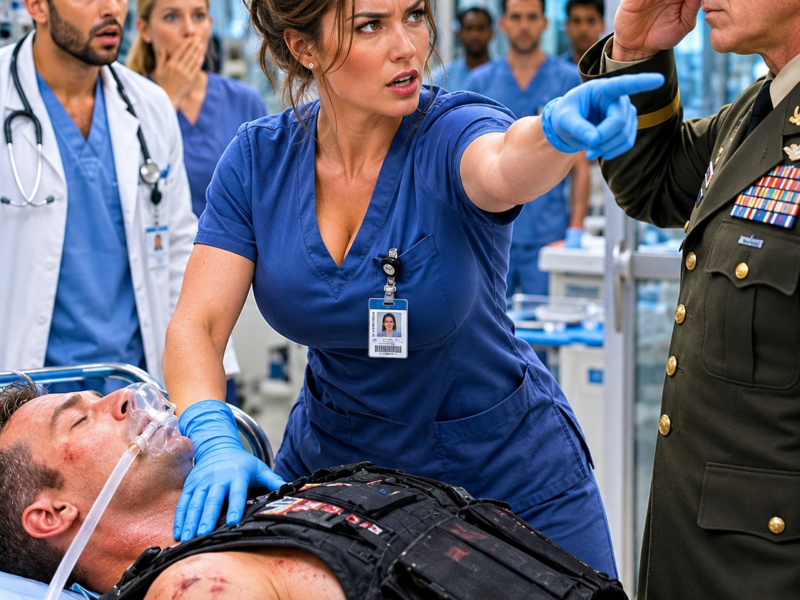
The colonel walked into Trauma Room 3 expecting to find a dying soldier. Instead, he found a nurse holding the man’s heart in her hands
Travis raised his weapon.
Caitlyn didn’t wait for him to pull the trigger.
She shoved the gurney sideways with both hands. Its metal frame slammed into the wall, forcing Travis to adjust his aim. The first shot struck the ceiling. A second punched through a cabinet behind them.
“Get down!” Harris shouted.
Caitlyn dropped behind the gurney as Harris pulled Adams out of the line of fire. The wounded sergeant groaned, still barely conscious, his body weakened by blood loss and the emergency surgery that had kept him alive.
Travis stepped closer.
“You always did know how to make an entrance,” he called. “Even after all these years.”
Caitlyn kept her eyes on him.
“You don’t have to do this, Travis.”
He gave a bitter laugh.
“You don’t get to tell me what I have to do.”
For a moment, the corridor seemed to disappear. She wasn’t standing in a Chicago hospital anymore. She was back with Echo Ross, surrounded by people she had trusted with her life. Travis had been her second-in-command. She had once handed him the lives of her entire team without hesitation.
Now he was standing across from her with a rifle.
“Nelson told you I was dead,” she said.
“He told me you abandoned us.”
“That isn’t what happened.”
“Does it matter?” Travis’s voice hardened. “The team is gone. The mission is over. And you walked away.”
“I didn’t walk away from them.”
“You walked away from me.”
The accusation landed harder than she expected.
Caitlyn had spent years telling herself that the past was finished. She had buried her uniform, her rank, her identity, and the names of the people who had died in Damascus. She had built a life where the hardest decisions involved crowded emergency rooms and families waiting for updates.
But the past had never been finished.
It had simply been waiting.
Travis raised his rifle again.
Harris moved to flank him, but Caitlyn caught his sleeve.
“Stay with Adams,” she whispered.
Then she looked directly at Travis.
“You remember the training facility in North Carolina?”
His expression shifted.
“You remember the steam system we used during the winter exercises?” she continued.
Travis glanced toward the ceiling.
That was all she needed.
Caitlyn grabbed the metal instrument tray beside her and hurled it toward the corridor. It crashed against the wall, sending instruments scattering across the floor. Travis instinctively turned toward the noise.
Caitlyn moved.
She reached the maintenance valve beside the service door and drove the edge of a scalpel into the exposed control assembly. The damaged valve released a violent burst of pressurized steam.
The corridor disappeared behind a white cloud.
Travis shouted and stumbled backward, dropping his rifle as he tried to shield his face.
Caitlyn came through the steam low and fast. She kicked the weapon away from him, caught his arm, and forced him against the wall.
“Don’t move.”
For several seconds, neither of them spoke.
Travis struggled once, then stopped.
“You could have killed me,” he rasped.
“I could have.”
“Why didn’t you?”
Caitlyn looked at him.
“Because I’m not Nelson.”
She secured his hands with a length of medical tubing and retrieved the rifle. Then she returned to Harris.
“Can you move him?”
Harris nodded. He and Caitlyn lifted Adams carefully, supporting his injured side as they continued toward the stairwell.
Behind them, Travis called her name.
“Caitlyn.”
She paused.
His voice sounded different now. Smaller.
“Nelson said there was no way out.”
She looked back.
“There was always a way out. You just had to stop doing what he told you.”
Then she continued up the stairs.
The rooftop door opened into a wall of cold November air.
Caitlyn stepped outside first, scanning the roofline and the surrounding buildings. The hospital’s emergency lights flashed below them. Somewhere in the distance, sirens cut through the night.
Harris helped carry Adams toward the center of the roof.
“Keep his head elevated,” Caitlyn instructed. “Watch the dressing. If he starts losing consciousness again, tell me immediately.”
“He’s still breathing,” Harris said.
“For now.”
A helicopter appeared beyond the neighboring buildings. Its searchlight swept across the rooftop before settling on them.
Harris raised one arm.
“That’s ours.”
The Black Hawk descended, its rotor wash whipping at their clothes and sending loose debris across the roof. Two personnel jumped out as soon as the aircraft touched down.
They brought a stretcher.
Caitlyn directed them through the transfer, making sure Adams’s chest dressing stayed secure and his injured side wasn’t compressed. She climbed aboard after him.
Harris followed.
As the helicopter lifted, Caitlyn looked down at Lakeshore Memorial.
From above, the hospital looked ordinary. Windows glowed against the dark. Ambulances moved through the entrance. Somewhere inside, nurses were still answering call lights, physicians were still treating patients, and families were still waiting for someone to tell them the person they loved would survive.
That was the life she had chosen.
And for a few years, she had believed it was enough to leave the other one behind.
Harris sat across from her, his face partially illuminated by the cabin lights.
“You know what this means,” he said.
Caitlyn didn’t answer.
“Nelson knows you’re alive. He knows Adams survived. And he knows you have enough information to destroy him.”
“Then he should be worried about the evidence.”
“He will be. But there’s something else.”
Harris leaned forward.
“The government is going to want you back.”
Caitlyn looked at him.
“I already told you. I’m Nurse Young.”
“You were Commander Walker before you were Nurse Young.”
“And I paid for that name.”
Harris studied her for a moment.
“I’m not asking you to put the uniform back on tonight. I’m asking you to stop hiding.”
She turned toward the open side of the aircraft.
For years, she had thought that surviving meant disappearing. She had believed that if she stayed quiet enough, worked hard enough, and kept her head down, the people who had destroyed Echo Ross would eventually forget she existed.
But Adams was alive.
The ledger was real.
And Nelson had spent years building his power on the assumption that no one could prove what he had done.
Caitlyn looked back at Harris.
“I’ll testify,” she said. “But not in a closed room. Not under some classified agreement that lets everyone pretend this never happened.”
Harris nodded slowly.
“Publicly?”
“Under oath. With my real name.”
“That’s a dangerous decision.”
“So was staying silent.”
The next six weeks were a battle of a different kind.
Caitlyn spent them answering questions, reviewing records, and meeting with investigators who wanted to know how a nurse at a Chicago hospital could possibly be connected to a military unit officially listed as having been killed in Syria.
Some questions were straightforward.
Others were painful.
She was asked to identify members of Echo Ross from photographs. She reviewed mission records and explained communications she had once believed would never be examined again. She described the operation that had brought her team to Damascus, the intelligence they had received, and the moment she realized their mission had been compromised.
She also explained how she had survived.
Not every detail could be made public. Some operational information remained protected. But the central truth was clear: General Douglas Nelson had been selling classified defense designs through a network of intermediaries and shell companies. When Echo Ross discovered evidence of his activities, he had arranged for the unit to be betrayed.
The ambush in Damascus had not been an accident.
It had been an attempt to erase the people who could expose him.
Adams’s ledger provided the missing link.
The document contained financial records, wire transfers, shell-company connections, and authorization codes that tied Nelson directly to the transactions. Investigators compared the entries with financial records and communications recovered during the investigation.
The evidence began to form a picture that was difficult to deny.
Nelson had not simply profited from stolen designs. He had used his position to conceal the operation, protect its participants, and eliminate anyone who threatened to expose it.
And now one of the people he had tried to erase was preparing to testify.
Adams finally regained consciousness after weeks of recovery.
Caitlyn visited him in the hospital room.
He looked thinner than he had before the incident, but his eyes were clear.
“You’re the nurse,” he said.
“That’s what the badge says.”
He managed a faint smile.
“I remember you. I remember the operating room. I thought I was dying.”
“You were in serious condition.”
“I remember you telling someone to hand you the suture.”
“That sounds like me.”
Adams glanced toward the window.
“Did you get it?”
Caitlyn knew what he meant.
“The ledger?”
He nodded.
“We have it.”
His shoulders relaxed.
“Good.”
“You need to tell the investigators everything you remember.”
“I will.”
“Especially where you got the ledger and who had access to it.”
Adams looked at her again.
“I know what it means.”
Caitlyn pulled a chair closer to the bed.
“Then make sure the people who need to hear it get the truth.”
He was quiet for a moment.
“Colonel Harris told me who you were.”
She didn’t respond.
“He said you were the commander of Echo Ross.”
“Was.”
Adams shook his head slightly.
“Some people don’t stop being who they are just because someone changes the paperwork.”
Caitlyn looked down at her hands.
She had spent years trying to become someone else. But she was beginning to understand that she didn’t have to choose between the woman who had led Echo Ross and the nurse who had saved Adams.
Both were real.
Both had mattered.
And neither had to disappear.
The Senate Armed Services hearing took place six weeks after the attack at Lakeshore Memorial.
The room was crowded.
Reporters lined the back wall. Cameras faced the witness table. Members of the committee reviewed thick folders containing financial records, classified findings, and testimony gathered during the investigation.
Caitlyn waited outside the hearing room.
She wore a dark suit rather than scrubs or a military uniform. Her hair was pulled back neatly. Her expression was composed, but her hands were cold.
Harris stood beside her.
“You don’t have to prove anything to me,” he said.
“I’m not here to prove anything to you.”
“I know.”
She looked through the open doorway.
“I just need to tell the truth.”
Harris nodded.
“Then do that.”
A staff member approached and called her name.
“Commander Caitlyn Walker?”
Caitlyn stood.
For a moment, the title sounded unfamiliar. Then she took a breath and stepped forward.
The hearing began with a review of the allegations against Nelson. Investigators outlined the suspected financial network, the defense designs involved, and the evidence linking the transactions to shell companies.
Then Caitlyn was called to testify.
She raised her right hand and swore to tell the truth.
When she sat down, the committee chair asked her to state her name and explain her connection to Echo Ross.
“My name is Caitlyn Walker,” she said. “I was the commanding officer of Echo Ross.”
A murmur moved through the room.
“The official record lists you as killed in Damascus,” the chair said.
“That record is incorrect.”
“Why was your death reported?”
“Because the operation that led to the loss of my team was compromised. I believed that remaining alive and undiscovered was the only way to prevent further harm and preserve the evidence I had.”
“Are you saying General Nelson was responsible for that operation?”
“I’m saying he was responsible for the betrayal that placed my team in danger. The evidence supporting that conclusion is now in the hands of investigators.”
She described the intelligence her unit had received, the unexpected changes to their mission, and the ambush that followed. She explained how she had discovered irregularities in the information provided to them and why she believed those irregularities had been deliberate.
The committee members listened.
Some took notes. Others watched her without moving.
When she finished describing Damascus, the chair asked about the events at Lakeshore Memorial.
Caitlyn explained how Adams had arrived with internal injuries, how she had recognized the severity of his condition, and how she had performed emergency treatment before the colonel identified her.
“Were you aware that Sergeant Adams possessed evidence related to General Nelson?”
“Not when he arrived. Colonel Harris informed me after the procedure.”
“And were you aware that armed individuals had followed the ambulance to the hospital?”
“Not until the hospital’s security situation deteriorated.”
“Did you recognize any of the people who entered the hospital?”
Caitlyn paused.
“Yes.”
“Who?”
“Travis Jenkins. He had served as my second-in-command in Echo Ross.”
The chair glanced at the documents before him.
“Mr. Jenkins is also expected to testify today.”
“I understand.”
The room grew quiet.
Travis entered several minutes later.
He looked older than Caitlyn remembered. His hair was shorter, and his face had lost some of the confidence he once carried. He avoided looking at her as he took his seat.
He swore an oath.
Then he began to speak.
At first, his answers were brief. He confirmed his position in Echo Ross and described his relationship with Caitlyn. He acknowledged that he had later worked with people connected to Nelson.
Then the committee questioned him about the Damascus operation.
“Did General Nelson order the destruction of Echo Ross?”
Travis swallowed.
“Yes.”
“Are you certain?”
“I heard the order discussed. I also saw the instructions that followed. The mission information was altered. The team was sent into a position where it could be eliminated.”
“Why did you cooperate?”
Travis looked down.
“Money. Protection. I thought I could survive by doing what Nelson wanted.”
“And the hospital attack?”
“He ordered it.”
A committee member leaned forward.
“General Nelson personally ordered an attack on a hospital?”
“He ordered the team to recover the ledger and kill Sergeant Adams. He knew the evidence could connect him to the defense-design sales. He also knew Commander Walker was alive.”
Travis finally looked at Caitlyn.
“I was told she was a threat.”
Caitlyn held his gaze.
The chair asked him to continue.
Travis described the instructions he had received and confirmed that the people who entered Lakeshore Memorial had been sent to eliminate Adams and retrieve the ledger.
His testimony matched the evidence investigators had collected.
It also matched the financial records.
When the hearing resumed after a short recess, the committee reviewed the transfers, shell companies, and authorization codes. Investigators explained how the records connected Nelson to the transactions.
The evidence was no longer a story told by one survivor.
It was a documented trail.
A trail that led directly to the man who had believed himself untouchable.
General Douglas Nelson was arrested later that day.
The announcement came while Caitlyn was still in the Senate building.
A staff member entered the waiting room and quietly informed Harris. He looked at his phone, read the message twice, then turned toward her.
“They have him.”
Caitlyn didn’t move.
“Nelson?”
Harris nodded.
“Agents took him into custody.”
For several seconds, she simply stared at the floor.
She had imagined this moment in countless ways during the years after Damascus. Sometimes she pictured herself confronting him. Sometimes she imagined hearing him admit what he had done. Sometimes she imagined that the news would finally make the memories stop.
But the actual moment was strangely quiet.
No dramatic speech.
No sense of triumph.
Just a message confirming that a man who had destroyed lives was finally facing the consequences of his actions.
“Is it over?” she asked.
Harris considered the question.
“The investigation is still going. The legal process will take time.”
“Then no.”
“Not completely.”
Caitlyn nodded.
She knew better than to confuse an arrest with justice.
But it was a beginning.
The investigation expanded beyond Nelson. Hughes Construction and other individuals connected to the stolen defense designs were examined. Financial records exposed additional participants. Investigators pursued those who had helped move the money, conceal the transactions, or facilitate the operation.
Travis cooperated with prosecutors.
He had provided testimony that helped establish the chain of events, but cooperation did not erase his role. He was charged for his part in the conspiracy and later sentenced to twenty years in prison.
Nelson’s case moved forward.
The evidence included the ledger, financial transfers, authorization codes, testimony from members of the investigation, and the accounts of people who had once served under him.
He was eventually convicted of treason, eleven murders, and conspiracy to sell classified defense designs.
The sentence was severe: three consecutive life terms without the possibility of parole.
His military medals and pension were forfeited.
The judgment did not bring back Echo Ross.
It did not undo Damascus or restore the years Caitlyn had spent living under a name that wasn’t hers.
But it established the truth.
Nelson had not been betrayed by an ambitious subordinate or ruined by an unfortunate misunderstanding. He had used his position to sell secrets, sacrifice his own people, and attempt to silence the survivors.
The people who had died were no longer officially remembered as casualties of an ordinary failed operation.
Their deaths were part of a crime.
And their commander had finally been able to say so in public.
Several weeks after the conviction, Caitlyn received a letter.
The envelope had no return address, only her name written in careful handwriting.
She recognized it immediately.
Travis.
She held it for a long time before opening it.
The letter was short.
He wrote that he remembered the first time she had selected him for Echo Ross. He remembered how she had trusted him, how she had defended his decisions, and how she had once told him that a team was only as strong as the trust between its members.
He admitted that he had chosen money and protection over that trust.
He wrote that he knew an apology could not bring back the people who had died. He didn’t ask her to forgive him.
Near the end, he wrote:
You could have killed me in that hospital. I know why you didn’t. I don’t deserve that mercy, but I won’t pretend I didn’t recognize it.
Caitlyn folded the letter and placed it inside a drawer.
She didn’t write back.
Not because she wanted him to suffer, but because she had nothing to give him that would change what had happened.
Forgiveness was not a requirement for moving forward.
And she no longer believed she owed anyone an explanation for the boundaries she chose to keep.
Colonel Harris visited her a few days later.
They met in a quiet office at the military facility where the final administrative matters were being handled.
He placed a folder on the desk.
“Your reinstatement paperwork.”
Caitlyn looked at it but didn’t open it.
“You’ve earned the right to return,” he said. “Your record can be corrected. Your rank can be restored. We can make arrangements for you to serve again.”
“What would I be doing?”
“Training. Advisory work. There are positions where your experience would be valuable.”
She considered the offer.
There had been a time when she would have accepted without hesitation. Command had been her identity. Her purpose had been to protect the people under her authority and complete the mission.
But she had discovered something during her years at Lakeshore.
People needed protection in places that had nothing to do with battlefields.
A frightened teenager with a serious injury needed someone who could stay calm. A construction worker trapped beneath machinery needed someone who understood trauma and could make decisions under pressure. A family waiting outside an operating room needed someone who would tell them the truth without turning away.
Those people mattered too.
“I appreciate it,” she said.
Harris waited.
“But I don’t want my old job back.”
“Are you sure?”
“Yes.”
“You know you could make a difference in the military.”
“I know.”
She pushed the folder gently back across the desk.
“I can teach combat trauma to civilian clinicians. I can help emergency departments prepare for mass-casualty incidents. I can share what I learned without going back to the life I left.”
Harris looked at her for a long moment.
“You really are choosing the hospital.”
“I’m choosing the work.”
He smiled faintly.
“That’s a distinction I should have expected you to make.”
Caitlyn stood.
“There’s something else.”
“What?”
“I want to keep working at Lakeshore.”
Harris shook his head with a small, almost amused expression.
“You saved a soldier, exposed a general, testified before Congress, and helped bring down a conspiracy. And you want to go back to night shift?”
“Someone has to work nights.”
For the first time in weeks, Harris laughed.
“Then I suppose I won’t argue.”
The first evening Caitlyn returned to Lakeshore Memorial, the emergency department was busy.
An ambulance had just arrived with a patient suffering from chest pain. A child was crying near the waiting room. A physician called for an additional nurse, and someone at the front desk was trying to explain the delay to a frustrated family.
It was ordinary.
Beautifully, relentlessly ordinary.
Caitlyn walked through the entrance wearing navy scrubs.
Her badge read:
CAITLYN YOUNG, RN
She had considered changing it.
In the end, she decided there was no reason to.
Young was the name she had used when she came to Lakeshore. It belonged to the years she had built there, the patients she had cared for, and the colleagues who had known her before the world discovered her other identity.
She didn’t need to erase that part of herself.
A nurse named Tiffany spotted her first.
For a second, Tiffany simply stared.
Then she crossed the room and hugged Caitlyn so tightly that Caitlyn nearly lost her balance.
“You’re back,” Tiffany said.
“I’m back.”
Tiffany pulled away, eyes wet.
“You scared us.”
“I know.”
“You could have at least told me you were going to disappear into some federal investigation.”
Caitlyn gave her a small smile.
“I’ll try to give you more notice next time.”
Tiffany laughed through her tears.
Across the room, Dr. Brandon Fisher approached.
He looked uncomfortable.
“Caitlyn?”
“Doctor.”
He rubbed the back of his neck.
“I owe you an apology.”
She waited.
“During the trauma, I froze. I saw the patient’s condition, and I didn’t know what to do. You stepped in, and I just stood there.”
“You were overwhelmed.”
“I should have been better.”
“You will be.”
He looked surprised.
“You think so?”
“I think you can learn. But you have to stop treating every mistake like it’s the end of your career. Patients don’t need perfect people. They need people who recognize what they don’t know and keep learning.”
Fisher nodded.
“I’ve been practicing central lines.”
“Good.”
“I’d like to learn more from you, if you’re willing.”
Caitlyn glanced toward the supply room.
“Get a mannequin.”
He blinked.
“Now?”
“Not during a busy shift. But yes, we’ll practice.”
He smiled, relieved.
Then she added, “And next time you see a patient crashing, don’t wait for someone else to become the person in charge. Start doing what you know needs to be done.”
“I will.”
“Good. Now go check on that patient in bed four.”
Fisher turned and hurried away.
Tiffany watched him go.
“You’re not going to tell him everything, are you?”
“Everything about what?”
Tiffany gave her a look.
Caitlyn smiled.
“Some things don’t belong in the break room.”
“Fair enough.”
Later that night, Caitlyn stood beside a patient whose condition had begun to deteriorate.
The monitor beeped steadily. A physician reviewed the chart. Another nurse prepared medication.
Caitlyn checked the patient’s breathing, assessed the monitor, and listened as the doctor explained the next steps to the family.
There was no helicopter waiting outside.
No classified operation.
No one trying to erase her identity.
Just a patient who needed help.
She moved through the room with the same calm precision she had once brought to Echo Ross. Her voice stayed even. Her instructions were clear. She noticed the small changes others might have missed.
And when the patient stabilized, she stepped into the hallway and let out a quiet breath.
Harris had offered her the old uniform.
She had declined.
But she hadn’t rejected the person who had worn it.
She still carried the lessons, the discipline, and the responsibility. She simply understood now that those qualities did not belong to one institution or one title.
They belonged to her.
Near the end of her shift, Caitlyn walked past the trauma bay where Sergeant Adams had nearly died.
The room was empty.
For a moment, she remembered the blood on the floor, the emergency lights, and the colonel who had recognized her when she thought that part of her life was gone forever.
She remembered Travis raising his rifle.
She remembered the names of the people who hadn’t made it out of Damascus.
Then she looked toward the nurses’ station.
Tiffany was laughing with another nurse. Fisher was studying a chart, his expression serious. An ambulance crew was bringing in another patient.
The hospital kept moving.
So did she.
Caitlyn adjusted her badge and returned to the department.
She had once commanded a unit whose mission was to protect others in places most people would never see.
Now she protected people in a different kind of battlefield, one that had no uniforms, no medals, and no official record of the lives saved.
She was no longer running from her past.
She was no longer hiding from her name.
And when the next emergency came through the doors, she would be ready.
Not because she was Commander Walker.
Not because a colonel had saluted her.
But because she was Caitlyn Young, a nurse who knew exactly what it meant to stand between someone and the worst moment of their life.
And she had chosen to stay.
The end.









