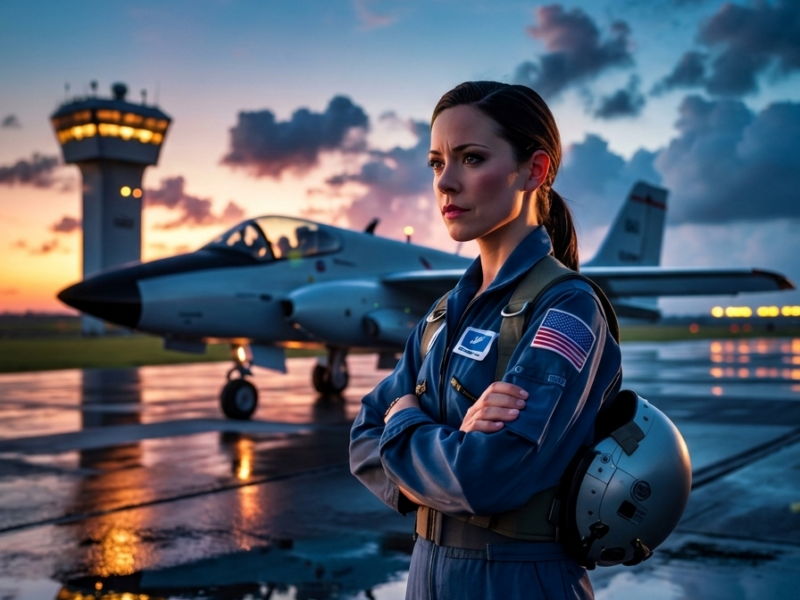
The colonel laughed when I climbed into the cockpit at Fort Rucker, Alabama, calling me “the colonel’s little passenger” in front of the entire flight crew
The heat at Fort Rucker, Alabama, in mid-July did not merely warm the air; it hung over the airfield like a thick, damp blanket that smelled of hot asphalt, aviation fuel, and red mud. Out on the flight line, the ground radiated waves of distortion that made the olive-drab fuselages of the helicopters look as though they were shivering under the relentless sun.
I stood beside a heavy UH-60 Black Hawk with my flight bag slung over my right shoulder and my official orders clutched in my left hand. My uniform was crisp, the fabric stiff against my skin, and the leather of my flight boots felt hot enough to scorch my soles. I kept my posture straight, my shoulders back, and my eyes fixed on the distant treeline where the pine trees met the pale blue sky.
Around me, the flight apron was a hive of activity. Mechanics in grease-stained coveralls hauled power carts across the concrete; young warrant officers in flight suits joked near the staging bay, their laughter carrying over the high-pitched whine of an auxiliary power unit warming up in the distance. But as I approached the lead aircraft of the morning rotation, the casual noise began to dwindle, replaced by a cautious, watchful silence.
“Well now,” a booming voice echoed across the hardtop, sharp and careless. “What do we have here?”
Colonel Robert Hayes stepped out from behind the trailing edge of the Black Hawk’s tail rotor. He was a tall, thick-chested man with graying hair cropped so close to his scalp it showed the pale skin beneath. His uniform was immaculate, adorned with rows of ribbons that spoke of decades in tactical command, and his face carried the deep, weathered lines of a man who had spent his entire life expecting people to flinch when he spoke.
He stopped ten feet from me, resting his hands on his belt, and looked me up and down. A smirk tugged at the corner of his mouth—not a smile of warmth, but the easy, dismissive grin of someone who believed he already understood everything about the world and everyone in it.
“You must be the transfer from the depot command,” Hayes said, his voice carrying easily to the five or six young crew members standing nearby. He glanced down at the name badge pinned above my left chest pocket—CAPTAIN M. VANCE—and then back up to my face. “They told me they were sending fresh blood, but I assumed they meant an actual pilot, not the colonel’s little passenger.”
A couple of the younger aviators chuckled softly, a nervous, habitual sound meant to show loyalty to the commanding officer. A few others looked away, suddenly intensely interested in their clipboards or the rotor blades above them.
I did not flinch. I did not blink. I had spent twelve long, grueling years in military aviation—enduring freezing high-altitude flight schools in North Dakota, grueling night-vision tactical maneuvers over the deserts of New Mexico, and thousands of hours in aircraft that most people were afraid to even stand near. I had earned every stitch on my suit. But I knew better than to argue on a flight line. When a room full of men decides what you are before you even speak, words are just noise. Results are the only currency that matters.
“Captain Maria Vance reporting for flight evaluation, sir,” I said. My voice was calm, flat, and steady, devoid of anger or deference.
Hayes laughed again, shaking his head as he stepped closer, towering over me. “Evaluation? Ma’am, this isn’t a sightseeing tour over the county fair. We fly heavy iron here. We fly real missions. You’d be much better off sitting in the air-conditioned office back at head-quarters handling supply logistics.”
Before I could answer, the heavy steel door of the operations center behind us banged open. A young communications officer stumbled out onto the ramp, his face pale, his breath coming in ragged gasps as he sprinted toward Colonel Hayes.
“Sir! Colonel Hayes, sir!” the officer shouted, his voice cracking with panic. “We have an emergency on the southern range! Flight 4-2—it’s a training craft with three personnel on board. They’ve lost primary navigation, their tail rotor control is intermittent, and the squall line from the Gulf just shifted forty miles north! They’re blind, sir, and they’re drifting straight into restricted artillery airspace!”
The casual atmosphere on the flight line evaporated in an instant. The smirk vanished from Hayes’s face, replaced by a sudden, sharp edge of authority. “What do you mean blind? Where is their escort?”
“The escort turned back when the cloud deck dropped below two hundred feet, sir! Thunderstorms are stacking up over the ridge—winds are gusting over fifty knots. Radar loss is imminent!”
Hayes cursed, stepping toward the operations door. “Get the lead instructor up there! Tell him to launch the duty bird!”
“Sir, the duty instructor refused to clear the pad!” the young officer blurted out, trembling. “He said the visibility is zero and the wind shear will roll any aircraft that tries to climb over the ridge!”
A heavy, suffocating silence fell over the group. The distant rumble of thunder rolled across the Alabama hills, low and ominous, as the southern horizon began to turn a deep, bruised purple. The storm wasn’t coming—it was already here.
I stepped forward, setting my flight bag down beside the landing gear.
“I can bring them home,” I said.
Colonel Hayes stopped dead in his tracks. He turned slowly, looking at me as if I had spoken in an ancient, forgotten language. He laughed again, but this time, nobody joined him. The air was too cold, the stakes too high.
“You?” Hayes sneered, his voice dropping into a dangerous register. “Did you not hear what he just said, Captain? That’s a class-five storm cell sitting on top of a mountain ridge. You’d paint yourself across the trees before you cleared the treeline.”
I didn’t answer with words. Instead, I reached into my flight suit breast pocket, pulled out my leather-bound master qualification record, and handed it directly to him.
Hayes took it reluctantly, his brow furrowed in annoyance. But as his thumb flicked the book open and his eyes scanned the official gold seal and the specific, highly classified flight authorizations stamped inside, his eyes widened. His thumb paused over a single line at the bottom of the page—a rating that fewer than five active pilots in the entire United States military possessed.
He stared at the paper longer than he should have, his jaw tightening.
Before he could speak, the squawk box on the outer wall of the hangar burst into life with loud, sharp static. The voice of the tower operator echoed across the pavement: “All stations, all stations! Flight 4-2 has stopped transmitting. We have lost secondary radar contact. Aircraft is presumed down or descending out of control over Sector Nine.”
I didn’t wait for Hayes to give an order. I turned on my heel, grabbed my helmet from my bag, and climbed directly into the cockpit of the idling Black Hawk.
“Vance! Get out of that aircraft!” Hayes roared, running toward the side door.
I pulled the heavy flight helmet over my head, buckled the chin strap, and flipped down the tinted visor. Through the glass, I looked down at the colonel as he reached the cabin door.
“You want those men back or not, Colonel?” I called out through the open door as I began flipping the overhead switches, bringing the twin turbine engines screaming to life.
Hayes stared at me, his face pale beneath his weathered tan. For three agonizing seconds, he stood paralyzed by the roar of the rotors beginning to sweep overhead. Finally, he slammed his hand against the side of the fuselage and stepped back. “Bring them back,” he shouted over the engine noise. “Or God help you!”
I pulled the collective back, and the heavy helicopter lifted off the ground, turning its nose directly into the black, swirling heart of the storm.
The moment the Black Hawk cleared the perimeter wire of Fort Rucker, the world dissolved into chaos.
Rain hit the windshield not as drops, but as solid sheets of water that slapped against the heavy plexiglass with the sound of gravel being thrown from a bucket. The wind caught the thirty-thousand-pound machine and slammed it sideways, forcing my hands to react instantaneously—adjusting the cyclic, feathering the pedals, balancing the aircraft on a knife-edge of pure instinct.
Below me, the rolling green hills of Alabama were swallowed whole by a dense, churning sea of gray and black clouds. Up here, there was no horizon. There was no sky. There was only the roar of the twin engines, the violent shudder of the rotor blades bite-biting into turbulent air, and the absolute darkness of a storm that had swallowed the afternoon sun.
I pulled the aircraft up to fifteen hundred feet, breaking into the lower layer of the cloud deck. The instrument panel glowed green in the dim cockpit, light bouncing off my visor.
On the radio, the Fort Rucker tower was a mess of frantic, broken transmissions.
“Flight One-Zero… tower… do you read? You are entering… high turbulence zone… pull back…”
“Tower, this is Vance,” I said, my voice steady against the roar of the wind outside. “I am switching to emergency frequency Alpha-Nine. Clear the channel.”
“Captain Vance, you are off radar! Repeat, you are off radar! We cannot track your position!”
“I don’t need you to track me,” I replied cold-bloodedly. “Just keep the medical units on standby.”
I switched the radio frequency, turning off the primary tower feed. The chaotic chatter vanished, replaced by the low, rhythmic hiss of atmospheric static.
For twenty minutes, I flew completely blind.
In conditions like these, most pilots rely entirely on their visual flight indicators or modern GPS overlays. But I knew that in the hills of Sector Nine, iron deposits in the ground combined with heavy electrical storms corrupted digital navigation. If you relied on the screens, you would fly straight into the side of a mountain.
I closed my eyes for two seconds, letting my hands feel the vibration of the airframe.
Feel the air, Maria, a voice echoed in the back of my mind—a deep, calm voice from a lifetime ago. The machine isn’t a building; it’s a bird. Don’t fight the storm. Let the storm tell you where the ground is.
My father had taught me that when I was eleven years old, sitting on a wooden crate in an unmarked hangar in Western Texas, watching him grease the bearings of an old Bell 206. Everyone thought he was just a quiet mechanic with grease under his fingernails and a habit of staring at the sky. Nobody knew what he had really been. Nobody knew what he had done for the military before he vanished from the world.
I opened my eyes, adjusted the throttle, and pushed the nose down, diving straight through the bottom of the clouds.
The aircraft screamed toward the tree canopy below. Fifty feet. Forty feet. Thirty feet.
Then, through the blinding torrents of rain, I saw it.
A thin, dark line cut through the thick forest below—a stretch of abandoned, flooded two-lane highway that had been closed off for years due to mudslides. And there, resting awkwardly in the middle of the asphalt, surrounded by miles of thick brush and raging floodwaters, was the broken silhouette of the missing training helicopter.
Its main rotor was sheared off, lying thirty yards away in the brush like a broken toy. Its engine was smoking, blue fumes whipped away instantly by the howling gale. Inside the glass bubble, I could see three figures trapped in their harnesses, waving frantic red signal lights.
“Tower, this is Vance,” I broke the radio silence, my voice cutting through the static at the base station. “I have visual.”
Back in the Fort Rucker control tower, forty miles away, a silence descended so absolute that you could hear the tick of the wall clock.
“Vance!” Colonel Hayes’s voice burst over the radio, laced with disbelief and sudden panic. “Where are you? What is your status?”
“I’m over Sector Nine,” I said calmly. “The training bird is grounded on Highway 84. Structural damage, no fire, but the water level is rising fast from the creek overflow. They’ll be swept into the ravine in ten minutes.”
“There’s nowhere to land an aircraft your size down there!” Hayes shouted. “The trees are too tight! The highway is too narrow! Hold position and wait for a ground rescue team!”
“A ground team will take two hours, Colonel,” I replied. “They don’t have ten minutes.”
I pulled the Black Hawk into a tight, sickening bank, bringing the tail rotor within feet of the towering pine trees framing the narrow highway.
To land a heavy transport helicopter on an abandoned, flooded road flanked by dense forest in fifty-knot crosswinds is not something taught in military manuals. It requires an absolute refusal to fear death. One tilt of the rotor blades, one sudden gust pushing the tail five inches to the left, and the carbon-fiber blades would strike the trees, exploding the aircraft into a thousand pieces of shrapnel.
I lined up the nose. The wind slammed into the side of the helicopter, trying to throw us toward the rocky cliffside. I kicked the right rudder pedal hard, forcing the nose into the wind, and lowered the collective.
The aircraft dropped like a stone.
“Come on,” I whispered through gritted teeth, my wrists straining against the hydraulic pressure of the controls. “Come on, baby. Stay with me.”
The landing gear hovered five feet above the roaring, brown floodwater rushing across the road. Beneath us, two rusted, abandoned civilian sedans sat half-submerged. I had less than six feet of clearance on either side between my rotor tips and the encroaching forest.
With a final, violent shudder that rattled every tooth in my jaw, the wheels touched down on the cracked asphalt.
I kept the engines screaming, keeping just enough pitch in the rotor blades to hold the heavy aircraft grounded against the raging wind.
Across the flooded road, the emergency door of the downed training helicopter was kicked open. Three young soldiers, drenched, bleeding, but alive, scrambled out into the knee-deep water, dragging each other toward my open side door. My crew chief leaned out, grabbing them by their tactical vests and hauling them one by one into the cabin.
“All personnel secured!” the chief yelled over the intercom, his voice shaking with pure adrenaline. “We’re full! Get us out of here!”
I slammed the collective up. The Black Hawk roared, fighting gravity and the howling gale, and surged upward into the dark gray sky, clearing the treetops by less than a foot as the road below was swallowed by a rushing torrent of mud and debris.
Behind us, the storm raged on, but inside the cockpit, the air was suddenly quiet.
I turned the aircraft back toward Fort Rucker. My hands were shaking so violently against the controls that I had to lock my elbows against my thighs to keep the helicopter steady.
Twenty minutes later, the lights of the main airfield cut through the rain. As I brought the Black Hawk down onto the center of the primary helipad, I could see dozens of people standing under the overhang of the main hangar—mechanics, officers, firefighters, and medical personnel.
And at the very front of the crowd, completely unmindful of the rain pouring off his cap, stood Colonel Robert Hayes.
The massive twin rotors of the Black Hawk spun down to a slow, whistling stop, casting long, dramatic shadows across the wet concrete of the tarmac. The ground crew rushed forward, sliding open the side cabin door to assist the three injured soldiers. Paramedics wrapped them in thick orange blankets, guiding them toward waiting ambulances, but as the young men passed my cockpit, each of them stopped, looking up through the glass to offer a crisp, silent salute.
I removed my flight helmet, letting my damp hair fall down over my shoulders. My head was pounding, a dull, thumping ache brought on by the immense concentration required to keep twelve tons of metal from smashing into a mountain side.
I unbuckled my harness, stepped down from the high cockpit, and set my feet firmly on the ground.
The rain had softened into a steady, misting drizzle. The flight line was quiet now, save for the flashing red and blue lights of the emergency vehicles idling near the hangar.
Colonel Hayes walked toward me slowly.
He had removed his military cap, and the rain glistened on his short gray hair. The arrogant, dismissive smirk that had defined his face two hours ago was completely gone. In its place was a look of deep, unsettled confusion—the expression of a man who had just watched a ghost perform a miracle.
He stopped three feet away from me. He looked at the aircraft, taking in the leaves and small pine branches caught in the landing gear assembly, then looked back at my face.
“I’ve been in Army Aviation for thirty-four years,” Hayes said, his voice unusually low, lacking its usual boom. “I’ve seen combat pilots in Desert Storm. I’ve seen special operations flyers in the mountains of Afghanistan. I have never seen anyone handle an airframe like that in a zero-visibility crosswind.”
“I did what was necessary, sir,” I replied quietly, wiping a stray drop of rain from my forehead.
Hayes narrowed his eyes, studying my features with an intensity that made the skin on the back of my neck prickle. “That maneuver you pulled on the descent—the side-slip approach into the wind envelope… that isn’t taught at Fort Rucker. That isn’t taught at West Point or anywhere in the tactical syllabus. There was only one unit that ever used that technique.”
He took a step closer, his hands resting heavily on his belt. “You never told me who trained you, Captain. Your record says you did your primary flight training in Texas, but no standard instructor teaches a pilot to fly by the seat of their pants like that.”
I looked directly into his eyes, holding his gaze without a single trace of hesitation.
“My father did,” I said.
Hayes let out a short, cynical breath, shaking his head. “Your father? What was he, an old crop duster? A commercial pilot?”
“No, sir,” I answered calm and cool. “He was military. Just like you.”
Hayes frowned, his brow furrowing deeper. “What was his name? I know almost every senior pilot who came through this base in the last thirty years.”
Instead of answering him with words, I reached into the breast pocket of my flight suit. My fingers touched the cool, smooth surface of a small, laminated object I had carried with me every single day of my military life—through every training drill, every deployment, every lonely night in barracks across the country.
I pulled it out and handed it to him.
It was an old, faded color photograph, its edges slightly frayed despite the plastic coating.
Colonel Hayes took it from my hand. At first, he looked at it casually, expecting perhaps a picture of a young girl standing beside a veteran at a parade.
But as his eyes registered the image, the color drained from his face so fast it looked as if he had been struck.
The photograph showed two men standing in front of an experimental, dark-painted reconnaissance helicopter on an unmarked landing pad in the desert. On the left was a younger version of Colonel Hayes himself—wearing the uniform of a Major, smiling broadly with his arm slung over the shoulder of the man next to him.
And on the right stood a taller man with bright, intelligent blue eyes, wearing an unbadged flight suit, holding a little six-year-old girl with dark hair on his hip.
The man on the right was my father, Major Thomas Vance.
Hayes’s hands began to tremble—a slight, uncontrollable shaking that caused the photo to rustle in the damp air. His lips parted, but no sound came out for several long seconds.
“This… this isn’t possible,” Hayes whispered, his voice barely audible over the hum of the hangar lights. He looked up from the photograph to my face, his eyes wide with a sudden, terrible realization. “Thomas…”
“You know who he is, don’t you, Colonel?” I said, my voice dropping an octave, razor-sharp.
“Thomas Vance died twelve years ago,” Hayes blurted out, his voice cracking with a strange, defensive panic. “He was lost over the Gulf of Mexico during a high-altitude tactical evaluation! His aircraft suffered catastrophic engine failure! The wreckage was never recovered!”
“That’s the official story you gave the Department of Defense,” I stepped closer to him, lowering my voice so the surrounding crew members couldn’t hear. “That’s the story you signed your name to on the official casualty report. You told my mother he was gone. You told the press he made an error in judgment during bad weather.”
Hayes swallowed hard, his throat moving nervously. He looked around frantically, ensuring none of his junior officers were close enough to overhear us. “Captain… Maria… you don’t understand what happened back then. That operation—Operation Blackwing—it was classified at the highest level of National Security. We were testing prototype stealth rotors!”
“I don’t care about your prototypes, Colonel,” I said, my eyes burning into his. “I care about the fact that my father didn’t die because of an instrument error. He died because someone turned off his beacon before he cleared the drop zone.”
Hayes turned pale as a sheet. “Who told you that?”
“Nobody had to tell me,” I said, leaning in. “I found his flight logs in his personal safe three years ago. He knew what you were doing with the contractor funds, Hayes. He knew you were falsifying safety reports on those experimental rotor heads to keep the contract money flowing.”
Hayes stared at me, his jaw trembling. He looked like a man who had suddenly seen the ground open up beneath his feet. “That mission… that mission was never supposed to have survivors,” he whispered, almost to himself, a terrifying confession slipping through his teeth in his state of shock.
I felt a cold thrill run down my spine, but before I could speak, I looked toward the dark, cloud-heavy sky above the airfield.
“That’s why I came here, Colonel,” I said softly. “I didn’t transfer to Fort Rucker to advance my career. I came to look you in the eye and let you know that the past doesn’t stay buried.”
Hayes opened his mouth to reply, his face twisted in a mixture of fear and growing anger, preparing to use his rank to shut me down, to order me arrested, or to sweep everything under the rug once again.
But before he could utter a single word, the giant loudspeakers of the airfield’s central communications tower burst into life.
A sharp, violent pulse of static echoed across the entire base, screeching through the air and making every soldier on the tarmac cover their ears.
The screeching static from the base tower speakers cut through the rainy night like a knife, forcing crew members across the tarmac to drop their gear and clutch their hands to their ears.
Inside the glass-walled main control room high above the airfield, emergency lights began flashing crimson.
“All units, clear the tactical frequencies! We have an unauthorized signal override!” the tower controller’s voice boomed out through the lower field speakers, laced with confusion and alarm. “Frequency zero-zero-nine has been breached!”
Colonel Hayes froze. His hand, still clutching my father’s photograph, dropped to his side. “What is going on up there?” he bellowed, turning toward the stairs leading up to the flight operations center. “Get comms back on line!”
“Sir!” a frantic voice yelled down from the second-story balcony of the operations building. An officer was leaning over the railing, holding a headset against his ear, his face completely devoid of color. “Sir, you need to come up here right now! The emergency beacon frequency… it’s transmitting!”
“Which emergency beacon?” Hayes yelled back, stepping toward the stairs.
“Frequency Alpha-Black, sir!” the officer shouted back, his voice trembling so hard it echoed across the tarmac. “The old classified frequency from 2014! The one that was decommissioned twelve years ago!”
My heart slammed against my ribs with the force of a sledgehammer.
2014. Operation Blackwing.
I didn’t wait for Hayes. I sprinted past him, my combat boots pounding against the wet concrete, taking the metal stairs three at a time. Hayes swore loudly behind me, scrambling to keep up despite his heavy build.
We burst into the main flight operations room.
The room was in total disarray. Five operators were hunched over their illuminated consoles, digital audio waveforms spiking in bright green spikes across their screens. The primary radar array was sweeping rhythmically, but showing absolutely nothing—just empty gray circles over the map of the Alabama wilderness.
“Where is the signal coming from?” I demanded, pushing past a stunned communications technician and staring at the master audio console.
“We… we don’t know, ma’am!” the technician blurted out, pointing at a blinking red indicator light labeled ANALOG INPUT – UNRESOLVED. “It’s not coming from a modern satellite or a military tower. It’s an old shortwave military transponder signal, heavily encrypted using old Cold War rolling codes!”
Colonel Hayes burst into the room, out of breath, his face dark with fury and terror. “Kill the feed!” he roared, slamming his fist onto the edge of the console. “Cut the power to that receiver immediately! That’s an old automated system glitch! Cut it!”
“Don’t you dare touch that switch!” I turned on Hayes, stepping between him and the main power toggle, my hand dropping instinctively to the holster at my hip.
The room went dead silent. The young technicians looked back and forth between the high-ranking Colonel and the drenched, fierce Captain who had just rescued three men from a hurricane. Nobody moved.
“Captain Vance,” Hayes growled, his voice dangerously low. “You are bordering on mutiny. Step away from that console or I will have you stripped of your rank and placed in leg irons before the sun comes up.”
“Shut up, Hayes,” I said, my voice ice cold. “Just shut up and listen.”
The ambient static coming from the wall-mounted speakers began to alter. The chaotic, harsh white noise of the rain storm started to rhythmicize, smoothing out into a clear, steady hum—the unmistakable, distinct background audio of an operating cockpit. The whir of a specialized turbine, the soft clicking of an older-generation cyclic stick, and the deep, heavy breathing of a pilot wearing an oxygen mask.
Every person in the room stopped breathing.
Then, a voice cut through the speaker.
It was heavy, raspy, and worn by time and pain—sounding as though it had been pulled through a mile of broken glass and gravel. But beneath the static and the age, the cadence was unmistakable. It was a voice I had heard in my dreams every night for twelve long years. A voice that used to sing me to sleep, that used to teach me the pitch angles of rotor blades.
“Fort Rucker Tower… this is Ghost One-Actual…” the voice crackled through the room, clear and crisp.
Hayes stumbled backward as if he had been shot in the chest, hitting the edge of a desk and knocking a stack of flight binders to the floor. “No…” he whimpered, his face turning an ash-gray color. “No, no, no… he died… I saw his bird hit the water…”
The voice on the radio continued, ignoring the background noise, speaking with a slow, deliberate strength that filled every corner of the room.
“I know you can hear me, Robert,” the voice said, calling Colonel Hayes by his first name—a name only an equal, a former partner, would ever use. “You thought forty fathoms of water in the Gulf would hide what you sold to the highest bidder. You thought writing my name on a piece of paper would erase the debt.”
“Track it!” Hayes screamed, his composure completely shattering as he lunged toward the main operator. “Track that signal! Find out what tower is broadcasting that tape! It’s a hoax! It’s a psychological operation!”
“It’s not a tape, sir,” the lead radar operator whispered, his hands hovering over his keyboard in absolute shock. “Look at the telemetry.”
On the main central monitor, a small, pulsing yellow dot suddenly materialized out of nowhere. It wasn’t over the mountains. It wasn’t over the Gulf.
It was hovering at three thousand feet, directly over the outer perimeter fence of Fort Rucker itself—completely invisible to primary radar, showing up only through the raw radio frequency ping.
The radio crackled one final time. The raspy voice softened, the military hardness melting away for just a fraction of a second, addressing the room with an intimate, heart-shattering clarity.
“Tell my daughter… I’m still alive.”
The transmission cut out with a sharp, definitive CLICK.
The green waveforms on the monitors flattened into straight lines. The blinking red indicator light went dark. The only sound left in the flight operations building was the steady, rhythmic patter of rain against the thick reinforced windows and the sound of Colonel Hayes’s rapid, panicked breathing.
I stood frozen in the middle of the room, my hands clenched into tight fists, the tears I had suppressed for twelve years finally welling up in my eyes, though I refused to let them fall.
He was alive.
My father was alive.
I slowly turned around to face Colonel Hayes. He was standing near the door, his eyes wide with wild, unadulterated terror, looking at me not as a subordinate, not as a woman he could dismiss, but as the daughter of the man who had returned from the dead to drag him into the light.
The silence inside the Fort Rucker flight operations center hung like a heavy shroud for what felt like an eternity. None of the young radar operators dared to move. Their eyes flicked back and forth between the blank radar screens, the trembling figure of their commanding officer, and me.
Colonel Hayes was the first to break the stillness.
He straightened his tunic with a violent, jerky movement, trying desperately to reassemble the shattered pieces of his authority. “Everyone out,” he barked, his voice thin and strained. “Clear this room right now! That is a direct order! Clear the facility!”
The technicians didn’t need to be told twice. They grabbed their caps and scrambled for the exit, passing me with hurried, nervous glances, leaving the door to swing shut behind them with a heavy metallic thud.
Now, it was just the two of us.
The dim green light from the unmanned consoles cast long, jagged shadows across the room. Outside, the storm had finally begun to break, the heavy downpour slackening into a low, steady drizzle against the glass.
Hayes turned to me, his chest heaving. The terrified, broken man who had listened to the voice on the radio was rapidly being replaced by a desperate animal pushed into a corner.
“You think you’ve won something here, Captain?” Hayes said, his voice dropping into a dangerous, gravelly whisper. “You think bringing a twelve-year-old radio trick into my tower changes anything?”
“That wasn’t a trick, Hayes,” I said, standing my ground, my voice cold and immovable as granite. “You heard him. You recognized his voice just as clearly as I did.”
“It doesn’t matter what I heard!” Hayes snapped, taking two aggressive steps toward me. “Do you have any idea what happens if that story gets out? Do you have any idea what kind of men are involved in Operation Blackwing? It wasn’t just me, Vance! It was senior officials in Defense Procurement, foreign intelligence contractors, men who make senators disappear with a single phone call!”
He pointed a thick, shaking finger at my chest. “If your father is alive, he is a rogue operative carrying top-secret military hardware. He is a traitor to this country. And if you are working with him, you are an accessory to treason.”
I let out a soft, bitter laugh—a sound completely devoid of humor.
“A traitor?” I stepped right into his space, forcing him to look up slightly to meet my eyes. “My father took a bullet in his airframe to cover your retreat in 2012. He spent his life serving this military while you were busy taking kickbacks from defense firms to approve faulty tail rotors that cost four young aviators their lives in Iraq.”
Hayes’s eyes narrowed, a dark, venomous look washing over his face. “You have no proof.”
“I don’t need proof anymore, Colonel,” I replied calmly. “You just confessed in front of a room full of audio recording equipment.”
Hayes’s eyes flicked instantly toward the main master console. High above the illuminated screens, a small, square panel glowed with a solid blue light: AUTOMATIC COCKPIT AND TOWER AUDIO RECOVERY SYSTEM – ACTIVE.
Every word spoken in the flight operations room during an active emergency launch was automatically encoded and transmitted directly to the Department of the Army Inspector General’s secure server in Washington D.C. It was an automated safety feature installed nationwide three years ago—a system Hayes, in his sudden panic, had completely forgotten to disable.
His face went from pale to a sickly, mottled gray. “You… you set me up.”
“I didn’t set you up,” I said, reaching out and calmly taking my father’s photograph back from his slack fingers. “You set yourself up twelve years ago when you decided that money was worth more than the lives of the men under your command.”
Before Hayes could answer, the heavy steel security doors at the base of the tower stairs burst open with a loud metallic crash.
Heavy, rhythmic bootfalls echoed up the stairwell—not the sound of nervous flight technicians, but the crisp, synchronized march of armed military police.
A tall, broad-shouldered officer wearing the star of a Brigadier General on his collar pushed the door open, flanked by four heavily armed MPs carrying tactical sidearms.
General Marcus Vance—no relation to me, but the Regional Commander of Military Operations—stepped into the room. His face was rigid, his eyes scanning the room until they settled on Hayes.
“Colonel Robert Hayes,” the General announced, his voice echoing with absolute, uncompromising authority. “By order of the Department of the Army Inspector General and the Armed Services Judiciary, you are hereby relieved of your command effective immediately.”
Hayes stumbled back a step, pointing blindly at me. “General! This woman—she compromised the communications net! She’s in contact with a rogue element!”
“Be quiet, Robert,” General Vance said coldly, pulling a signed federal warrant from his jacket. “The Inspector General’s office has been monitoring your offshore accounts for eighteen months. We were just waiting for the final piece of digital evidence connecting you to the Blackwing sabotage. We just received the live audio feed from this room.”
The General nodded to the two MPs. They moved forward instantly, grabbing Hayes by his arms, stripping him of his sidearm, and forcing his hands behind his back in two quick, practiced motions.
Hayes didn’t fight them. All the fight, all the arrogance, all the forty years of military posture had completely evaporated. He looked small, broken, and old as they marched him toward the stairs.
As he passed me, he stopped for a fraction of a second, looking at me with a mixture of awe and utter defeat. “Where is he?” he whispered. “Where has he been all these years?”
“Somewhere you’ll never be able to reach him,” I answered softly.
The MPs pulled Hayes down the stairs, his footsteps fading into the dark corridors below until the heavy steel doors slammed shut, leaving the tower silent once again.
General Vance walked over to where I was standing. He looked at me for a long moment, taking in my wet flight suit, my muddy boots, and the quiet, steady posture I maintained despite everything that had just transpired.
“You flew a hell of a mission out there today, Captain,” the General said quietly. “Those three young men down in the infirmary owe you their lives.”
“I was just doing my job, sir,” I replied.
“Your father would be proud of you,” General Vance added, his voice softening slightly. “He was the best flyer I ever served with.”
I looked out the high glass windows of the control tower.
The storm clouds had finally parted over Fort Rucker, revealing a vast, dark night sky illuminated by millions of brilliant, sharp stars. The wind had died down to a gentle breeze, carrying the sweet, clean smell of wet pine across the airfield.
Out on the edge of the distant horizon, far beyond the perimeter fences and the military boundary lines, a single, tiny flashing strobe light—a white light moving at high speed without a radar signature—was climbing steadily toward the north, disappearing into the dark, beautiful expanse of the sky.
I held the photograph tight in my hand, feeling the warm plastic against my skin.
The search was over. The truth was out.
And for the first time in twelve years, I knew that whenever I stepped into a cockpit and looked toward the clouds, I was never flying alone.
The end.









