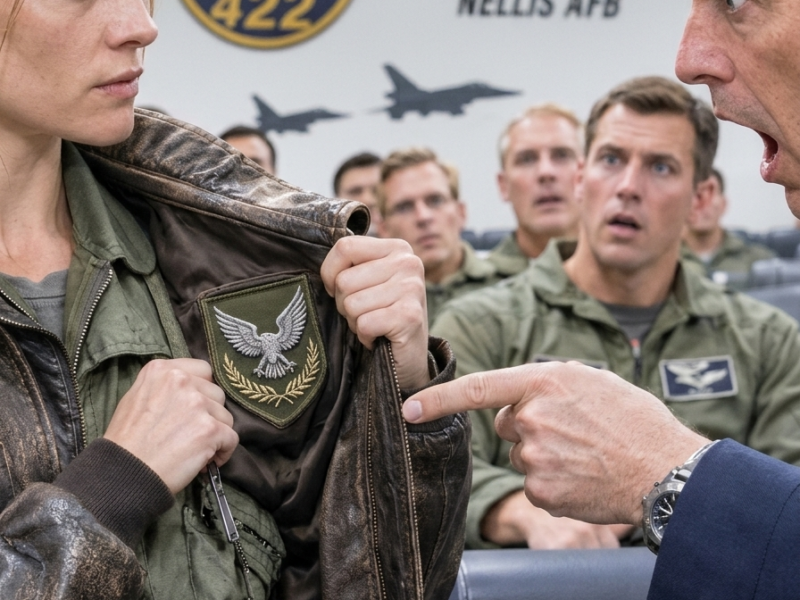
The colonel laughed in front of an entire military briefing room when he saw my faded flight jacket, calling me a washed-up pilot who had mistaken an old uniform for a lifetime achievement
The air inside the Andrews Air Force Base briefing room felt suddenly thin, charged with a static electricity that made the fine hairs on my arms stand on end. Thirty high-ranking Air Force officers sat motionless around the polished mahogany table, their earlier smirks and casual laughter completely evaporated, replaced by a stunned, suffocating silence.
I couldn’t take my eyes off the second photograph General Marcus Vance had just laid down on the table beside mine.
My hands, which had stayed perfectly steady when Colonel Richard Hayes had mocked my worn leather jacket and called me a washed-up civilian consultant, were now trembling uncontrollably against the edge of the briefing table. My throat tightened so violently that breathing felt like inhaling broken glass.
In the photograph—a grainy, high-contrast black-and-white print stamped with an obsolete black-ink classification header—stood Lieutenant Daniel Hayes, young, smiling faintly, leaning against the sleek, angular fuselage of an experimental delta-wing aircraft that had no vertical tail stabilizers and no visible intake vents. It was an airframe that defied every aerodynamic textbook in the Pentagon’s library.
And standing two paces behind Daniel, resting her gloved hand on the canopy frame, wearing a crisp, brand-new version of the exact faded leather flight jacket currently draped over my shoulders, was Captain Elena Vance-Cruz.
My sister.
The woman whose empty casket I had watched lowered into the rain-soaked earth of Arlington National Cemetery twenty-six years ago.
“No…” I whispered, the sound barely escaping my lips. My knees buckled slightly, and I had to brace my palms flat against the tabletop to keep from collapsing. “No, that’s impossible. Elena died in the Pacific. I was there. I saw her jet go down in the typhoon.”
General Vance—a man with four stars on his shoulders and decades of classified intelligence operations etched into the deep lines of his face—exchanged a grim glance with the two stern-faced Office of Special Investigations agents standing behind him.
“The official record states that Captain Elena Cruz perished during an unrecoverable flat spin over the Mariana Trench on October 14, twenty-six years ago,” General Vance said quietly, his voice carrying clearly across the silent room. “Her wreckage was never recovered due to extreme ocean depth.”
“Because there was no wreckage to recover,” I breathed, my eyes dropping to the bottom margin of the photograph.
Written across the white border in faded blue fountain-pen ink—the exact same cheap ink pens Elena used to steal from the flight-line briefing desks because she liked the way they glided over flight logs—was a single, slanted line of handwriting:
“If you’re reading this, Sarah, don’t look at the ocean. Look at the stars. — E.”
My breath hitched. A hot tear spilled over my lower eyelid, tracking down my cheek and falling onto the mahogany table right beside the photo. I hadn’t cried in twenty-six years. I had locked every grief, every scar, and every memory of that terrible night inside the lining of my leather jacket and carried it like armor. Now, a single scrap of paper had shattered that armor into dust.
Beside me, Colonel Richard Hayes stood frozen, his face as pale as chalk. The arrogant, aggressive posture he had worn ten minutes ago was gone. He looked down at the photograph of his father standing next to the impossible black aircraft, his jaw clenching tightly.
“General Vance,” Hayes said, his voice tight and stripped of its earlier condescension. “What is this? My father died from pulmonary complications six years after his rescue. He was a conventional test pilot assigned to the Pacific Fleet. He never flew… whatever that machine is.”
“Your father didn’t die of natural complications, Colonel,” one of the intelligence officers spoke up, stepping forward and placing a heavy, red-stamped manila dossier on the table. “And Captain Sarah Morgan wasn’t invited here today merely to review a missing training flight.”
I slowly looked up from the photograph, wiping my cheek with the back of my sleeve, forcing the cold, analytical focus of a veteran test pilot back into my mind. “The pilot who disappeared three days ago over the Nevada test range,” I said, my voice hardening. “Lieutenant David Miller. His telemetry logs showed an instantaneous altitude spike from thirty thousand feet to ninety-five thousand feet in four seconds—followed by complete radar loss.”
General Vance nodded slowly. “The exact same flight profile recorded on your sister’s radar track twenty-six years ago over the Pacific. And the exact same profile recorded on a dozen other unpublicized disappearances over the last three decades.”
“You didn’t call me here as a consultant,” I said, looking directly at the four-star general. “You called me here because you think whoever took my sister twenty-six years ago just took Lieutenant Miller.”
“Not took, Captain,” General Vance corrected softly. “Recruited. Or captured. And before we can determine which, we need to understand what happened on that damaged island runway on October 14.”
The general turned to the thirty officers seated around the table. “This briefing is now classified Top Secret—Compartmented Eyes Only. Every officer below the rank of Colonel is dismissed. Leave your data slates on the table. Seal the doors behind you.”
Chairs scraped loudly against the floor as twenty-five officers hurried out of the room, casting nervous, bewildered glances back at me—the “washed-up” civilian woman in the cracked leather jacket who had just turned their routine morning briefing upside down.
When the heavy oak doors clicked shut, leaving only General Vance, the two intelligence officers, Colonel Hayes, and myself in the room, Hayes slowly turned toward me. The animosity in his eyes had been replaced by a complex, painful mixture of shame and desperate curiosity.
“You pulled my father out of that fire,” Hayes said quietly, his voice barely above a whisper. “He never told me who saved him. He only told me that an angel in a leather jacket walked through burning jet fuel to bring him home to me.”
I looked down at the tiny embroidered patch inside my collar—D.H. — OCTOBER 14—and then back up at the son of the man I had broken every military rule to save.
“He wasn’t just trying to survive that night, Richard,” I said softly. “He was trying to bring something back with him. And if this photograph is real… he didn’t finish the job.”
The intelligence officer—a sharp-eyed woman in a dark civilian suit who introduced herself only as Agent Mercer—activated the briefing room’s central holographic projector. The room dimmed automatically, and a high-resolution three-dimensional map of the central Pacific Ocean materialized above the table, dotted with glowing red telemetry lines and timestamp markers.
“Twenty-six years ago, on the night of October 14,” Agent Mercer began, tapping a control pad on the table, “Captain Sarah Morgan, Lieutenant Daniel Hayes, and Captain Elena Cruz were conducting a classified high-altitude interception exercise three hundred miles southwest of Wake Island. Officially, you were testing experimental radar-absorbent coatings on modified F-15 airframes.”
“That’s what our mission orders said,” I confirmed, crossing my arms over my chest, feeling the familiar stiffness in my left shoulder where the shrapnel and burns had healed poorly decades ago. “We were flying in a three-ship diamond formation at forty-five thousand feet. Weather was deteriorating rapidly—a Category 4 typhoon was moving up from the south.”
“At 0214 hours Zulu,” Mercer continued, zooming the holographic map in on a narrow corridor of empty ocean, “an unidentified radar contact entered your airspace from an altitude above one hundred thousand feet. It was traveling at Mach 6.2 with zero heat signature.”
I closed my eyes for a fraction of a second, and suddenly I wasn’t in a climate-controlled room in Maryland anymore. I was back in that cramped, vibrating cockpit, rain lashing against the polycarbonate canopy like gravel, the green glow of my radar scope flickering wildly as an impossible white blip tore across my screen at speeds no human aircraft could survive.
“Lead, this is Two,” Elena’s voice had crackled over our encrypted tactical frequency, breathless and filled with fierce excitement. “Do you have a lock on that bogey? It’s not on any flight plan!”
“Negative, Two, maintain formation!” I had screamed back into my oxygen mask as the typhoon winds violently buffeted my wings. “Break off! Do not pursue!”
“Too late, Sarah! It’s descending right into my vector—God, look at the shape of it—it doesn’t have wings—”
Then came the blinding flash of blue-white light that illuminated the entire storm cloud from within, followed by a deafening burst of static that blew out my headset speakers. When the static cleared, Elena’s transponder was gone. Completely erased from the sky.
“I banked hard to search for her parachute,” I said aloud, opening my eyes and staring into the glowing blue hologram. “That’s when Daniel’s jet took a hit. Not from a missile—from an electromagnetic shockwave that fried his fly-by-wire controls and jammed his ejection seat canopy.”
Colonel Hayes leaned forward, his hands gripping the edge of the table tightly as he listened to the truth of his father’s final flight for the first time. “You were ordered to abort.”
“Command told me to climb out of the storm and return to the carrier,” I said flatly. “They said the radar anomaly was a weather balloon or a meteor strike, and that landing on the abandoned World War II airstrip on Johnston Atoll in a Category 4 storm was suicide. I turned off my command radio, followed Daniel’s emergency beacon through zero visibility, and put my jet down on six thousand feet of cracked coral runway.”
I remembered the heat. Even now, twenty-six years later, I could smell the acrid stench of burning JP-8 jet fuel and melting composite wiring. Daniel’s cockpit canopy had been fused shut by the electrical surge. I had used a heavy emergency crash axe from my survival kit to smash through the reinforced glass while flames licked up the fuselage, dragging his unconscious body clear into the torrential rain just six seconds before the main fuel cells detonated, throwing me thirty feet across the tarmac and shattering my left collarbone and three ribs.
“When the rescue helicopters arrived four hours later,” General Vance interjected, taking over the briefing, “Lieutenant Hayes was transferred to a classified medical facility in Hawaii. Captain Morgan was honorably discharged due to permanent spinal and pulmonary damage. The incident was sealed under National Security Directive 44.”
“Then how did my father take that photograph?” Colonel Hayes demanded, pointing a trembling finger at the black-and-white print on the table. “If he was in a hospital in Hawaii, and Elena Cruz was supposedly dead at the bottom of the Pacific, when was this taken?!”
Agent Mercer pressed another button on her console. The holographic map shifted away from the Pacific Ocean, zooming across the continental United States until it focused on a remote, mountainous region of northern Nevada, fifty miles north of the standard Nellis testing grounds.
“Six months after your father was discharged from the hospital, Colonel,” Mercer said quietly, “he disappeared from his home in Virginia for eleven days. His family believed he was attending a veteran rehabilitation retreat in Colorado. In reality, he traveled here.”
A satellite photograph appeared in the hologram, showing a massive, concealed subterranean hangar entrance built directly into the sheer granite face of a desert canyon, completely camouflaged by artificial rock formations and radar-scattering netting.
“Project Black Horizon,” General Vance said, his voice grim. “A rogue, off-the-books aerospace research initiative funded through diverted defense appropriations in the late 1990s. Operated by a private defense consortium called Aether Dynamics.”
I stared at the satellite image, my mind racing as the pieces began to snap together with terrifying clarity. “The black aircraft in the photo… that wasn’t an alien ship we saw over the Pacific.”
“No, Captain,” Vance confirmed. “It was a prototype propulsion testbed built using reverse-engineered magnetohydrodynamic drives. A machine capable of atmospheric flight at speeds exceeding Mach 8 without sonic booms or thermal exhaust. Your sister didn’t crash into the ocean twenty-six years ago. Her aircraft was captured mid-air by a magnetic grapple test system, and she was forced to land at a secret Pacific test platform before being transferred to Nevada.”
“Why?” I asked, my voice rising with a cold, burning anger. “Why fake her death? Why destroy her family?”
“Because Elena Cruz was the only test pilot in the Air Force with the neural-reflex conditioning required to survive the G-forces of their prototype drive,” Agent Mercer explained. “She wasn’t a prisoner in a cell, Captain. They convinced her she was working on a classified national defense project—until she discovered they weren’t building it for the United States military. They were selling the telemetry data to foreign adversaries.”
Colonel Hayes looked down at the photograph of his father once more, his eyes narrowing as he noticed a small detail near the bottom corner of the frame. “My father found her.”
“Yes,” General Vance said. “Daniel Hayes spent six years quietly tracking the financial records of the contractors who built your sister’s jet. He tracked her to the Nevada facility, infiltrated the perimeter, and met with her in secret. This photograph was taken by your father inside Hangar 4—just two weeks before he died.”
“He didn’t die of lung complications from the fire,” Hayes whispered, his hands clenching into white-knuckled fists on the table. “They poisoned him.”
“We believe so,” Vance said grimly. “Before he died, Daniel managed to smuggle a single physical data drive out of the Nevada facility. We recovered it from a safe deposit box in his name three days ago—right after Lieutenant David Miller disappeared using the exact same flight profile.”
Vance picked up a small, battered titanium flash drive from the red dossier and slid it across the polished wood toward me.
“The drive is encrypted with a dual-key biometric and voice-print lock,” the General said, locking eyes with me. “One half of the key was coded to Daniel Hayes’s service serial number. The other half… was coded to yours, Captain Morgan.”
The room was dead silent as I stared at the small titanium drive resting on the table before me. Twenty-six years of grief, twenty-six years of waking up in cold sweats hearing my sister’s voice scream through static, had all led to this single piece of metal.
“Why me?” I asked quietly, looking up at General Vance. “I’m a retired pilot living on a disability pension in Maine. Why didn’t Daniel give this to the Pentagon?”
“Because Daniel didn’t know who inside the Pentagon was taking money from Aether Dynamics,” Agent Mercer replied. “He trusted only one person on earth with his life—the woman who walked through fire to pull him out of a burning cockpit.”
Colonel Hayes stepped up beside me, looking down at the titanium drive, then at my face. The bitterness and arrogance that had defined him an hour ago had vanished completely, replaced by the quiet, intense resolve of a son determined to avenge his father’s murder.
“I have my father’s service records and his personal identification cipher on my secure terminal,” Hayes said, his voice steady and firm. “Tell me what you need, Captain.”
I looked at Hayes—really looked at him for the first time. Beneath the crisp uniform and the sharp military bearing, I saw the exact same stubborn, fiercely loyal eyes that had looked back at me from the cockpit of a burning F-15 twenty-six years ago.
“I need a secure terminal,” I said, standing up straight and pulling my worn leather jacket tighter around my shoulders. “And I need a flight suit.”
General Vance raised an eyebrow. “Captain Morgan, your medical file clearly states—”
“My medical file is twenty-six years old, General,” I interrupted, my voice ringing out across the quiet room with the unmistakable authority of a flight commander. “You told me Lieutenant Miller disappeared three days ago over Nevada. If Aether Dynamics is still operating that underground facility, and if my sister is still alive inside that mountain, I’m not sitting in a briefing room in Maryland while a bunch of bureaucrats file paperwork.”
Agent Mercer connected the titanium drive to a ruggedized, air-gapped military laptop on the table. A prompt flashed onto the screen: ENTER PRIMARY CIPHER AND VOICE AUTHORIZATION.
Colonel Hayes leaned over the keyboard, typing in a twelve-digit alphanumeric sequence from memory—his father’s classified tactical service code. The screen flashed amber, shifting to a second prompt: VOICE VERIFICATION REQUIRED — SUBJECT: CAPTAIN SARAH MORGAN.
I leaned down toward the laptop’s microphone, took a slow, deep breath, and spoke the call-sign phrase Elena and I had used on every flight since we were cadets at the Academy:
“Valkyrie Lead to Valkyrie Two. Wings level, eyes on the horizon.”
BEEP.
The amber screen turned a brilliant, solid green. ACCESS GRANTED.
Hundreds of encrypted folders, CAD schematics, financial wire ledgers, and high-resolution surveillance files flooded the screen. Agent Mercer immediately began sorting through the directories, her fingers flying across the keys.
“My God…” Mercer whispered, her face paling as she opened a folder labeled TEST PILOT ROSTER — ACTIVE. “General, look at this.”
We all crowded around the laptop screen.
On the display was a series of live biometric telemetry feeds monitoring four individuals inside a subterranean pressurized habitat beneath the Nevada desert. Three of the feeds were labeled with the names of missing Air Force test pilots from the last decade—including Lieutenant David Miller, whose heart rate was elevated at 135 beats per minute, indicating he was alive, conscious, and currently undergoing high-G centrifuge conditioning.
And at the very top of the screen was the fourth feed: SUBJECT 01 — ELENA CRUZ. STATUS: ACTIVE. LOCATION: SUB-LEVEL 4, CONTROL CORE.
My heart slammed against my ribs so hard it hurt. I stared at the steady, rhythmic green line of Elena’s heartbeat pulsing across the monitor. She was alive. After twenty-six years in the dark, my little sister was still breathing.
“They’re preparing a launch,” Colonel Hayes said, pointing to a secondary timeline scrolling along the bottom of the screen. “Look at the fuel telemetry on Bay 1. They’re charging the magnetohydrodynamic capacitors on the primary prototype. Countdown shows… four hours until launch.”
“Where are they launching it?” General Vance demanded, leaning over the table.
“Not into orbit,” I said, my eyes scanning the trajectory calculations displayed on the CAD screen. “Look at the flight vector. Low-altitude, terrain-following supersonic cruise heading due west across the Pacific. They’re flying the prototype out of U.S. airspace—straight toward an international pickup vessel in the South China Sea.”
“They’re defecting with the technology,” Vance snarled, his four-star authority snapping into full command mode. “And they’re taking the pilots with them to operate it!”
“If we send a conventional strike wing from Nellis,” Hayes said quickly, his tactical mind instantly analyzing the problem, “their subterranean radar array will detect the incoming fighters fifty miles out. They’ll seal the mountain blast doors, flood the lower levels with halon gas, and destroy every piece of evidence—including the pilots.”
“They won’t detect a low-altitude insertion if it comes in through the canyon blind spot,” I said, pointing at the topographical map on the screen. “Look at the northern ridge of the canyon. There’s a three-hundred-foot radar shadow caused by the iron-ore deposits in the granite cliffs. A single light-attack helicopter or a low-observable tilt-rotor flying nap-of-the-earth at fifty feet can drop a breach team right onto the ventilation exhaust pad before their sensors even register a blip.”
General Vance looked at me, then at Colonel Hayes, and finally at Agent Mercer.
“Colonel Hayes,” Vance barked. “You command the 89th Operations Support Squadron here at Andrews. How fast can you have a stealth-modified MH-60 Black Hawk fueled, armed, and ready for immediate airlift via C-17 transport to Nevada?”
Hayes didn’t hesitate for a fraction of a second. He snapped to attention, his eyes shining with fierce determination. “Twenty minutes, sir. And I’m flying it myself.”
Vance turned to me, his expression grim. “Captain Morgan, technically you are a civilian. If you get on that aircraft, I cannot offer you official military protection until we secure the facility.”
I reached up, zipped my cracked, faded leather jacket all the way to my chin, and met the general’s gaze without blinking.
“I didn’t ask for protection twenty-six years ago, General,” I said coldly. “I just asked for a runway.”
Three hours and forty minutes later, the howling roar of four turbofan engines faded into the thin, freezing night air of the Nevada high desert.
We had flown across the continent in the belly of a C-17 Globemaster at maximum cruise speed, launching our blacked-out stealth helicopter straight out of the rear cargo ramp at five thousand feet over the Mojave border. Now, with our running lights completely extinguished and our rotor blades muffled by active noise-cancellation arrays, Colonel Hayes guided the aircraft low through the jagged, pitch-black canyon walls of northern Nevada.
Sitting in the co-pilot’s seat beside him, wearing a borrowed flight helmet and a Kevlar tactical vest strapped over my faded leather jacket, I watched the green terrain-following radar sweep across the dark granite cliffs passing less than forty feet off our rotor tips.
“Approaching the northern iron-ore ridge,” Hayes murmured into his headset, his hands steady on the cyclic stick, his eyes locked onto his night-vision display. “Wind is fifteen knots out of the west. Dropping to thirty feet. Hold onto your teeth, Captain.”
The helicopter dipped sharply into the narrow, winding ravine, skimming just above the dry, boulder-strewn riverbed. Behind us in the troop bay, Agent Mercer and six elite operators from the Air Force’s 24th Special Tactics Squadron checked the suppressed carbines and thermal breaching charges resting across their laps.
“Twenty minutes until Aether Dynamics initiates their launch sequence,” Mercer called out over the intercom, checking the encrypted tablet wired into the helicopter’s comms array. “Heat signatures inside Hangar 4 are spiking. They’re powering up the main drive.”
“There,” I said, pointing through the armored windshield toward a sheer, vertical cliff face ahead where a faint, unnatural shimmer distorted the starlight—the thermal exhaust vent of an underground nuclear-powered facility. “Right above that ledge. Put us down.”
Hayes flared the helicopter with master-pilot precision, bringing the skids to a gentle, silent touchdown on a narrow granite shelf thirty yards above the concealed hangar entrance.
Before the rotor blades had even slowed, the six Special Tactics operators slid out of the side doors, moving like shadows across the rocks toward the heavy steel ventilation grates. I unbuckled my harness, grabbed a suppressed 9mm pistol from the center console, and followed them out into the biting desert cold, with Colonel Hayes right on my heels after putting the helicopter into low-idle standby.
“Thermal breach set,” the squad leader whispered, slapping a strip of shaped plastic explosive onto the titanium locking bars of the main service hatch. “Fire in the hole.”
THUMP.
A dull, muffled detonation sheared the locking bolts cleanly without echoing down the canyon. Two operators hauled the heavy hatch open, revealing a narrow, dimly lit concrete maintenance stairwell descending deep into the mountain.
We moved fast and silent down the steel stairs, boots barely making a sound against the grated steps. Two levels down, we breached an interior security door and emerged onto a high metal catwalk overlooking the massive, cavernous interior of Hangar 4.
My breath caught in my throat.
Sitting in the center of the brightly lit subterranean cavern was the black, delta-wing aircraft from my father’s photograph. It was breathtaking and terrifying—fifty feet long, seamless, its dark composite skin humming with an intense, low-frequency vibration that made the catwalk railing tremble beneath my hands.
Around the aircraft, a dozen armed private security contractors in black tactical gear were establishing a perimeter while technicians in white clean-suits disconnected the final fuel umbilicals.
And standing on the boarding platform beside the open cockpit canopy, wearing a dark flight suit with her hair pulled back into a tight silver-streaked braid, was Elena.
Even from a hundred feet above, I would have known the set of her shoulders anywhere in the universe.
“There she is,” I whispered, my hand tightening around the grip of my pistol.
Beside me, Colonel Hayes raised his carbine, peering through his thermal scope at a glass-walled control booth overlooking the hangar floor. Inside stood a tall, silver-haired man in an expensive tailored suit—the CEO of Aether Dynamics—flanked by two armed guards and a young, terrified pilot strapped into a gurney near the wall: Lieutenant David Miller.
“They’re forcing Miller into the secondary seat,” Hayes hissed. “They’re going to use him as a biological shield if anyone tries to intercept them over the Pacific.”
“Squad, take the perimeter guards on my mark,” the Special Tactics leader whispered into his throat mic. “Suppressors only. Do not hit the aircraft’s power capacitors—if those things rupture, they’ll take half the mountain with them.”
“Wait,” I said, stepping toward the ladder leading down to the hangar floor. “The second those guards drop, the man in the control booth will hit the blast-door override and seal the mountain. I’m going for Elena.”
“Sarah, stay on the catwalk—” Hayes started, reaching for my arm, but I was already sliding down the steel ladder rails, dropping silently behind a stack of heavy cryogenic coolant tanks twenty yards from the boarding platform.
POP-POP-POP-POP!
From the catwalk above, six suppressed rifles spat quiet bursts of precision fire. Within three seconds, eight private security contractors dropped silently to the concrete floor before a single alarm could sound.
Up in the glass control booth, the silver-haired CEO spun around in shock, slamming his palm down on a large red emergency button on his console.
WEE-OOO! WEE-OOO! WEE-OOO!
Deafening sirens erupted throughout the cavern. Massive, three-foot-thick steel blast doors began grinding downward across the canyon exit tunnel, while armored security shutters slammed shut over the control booth windows.
“Elena!” I screamed over the howling sirens, stepping out from behind the coolant tanks with my pistol raised, dropping two remaining guards who turned toward the boarding platform.
Elena froze on the metal steps beside the black aircraft. Slowly, she turned her head, her dark eyes widening in absolute, stunned disbelief as she saw me standing there in the center of the cavern, wearing our old leather jacket.
“Sarah…?” Elena breathed, her hand flying to her mouth as tears instantly flooded her eyes. “Sarah, what are you doing here?!”
“Taking you home!” I shouted, sprinting toward the boarding platform as heavy footsteps echoed from the far side of the hangar—a reinforcement squad of twenty heavily armed mercenaries pouring through the lower barracks doors.
The cavern erupted into a storm of gunfire. Tracer rounds ricocheted off the concrete pillars and sparked violently against the steel catwalks above as the Special Tactics operators laid down suppressive fire to hold back the advancing mercenaries.
I reached the boarding platform, throwing my arms around Elena for one brief, desperate second. She felt solid, warm, and real—not a ghost, not a memory, but my sister.
“Twenty-six years, Elena,” I choked out, pulling back to look into her tear-streaked face. “I buried an empty box.”
“I tried to get a message out, Sarah,” Elena sobbed, grabbing my arm as bullets pinged off the metal stairs beside us. “When Daniel Hayes found me six years ago, we planned an escape, but they caught him before we could launch—they told me they killed him!”
“He survived long enough to leave me the map,” I said, pulling her toward the gurney where young Lieutenant David Miller was strapped down, staring wide-eyed at the firefight raging around him. I sliced through his leather restraints with my survival knife and hauled him to his feet. “Can you walk, Lieutenant?”
“Yes, ma’am!” Miller gasped, scrambling behind the cover of the boarding stairs.
Above us, the massive canyon blast doors were already halfway down, closing off the exit tunnel at terrifying speed. Meanwhile, the mercenaries had pinned down the Special Tactics team on the upper catwalk with heavy rotary machine-gun fire, cutting off our escape route back up the maintenance stairwell.
“We’re trapped!” Colonel Hayes yelled over our comms channel, firing bursts from behind a steel girder above. “They’ve got the stairs covered, and the main tunnel doors will seal in forty seconds!”
I looked at the black, humming delta-wing aircraft sitting ten feet away on the launch rails, its canopy still wide open, its magnetohydrodynamic drive glowing with a fierce, ready azure light. Then I looked at Elena.
“How many seats?” I asked, a wild, reckless grin breaking across my face.
Elena wiped the tears from her cheeks, and suddenly, the brilliant, fearless test pilot I had flown beside twenty-six years ago stepped back into her eyes. “Two flight seats and an equipment bay behind the bulkhead. Can you still fly, Valkyrie Lead?”
“Like I never left,” I said, shoving Lieutenant Miller into the rear equipment compartment and vaulting into the co-pilot’s seat while Elena leaped into the pilot’s station.
“Hayes!” I shouted into my helmet mic. “Get your team back up the shaft to the Black Hawk and meet us at the Edwards Air Force Base runway! We’re taking the scenic route out!”
“You’re insane, Captain!” Hayes roared back, though I could hear the fierce pride in his voice. “Clear the tunnel! We’re right behind you!”
The heavy polycarbonate canopy sealed shut with a pressurized hiss, cutting off the deafening roar of the gunfire outside. Elena’s hands flew across the glowing holographic flight controls with effortless, twenty-six-year mastery.
“Drive capacitors at one hundred percent,” Elena announced, her voice calm, clear, and ringing through our internal comms. “Inertial dampeners engaged. Hold onto your jacket, big sister.”
She slammed the throttle forward.
There was no deafening roar of jet engines—only a deep, resonant hum that vibrated through the very marrow of our bones. The black aircraft leaped forward along the magnetic launch rails, accelerating from zero to four hundred knots in two seconds flat.
The massive steel blast doors at the end of the canyon tunnel were less than twelve feet off the floor—barely enough clearance for the aircraft’s slim, delta-wing profile.
“Wings level!” Elena shouted.
“Eyes on the horizon!” I answered, gripping the edge of my console.
The aircraft shot beneath the descending steel wall with inches to spare, bursting out of the granite cliff face into the open, starlit sky of the Nevada desert. Elena pulled back sharply on the control stick, pitching the nose vertical as the experimental drive roared silently, carrying us straight up toward the edge of the atmosphere in a streak of brilliant blue light.
Behind us, deep within the canyon, the heavy blast doors slammed shut too late—trapping the CEO of Aether Dynamics and his mercenaries inside their own mountain fortress as General Vance’s orbital strike teams and federal tactical units descended from the night sky to surround the perimeter.
Forty minutes later, the impossible black aircraft touched down smoothly on the main runway at Edwards Air Force Base, surrounded by dozens of flashing emergency vehicles, military police escorts, and a waiting transport jet carrying General Vance.
When the canopy hissed open, the cool California desert air washed over us.
I climbed down the boarding ladder, slightly unsteady on my legs, helping Elena and young Lieutenant Miller down onto the tarmac. Standing near the edge of the runway, waiting beside a sleek military sedan, was Colonel Richard Hayes.
He walked slowly toward us, his helmet tucked under his arm, his eyes fixed on Elena—the woman his father had died trying to rescue—and then shifting to me.
Hayes stopped three feet away, came to rigid attention, and raised his right hand in a sharp, crisp military salute.
“Welcome home, Captain Cruz,” Hayes said, his voice thick with emotion. Then he looked at me, offering a genuine, humbled smile. “And thank you, Captain Morgan. My father would have been proud to see this day.”
I reached up, unfastened the tiny, worn leather collar of my jacket, and looked at the embroidered patch sewn inside: D.H. — OCTOBER 14.
“He was right there with us, Richard,” I said softly, wrapping one arm around my sister’s shoulders as the first golden light of dawn broke over the desert mountains. “Every single mile of the way.”
THE End.









