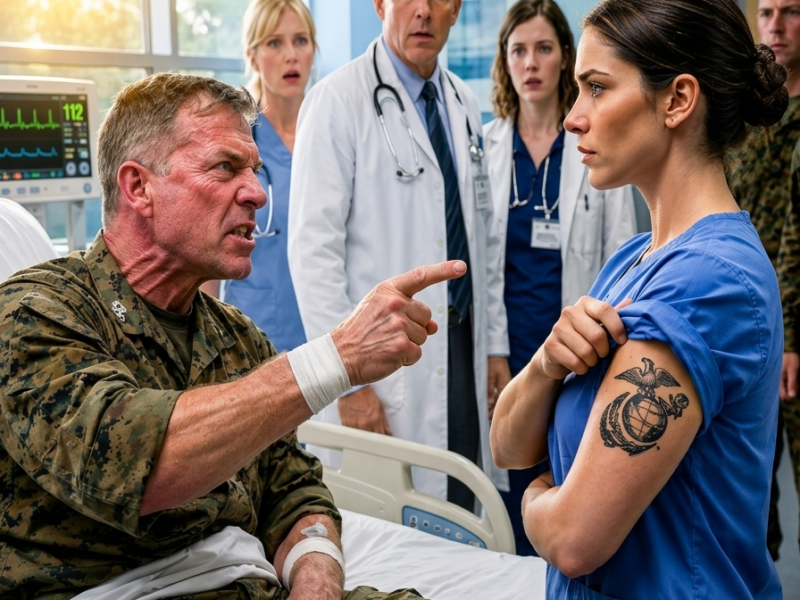
The colonel humiliated me in front of twelve soldiers at Walter Reed Medical Center, ordering me out of his hospital room like I was nothing
“Get out of my room!” Colonel Richard Hayes barked, throwing his water glass against the wall.
The glass shattered beside my shoes, sending tiny fragments scattering across the polished hospital floor. The harsh fluorescent lights of Walter Reed Medical Center caught the droplets of water, making them glitter like broken diamonds.
Twelve soldiers stood frozen near the doorway, their posture stiff, their faces masks of disciplined neutrality. Yet I could feel their eyes burning into me, watching their legendary commanding officer unleash his fury on a woman wearing a plain blue nursing uniform.
I didn’t move.
“I’m your assigned night nurse, Colonel,” I said quietly, keeping my hands resting calmly at my sides despite the adrenaline surging through my veins.
“I don’t care who you are,” he snapped, his breathing raspy as he sat upright in his hospital bed. “I want someone competent. Someone who knows how to follow orders, not some civilian rookie gawking at my medical chart.”
His harsh words hurt less than the look in his eyes. It was a cold, piercing glare—the exact same look I had seen in old, faded photographs of him standing shoulder-to-shoulder with my father before the military reported him killed in action.
Twenty years earlier, my father, Captain Daniel Vance, had disappeared during a classified operation in the rugged mountains of Eastern Europe. He left behind no body, only a bloodstained uniform, a folded American flag delivered to our front door, and a heavily redacted letter that never explained what actually happened on that final night.
My mother spent the rest of her life broken, dying of cancer five years ago believing my father had abandoned us or died in disgrace. I had grown up believing the exact same painful narrative.
Until three nights ago.
While reviewing late-night transfer logs in the intensive care unit, I discovered my father’s name buried deep inside Colonel Hayes’s restricted medical records. The document was marked with a red clearance stamp that should have been way above my paygrade, but a system glitch had left it exposed on my terminal screen for five brief minutes. That was all it took for me to request a shift transfer directly to Hayes’s private wing.
I had spent seven years becoming a specialized critical care nurse, never imagining that the key to my family’s ruin would be lying in a hospital bed right under my care.
“Please leave,” Hayes ordered again, his hand reaching with visible effort toward the call button mounted on the wall. “Or I will have the guards escort you off this floor.”
Instead of stepping back toward the exit, I took one deliberate step closer to his bed. Slowly, without taking my eyes off his face, I rolled up my left sleeve.
A jagged, pale scar crossed my forearm, surrounding a small, crescent-shaped birthmark. It was a distinctive mark. When I was a little girl, my father used to trace that exact mark with his thumb, kissing it whenever I scraped my skin on the playground, telling me it was our secret family seal.
The colonel stopped breathing for a moment. His eyes widened, his gaze locking onto my arm as if he had just seen a ghost rising from the cold tiles. His fingers trembled against the white hospital blanket.
“Where… where did you get that?” he whispered, his booming voice suddenly collapsing into a raspy murmur.
“My father gave me something before he disappeared,” I replied, my voice dropping to a low, unwavering pitch. “Something he told me never to show anyone unless I found the man who came home without him.”
I reached into my scrub pocket and pulled out a tarnished, dented military dog tag. The metal was cool against my skin. I stepped forward and placed it gently on his bedside tray, right beside his overturned water pitcher.
Hayes stared at the silver rectangle as if it were a loaded gun aimed directly at his heart. The stamped letters—VANCE, DANIEL M.—caught the harsh overhead lights.
Then the old commander’s legendary composure completely broke. His face crumpled, the harsh lines around his mouth softening into profound sorrow.
“Dear God,” he murmured, clutching his chest as his heart monitor spiked with rapid beeps. “You’re Daniel’s daughter. You’re little Clara.”
For the first time that night, the decorated military hero looked less like an intimidating commander and more like a deeply frightened, broken old man carried away by ghosts.
“Tell me what happened to my father,” I demanded, fighting with everything inside me to keep my voice steady. “No more cover-ups. No more classified lies.”
He glanced past me toward the twelve soldiers standing outside the open door, watching the silent drama unfold with growing curiosity.
“Leave us,” Hayes ordered, his voice echoing with the sudden authority of a general. “Clear the hallway. Shut the door behind you.”
The soldiers hesitated for a fraction of a second, then snapped crisp salutes, turned on their heels, and marched away. The heavy wooden door clicked shut, sealing us in an abrupt, heavy silence.
When we were completely alone, Hayes reached beneath his pillow with trembling fingers. He pulled out a small, worn envelope, yellowed around the edges with age and sealed with faded red military wax.
“I’ve carried this with me for twenty years,” he confessed, holding it out toward me like a sacred offering. “I promised your father I’d deliver it if the truth ever caught up with me. I prayed every day that this moment would never come, for your sake.”
My hands shook violently as I took the envelope. The wax cracked under my thumb as I broke the seal. Inside was a single black-and-white photograph of my father standing beside a younger, uninjured Colonel Hayes. Both were covered in dark mud and tactical gear, their faces streaked with soot and dry blood.
On the back of the photo, written in faded black ink, was my father’s distinct, sharp handwriting: If my daughter ever finds you, tell her why I stayed behind.
I looked up, tears blurring my vision as I stared at the man lying in the bed. “Stayed behind where? What happened in those mountains?”
Hayes opened his mouth, his lips trembling as he prepared to speak, but before a single word could escape his throat, the hospital room door slammed shut with a deafening bang.
The magnetic locks engaged with a harsh electronic screech. The emergency intercom on the wall crackled to life, a nurse’s voice coming through, trembling with unadulterated panic.
“Colonel! Medical security is breached! There’s someone downstairs in the main lobby asking for your daughter… he’s claiming he has an authorization code from the Pentagon!”
Hayes’s face drained of what little color remained. He lunged forward, grabbing my wrist with a desperate, crushing grip.
“Listen to me, Clara,” he whispered, his eyes wide with terrifying urgency. “If he’s found you here, then the operation was compromised from the very start. And your father… your father might still be alive.”
My heart stopped beating in my chest. “Alive? What are you talking about?”
Then Colonel Hayes turned his head toward the darkened window reflecting the rain-slicked city below, and spoke the words that shattered every single truth I had built my life upon:
“Because, sweetheart, the military never buried your father. We left him inside Sector 4.”
Suddenly, the lights in the room flickered and died, plunging us into absolute darkness as a heavy metallic thud echoed from the corridor outside.
The backup generators whirred to life five seconds later, casting a eerie, pale red glow across the private room. The emergency lights bathed Colonel Hayes’s pale face in crimson hues, making him look like a phantom from a forgotten war.
Outside the reinforced door, the sound of heavy footsteps echoed through the hallway—controlled, rhythmic, and terrifyingly precise. It wasn’t the frantic running of hospital staff responding to a power outage; it was the deliberate march of trained tactical operators.
“They’re already on the floor,” Hayes rasped, pulling himself up against his pillows. He tore the IV line straight out of his arm, ignoring the bead of blood that welled up on his skin. “Clara, you need to listen to me very carefully. We don’t have more than two minutes.”
“Who is out there?” I asked, my voice barely a whisper as I backed away from the locked door. “Who is looking for me?”
“The men who ordered Sector 4 to be scrubbed from the history books,” Hayes said, his breath hitching as he swung his frail legs over the edge of the hospital bed. “Twenty years ago, your father wasn’t just on a reconnaissance mission. Captain Daniel Vance was leading a deep-recon retrieval team into a subterranean research facility beneath the Black Sea border. We were supposed to retrieve an intelligence asset—a scientist who possessed evidence of a rogue black-budget syndicate operating within our own command structure.”
I stared at him, my mind spinning as the pieces of a dark puzzle began to align. “A syndicate? In the military?”
“Inside the highest levels of Defense Intelligence,” Hayes confirmed, his teeth gritted in pain as he stood up, leaning heavily against his bedside table. “When we reached the lower levels of Sector 4, we were ambushed. Not by enemy forces, Clara. By our own support unit. It was a clean-up operation designed to bury the research, the asset, and everyone who had seen the files.”
He reached out and grabbed my shoulders, his eyes fierce with a sudden, adrenaline-fueled intensity.
“Your father realized what was happening before the rest of us did. He forced me into the extraction elevator, locked the control panel from the outside, and detonated the access tunnel charges. He collapsed the entrance to save my life and to keep the syndicate from securing the master drive.”
“He sacrificed himself…” I breathed, the tears finally overflowing and tracing hot paths down my cheeks.
“No,” Hayes interrupted, shaking his head firmly. “That’s what I believed for fifteen years. I brought back his dog tags because I found them hooked onto the elevator frame. I assumed he died in the cave-in. But five years ago, a encrypted signal pinged a dead-drop server in Geneva. It contained your father’s personal tactical cipher. A cipher only he and I knew.”
The heavy door behind us groaned as something heavy slammed against the reinforced steel frame. The electronic lock sparked, emitting a sharp burning smell that filled the room.
“He survived?” I gasped, grabbing Hayes’s arm to steady him as he stumbled.
“He didn’t just survive. He was taken,” Hayes whispered hoarsely. “The syndicate didn’t kill him because he was the only one who knew the access codes to the encrypted vault inside Sector 4. They’ve been holding him in an unsanctioned black site for two decades, trying to break his mind. But Daniel never broke. He waited. He knew that eventually, you would grow up, and that I would find a way to reach you.”
BANG.
The top hinge of the heavy door gave way with a screech of twisting metal. Through the small frosted glass window on the door, I saw dark shadows moving—men wearing unmarked black tactical gear, equipped with suppressed sidearms.
“Where is he?” I cried out over the metallic din. “Hayes, where is my father right now?”
“The note in the envelope,” Hayes gasped, reaching into his pocket and slipping a small, brass key into my hand. “The photograph has a micro-film layer pressed between the paper. The key opens a safety deposit box at the First Federal Bank on 4th Street. Inside is the decryption tool for your father’s cipher.”
“You need to come with me!” I urged, grabbing his medical gown. “I am not leaving you here to die!”
“I’m an old man with a failing heart, Clara,” Hayes said, giving me a sad, remarkably peaceful smile. “I’ve lived twenty years on borrowed time while your father suffered in the dark. My war ends tonight. Yours is just beginning.”
He shoved me backward toward the private room’s adjoining bathroom. “There’s a laundry chute inside the supply closet behind the mirror. It drops directly into the basement linen processing room. Go! NOW!”
“Colonel, no!”
Before I could protest further, Hayes turned toward the door, picked up a heavy chrome IV pole, and planted his feet firmly on the floor, adopting a combat stance despite his trembling legs.
The hospital door blew inward with a sharp explosion of plastic and metal.
I scrambled into the bathroom, slamming the heavy wooden door shut and throwing the manual deadbolt just as the room outside erupted into chaos. Gunfire echoed through the private suite—suppressed, rapid bursts—followed by the heavy thud of a body hitting the floor.
“Clear the room!” a cold, mechanical voice shouted through the wall. “Find the girl! She has the key!”
Desperation drove me forward. I ripped open the supply closet, shoved aside the stacks of clean towels, and found the small metallic chute door set into the wall. I didn’t hesitate. I threw my body headfirst into the dark stainless-steel shaft, sliding downward into pitch blackness just as heavy boots kicked open the bathroom door above me.
The descent was a terrifying blur of rushing air and cold metal. I crashed onto a massive mountain of soiled hospital linens in the basement sub-level, the impact knocking the wind completely out of my lungs.
I lay there in the dark for a few frantic seconds, gasping for air, listening intently. Above me, faint sirens were beginning to wail throughout the hospital complex, signaling a code-black security lockdown.
I scrambled out of the linen hamper, clutching my scrubs tightly around me. In my right hand, my knuckles were white from gripping the tiny brass key Colonel Hayes had given me. In my left pocket, the old photograph of my father rested safely against my chest.
Using my knowledge of the hospital’s service corridors, I navigated through the labyrinthine basement passageways, dodging bewildered maintenance workers and frantic staff who were reacting to the sudden power grid failure. I burst through an emergency fire exit that led into a narrow, rain-slicked alleyway behind the medical center.
The cool night rain hit my face, shocking my senses into sharp focus. Downtown Washington D.C. stretched out before me, bathed in the neon glow of streetlights and passing traffic. I pulled my blue nursing jacket tighter around my shoulders, lowered my head, and began to run toward 4th Street.
Every shadow seemed to stretch toward me. Every passing black SUV made my heart leap into my throat. The cold realization was sinking in: the people who had erased my father were not just criminals in the street; they were powerful figures who commanded tactical teams and held clearance inside the United States military.
Forty minutes later, dripping wet and shivering violently, I stood inside the vault room of the First Federal Bank on 4th Street.
Because I had my father’s original trust paperwork—which my mother had preserved in our family safe for two decades—and the matching brass key, the late-night vault officer didn’t question my presence. He unlocked the heavy outer gate, ushered me into a small, private viewing room, and handed me a heavy metal safety deposit box bearing the number 418.
The heavy door clicked shut, leaving me alone in the sterile, soundproof room.
With hands that refused to stop shaking, I inserted the brass key into the lock and turned it. The lid popped open with a dull metallic click.
Inside lay three items: a heavy leather-bound journal, a small black USB hardware drive wrapped in anti-static plastic, and an old handheld military radio unit with a manual frequency dial.
I opened the leather journal first. The pages were filled with dense columns of hand-written numbers, tactical coordinates, and names—names that made my stomach turn. I recognized several of them from evening news broadcasts: prominent defense contractors, retired generals, and sitting members of congressional intelligence committees.
Glued to the inside cover of the journal was a fresh, unredacted document dated only six months ago.
It was a transfer manifest for a black-site facility code-named VANGUARD-OUTPOST, located in an uncharted coastal region of northern Maine. And listed under the section titled ACTIVE ASSETS / HIGH-VALUE DETAINEES was a single entry:
SUBJECT: VANCE, DANIEL M.
STATUS: ACTIVE INTERROGATION / PHASE 4 CLEARANCE ONLY
CONDITION: STABLE / NON-COMPLIANT
A dry sob escaped my throat. He was alive. After twenty agonizing years of believing my father had bled out in some frozen crater, after watching my mother die of a broken heart, he was breathing. He was sitting in a dark room somewhere, fighting every single day just to hold onto his sanity.
Suddenly, the small military radio unit sitting in the deposit box began to hum with static electricity.
I froze, staring at the small screen. The LED display flickered to life, glowing in a pale green light. The frequency counter scrambled rapidly through dozens of channels before locking onto a single, secure band.
A sharp, static-filled audio stream cracked through the tiny speaker.
“Bravo-Actual to Control,” a harsh, distorted voice spoke through the speaker. “Target Hayes has been neutralized at Walter Reed. The asset’s daughter escaped down the service shaft. Tactical teams are sweeping the district now. Track her phone and monitor all transit hubs.”
“Negative on the phone sweep,” a second voice replied over the radio—a voice that sounded chillingly calm and sophisticated. “She left her phone in the nursing locker room. But she knows about Sector 4 now. If she has the cipher key, she will head for the Maine coordinate.”
“What are your orders, Director?”
There was a long, excruciating pause over the open frequency. I held my breath, afraid that even the sound of my breathing might give away my location through the airwaves.
“If Daniel Vance’s daughter touches the perimeter of Outpost Vanguard,” the Director’s voice whispered through the static, “kill her on sight. We have waited twenty years to bury that family. Let’s finish it tonight.”
The radio clicked dead.
The storm raged violently along the rocky coastline of northern Maine. Heavy rain slammed against the windshield of the stolen farm truck I had purchased with cash from a rural gas station six hours north of D.C.
For twelve straight hours, I had driven without stopping, fuel stops kept brief, my eyes constantly checking the rearview mirror for black sedans or trailing headlights. The heavy leather journal rested on the passenger seat beside me, its pages open to the topographical maps of the coastline near Cutler Point.
According to Colonel Hayes’s notes, VANGUARD-OUTPOST was disguised as an abandoned Cold War radar installation jutting out over the Atlantic cliffs. To the outside world, it was a crumbling concrete relic of the 1960s, surrounded by rust-eaten chain-link fences and danger signs warning trespassers of unsafe terrain.
In reality, the facility extended six stories beneath the solid granite bedrock—a fully self-contained black site operated by the syndicate, completely off the grid, unacknowledged by any government oversight body.
I pulled the truck off the main coastal highway and doused the headlights, letting the vehicle coast silently down a dirt logging trail lined with dense pine trees. The rain lashed against the trees, creating a roaring wall of sound that masked the truck’s engine noise.
I brought the vehicle to a stop behind an overgrown thicket of pine trees, three hundred yards from the facility’s outer perimeter fence.
Stepping out into the freezing deluge, I pulled a dark raincoat tightly around my scrubs. In my pocket, I carried the USB drive and a heavy tactical flashlight I had pulled from the truck’s glovebox. On my hip, I wore a stolen security sidearm I had taken from the glove compartment of a medical transport van at Walter Reed—a weapon I had never fired in my life, but one I knew how to load thanks to my father’s early marksmanship lessons when I was a child.
I approached the perimeter fence on foot, slipping through a hole in the rusted wire mesh that Hayes had marked on his hand-drawn map.
The wind howled off the ocean, carrying the salty spray of crashing waves hundreds of feet below the cliffside. Rising out of the mist like a jagged stone tooth was the main radar dome, its parabolic dish rusted and tilted toward the stormy sky.
I navigated through the shadows of the abandoned surface structures, moving from concrete pillar to concrete pillar. My heart was pounding against my ribs like a trapped bird. Every instinct in my body screamed at me to turn around, to go to the federal authorities, to call the police. But I knew the truth now: the syndicate was the authority. Bringing this to the public without my father’s physical testimony would only end with my quiet disappearance.
Near the base of the central control tower, I found the hidden entrance—a heavy steel blast hatch buried beneath a pile of rotting wooden pallets and tarp.
I swept away the debris, revealing a electronic keypad matching the description in Hayes’s journal. I pulled out the USB drive, plugged its interface lead into the maintenance port beneath the key pad, and watched as the drive’s built-in bypass script began to run.
Small green LEDs on the drive flashed rhythmically. 3… 2… 1…
With a deep pneumatic hiss, the heavy blast door unlocked, unsealing with a puff of pressurized air. A dark, concrete staircase descended into the earth, illuminated only by dim blue emergency floor striping.
I drew my weapon, clicked on my flashlight, and stepped into the deep dark below.
The air inside the facility was cold, smelling of ozone, diesel fuel, and damp concrete. As I moved down flight after flight of stairs, the heavy thrum of industrial ventilation systems grew louder. I reached Level 4—the detention tier.
The corridor stretched out before me, lined with heavy steel cell doors equipped with small reinforced glass observation ports. Most of the cells were completely empty, their interior lights turned off, standing as silent monuments to two decades of unspeakable secrets.
I moved down the hallway, checking each viewport one by one, my breath hitching in my throat with every step.
“Father?” I whispered softly into the shadows, afraid to raise my voice. “Dad?”
I reached the very end of the corridor, where a isolated cell sat behind a double-locked security door.
I pressed my face against the thick glass of the observation window. Inside, illuminated by a single hanging bulb, sat a man.
He was sitting on the edge of a narrow iron cot, his back turned to the door. His hair was long and entirely white, falling over broad, hunched shoulders. He was wearing a faded, gray prison jumpsuit, his hands resting motionless on his knees.
Despite twenty years of age, isolation, and suffering, I recognized the posture instantly. It was the same posture of the man who used to read me bedtime stories, the man who used to hold my mother’s hand in our backyard garden.
“Dad?” I choked out, my voice cracking with overwhelming emotion.
The man in the cell froze. Slowly, agonizingly, he turned his head toward the window.
His face was weathered, lined with deep scars and decades of pain, but his eyes—those familiar, sharp hazel eyes—were unmistakably his. He stared at the small glass window, his brow furrowing in utter disbelief.
“Clara…?” he rasped, his voice barely a hollow whisper, as if he hadn’t spoken human words in years.
“Clara… no… no, it can’t be you,” my father stammered, scrambling off the cot with weak, uncertain steps. He stumbled toward the heavy steel door, pressing his trembling, calloused hands flat against the small glass panel. “How… how are you here? My baby… you shouldn’t be here!”
“I found Colonel Hayes,” I cried, tears pouring down my face as I pressed my hand against the glass, matching his palm through the thick barrier. “He gave me the key, Dad. He told me everything. He told me you stayed behind.”
“Hayes…” A sudden flash of fierce warmth lit up my father’s sunken eyes. “The old fool actually made it… he kept his promise.”
“I’m getting you out of here right now,” I said, hastily pulling out the USB bypass drive and plugging it into the cell door’s digital lock interface. “We’re going home, Dad. Mom… Mom is gone, but I am here. We can end this.”
My father’s face darkened at the mention of my mother, a look of profound, crushing grief passing over his features. “Your mother… God forgive me, Sarah… I’m so sorry.”
The electronic keypad on the door began to chime as the bypass code uploaded. BEEP. BEEP. BEEP.
“Hurry, Clara,” my father urged, his eyes shifting nervously toward the dark hallway behind me. “They monitor the door locks from the primary control room on Level 1. The moment that lock cycles, the main alarm will trigger.”
CLICK-CLACK.
The heavy steel bolts inside the frame retracted. I threw open the heavy door and threw my arms around my father’s neck. He pulled me into a fierce, desperate embrace, burying his face in my hair, his body trembling as he squeezed me with what little physical strength he had left. The smell of cold concrete and familiar, faded soap filled my senses.
“I never stopped thinking about you,” he sobbed quietly into my shoulder. “Not for one single second in twenty years. Every day they tried to break me, every day they asked for the Sector 4 vault codes, I just held your face in my mind.”
“I know, Dad. I know,” I whispered, pulling back to look into his eyes. “Now come on. We have to move.”
Before we could take three steps into the hallway, a loud electronic siren began to blare throughout the subterranean facility. Red strobe lights flashed against the concrete walls, casting long, chaotic shadows down the corridor.
“ATTENTION ALL UNITS,” a synthesized voice boomed over the facility’s public address system. “SECURITY BREACH ON LEVEL 4. DETENTION CELL 12 COMPROMISED. DEPLOY LETHAL FORCE.”
“This way!” I shouted, grabbing my father’s arm to support his unsteady stride as we sprinted toward the central stairwell.
We pushed through the heavy fire doors and began the grueling ascent up the concrete stairs. My father’s breathing was heavy and ragged, his body weakened by years of confinement, but sheer force of willpower drove him forward with every step.
As we reached the Level 1 landing, the heavy access doors at the top of the stairs blew open.
Three armed security guards in black tactical gear burst onto the landing, their weapons raised. “DON’T MOVE! DROP TO THE GROUND!”
Instinct took over. I raised the stolen sidearm with both hands, aiming blindly down the corridor, and squeezed the trigger. The gunshot was deafening in the enclosed stairwell. The bullet struck the concrete wall right above the lead guard’s head, sending a shower of sharp sparks and plaster dust into their faces.
“GO! GO!” my father yelled, grabbing my coat collar and pulling me through the heavy emergency exit door as the guards ducked for cover.
We burst out into the storming Maine night. The torrential rain hit us like a wall of ice, but the fresh, wild air felt like pure freedom after the suffocating darkness of the underground complex.
We ran through the muddy brush toward the thicket where I had hidden the farm truck. High-powered searchlights mounted on the central radar tower snapped on, sweeping across the tall grass, their blinding beams cutting through the heavy sheets of rain.
Behind us, shouts and gunshots echoed over the roaring wind. Bullets snapped through the pine branches around us, tearing bark from the trees.
“In the truck! Get in!” I screamed, sliding across the hood and throwing open the driver-side door.
My father tumbled into the passenger seat, gasping for air as I slammed the door, jammed the key into the ignition, and floored the accelerator. The heavy tires spun wildly in the deep mud before catching traction, throwing up a massive spray of dirt as the truck surged forward onto the main logging road.
Behind us, two black tactical SUVs roared out of the facility’s main gates, their high beams blindingly bright in my rearview mirror as they began high-speed pursuit down the winding dirt track.
“They’re coming!” I yelled, fighting to keep the heavy truck on the slippery, rain-slicked road.
My father reached across the console, his eyes cold and focused with the sharp tactical instinct that twenty years of captivity had failed to erase. He grabbed the small leather journal and the black USB drive from the dashboard.
“Drive toward the coast, Clara! Toward the cliffs at Cutler Point!” he commanded.
“The cliffs? That’s a dead end!”
“There’s a Coast Guard cutter anchored three miles offshore!” he shouted over the roar of the engine. “Colonel Hayes set up an automated distress beacon linked to this USB drive. The moment we reach the cliff edge, the drive broadcasts the encrypted evidence to every federal agency in the country and triggers the Coast Guard emergency response!”
I pressed my foot flat against the floorboards. The truck roared forward, tearing around dangerous hairpin turns as the sheer drop of the ocean cliffside opened up on our right.
The lead black SUV pulled up alongside our rear bumper, its heavy bull-bar slamming into our back tailgate with a violent metallic crunch. The truck fishtailed wildly toward the cliff edge.
“Hold on!” I screamed, turning the wheel hard into the collision, turning the heavy steel frame of the farm truck directly into the SUV’s front fender.
The two vehicles collided with a deafening screech of tearing metal. The SUV’s driver lost control on the slick mud; the vehicle skidded sideways, flipped violently over the low wooden guardrail, and plunged off the edge of the hundred-foot cliff, tumbling into the churning Atlantic rocks below.
The second SUV slammed on its brakes, skidding to a halt as we burst onto the open rocky plateau of Cutler Point.
I slammed on the brakes, bringing the truck to a sliding halt just ten feet from the sheer drop of the cliff edge. Rain hammered against the windshield as the storm reached its terrifying peak.
My father immediately plugged the black USB drive into the satellite communications rig built into the truck’s dashboard—a modification I hadn’t understood when I bought the vehicle from Hayes’s hidden contact.
The digital screen lit up: UPLOADING ENCRYPTED EVIDENCE… BROADCASTING TO DOJ / DEPT OF DEFENSE / MEDIA NETWORKS.
PROGRESS: 80%… 90%… 100%… TRANSMISSION COMPLETE.
Outside the truck, three tactical operators stepped out of the remaining SUV, their weapons trained directly on our windshield. The leader—the man with the calm, terrifying voice from the radio—stepped forward, holding a detonation control device.
“It’s over, Vance!” the commander shouted over the roaring wind and rain. “You have nowhere left to run!”
My father looked at me, a profound, peaceful smile spreading across his face. He reached out, took my hand, and squeezed it tightly, tracing the small crescent-shaped scar on my forearm with his thumb.
“They thought they buried us twenty years ago, Clara,” he whispered softly, his eyes shining with pride and unconditional love. “But they forgot that seeds grow in the dark.”
He reached over, grabbed the truck’s horn, and held it down—a long, continuous signal that echoed out over the stormy ocean.
Suddenly, the night sky above the cliffs erupted with light.
Two massive Coast Guard Jayhawk helicopters burst through the low storm clouds, their powerful searchlights blinding the tactical team below. Sirens blared across the water as three high-speed naval interceptor vessels rounded the rocky point, their heavy deck guns trained directly on the syndicate operatives.
“U.S. COAST GUARD! DROP YOUR WEAPONS AND GET ON THE GROUND IMMEDIATELY!” a amplified voice thundered from the lead helicopter.
The syndicate operators looked up in utter horror as military tactical teams descended on ropes from the hovering aircraft, surrounding them in seconds. The Director’s men threw their weapons onto the muddy ground, raising their hands in surrender as flashbangs illuminated the night.
Inside the quiet cab of the truck, the storm outside seemed to fade into a distant hum.
My father pulled me close, wrapping his arm around my shoulders as the blue and red lights of the rescue teams reflected off the wet glass.
“We made it, Clara,” he whispered, his voice trembling as he kissed the top of my head. “The story is finally over.”
I rested my head against my father’s chest, listening to the steady, strong beat of his heart—a sound I had waited twenty long years to hear again. For the first time in my life, as the morning sun began to break through the dark Atlantic clouds, I knew that the ghosts of our past were finally laid to rest, and we were finally going home.
The end.









