The CEO slammed my termination papers onto the conference table and called me a useless liar in front of thirty employees
The air in the forty-fourth-floor boardroom of Hayes Global Logistics was thick with the scent of expensive leather, cold espresso, and impending execution. Outside the floor-to-ceiling windows, Chicago was shrouded in a dreary September drizzle, but inside, the light was brutal, blinding, and unforgiving.
“Sign the papers, Emily. Or I call the Federal Bureau of Investigation right now.”
Richard Hayes did not raise his voice. He didn’t need to. As the Chief Executive Officer of a multi-billion-dollar defense and commercial logistics conglomerate, his whisper carried the weight of a guillotine blade. He stood at the head of the polished mahogany table, adjusting the cufflinks of his bespoke Italian suit. Beneath his manicured fingers lay a thick red folder, stamped in bold black ink: TERMINATION & PROSECUTION PROCEEDINGS.
Around the perimeter of the room stood thirty executives, senior analysts, and junior managers. Among them was Sarah, my cubicle neighbor and the woman who had shared lunch with me every single afternoon for three years. She was staring intently at the carpet, her hands clutched so tightly around her tablet that her knuckles had turned chalk white. Not a single person met my eyes. The court of public opinion within Hayes Global had already deliberated, voted, and sentenced me before the elevator had even brought me up to the executive suite.
“I didn’t do it, Richard,” I said. My voice was raspy, barely carrying across the vast expanse of mahogany. “I didn’t transfer those encrypted logistics schematics to the foreign server. I don’t even have level-five clearance for those files.”
“Don’t lie to me!” Richard slammed his palm against the table, the sharp crack echoing like a gunshot against the glass walls. Several junior analysts flinched. “Your digital footprint is written all over the breach! The IP address traces directly to your home network in Oak Park. You took three million dollars from a third-party intelligence broker to compromise our commercial defense transport lines. You’re a leech, Emily. A useless, talentless fraud who thought she could play corporate espionage.”
He turned toward the glass doors of the boardroom, where two hulking private security guards stood waiting. “Escort her out. Strip her of her badge, her laptop, and her dignity. Leave her phone. Federal agents are waiting in the lobby.”
I stared down at my hands. They were trembling, but not from fear of prison. They were trembling because of the phantom sensation that always haunted me when my adrenaline spiked—the feeling of coarse Afghan sand grinding beneath my fingernails, the smell of vaporized diesel, and the iron metallic stench of arterial blood under a moonless desert sky.
For seven years, I had built this quiet, invisible life under the name Emily Vance. I wore muted beige cardigans, spoke softly, ate plain salads, and filed mundane supply-chain reports. I had deliberately flattened my existence into something so utterly bland that no one would ever look twice at me. I was the office ghost.
“Get up, Emily,” Richard sneered, motioning to the security guards. “Don’t make them drag you.”
I reached slowly for my purse on the chair beside me, feeling something fundamental inside my chest fracture and collapse. I had survived mortar strikes in Helmand Province only to be destroyed by corporate spreadsheets and a silver-tongued sociopath in a three-thousand-dollar suit.
Then, the building shook.
It was not an earthquake. It was a rhythmic, heavy vibration that thrummed through the reinforced concrete flooring, rattling the crystal water decanters on the side table.
Before the security guards could reach my chair, the heavy double glass doors of the executive suite didn’t just open—they shattered inward, bursting off their hydraulic hinges in a shower of reinforced safety glass.
Women screamed. Men scrambled backward, overturning chairs and crashing into the credenza. Richard stumbled back, his face instantly draining of color as he fell heavily into his leather executive chair.
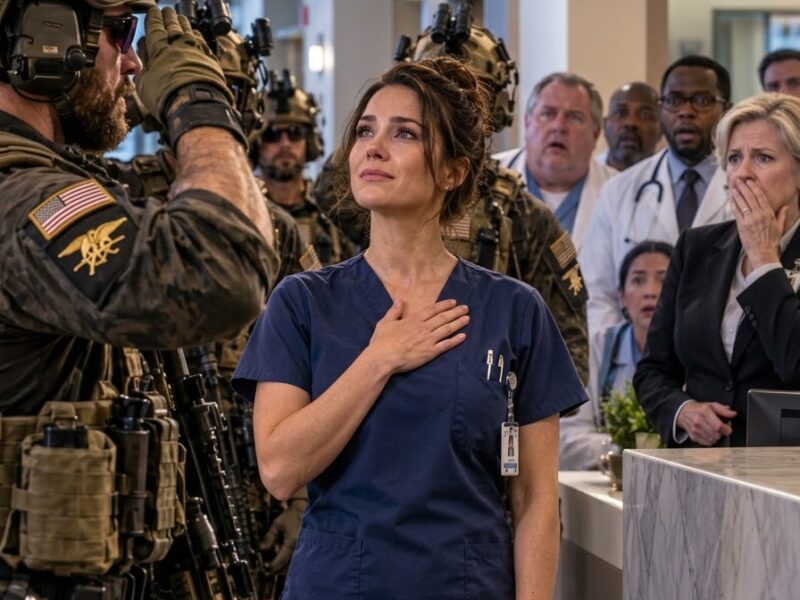
Six figures poured through the doorway with terrifying, violent speed. They moved not like police officers, but like a single, lethal apex predator. They wore full tactical assault gear—black multicam uniforms, high-cut combat helmets, night-vision mounts, and heavy plate carriers loaded with primary magazines. Their suppressed assault rifles were raised at a precise low-ready position.
The security guards hired by Hayes Global dropped to their knees instantly, their hands raised in pure, instinctual terror.
“Nobody move! Hands where we can see them!” a voice barked. It was a sound born of brass and war, commanding absolute obedience.
The six operators swept the room in a three-second tactical movement, securing every corner and exit. Then, the operator at the point of the wedge stepped forward. He reached up, unbuckled his tactical helmet, and pulled off his balaclava. He was a man in his late thirties, his skin weathered by sun and wind, with a jagged scar running from his jawline down into his collar.
He looked around the room, sweeping past Richard, past the terrified executives, until his piercing gray eyes locked onto mine.
Without a word, the commander snapped his boots together, brought his right hand up, and locked a crisp, razor-sharp military salute directly at me.
Behind him, the remaining five heavily armed operators seamlessly mirrored his action. Six elite Navy SEALs stood in the heart of Chicago’s financial district, standing at rigid attention, saluting a disgraced, low-level logistics clerk.
The silence in the room was absolute. Even the rain outside seemed to quiet down.
“What… what the hell is this?” Richard stammered, his voice rising an octave as he pressed himself flat against the wall. “This is private property! Security! Call the police!”
The commander ignored him entirely. He lowered his hand, took three deliberate steps toward my chair, and stopped two feet away.
“Captain Vance,” the commander said, his voice echoing in the dead silence. “Or should I say… Staff Sergeant Sarah Miller, 24th Special Tactics Squadron.”
A collective gasp rippled through the gathered employees. Sarah, my former friend, stared at me with wide, terrified eyes.
“Ma’am,” the commander continued, his tone softening with profound respect. “We are here because of your service. And because you are in immediate danger.”
I lowered my head, my heart hammering against my ribs like a trapped bird. Twelve years. For twelve years, I had buried Sarah Miller deep beneath the dirt of forgotten battlefields. I had buried the medals, the tactical ribbons, and the horrific nightmare of Operation Fallen Timber—the night I pulled three wounded soldiers from a burning, twisted Humvee while heavy enemy machine-gun fire tore through the darkness around us.
One of those soldiers had been a nineteen-year-old operator named Lucas. I had held his shattered leg together with a tourniquet and my bare hands while kneeling in a pool of burning fuel.
The commander reached into his tactical vest and pulled out a heavy, wax-sealed envelope marked with a Joint Special Operations Command classification stamp.
“Your cover identity was compromised three days ago, Sergeant Miller,” the commander said quietly, his gray eyes burning with intensity. “The corporate data leak you are being accused of was not a cyber-crime. It was an active counter-intelligence operation conducted by a rogue element within this very company, designed to frame you and pull you out into the open.”
Richard’s lips parted. His eyes darted frantically between the commander and me. “That’s absurd! She’s an employee! She signed a non-disclosure—”
“Shut your mouth,” the commander snapped, turning his head just enough to glare at Richard. “You are speaking to a recipient of the Navy Cross. If you speak out of turn again, my men will secure you to that chair with zip-ties.”
Before Richard could respond, his executive assistant rushed through the ruined doorway, her hair disheveled, holding a ringing secure-line phone.
“Mr. Hayes!” she cried out, her voice trembling. “The federal servers… the board files… everything is disappearing! Our main database is wiping itself!”
The commander turned back to me, his expression darkening into something grave and urgent. He leaned in closer, lowering his voice so only I could hear the next words.
“There is one more thing you need to know, Sarah,” he whispered. “The person who flagged your location and gave us your real name wasn’t an enemy agent.”
My breath hitched. “Who was it?”
“It was the survivor of Operation Fallen Timber,” the commander said softly. “The soldier whose life you saved twelve years ago.”
I shook my head, tears finally welling in my eyes. “No… Lucas died in the medevac chopper. They told me his heart stopped before they reached Bagram.”
“They lied to you,” the commander said. “He survived. And he’s standing on the roof of this building right now with a sniper rifle, covering our extraction.”
The world seemed to tilt on its axis.
Twelve years of grief, twelve years of carrying the crush of phantom guilt, collapsed in a single second. Lucas was alive. The nineteen-year-old kid with bright blue eyes and a picture of his mother tucked inside his helmet band—the boy whose blood had soaked through my uniform as I screamed for a medevac—was sitting on the rooftop above my head.
“Sarah,” the commander said, his tone shifting from solemn respect to battle-ready urgency. “We have ninety seconds before this entire floor goes dark. We need to move. Now.”
“Wait!” Richard yelled, suddenly regaining his posture as he realized his corporate empire was crumbling in real time. He stepped out from behind his chair, pointing a shaking finger at me. “You can’t just walk out of here! You’re under contract! The federal authorities—”
The commander didn’t even turn his body. He simply reached out, grabbed Richard by the lapels of his three-thousand-dollar suit, and slammed him against the glass wall. The heavy glass groaned under the impact.
“Your company, Hayes Global, has been under investigation by the Department of Defense for nine months for trafficking black-market military hardware through civilian logistics networks,” the commander growled into Richard’s face. “The reason Sarah’s home IP address was flagged is because you routed the illicit transfers through her assigned remote router. You framed a decorated veteran to cover your own treason.”
The executives in the room backed away from Richard as if he had suddenly caught fire. Sarah, my former cubicle neighbor, covered her mouth with both hands, tears spilling over her cheeks. She looked at me, her eyes pleading for forgiveness, but I couldn’t bring myself to feel anger toward her. She was just another civilian pawn in Richard’s game.
“Master Sergeant,” I said, my voice crisping into an authority I hadn’t used in over a decade. “What’s your name?”
The commander released Richard, letting the CEO slide down the glass wall in a crumpled heap. He turned to me and snapped to attention once more. “Master Sergeant Miller, ma’am. No relation. But Lucas… Lucas was my younger brother.”
The room seemed to shrink. Master Sergeant Miller looked at me with a mixture of intense gratitude and raw pain. “He never stopped looking for you, Sarah. When the military classified your discharge records under the Special Activities Center, they told us you were dead. It took Lucas twelve years of hunting through dark-web defense databases to trace your true identity. When he realized Hayes was using your credentials as a scapegoat, he triggered the extraction protocol.”
Suddenly, the overhead fluorescent lights flickered violently and died.
The entire forty-fourth floor was plunged into darkness, save for the gray, dreary light filtering through the windows. Seconds later, the emergency sirens began to wail—a high-pitched, piercing screech that echoed through the ventilation shafts.
“Comms check!” Master Sergeant Miller barked into his shoulder mic.
A voice crackled through the comms speaker, crisp, calm, and unmistakably familiar—though deeper than I remembered from twelve years ago.
“Visual on the floor,” the voice over the radio said. “Target element Hayes has secondary security moving up the fire stairwell. Four armed contractors, non-military, heavy sidearms. They aren’t local police, Miller. They’re Hayes’s personal clean-up crew.”
My heart slammed against my ribs. “Lucas?” I whispered toward the commander’s shoulder mic.
A brief pause echoed over the radio transmission. When the voice came back, it was thick with emotion. “I told you I’d pay you back for that tourniquet, Sergeant Miller. Welcome back to the land of the living.”
“Lucas, you shouldn’t be here,” I said, stepping closer to the commander. “If JSOC finds out—”
“JSOC sanctioned this, Sarah,” Lucas cut in. “Hayes isn’t just a dirty CEO. He’s selling tactical tracking software to foreign cartels. The moment he realized you were former STS, he knew you had the technical capability to figure out what his code was doing. He wasn’t just going to fire you today. Those ‘federal agents’ waiting for you in the lobby? They were going to take you to a secondary location and make sure you never spoke again.”
A cold shiver ran down my spine. I turned to look at Richard. The CEO was sitting on the floor, frantically tapping on his glowing smartphone, trying to send an encrypted message.
Before I could move, Master Sergeant Miller drew his sidearm, stepped over, and crushed Richard’s phone beneath his heavy combat boot. The screen shattered into a thousand glittering pieces.
“You’re coming with us, Hayes,” Miller said coldly.
“Miller, you’ve got movement!” Lucas’s voice cracked over the comms, urgent now. “Stairwell door on the south side of the floor. They’re breaching in five seconds!”
“Defensive positions!” Miller ordered.
The five Navy SEALs instantly fanned out, taking cover behind the heavy mahogany table and concrete pillars. The corporate executives screamed and scrambled into the corner, huddling together like terrified cattle.
I looked down at my skirt and cardigan. I had no weapon, no body armor, and no tactical gear. But as the heavy steel stairwell door at the end of the hallway crashed open, something ancient and dormant awoke inside my brain. The fear vanished, replaced by the terrifying, hyper-focused clarity of a combat medic under fire.
“Sarah, stay behind me!” Miller shouted, raising his rifle toward the hallway.
“Give me a sidearm, Sergeant,” I said, my tone flat and unyielding.
Miller looked at me for a fraction of a second, saw the cold flame burning in my eyes, and didn’t hesitate. He unholstered his backup Sig Sauer 9mm pistol from his chest rig and slapped it into my hand, along with a spare magazine.
The weight of the cold steel in my grip felt shockingly natural.
Four men in tactical windbreakers burst into the hallway, weapons raised. They weren’t police. They had no badges. They were black-market mercenaries hired to ensure that Hayes Global’s secrets stayed buried along with me.
“Drop your weapons!” Miller roared.
The lead mercenary didn’t drop his weapon. He raised his suppressed submachine gun and fired.
The quiet corporate office exploded into chaos.
Subsonic rounds chewed through the drywall, shattering glass whiteboards and sending showers of paper and dust cascading into the air. The corporate executives screamed in absolute terror, pressing themselves flat against the carpet.
The SEALs responded instantly. A controlled surge of suppressed rifle fire ripped through the hallway. The lead mercenary was lifted off his feet by the force of two armor-piercing rounds to his chest plate, crashing hard against the water cooler.
“Suppressing fire! Move the package!” Miller shouted over the deafening noise.
I didn’t wait for an order. Dropping low into a combat crouch, I maneuvered around the mahogany table, using the heavy reinforced concrete pillars for cover. Years of corporate monotony had not erased the muscle memory carved into my body by months of intense special operations training.
A second mercenary rounded the corner, angling his weapon toward Miller’s exposed flank as the commander tracked another target.
I raised the Sig Sauer, aligned the front sight post with the center mass of the mercenary’s tactical vest, and squeezed the trigger twice.
Pfft-pfft.
The double-tap struck the mercenary directly in the soft flesh of his shoulder, spinning him around. He dropped his weapon with a howl of pain, crashing into a row of cubicles.
“Clear right!” I shouted, dropping back behind the pillar and re-engaging the safety.
Miller turned his head, his eyes widening in sheer amazement as he saw his brother’s savior operating with the cold, methodical efficiency of an active operator. “Nice shot, Sergeant!”
“Two more pushing from the north elevator bank!” Lucas’s voice cut through the static on the comms. “I don’t have a angle through the reinforced glass on that side! Sarah, you’ve got to clear the floor to the roof access!”
“Understood!” I called out. I turned toward the huddling group of executives. Among them, Richard Hayes was trying to crawl toward the service elevator behind the kitchenette.
I stepped forward, grabbed Richard by his silk tie, and hauled him to his feet with an iron grip that shocked even me. He sputtered, his face red and sweaty, his hands clutching at mine.
“You… you’re a monster!” Richard choked out, tears of genuine panic streaming down his cheeks.
“I’m a combat medic, Richard,” I growled into his ear. “And right now, you’re my primary VIP target for a federal trial. You’re coming with me whether you have your shoes on or not.”
“Team, form a diamond around the Captain and the high-value target!” Miller ordered. “We push for the roof stairwell. Move!”
The four remaining SEALs flanked us, weapons locked on every doorway and corridor as we sprinted through the haze of drywall dust and shattered glass. The sleek, modern corporate office had been transformed into an urban warzone in less than three minutes.
We reached the heavy steel door marked ROOF ACCESS – AUTHORIZED PERSONNEL ONLY. Miller kicked the crash bar, and the door swung open, revealing a tight, concrete stairwell leading upward.
“Go, go, go!” Miller yelled, wave-signaling his men up the stairs.
I shoved Richard into the stairwell ahead of me, keeping the pistol pointed at his lower back. As I stepped through the doorway, I paused for a split second and looked back at the ruined boardroom.
Sarah, my former desk neighbor, was sitting against the wall, trembling, holding her arms around her knees. She looked up at me through the dust, her eyes filled with awe, confusion, and deep regret.
“File your quarterly report, Sarah,” I said softly, my voice carrying over the ringing fire alarms. “And tell the board that I resign.”
Before she could answer, I slammed the heavy fire door shut behind us, locking the corporate world away forever.
We pounded up three flights of concrete stairs, the sound of tactical boots echoing off the bare walls. Up here, the air grew colder, smelling of concrete, rain, and the faint scent of aviation fuel.
When Miller threw open the final heavy door to the roof, the Chicago wind hit us like a physical wall.
Rain lashed against my face, instantly soaking my cardigan and plastering my hair to my forehead. The gray clouds hung low over the city, obscuring the tops of nearby skyscrapers.
Standing on the edge of the helipad, clad in dark tactical gear and holding a heavy long-range sniper rifle, was a man. He turned as the door opened.
He was older now, his jawline square, a faint scar cutting across his left eyebrow. But those eyes—bright, intense, and instantly recognizable—belonged to the boy I had pulled from the burning wreckage of a Humvee in the desert twelve years ago.
Lucas lowered his rifle, stepped away from the ledge, and walked slowly toward me through the driving rain.
I froze. The pistol in my hand suddenly felt impossibly heavy.
Lucas stopped three feet away. He didn’t offer a military salute. He didn’t offer a formal briefing. Instead, he pulled off his tactical glove, reached out, and gently touched the faint line of my jaw where a piece of flying shrapnel had scarred me on that terrible night.
“I found you, Sarah,” he said, his voice trembling against the roar of the wind. “I told you I wouldn’t leave you behind.”
Tears mixed with the cold rain on my cheeks. For twelve long, agonizing years, I had believed that my efforts on that bloody Afghan highway had been in vain. I had spent over a decade carrying the weight of a ghost, letting the guilt consume my identity until I was nothing more than a shadow filing paperwork in a corporate tower.
“They told me you didn’t make it, Lucas,” I whispered, my voice barely audible over the gale-force wind sweeping across the roof. “They said the blood loss was too severe.”
“I was in a coma for four months at Walter Reed,” Lucas said, his eyes searching my face with overwhelming intensity. “When I woke up, they had scrubbed your name from the unit manifest. classified under Black Budget protocols. They told my family that the medic who saved me was killed in action during a secondary mortar strike.”
“Why?” I turned my head toward Master Sergeant Miller, who was standing watch near the stairwell door, his weapon raised, keeping a terrified Richard Hayes pinned to the ground. “Why would JSOC fake my death?”
Lucas’s expression darkened. He looked down at the rain-slicked concrete of the helipad. “Because the driver of the vehicle that hit us wasn’t an insurgent, Sarah. It was a private security contractor working for a defense shell company—a company funded directly by Hayes Global Logistics.”
The realization hit me like a physical blow.
“They were testing unauthorized tactical hardware in active warzones,” Lucas continued, his voice laced with cold fury. “When your unit accidentally stumbled onto their illegal transport convoy, they tried to erase the evidence. You weren’t just a medic that night, Sarah. You were the sole surviving witness to an act of high treason committed by an American contractor against American soldiers.”
I looked back at Richard. The CEO was shivering in the rain, his expensive suit ruined, his eyes wide with horror as he realized the magnitude of the trap that had just closed around him.
“You…” I stepped toward Richard, the Sig Sauer held firmly at my side. “You bombed your own country’s soldiers to protect a hardware contract?”
“It… it wasn’t me!” Richard stammered, his teeth chattering uncontrollably from the cold and absolute terror. “It was the board! The original founders! I just took over the corporate structure five years ago! I didn’t know about Afghanistan until three months ago when the old files were unencrypted!”
“Lie,” Lucas spat, walking up beside me. “When you found out Sarah Miller was working in your accounting department under the alias Emily Vance, you realized she was a ticking time bomb. You couldn’t just assassinate her—not with the Department of Defense already auditing your international shipping lanes. So you built a paper trail. You framed her for selling secrets to foreign intelligence, planning to have her arrested, silenced in a federal facility, or executed during a staged escape.”
In the distance, through the heavy cloud cover, a deep, rhythmic thrumming sound began to vibrate through the air.
Thump-thump-thump-thump.
A sleek, black MH-60 Blackhawk helicopter broke through the low-hanging fog, its dual rotors cutting through the rain. It hovered fifty feet above the skyscraper’s helipad, its landing lights blinding us with a harsh white beam.
“Extraction is here!” Master Sergeant Miller yelled over the deafening roar of the helicopter engines. “Move to the bird!”
Two tactical air-crew members leaned out of the open side doors of the Blackhawk, throwing down heavy steel winch cables.
“Get him up first!” Miller ordered, dragging Richard toward the center of the pad. The SEALs quickly strapped a heavy tactical harness around the weeping CEO, securing him to the primary recovery cable. With a thumb-up signal from Miller, the winch engaged, hoisting the terrified executive up into the belly of the military aircraft.
“Sarah! You’re up next!” Miller called out, holding a second harness out to me.
I looked at the harness, then back at Lucas. The wind whipped our clothes as the helicopter hovered above us like a giant steel predator.
“Where are we going?” I asked Lucas over the roar of the engines.
“To Washington,” Lucas replied, offering me a hand. “To the Pentagon. The Senate Armed Services Committee has been waiting twelve years for your testimony, Captain. It’s time to put the ghosts to rest.”
I looked down at the city of Chicago spread out beneath us—a vast grid of glowing streetlights and tiny, microscopic cars. Down there was the quiet, lonely, miserable life I had built to hide from my past. Down there was the desk where I had spent three years staring at spreadsheets, letting my soul slowly wither away.
I tossed the Sig Sauer pistol to Master Sergeant Miller, took Lucas’s hand, and stepped into the harness.
“Let’s finish it,” I said.
Three weeks later.
The Senate Armed Services Committee hearing room in Washington, D.C., was bathed in the warm, solemn light of mahogany chandeliers and bronze fixtures. Unlike the cold, brutal boardroom in Chicago, this room felt heavy with historical weight.
I sat at the witness table in the center of the room. I was no longer wearing beige cardigans or muted office skirts. I wore the dark blue Service Dress uniform of the United States Air Force, complete with the silver Captain’s bars on my shoulders and a thick cluster of decorations across my chest—anchored at the top by the crisp blue and white ribbon of the Navy Cross.
Beside me sat Lucas, wearing his own crisp military dress uniform. Behind us, sitting in the public gallery, were Master Sergeant Miller and the four SEALs who had stormed the forty-fourth floor of Hayes Global Logistics.
At the opposing table sat Richard Hayes, flanked by a team of six high-priced defense attorneys. But no amount of legal talent could save him. Over the past twenty-one days, federal agents had raided nine Hayes Global facilities across three continents, seizing unencrypted server logs, off-shore account records, and illegal weapons schematics that spanned more than a decade of corporate corruption.
The Chairman of the Committee, an elderly Senator with silver hair and a sharp, piercing gaze, leaned toward his microphone.
“Captain Sarah Miller,” the Senator said, his voice echoing through the packed chamber and out into the national television broadcast. “For twelve years, the records of this nation reflected that you were deceased. For twelve years, you lived in silence, bearing the false stigma of a war you thought had abandoned you. On behalf of the United States government and the Department of Defense, I offer you our deepest, most profound apologies.”
The entire Senate committee stood up. Across the gallery, hundreds of military officers, journalists, and spectators rose to their feet, erupting into a long, thunderous ovation.
I sat straight, my chin held high, feeling a weight that had crushed my chest for twelve years finally dissolve into the air.
I looked over at Richard Hayes. The former CEO was staring down at his hands, his face pale, his empire completely destroyed. He would spend the rest of his natural life inside a federal supermax facility, stripped of every dollar, every suit, and every shred of prestige he had ever possessed.
When the applause finally settled, the Senator motioned to the reporters in the back. “Captain Miller, do you have a final statement for this record before we conclude these proceedings?”
I pressed the button on my microphone. The room fell into absolute, breathless silence.
“For a long time,” I began, my voice clear, strong, and echoing with absolute conviction, “I believed that my life ended in a burning valley in Afghanistan. I believed that surviving meant hiding, fading into the background, and pretending that the pain didn’t exist.”
I turned my head slightly to look at Lucas, who smiled back at me with quiet, unyielding pride.
“But I was wrong,” I continued, turning back to the committee. “Courage isn’t the absence of trauma. It’s the willingness to step back into the light when the truth demands it. I am Sarah Miller. I am a combat medic. And I am finally coming home.”
Three months later.
The morning air in the mountains of Colorado was crisp and clear, smelling of blue spruce and fresh pine. The sun was just rising over the snow-capped peaks, painting the sky in vibrant shades of gold and deep pink.
I stood on the wide wooden porch of a newly built timber cabin, holding a steaming mug of black coffee in both hands. Below the cabin, a clear mountain stream wound through the valley, sparkling in the dawn light.
The screen door creaked open behind me. Lucas stepped out onto the porch, wearing a flannel shirt and carrying his own mug. He walked over, leaning against the wooden railing beside me, looking out over the endless wilderness.
“It’s quiet up here,” he said softly.
“It is,” I agreed, taking a sip of the warm coffee. “No glass towers. No fire alarms. No spreadsheets.”
Lucas reached out, his hand sliding over mine on the railing, his fingers intertwining with mine. “Master Sergeant Miller called this morning. The Pentagon officially approved your full reinstatement and honorable retirement package. You’re officially a free woman, Captain.”
I looked down at our joined hands, feeling the warm, solid reality of the present moment. The nightmares hadn’t disappeared entirely—war leaves scars that time can only soften, never fully erase. But the ghosts no longer held power over me. They were no longer shadows waiting in the dark to destroy me; they were memories of strength, honor, and survival.
“What are you going to do now?” Lucas asked, turning his bright blue eyes toward me.
I looked out across the golden valley, watching an eagle soar effortlessly through the crisp mountain air.
“I think,” I said softly, a genuine smile touching my lips for the first time in twelve years, “I’m going to start living.”
The end.









