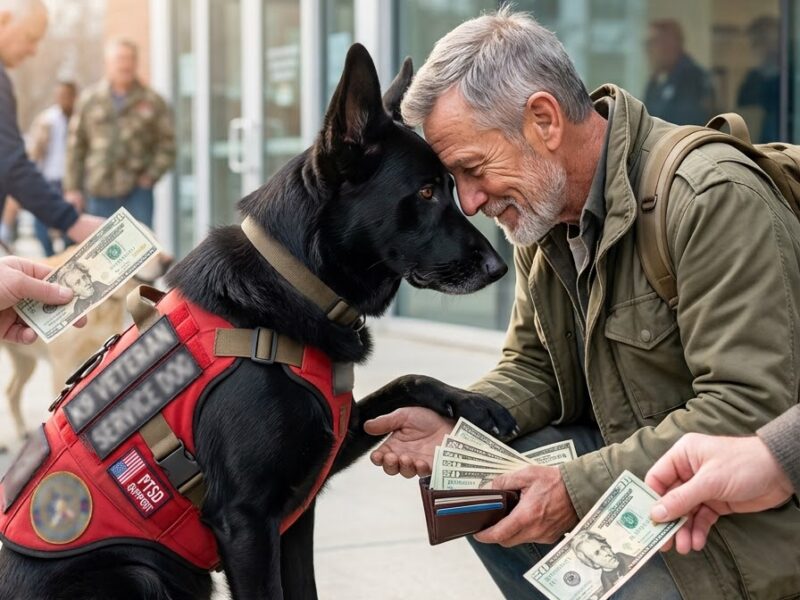
The cashier laughed when I spent my last $29 on a filthy black dog nobody wanted at a roadside shelter in Detroit
The freezing Detroit wind felt like a dull blade scraping across my face as I stepped into the cramped, concrete lobby of the shelter on the city’s east side. The heavy scent of cheap floor disinfectant and damp fur hung thick in the warm air. Behind the rusted iron cages lining the narrow hallway, dozens of dogs barked frantically, their claws scraping against the cold tiles in a desperate bid for human attention.
I didn’t look at them. I kept walking toward the very back of the facility, where the fluorescent lights flickered softly and the shadows settled heavy against the cinderblock walls.
In the furthest, darkest cage, a small black dog lay motionless on a thin sheet of damp cardboard. His fur was matted with dried mud, one eye was swollen shut beneath a deep, jagged scab, and his visible ribs looked like the wooden framework of a sunken boat. When the other dogs leaped toward the wire mesh, he didn’t move. He merely raised his good eye, fixing me with a hollow, silver-gray stare that held no hope, no anger, and no expectation of rescue.
“That one’s a lost cause,” a female voice echoed down the hall.
I turned to see the shelter worker leaning against a metal doorframe, her arms crossed over a grease-stained apron. She glanced at the dog with a mix of pity and exhaustion.
“He came in with animal control four days ago off the industrial docks,” she said, tapping a pen against her clipboard. “No chip, no tags, full of parasites. We don’t have the funds to fix a dog in that condition. Euthanasia is scheduled for six o’clock.”
I reached into the pocket of my worn canvas jacket, pulling out a crumpled stack of bills and a handful of loose quarters. I smoothed them out against my leg, counting carefully under my breath.
Twenty-nine dollars. It was every cent I had to my name. It was the change left over from selling my father’s old pocket watch at a pawn shop two days prior.
“What’s his name?” I asked, my voice dry and cracked from the cold.
The worker shrugged, not bothering to look up from her paperwork. “Nobody’s bothered to give him one.”
I stepped closer to the wire mesh, sliding my hand through the cold iron links. The dog didn’t flinch. Slowly, agonizingly, he lifted his heavy head and rested his wet nose directly against the palm of my hand. A faint, barely audible vibration rumbled in his frail chest.
“I’ll take him,” I said, placing the crumpled pile of cash on her clipboard.
The cashier looked at the twenty-nine dollars, then at my ragged combat boots, and finally up at my bruised, bearded face. A small, mocking laugh escaped her lips. “You’re living on the street, buddy. You can barely feed yourself. You really want to spend your last dime on a filthy black dog nobody wants?”
“He’s coming with me,” I said, my tone flat, leaving no room for argument.
She sighed, slammed a metal drawer, and handed me a cheap nylon slip-lead. “Twenty-nine dollars. He’s your problem now.”
I unlocked the cage door myself. The dog tried to stand, but his back leg buckled beneath him. Without hesitation, I knelt in the dirt, scooped his trembling, mud-caked body into my arms, and pressed him tightly against my chest. As I carried him out into the biting Detroit rain, I felt his ragged breath warm against my neck.
“I’ll call you Midnight,” I whispered into his matted ear.
That night, the temperature plummeted below freezing. The city was a vast expanse of dark concrete and yellow streetlights, completely unconcerned with two forgotten souls seeking shelter. We ended up beneath an overpass near the train yards, tucked behind a concrete pillar to block the howling wind. I laid down on a sheet of discarded insulation, wrapped my torn army surplus blanket around us both, and pulled Midnight close.
Midnight didn’t run. He pressed his back against my chest, shivering uncontrollably at first, then gradually relaxing as our combined body heat began to fight off the frost.
In the quiet dark, listening to the rhythmic hum of traffic overhead, my mind drifted back to the dry, dusty air of Helmand Province. Five years ago, I was Sergeant Marcus Miller of the 75th Ranger Regiment. I had a purpose, a team, and a younger brother named Ethan who served in the same theater as a reconnaissance specialist.
Then came the roadside IED that shattered my hip, shattered my mind, and stole my memory of the weeks surrounding my final operation. When I woke up in a military hospital in Germany, I was told my service was over. Worse, I was told Ethan’s unit had been hit in a remote mountain pass—his body never recovered, officially declared Killed in Action.
After returning home, my life spiraled out of control. Memory loss, severe PTSD, and a system that didn’t care left me without a job, without an apartment, and without a single person who remembered my name.
Midnight shifted, resting his heavy chin over my forearm, snapping me out of the dark spiral. For the first time in five years, I didn’t feel entirely invisible.
The next two weeks were a test of endurance. Every morning, Midnight followed me closely down the wet sidewalks of downtown Detroit while I stood in line at day-labor agencies or looked for scrap metal to sell. He walked with a slight limp, but his focus never wavered. Whenever my hands started to shake from anxiety or when the loud hiss of city buses triggered memories of combat mortars, Midnight would stop, lean his shoulder firmly against my shin, and look up until my breathing slowed down.
One icy afternoon, as we walked past an alleyway behind an abandoned auto parts factory, Midnight suddenly stopped. His ears pinned back, his tail went stiff, and he let out a sharp, urgent bark.
Before I could grab his lead, he bolted into the shadows of the alley.
“Midnight! Heel!” I shouted, chasing after him as my bad hip throbbed with pain.
At the end of the alley, lying face down beside an overflowing dumpster, was an elderly man wrapped in a threadbare coat. His skin was gray, and his lips were blue from hypothermia. Midnight was standing over him, licking his frozen forehead and barking toward the main street.
I dropped to my knees, checking the man’s pulse. It was faint and thready. I ran back to the street, flagged down a passing patrol car, and guided the paramedics into the alley.
As they loaded the old man onto a gurney, he weakly opened his eyes. He reached out with a trembling, liver-spotted hand, his fingers catching the sleeve of my jacket. He looked past me toward the black dog standing quietly by my side.
“That dog… saved my life,” the old man rasped, his voice barely a whisper against the hum of the ambulance engine.
I knelt beside the stretcher, running a hand down Midnight’s back. “He saved mine too, sir.”
Three days later, the rain returned, turning the dirt beneath our overpass into cold black mud. Midnight and I were sitting beneath the concrete arch, sharing a small tin of Vienna sausages I had bought with money earned from loading delivery trucks.
A sleek, midnight-black sedan with dark tinted windows slowed to a crawl along the access road. It stopped twenty feet from our spot.
The door opened, and a woman in a tailored cashmere coat stepped out into the mud. She looked around the dirty encampment with sharp, calculating eyes until her gaze landed squarely on Midnight.
Her face went deathly pale. The umbrella in her hand slipped, clattering against the pavement.
“Where did you get that dog?” she asked, her voice tight, barely controlling a sudden surge of emotion.
I immediately stood up, stepping in front of Midnight, my boots sliding in the mud as I shortened my grip on his leash. “Why?”
Without speaking, the woman reached into her leather handbag, pulled out a laminated photograph, and held it out toward me with a shaking hand.
I took the photo. It showed a younger, healthy Midnight wearing a reinforced military K9 harness fitted with tactical cameras. Standing beside him, his hand resting proudly on the dog’s head, was a young soldier in desert camo.
My lungs froze. The air left my body all at once.
The soldier in the photograph had my eyes. He had the same crooked smile, the same small scar beneath his chin.
It was my younger brother, Ethan.
“That dog belonged to him,” the woman whispered, wiping a stray tear from her cheek. “He was a specially trained tracking asset assigned to Black Operations.”
My hands began to shake so violently that the photograph almost fell into the mud. “Ethan is dead,” I managed to say, my voice choking on the name I hadn’t spoken out loud in six years. “His unit was wiped out in Afghanistan. They never found his body.”
The woman stepped closer, her eyes flashing with a dangerous, dark intensity. “That’s what they wanted you to believe, Marcus.”
I stared at her, shocked that she knew my name. Before I could demand an answer, Midnight let out a low, guttural whine. He dropped to his chest and began scratching frantically at the wet earth and gravel beneath the concrete pillar where we had slept for weeks.
I dropped to my knees beside him, pushing his paws aside to help him dig. Brushing away six inches of packed dirt and debris, my fingers struck something cold, square, and metallic.
It was a small, waterproof military identification case, stamped with a high-classification insignia.
I popped the heavy steel latches. Inside lay a folded photograph of Ethan and me as children, and a handwritten letter written on field paper, protected by a plastic sleeve. The handwriting was unmistakably my brother’s sharp, slanted block lettering.
I unfolded the paper with trembling fingers. The first line cut through the sound of the falling rain and made the entire world go completely silent:
Brother, if Midnight found you, it means they failed to bury the truth.
The words on the wet paper burned into my retina. I sat in the dirt, the rain soaking through my jacket, while the world around me dissolved into a surreal fog.
Brother, if Midnight found you, it means they failed to bury the truth.
I continued reading, my eyes scanning Ethan’s frantic handwriting:
If you are reading this, Marcus, my unit was betrayed from the top. Operation Silent Arch was never a recon mission—it was an illegal weapons recovery for a private contractor called Vanguard Sentinel. They used us to clear the site, then called in a rogue strike to sanitize the evidence. I survived the blast because Ghost—the dog you now call Midnight—dragged me into a drainage tunnel. I am alive, but I am being held in a private facility near the Great Lakes shipping corridor. Ghost carries the primary access key under his collar. Find him, Marcus. Trust no one in uniform.
I stared at the paper, my pulse hammering in my ears like a war drum. Ethan was alive. The official military report that had broken my spirit six years ago was a lie constructed by corrupt men to cover up treason.
I looked up. The woman in the expensive coat was standing right over me, a small, suppressed pistol now visible in her hand, pointed down at my chest.
“Hand over the case, Marcus,” she said, her voice completely stripped of its previous emotion. It was cold, precise, and lethal.
“Who are you?” I demanded, slowly shifting my weight to my left leg, keeping Midnight behind my body.
“My name is Agent Cross,” she replied, stepping closer. “Vanguard Sentinel doesn’t like loose ends. For six years, we thought that damn K9 died in the valley with the rest of your brother’s squad. When our automated regional shelters flagged a dog matching his physical markers two weeks ago, we waited to see who would claim him. We knew if anyone could unlock his sub-dermal chip, it would be his handler’s blood.”
“You used him as bait,” I growled, my jaw clenching.
“And you walked right into it,” she said, pulling the hammer back on the pistol with a sharp click. “Give me the key from his collar, and I’ll make your death quick.”
Before she could finish her sentence, Midnight didn’t bark—he launched his ninety-pound body straight off the mud, aiming directly at her throat.
Cross fired a round, but the bullet slammed harmlessly into the concrete arch behind me as Midnight’s heavy jaws locked onto her wrist. She let out a sharp scream, dropping the gun into the dirt.
I moved on pure, unadulterated combat instinct. Years of suppressed military training surged through my veins. I lunged forward, sweeping her legs out from beneath her, slamming her hard onto the icy pavement. I grabbed her fallen weapon, cleared the chamber, and pointed it at her face.
“Don’t move,” I rasped, my breath coming in ragged gasps.
Midnight stood over her, his ears back, a deep, terrifying growl rattling his ribs. His good eye was bright, alive with the fierce intelligence of a battle-tested war dog.
I reached down to Midnight’s neck, digging my fingers deep beneath his thick black fur until I felt a hard, metallic seam underneath his standard leather collar. Tucked against his skin was a second, ultra-thin titanium band stamped with a high-grade encryption circuit.
It wasn’t just a military tag. It was a encrypted hardware security module—a physical drive holding the classified telemetry and audio recordings from Ethan’s last operation.
“You won’t get ten miles out of the city,” Cross spat, clutching her bleeding wrist as she glared up at me. “Vanguard owns the local authorities. They own the docks. You’re just a broken homeless vet with a half-blind dog.”
“Then they should have checked my service record more carefully,” I said, cold satisfaction washing over me.
I grabbed her radio and mobile phone, smashed them beneath my boot, and whistled for Midnight. “Midnight, on me!”
The dog instantly broke his stance, falling into step right beside my left knee. We vanished into the thick rain and alleyways of industrial Detroit, leaving the woman bleeding in the mud.
My mind was racing. I needed a secure place to analyze the drive, but I had no money, no vehicle, and no safe house. Then I remembered the old man Midnight had saved three days ago.
His name was Thomas Vance. The paramedics had mentioned he was a retired shopkeeper who lived above an auto repair garage three blocks from the river.
Twenty minutes later, soaked and shivering, I knocked on the side door of a weathered two-story brick building on East Jefferson Avenue. The door opened slowly, revealing the elderly man holding a heavy iron wrench. He looked at me, then down at the black dog standing at my side.
Recognizing us instantly, his face softened. “You’re the young man from the alley,” he said, opening the door wider. “Come in, son. Get out of the cold.”
We stepped inside the warm garage, the heavy smell of motor oil and hot coffee immediately wrapping around us. Thomas brought us thick wool blankets and sat us down near a space heater in his back office.
“You’re in trouble,” Thomas said quietly, watching me inspect Cross’s tactical pistol on his desk. “I’ve seen that look before. I served in Korea.”
“The people who took my brother are hunting us,” I said directly, holding nothing back. “I need a computer with an isolated satellite connection and five minutes of time.”
Thomas didn’t ask questions. He walked to a metal cabinet, pulled out a military-grade Panasonic Toughbook laptop, and plugged it into a backup generator. “My son left this here before he moved west. It’s clean.”
I plugged the titanium band from Midnight’s collar into the laptop’s high-speed data port.
The screen flickered, instantly prompting a high-level military security protocol: ENCRYPTION ACCESS KEY REQUIRED.
I stared at the blinking cursor. What key would Ethan use? A date of birth? His service number?
I pulled out the folded note Ethan had left beneath the bridge. I looked at the final line: Brother, if Midnight found you, it means they failed to bury the truth.
I typed in the military grid coordinates of our childhood home in Michigan: 4582-NORTH-LAKE.
The screen turned bright green. ACCESS GRANTED.
A massive archive of encrypted audio files, aerial mapping data, and corporate emails burst onto the display. At the top of the queue was a single, high-definition video file timestamped six years ago.
I clicked play.
The video was taken from a helmet-mounted tactical camera. The lens showed a subterranean concrete facility filled with heavy shipping crates bearing the logo of Vanguard Sentinel. Standing in the center of the room, speaking with a high-ranking military officer, was a man in an expensive suit.
I recognized the corporate officer immediately. He was Richard Vance, the CEO of Vanguard Sentinel and one of the most powerful defense contractors in the nation.
“The shipment of advanced optical guidance systems is secured,” Richard Vance’s voice echoed through the laptop speakers. “Once Sergeant Ethan Miller’s squad clears the valley, detonate the charges. Frame the local insurgents. Make sure no one from the 75th survives to ask questions.”
The video cut to chaotic footage of an explosion, screaming soldiers, and Ethan’s face appearing close to the lens. He was wounded, blood dripping down his cheek, but his eyes were resolute.
“Marcus,” Ethan’s recorded voice rasped into the microphone as gunfire echoed behind him. “If you’re watching this, I managed to hide the raw files in Ghost’s telemetry unit. Vanguard is operating a black site off Lake Huron—Facility Delta. They are keeping me alive because I encrypted the override codes to their financial servers. Get this file to the federal prosecutor. Save yourself.”
The video ended, leaving the small garage office in dead, terrifying silence.
I sat back, my fist clenched so tightly my knuckles turned white. My brother wasn’t just alive; he was being tortured in a secret facility less than two hours away from where I stood.
Suddenly, Midnight jumped to his feet, a deep, bone-rattling growl rising in his throat.
Outside the garage, the heavy iron security gates rattled. The low rumble of multiple idling V8 engines vibrated through the concrete floor.
Thomas looked out the window, his expression hardening. “Black SUVs,” he whispered. “At least ten armed men taking positions around the building.”
I looked down at Midnight, then at the Toughbook laptop containing the evidence that could tear down an empire.
“They found us faster than I thought,” I said softly.
Thomas reached under his desk, pulling out a heavy 12-gauge Remington shotgun, racking a shell into the chamber with a loud, metallic clack. “They aren’t taking anyone out of my garage, son. Not today.”
I looked down at Midnight, his tail giving a single, steady thump against the floor.
“We fight our way out,” I said, chambering a round in Cross’s pistol. “Together.”
The first breaching charge detonated against the front service bay doors with a blinding white flash and a concussion wave that shattered the glass windows of the garage office. High-density smoke began pouring through the twisted metal frame as heavily armed operators in unmarked tactical gear rushed into the building.
“Movement left!” a voice shouted over the radio chatter inside the bay.
Thomas didn’t hesitate. He stepped out from behind the doorframe and racked three heavy buckshot rounds down the main aisle, sending two Vanguard contractors scrambling behind a raised hydraulic lift for cover.
“Marcus, take the back alley exit!” Thomas yelled over the deafening noise of the gunfire. “I’ll hold the main floor!”
“I’m not leaving you, Thomas!” I shouted back, staying low as a hail of submachine-gun fire chewed through the drywall above our heads, raining white dust over us.
“I’ve lived my life, son!” Thomas roared, reloading his shotgun with steady, veteran hands. “Your brother is still waiting for you! Get that laptop to the federal marshals and get your family back!”
Midnight was pressed flat against my side, his ears pinned back, his body tense like a coiled spring. He didn’t show an ounce of panic. He was waiting for my command, his training overriding every natural instinct of fear.
I pulled the laptop from the desk, slid it into a heavy waterproof tactical pack, and strapped it tightly to my back. I grabbed two spare magazines from the drawer, racked the slide on my pistol, and laid my hand on Midnight’s head.
“Midnight, strike!” I commanded, pointing toward the side corridor leading to the alley.
The dog moved like a shadow through the thick white smoke. A contractor was clearing the narrow hallway with a suppressed rifle. Before he could raise his barrel, Midnight leaped off a metal workbench, slamming his entire weight into the operator’s chest.
The man hit the concrete floor hard, his rifle clattering away. Midnight locked his jaw onto the contractor’s tactical vest strap, dragging him violently off balance while I pushed past them, delivering a heavy strike to the contractor’s helmet with the butt of my pistol, knocking him unconscious.
“Good boy!” I yelled, whistling for Midnight to fall back into position.
We reached the heavy steel rear exit door. I kicked the crash bar open, stepping out into the freezing alley air.
Two black SUVs were parked horizontally across the alley exit, blocking off any escape route on foot. Four men carrying assault rifles were advancing down the narrow brick passageway, their tactical lights cutting through the heavy snowfall.
“Target sighted! Take him down!” the lead contractor yelled, raising his rifle.
There was no cover in the narrow alley. We were caught in an open fatal funnel.
Instead of retreating, I made a split-second decision. I aimed my pistol at the overhead high-voltage transformer mounted on the utility pole directly above the contractors’ heads and fired three quick rounds.
Sparks erupted in a blinding shower of blue and orange light. The transformer blew with a loud, deafening roar, sending high-voltage cables whipping down onto the wet asphalt. The sudden explosion created a massive wall of fire and blinding light between us and the contractors.
“Go! Go!” I shouted, grabbing Midnight by his tactical harness as we vaulted over a low brick wall into an adjoining alleyway.
We ran three blocks through the blinding snowstorm, my bad hip screaming in agony with every step, until we reached the secondary railway yard along the Detroit River. The cold wind off the water burned my lungs, but I didn’t slow down.
Behind us, the sound of sirens began to echo across the city as local police responded to the massive explosion at Thomas’s garage.
We slipped into an open boxcar on a stationary freight train bound north toward Port Huron. I pulled the heavy wooden door shut, leaving a tiny two-inch crack to monitor the tracks outside.
I collapsed onto a pile of dry wooden pallets, my chest heaving, my body shaking from physical exhaustion and the icy cold. Midnight immediately crawled over, lying across my legs to provide warmth, his warm tongue checking the small cuts on my hands.
“We made it, buddy,” I whispered, resting my forehead against his wet fur. “We made it through the first wave.”
I opened the tactical pack and pulled out the Toughbook. The drive was safe, but we were now classified fugitives. Vanguard Sentinel owned the media, the corporate infrastructure, and the private military contractors hunting us down.
If I simply walked into a police station or a federal building in Detroit, Cross’s people would intercept us before we reached the front desk.
There was only one way to end this. We had to go directly to Facility Delta—the private black site off Lake Huron where Ethan was being held. We had to break him out ourselves and broadcast the unencrypted files directly to every major news network and federal agency simultaneously using the facility’s high-power satellite array.
I opened the mapping program on the laptop, tracing the rail lines leading north along the Lake Huron coast. Facility Delta was situated inside an abandoned industrial shipping terminal near Alpena, surrounded by thick pine forests and icy water.
It was an iron fortress. A broken veteran and a half-blind dog stood almost zero statistical chance of surviving a direct assault on a fortified contractor facility.
I looked down at Midnight. The dog looked up at me, his one good eye steady, filled with an ancient, unwavering trust that transcended logic.
He had carried this secret across thousands of miles of battlefield and city streets. He had survived starvation, cold, beatings, and gunshots, all for the singular purpose of returning to the man who had raised him—and saving the brother who had taken his place.
“They think we’re broken, Midnight,” I said, my voice hardening into pure steel as I reached down to adjust his harness. “They think because we were thrown away, we don’t have any fight left in us.”
Midnight gave a short, sharp bark that echoed inside the cold steel boxcar.
As the train engine let out a long whistle and began to jerk forward, moving north into the dark, snowy night, I knew one thing with absolute certainty:
We weren’t running anymore. We were going to war.
The freight train slowed to a crawl as it passed through the dense, snow-covered pine forests three miles west of the Alpena shipping terminal. The storm had intensified into a full blizzard, casting a white shroud over the landscape and dropping visibility down to less than ten feet.
Midnight and I jumped from the slow-moving boxcar, landing soft in a deep snowdrift along the embankment.
We moved silently through the freezing woods, using the heavy tree line to mask our approach. My combat instincts, dormant for five long years, had fully taken over. Every footstep was deliberate; every breath was controlled.
After an hour of tactical movement, we reached the perimeter fence of Facility Delta.
The site was massive—a sprawling complex of corrugated steel warehouses, heavy concrete guard towers, and high-security chain-link fencing topped with razor wire. High-powered halogen spotlights swept across the perimeter at regular intervals, illuminating the falling snow.
Through my field binoculars, I spotted the primary satellite uplink dish mounted on the roof of the central administrative building. That was our target.
“Midnight, stay low,” I whispered, patting his flank.
We crawled through a drainage culvert running beneath the outer perimeter fence, slipping past the thermal camera grid during a power cycle sweep. The cold water in the ditch was knee-deep and slushy, but neither of us slowed down.
Once inside the compound, we used the shadows of parked fuel trucks to reach the rear entrance of the main holding block. Two Vanguard contractors dressed in heavy arctic camouflage were standing guard near the loading dock, holding assault rifles, their breath puffing white in the freezing air.
I checked my pistol. Three rounds left in the magazine. Not enough for a prolonged firefight.
I picked up a heavy iron bolt from the ground, looking down at Midnight. “Distraction, left flank. Low noise.”
Midnight understood instantly. He slipped beneath a shipping container, trotting thirty yards to the west before intentionally knocking over a stack of empty oil drums.
The loud metallic crash echoed through the yard.
“What was that? Check it out,” one of the guards said, unclipping his flashlight as both contractors walked toward the noise.
The moment their backs were turned, I stepped out from the shadows, closed the distance silently, and eliminated both guards with quick, non-lethal strikes using the weighted butt of my weapon.
I dragged their bodies behind the containers, stripped one of his keycards and tactical vest, and whistled softly. Midnight returned to my side like an arrow finding its mark.
Using the stolen keycard, we slipped through the heavy steel security doors and entered the subterranean levels of Facility Delta.
The interior was stark, industrial, and clinical. White concrete walls, bright LED lighting, and the constant hum of high-power ventilation systems filled the corridors.
We navigated down two flights of stairs, following the security signage marked SPECIAL DETENTION UNIT.
At the end of a long hallway lined with reinforced steel doors stood a single glass-enclosed monitoring station. Inside sat a senior contractor operator, his back turned to the door as he monitored a bank of security screens.
On the center monitor, my heart stopped.
It was a live camera feed of a small concrete isolation cell. Sitting on a wooden bench, his hands bound in heavy magnetic cuffs, was Ethan. He was thinner, his face marked with scars, but he was alive.
A surge of protective rage rushed through me.
I smashed the safety glass of the control booth with my elbow, reached inside, and dragged the contractor out through the frame before he could hit the main alarm button. I slammed him against the concrete floor, pressing my knee into his spine.
“Where is the override key for Cell 4?” I growled into his ear.
The contractor choked out a gasp, pointing toward a red master keycard hanging on a lanyard near the control panel.
I grabbed the keycard, rendered the contractor unconscious, and ran down the corridor toward Cell 4.
My hands shook violently as I swiped the card through the electronic reader.
The heavy steel door unlocked with a deep, pneumatic hiss, swinging open slowly.
Ethan looked up, shielding his eyes from the hallway light. His face was pale, hollowed out by six years of isolation and dark concrete.
When his eyes adjusted, he stared at me in complete, unadulterated shock.
“Marcus?” he whispered, his voice trembling, sounding like a man who believed he was dreaming. “No… no, you’re not real. I’m losing my mind…”
Before I could answer, Midnight pushed past my legs. The dog let out a soft, high-pitched whine that broke the silence of the facility, sprinting across the cell and resting his large black head directly onto Ethan’s lap.
Ethan froze. He looked down at the dog, his bruised hands trembling as he buried his face in Midnight’s thick fur, letting out a ragged, sob-racked gasp.
“Ghost…” Ethan wept, clutching the dog tight against his chest. “You brought him… you actually brought him…”
I knelt in front of them both, wrapping my arms around my brother and the dog who had saved us both.
“I told you I’d always come for you, little brother,” I said, my voice thick with tears. “Now let’s go home.”
Suddenly, high-pitched red alarm strobes began flashing across the ceiling. A loud, mechanical siren began wailing throughout the subterranean complex.
WARNING: SECURITY BREACH IN LEVEL 3 DETENTION. ALL TACTICAL UNITS RESPOND IMMEDIATELY.
Ethan looked up, his eyes wide with urgency. “They know you’re here! Marcus, the facility has a automated lockdown protocol! They’ll flood the lower levels with CS gas!”
“We’re not going back out the front door,” I said, pulling the Toughbook from my pack and handing Ethan a heavy tactical sidearm from the control booth. “We’re going to the roof. We’re going to tell the world what they did.”
The steel stairwell leading to the roof of Facility Delta was a vertical war zone.
Red emergency lights flashed against the concrete walls as siren wails bounced off the steel risers. Below us, the heavy boots of Vanguard contractors echoed as they rushed up the stairs, firing bursts of automatic gunfire that chipped concrete splinters off the steps.
Ethan, despite six years of captivity, moved with the precision of a trained operator. He fired calculated cover shots down the stairwell while Midnight guarded our rear, his fierce barking echoing through the shaft to disorient the advancing contractors.
“Three more flights!” I shouted over the deafening noise, pushing open the heavy fire door leading to the roof access module.
We burst out into the howling blizzard on the roof of the administrative building. The wind was a roaring beast, driving freezing snow sideways across the slippery gravel surface. Fifty feet away, towering against the dark night sky, was the massive white dish of the high-gain satellite array.
“Ethan! Plug the Toughbook directly into the array’s emergency override terminal!” I yelled, shielding his body from the wind as he ran to the base of the tower.
Ethan popped the weatherproof access panel on the satellite housing, plugged the Toughbook’s data cable into the main bus, and began executing the override script.
“I need three minutes to force the broadcast through their corporate relays!” Ethan shouted, his fingers flying across the keyboard despite his frozen hands. “If they cut the main generator downstairs, the signal dies!”
“You get those three minutes!” I promised, turning around to face the roof exit door.
The heavy steel door blew open. Four Vanguard contractors stepped onto the roof, led by a man in a tactical commander’s parka.
It was Richard Vance himself—the CEO of Vanguard Sentinel.
“Drop your weapons, Marcus!” Vance shouted over the roar of the wind, his pistol leveled directly at my chest. “You’re out of options! You’re a disgraced, broken soldier with nothing left! Give me that drive!”
“I spent five years believing I was nothing,” I said, stepping forward onto the ice, my body standing directly between Vance’s weapons and my brother. “I spent five years believing my brother died because I wasn’t strong enough to save him. But you didn’t break us, Vance. You just gave us something to fight for.”
Vance smiled coldly, his finger tightening on the trigger. “It ends here.”
Before he could pull the trigger, Midnight didn’t wait.
The black dog charged across the icy roof, leaping straight through the swirling snow like a phantom. He slammed into Vance’s chest just as the CEO fired a shot, sending the bullet wild into the night air.
Vance screamed as he hit the slippery gravel, dropping his weapon as Midnight pinned his arms to the roof. The remaining contractors tried to raise their weapons toward the dog, but Ethan and I fired simultaneously, neutralizing the guards before they could pull their triggers.
On the base of the satellite dish, the Toughbook screen flashed bright neon green:
UPLINK ESTABLISHED. BROADCASTING UNENCRYPTED FILES TO FEDERAL PROSECUTORS, DEPARTMENT OF DEFENSE, AND MEDIA OUTLETS NATIONWIDE.
PROGRESS: 100% – TRANSMISSION COMPLETE.
At that exact second, the sky above the facility exploded with the roar of heavy rotors.
Three massive Sikorsky UH-60 Black Hawk helicopters, bearing the official markings of the United States Federal Marshal Service and the Department of Homeland Security, tore through the blizzard clouds overhead. Bright, blinding searchlights descended upon the roof, illuminating Vance, the fallen contractors, and the three of us standing together in the snow.
“FACILITY DELTA, THIS IS FEDERAL TACTICAL COMMAND!” a voice boomed from a loudspeaker overhead. “DROP YOUR WEAPONS IMMEDIATELY! THIS FACILITY IS UNDER FEDERAL SEIZURE!”
Vance lay in the snow, his eyes wide with absolute, horrified realization as federal operators rappelled down onto the roof, locking him in heavy steel handcuffs.
Ethan collapsed against the base of the satellite dish, letting out a long, ragged sigh of relief that turned into laughter. I walked over, sitting down beside him in the deep snow, pulling my brother into a tight, crushing hug.
Midnight trotted over, squeezing his heavy body right between the two of us, resting his chin on our crossed knees, his good eye gleaming under the bright searchlights of the rescue helicopters.
Six months later.
The summer sun was warm and bright over the green pastures of northern Michigan. The air smelled of fresh pine, wild clover, and the cool breeze drifting off the nearby lake.
A newly renovated white wooden farmhouse sat at the end of a long gravel driveway. On the front porch, Ethan was sitting on a wooden bench, reading through a stack of legal documents detailing the complete dismantling of Vanguard Sentinel and the criminal indictments of dozens of corrupt corporate officers. His health had returned, his eyes were bright, and his spirit was restored.
I walked out onto the porch holding two mugs of hot coffee, handing one to my brother.
Down in the green pasture, a small group of rescued military working dogs was running freely across the open grass. And leading the pack, his coat sleek, black, and shimmering in the golden sunlight, was Midnight.
He didn’t limp anymore. His scars remained—a testimony to the war he had fought and the lives he had saved—but he was no longer a filthy, unwanted stray sitting in a dark shelter cage in Detroit.
He was a hero. A brother. A guardian who had held a family together when the rest of the world had written us off as garbage.
Midnight suddenly stopped in the middle of the field, turned his head toward the porch, and let out a single, happy bark. He sprinted up the grassy hill, his tail wagging furiously, and rested his head directly across my lap.
I looked down at him, running my hand gently over his soft ears, remembering the day I spent my last twenty-nine dollars on a dog nobody wanted.
“Best money I ever spent,” I whispered.
Midnight looked up at me, gave my hand a gentle lick, and closed his eyes, finally at peace, finally home.
The end.









