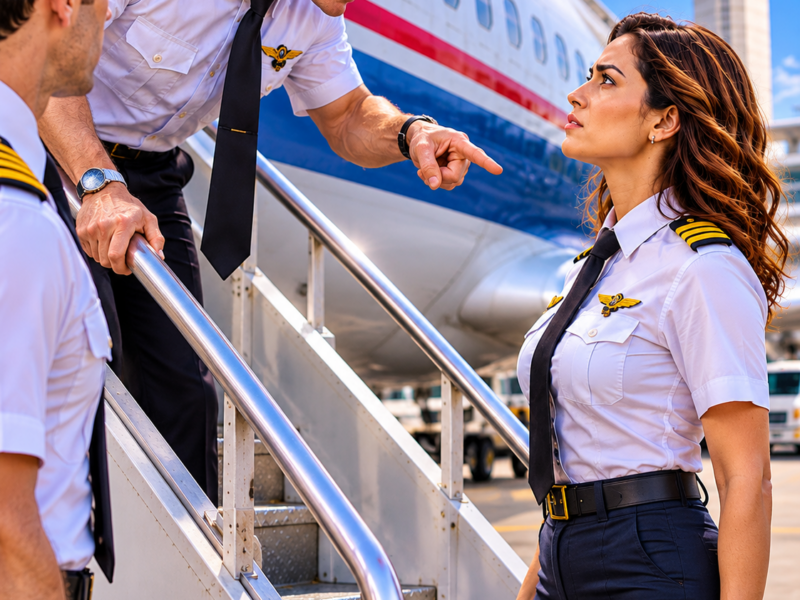
“The captain looked me up and down at Gate 25, then ordered me removed from the flight crew in front of dozens of waiting passengers
The name beside the approval was Robert Mitchell.
I stared at it for several seconds.
Then I looked at Captain Ryan Mitchell, who was standing across the conference table.
“Captain, do you recognize this name?”
He glanced at the screen.
His face changed.
“That’s my brother.”
Nobody spoke.
The maintenance supervisor, Daniel Foster, looked between us.
“Your brother?”
“Robert Mitchell. He’s a senior technical inspector with the airline’s maintenance division.”
I looked back at the report.
The approval date was three weeks earlier.
The document stated that the intermittent monitoring indication had been investigated, corrected, and cleared for normal operations.
But the latest readings suggested that the underlying problem might still exist.
“Captain,” I said carefully, “did you know your brother had signed this report?”
Ryan’s expression hardened.
“I know what you’re implying, and I don’t appreciate it.”
“I’m not implying anything. I’m asking whether you knew.”
“Robert has twenty-seven years of maintenance experience. He’s one of the most respected inspectors in the company.”
The airport director raised his hand.
“Let’s keep this professional. Nobody is accusing anyone of misconduct. We need to establish the facts.”
I nodded.
“Agreed.”
Daniel enlarged the report.
“There’s another issue. The corrective action references a replacement component, but the serial number on the installation record doesn’t match the number in the inspection log.”
The director leaned closer.
“Could that be an administrative error?”
“It could,” Daniel answered. “But we cannot assume that.”
I looked at the document again.
The same component had been mentioned in my original flight information.
I had noticed the discrepancy because the maintenance notation described an intermittent indication, while the subsequent report claimed the problem had been permanently resolved.
The two records didn’t tell the same story.
“Has anyone contacted Robert?” I asked.
The director picked up his phone.
“We’re going to.”
Captain Mitchell stepped away from the table.
“I think this is getting out of proportion.”
The director turned toward him.
“Captain, your personal relationship with the inspector makes this more important to handle transparently, not less.”
Ryan looked as if he wanted to argue.
Instead, he walked toward the window.
I watched him for a moment.
I couldn’t tell whether he was worried about his brother or about what the report might reveal.
Perhaps both.
Twenty minutes later, Robert Mitchell joined the conference through a secure video call.
He appeared to be in his late fifties, with gray hair and rectangular glasses.
His office was filled with maintenance manuals and technical documents.
The airport director introduced everyone.
“Robert, we’ve identified an unresolved discrepancy involving the monitoring system on Flight 445. Your name appears on the original clearance report.”
Robert adjusted his glasses.
“I remember the inspection.”
“Can you explain the corrective work?”
Robert opened a document on his computer.
“The original indication was investigated. The affected component was replaced, the system was tested, and the aircraft passed the required checks.”
Daniel Foster interrupted politely.
“Sir, we’re seeing a mismatch between the installation record and the component serial number.”
Robert stopped moving.
“Which aircraft?”
“Flight 445.”
He looked down at his papers.
“Give me a moment.”
The room waited.
I watched his expression change as he reviewed the information.
Finally, he spoke.
“That replacement was supposed to be completed during the scheduled maintenance visit.”
“Was it completed?” the director asked.
Robert didn’t answer immediately.
“I signed the inspection report based on the documentation submitted to my department.”
Daniel leaned forward.
“Did you physically verify the replacement?”
Another pause.
“I reviewed the inspection results.”
“That’s not the same question,” Daniel said.
Robert removed his glasses.
“No. I did not personally supervise the installation.”
The director remained calm.
“Who did?”
Robert searched through his records.
“Maintenance technician Peter Lawson. He was assigned to the aircraft that week.”
Daniel exchanged a look with another supervisor.
“Peter Lawson is no longer employed here.”
Robert frowned.
“What?”
“He left the company twelve days ago.”
The room became very quiet.
I looked again at the approval date.
Three weeks earlier.
Twelve days before his departure, Peter Lawson had apparently been involved in a repair that was now under investigation.
“Do we have his complete maintenance documentation?” I asked.
Daniel nodded.
“We’re retrieving it.”
Ryan turned away from the window.
“Are you suggesting Peter falsified the report?”
I answered carefully.
“I’m suggesting we verify whether the work documented was actually performed.”
Robert looked directly into the camera.
“That’s what needs to happen.”
For the first time since the call began, he seemed less defensive.
He looked tired.
“Director, I want to make something clear. I would never knowingly approve an aircraft I believed to be unsafe.”
The director nodded.
“Then help us establish what happened.”
Robert agreed to send every document associated with the inspection.
The call ended.
Nobody spoke for several seconds.
Then Daniel opened the maintenance archive.
The next hour was spent comparing records.
The aircraft remained on the taxiway, its engines shut down.
Passengers were being kept informed, and airline representatives had begun arranging alternative travel for those with connecting flights.
Nobody was allowed to rush the technical investigation.
Daniel opened the first maintenance entry.
“Here is the original discrepancy.”
He displayed the recorded warning.
Then he opened the repair authorization.
The document listed a replacement component.
Finally, he displayed the installation record.
The serial number was different.
“Could this be a data-entry mistake?” the director asked.
“Possibly,” Daniel answered. “But we need to establish which component was actually installed.”
Another technician brought up the electronic inventory records.
He examined them, then shook his head.
“The component listed on the installation record was never issued from our warehouse.”
Daniel looked at him.
“Are you certain?”
“I’ve checked the inventory transactions and the supplier records. There’s no matching issue entry.”
Ryan stepped toward the screen.
“Maybe it was transferred from another aircraft.”
“Then there should be a transfer record.”
The technician searched again.
There wasn’t one.
I felt a cold knot form in my stomach.
The problem was no longer just a warning light.
We had an aircraft with a technical discrepancy, a maintenance report claiming a repair had been completed, and no clear evidence that the documented component had ever been installed.
The director looked at Daniel.
“What do we know for certain?”
Daniel answered slowly.
“We know the monitoring system is producing an abnormal indication. We know the maintenance documentation contains an unresolved serial-number discrepancy. We do not yet know the physical condition of the component or the complete cause of the warning.”
“Can the aircraft fly?”
Daniel shook his head.
“Not until the required inspection is completed and the issue is resolved.”
The director nodded.
“Then it doesn’t fly.”
Ryan looked toward me.
I could see the embarrassment on his face.
“Captain Carter, I owe you an explanation.”
I waited.
He rubbed his forehead.
“When I first saw your name on the roster, I questioned the assignment.”
“Why?”
He looked at the floor.
“I thought the airline had made the assignment for reasons unrelated to experience. I assumed you hadn’t flown this aircraft enough to handle the route.”
I stared at him.
“My flight hours and qualifications were available in the roster.”
“I know that now.”
“Then why didn’t you review them?”
He didn’t answer.
The director intervened.
“Captain Mitchell, this isn’t the time for a personal discussion. We need the technical investigation completed.”
Ryan nodded.
But before he turned away, he said quietly, “I should have listened.”
I didn’t respond.
An apology was important.
But the aircraft still wasn’t safe to release.
At 10:35 a.m., Daniel received a call from the maintenance hangar.
The physical inspection had begun.
A specialized technical team had arrived with the required equipment and documentation.
The airport director asked me to accompany them to the observation area.
“Captain Carter, your familiarity with the original flight information may help us understand the discrepancy.”
“I’ll assist where appropriate, sir.”
We walked toward the maintenance hangar.
The aircraft had been moved from the taxiway under controlled ground procedures.
Its passengers had already been transferred to another flight.
No one was injured.
A maintenance team was examining the relevant system.
I stood behind the marked safety line as Daniel spoke with the lead technician.
“What’s your preliminary finding?”
The technician pointed toward a diagnostic display.
“We’ve identified an abnormal signal in the monitoring circuit. We’re tracing it back through the associated components.”
“Could it explain the repeated warning?”
“It could, but we haven’t confirmed the root cause.”
I looked at the readings.
Something caught my attention.
“Can you compare that with the earlier maintenance record?”
Daniel opened the file.
The technician examined both screens.
“That’s interesting.”
“What?”
“The earlier inspection recorded a stable signal after the documented repair. But our current test is showing intermittent fluctuations.”
I leaned closer.
“Does the record show the system was tested under the same operating conditions?”
The technician searched.
“No. The test conditions aren’t fully documented.”
Daniel sighed.
“That should have been included.”
“Yes.”
I looked at the technician.
“Could the earlier test have missed an intermittent fault?”
“That’s one possibility.”
He returned to the equipment.
“We need to inspect the physical installation and test the complete circuit.”
I nodded.
“Then that’s what we do.”
For the next two hours, the team worked methodically.
They inspected connectors, verified installation records, checked the associated wiring, and repeated diagnostic tests.
No one made assumptions.
No one declared the aircraft safe simply because a particular reading temporarily returned to normal.
At one point, the lead technician called Daniel over.
“We’ve isolated the abnormal signal to a section of the monitoring circuit.”
Daniel examined the readings.
“Do we have the cause?”
“Not yet. But we’re narrowing it down.”
He looked toward me.
“Captain Carter, you were right to question the inconsistency.”
I didn’t smile.
“I wasn’t trying to be right. I was trying to understand why the records didn’t match.”
He nodded.
“Fair enough.”
At noon, the airport director called an emergency operational review.
Robert Mitchell had returned to the video conference.
This time, he looked considerably less confident.
Daniel presented the findings.
“We’ve confirmed that the monitoring system has an intermittent abnormal signal. The documented component replacement cannot currently be verified through our inventory or installation records.”
Robert leaned forward.
“Have you identified whether the original component remains installed?”
“That’s part of the physical inspection.”
Robert looked down.
“I want to review the original paperwork again.”
The director nodded.
“You’ll have access to the complete file.”
Ryan sat silently beside him.
Then Robert spoke.
“I should explain something.”
Everyone looked at the screen.
“When Peter Lawson submitted the repair documentation, the department was dealing with a significant backlog. Several aircraft were waiting for inspection, and we were under pressure to clear outstanding maintenance items.”
Daniel frowned.
“Are you saying the inspection was rushed?”
“I’m saying I relied on the submitted records instead of requiring an additional physical verification.”
The director’s expression hardened.
“Was that consistent with the required procedure?”
Robert hesitated.
“No.”
The answer hung in the room.
“Why did you sign it?” the director asked.
Robert looked older than he had an hour earlier.
“Because I believed the work had been completed.”
Ryan finally spoke.
“Robert, did you know the component wasn’t installed?”
“No.”
“Then why didn’t you check?”
Robert looked at his brother.
“I should have.”
There was no dramatic argument.
No raised voices.
Just two men realizing that a professional decision had consequences neither had expected.
The director closed his folder.
“This matter will be referred for a formal compliance investigation. Until that investigation is complete, the relevant approvals will be reviewed independently.”
Robert nodded.
“I understand.”
The call ended.
Ryan remained seated.
I could see that he was struggling with the fact that his brother might have made a serious professional mistake.
I understood something about that feeling.
Sometimes the people we trust are still capable of making decisions that hurt others.
Respecting someone doesn’t mean refusing to examine what they’ve done.
At 1:20 p.m., the maintenance team made another discovery.
The lead technician approached Daniel with a diagnostic report.
“We’ve identified the source of the abnormal reading.”
The director immediately stood.
“What is it?”
The technician explained that a connection in the monitoring circuit was not performing consistently under the test conditions.
The physical inspection revealed a problem that required corrective maintenance and further testing.
Daniel examined the report.
“Does this account for the repeated caution indications?”
“It explains the abnormal signal we’ve been tracking. But we still need to complete the prescribed checks to confirm the entire system is functioning correctly.”
The director looked at me.
“Would the original discrepancy have justified holding the aircraft?”
“Yes, sir.”
“Even without knowing what the fault was?”
“Especially then. A warning doesn’t have to tell us the complete cause before we take it seriously.”
He nodded.
“Understood.”
The technician continued.
“We’ve isolated the affected circuit. The corrective work will require replacing the faulty connection assembly, verifying the associated wiring, and repeating the required system tests.”
“How long?” the director asked.
“We won’t give a release time until the work and inspections are complete.”
The director accepted that.
“Take whatever time is necessary.”
I looked toward the aircraft.
Its cabin windows reflected the afternoon sun.
Just a few hours earlier, passengers had been preparing to fly home.
Most would never know how close they had come to boarding an aircraft with an unresolved technical discrepancy.
They didn’t need to know every detail.
They simply needed the people responsible for their safety to do their jobs properly.
At 3:45 p.m., the maintenance team completed the corrective work.
But the aircraft was still not cleared.
A second independent inspection was required.
The team reviewed the installation, verified the replacement parts, checked the relevant wiring, and performed the prescribed functional tests.
Daniel stood beside the technical supervisor as the results came in.
“All readings within the required limits,” the supervisor reported.
“Any recurring indications?”
“None during the completed tests.”
“Documentation?”
“Complete and signed.”
Daniel looked toward the director.
“The corrective work has passed the required inspections. We still need the authorized maintenance release and operational approval before the aircraft can return to service.”
The director nodded.
“Proceed through the normal approval process.”
I watched the team complete the documentation.
Nobody rushed.
Nobody skipped a signature.
Nobody treated the fact that the aircraft had already lost several hours as a reason to take a shortcut.
Finally, the maintenance supervisor returned with the completed report.
“The aircraft has received its official maintenance release. All required checks and corrective actions are documented.”
The director reviewed the paperwork.
“Independent verification completed?”
“Yes, sir.”
“Then operational control can review the release for return to service.”
A few minutes later, the official clearance was confirmed.
The aircraft could return to service under normal procedures.
It would not be used for the original flight.
That flight had already been reassigned.
But the aircraft was no longer sitting on the ground because nobody knew what was wrong.
It was returning to service because the required work had been completed and verified.
There was a difference.
And that difference mattered.
The airport director asked everyone involved to gather in the conference room.
Captain Mitchell sat across from me.
Daniel placed the completed technical report on the table.
The director spoke first.
“Today’s incident exposed several problems. We had an unresolved technical discrepancy, incomplete supporting documentation, and a communication failure involving the flight crew.”
He looked at Ryan.
“Captain Mitchell, you removed Captain Carter from the flight without adequately addressing the safety concern she raised.”
Ryan nodded.
“Yes, sir.”
“Why?”
Ryan took a breath.
“I made an assumption about her assignment and her experience. Instead of reviewing the information she brought to me, I treated her concern as an unnecessary delay.”
He looked toward me.
“That was unprofessional.”
The director waited.
Ryan continued.
“I also allowed the departure schedule to influence my judgment. I should have stopped and listened.”
I appreciated that he was finally saying the words.
But I didn’t want the conversation to become a ceremony about my reputation.
There was a larger issue.
“Captain Mitchell,” I said, “I want to ask you something.”
He looked up.
“Go ahead.”
“If another first officer raises a technical concern during a future flight, what will you do?”
He didn’t hesitate.
“I’ll listen. I’ll review the information, and I’ll make sure the concern is addressed through the proper procedures.”
“And if you disagree?”
“Then we’ll verify it. We won’t dismiss it because we’re behind schedule.”
I nodded.
“That’s all I wanted.”
The director turned toward Daniel.
“The maintenance documentation issue will be investigated separately. Robert Mitchell and the relevant personnel will be required to cooperate with the review.”
Daniel nodded.
“Understood.”
Then the director looked at me.
“Captain Carter, I owe you an apology as well.”
I was surprised.
“Sir?”
“The crew change should never have been handled in a way that made you feel your professional concerns were irrelevant. Your experience deserved to be reviewed properly.”
I looked at the report.
“Thank you, sir.”
He continued.
“I’d also like you to participate in a review of our flight crew safety communication procedures.”
I considered the request.
“I’d be glad to help.”
“Good. We need to make sure the next person who notices something unusual is heard before the situation reaches a taxiway.”
The following morning, I returned to the crew briefing room.
The same departure board was glowing above the desks.
The same coffee machine was making the same terrible noise.
But the atmosphere felt different.
Captain Mitchell was standing beside the flight roster.
When he saw me, he stepped forward.
“Good morning, Captain Carter.”
“Good morning.”
He held out a revised crew assignment.
“I’ve spoken with operations. I’d like you to join me on tomorrow’s flight, assuming the assignment is approved through the normal scheduling process.”
I looked at the document.
“Thank you.”
He hesitated.
“And I want to say something else.”
I waited.
“I judged you before I knew you. I saw your name on the roster and decided I knew what kind of pilot you were.”
He looked uncomfortable.
“I was wrong.”
I folded the assignment sheet.
“Why did you think I wasn’t qualified?”
He took a moment.
“Honestly? I don’t have a good answer.”
“Then I hope you think about that.”
He nodded.
“I will.”
I wasn’t interested in humiliating him.
I didn’t need him to feel small so I could feel respected.
I needed him to understand that a cockpit wasn’t a place where one person’s pride mattered more than everyone else’s safety.
He seemed to understand that now.
“One more thing,” I said.
“Yes?”
“If I raise a concern tomorrow, I expect you to listen.”
He almost smiled.
“I would expect nothing less.”
Three days later, I attended a meeting about the incident review.
The technical investigation had been expanded beyond Flight 445.
The airline was examining the maintenance documentation process, the verification procedures, and how intermittent technical discrepancies were recorded and closed.
Peter Lawson, the former technician, was contacted as part of the formal investigation.
The company had not yet reached a final conclusion about his actions.
That was important.
A missing record did not automatically prove intentional misconduct.
An incomplete inspection did not automatically establish fraud.
The evidence had to be examined properly.
Robert Mitchell was temporarily removed from independent approval duties while the review continued.
He was not publicly declared guilty of anything.
But his decision to approve documentation without the required verification was being taken seriously.
A week later, I received an unexpected phone call.
It was Robert.
I considered letting it go to voicemail.
Then I answered.
“Captain Carter.”
“Mr. Mitchell.”
“I wanted to speak with you about what happened.”
I waited.
“I’ve reviewed the entire maintenance file. I should have requested the physical verification before signing the report.”
“Yes, you should have.”
He sighed.
“I know.”
There was a pause.
“My brother told me what you said in the conference room.”
I wasn’t sure what to say.
“He said you told him that respect and safety have to come before everything.”
“That’s correct.”
“I think I needed to hear that.”
I looked through the office window.
A plane was moving slowly toward its gate.
“Mr. Mitchell, I don’t know whether the investigation will find additional problems. That’s for the technical team to determine.”
“I understand.”
“But I hope you take this seriously. Maintenance records aren’t just paperwork. They’re part of the information pilots rely on when they make decisions.”
He was quiet.
Then he said, “You’re right.”
We ended the call.
I didn’t feel victorious.
I felt relieved that someone had finally understood the importance of the issue.
A month later, I was assigned to another morning flight.
The departure was scheduled for 7:15 a.m.
I arrived early, reviewed the operational information, and met Captain Mitchell at the crew briefing area.
He was holding two cups of coffee.
He offered me one.
“Peace offering.”
I took it.
“Should I be worried?”
“It’s terrible coffee.”
“Then I know it’s genuine.”
He laughed.
We reviewed the flight plan, the weather, and the aircraft information.
Before we finished, a young first officer named Emily Ross approached.
She looked nervous.
“Captain Carter?”
“Yes?”
“Could I ask you something?”
“Of course.”
She showed me a technical notation on her tablet.
“I noticed a discrepancy in the latest report. It might be nothing, but I wasn’t sure whether I should bring it up.”
I looked at the information.
Then I turned toward Captain Mitchell.
He immediately put down his coffee.
“Let’s review it.”
Emily looked surprised.
I smiled.
“Show us what you found.”
She explained the discrepancy.
We checked the relevant documentation and contacted the appropriate technical personnel.
It turned out to be an administrative mismatch that had already been corrected in the official record.
There was no aircraft defect.
But Emily had done exactly what a responsible first officer should do.
She had noticed something unusual and raised it before departure.
When the review was complete, Captain Mitchell turned toward her.
“Good catch.”
Emily smiled.
“Thank you, sir.”
He added, “Never hesitate to ask about something you don’t understand.”
She nodded and returned to her preparations.
I watched her walk away.
Then Ryan looked at me.
“That was the right thing to do, wasn’t it?”
I nodded.
“Yes.”
He took a sip of coffee and grimaced.
“Still terrible.”
“Some things never change.”
That afternoon, I received an email from the airport director.
He had attached a copy of the revised safety communication guidance.
At the top was a sentence that had been included following the review:
Every safety concern deserves to be heard, documented, and assessed before an operational decision is made.
I read it twice.
Then I saved the document.
It wasn’t a complicated idea.
It wasn’t a revolutionary discovery.
But it was something that could make a difference if people actually followed it.
A few days later, I was asked to speak at a crew safety meeting.
There were pilots, cabin crew members, dispatchers, and maintenance personnel in the room.
Some had decades of experience.
Others were still completing their first year.
I stood at the front and looked around.
“I want to tell you something about a flight that never left the ground.”
I explained what happened at Gate 25.
I didn’t name Robert or Peter.
I didn’t make the story about Captain Mitchell’s mistake.
I described the technical discrepancy, the incomplete documentation, and the decision to hold the aircraft until the facts were established.
Then I told them about the young first officer who had approached me that morning.
“She wasn’t certain her observation was important. She was worried about wasting everyone’s time.”
I paused.
“That’s exactly why we need an environment where people can speak up.”
A maintenance supervisor raised his hand.
“What if someone repeatedly raises concerns that turn out to be nothing?”
I answered honestly.
“Then we examine them professionally, document the result, and explain what we found. We don’t punish people for asking reasonable safety questions.”
Another pilot asked, “What if the captain disagrees?”
“Then the captain should be able to explain the disagreement using the relevant procedures and evidence. Authority doesn’t eliminate the responsibility to listen.”
I looked across the room.
“A cockpit needs teamwork. A maintenance hangar needs teamwork. An airport needs teamwork. Nobody should feel that their rank, experience, or position gives them permission to ignore information that might affect someone else’s safety.”
The room remained quiet.
Then an older captain in the second row nodded.
I knew he understood.
Six months later, Flight 445 had become a reference point in the airline’s internal safety training.
Not because anyone had been injured.
Not because the aircraft had suffered a catastrophic failure.
But because a warning had been raised, dismissed, investigated, and ultimately taken seriously before the aircraft left the ground.
The technical review had confirmed failures in the maintenance verification process.
The airline introduced additional checks for certain component replacements and strengthened independent review requirements.
Robert Mitchell completed the investigation process and received formal corrective action under the company’s maintenance oversight policy.
He was later permitted to return to technical duties under revised supervision.
Peter Lawson’s involvement was reviewed separately.
The investigation found that his maintenance documentation had not adequately supported the claimed corrective work, and the company took action based on the verified findings.
Captain Mitchell also completed additional crew resource management training.
He remained a captain.
But I noticed a change in the way he worked.
He asked more questions.
He gave first officers time to explain concerns.
And when someone disagreed with him, he listened before answering.
One morning, as we were preparing for another departure, he turned toward me.
“Ready, Captain Carter?”
I checked my watch.
Then I looked at the aircraft through the terminal windows.
“Ready, Captain.”
He smiled.
“Good. Let’s make this a safe flight.”
I adjusted my father’s silver aviation watch.
For a moment, I remembered the morning at Gate 25.
The public humiliation.
The unanswered questions.
The warning on the screen.
And the name on that maintenance report.
I also remembered the passengers sitting quietly in their seats, trusting that the people responsible for their flight would do the right thing.
They would never know how many decisions had been made on their behalf that day.
They didn’t need to.
They deserved to board an aircraft knowing that someone had checked the details, questioned the inconsistencies, and refused to gamble with their lives.
I picked up my flight documents and followed Captain Mitchell toward the cockpit.
As I reached the door, I glanced back at the terminal.
A young first officer was reviewing her tablet.
She noticed something, frowned, and turned toward her captain.
He stopped to listen.
I smiled.
That was the moment I knew the lesson had finally reached beyond one flight, one airport, and one difficult morning.
Because the greatest responsibility in aviation isn’t proving who has the most authority.
It’s making sure that everyone has the courage to speak when something doesn’t look right.
And sometimes, the safest flight is the one that never takes off until every question has been answered.
The End.









