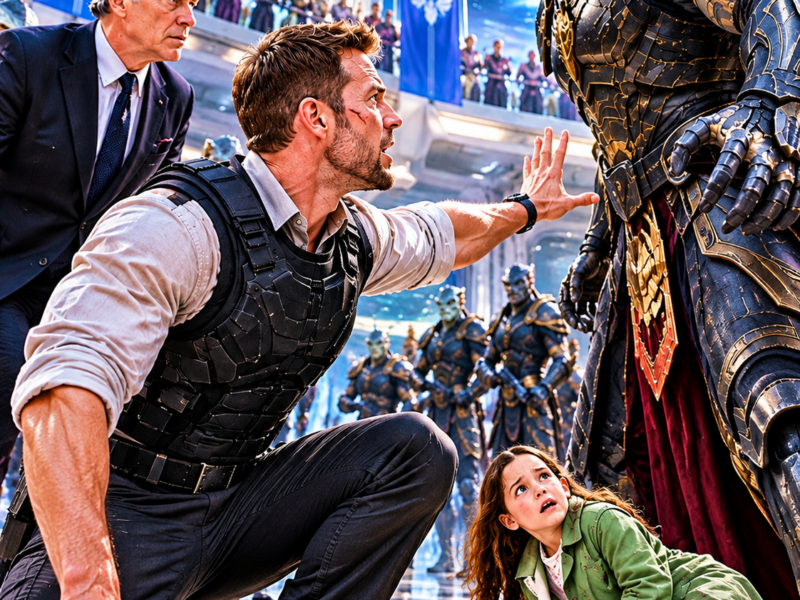
The canvas sack hit the marble floor of the Galactic Assembly with a heavy thud. Something rolled out.
The medical bay was quiet when Matthew Dixon arrived.
For the first time since the attack on Gardner Station, he was no longer thinking about the Osari Hegemony, the Galactic Assembly, or the hundred and forty warships that had just been destroyed.
He was thinking about one little girl.
His daughter.
Mia lay in a medical bed beneath a thin white blanket. Her green raincoat had been removed, and medical monitors surrounded her. A bandage covered part of her head. Her breathing was steady, but her face looked pale against the pillow.
Dixon stopped at the doorway.
He had walked through the Hegemony’s strongest security perimeter. He had watched twenty elite soldiers fall in darkness. He had stood over a warlord who had conquered twelve worlds and made entire civilizations tremble.
None of that had frightened him as much as the sight of his daughter lying motionless in that bed.
Dr. William Bradley stood beside the medical console.
“She’s stable,” the surgeon said quietly. “Three broken ribs, a bruised lung, and a concussion. The swelling has gone down. We will continue monitoring her, but she’s going to recover.”
Dixon nodded.
He wanted to ask a hundred questions, but his throat was too tight.
Instead, he reached into his breast pocket.
The brass compass was there.
He opened it carefully and looked at the little needle. It had survived the fall across the marble floor, just as Mia had survived the terrible blow.
He approached the bed and sat down.
For a while, he simply watched her breathe.
Then he took her hand and placed the compass in her palm.
Mia’s fingers moved slightly.
“Daddy?”
Dixon leaned forward.
“I’m here, sweetheart.”
Her eyes opened slowly.
She looked confused for a moment, then noticed the compass.
“You found it.”
“I told you I would.”
She tried to smile, but her ribs hurt.
“Did the big angry man go away?”
Dixon closed his eyes for a brief moment.
“Yes. He won’t hurt you again.”
Mia looked down at the compass.
“Grandpa said it always points somewhere.”
“That’s right.”
“Where does it point now?”
Dixon glanced at the needle.
It was pointing toward him.
He gave her a tired smile.
“Looks like it points home.”
Mia seemed satisfied with that answer.
She closed her eyes again, still holding the compass.
Dixon remained beside her.
He did not tell her about the warlord’s death. He did not tell her about the fleet or the Assembly or the way an entire galaxy had watched humanity reveal its military strength.
She was eight years old.
She needed her father, not a report about a battle.
So he stayed.
And for the first time that day, Matthew Dixon allowed himself to cry.
***
Across Gardner Station, the Galactic Assembly was experiencing a different kind of crisis.
The chamber had been designed to accommodate representatives from dozens of civilizations. Its ceiling rose high above the central floor, and the seats were arranged in concentric circles so that no delegation could claim another had been given a position of greater honor.
It was a place built around the idea that every civilization deserved a voice.
But that afternoon, the voices had almost disappeared.
The holographic display still showed the remains of the Osari Seventh Fleet.
One hundred and forty warships had entered the system.
None had survived.
The delegates who had once laughed at human cargo ships were now studying the four black dreadnoughts that had emerged from beneath their disguises.
They were not beautiful vessels.
They had no elaborate decorations, no glowing weapons mounted for display, and no ceremonial markings.
They looked like machines designed for one purpose.
To fight.
Admiral Jennifer West remained on the holographic channel, sitting calmly before her command screens.
She had not celebrated the destruction of the enemy fleet. She had not raised her voice or delivered a triumphant speech.
She had simply given an order.
Fire.
And the galaxy had watched the consequences.
At the center of the chamber, Ambassador Gregory Elliot stood beside the Terran lectern.
The Osari Chancellor, Scythe, had been taken away under guard.
The six human operators who had entered the chamber had ensured that the Hegemony’s leadership could no longer turn the Assembly into a battlefield.
The ambassador looked toward the remaining delegations.
“Before anyone misunderstands what has happened here,” he began, “I want to make one thing clear.”
The chamber fell silent.
“Humanity did not come to Gardner Station looking for a war. We came to discuss trade, diplomacy, and peaceful cooperation.”
He paused.
“We still want those things.”
Several representatives shifted in their seats.
One delegate from the Veyran Republic slowly raised a hand.
“Ambassador Elliot, are you saying Earth intends to withdraw from the Galactic Concordat?”
“No.”
“Then what do you intend to do?”
Elliot folded his hands.
“We intend to hold the Osari Hegemony accountable for its actions.”
The Veyran delegate hesitated.
“Your director has killed a recognized warlord on neutral territory.”
Elliot looked directly at him.
“Warlord Kesh assaulted a civilian child on neutral territory. He did so without provocation. The fact that he held a title does not make that action acceptable.”
“But you have destroyed an entire fleet.”
“The fleet was ordered to destroy our ships.”
“You could have negotiated.”
Elliot’s expression remained calm.
“We negotiated for two days over the Tessan Reach mining concession. We refused to sign an agreement that would allow an entire population to be exploited. The Hegemony responded by attacking a child and threatening our delegation.”
He let the words settle.
“At some point, negotiation becomes an excuse for allowing cruelty to continue.”
No one answered.
The ambassador continued.
“Earth is not asking this Assembly to love us. We are not asking you to admire our military capabilities. We are asking you to understand that our peaceful intentions should never be mistaken for permission to harm our people.”
He looked toward the empty Osari seats.
“The Hegemony has occupied twelve worlds. Those worlds have populations, families, children, and people who have spent generations living under someone else’s authority.”
Elliot turned back to the chamber.
“Those people deserve the chance to decide their own future.”
A murmur moved through the delegates.
Some were uncomfortable.
Others were calculating.
A few were already wondering what would happen if Earth decided to apply the same pressure to their own empires.
The ambassador noticed.
He had expected it.
For centuries, the great powers of the galaxy had built their influence through fear. Some had conquered planets. Others had controlled trade routes, food supplies, and access to technology.
The Galactic Assembly had been created to prevent another major interstellar war.
But it had never completely eliminated the ambitions that caused those wars.
Now humanity had demonstrated that it possessed the means to challenge even the most powerful empire.
The question was what humanity would do with that power.
***
Admiral Jennifer West watched the tactical display from the command deck of the lead dreadnought.
The wreckage of the Seventh Fleet drifted through the system.
Her officers were checking for survivors and confirming that no hostile vessels remained operational.
“Admiral,” the tactical officer said, “we’ve detected escape pods from three enemy ships.”
“Mark their positions.”
“Shall we recover them?”
“Of course.”
The officer looked surprised.
West noticed.
“Something wrong?”
“They were trying to destroy us.”
“And now they’re helpless.”
She turned toward him.
“We’re not here to punish people for losing a battle. Recover the pods. Treat the wounded. Any surviving crew members are to be held as prisoners of war until the Assembly determines their status.”
“Understood.”
West looked back at the screen.
The human ships had won.
But victory was not the same as justice.
She knew the difference.
And she intended to make sure the galaxy understood it too.
***
On the fourth tier of Gardner Station, the Hegemony’s remaining diplomatic staff gathered in a private conference room.
Their leader, Chancellor Scythe, had been removed from the Assembly.
Kesh was dead.
The Seventh Fleet was gone.
For the first time in generations, the Osari Hegemony faced a threat it could not simply intimidate.
A young military representative stood near the conference table.
“What do we do now?”
No one answered immediately.
An older diplomat finally spoke.
“We contact the remaining governors.”
“To prepare a counterattack?”
“No.”
The diplomat looked at him.
“To prevent one.”
The younger representative frowned.
“You want us to surrender?”
“I want us to survive.”
He moved toward the window.
Beyond the glass, the human dreadnoughts remained in formation.
They were not firing.
They were not advancing.
They were simply waiting.
That was what disturbed him most.
The humans had demonstrated that they could destroy the Hegemony’s fleet. They had also demonstrated that they could have attacked the diplomatic delegation but had not.
They were showing restraint.
And restraint was something the Osari leadership had never understood.
For them, power existed to be used.
For humanity, it seemed power could also exist to prevent others from suffering.
The older diplomat turned back toward the table.
“Send a message to every occupied world. Tell their governors that we are suspending military operations until further notice.”
“That will look like weakness.”
The diplomat gave a tired laugh.
“Perhaps. But weakness is not the same as defeat.”
He looked toward the human ships again.
“Today, we learned that.”
***
The following morning, Ambassador Elliot received an unexpected request.
A delegation from Tessan Reach wanted to meet him.
Tessan Reach was the border world whose mining rights had caused the original dispute. Its mineral deposits were valuable, but the planet also had a large civilian population living near the extraction zones.
The Osari had wanted unrestricted access to those deposits.
The humans had refused.
Now representatives from Tessan Reach were asking for something different.
They wanted to know whether Earth would help them establish an independent government.
Elliot read the message twice.
Then he looked at his diplomatic adviser.
“What do we know about their leadership?”
“They have a civilian council. The Osari appointed the current governor, but most local communities do not recognize his authority.”
“Any armed resistance?”
“Several local groups, but no unified command.”
Elliot considered that.
“We will meet with their council.”
“Ambassador, we have no guarantee the Hegemony will accept an independent Tessan Reach.”
“Then we’ll make it clear that the decision belongs to the people of Tessan Reach.”
His adviser hesitated.
“Do you think the other occupied worlds will ask for the same thing?”
Elliot looked toward the holographic map.
Twelve worlds.
Twelve populations.
Some had been occupied for decades. Others had been conquered only recently.
“Yes,” he said.
“And what will we do?”
Elliot straightened his jacket.
“We’ll listen.”
***
Three days after the attack, Mia was finally allowed to leave the medical bay.
She still had to move carefully, and the doctors had warned that her ribs would take time to heal.
But she was awake, talking, and already asking questions about everything she had missed.
Dixon walked beside her through the station’s quieter corridors.
He had changed into a clean suit, though the exhaustion remained visible on his face.
Mia wore her green raincoat again.
Her grandfather’s compass hung from a small cord around her neck.
“Are we going home?” she asked.
“Not quite yet.”
“Why?”
“Your grandfather’s compass needs to see a few more places.”
Mia considered this.
“Does it work here?”
“Not very well.”
She giggled.
They approached a large observation window overlooking the station’s exterior.
Beyond the glass, the stars stretched into an endless field of light.
Four human warships remained visible in the distance.
Mia pointed.
“Are those our ships?”
“Yes.”
“Are they big?”
“Very.”
“Are they stronger than the bad man’s ships?”
Dixon thought about how to answer.
“Strong enough to protect us.”
Mia looked at him.
“Did they hurt anybody?”
He took a moment.
“Some people got hurt during the fighting.”
“Even people who didn’t do anything?”
“War is complicated, sweetheart.”
She looked back at the ships.
“Grandpa says being strong doesn’t mean you should push people around.”
Dixon smiled faintly.
“Your grandfather is a wise man.”
Mia touched the compass.
“He also says if you have to fight, you should know when to stop.”
Dixon looked down at her.
For a moment, he could not speak.
Then he crouched carefully so they were at eye level.
“That’s something I hope you always remember.”
She nodded.
“Will the bad people come back?”
“I don’t think so.”
“Promise?”
Dixon gently adjusted the cord around her neck.
“I promise I’ll do everything I can to keep you safe.”
Mia accepted that.
Then she took his hand.
They continued walking.
***
A week later, the Galactic Assembly held an emergency session.
The Hegemony’s remaining representatives attended under strict security arrangements.
The twelve occupied worlds had submitted formal requests for independence.
Several other civilizations had also proposed a new treaty governing the treatment of civilian populations during interstellar conflicts.
Ambassador Elliot stood before the chamber.
He looked older than he had a week earlier, but his voice remained steady.
“Humanity has no desire to replace one empire with another,” he said. “We do not intend to rule the worlds that the Osari once occupied. We do not want their resources, their taxes, or their allegiance.”
He paused.
“We want the people living there to have a choice.”
The chamber listened.
“That is what we came here to defend. Not territory. Not prestige. Not the right to dominate someone weaker.”
He glanced toward the Terran delegation.
“And certainly not the right to hurt a child because you believe no one can stop you.”
The new resolution was put to a vote.
It passed.
The Hegemony’s representatives did not support it, but they no longer had the strength to prevent it.
The first step toward independence for the twelve occupied worlds had begun.
And the Galactic Assembly would never again look at humanity in quite the same way.
***
Months later, Mia stood in the garden of the human diplomatic residence on Earth.
Her ribs had healed. The concussion was behind her, and the doctors had cleared her to return to normal activities.
She still carried the brass compass.
Her father sat nearby, watching her examine the needle.
It pointed toward the north, as it had for generations.
Mia turned it around.
The needle moved.
She frowned.
“Something’s wrong.”
Dixon looked up from his book.
“What is it?”
“The compass keeps pointing in different directions.”
He smiled.
“That’s because you’re moving it.”
“But Grandpa said it always points north.”
“Most of the time.”
Mia thought about that.
Then she looked toward her father.
“What’s the most important direction?”
Dixon closed his book.
He considered the question.
“Home,” he said.
Mia smiled.
She ran back toward the house, the compass bouncing against her chest.
Dixon watched her go.
He remembered the marble floor of Gardner Station. The terrible sound of the impact. The little green raincoat lying against the pillar.
He remembered the darkness in Kesh’s suite and the moment the entire galaxy had discovered what human restraint had been hiding.
But most of all, he remembered the message from the medical bay.
She’s awake.
She’s going to be fine.
That was the only victory that had ever truly mattered to him.
The galaxy would remember the destruction of the Seventh Fleet. It would remember the fall of the Osari Hegemony and the day a human director walked into the Assembly carrying the head of a warlord.
It would remember the warning Ambassador Elliot had delivered.
But Matthew Dixon would remember something smaller.
A little girl holding a brass compass.
A question about where it pointed.
And the simple promise he had made beside her hospital bed.
Humanity had spent thousands of years learning how dangerous it could become.
Then it had spent generations learning how to control that danger.
Not because it was incapable of fighting.
Not because it was afraid.
But because it wanted a universe where children could walk through a public hall without being afraid of the powerful.
That was the peace humanity had come to the stars to build.
And if anyone ever tried to take that peace away by hurting one of its children, they would discover that the gentlest species in the galaxy had never forgotten how to protect its own.
The end.









