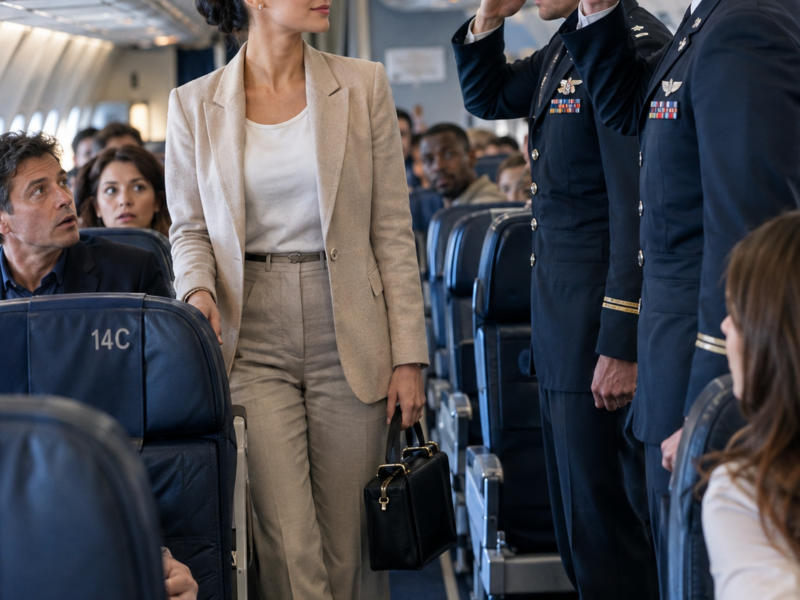
The businessman laughed when two fighter pilots stopped beside seat 14C and snapped to attention before a woman in a faded sweatshirt
The businessman laughed when two fighter pilots stopped beside seat 14C and snapped to attention before a woman in a faded sweatshirt. Then the captain stepped out of the cockpit, stared at her face, and whispered five words that drained the color from every military uniform aboard the aircraft.
“Commander Morgan. We thought you were dead.”
Three years earlier, the name had been erased from the walls of a classified operations center. Now, at thirty thousand feet, it was about to become the most important name in American military aviation.
Mara Morgan wished she had booked another flight.
Rain swept across the windows of Gate 27 at Denver International Airport, turning the runway into a sheet of silver beneath the terminal lights. Beyond the glass, ground crews moved between aircraft with reflective vests glowing in the mist. Somewhere outside, the deep rumble of a jet engine vibrated through the terminal floor, a familiar sound that made Mara instinctively tilt her head.
She listened for three seconds.
Then she looked away.
Old habits.
Her canvas bag hung from one shoulder, its strap frayed where it had rubbed against the collar of her sweatshirt. Inside were two changes of clothes, a paperback novel she had barely opened, and a small metal object wrapped in a handkerchief.
She had carried that object for three years.
She had never shown it to anyone.
“Boarding group one, please proceed to the gate.”
Mara joined the line without looking at the passengers around her. She was tired of airports, tired of questions, and especially tired of people who recognized the faint military bearing she could never quite eliminate.
At the gate entrance, a young airline employee glanced at her boarding pass.
“Fourteen C. Economy aisle.”
“Yes.”
The employee barely looked up.
“Just keep your bag under the seat, please.”
Mara nodded and walked down the jet bridge.
The aircraft smelled of coffee, cleaning solution, and the faint metallic odor of conditioned air. Passengers shuffled into their rows, wrestling with carry-ons while overhead bins slammed shut. Near the forward cabin, two men in dark blue military flight suits were speaking quietly with a flight attendant.
Their name patches read REEVES and HOLLOWAY.
Mara recognized the squadron insignia on their shoulders.
The 27th Fighter Squadron.
Her footsteps slowed.
Three years ago, she had trained pilots from that squadron. She had taught them how to read a threat before it appeared on radar, how to recognize a false sense of security in a perfectly functioning cockpit, and how to bring a damaged aircraft home when every instrument insisted the situation was hopeless.
Then came Operation Silent Anvil.
Three aircraft failed to return.
An investigation followed.
And Mara Morgan became the person everyone needed to blame.
She lowered her head and continued toward row fourteen.
“Excuse me, ma’am?”
She turned.
The taller pilot, Reeves, was staring at her.
For a moment, neither spoke. His eyes moved from her face to the faded sweatshirt, then to the old canvas bag.
Recognition arrived slowly.
Then all at once.
“Commander?”
Mara’s expression barely changed.
“You have the wrong person.”
Holloway turned at the sound of his colleague’s voice. He looked at Mara, and whatever he saw made him straighten so quickly that his shoulder brushed a passenger reaching for an overhead bin.
“No way,” he whispered.
Mara glanced toward seat 14C.
“Gentlemen, I’m trying to get home.”
Neither man moved.
Reeves stepped into the aisle. Holloway followed.
Then, in the narrow space between economy seats, both pilots brought their hands to their brows and delivered a formal military salute.
“Ma’am.”
The nearby passengers fell silent.
A businessman in a charcoal suit leaned across the aisle, his expensive watch catching the overhead light.
“What’s this supposed to be?” he asked with a laugh. “Did somebody mistake a flight attendant for a four-star general?”
Nobody answered him.
Mara felt the familiar weight of attention pressing against her shoulders. She had stood before intelligence panels, interrogators, and commanders who believed three minutes of shouting could replace three hours of evidence. A few curious passengers were nothing.
Still, she disliked the salute.
It brought back too much.
“Please lower your hands,” she said quietly.
Reeves hesitated.
“Respectfully, ma’am, we can’t do that until you acknowledge us.”
Mara looked directly at him.
“I acknowledge you.”
Both men lowered their hands.
She slid into seat 14C, fastened her seat belt, and placed her canvas bag beneath the seat in front of her.
The businessman shook his head.
“Unbelievable.”
Mara looked out the window.
The aircraft’s wing glistened under the airport lights. Rainwater streamed backward along its surface as a ground vehicle passed beneath the engine. She noticed a maintenance panel near the wing root, its fasteners clean and uniform except for one that reflected the light at a slightly different angle.
She watched it for another second.
Then she forced herself to look away.
Not her aircraft.
Not her problem.
A flight attendant approached Reeves and Holloway, asking them to return to their assigned seats. Both complied, though Reeves glanced back at Mara twice before disappearing toward the front cabin.
The aircraft doors closed.
Passengers settled in. A child cried somewhere behind her, and the ventilation system hummed steadily above the seats.
Then the captain’s voice came over the intercom.
“Ladies and gentlemen, we apologize for the delay. We’re handling an unexpected security matter and expect to depart shortly.”
Mara’s fingers tightened around the armrest.
Security matter.
She looked toward the cockpit.
A moment later, the cockpit door opened.
The captain emerged wearing four gold stripes on his shoulders. He was in his early fifties, with silver at his temples and the exhausted eyes of someone who had spent too many nights awake.
He scanned the cabin.
When he reached row fourteen, he stopped.
For several seconds, he simply stared at Mara.
Then he removed his cap.
“Commander Morgan?”
The businessman slowly turned his head.
Mara closed her eyes.
“I’m not a commander anymore, Captain.”
The captain crouched beside her seat, lowering his voice.
“Some of us never stopped considering you one.”
“That’s a mistake you should have corrected three years ago.”
Pain flickered across his face.
“You’re right.”
He reached inside his uniform jacket and withdrew a small envelope.
“General Whitaker instructed me to give you this if you ever boarded one of my flights.”
Mara stared at the handwriting.
She knew it immediately.
Lieutenant Daniel Brooks.
Her former wingman.
Her closest friend.
The man whose aircraft had vanished from military radar during the final minutes of Operation Silent Anvil.
The military had declared him dead after a six-month search.
Mara had never believed the official explanation. But believing something and proving it were different things, and she had spent three years learning how expensive the difference could be.
“Where did you get this?” she asked.
“An officer delivered it to our operations desk this morning.”
“Who?”
“General Whitaker’s aide.”
Mara broke the seal.
Inside lay a photograph of three fighter jets flying above a dense layer of clouds. She recognized the aircraft immediately. The lead jet carried the distinctive markings of her old squadron.
On the back, Daniel had written a message.
You were right about the coordinates. We found the wreckage.
Below it was a second sentence.
But we also found someone alive.
Mara read the words twice.
Her pulse remained steady, but the cabin seemed to contract around her.
“Who was found alive?”
The captain opened his mouth.
Before he could answer, the aircraft shuddered.
The overhead lights flickered once.
Then the cabin went dark for half a second before the emergency lighting came on.
A sharp electronic chime sounded from the cockpit.
The captain’s expression changed.
His phone vibrated.
He looked at the screen, and the blood drained from his face.
“What’s happening?” Mara asked.
He didn’t answer immediately.
Instead, he turned the screen toward her.
A message from an unknown number contained six words.
DANIEL BROOKS IS ON THIS PLANE.
Mara stared at the message.
Three years of grief, suspicion, and unanswered questions collapsed into a single impossible moment.
Then the aircraft’s internal communication system crackled.
A man’s voice emerged through the speaker, distorted by static but unmistakably familiar.
“Morgan, if you can hear me, listen carefully.”
Mara stopped breathing.
It was Daniel.
Older, perhaps. Exhausted. But alive.
“Whatever they tell you,” he continued, “do not let this aircraft land.”
The cockpit door slammed open.
Reeves appeared in the aisle, his face pale, one hand gripping the edge of a seat for balance.
“Captain, we’ve got a problem. Air traffic control just issued an emergency hold, and somebody has overridden our flight plan.”
He looked at Mara.
“Ma’am, they’re asking for you by name.”
Mara unbuckled her seat belt.
The captain stared at her as if he were seeing the woman from the classified reports rather than the passenger in seat 14C.
“Commander Morgan,” he whispered, “what should we do?”
Mara rose slowly.
For three years, she had let other people tell her story.
Not anymore.
Then Reeves spoke the words that made every uniformed passenger in the cabin stand.
“RAVEN SIX IS BACK.”
Every pilot, every armed security officer, and every service member aboard snapped into a rigid salute.
The cabin fell into absolute silence.
For three seconds, nobody moved.
Then Commander Mara Morgan looked at the captain and asked the one question nobody else had thought to ask.
“Captain, are we still connected to ground control?”
He blinked, apparently unprepared for the calmness of her voice.
“Yes, ma’am. But our assigned frequency keeps dropping.”
“Then stop transmitting on it.”
The captain stared at her.
“Excuse me?”
“Someone has compromised your communications. Until you know who, assume every instruction you’ve received is suspect.”
The businessman in the charcoal suit gave a nervous laugh.
“Oh, come on. She’s a passenger. You can’t seriously be taking orders from—”
“Sir,” Reeves interrupted, “sit down and remain quiet.”
The man’s mouth snapped shut.
Mara stepped into the aisle. The cabin lights had returned, but the atmosphere had changed. Passengers clutched their armrests, flight attendants stood frozen near the galley, and the low hum of the engines seemed suddenly louder.
She looked toward the cockpit.
“Captain, I need to see your flight data and the messages you’ve received.”
The captain hesitated.
“Ma’am, with respect, I don’t know what’s happening here.”
“Neither do you. That’s why you need to stop guessing.”
Her voice wasn’t loud. It didn’t need to be.
He studied her face, then stepped aside.
“Follow me.”
Mara walked forward, Reeves and Holloway close behind. As she passed the businessman, she noticed him staring at the small envelope still clenched in her hand.
For the first time since boarding, he looked frightened.
Inside the cockpit, the atmosphere was tight and cold. The first officer sat rigidly at his station, one hand hovering over the radio controls. Screens glowed across the instrument panel, displaying navigation information, engine parameters, and the aircraft’s projected route.
Mara didn’t touch anything.
She simply looked.
“Show me the last three clearances.”
The first officer brought up the communications log.
“Here. We were cleared for departure, then instructed to hold short. Two minutes later, we received a revised clearance.”
“From which controller?”
“Denver departure.”
“Did you verify it?”
The first officer hesitated.
“It came through our assigned frequency.”
“That wasn’t my question.”
“No, ma’am.”
Mara leaned closer to the display. The revised route had directed the aircraft toward a corridor that was technically available but currently subject to severe weather advisories.
She traced the route with her eyes.
Then she noticed the timestamp.
“Captain, when did the first communications interruption occur?”
“About four minutes ago.”
“And when was this clearance entered?”
“Three minutes and forty seconds ago.”
Mara looked at him.
“Your aircraft was already experiencing communications problems when you accepted the new route.”
The captain’s face tightened.
“We believed it was a temporary ground-system issue.”
“Perhaps it was. But someone issued a route change during the interruption, and nobody confirmed the source independently.”
She pointed toward the weather display.
“What’s the status of the storm line west of our route?”
The first officer checked the latest available information.
“It’s moving faster than forecast.”
“How much faster?”
“Approximately twenty knots.”
Mara watched the projected weather boundary advance across the screen.
“Then your current route is no longer acceptable without an updated assessment.”
The captain exhaled sharply.
“We have passengers aboard, a departure delay, and an unidentified security alert. I can’t simply abandon the flight plan because a former officer says something looks wrong.”
Mara turned toward him.
“Then don’t do it because I said so. Do it because your weather information is stale, your communications are unreliable, and your latest clearance hasn’t been independently verified.”
Silence settled over the cockpit.
The first officer glanced at the captain.
“She has a point.”
The captain looked as if he wanted to argue, but another alert appeared on the communications display.
A message had arrived through the aircraft’s internal system.
PASSENGER 14C MUST BE DETAINED BEFORE ARRIVAL. DO NOT INFORM HER.
Beneath it was a security authorization number.
The captain read it twice.
“That’s impossible.”
Mara leaned toward the screen.
“Who sent it?”
“It’s marked as originating from an aviation security liaison.”
“Is the authorization number valid?”
“I don’t know.”
“Then it’s an allegation, not an order.”
She studied the message header. Something about its formatting bothered her. The authorization field used an outdated designation that had been replaced months before her resignation.
She pointed to it.
“Your sender is using a retired credential format.”
The first officer leaned forward.
“Could that be a system error?”
“It could.”
Mara met his eyes.
“Or someone expects you to assume it’s a system error.”
The captain reached for the cockpit telephone.
“I’ll contact our operations center through the company channel.”
“Good. Use a separate communications path, and document everything.”
He nodded and began making the call.
Mara stepped back from the instruments. She had no authority to operate the aircraft, and she wasn’t about to pretend otherwise. But she could recognize a pattern.
A compromised clearance. An unexplained security order. A message claiming Daniel Brooks was aboard.
These weren’t separate problems.
Someone had arranged them to converge.
Her gaze fell on the envelope.
The photograph.
The coordinates.
The wreckage.
She remembered the final minutes of Operation Silent Anvil as clearly as if they had happened yesterday. Three aircraft had been dispatched to escort a damaged reconnaissance platform away from hostile airspace. The mission plan had contained a navigational correction that Mara challenged before takeoff.
Her warning was dismissed.
Hours later, the formation was scattered by a sudden communications blackout. One aircraft crashed. Another disappeared. Daniel’s jet vanished from radar.
Mara had broken formation to investigate an anomalous signal near the last known coordinates.
The official report called it abandonment.
She called it the only reason one pilot had made it home.
The report never explained why the recorded coordinates had changed after the mission.
Nor why the original telemetry had disappeared.
A sound from the cabin brought her back to the present.
Three sharp knocks came from the cockpit door.
Reeves opened it.
Holloway stood outside, holding a portable handset.
“Commander, this came through the cabin service channel.”
Mara accepted the handset.
Static hissed.
Then a voice whispered her name.
“Mara.”
She gripped the device.
“Daniel?”
A ragged breath came through the speaker.
“You shouldn’t have taken this flight.”
“Where are you?”
“I can’t tell you that yet.”
“Are you aboard this aircraft?”
A pause.
“Not the way you think.”
Mara glanced at the captain, who had stopped speaking on the telephone.
“What happened three years ago?”
“The coordinates were changed before we launched. You were right. Someone wanted us in that valley.”
“Who?”
“I found the original mission file.”
“Daniel, listen to me. Someone is issuing false instructions to this aircraft. They’ve sent a message demanding my detention.”
The line crackled.
For the first time, his voice sounded afraid.
“Then they know you’re carrying it.”
Mara looked down at the envelope.
“Carrying what?”
“The reason they buried the investigation.”
A burst of static swallowed the next few words.
She pressed the handset closer.
“Daniel, repeat that.”
“Don’t trust Whitaker.”
The connection died.
Nobody spoke.
The captain slowly lowered his telephone.
“General Whitaker is the one who contacted our operations desk.”
Mara looked toward the cockpit window, where rain had begun to streak across the glass.
“Then we have two possibilities,” she said. “Either the general is trying to help me, or someone is using his name to bring me somewhere I shouldn’t go.”
“And if the message was genuine?”
“Then he has some explaining to do.”
A new alert flashed across the flight-management display.
The captain turned sharply.
“What now?”
The first officer read the notification, then looked at Mara.
“Our departure clearance has been canceled.”
“By whom?”
“The system identifies the issuing authority as military airspace coordination.”
Mara’s expression hardened.
“Military airspace coordination doesn’t control your entire flight.”
The first officer nodded slowly.
“That’s what I thought.”
The captain reached for the company telephone again, but before he could lift it, the aircraft’s public-address system clicked on.
A calm male voice filled the cabin.
“Ladies and gentlemen, please remain seated. We are experiencing a temporary operational delay.”
Mara recognized the voice.
She had heard it once before, during a classified briefing three years earlier.
It belonged to Colonel Adrian Voss, the intelligence officer who had testified that she had abandoned her formation.
The man whose testimony had ended her career.
His voice continued over the speakers.
“Commander Morgan, this message is for you. We know you’re aboard. You have something that belongs to the United States government. For everyone’s safety, you will surrender it immediately.”
The captain stared at Mara.
She slowly opened the envelope again and examined the photograph.
Then she turned it over.
Under Daniel’s final message, nearly invisible beneath the handwriting, was a second line she hadn’t noticed before.
A set of coordinates.
And beside them, two words written in block capitals:
HE’S HERE.
Mara looked at the cockpit door.
Then at the captain.
“Whatever happens next,” she said, “do not let anyone remove that envelope from your possession.”
A heavy impact sounded somewhere beneath the cabin floor.
The aircraft shuddered.
The first officer looked at his instruments.
“Captain, we’ve got a problem.”
Mara turned toward the display.
One of the aircraft’s engine indications had changed.
Outside, beyond the rain-streaked cockpit windows, a dark military transport was moving across the adjacent taxiway.
Its lights were off.
And its nose was pointed directly toward their aircraft.
The military transport rolled out of the darkness with its lights extinguished.
For one terrible second, Captain Hayes could only stare through the cockpit windshield. The aircraft was moving across the taxiway ahead of them, closing the distance with a speed that made no sense for an ordinary ground maneuver.
“Ground control, this is Flight 728. Identify the military aircraft crossing our taxiway immediately.”
Static answered.
The first officer switched frequencies.
Nothing.
Behind them, passengers began shouting as the airliner lurched and the cabin lights flickered again. A flight attendant grabbed the back of a seat to steady herself.
Mara stood at the cockpit entrance, studying the military transport’s movement.
“Captain, how long have we been stationary?”
“Almost nine minutes.”
“Then why is our engine indication changing?”
Hayes turned toward the instrument panel.
The right engine’s displayed parameters had fluctuated twice since the previous warning. The values remained within the aircraft’s immediate operating limits, but the pattern was irregular enough to demand attention.
Mara leaned closer without touching the controls.
“Don’t increase thrust until your first officer has verified the indications.”
Hayes nodded.
The first officer began cross-checking the instruments against the aircraft’s monitoring system.
“Captain, I’m seeing an inconsistency between the primary display and the secondary engine data.”
“Can you identify the cause?”
“Not yet.”
Mara watched the numbers settle, then shift again.
“Treat it as an unresolved discrepancy. Follow your aircraft’s abnormal procedures and get maintenance control involved.”
Hayes looked at her.
“You think someone tampered with the aircraft?”
“I think we have enough unexplained events to stop assuming coincidence.”
Outside, the military transport had stopped moving.
Its cockpit remained dark.
Then its cargo ramp began to descend.
A figure appeared at the opening, illuminated briefly by a strip of red light inside the aircraft.
The man raised a hand.
Even at that distance, Mara recognized the gesture.
It was the same signal Daniel used during training when radio silence was mandatory.
Two fingers against the forehead.
Then a closed fist.
Wait. Someone is listening.
Mara’s heart hammered once against her ribs.
“Captain, I need the cabin secured. Nobody leaves their seat, and nobody opens an exterior door without your authorization.”
Hayes immediately contacted the senior flight attendant.
“Secure the cabin. Keep everyone seated and await further instructions.”
A passenger began yelling from the rear.
“What is going on? Why aren’t we moving?”
Nobody answered him.
Mara returned her attention to the transport.
The figure had disappeared.
A second later, the airliner’s public-address system crackled.
Colonel Voss’s voice returned, smoother and colder than before.
“Commander Morgan, you have thirty seconds to comply with the security directive. Surrender the envelope and remain seated. An authorized team is approaching your aircraft.”
Hayes looked toward Mara.
“Can they legally order us to hand over a passenger’s property?”
“Not on the strength of an unidentified announcement.”
She took a breath.
“But we need to establish who is actually transmitting.”
The captain reached for his communications panel.
“Flight 728 calling airport operations. We have an unidentified military aircraft blocking our taxiway, an unverified security directive, and an unresolved aircraft-system discrepancy. We require immediate assistance.”
This time, a response came through.
“Flight 728, remain stationary. Airport security is being dispatched.”
Mara listened carefully.
The controller’s voice was calm, but there was a faint echo behind the words.
A second transmission overlapped for a fraction of a second.
She caught only three words.
“—do not let Morgan—”
Then the frequency went silent.
Mara looked at the captain.
“Record that transmission.”
“Already recording.”
“Good. Don’t delete anything, even if someone tells you it’s a technical error.”
A sharp knock came from the cockpit door.
Reeves appeared, breathing hard.
“Commander, there’s a man in the forward cabin claiming to be federal security. He has identification, but the purser says he boarded through the jet bridge after the doors were closed.”
Hayes stiffened.
“That shouldn’t be possible.”
“Exactly,” Mara replied.
She turned to Reeves.
“Did anyone verify his credentials independently?”
“No, ma’am.”
“Then nobody follows his instructions until the captain and airport authorities establish who he is.”
Reeves nodded and disappeared.
For the first time, Mara felt the shape of the trap around them.
Someone had known her flight number.
Someone had arranged for the pilots to recognize her.
Someone had placed Daniel’s message in her hands.
And now an unidentified military aircraft was waiting outside while a stranger attempted to gain control of the cabin.
The plan had been built around one assumption: that Mara would panic when the past returned.
They had forgotten something.
She had spent years learning what panic did to people inside aircraft.
It made them stare at the wrong instrument.
It made them follow the loudest voice.
And it made them forget that a calm cockpit could still be heading toward disaster.
“Captain,” she said, “I want a direct confirmation from your operations center that this flight’s route and departure status are unchanged.”
Hayes picked up the company handset.
While he spoke, Mara opened the envelope and examined the photograph under the cockpit lighting.
The three fighter jets were flying in tight formation above the clouds. She recognized Daniel’s aircraft from its distinctive tail marking.
But the photograph contained another detail.
In the lower corner, reflected faintly in the canopy of the trailing aircraft, was the silhouette of a fourth jet.
It had no visible squadron markings.
She tilted the photograph.
The image sharpened just enough to reveal a number beneath the canopy.
711\.
Mara went completely still.
Aircraft 711 had been listed as destroyed during Operation Silent Anvil.
Its pilot had been identified as Daniel Brooks.
If the photograph was genuine, the official timeline was wrong.
If the aircraft had survived, somebody had falsified its final status.
And if somebody had falsified that status, the investigation that ruined her career had been built on a lie.
The captain ended his call.
“Operations confirms the flight plan hasn’t been changed from their end. They also say no military security team was authorized to board us.”
Mara looked up.
“Then we have an unauthorized person on this aircraft.”
Hayes reached for the intercom.
Before he could speak, a violent metallic bang echoed from beneath the floor.
The cockpit shook.
A warning tone sounded.
The first officer stared at his instruments.
“Captain, we’re seeing another abnormal engine indication.”
Hayes immediately began the aircraft’s prescribed checks.
Mara stepped back, giving the flight crew room to work.
She knew what mattered now: the pilots had to manage the aircraft, verify the discrepancy, and communicate with legitimate ground support. Whatever the intruders wanted, nobody could afford a rushed decision.
Then the cockpit door opened again.
The man claiming to be federal security stood in the doorway.
He wore a dark suit and carried a black identification wallet.
Two airport security officers were visible behind him, but neither appeared to be escorting him. They looked confused, as though they had arrived expecting one situation and found another.
The man focused on Mara.
“Commander Morgan. Come with me.”
“Who authorized you to board this aircraft?”
“I have a federal directive.”
“From which agency?”
“That information is classified.”
Mara glanced at the identification wallet.
“Then you won’t mind allowing the captain to verify it through an independent channel.”
The man’s jaw tightened.
“Your cooperation is not optional.”
“Neither is authentication.”
For the first time, his confidence slipped.
He looked past her toward the envelope.
“There is government property in your possession. Hand it over, and this ends peacefully.”
Mara didn’t move.
“You know what’s inside?”
The man’s eyes flicked toward the photograph.
That was enough.
She had never shown him the contents.
He took one step forward.
Reeves immediately moved between them.
“Sir, step back.”
The stranger reached inside his jacket.
Both airport security officers raised their hands.
“Keep your hands visible!”
The man froze.
Then the cabin speakers clicked again.
Daniel’s voice filled the aircraft.
“Mara, if you’re hearing this, they found you sooner than I expected.”
The stranger’s face went white.
Daniel continued.
“Listen carefully. The aircraft marked 711 was never destroyed. I survived the mission, and I have the original telemetry. But there’s something you need to understand.”
The transmission broke into static.
Then his final words came through, clear enough for every passenger to hear.
“The person who ordered your removal is standing inside that cockpit.”
Every eye turned toward Captain Hayes.
Hayes stared at the speaker.
“I have never met this man,” he said.
Mara looked at the captain, then at the stranger, then at the sealed cockpit door behind them.
Someone was lying.
And whoever it was had just made a fatal mistake.
They had given Mara a new mission.
Find Daniel Brooks.
Recover the original telemetry.
And discover who had spent three years making sure the truth stayed buried.
Outside, the military transport’s cargo ramp began closing.
Its engines spooled up.
The aircraft turned toward the far end of the taxiway.
Mara caught one last glimpse of the figure in its doorway.
Two fingers touched the forehead.
Then the transport vanished into the rain.
She tightened her grip on the envelope.
“Captain,” she said, “we need to get this aircraft somewhere secure, with legitimate authorities and a verified communications channel.”
Hayes nodded.
For the first time that morning, he didn’t ask whether she still had the authority to give advice.
He simply turned back to his instruments.
And Mara Morgan, the woman who had boarded in seat 14C hoping nobody would recognize her, realized that her old life wasn’t coming back.
It had been waiting for her all along.
The cockpit fell silent after Daniel’s final transmission.
Captain Hayes stared at the communications panel, while the unidentified security agent stood motionless between the cockpit door and the first officer’s seat. Outside, rain battered the windshield, and the military transport had disappeared beyond the hangars.
Mara broke the silence.
“Captain, is the aircraft safe to move?”
Hayes glanced at the first officer.
“We’re still investigating the engine indication. We’re not moving until we’ve completed the required checks.”
“Good. Then let’s find out who has been sending those messages.”
The stranger gave a humorless smile.
“You’re making a serious mistake, Commander.”
Mara turned toward him.
“Then explain it to me.”
He said nothing.
She held up the envelope.
“You knew this photograph existed. You knew the contents were important. And you appeared aboard this aircraft immediately after someone demanded that I surrender it.”
“You don’t understand the situation.”
“Then help me understand.”
His eyes shifted toward the captain.
That small movement told her more than his words had.
Mara stepped aside, allowing the airport security officers to approach him. One officer asked for his identification again. The man refused, insisting that his orders came from a classified authority.
The officers escorted him away from the cockpit entrance while they sought independent verification.
For the moment, he was no longer controlling the situation.
Then the aircraft’s communications system activated again.
“Mara, can you hear me?”
Daniel’s voice was weaker this time.
She seized the handset.
“I’m here. Tell me where you are.”
“Listen carefully. You need to get the photograph to General Whitaker.”
“Why should I trust him?”
“Because he tried to stop the operation before we launched.”
Mara felt the words strike harder than she expected.
For three years, she had believed Whitaker had signed the order that destroyed her career.
“He testified against me.”
“I know.”
“He allowed the investigation to brand me a traitor.”
“I know, Mara.”
“Then explain.”
The line crackled.
“His testimony was altered. The original recording proves he objected to the mission coordinates. Someone replaced the audio before the hearing.”
Mara closed her eyes briefly.
She remembered the hearing room. Whitaker had sat behind a polished table, his expression unreadable. When asked whether she had disobeyed a lawful order, he had answered with a sentence that followed her into every sleepless night.
Commander Morgan failed to maintain the assigned formation.
He had never said she abandoned her people deliberately.
But he had never defended her, either.
“Where is the original recording?” she asked.
“Not on the military network.”
“Where, Daniel?”
“I’m trying to get it to you.”
A sharp burst of interference swallowed his next words.
Then the transmission ended.
Mara lowered the handset.
The first officer was studying the navigation display.
“Captain, airport operations has given us a secure ground frequency. They’re sending a technical team to examine the engine discrepancy.”
Hayes nodded.
“Tell them we won’t move until they arrive.”
Mara watched the rain outside.
The aircraft had become a sealed room full of unanswered questions. The stranger was being investigated. The military transport was gone. Daniel was alive—or someone had access to a voice recording convincing enough to imitate him.
But one thing was certain.
The people behind this operation had become desperate.
Desperate people made mistakes.
And Mara had spent years learning to recognize them.
A flight attendant appeared at the cockpit door.
“Captain, there’s a passenger asking for Commander Morgan.”
“Who?”
“He says his name is Brooks.”
Mara’s heart stopped.
“Bring him here.”
The captain raised a hand.
“Wait. We need to verify his identity first.”
Mara nodded.
“Absolutely. Nobody opens an exterior door or changes the aircraft’s status until airport security confirms who he is.”
The flight attendant disappeared.
Seconds stretched into a minute.
Then another.
Mara stared at the cockpit entrance, afraid to hope and more afraid of what hope might cost her.
Finally, Reeves returned.
“Commander, airport security has a man at the forward service entrance. He’s carrying military identification and requesting to speak with you.”
“Have they verified him?”
“They’re checking.”
Mara walked to the doorway, but stopped before crossing it.
“Tell them to ask him about the valley.”
Reeves frowned.
“What valley?”
“Just ask.”
He left.
Less than a minute later, he returned with a message.
“He says you called it the place where the sky went silent.”
Mara’s knees nearly weakened.
Only one person had ever heard her use those words.
Daniel.
Three years earlier, during the final mission, their formation had entered a narrow valley beneath a ceiling of storm clouds. Their radios had failed one after another, and the terrain had swallowed their radar returns.
Mara had watched Daniel’s aircraft disappear into the gray.
She had searched until her fuel reserves forced her to turn back.
Later, investigators claimed she had abandoned the formation before the emergency began.
Now someone at the aircraft’s forward service entrance remembered the phrase she had spoken when she thought her friend was gone forever.
Mara looked at Hayes.
“I need to see him.”
The captain nodded to the security team.
A moment later, a man appeared at the cockpit entrance.
He was thinner than she remembered. His face bore a pale scar along the jaw, and his dark hair had been cut close to his scalp. He wore civilian clothes beneath a weather-beaten jacket.
But his eyes were unchanged.
“Mara.”
She stared at him.
For three years, she had imagined this moment in a thousand different ways. In some versions, she struck him for leaving her with the blame. In others, she demanded every answer before allowing herself to believe he was real.
Instead, she whispered one word.
“Daniel?”
He nodded.
She crossed the space between them and gripped his shoulders, searching his face as though some detail might reveal a trick.
Then she struck his chest once with the heel of her hand.
“You were dead.”
“I know.”
“I attended a memorial service.”
“I know.”
“They took my wings.”
His expression crumpled.
“I know, Mara.”
She stepped away, breathing hard.
“Three years. You let me believe you were dead for three years.”
“I couldn’t contact you without exposing the people who helped me survive.”
“Who helped you?”
Daniel glanced toward the cockpit.
“That’s why I came. The people who covered up the mission have discovered that I recovered the original flight recorder. They know I can prove what happened.”
Mara held up the photograph.
“Then tell me what happened.”
Daniel looked at it.
“Aircraft 711 wasn’t destroyed. I managed to eject before the aircraft went down. A local rescue team found me, but by the time I could contact anyone, the official report had already declared me dead.”
“And the recorder?”
“I recovered it from the wreckage months later.”
“What does it prove?”
“That the coordinates were changed before the mission began. The change redirected our formation into the valley. Someone knew the enemy’s air defenses would be waiting there.”
Mara felt cold spread through her chest.
“Who?”
Daniel reached into his jacket.
Before he could answer, the cabin lights flickered.
A warning tone sounded from the cockpit.
The first officer turned toward the engine display.
“Captain, the discrepancy has returned.”
Hayes immediately began the appropriate checks.
At the same moment, Daniel’s expression changed.
He looked through the windshield toward the rain-darkened taxiway.
“They’ve found us.”
A second aircraft appeared beyond the hangars, its lights cutting through the storm.
Then the cockpit radio crackled.
An unfamiliar voice issued a demand for the aircraft to prepare for immediate movement.
Hayes rejected the instruction and requested authentication.
No valid response came.
Daniel seized Mara’s arm.
“They don’t want the recorder. Not anymore.”
“Then what do they want?”
He looked directly into her eyes.
“You.”
The radio crackled again.
This time, the voice was unmistakable.
Colonel Adrian Voss.
“Commander Morgan, you have one final opportunity to cooperate. Surrender the evidence, and your role in this incident will be reconsidered.”
Mara looked at Daniel.
Then at the captain, who was refusing to acknowledge the unverified instruction.
Finally, she turned toward the rain-swept runway.
Three years ago, she had trusted the chain of command and lost everything.
This time, she would trust the evidence.
“Colonel Voss,” she said into the handset, “you’ve made one mistake.”
Silence.
“You assumed I was still afraid of what you could take away from me.”
She handed the handset back to the captain.
“Now let’s find out what you’re afraid of losing.”
Outside, the storm swallowed the runway lights one by one.
And somewhere beyond the hangars, an aircraft began moving toward them.
The sound beyond the hangars grew louder.
Mara Morgan recognized the engine note before anyone else did.
It was an F-16.
But the airfield had supposedly suspended all military flight operations.
“Captain,” Mara said, “keep every passenger seated. Lock the cabin doors, and do not accept instructions from anyone unless they come through verified civilian air traffic control.”
The captain stared at her. “And what are you going to do?”
“Finish what I started three years ago.”
Daniel Brooks stepped beside her, clutching the recovered flight recorder beneath his jacket.
“They know I have the original telemetry,” he said. “That’s why Voss is desperate.”
A figure appeared at the edge of the hangar, illuminated by the flashing red lights.
Colonel Adrian Voss.
Two armed men stood behind him.
“You have no authority here, Commander,” Voss called. “Hand over the recorder, and I might allow you both to walk away.”
Mara looked at the colonel who had once convinced an entire military tribunal that she had abandoned her wingmen.
“You told them I ignored the recall order.”
“I told them what the evidence showed.”
“No.” Daniel lifted the recorder. “You showed them evidence you had altered.”
Voss’s expression tightened.
Mara continued, her voice steady. “You changed our coordinates before Silent Anvil. You sent three aircraft into a kill zone, then falsified the telemetry to conceal the operation. When Daniel survived, you made sure the official record said he died.”
“And who would believe you?” Voss snapped. “A disgraced commander and a dead pilot?”
A new voice answered from behind him.
“We would.”
Two fighter pilots emerged from the darkness.
Reeves and Holloway.
They had followed the military transport after recognizing its unauthorized departure. Behind them stood an airfield security officer and a uniformed investigator carrying a sealed evidence case.
Voss turned sharply.
Reeves stepped forward. “Sir, your transport crew transmitted an emergency maintenance request using the same obsolete authentication code found in the compromised flight plan.”
Holloway added, “We traced the transmission to your command terminal. The original coordinates were restored from a backup server.”
The investigator opened the evidence case.
“We also recovered the authorization logs,” she said. “They link Colonel Voss directly to the changes made before Operation Silent Anvil.”
For the first time that night, Voss had nothing to say.
Then the F-16’s engine roared again.
Mara looked toward the runway. The fighter was moving toward the active taxiway without clearance.
“Stop that aircraft!” she shouted.
The security officer grabbed his radio.
Mara recognized the tail number.
It belonged to a training aircraft assigned to a unit whose flight-control credentials had been compromised.
“They’re trying to destroy the evidence,” Daniel said.
Mara shook her head. “No. They’re trying to make us believe they can still control the situation.”
She took the radio from the captain and contacted the airfield tower through the verified emergency channel.
“This is Commander Mara Morgan, former mission lead for Silent Anvil. An unauthorized fighter is taxiing without clearance. Initiate the established ground emergency procedure. Confirm the runway is blocked and coordinate with the aircraft’s legitimate flight crew.”
The tower responded immediately.
Within seconds, runway lights changed, ground vehicles moved into position, and the fighter slowed as its pilot received verified instructions from the tower.
The aircraft stopped short of the runway.
No collision. No explosion. No desperate last-minute gamble.
Just trained professionals doing their jobs.
Mara lowered the radio.
For three years, she had imagined that reclaiming her name would require one spectacular act of courage.
Instead, it had taken the truth, a calm voice, and people willing to listen.
Voss was escorted away. The investigator secured the recorder, Daniel’s testimony, and the recovered communications logs. By dawn, the military command had ordered a formal reopening of Operation Silent Anvil.
And the aircraft carrying the passengers from Gate 22?
It was cleared to depart only after a complete security inspection. Every passenger was accounted for. Every system was verified.
When Mara finally returned to the cabin, Reeves and Holloway stood in the aisle.
This time, the passengers watched in silence.
The two pilots saluted her again.
Mara paused beside seat 14C.
“You don’t have to do that,” she told them softly.
Reeves lowered his hand only after Holloway answered.
“With respect, ma’am, we do.”
A woman holding a sleeping child looked up from across the aisle.
“Are you someone important?” she asked.
Mara glanced at Daniel, who stood near the forward galley, alive after three years of being officially dead.
“I’m someone who made mistakes,” Mara replied. “Someone who lost people she couldn’t save. And someone who refused to let a lie become the final word.”
The woman considered that, then nodded.
“That sounds important to me.”
Mara smiled for the first time that night.
Weeks later, the official investigation confirmed what she and Daniel had risked everything to prove. Their mission data had been deliberately altered. The men responsible faced court-martial and criminal charges. Mara’s name was formally cleared, and Daniel’s service record was corrected.
At a ceremony attended by pilots, veterans, and families of those lost during Silent Anvil, Mara stood before three empty chairs bearing the names of her fallen wingmen.
She did not call herself a hero.
She spoke of the people who had trusted her, the colleagues who had stood beside her, and the responsibility that came with wearing a uniform.
Then she looked toward the young women seated in the front row—the future pilots who had come to hear her story.
“Some people will decide who you are before you ever enter the room,” she told them. “They may mistake your silence for weakness, your patience for fear, or your setbacks for proof that you don’t belong.”
She paused.
“Don’t waste your life trying to look powerful to those people. Learn your craft. Tell the truth. Protect the people who depend on you. And when the moment comes, have the courage to stand.”
The room rose to its feet.
Among them, Reeves and Holloway stood together and saluted.
Mara returned the salute.
She had once boarded an ordinary passenger aircraft hoping to disappear into the crowd.
Instead, she had reminded an entire command what honor looked like.
And somewhere above the clouds, the sky waited—not for a legend, not for a perfect soldier, but for the next woman brave enough to claim her place in it.
THE END.









