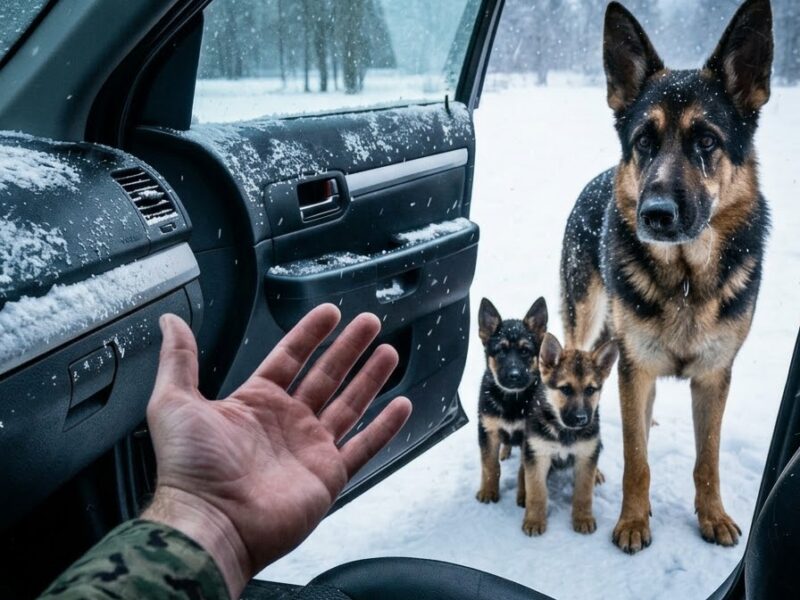
The blizzard was so violent I could barely see my patrol truck when I opened the door of an abandoned pickup and found a freezing mother dog shielding her puppies
The snowstorm had swallowed Montana Highway 2 long before twilight, turning the world into a blinding wall of white. Outside the windshield of my state patrol truck, the wind sounded like a continuous roar, shoving forty-mile-an-hour gusts against the heavy steel doors. I had been creeping along the shoulder at fifteen miles an hour for nearly three hours, my searchlight cutting through the swirling blizzard, hunting for any sign of stranded motorists who had been caught off guard by the sudden November arctic front.
In this part of Montana, when the temp plunges to twenty below zero and the wind chill drops into lethal territory, an engine failure isn’t an inconvenience—it’s a death sentence.
I was about to turn back toward the station in Shelby when my beam grazed something sitting sideways in a snowbank near Mile Marker 114. It was an old, rust-potted Ford pickup, tilted precariously toward the ditch. Snow had already drifted halfway up its tires, blanketing the bed in heavy white powder.
I pulled my patrol truck behind it, leaving my emergency lights flashing, and grabbed my heavy utility flashlight. Stepping out into the storm felt like stepping into an ocean of ice. The freezing air burned my lungs instantly, and the snow stung my eyes like shards of broken glass.
I dragged my boots through the knee-deep powder and approached the driver’s side window of the abandoned truck. It was completely caked in ice, opaque and silent. I tapped my flashlight against the glass.
“State Patrol! Hello? Is anyone in there?”
No answer. Only the howling wind.
I circled around to the passenger side, wiping the thick frost away with my heavy leather glove. When I shined the yellow beam into the cabin, my heart skipped a beat. Something had moved behind the fogged-up glass near the center console.
I grabbed the heavy door handle and pulled. The latch screamed as ice cracked, and the passenger door finally swung open, letting a wave of freezing air rush inside.
I froze on the running board.
Curled on the frozen floorboards was a large golden retriever. She was impossibly thin, her ribs visible beneath a matted, snow-dusted coat. Wrapped in the curve of her belly were four tiny puppies, no more than a few days old. The mother dog was trembling violently, her ears pinned flat against her head, her dark eyes wide with an agony of cold and terror. Ice had formed tiny crystals around her muzzle and along the tips of her ears.
The puppies were silent. The smallest one, a tiny pale bundle, wasn’t moving at all.
“Oh, sweetheart…” I whispered, my voice caught in my throat.
I didn’t hesitate. I unzipped my heavy insulated patrol coat, laid it across the frozen seat, and gently lifted the puppies one by one. Their tiny bodies felt like blocks of ice in my gloved hands. I wrapped them carefully in the warm lining of my jacket, cradling them against my chest, and carried them back to my patrol truck. I placed them on the passenger seat right in front of the heater vent, which was blasting hot air into the cab.
“Come on, girl,” I called out, turning back to the truck to get the mother. “Come get warm.”
But the golden retriever refused to step out into the storm.
Instead, she stood up on her shaky, trembling legs, turned toward the dark back seat of the extended cab, and began scratching frantically at a dirty, frozen moving blanket piled behind the driver’s seat. She let out a low, guttural whine—a desperate, terrifying sound.
“What’s wrong, girl? There’s nothing left in there. Come on.”
The dog turned her head, leaped off the floorboard, grabbed the sleeve of my heavy uniform jacket between her teeth, and pulled with all the strength left in her frail body. She was trying to drag a two-hundred-pound state trooper into the back of a frozen truck.
I climbed up onto the floorboard, my boots crunching on the frost, and shined my flashlight into the back seat.
“Is there something back here?”
The dog thrust her nose under the edge of the dirty blanket, whining incessantly.
I reached out and yanked the heavy canvas back. Sitting beneath it was a single, tiny red mitten.
My stomach plummeted into a cold abyss.
Then, beneath the howling of the wind outside, I heard it—a sound so faint it almost dissolved into the storm. A rhythmic, shallow, clicking gasp.
I threw the entire blanket aside.
Curled in a tight ball on the bare vinyl bench, her body stiff and pale as marble, was a little girl. She couldn’t have been more than five years old. She wore a thin denim jacket and light pants—completely inadequate for the arctic night. Her lips were a deep, bruised blue, and her long brown hair was matted with ice. The mother dog had clearly been lying over her for hours, giving her every drop of body heat she possessed, until the puppies began to freeze on the floor.
“Dispatch! Dispatch! Code 3 emergency at Mile Marker 114!” I yelled into my shoulder mic, grabbing the little girl in my arms. Her skin felt like frozen porcelain. “I have a pediatric hypothermia victim! Unresponsive! Requesting immediate EMS!”
“Unit 4, road conditions are impassable for standard EMS,” dispatch crackled back through the static. “Search and Rescue unit with a snowcat is en route, ETA twenty minutes.”
Twenty minutes was twenty minutes too long. She would be dead in ten.
I gathered the little girl against my chest, shielding her face from the biting wind, and scrambled through the snow back to my running truck. The golden retriever didn’t hesitate this time; she bounded out of the pickup, trailing right behind my boots, and leaped into the passenger side of my patrol vehicle, landing heavily beside her puppies.
I laid the little girl across the heated front seats, laying my fleece coat over her, and turned the truck’s heater to maximum. I grabbed emergency space blankets from my trunk, wrapping her stiff limbs, and began frantically rubbing her small arms and legs to force circulation back into her freezing tissue.
“Stay with me, little one. Come on, stay with me,” I pleaded, my own hands shaking as I checked her neck for a pulse. It was terribly slow—barely twenty beats a minute.
Beside her, the golden retriever pressed her large, warm head directly against the child’s chest, letting out a soft, weeping whine, frantically licking the little girl’s pale forehead.
Slowly, agonizingly, after five terrifying minutes, the girl’s chest gave a sharp, hitching gasp. Her eyelids fluttered open, dark and dazed under the cab’s interior light.
She looked up at me, then down at the dog.
“…Daisy,” she whispered, her voice barely a thread of dry air.
I sank back against the driver’s door, letting out a breath I felt like I had been holding for an hour. “Is that her name, sweetheart? Daisy?”
The girl gave a tiny, almost imperceptible nod. “Daisy… kept me warm.”
My throat locked up. “You’re safe now, honey. You’re in my truck. Daisy saved you.”
The little girl’s eyes filled with tears that froze against her eyelashes as she looked around the empty cab of my patrol vehicle.
“Where’s… where’s Mommy?” she whimpered softly.
I looked at the mother dog, then back at the small child. “Was your mommy in the truck with you?”
The girl began to cry—a quiet, heartbreaking sound. “Mommy went to find help… when the truck stopped starting. But Daisy wouldn’t let me go outside. Daisy pulled my coat and made me stay under the blanket.”
I stared at the golden retriever in complete shock. The dog had physically blocked a five-year-old child from wandering out into a fatal whiteout storm, keeping her hidden beneath a blanket with her own body heat, even while she gave birth to her puppies on the freezing floor.
“How long ago did Mommy leave, sweetheart?” I asked, my voice tight with a sudden, mounting panic.
The little girl swallowed weakly, her dark eyes filled with absolute terror. “A long time… She said she was going to walk to the big lights up the hill. But she didn’t come back. Daisy barked at the window… and then Mommy fell down the mountain.”
My blood ran colder than the wind outside.
“Dispatch, Unit 4,” I barked into my shoulder microphone, stepping slightly out of the cab so the girl wouldn’t hear the panic in my voice. “Change of situation at Mile Marker 114. We have an adult female missing in the storm. Mother of the victim. She attempted to walk for help on foot toward the Ridge Cut. I need a search grid established immediately!”
“Unit 4, storm conditions are worsening,” dispatch replied, static popping violently over the speaker. “Wind speeds are exceeding fifty knots near the ridge. Visibility is zero. We cannot launch air support, and ground crews are delayed by drifts on Highway 2.”
“I can’t wait for ground crews!” I snapped into the mic. “She’s been out in twenty-below weather for at least an hour! If she’s down in the cut, she’s already freezing to death!”
I looked back inside the warm cab. The snowcat medical rescue unit was finally cresting the hill behind me, its red and yellow warning strobes flashing through the blinding white powder. Two paramedics jumped out before the vehicle had even come to a full stop, dragging heavy medical kits through the drifts.
“We’ve got her,” the lead paramedic, a veteran named Sarah, said as she stepped up to my patrol door. “We’ll get the little girl and the pups stabilized in the snowcat’s heated compartment. What’s your play, Sam?”
“The mother is somewhere out on the ridge,” I said, pulling my heavy snow goggles down over my eyes and tightening the straps of my utility belt. “She tried to walk up toward the cell tower lights at the Ridge Cut. The girl said she fell.”
The Ridge Cut was an infamous section of Highway 2—a steep, forty-foot shale embankment that dropped down into a dense bed of pine trees and jagged boulders. In a whiteout, a person walking along the shoulder wouldn’t even realize they had reached the edge of the drop until the ground disappeared beneath their boots.
As I grabbed my heavy search rope and secondary high-lumen lantern from the back of my patrol truck, a loud, sharp bark echoed from the front seat.
Daisy had pushed her way past the paramedics, her front paws planted on the snow bank outside. She didn’t look at her puppies, who were now safe and nursing contentedly inside a warm fleece blanket in Sarah’s arms. She looked straight at me, then turned her head toward the roaring blackness beyond the highway guardrail.
“No, Daisy, stay,” I commanded, placing a hand on her chest. “You’re weak, girl. You’ve done enough.”
The golden retriever let out a fierce, stubborn bark, shoved her snout against my glove, and took three limping strides into the deep snow toward the edge of the embankment. She turned back to look at me, her dark eyes flashing through the storm with a clear, undeniable message: I know where she is.
“Sam, you can’t take that dog out there,” Sarah yelled over the roar of the wind, holding her hood against her face. “She’s exhausted! She nearly froze to death herself!”
“She’s the only one who knows the line she took,” I said, looking into Daisy’s eyes. The bond between this animal and her missing family was something beyond training, beyond instinct—it was pure, fierce devotion. “Come on, girl. Show me.”
Daisy didn’t hesitate. She plunged into the deep drifts, her tail cutting through the snow like a rudder, leading me straight toward the steel guardrail that ran along the highest point of the ridge.
The wind at the edge of the cut was deafening. It hit me like a solid wall, tearing at my heavy coat, threatening to throw me off balance. Visibility was down to less than two feet. If it weren’t for the bright yellow coat of the dog moving ahead of me, I would have been completely blind.
Daisy stopped at a break in the guardrail where a snowdrift had formed a smooth, deceptive ramp over the cliff edge. She dropped her nose to the freezing crust, snorted softly, and let out a long, mournful howl that was instantly swallowed by the storm.
I crept up beside her, dropping to my knees on the ice, and shined my heavy lantern beam down into the black abyss of the ravine.
The light cut through the thick veil of falling snow, revealing a jagged slope of loose shale and snow-covered pine branches forty feet below. Halfway down the embankment, wedged against the thick trunk of an old Douglas fir, was a dark shape.
It was a woman’s coat, half-buried under a fresh blanket of white powder.
“I’ve got a visual!” I yelled into my radio, my voice trembling from the cold. “Mile Marker 114, south side of the cut! I’m going down!”
“Sam, wait for backup!” dispatch crackled in my ear. “That slope is unstable!”
“She’s not moving, dispatch! I’m descending now!”
I secured my search rope to the heavy steel post of the guardrail, looped the thick nylon line twice around my harness, and backed over the edge into the dark void.
Daisy stayed at the top for only a second before she began scrambling down the icy slope right beside me, slipping and sliding through the loose shale, driven by a desperate, unstoppable force.
I slid twenty feet down the steep incline, snow filling my boots, the sharp branches of pine trees whipping against my face and goggles. When my feet finally hit the ledge near the Douglas fir, I unhooked my carabiner and dropped to my knees beside the motionless figure.
She was lying on her side, her body contorted at an unnatural angle against the tree trunk. Snow had already accumulated over her face and chest. Her hands were bare—her gloves had been lost during the fall—and her fingers were stiff and waxy white.
I brushed the thick snow off her face, pressing my gloved fingers gently against her cold neck, searching desperately for a pulse.
For three long, agonizing seconds, I felt nothing except the icy chill of her skin.
Then, deep beneath the frozen tissue, I felt a faint, erratic thump… thump…
“She’s alive!” I shouted into the wind, wrapping my arms around her shoulders to pull her away from the tree. “I’ve got a pulse! Get a basket down here now!”
Daisy dropped to her knees beside the woman’s head, pressing her warm face directly against the mother’s frozen cheek, whimpering and licking the ice from her closed eyelids.
The woman’s lips parted slightly, a tiny plume of white frost escaping her breath.
“…Lily?” she rasped, her voice barely a whisper against the storm. “…My baby…”
“Lily is safe,” I told her, holding her tight against my chest to share my body warmth. “She’s in the ambulance, warm and safe. Daisy saved her.”
Tears welled in the mother’s closed eyes, freezing instantly into tiny clear beads on her pale skin. She reached out with a stiff, trembling hand, her fingers blindly brushing against Daisy’s thick golden fur.
“Thank God…” she whimpered softly. “Thank God…”
As I heard the heavy engine of the search and rescue snowcat rumble to the edge of the cliff above us, lowering a metal rescue sled through the darkness, I looked down at the mother, the dog, and the deep snow around us.
I thought the miracle was over. I thought we had fought the storm and won.
I had no idea that the real secret—the dark truth that had brought this mother and child to a deserted highway in the middle of a deadly Montana blizzard—was still waiting for me in the glove compartment of that abandoned pickup truck.
It took three officers and a pulley system on the snowcat to drag the rescue sled carrying the mother up the slick shale embankment. By the time we reached the top of the ridge, her core temperature had dropped to eighty-four degrees. The paramedics immediately pulled her into the back of the heavy vehicle, hooking her up to heated IV fluids and oxygen alongside her daughter.
Inside the heated compartment of the snowcat, the scene was emotional enough to bring a tear to the eye of the toughest mountain trooper.
The little girl, Lily, had been wrapped in three layers of thermal blankets, her color slowly returning to a healthy, flushed pink. When the medics brought her mother, whose name was Sarah, onto the adjacent gurney, Lily reached her small hand across the aisle, clutching her mother’s fingers tightly. Daisy had curled her heavy body across both of their feet, her chin resting on the edge of the gurney, her dark eyes watching every breath the two humans took. Her four puppies were tucked safely into a heated isolette in the corner, sleeping soundly after their harrowing night.
“They’re going to make it,” Sarah, the lead medic, told me as she adjusted the IV drip. “Both of them have some severe frostbite on their extremities, but there’s no permanent tissue death. Another thirty minutes out there, though… and they’d both be gone.”
“Good job, Sam,” the snowcat driver said, clapping me on the shoulder. “We’re going to transport them directly to Logan Health in Kalispell. You coming with us?”
I looked back down the highway toward the abandoned Ford pickup. Its flashing yellow hazards were dying now, the truck’s battery finally giving out under the extreme cold. The vehicle sat like a dark, hollow tomb in the middle of the drifting snow.
“I’ll follow you down in my truck,” I said, wiping the melting ice from my brow. “I need to secure the vehicle first and clear it from the lane so the snowplows don’t slam into it.”
“Copy that. Drive safe, Trooper.”
The snowcat rumbled to life, its heavy rubber tracks chewing through the deep snow as it began its slow, steady trip toward the hospital.
I walked back through the howling wind to the abandoned Ford. The storm was finally beginning to lose its teeth, the heavy gale dropping into a steady, quiet snowfall, the temperature hovering at a bitter fifteen below.
I climbed into the driver’s side of the stalled truck to turn off the ignition and look for the vehicle registration. The cab smelled of stale coffee, old wool, and the unmistakable scent of wet dog and cold leather.
I flipped down the sun visor—nothing. I looked in the center console—only a few loose quarters and an empty wrapper.
Then I opened the glove compartment.
Inside was a faded leather folder. I pulled it out, shining my flashlight onto the documents inside, intending to find an insurance card or an owner’s manual so I could contact the family’s relatives.
Instead, a thick stack of papers bound by a red rubber band fell out onto my lap.
I picked up the top document. It was a formal court order stamped by the State of Washington Superior Court, issued only forty-eight hours prior.
At the top of the page, bold black letters read: EMERGENCY PROTECTION ORDER AND RESTRAINING MANDATE.
My eyes scanned down the page. The petitioner was Sarah Vance—the mother in the ambulance. The respondent was a man named Marcus Vance.
Attached to the court order were several high-resolution crime scene photographs. My skin crawled as I flipped through them. They showed a blood-spattered kitchen in a suburban home outside Seattle. Broken glass covered the floor. A heavy wooden door had been shattered off its hinges.
Beneath the photographs was a urgent police bulletin stamped in bright red ink: ARMED AND DANGEROUS / SUSPECT AT LARGE.
Marcus Vance is wanted for aggravated assault, domestic battery, and the armed abduction of a minor. Suspect is believed to be tracking the victims via a GPS device attached to their personal vehicle. Exercise extreme caution.
I sat frozen in the freezing cab of the truck, the flashlight beam trembling in my hand.
Sarah hadn’t been driving through a Montana blizzard because she was taking a holiday road trip. She was running for her life. She was fleeing across state lines, trying to escape a violent husband who was actively tracking her.
Suddenly, a realization hit me like a physical blow.
I looked down at the dash of the old Ford pickup. The hood latch on the truck was slightly popped.
I scrambled out of the cab, rushed to the front of the truck, and shoved the heavy steel hood up. I shined my flashlight onto the engine block.
The alternator belt hadn’t snapped. The fuel line hadn’t frozen.
The main ignition wires running from the battery to the distributor cap had been cleanly, deliberately cut with a pair of heavy wire cutters.
The truck hadn’t stalled because of the storm.
Someone had followed them to this remote stretch of Highway 2, waited for them to stop at the scenic pullout during the initial burst of the blizzard, crept up to the engine while Sarah was inside checking her map, cut the wires, and disabled the vehicle—leaving a mother, a five-year-old child, and a pregnant dog to freeze to death in the middle of nowhere.
My heart hammered wildly against my ribs as I looked back over my shoulder into the dark, snowy woods surrounding the highway.
If the person who cut those wires was tracking them… he wasn’t miles away in Washington.
He was out here in the storm.
My hand went instantly to the heavy grip of my sidearm. I unlatched the safety strap on my holster, my eyes darting frantically across the dark tree line bordering Highway 2.
The storm had quieted down to a soft, eerie murmur, large white snowflakes falling silently through the beam of my patrol truck’s headlights. Everything was dead quiet.
I stepped slowly around to the passenger side of the disabled truck, dropping to one knee in the deep powder. I shined my lantern flat across the snow, looking for any disturbances in the fresh drifts.
Near the rear bumper, half-filled by the freshly fallen snow, was a distinct set of heavy boot tracks.
They didn’t belong to me, and they didn’t belong to Sarah. They were massive, deep treads—size twelve winter work boots—leading away from the disabled engine, around the back of the pickup, and straight toward the dark treeline on the north side of the road.
“Dispatch, Unit 4!” I hissed into my shoulder radio, keeping my voice low as I crouched behind the truck’s bed. “I have a 10-00 emergency at Mile Marker 114! The vehicle failure was caused by sabotage! Repeat, ignition wires were cut! Suspect may still be on scene! I need immediate tactical backup!”
Static crackled back over the receiver, thin and broken. “Unit 4… signal… degrading… repeat… backup is… twenty minutes out…”
The storm had knocked out the local repeater tower on the ridge. I was entirely on my own.
I looked down at the boot prints. They were fresh—no more than thirty minutes old. The snow was filling them slowly, but the edges were still sharp.
The suspect had cut the wires, disabled the truck, and then stepped back into the tree line to watch from the shadows, waiting for the freezing weather to do his dirty work for him. But when my patrol truck arrived with its flashing lights, he must have realized his plan was falling apart. He had retreated into the woods.
And then I saw something that made my blood run cold.
In the snow beside the heavy boot prints, near the edge of the treeline, was a second set of smaller, lighter tracks leading out of the woods, heading straight toward the highway… toward where the snowcat had just departed.
He wasn’t hiding in the woods anymore.
When the snowcat arrived and loaded Sarah and Lily inside, he had slipped out of the trees, observed the rescue, and was now trailing the slow-moving emergency vehicle down the mountain toward the hospital.
I sprinted back to my patrol truck, slammed the door, and jammed the gear shift into drive. My tires spun violently on the icy asphalt before grabbing traction, throwing up clouds of snow as I roared down Highway 2 after the snowcat.
The snowcat was heavy and slow, capped at a maximum speed of twenty-five miles an hour on the icy mountain roads. It had a ten-minute head start, but on the winding, treacherous curves of the Ridge Cut, twenty-five miles an hour was a long way ahead.
I pushed my patrol truck to forty, my high beams cutting through the falling white sheets. The road was a sheer sheet of glare ice. Every curve sent the tail of my heavy truck sliding toward the sharp drop-off, requiring every ounce of my winter driving experience to keep the vehicle from spinning into the ravine.
Three miles down the pass, as the road straightened out near the old logging bridge, I saw red taillights flickering through the trees ahead.
It was the snowcat, its hazard lights blinking rhythmically as it navigated the narrow wooden bridge spanning the roaring, icy waters of the Flathead River fifty feet below.
Behind the snowcat, trailing less than fifty yards behind its heavy rubber tracks, was a dark, unlit Chevrolet SUV. Its headlights were completely off, stealthily following the rescue vehicle through the dark.
“He’s right behind them,” I growled through gritted teeth, stomping on the accelerator.
The patrol truck surged forward, its siren screaming to life as I flipped the red and blue emergency strobes on. The piercing sound shattered the silence of the winter night, echoing off the high granite walls of the canyon.
The dark SUV immediately hit its brakes, its tires locking up on the icy bridge. The vehicle fish-tailed wildly across the wooden planks, smashing against the rusted steel guardrail of the bridge with a loud, metallic crunch of crumpling fiberglass and twisting steel.
The SUV ground to a halt, blocking the narrow bridge entirely.
I slammed on my brakes, sliding my patrol truck sideways across the icy road, stopping twenty feet from the disabled SUV, blocking its escape route.
The driver’s door of the Chevrolet flew open.
A large man stepped out onto the slick wooden planks of the bridge. He was towering—at least six-foot-four—wearing a heavy camouflage hunting coat and dark winter boots. In his right hand, reflecting the flashing red light of my patrol strobes, was a heavy steel hunting knife.
His face was contorted in a terrifying, animalistic fury.
“Get out of the way, cop!” Marcus Vance screamed, his voice carrying over the sound of the rushing river below. “That’s my wife and daughter in that rig! They belong to me!”
I stepped out from behind the door of my patrol truck, my service weapon drawn and steady, aimed directly at the center of his chest. The cold wind whipped my coat around my legs, but my hands were dead still.
“Drop the weapon, Marcus!” I ordered, my voice firm and uncompromising. “Drop the knife and get on the ground! Now!”
“You don’t understand!” he yelled, taking a wild, unhinged step toward me, his boots crunching on the snow-covered planks. “She took my child! She had no right to run! I tracked them all the way from Seattle! I waited for the storm so nobody would see!”
“I know what you did, Marcus,” I said, taking a slow step sideways to flank him, keeping my sights aligned with his heart. “I saw the court order. I saw what you did to your home. And I saw the wires you cut in that truck. You left your five-year-old daughter to freeze to death in a blizzard!”
“I was going to get the girl after Sarah froze!” he shrieked, his eyes wild and bloodshot, completely consumed by madness. “I was coming back for Lily! But that damn dog… that dog bit me when I opened the door! She wouldn’t let me touch the handle!”
A cold satisfaction settled deep in my chest. Daisy hadn’t just kept Lily warm—she had actively defended the child against a violent monster in the middle of a whiteout, biting his hand and forcing him to retreat back into the woods before he could tear the child away from her hiding place.
“It’s over, Marcus,” I said coldly. “Put the knife down.”
Instead of dropping the weapon, Marcus let out a terrifying roar of rage and lunged forward across the slick ice, raising the heavy blade to strike.
BANG.
A single shot echoed off the granite canyon walls, sharp and loud as a thunderclap.
The bullet struck the ice right at Marcus’s boots, shattering the frozen crust into a cloud of white dust and sending sharp fragments of ice flying into his face. He lost his footing on the slick wood, his legs slipping out from under him, and he crashed hard onto the timber deck of the bridge, the heavy knife flying from his grip and clattering down through the wooden slats into the freezing river below.
Before he could push himself back up, I closed the distance, planting my heavy boot firmly into the center of his back, shoving his face into the freezing snow, and pulling his arms tightly behind him.
The cold steel of my handcuffs clicked loudly over his wrists.
“Marcus Vance, you are under arrest,” I growled in his ear, pulling the cuffs tight. “For attempted murder, child endangerment, and felony assault.”
Within ten minutes, three state patrol cruisers arrived, their sirens wailing as they cleared the bridge. Two officers took custody of Marcus, hauling him into the back of a transport vehicle while I leaned against the hood of my truck, finally letting out a long, exhausted sigh into the freezing night air.
The storm was finally ending. The dark clouds above were breaking apart, revealing a clear, star-filled Montana sky, the northern lights casting a brilliant, dancing wave of green and violet light across the snow-capped peaks of the Continental Divide.
Two weeks later, the sun was shining brightly over the Shelby State Patrol Station.
The air was crisp and clear, the temperature a comfortable thirty degrees. I was sitting at my desk finishing the incident reports when the front glass doors of the station opened with a cheerful chime.
Walking into the lobby was Sarah. She looked healthy, her color fully restored, holding the hand of little Lily, who was wearing a bright red winter coat and a warm woolen hat.
And walking right beside them, her tail wagging wildly, her golden coat shining in the afternoon sun, was Daisy.
Behind them, paramedic Sarah was carrying a soft fleece basket filled with four healthy, plump golden retriever puppies, their tiny eyes now fully open, squirming and Yipping happily.
“Trooper Sam!” Lily cried out, letting go of her mother’s hand and running across the lobby to throw her small arms around my waist.
I dropped to one knee, wrapping my arms around the little girl, laughing softly as Daisy trotted over and shoved her warm, wet nose straight into my cheek, giving me a huge, wet lick.
“Look at you, sweetheart,” I said, brushing a strand of hair from Lily’s forehead. “You look good as new.”
“We wanted to see you before we left for my sister’s house in Bozeman,” Sarah said, stepping forward, her eyes filled with deep, overwhelming gratitude. She reached out and took my hand, squeezing it tightly. “The prosecutor said Marcus is going away for a very long time. We’re safe now, Sam. Truly safe.”
“You have Daisy to thank for that,” I said, looking down at the golden retriever, who was sitting proudly at my side, her tail thumping against the tile floor. “She’s the real trooper.”
“We’re keeping all four puppies,” Lily said proudly, holding up four small fingers. “Mommy said Daisy needs her family close.”
We talked for nearly an hour, sharing warm coffee in the station lobby while the officers played with the puppies on the rug. When it was finally time for them to leave, Lily gave me one last, tight hug at the door.
“You’re my hero, Trooper Sam,” she whispered against my ear.
I looked down at Daisy, who gave one short, happy bark, her dark eyes filled with intelligence and warmth.
“No, sweetheart,” I smiled, patting the golden dog’s head. “She is.”
I watched them load into a new, safe vehicle, driving away down Highway 2 under a clear, blue Montana sky.
As I turned back toward my patrol truck to start my afternoon shift, I noticed something tucked neatly beneath my driver’s side windshield wiper.
I pulled it out. It was a polaroid photograph that Sarah had taken in the hospital room two days after the rescue.
It showed Lily sitting up in her hospital bed, smiling brightly, with her arms wrapped around Daisy’s neck. Sitting beside them on the blanket were the four tiny puppies, safe and warm.
I flipped the polaroid over. On the back, written in neat cursive, were a few simple words:
Thank you for opening the door when nobody else came. You saved our lives.
I stood in the quiet parking lot for a long moment, holding the photograph gently against my chest, watching the sunlight bounce off the snow-covered peaks in the distance.
I had been a state trooper for fifteen years. I had seen the worst of human nature, the darkest nights, and the coldest storms. But as I placed that photograph on the dashboard of my truck, I knew I would never look at a winter night the same way again.
Because sometimes, in the darkest, coldest corners of the world, the lives we reach out to save end up saving the very best parts of ourselves.
The end.









