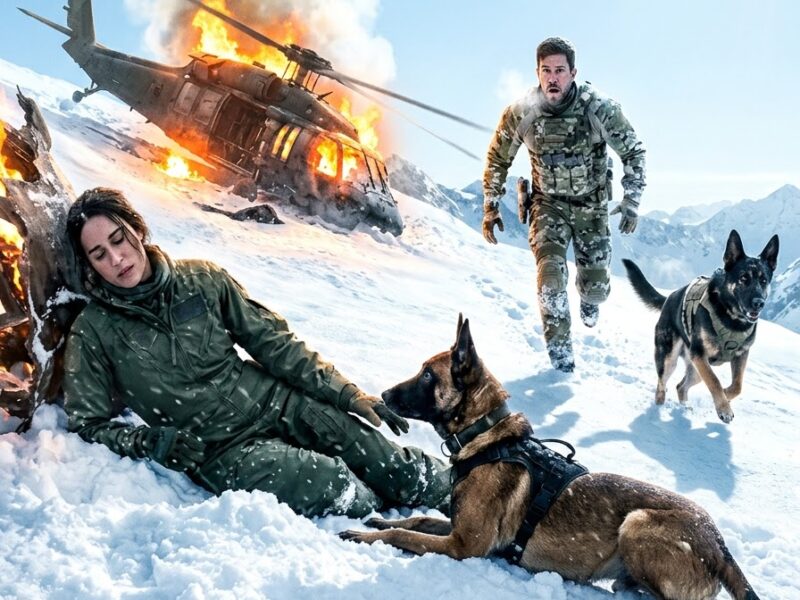
The blizzard had swallowed my helicopter whole, and when my K9 and I were finally found frozen beside the wreckage
The white wall of blowing ice didn’t just blind us; it erased the world. Outside the shattered aluminum skin of the downed Bell 412, the wind shrieked like a dying engine. Snow was piling fast through the crushed cockpit frame, threatening to turn the interior into an icy tomb. My hands were stiff, the skin turned a marble-gray beneath my leather flight gloves, and every breath burned like dry lye in my lungs.
Beside me, the black-and-tan German Shepherd brought by the stranger leaned his massive chest against Scout. The warmth between the two dogs was a thin, fragile wall against the sub-zero mountain air.
The man in the torn Navy parka—a former SEAL named Lieutenant Commander Jackson Vance, as the worn name tape on his chest indicated—knelt in the snow, holding the satellite phone found beneath the wreckage. His face was weathered, hardened by years of exposure, but his eyes were sharp, calculating the tactical realities of our situation in a heartbeat.
“They’re fifty yards out,” Vance said, his voice dropping into a raspy, disciplined whisper. He didn’t panic. He snapped the satellite phone closed and shoved it into the dry inner pocket of his parka. “Moving in a wedge formation. Fireteam size. They aren’t local search and rescue, Miller. Search crews don’t advance with thermal scopes raised.”
“My CO…” I choked out, my voice ragged from smoke inhalation and cold. “Captain Thomas… he signed my flight clearance personally… he said it was a routine medical transport run out of Malmstrom…”
“Then Thomas wanted you buried in this storm,” Vance replied coldly. He reached down, grabbed the shoulder harness of my survival vest, and dragged me back into the dark recess of the crushed fuselage. “If they find two bodies in this wreck, they take the satellite phone, burn the wreckage, and log it as an aviation mishap due to severe weather. Nobody asks questions.”
Scout let out a low, vibrating growl from his throat. I placed my gloved hand over his muzzle, feeling his warm breath against my palm. “Easy, boy. Silent.”
Outside, the crunch of heavy tactical boots against frozen crust broke through the howl of the gale. Two beams of high-intensity green light from night-vision optics swept across the shredded aluminum tail boom of the helicopter.
“Target is down,” a voice called out over the wind. It was metallic, filtered through a tactical throat microphone. “Impact crushed the nose. Fuel lines are severed. Check the cockpit for the flight recorder and the pilot’s gear.”
“What about the dog?” another voice asked, closer now—no more than fifteen feet from where Vance and I were crouched behind the overturned engine casing.
“Eliminate any biological assets,” the first voice replied without a shred of hesitation. “Captain Thomas was clear. Zero survivors. No K9 tracks leading off the mountain.”
I felt a surge of adrenaline cut through the deadening numbness in my limbs. Scout wasn’t just a military working dog; he was my partner, my wingman, the only reason I was still breathing after twelve years of low-level transport runs over hostile territory.
Vance leaned close to my ear. “I have a suppressed Sig Sauer P226 with two magazines. You can barely hold your arms up. Can you shoot if I draw their fire?”
“I can hold a trigger,” I whispered back, pulling my frozen right hand out of my glove and gripping the cold steel of my standard-issue M9 pistol from my chest holster. My fingers were so stiff they felt like wooden pegs, but the muscle memory was locked deep in my bones.
“On my mark,” Vance said. “We don’t fight them here. We hit the lead man, break through the left flank, and use the pine thicket down the slope for cover.”
Vance didn’t wait for a response. He leaned out from behind the crumpled tail rotor, his suppressed Sig coughing twice in rapid succession. Pfft. Pfft.
The lead operative in the snow snapped backward, his tactical lantern flying into a drift as he collapsed without a sound.
“CONTACT LEFT!” the second man screamed, dropping into a kneeling position and opening fire with a short-barreled carbine. High-velocity 5.56mm rounds tore through the thin aluminum hull of the helicopter, showering us with sparks, insulation, and jagged metal splinters.
“GO!” Vance roared.
His black-and-tan K9, a veteran war dog named Dutch, lunged from the shadow of the fuselage like a thunderbolt, hitting the second shooter square in the chest before the man could adjust his line of fire. The operative went down hard into the deep snow, his weapon discharging uselessly into the sky.
Scout followed instantly, clearing the jagged wreckage behind Dutch, his jaws locking onto the tactical vest of a third operative who was attempting to flank us from the right.
I pushed myself out of the crushed cockpit, dragging my half-frozen left leg through the snow. Vance was right beside me, providing suppressing fire into the blinding white curtain of the storm. The flash of muzzle fire lit up the falling snow in brilliant, violent bursts of red and orange.
“Down the ridge!” Vance ordered, grabbing my shoulder and shoving me toward the dense treeline of lodgepole pines fifty yards down the slope. “Move!”
We stumbled down the steep, icy incline, tumbling through snowdrifts that swallowed us to our waists. Behind us, the surviving members of the hit squad began throwing tactical flares into the wreckage, illuminating the mountain peak in an eerie, blood-red glare.
“They’re going to burn the crash site!” I shouted over the wind, holding Scout’s collar as he bounded through the powder beside me.
“Let them burn it!” Vance called back, his eyes fixed on the dark shadow of the forest ahead. “It buys us time. They’ll think we were consumed in the fire until they count the brass!”
We hit the tree line just as a massive fireball erupted on the ridge above. The helicopter’s remaining auxiliary fuel tank had detonated, sending a shockwave of heat and roaring flame towering into the midnight sky, casting long, writhing shadows across the frozen wilderness of Montana.
The forest offered relief from the relentless wind, but the temperature inside the dense pine canopy was dropping toward twenty below zero. Every branch was heavy with accumulated ice, snapping like gunfire whenever the wind gusted overhead.
We kept moving for forty minutes, pushing deeper into the uncharted drainage basin of Blackwood Canyon. My left boot was filled with slush, my toes completely devoid of sensation, and every step felt like driving a rusted spike up my shinbone. Vance set a brutal pace, moving with the rhythmic, mechanical efficiency of a man who had spent a lifetime escaping capture in hostile territory.
Dutch and Scout moved as a rearguard, trailing fifty feet behind us, their heads turning constantly toward our backtrail, ears pinned back against the freezing wind.
“Hold up,” Vance muttered, raising his hand as we reached a natural granite overhang jutting out from the side of a steep ravine.
He cleared a patch of frozen dirt beneath the rock ledge with his boot, then pulled me down into the sheltered alcove. I collapsed against the cold stone wall, my chest heaving, my breath blooming in thick, gray clouds in the freezing air.
Scout immediately curled over my bare boots, pressing his heavy, fur-covered torso directly across my feet to transfer his body heat.
“Drink this,” Vance commanded, pulling a small silver flask from his inner jacket pocket and pressing it to my lips. It wasn’t alcohol; it was warm, heavily salted broth that tasted metallic and rich.
The hot liquid hit my stomach like a match flame, sending a surge of sensation back into my core.
“Who are you, Vance?” I asked, leaning my head back against the granite wall. “You aren’t active duty Navy anymore. What are you doing out on this ridge in the middle of a blizzard?”
Vance leaned against the entrance of the overhang, his Sig Sauer held low, his eyes scanning the pitch-black woods. “I was attached to SEAL Team 2 out of Little Creek. Retired four years ago after an operation in Eastern Europe went dark. I live in a cabin three miles south of here.”
“How did you find us?”
“I heard your engine failing,” Vance said softly. “A Bell 412 has a distinct dual-turbine whine when the main gearbox starts stripping gears. I saw your rotor lights drop over the ridge, grabbed Dutch, and started moving. I thought I was recovering a downed forest service crew.”
“And instead, you stepped into a military execution,” I said bitterly.
“I’ve been tracking Captain Thomas for eighteen months, Miller,” Vance dropped the bombshell with a quiet, terrifying calm.
I stared at him, my mind spinning through the cold haze. “What?”
Vance pulled the recovered satellite phone from his parka, illuminated the screen under his gloved thumb, and held it out so I could see the underlying menu codes.
“Thomas isn’t just a commanding officer at Malmstrom Air Force Base,” Vance explained. “He’s the primary logistics coordinator for an off-grid defense contractor called Apex Global. They use military transport flights to move decommissioned hardware, classified tracking tech, and specialized assets out of government stockpiles before the inventory audits hit Washington.”
“And my flight…”
“Your flight wasn’t a medical run,” Vance said, his voice flat. “You were carrying a sealed avionics crate in the rear cargo bay, weren’t you?”
The memory flashed through my mind—the two armed security guards who had loaded the heavy, steel-banded container into the back of my chopper at 0200 hours, locking it to the deck tie-downs, telling me the contents were classified medical diagnostics destined for a remote facility in Canada.
“Yes,” I breathed. “A steel crate. They told me not to open it under any circumstances.”
“That crate didn’t contain medical gear, Miller,” Vance said, his eyes narrowing as he looked down at Scout. “It contained the prototype hardware for the Navy’s autonomous K9 tracking system—a neural interface program that Thomas’s group sold to a foreign buyer for twenty million dollars. You were the courier. And the crash was designed to make the hardware vanish from the books forever.”
Before I could digest the horror of his words, Scout stood up on my feet, his upper lip pulling back over his teeth, a low, subterranean growl rattling through his chest.
Dutch joined him at the edge of the overhang, his shoulder muscles tense, his head turned toward the upper ridge we had descended thirty minutes prior.
Through the trees, the faint, rhythmically blinking glow of red infrared tracking lights cut through the falling snow. They weren’t following our footprints.
They were using a handler.
A high-pitched, metallic whistle echoed through the forest, followed by the deep, terrifying baying of a tracking hound—a specialized Belgian Malinois trained to hunt human scent through snow and fire.
“They brought a blood hound,” Vance muttered, his jaw clenching. “They know we survived the crash.”
“We can’t outrun a K9 team in this deep powder,” I said, struggling to push myself up against the rock wall. “Not with my leg.”
Vance looked at me, then down at Scout, then back toward the dark forest ahead. “We don’t need to outrun them, Miller. We need to lead them into the old silver shafts.”
“What silver shafts?”
“Two hundred yards down this ravine lies the entrance to the Ironhead Mine,” Vance said, his voice filled with a dark, dangerous determination. “It’s been abandoned since 1954. Four miles of unmapped tunnels running directly under the ridge. If they want to hunt us in the cold, we’ll give them a dark place to die.”
The entrance to the Ironhead Mine looked like the open mouth of a leviathan buried beneath the mountain. Ancient timber framing, black with age and heavy with hanging icicles, supported a narrow portal cut directly into the vertical granite cliff face.
The air blowing out of the mine shaft was strangely warm compared to the sub-zero blizzard outside—a damp, heavy draft that smelled of wet slate, copper, and rotten wood.
We slipped through the decayed wooden portal just as the baying of the contractor’s tracking dog reached the lip of the ravine above us.
Vance immediately pulled a heavy iron beam across the entrance, jamming it into the rock frame to secure the rotten timber door. He pulled a small tactical flashlight from his vest, keeping the beam hooded with his hand to produce only a narrow, amber sliver of light against the wet rock floor.
“Keep close,” Vance instructed, his voice echoing softly into the blackness ahead. “The main shaft slopes down at a fifteen-degree angle for half a mile before it hits the old central ventilation hub. Watch your footing. The floor is full of abandoned rail spikes and open ore chutes.”
Scout took the lead, his nose low, his tail stiff. Dutch stayed on his flank, the two working dogs moving with a quiet, instinctual synchronicity that only elite working breeds possessed.
The silence inside the mountain was absolute, suffocating, broken only by the steady drip-drip-drip of water condensing on the high stone ceiling and the heavy sound of our own ragged breathing.
As we pushed deeper into the dark, the air grew thicker, heavy with the trapped heat of the earth. My frozen fingers began to throb with an excruciating, burning pain as the blood forced its way back into my capillary vessels—the agonizing onset of deep frostbite thawing out.
“Here,” Vance stopped beside a massive wooden winch house built into a wide cavern chamber three hundred yards inside the mountain.
In the center of the chamber sat a rusted iron ore car, still sitting on narrow steel tracks that vanished into the darkness ahead. Stacked against the stone wall were dozens of ancient wooden crates marked with faded red lettering: DYNAMITE — DANGER — DOW CHEMICAL 1948.
“Is that stuff still live?” I whispered, staring at the sweating, crystalized wax paper poking out from the rotted wooden crates.
“Sweating dynamite is unstable as nitroglycerin,” Vance said, his voice deadly serious. “A sharp shock, a raised temperature, or a stray round will detonate this entire chamber and bring four hundred feet of mountain down on top of it.”
“Then we shouldn’t be standing next to it,” I said, taking a cautious step back.
“No,” Vance countered, a grim smile touching his weathered lips. “This is our bottleneck. They have night vision, superior numbers, and automatic carbines. In a straight gunfight inside these narrow tunnels, we lose. But if we control this chamber, we control the only way out of this mountain.”
From the entrance shaft behind us came the heavy, splintering crash of iron meeting wood.
The contractors were breaking through the timber portal.
“Spread out!” a voice echoed down the tunnel, distorted by the stone walls. “Check the side shafts! They’re trapped in the grid!”
Vance turned to me, gripping my shoulder. “Take Scout and push down the lower rail line to the secondary ventilation exit—it comes out near my cabin on the south ridge. Take the satellite phone and transmit the GPS coordinates of Thomas’s offshore account to the federal prosecutor’s office in Helena.”
“I’m not leaving you here, Vance,” I said, setting my jaw.
“You aren’t leaving me, Miller,” Vance said, pulling a roll of tactical detonation cord and a small electronic timer from his pack. “You’re securing the evidence. If Thomas gets word that we survived the mine collapse, he’ll scrub the servers and vanish before the marshals can touch him. You have to send that file.”
Scout let out a low whine, stepping between Vance and me, his dark eyes shifting between us as if he understood every word of the tactical trade-off being made.
“Go!” Vance ordered, turning back toward the dark entrance tunnel with his suppressed Sig Sauer raised. “Dutch, with me!”
I looked at Vance, felt the cold weight of the satellite phone in my pocket, and nodded once. “Don’t get buried, Commander.”
“I’m too stubborn to die in a hole, Sergeant,” Vance grunted. “Now move!”
I turned and began limping as fast as my battered body would allow down the narrow, downward-sloping rail tunnel, with Scout trailing right at my heels.
Behind us, inside the dynamite chamber, the dark tunnel erupted into a deafening roar of automatic gunfire, the blinding flashes of muzzle fire illuminating the cavern walls in violent, rhythmic surges of light.
The sound of the firefight behind us echoed down the narrow stone gallery like thunder trapped inside a iron drum. High-caliber rounds screamed off the granite walls, showering the darkness with ricochets and flying stone splinters.
I kept moving, leaning heavily against the damp rock wall, my leg dragging through the black water pooling between the rusted iron rail ties. Scout moved beside me, his shoulder pressed against my hip, providing physical support every time my knee buckled from exhaustion.
We reached a massive vertical junction where three separate mining shafts converged into a central ventilation hub. Above us, a wide, circular iron ladder climbed up into a dark, vertical air shaft that led toward the surface.
I pulled the satellite phone from my pocket, opened the antenna, and waited for the signal bar to flicker to life under the open air shaft.
SIGNAL DETECTED — CONNECTING TO SECURE SERVER.
My hands trembled violently as I punched in the emergency routing code for the Federal District Attorney’s office in Helena, attaching the encrypted data file extracted from Captain Thomas’s satellite ledger.
The screen blinked yellow: TRANSMITTING FILE… 45%… 60%…
“Come on… come on…” I muttered under my breath.
Suddenly, a heavy, brutal blast shook the entire mountain structure.
The explosion was so powerful that the air pressure inside the tunnel dropped instantly, popping my eardrums with a agonizing spike of pain. A wave of heat, dust, and pulverized granite rolled down the rail shaft behind us, knocking me off my feet and sending the satellite phone flying into the shallow water on the floor.
“Vance!” I screamed into the dark dust cloud.
The mountain groaned overhead. Thousands of tons of rock, ancient timber, and earth collapsed in a terrifying, continuous roar that lasted for fifteen endless seconds. The tunnel behind us was completely sealed, buried under a solid wall of fallen granite.
Silence descended over the mine—a thick, suffocating stillness broken only by the sound of falling dust and my own ragged coughing.
“Vance!” I yelled again, crawling through the wet gravel on my hands and knees, searching frantically for the satellite phone.
My fingers brushed the plastic casing beneath a pile of fallen shale. The screen was cracked, but the green LED light was still glowing:
TRANSMISSION COMPLETE — DATA RECEIVED BY FEDERAL AUTHORITY.
I let out a ragged sigh of relief, collapsing back against the rock wall. The evidence was safe. Captain Thomas’s career, his network, and his criminal empire were over.
Then I heard a sound from the dust haze ahead.
It wasn’t a rock falling. It was the distinct, metallic click of a rifle bolt being pulled back.
Out of the gray, floating dust cloud stepped a figure wrapped in a torn tactical vest. His face was covered in soot, his left arm hanging uselessly at his side, his eyes wild with a manic, cornered fury.
It was Captain Thomas.
He had entered the mine behind his contractor hit squad, surviving the dynamite collapse by taking shelter in a shallow equipment recess near the entrance. In his right hand, he held a short-barreled Colt carbine, pointed straight at my chest.
“You were always a stubborn bastard, Miller,” Thomas rasped, his voice thick with pulverized granite dust and blood. “You should have died in the crash. It would have been cleaner for everyone.”
“It’s over, Thomas,” I said, holding his glare through the dark dust haze. “The file was transmitted three seconds ago. The federal marshals have your accounts, your clearance codes, and your buyer lists. You’re done.”
Thomas’s face contorted into a terrifying mask of rage. “Then I’m taking you to hell with me!”
He raised the carbine, his finger tightening on the trigger.
He never got the chance to shoot.
Out of the dark shadow of the upper ventilation shaft overhead, a massive black-and-tan shape descended like a falling stone.
Scout didn’t wait for a command. He didn’t care about the rifle. He launched his entire body off the elevated rail platform, striking Captain Thomas squarely in the throat at thirty miles an hour.
The impact was devastating. Thomas was thrown backward onto the wet iron tracks, his carbine flying into the dark water, as Scout’s massive jaws locked onto his tactical vest collar, pinning the officer to the stone floor with absolute, crushing force.
“GET HIM OFF ME!” Thomas shrieked, beating his hands wildly against the dog’s heavy neck.
Scout didn’t bite to kill. He held the man down with the cold, immovable restraint of a military war dog, his throat emitting a sound that shook the very dust from the ceiling.
I dragged myself over, picked up the fallen carbine, cleared the chamber, and tossed the weapon into the deep ventilation pit behind us.
“Stay down, Thomas,” I said coldly, looking down at my former commander. “Or I tell him to let go.”
Twenty minutes later, the faint sound of iron tools scraping against stone echoed from the far side of the dynamite cave-in.
A heavy granite slab shifted, falling into the rubble pile with a dull thud, and through the opening stepped Lieutenant Commander Vance, his face covered in gray rock dust, his parka torn to shreds, but his eyes bright and clear.
Beside him stood Dutch, his snout white with stone powder, his tail wagging as he spotted Scout standing guard over Captain Thomas.
“You take forever to clear a tunnel, Commander,” I called out, offering a weak smile from my seat on the ore car.
Vance wiped a streak of blood from his forehead and chuckled—a low, dry sound that echoed through the stone chamber. “The old timbers were stubborn. But Dutch found a soft drainage pocket through the rubble.”
He walked over, looked down at Captain Thomas pinned beneath Scout’s paws, and nodded with grim satisfaction. “Federal marshals and two Blackhawks from the Montana National Guard just landed on the south ridge. They picked up your satellite transmission.”
“Then let’s get out of this hole,” I said.
Vance helped me push myself up, supporting my weight on his shoulder, while Scout released his grip on Thomas’s collar, allowing the disgraced captain to be dragged up toward the surface shaft in handcuffs.
We climbed up the long vertical iron ladder of the ventilation shaft, emerging out into the blinding, brilliant white daylight of the Montana morning.
The blizzard had completely passed. The sky over the Absaroka Range was a deep, crystalline blue, the morning sun reflecting off millions of frozen pine needles like shattered diamonds. The air was cold, crisp, and pure—the cleanest air I had ever breathed in my life.
Two massive olive-drab Sikorsky UH-60 Blackhawk helicopters were idling on a clear snowfield two hundred yards down the ridge, their rotor blades throwing up bright clouds of sparkling snow dust into the sunlight. Federal agents in heavy winter gear were already securing the perimeter, loading Captain Thomas and the surviving contractors into transport vans.
A team of military flight medics rushed up the slope toward us, unfolding a field gurney and carrying thermal blankets and IV lines.
“Sir, lay down!” a young Air Force medic urged, grabbing my arm. “You have second-degree frostbite on both feet and severe hypothermia!”
“I can walk,” I said, pushing the gurney aside gently.
I walked down the snowfield under my own power, my boots crunching rhythmically into the fresh powder, with Scout stepping right beside my left leg, his tail held high, his nose catching the clean mountain wind.
Vance walked beside us, his hand resting comfortably on Dutch’s head.
“What are you going to do now, Miller?” Vance asked as we reached the open side door of the lead Blackhawk. “Your flying days with the Air Force are probably over after this medical review.”
I looked down at Scout, feeling his warm, powerful chest pressing against my knee, then looked out over the endless, majestic expanse of the Montana wilderness stretching out toward the horizon.
“I’m done flying military hardware, Commander,” I said, a deep sense of peace washing over me for the first time in twelve years. “I’ve got fifty acres of timberland down in the Paradise Valley. I think I’m going to build a ranch. A place for retired K9 handlers and working dogs who need a home.”
Vance smiled, reaching out his gloved hand. “Sounds like a noble mission, Sergeant. Mind if Dutch and I stop by to help build the fence?”
“The door is always open, Commander,” I said, shaking his hand with a firm, solid grip.
I climbed into the warm, heated cabin of the Blackhawk helicopter. Scout leaped up onto the deck beside me, turning around twice before settling his heavy head comfortably across my lap.
The turbines roared to life, the rotor blades cutting through the clear mountain air as the helicopter lifted off the snow, turning south toward the valley below.
I rested my hand on Scout’s warm head, feeling his steady, rhythmic breathing beneath my palm as the sun rose higher over the mountains.
We had survived the fire, the storm, and the dark secrets buried beneath the ice. And as the helicopter flew into the golden light of the new day, I knew we were finally going home.
The end.









