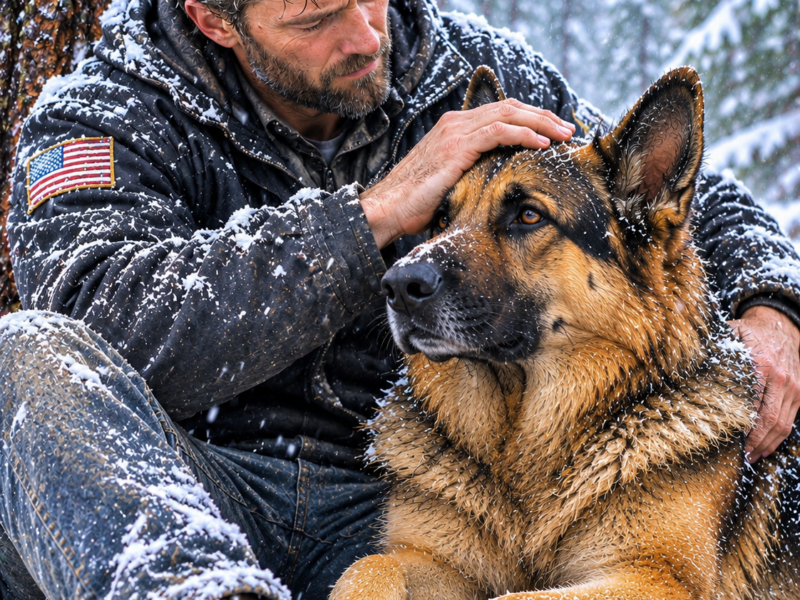
“The blizzard had buried my truck, my phone was dead, and I was lying on the frozen floor of my remote Montana cabin when a German Shepherd scratched at my door1
The man outside struck the door three more times.
“Jack, you have thirty seconds before we come in.”
I stood beside the fireplace with Daniel’s dog tag clenched in my fist, listening to the wind shove snow against the cabin windows.
The German Shepherd had positioned himself between me and the entrance. His lips curled back from his teeth, but he made no sound.
That bothered me more than barking would have.
A frightened dog made noise.
A trained dog waited.
I looked at the harness strapped across his chest. The faded insignia was nearly invisible beneath the mud, but I recognized it from my years in the Navy SEAL teams. It belonged to a military working-dog program that had supposedly been shut down after an investigation twelve years earlier.
Daniel Cross had been part of that investigation.
At least, I had always suspected he was.
“Who are you?” I called toward the door.
“Federal personnel. Open up.”
“Then show me a warrant.”
Silence.
A gust of wind rattled the porch railing.
The man spoke again, his voice colder now.
“You don’t understand what you’re holding, Mercer. Give us the dog, and you can forget this ever happened.”
I looked at the Shepherd.
He turned his head toward me, and for one strange second, his expression reminded me of Daniel listening to a briefing he didn’t trust.
I lowered my voice.
“What’s your name, buddy?”
The dog glanced at the waterproof pouch on the table.
Then he looked toward the old wooden chest beneath the window.
A thought began to form, but before I could follow it, the doorknob turned.
I had locked it when I came inside.
The handle moved again.
Someone outside was trying a key.
I backed away from the entrance and reached for the old hunting rifle mounted above the fireplace. My injured shoulder protested as I lifted it, but the familiar weight steadied my hands.
“Last warning,” the man said.
I didn’t answer.
A metallic click came from the lock.
Then the Shepherd lunged at the door and barked so violently that the sound seemed to shake the cabin.
The person outside stopped.
A second later, headlights swept across the windows as the vehicle reversed down the driveway.
I watched through the narrow gap in the curtains until the lights disappeared into the blizzard.
Only then did I lower the rifle.
The dog stood motionless, ears forward, listening.
“That was close,” I murmured.
He approached me and nudged my hand with his nose.
I scratched behind his ears.
“All right. Let’s figure out why you brought me a dead man’s dog tag.”
I carried the brass key to the wooden chest.
For twelve years, I’d walked past that chest almost every day without touching it. Daniel’s mother had given it to me after the memorial service, along with a photograph of him as a teenager and a letter I couldn’t bring myself to read.
I’d told myself I was preserving his memory.
The truth was simpler.
I was afraid that opening it would make his death feel final.
Now I slid the brass key into the lock.
It fit perfectly.
The lid creaked open.
Inside lay a folded Navy uniform, several photographs, an old field notebook, and a sealed envelope addressed to me in Daniel’s handwriting.
My name had been written in block letters, the same way he used to label equipment before every deployment.
I sat on the floor.
The Shepherd lowered himself beside me, resting his chin against my thigh.
I opened the envelope.
Jack,
If you’re reading this, something went wrong, and I wasn’t able to explain it to you in person.
First, I need you to know that I never blamed you for refusing to help me. You didn’t have the information I had, and I couldn’t give it to you without putting you in danger.
Second, the official report about my death is false.
I stopped reading.
The room seemed to grow smaller around me.
I had spent twelve years learning how to live with Daniel’s death. I’d attended the memorial, called his mother every Christmas, and visited the cemetery where a marker stood in his name despite the absence of a body.
I’d learned to accept that some military operations ended without answers.
Now the man I had mourned was telling me, in his own handwriting, that the story I’d accepted was a lie.
I continued.
The program was called Sentinel. It was supposed to develop advanced search-and-rescue capabilities for military working dogs. Instead, someone began using the equipment to track personnel without authorization.
The system recorded the locations of handlers, their movements, and their communications. It could also be manipulated to generate false coordinates.
When I discovered that the information was being used to direct teams into compromised locations, I tried to report it.
My report disappeared.
The officer responsible for approving the altered mission data was Commander Richard Voss.
I knew the name.
Voss had been a senior intelligence officer attached to our command. He’d briefed my team on several operations, including the mission that had supposedly killed Daniel.
I remembered his immaculate uniform, his quiet voice, and the way he could make an order sound like a reasonable suggestion.
The letter continued.
I found evidence that the Sentinel system had been used to manipulate the mission that killed two members of our unit. I believe the same people arranged the cover story afterward.
I have one copy of the original records. The other is hidden where no one will think to look.
The dog will lead you there.
Trust him, Jack. He’s the reason I made it this far.
The letter ended without a signature.
I read it again, then folded it carefully.
The German Shepherd lifted his head.
“You knew Daniel?”
The dog gave a soft whine.
I reached for the field notebook.
Its pages contained dates, grid coordinates, equipment serial numbers, and short notes written in Daniel’s cramped handwriting. Most entries were difficult to interpret without the original mission files.
One page had been marked with a strip of red tape.
Beneath it was a photograph of Daniel crouching beside the same Shepherd that now sat beside me.
The dog in the photograph had a white patch beneath his chin and a small crescent-shaped scar above his left eye.
I looked at the dog beside me.
The scar was still there.
“You’re his dog,” I whispered.
The Shepherd pushed his nose against the photograph.
A name was written beneath it.
BEAR.
I ran my fingers along the dog’s neck.
“Bear.”
His ears lifted.
Then his tail struck the floor twice.
I had heard stories about military working dogs recognizing former handlers after years apart, but Bear wasn’t my dog. I had only met him once during a training exercise overseas, when Daniel had introduced him as the most stubborn animal he’d ever worked with.
Bear had refused to leave Daniel’s side throughout the exercise.
Daniel had laughed and said, “Some bonds don’t need explaining.”
I had forgotten that moment until now.
I turned another page in the notebook.
A small map had been taped to the paper. It showed a remote training compound in the mountains of northern Idaho, marked with the words SITE NINE.
A set of coordinates matched the numbers from the waterproof pouch.
Below the map, Daniel had written a sentence.
IF BEAR REACHES JACK, THE ARCHIVE IS STILL INTACT.
I leaned back against the wall.
The storm had not eased. Snow continued to pile against the windows, and the cabin temperature was dropping by the minute.
My phone was dead.
The generator was useless.
And somewhere out there, people who knew my name had just tried to take Bear.
I looked at the rifle, then at the old field notebook.
I had a decision to make.
I could wait for daylight, hope the storm passed, and call the authorities.
Or I could assume the men outside were telling the truth about one thing: whatever Bear carried was important enough for them to risk the mountain road in a blizzard.
I chose to wait long enough to get us both warm.
I added two logs to the fireplace, opened a can of soup, and filled a bowl with water for Bear. He ate only a little before returning to the door.
His attention never wandered far from the storm.
I found a thick blanket and spread it near the fire.
“Get some rest,” I told him.
He lay down, but his eyes remained open.
I tried to sleep in the chair.
Every time I closed my eyes, I saw Daniel’s handwriting.
The official report about my death is false.
At two in the morning, the wind finally began to weaken.
I woke with a stiff neck and a throbbing shoulder. The fire had burned down to embers, and Bear was standing beside the table.
He had dragged the field notebook onto the floor.
Now he was pawing at a page near the back.
I knelt beside him.
“What is it?”
He nudged the paper again.
A small square of writing had been hidden beneath the inside cover, nearly invisible unless the notebook was held at an angle.
It contained four numbers and a name.
SITE NINE.
BELOW THE WATER TANK.
I looked at the map.
The old training compound was less than three hours away in good weather, but the roads would be dangerous until the snowplows reached the mountain passes.
I couldn’t reach it alone on foot.
And Bear was injured.
I checked his paws and examined the harness more closely. Beneath a torn flap, I found a small capsule sewn into the lining.
Inside was a memory card and a strip of paper.
The message was brief.
THE ARCHIVE REQUIRES TWO KEYS.
ONE IS WITH JACK MERCER.
THE OTHER IS WITH THE MAN WHO BURIED ME.
I read it twice.
Daniel had been declared dead, but someone had buried him.
Someone who had known the truth.
I looked toward the chest.
At the bottom, beneath the folded uniform, was a second envelope.
This one had been addressed to Daniel’s mother.
I hesitated before opening it.
Inside was a letter written by a woman named Sarah Whitmore, a name I recognized from the old Sentinel investigation. She had been a civilian veterinarian assigned to the working-dog program.
Jack,
If this reaches you, Daniel’s plan has failed, and Bear has been sent to find you.
I helped Daniel escape the compound after the operation. He was badly injured, and I couldn’t take him to a military hospital without alerting the people searching for him.
I arranged for him to receive treatment under another identity.
He survived.
But he could not safely return to his old life.
I stopped reading.
The words blurred.
Daniel had survived.
For twelve years, I’d carried his death as an unquestionable fact. I’d mourned him with his family, visited a grave that held no body, and told myself that no amount of regret could change what happened.
Now I was reading that my best friend had lived.
I forced myself to continue.
He stayed hidden while we collected evidence against Commander Voss and the people who had used Sentinel to compromise military operations. We believed we could expose the program through official channels, but every attempt was blocked.
Daniel refused to let the evidence disappear.
He told me that if the archive could not be delivered safely, Bear would take the key to the only person he trusted to finish the job.
That person was you.
The final line was written in a different hand.
If you want to know where Daniel is, go to Site Nine. But do not go there alone.
I lowered the letter.
Bear stood beside me, watching my face.
I placed my hand on his head.
“He’s alive,” I whispered.
The dog leaned against my leg.
For the first time in twelve years, the grief I had carried seemed to shift. It didn’t vanish. It became something else—fear, anger, and a fragile hope I hardly dared to name.
I needed help.
I reached for my phone out of habit, then remembered the dead battery.
My landline had been disconnected two years earlier.
The nearest neighbor lived four miles down the mountain road, but the storm had made travel dangerous.
I could wait for daylight and hope the men in the SUV had left.
Or I could use the old emergency radio in the cabinet.
I dug it out, connected it to the backup battery, and turned the dial until I found a county emergency frequency.
Static hissed through the speaker.
I identified myself, gave my location, and requested assistance due to a vehicle that had attempted to enter my property.
A dispatcher answered, but before I could finish explaining, a second voice broke through the transmission.
“Mercer, stand down. This is a federal security operation.”
I stared at the radio.
The dispatcher asked the unidentified caller to provide credentials.
The voice ignored her.
“Jack, if you can hear me, you are interfering with a classified investigation. Stay inside your cabin and wait for our team.”
Bear began to growl.
The voice continued.
“Do not attempt to travel to Site Nine.”
My hand tightened around the radio.
I hadn’t mentioned Site Nine.
I hadn’t even known what it was until hours earlier.
Someone was listening.
Someone knew what was in Daniel’s notebook.
And someone was desperate enough to warn me away before I could reach it.
I switched off the radio.
“Well, Bear,” I said quietly, “I guess we’re going to Site Nine.”
The next morning, the storm had reduced to a light snowfall.
My truck was buried beneath nearly three feet of snow, and the driveway was blocked by a fallen pine. I spent an hour clearing enough space to reach the old utility shed, where I kept a snowmobile for emergencies.
The machine was old but reliable.
I checked the fuel, packed food, water, a first-aid kit, the field notebook, and the memory card. I also took Daniel’s old photograph and the letter from Sarah.
Bear watched me from the doorway.
When I strapped a padded blanket into the cargo carrier, he approached and sniffed it.
“You’ll ride here,” I told him. “No arguments.”
He lowered his head as if considering the proposal.
Then he climbed into the carrier.
By eight o’clock, we were moving through the forest.
The trail was narrow, and snow covered the exposed roots. My knee ached with every shift of weight, but I kept the snowmobile moving.
Bear sat quietly behind me, occasionally lifting his nose to catch the air.
We reached the first mountain pass just after ten.
Beyond it, the road descended into a valley where the trees thinned and an old military access route cut through the snow.
I stopped near a weathered sign.
SITE NINE — RESTRICTED ACCESS.
The gate stood open.
Fresh tire tracks crossed the entrance.
I killed the engine.
“Someone beat us here.”
Bear rose in the carrier and stared toward the compound.
A low rumble escaped his throat.
I drew a breath and followed the tracks.
The compound consisted of three low buildings, a fenced training yard, and an old water tower that leaned slightly to one side. Snow covered the roofs, but smoke rose from a chimney near the central building.
Someone was inside.
I parked behind a row of abandoned vehicles and approached on foot.
The main entrance stood open.
Inside, I found a corridor lined with old kennels. Most were empty, but several still contained faded identification plates.
I moved past them until I reached a room with a metal desk and a wall of filing cabinets.
A photograph hung above the desk.
Daniel stood beside Bear, one hand resting on the dog’s harness.
Behind them was a man in civilian clothes.
I recognized him from the last photograph in Daniel’s notebook.
Commander Richard Voss.
He looked younger in the picture, but the expression was unmistakable.
Beneath the photograph was a brass plaque.
SENTINEL FIELD OPERATIONS.
A sound came from the far side of the building.
A door slammed.
I turned.
A man stepped into the corridor, holding a flashlight.
He was tall and thin, with a gray beard and a walking stick. His clothes were worn, and a deep scar ran from his temple to his cheek.
He stared at me as if he had seen a ghost.
Then his eyes moved to Bear.
The flashlight slipped from his hand.
“Bear?”
The dog surged forward.
The man dropped to one knee, and Bear pressed his head against his chest, whining and licking his face.
The man wrapped both arms around the dog.
For a long moment, neither of them moved.
Then the man looked up at me.
His eyes were wet.
“Jack.”
I knew that voice.
I had heard it in a hundred briefings, over radio transmissions, and in the last conversation I remembered having with my closest friend.
Daniel Cross was alive.
He stood slowly, leaning heavily on the walking stick.
His face was thinner, his hair almost entirely gray, and the scar along his cheek pulled when he tried to smile.
But his eyes were the same.
“You’re supposed to be dead,” I said.
“I know.”
I took a step toward him, then stopped.
Twelve years of grief stood between us, along with questions I didn’t know how to ask.
“You let us bury you.”
Daniel lowered his head.
“I never wanted you to believe I was gone.”
“But you let me believe it.”
“I had to.”
I laughed once, bitterly.
“That’s a hell of an explanation.”
“I know.”
He didn’t try to defend himself.
That made it harder to stay angry.
I looked at Bear, who remained pressed against Daniel’s leg.
“Sarah said you were injured.”
“I was. The operation left me with a damaged spine and a leg that never healed properly. Sarah got me out before Voss could find me.”
“Why didn’t you contact your family?”
Daniel’s eyes filled with pain.
“Because Voss threatened them. He had access to the mission records, the intelligence network, and the people assigned to investigate my disappearance. If I surfaced, he would have known the evidence was still out there.”
“And you thought leaving everyone to mourn you was better?”
“No,” he said. “I thought it was the only way to keep them alive.”
I wanted to believe him.
I also wanted to grab his jacket and shake him until twelve years of unanswered questions came pouring out.
Instead, I stood there, looking at the friend I had mourned for half my life.
“What happens now?”
Daniel nodded toward the back of the building.
“We finish what we started.”
He led me through a storage room to a steel hatch beneath the water tower. The brass key from the cabin fit into the lock.
Below the hatch was a narrow stairwell leading to an underground archive.
Rows of sealed equipment cases lined the walls. A small computer sat on a desk beside a secure storage unit.
Daniel opened a drawer and removed a metal key.
“This is the second key.”
He placed it beside the memory card.
“The archive contains the original Sentinel logs, the altered mission orders, and the communications that prove Voss knew our operation had been compromised.”
I stared at the computer.
“Why didn’t you take it to the authorities?”
“I tried. Twice. Both times, the evidence disappeared before it reached an independent investigator. The last time, someone came to kill me.”
He looked at Bear.
“That’s when I sent him to find you.”
I touched the dog’s harness.
“You trusted him to cross the mountains in a blizzard?”
“I trusted him to find the person who would never abandon him.”
Daniel’s voice broke on the last word.
I looked away.
The archive computer required both keys and a biometric verification. Daniel entered his identification, and I inserted the memory card.
A list of files appeared.
Mission reports.
Communications logs.
Personnel records.
And a folder labeled OPERATION COLD HARBOR.
My breath caught.
That was the operation that had supposedly killed Daniel.
He opened the folder.
The first document contained the original mission coordinates, followed by a second set of coordinates entered hours later. The change had been authorized by Commander Voss.
The next file was a recording.
Voss’s voice filled the small room.
“Proceed with the revised coordinates. The team must reach the location before the transfer is complete.”
Another voice asked, “And Cross?”
“Cross has become a liability. If he attempts to remove the evidence, the operation will be considered compromised.”
The recording ended.
I stared at the screen.
Daniel had not been killed by enemy forces.
He had been sent into a trap.
The same man who had briefed our team had knowingly redirected us into danger to protect an illegal surveillance program.
I felt anger rise in my chest, hot and sharp.
“Why didn’t you tell me sooner?”
Daniel looked at me.
“Because I needed you alive, Jack. And because I knew you’d come after me if you thought there was a chance I had survived.”
He was right.
I would have crossed every border, ignored every order, and followed every rumor until someone stopped me.
That was exactly what Voss had counted on.
Daniel closed the file.
“We need to get this archive out of here. Once Voss realizes Bear has brought you to the compound, he’ll send someone.”
As if summoned by the words, an engine roared outside.
Then another.
Daniel’s face changed.
“They found us.”
I grabbed the memory card and copied the most important files onto the portable drive from my pack. Daniel locked the archive and handed me the second key.
“There’s a service tunnel behind the water tower,” he said. “It leads to the old access road.”
“What about you?”
“I’m not leaving Bear again.”
I looked at him.
“Then you’re coming with us.”
We moved through the tunnel as the first vehicle stopped outside.
Boots pounded across the concrete above us.
Someone shouted Daniel’s name.
The tunnel emerged behind the water tower, where a narrow path wound through the trees toward the snowmobile.
We were halfway there when a voice rang out behind us.
“Cross! Stop where you are!”
A man stood at the edge of the clearing, dressed in a dark tactical jacket.
Commander Voss had aged, but he still carried himself like a man accustomed to being obeyed.
Two armed men stood beside him.
“Give me the archive,” Voss said. “You have no idea how many lives you’re about to ruin.”
Daniel stepped forward.
“You ruined those lives when you changed the mission coordinates.”
Voss’s jaw tightened.
“You were given an order.”
“I was given a lie.”
Voss looked at me.
“Mercer, you have served your country honorably. Don’t throw away everything you earned because a disgruntled officer has spent twelve years feeding you a story.”
I thought of the memorial service, Daniel’s mother holding the folded flag, and the years I had spent believing my friend had died because I couldn’t save him.
Then I looked at Bear.
The dog had stood beside Daniel through the worst of it and still trusted him enough to lead him home.
I raised the portable drive.
“The truth is on here.”
Voss took a step forward.
“Give it to me.”
“No.”
For the first time, the commander’s composure cracked.
He signaled to the men beside him.
Before they could move, sirens sounded beyond the trees.
Vehicles came up the access road, their lights flashing through the snow.
A voice called out from behind the trees.
“Federal investigators! Put your weapons down!”
Voss turned.
Daniel looked at me, stunned.
I held up my phone.
“I sent the archive to an independent investigator before we left the cabin. She knew where we’d be.”
The officers moved quickly, separating Voss from the two men who had accompanied him. One investigator approached Daniel and identified herself as Rachel Collins, the former military investigator who had spent years examining irregularities in the Sentinel program.
She took the portable drive and checked the evidence transfer confirmation on her tablet.
“We have the files,” she said. “And we have enough to begin the arrests.”
Voss protested, demanding to speak with his attorney, but the officers led him away.
Daniel watched in silence until the vehicles disappeared down the road.
Then his knees gave way.
I caught him before he hit the snow.
For a moment, neither of us spoke.
I held my closest friend upright while Bear pressed against our legs, his tail moving slowly through the snow.
“You’re really here,” I said.
Daniel gave a tired laugh.
“Yeah, Jack. I’m really here.”
I looked at him, and the anger I’d carried for twelve years finally found room beside the relief.
“I don’t know how to forgive you for what you did.”
He nodded.
“You don’t have to do it today.”
That answer was the first thing he’d said since I found him that made the years between us feel smaller.
We returned to my cabin after the roads were cleared. Daniel needed medical care, and Bear needed rest. I drove slowly, checking the rearview mirror every few minutes to make sure they were both still there.
The next several months were difficult.
The investigation exposed a network of officials and contractors who had used Sentinel to monitor military personnel and manipulate mission intelligence. Commander Voss was charged with conspiracy, obstruction, and offenses connected to the illegal operation. Several others were removed from their positions as investigators traced the altered records.
Daniel testified under his real name.
For the first time in twelve years, his family learned that he was alive.
His mother cried when she saw him.
She held his face between her hands, touching his cheeks as though she needed to convince herself he was real.
Daniel apologized, but she didn’t let him finish.
She pulled him into her arms and held him for a long time.
I stood outside the room with Bear beside me, giving them the privacy they deserved.
Later, Daniel came to live in a small cabin down the road from mine.
His injuries meant he could no longer return to active duty, but he found work helping train service dogs and retired military working dogs. Bear stayed with him, though the dog often spent afternoons sleeping beside my fireplace.
I returned to the life I’d built in the mountains, but it no longer felt like a place I’d chosen simply to disappear.
I started repairing furniture again.
I called old friends.
I even began answering my phone.
Some wounds don’t disappear just because the truth finally comes out. I still woke from nightmares, and Daniel still struggled with the years he’d spent hiding. We had difficult conversations, sometimes angry ones, about what had happened and what we had lost.
But we kept having them.
One spring afternoon, I stood on my porch watching Bear move slowly through the grass.
The snow had melted from the lower slopes, revealing patches of dark earth and the first green shoots of the season.
Daniel sat beside me with a cup of coffee.
“Do you ever wish I’d stayed hidden?” he asked.
I watched Bear stop to investigate a fallen branch.
“Sometimes,” I admitted. “Not because I wanted you dead. Because I spent twelve years learning how to live with losing you.”
Daniel nodded.
“I know.”
“But I would rather have the truth than another twelve years of a lie.”
He looked down at his hands.
“I’m sorry, Jack.”
This time, I believed him.
I didn’t tell him everything was forgiven. Some things needed more than a single conversation, and friendship wasn’t a debt that could be settled with an apology.
Instead, I rested my hand on his shoulder.
“We’ll figure out the rest.”
Bear came trotting toward us, carrying an old tennis ball in his mouth. He dropped it at Daniel’s feet, then turned and looked at me expectantly.
For the first time in years, I laughed without feeling guilty about it.
Daniel threw the ball across the yard.
Bear bounded after it, his ears lifted and his tail high.
I watched them disappear into the afternoon sunlight, and I understood something I hadn’t been able to understand during all those years alone in the mountains.
I’d thought surviving meant learning to live without the people I’d lost.
But sometimes survival meant opening the door when the past came back through the storm, even when you were afraid of what it would ask you to remember.
And sometimes, the first sign that your life isn’t over is a dog standing on your porch, refusing to let you give up.
THE END.









