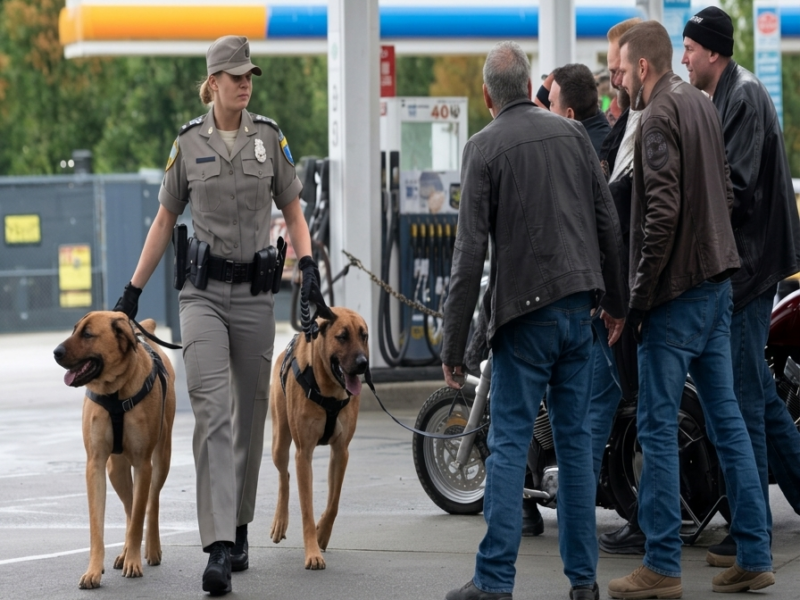
The bikers laughed when they cornered me outside a roadside diner in rural Texas, mocking my military uniform and calling my two German Shepherds oversized pets
The scorching Texas heat shimmered off the asphalt of Highway 287, creating distorted mirages against the endless horizon. I sat on the hood of my weathered pickup truck outside Miller’s Diner, inhaling the bitter aroma of stale diner coffee. After a twelve-hour drive home from a grueling military exercise at Fort Cavazos, my body burned with physical exhaustion, but my mind was far more worn down. I was heading back to an empty house—a house where the silence was often too loud to bear.
Beside my scuffed combat boots sat Rex and Shadow. Their thick black-and-tan coats were covered in highway dust. Rex, an eleven-year-old German Shepherd with a scarred muzzle and graying ears, was a veteran of three combat deployments in the Middle East. Shadow, three years younger, was leaner, faster, and hyper-vigilant. Both were retired military working dogs. While the military had officially discharged them, retirement had done nothing to erase the deeply ingrained instincts forged through years of war.
The low rumble of heavy engines cut through the quiet afternoon air.
Seven motorcycles pulled into the gravel lot, dust swirling around their polished chrome. The riders, dressed in faded leather vests adorned with unmarked patches, parked haphazardly across three spaces. They dismounted with loud, performative bravado, their laughter turning the heads of the few patrons watching from behind the diner’s grease-stained windows.
One of the men, heavily tattooed with a thick beard, stopped and pointed at Rex and Shadow. “Those things look mean,” he called out, stepping closer with a predatory smirk. “You sure those oversized pets won’t eat their own handler?”
A second biker stepped alongside him, eyes scanning my olive-drab fatigue jacket. “Playing soldier, sweetheart?”
I squeezed the cardboard coffee cup in my hand until the lid buckled. “I’m just trying to get home,” I said, keeping my voice level, stripped of all emotion.
The second man smirked, kicking my canvas travel bag across the dusty pavement with the toe of his boot. “Then pick up your stuff and smile, girl.”
I felt the eyes of the diner patrons burning through the glass. For a brief, humiliating moment, I felt like a vulnerable twenty-year-old cadet again, standing before people who routinely mistook silence for weakness.
Then the largest biker made a critical mistake. He reached out, carelessly aiming his hand toward Rex’s tactical collar.
Rex didn’t bark. He didn’t bare his teeth or make a grand display of aggression. He simply stood up, shifting his seventy-pound frame directly into the path of the man’s hand. His body went rock-rigid, his dark, intelligent eyes locking onto the biker’s wrist. Shadow instantly rose beside him, taking a flanking stance, his ears pinned back in total tactical readiness.
The laughter died instantly.
“Get your dogs under control,” the bearded biker snapped, pulling his hand back as if he’d touched hot iron.
“They are under control,” I replied quietly, looking him dead in the eye. “That’s why you still have a choice.”
Refusing to lose face in front of his crew, the biker stepped forward again, reaching for Rex’s collar a second time.
Before his fingers could touch fur, both dogs shifted forward in perfect synchronization—a sharp, silent burst of controlled aggression that forced the man to stumble backward, colliding hard with his comrades.
“What the hell!” one of the bikers cursed, reaching behind his back toward his belt.
“Stop! Don’t move!”
The voice came from the oldest biker in the group. He was a tall, lean man with white hair, weathered skin, and a thick scar running down his jawline. His voice wasn’t filled with anger; it was thick with sudden, paralyzing shock. He stepped past the bearded man, his eyes entirely fixed on a small, faded tattoo visible on his own left wrist beneath his leather cuff.
It was a small black compass surrounded by three stars.
My pulse spiked. I recognized that symbol. It was the unofficial insignia of the 4th Tactical K9 Reconnaissance Unit—a elite joint-operations team that had been quietly disbanded twelve years ago following a highly classified mission in the Helmand Province that went disastrously wrong. A mission that had cost my father’s best friend his life.
I stepped closer, my voice dropping into a cold register. “What unit were you with?”
The old biker didn’t answer right away. He slowly raised his gaze from Rex to the stitched name tape on my left chest pocket: CAPT. MORGAN.
His face drained of all color, the tan skin turning ash-gray. “You’re… you’re Captain Thomas Morgan’s daughter.”
My fingers tightened so hard on the coffee cup that it burst, spilling cold black liquid over my boots as it shattered on the pavement.
My father, Captain Thomas Morgan, had died overseas when I was seventeen years old. The official Department of Defense report delivered to our doorstep had called it an unavoidable tragedy—a vehicle rollover during a routine security sweep. I had spent nearly nine years believing that official lie.
“How do you know my father’s name?” I demanded, my chest heaving.
Rex, who had served as my father’s primary working dog during that final deployment before being reassigned to me, suddenly lowered his head. A low, agonizing whine escaped the old dog’s throat. He stepped toward the white-haired biker, sniffing the air, his tail making a slow, hesitant sweep against the dust.
The old biker looked at the ground, utterly unable to meet my eyes. “I can’t talk about this,” he stammered, backing toward his motorcycle. “I can’t.”
“You had plenty to say when you thought I was just some girl on the side of the road!” I shouted, tears of rage burning behind my eyes. “Tell me what happened to him!”
The parking lot was dead silent. The other six bikers stood frozen, sensing the sudden change in atmosphere.
The old man swallowed hard, his hands trembling as he gripped his leather vest. “Your father didn’t die in an accident, Captain,” he whispered, his voice cracking. “The Helmand operation… it was compromised before team four ever touched the ground. Someone sold the landing coordinates. Your father stayed behind with Rex to cover the extraction of two wounded teammates. But the secondary extraction team never came. They were ordered to abandon the LZ.”
“Ordered by who?” I stepped into his personal space, my voice shaking with raw grief. “Who left him there?!”
The old man opened his mouth to speak, but before a name could cross his lips, a high-pitched engine roared to life behind us.
One of the younger bikers, wearing a helmet that obscured his face, slammed his motorcycle into gear. He spun his rear tire in the gravel, spraying rock dust across the lot, and tore out onto the highway, accelerating wildly toward the north.
Shadow instantly bolted toward the highway entrance, his muscles surging, barking frantically at the retreating motorcycle.
“Shadow, HEEL!” I commanded. The dog skidded to a halt on the gravel, returning to my side but keeping his eyes locked on the disappearing taillight.
The white-haired biker watched the fleeing motorcycle with pure terror written across his features. “That was him,” he whispered, his body shaking. “That’s the officer who gave the abandon order twelve years ago.”
I pulled my cell phone from my pocket, my fingers trembling violently as I unlocked the screen. “You’re going to give me his name, and you’re going to tell me every single detail right now.”
The man nodded slowly, tears welling in his aged eyes. “I will. God help me, I will.”
As I stepped toward him, Rex leaned against my leg, pressing his warm snout firmly against my hand. He whined again—a soft, urgent sound he had never made in all the years I had owned him.
I looked down.
Rex was nudging a small piece of metal hanging from his tactical collar. It wasn’t his standard military ID tag. Tucked behind his rabies tag was a small, weathered piece of steel engraved with custom block lettering.
I reached down, my hands cold, and flipped the metal tag over.
Engraved on the back were three words:
YOUR FATHER SURVIVED.
And directly beneath those words was a stamped date from six months ago, alongside a set of GPS coordinates located deep within the pine forests of East Texas.
My vision blurred as I stared at the metal tag swinging beneath Rex’s chin.
Six months ago.
While I had been sitting in an office at Fort Cavazos, processing routine logistics reports and mourning a ghost, someone had put this tag on my father’s dog.
I looked up at the white-haired biker, my voice cold and sharp as broken glass. “Where did you get this tag?”
The man looked confused, staring at the metal piece in my palm. “I… I didn’t put that there, Captain. I swear to God. I haven’t touched that dog in twelve years.”
“Then who did?” I demanded.
“His name is Miller,” the old biker said hurriedly, glancing nervously toward the empty highway where the other rider had fled. “Major Robert Miller. Back in ’14, he was the liaison officer between our unit and private defense contractors in Afghanistan. When the LZ was compromised, Miller claimed your father was killed by an IED. He signed the casualty report himself. He closed the case, classified the file, and received a promotion two months later.”
“And the man who just rode away?”
“That was Miller’s son, Jackson,” the biker replied, his head bowed in shame. “Miller runs a private security firm out near Tyler now. Jackson keeps tabs on anyone from the old unit to make sure nobody talks. We were on our way to his estate when we stopped here.”
I didn’t waste another second. I memorized the GPS coordinates stamped onto the tag: 31.5421° N, 95.2104° W. It mapped directly into the dense, swampy wilderness of the Davy Crockett National Forest—an isolated strip of timberland nearly two hours east.
“If you’re lying to me,” I said, stepping toward my truck, “I’ll find you.”
“I’m not lying,” the old man whispered, his eyes filled with a lifetime of guilt. “Your father was a good man, Captain. We were cowards for staying silent. If Thomas is somehow still out there… God forgive us.”
I whistled once. Rex and Shadow leaped gracefully into the crew cab of my Ford F-250. I slammed the door, shifted into drive, and tore out of the diner parking lot, leaving a cloud of gravel dust behind.
As I accelerated onto Highway 287, my mind churned in a sea of impossible questions. How could he be alive? Where had he been for twelve years? Why hadn’t he come home?
Beside me in the passenger seat, Rex rested his massive head on the center console. His dark eyes were fixed on me with an unnatural intensity, as if he understood every single thought racing through my head. Rex had been with my father on that fateful night in Helmand. When the military brought Rex back to the States two years after my father’s supposed death, he had been scarred, traumatized, and scheduled to be euthanized due to extreme aggression. I had fought through three levels of military bureaucracy to adopt him.
He hadn’t been aggressive. He had been waiting.
Two hours later, the afternoon sun began its descent behind the dense canopy of pine trees lining the dirt roads of Houston County. The paved highway had long since given way to rutted logging trails choked with red mud and thick underbrush.
The GPS coordinates led to a dead end—an abandoned fire watchtower standing like a rusting sentinel above a clearing of wild pines.
I cut the truck’s engine. The sudden silence of the forest was deafening, broken only by the caw of a distant crow and the ticking of the cooling exhaust manifold.
“Stay,” I instructed the dogs, reaching behind the seat to unholster my personal Sig Sauer P320 pistol. I chambered a round, engaged the safety, and tucked it securely into the waistband of my tactical pants.
I stepped out onto the damp pine needles. The air was thick with the smell of wet earth and sap.
Rex immediately whined from inside the truck, pawing urgently at the window glass.
“Alright,” I whispered, opening the rear door. “Search.”
The moment his paws hit the ground, Rex took off. He didn’t wander or sniff aimlessly; he moved with the laser-focused determination of a working dog on an active track. Shadow followed three paces behind, his ears swivelled forward, guarding his elder’s flank.
I ran after them, my boots sinking into the soft mud. Rex led me past the watchtower, down a steep ravine carpeted with thick ferns, and toward a hidden clearing surrounded by high limestone bluffs.
Nestled into the base of the cliff was a small structure made of stacked logs and corrugated tin, almost completely camouflaged by surrounding brush. Solar panels were mounted discreetly on the roof, and a thin wisp of woodsmoke curled up from a stone chimney.
Rex stopped at the perimeter of the clearing. He didn’t bark. He sat down, his tail thump-thumping against the damp leaves.
My heart hammered against my ribs like a trapped bird. “Hello?” I called out, my hand resting firmly on the grip of my sidearm. “Is anyone there?”
The heavy wooden door of the cabin creaked open.
A man stepped out into the fading light. He wore an old military field jacket, faded denim, and heavy boots. His hair was completely silver, his face deeply lined with heavy weather-beaten furrows, and his left leg moved with a pronounced, mechanical limp. In his hands, held comfortably at hip level, was an old Winchester lever-action rifle.
The rifle slipped from his fingers, clattering against the wooden porch steps.
The man stared across the clearing, his pale blue eyes wide with an emotion so raw it seemed to shatter the air between us.
“Maya?” he rasped, his voice rough and dry, like dry leaves scraping across concrete.
I froze. Only one person in the world had ever called me Maya instead of my rank or full name.
My knees went weak. The pistol slipped from my mind as tears erupted from my eyes, blinding me.
“Dad?” I choked out.
Twelve years of grieving dissolved in a single, ragged breath as I ran across the clearing and threw my arms around my father’s neck.
He held me with a desperate, crushing strength, his weathered hands burying themselves in my hair as he wept silently against my shoulder. The scent of woodsmoke, gun oil, and cedar wrapped around me—a scent I had carried only in my childhood memories.
Rex trotted up the steps, nudging his gray snout directly into my father’s palm. Dad broke away from me, dropping to his knees on the wooden porch, and pulled the old dog into his chest. Rex leaned his heavy head against my father’s neck, letting out a soft, contented sigh.
“I thought I lost you both,” my father sobbed, his voice buried in Rex’s fur. “God help me, I thought I lost everyone.”
Ten minutes later, we sat inside the small, warm cabin. A cast-iron stove radiated heat in the corner. The walls were lined with hand-drawn maps of East Texas, radio equipment, and surveillance logs tracking local vehicle movements. Shadow sat near the door, ever vigilant, while Rex lay curled at my father’s feet, refusing to leave his side.
“How?” I asked, my voice trembling as I held a mug of hot tea my father had poured for me. “The military gave us an official death certificate, Dad. They gave us a folded flag. They said your humvee was hit by an IED in Helmand.”
My father looked down at his scarred hands, his jaw tightening. “There was no IED, Maya. It was a setup.”
He reached into his pocket and pulled out a faded photograph of his old K9 unit—the same group from the diner.
“Major Robert Miller was running an illegal arms siphon,” Dad explained, his eyes darkening with anger. “He was selling captured military ordinance to private warlords in the region. My unit stumbled onto one of his stash sites during a routine sweep. I confronted Miller. I told him I was reporting him to JAG the moment we returned to base.”
He paused, taking a shaky breath.
“Two days later, Miller assigned my team to a high-risk recon mission in a valley controlled by hostile insurgents. He intentionally leaked our extraction coordinates. When the ambush started, Miller canceled our air support. He reported over the radio that our entire squad was wiped out.”
“And you survived?”
“I was critically wounded,” Dad said, tapping his prosthetic left leg beneath his trousers. “Two of my men died in that ditch, Maya. I managed to drag myself and two wounded survivors into a cave system. A local village elder sheltered us for months until we could cross the border into Pakistan. But by the time I made it back to a US diplomatic outpost six months later, Miller had already been promoted to Colonel and covered his tracks completely.”
“Why didn’t you come home then?!” I cried, tears spilling over my cheeks again. “Why didn’t you come back to Mom and me?!”
Dad looked at me with an expression of agonizing pain. “Because the day I landed in Germany, Miller sent me a package. It contained clear, high-resolution photographs of you walking to high school in San Antonio. And a note. ‘If you ever surface, if you ever speak a word, your daughter dies.'”
My breath caught in my throat.
“Miller had built a private security empire by then,” Dad continued, his voice trembling with fury. “He had men everywhere—in local law enforcement, in private defense firms, even in state intelligence. I realized that if I came home, I would be putting a target directly on your back. The only way to keep you alive was to let the world believe Thomas Morgan was dead.”
“So you lived in these woods… like a ghost?”
“For twelve years,” Dad said quietly. “Watching you from afar. Watching you graduate from college, watching you join the Army, watching you become an officer. I hired a private investigator six months ago to track Rex when I learned he was being retired from active service. I intercepted the transport van, attached that tag to his collar, and sent him back to you, hoping… praying that one day, if you ever found yourself in trouble, he would lead you to me.”
A sudden, sharp bark from Shadow shattered the emotional quiet of the cabin.
The younger dog scrambled to his feet, staring intently at the dark woods outside the cabin window. Rex immediately sat up, his ears pinned back, his throat emitting a low, dangerous growl.
Dad reached for his Winchester rifle, his eyes instantly shifting into tactical alertness. “Shadow, what do you see?”
Outside, high-powered vehicle engines hummed through the trees, approaching fast from the logging road. Headlights cut through the darkness, sweeping across the cabin windows.
My phone vibrated violently on the table. It was an incoming call from an unlisted number.
I picked it up, pressing it to my ear. “Who is this?”
“Captain Morgan,” a slick, cultured voice spoke through the speaker. “It seems your little reunion has concluded ahead of schedule. I must admit, I was impressed when my son told me you tracked down old Miller’s diner crew.”
“Major Miller,” I whispered, my blood turning to ice.
“Retired Colonel Miller now, Captain,” he corrected smoothly. “You should have stayed on your way home to your empty house. Now, I’m afraid I have to finish the job I started in Afghanistan twelve years ago. Tell your father I said hello.”
The line went dead.
A sudden flash of light illuminated the forest outside, followed by the deafening CRACK of a high-caliber sniper round shattering the cabin’s front window.
“DOWN!” Dad roared, tackling me to the floor just as a second sniper round tore through the wooden wall, embedding itself deep into the stone fireplace with a shower of sparks.
Glass rained down upon us. Shadow and Rex scrambled beneath the heavy oak table, both dogs barking fiercely against the sudden assault.
“Are you hit?!” I yelled, pulling my Sig Sauer pistol from my belt and racking the slide.
“I’m fine!” Dad yelled back, crawling toward the window sill. “They brought snipers with thermal scopes! They’re thermal-imaging the cabin!”
Outside, the darkness was punctuated by the tactical flashlights of at least a dozen armed men advancing through the timber in a wide pincer movement. Engines idled in the distance—armored SUVs blocking the only exit road.
“They aren’t law enforcement,” I said, peeking carefully over the wooden ledge. “They’re wearing private contractor gear. Miller’s personal security squad.”
“He came to destroy the last remaining evidence,” Dad said, his blue eyes burning with a fierce, lethal light. “He knows if the public finds out I’m alive, his entire fortune and political network collapse overnight.”
Dad pulled a heavy wooden trapdoor open in the floorboards beneath the table. “There’s a drainage tunnel under the cabin leading to the limestone creek bed two hundred yards south. Take the dogs and go, Maya!”
“I am NOT leaving you again!” I screamed over the sound of automatic rifle fire tearing through the outer cedar siding. Splinters rained down on us like shrapnel. “We fight together, Dad! I’m a Captain in the United States Army, and you’re my commanding officer! Give me an order, but don’t order me to run!”
Dad looked at me, his scarred face softening for a split second before transforming into pure military resolve. “Alright. We execute a phased withdrawal. We use the dogs to disrupt their front line, flush their snipers, and take their transport.”
He reached into a hidden chest beneath the floorboards, pulling out two tactical radio vests and securing them around Rex and Shadow. He clipped small, high-intensity strobe devices to their harnesses.
“Rex! Shadow!” I called out. Both dogs crawled to my side, their bodies taut as bowstrings. “Red Light! ATTACK!”
I kicked the shattered back door open and tossed two emergency smoke canisters into the clearing outside. Thick gray smoke billowed into the night, clouding the contractors’ thermal optics.
“GO!”
Rex and Shadow launched themselves out the door like black-and-tan lightning bolts, disappearing into the dense smoke.
A second later, screams of panic erupted from the woods.
“Contact left! Contact left! It’s military dogs!” a contractor yelled over his radio before his voice was cut off by a fierce snarl and the sound of a body hitting the mud.
The strobes on the dogs’ vests flashed violently through the smoke, blinding the contractors’ night-vision equipment. Rex, moving with the seasoned tactical grace of a veteran warrior, slammed into a contractor holding a rifle, driving him to the ground. Shadow sprinted behind the sniper position on the ridge, flushing the shooter from his high perch.
“Moving!” Dad shouted, firing his Winchester through the broken front window to suppress two contractors advancing up the porch steps.
We burst out the back door, staying low behind the tree line. The night was alive with chaos—muzzle flashes illuminating the pines, smoke hanging thick in the humid air, and the fierce barks of two working dogs reclaiming the battlefield.
As we reached the edge of the clearing, a heavy tactical SUV slammed through the brush, cutting off our path to the main logging road.
The driver’s side door opened. Jackson Miller—the young biker from the diner—stepped out, holding a suppressed assault rifle. Beside him in the passenger seat sat an older man in an expensive tailored coat: Colonel Robert Miller himself.
“Thomas Morgan,” Colonel Miller called out, his voice amplified through the vehicle’s bullhorn. “You should have stayed dead, Tom! You survived a war zone just to die in a Texas swamp!”
Jackson raised his rifle, aiming directly at my father’s chest.
Before Jackson could pull the trigger, a dark shadow burst from the high ferns.
Rex leaped three feet into the air, his powerful jaws clamping directly onto Jackson’s rifle barrel, ripping the weapon completely out of the young man’s hands. The force of the impact slammed Jackson against the SUV’s frame.
“Agh! Get it off me!” Jackson shrieked, scrambling back into the vehicle.
“Rex, RELEASE!” I shouted, sprinting forward.
Rex released his grip, standing guard at the driver’s door, his teeth bared in a terrifying snarl that held both men paralyzed inside the cab.
Dad stepped up to the passenger window, raising his Winchester rifle and placing the barrel directly against the glass, inches from Colonel Miller’s face.
“Step out of the car, Robert,” Dad said, his voice as quiet and cold as a winter grave. “Or I end this twelve-year war right here on this dirt road.”
Colonel Miller’s face was pale as death as he slowly opened the SUV door and stepped out onto the muddy road, his hands raised high above his head. His son, Jackson, cowered inside the vehicle, clutching his bruised wrist.
The tactical gunfire in the woods behind us had died down. Shadow trotted out from the smoke, his tongue panting, standing proudly alongside Rex. The remaining private contractors, seeing their employer captured and their snipers neutralized, were fleeing into the surrounding darkness.
“You can’t do this, Tom,” Miller stammered, his polished composure completely shattered. “I have connections in Washington. I have federal judges on my payroll. If you kill me here, you’ll spend the rest of your life in a military prison!”
I stepped forward, pulling my phone from my pocket. The screen was lit up, showing an active, encrypted call to the State Attorney General’s Office and the Military Inspector General.
“He isn’t going to kill you, Colonel,” I said, holding the phone up so Miller could see the recording icon. “Every word spoken in this clearing for the last ten minutes has been broadcast live to federal authorities. Including your confession about Afghanistan.”
Miller stared at the phone screen, his eyes wide with horror as he realized his empire, his wealth, and his freedom had just evaporated into the Texas night air.
In the distance, the wail of approaching sirens echoed through the timberland. Dozens of red and blue police lights swept through the trees as state troopers and federal Marshals, alerted by my encrypted distress signal, flooded the logging roads.
Dad lowered his rifle slightly, looking at his former commanding officer with a mixture of pity and quiet disdain. “Twelve years ago, you thought you could erase my name, Robert. But you forgot one thing.”
Dad reached down, gently resting his hand on Rex’s head.
“A military working dog never forgets who betrayed his handler.”
THREE MONTHS LATER
The morning sun rose bright and warm over the rolling hills of San Antonio, casting a golden glow over the manicured green lawns of the Fort Sam Houston National Cemetery.
I stood near the crest of the hill, wearing my immaculate Army Service Uniform, my Captain’s bars gleaming in the light.
Beside me stood my father. He wore a sharp civilian suit, his posture straight and proud, his arm wrapped around my shoulders. He was no longer a ghost hiding in the pine forests of East Texas. A federal tribunal had fully exonerated him, restored his military pension, and handed down lifetime prison sentences to Colonel Robert Miller and his co-conspirators.
At our feet sat Rex and Shadow.
Rex wore a brand-new, custom tactical harness embroidered with gold lettering: HONORABLY DISCHARGED – UNIT 4 RECON. He looked older, his gray muzzle catching the morning light, but his dark eyes were bright, calm, and entirely at peace.
A small crowd of military officers, news reporters, and surviving veterans from the old unit had gathered near a newly erected marble monument at the base of the hill—a monument dedicated to the fallen soldiers of the Helmand Province mission whose names had finally been restored to history.
The bugler played Taps, the solemn notes drifting across the quiet graveyard.
My father took a deep breath, wiping a single tear from his cheek. “It feels strange,” he whispered softly. “Walking in the sunlight again.”
I reached out, taking his hand, squeezing it tight. “You’re not walking alone anymore, Dad. None of us are.”
Rex leaned against my father’s leg, letting out a deep, contented sigh as Shadow rested his head on my boots.
The nightmare was finally over. The shadows of the past had cleared, leaving only the warmth of the rising sun and the unbreakable bond between a soldier, her father, and the faithful hounds who had brought us home.
The end.









