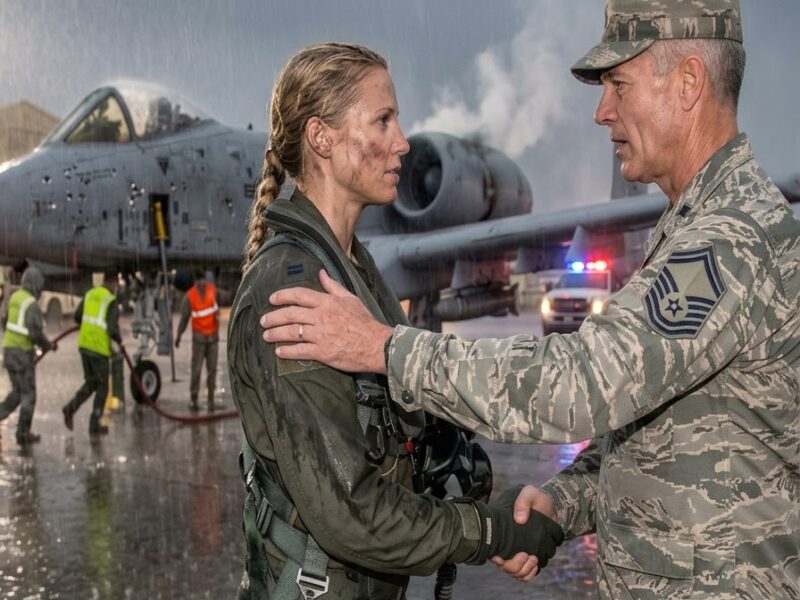
The base commander pointed at my damaged A-10 and ordered me to stay behind, saying, “You’ll slow us down,”
Cold rain smashed against the asphalt at Fort Carson, churning oil, hydraulic fluid, and gravel into a slick slurry across the tarmac. The storm blew in hard off the Front Range, reducing visibility to a few hundred feet. I stood beside the towering titanium twin-tails of my A-10 Thunderbolt II—the “Warthog”—wearing a flight suit damp at the collar, watching six sleek F-16 Vipers taxi toward the runway in single file.
My Warthog sat propped on jack stands near Hangar 4. Two days earlier, during a low-level strafing run over the mountain target grid, a stray fragment of high-density target plating had bounced into my left TF34 engine bay, severing a primary hydraulic loop and shredding the fan blades. The maintenance crew was still working on it. Their tools clattered under the shelter of the overhang as grease-stained mechanics wrestled with a replacement compressor stage.
Footsteps splashed through the standing water behind me. I turned to see Commander Hayes approaching, shrouded in a heavy vinyl rain parka, holding a thick, red-stamped operational folder tight against his chest.
“You’re staying here, Captain,” Hayes said, his voice flat, barely carrying over the dull roar of idling jet engines.
I pulled myself up straight, wiping rainwater off my chin. “Sir, I can still fly. The right engine is 100 percent. The flight controls are responsive. Clear me for the secondary wing.”
Hayes didn’t look me in the eye. He looked past my shoulder, staring at the missing panel panels on my left engine cowl.
“You’ll slow us down,” he said.
The words slammed into my chest harder than any mountain downdraft. Fifteen years. Fifteen years of tactical flying, low-altitude weapons delivery, and two deployments in hot zones. I had logged more combat hours in the A-10 than any pilot currently sitting on that taxiway. Yet with four brief words, Commander Hayes sidelined me like a cracked spare tire.
“Sir, the mission profile calls for heavy ground-attack capability,” I argued, step-for-step with him as he turned toward the tactical ops building. “If those Vipers run into concentrated anti-air batteries in the valley, they don’t have the armor or the cannon to suppress it. My 30mm Avenger can rip through whatever they encounter.”
“The order is given, Mitchell,” Hayes cut me off without stopping. “The strike package is already rolling. Ground yourself.”
I watched from the edge of the apron as the six F-16s lined up on the runway. Their afterburners ignited in blinding bursts of violet flame, tearing through the storm noise as they lifted off, disappearing instantly into the low, oppressive ceiling of gray clouds.
I walked back into the maintenance bay, my jaw locked so tight my teeth ached. Master Sergeant Miller, his hands blackened with grease, looked up from the open belly of my jet.
“He grounded you?” Miller asked.
“Yeah,” I muttered, kicking a tire chock out of the way. “Said I was a drag on the formation.”
Miller grunted, wiping his brow with a rag. “Nonsense. The left engine’s buttoned up. She ain’t pretty, and the interstage turbine temperature is gonna run hot, but she’ll spin.”
Twenty minutes passed in agonizing, silent frustration. I sat on an ammo crate, re-lacing my flight boots, listening to the monotonous hum of the base power generators.
Then every emergency loudspeaker on the airfield shrieked to life.
MAYDAY! MAYDAY! ALL UNITS, STRIKE PACKAGE ONE IS ENGAGED!
The radio in the hangar crew chief’s booth erupted into chaotic, overlapping static. Voices—voices I knew, pilots I had eaten breakfast with three hours ago—were screaming over the tactical frequency.
“Viper Lead is down! I repeat, Viper Lead is down!”
“Radar lock! Radar lock! Where is it coming from?!”
“They trapped us in the corridor! Navigation systems are jammed! We can’t acquire the horizon!”
I scrambled into the booth, grabbing the headset off the hook. “Base Command, this is Captain Mitchell! What is the status of Strike Package One?”
The voice of the duty controller came back, laced with sheer terror. “They flew into a concentrated SAM ambush in Sector 7, inside the Black Canyon corridor. Mobile radar units bypassed our early warning grid. Six aircraft took fire upon entry. Two are down, four are pinned at low altitude under heavy radar tracking.”
“Command, send air support!” a pilot screamed over the open link. “We need suppression now! We’re running out of flares!”
A long pause stretched over the channel—five seconds, six seconds, seven seconds. Then came the official response from the Command Post.
“All available aircraft are grounded due to severe weather and compromised airspace. Hold position.”
I stared at the radio receiver in total disbelief. Grounded? They were leaving six pilots to get picked apart in a kill box.
I dropped the headset, turned on my heel, and marched out into the rain toward my jet.
“Miller!” I yelled. “How much time?”
Miller looked up from the wing, a wrench still in his grip. He hesitated, looking at the open cowling and the warning tags hanging from the engine bay. “She’s not ready, Sarah. The left engine hasn’t been load-tested! If you push the throttle past eighty percent, the turbine could disintegrate!”
“Neither are those pilots,” I said, stepping onto the ladder rung and hauling myself into the tub. “Clear the stands. Crank the auxiliary power unit.”
Miller didn’t ask another question. He barked orders at his crew, and within ninety seconds, the ground power unit whined. I hit the fuel pumps, snapped the canopy closed, and initiated engine start. The right engine roared to life smoothly. I pushed the left engine fuel flow lever forward.
The left TF34 engine coughed, spat a ring of black smoke, and vibrated violently, sending shudders through the titanium rudder pedals under my boots. The Interstage Turbine Temperature needle instantly pegged near the red line.
“You’ve got red lights across the caution panel!” Miller screamed over the ground crew comms.
“She’ll fly!” I shouted back.
Without waiting for tower clearance, I taxied out onto the storm-swept runway, aligned the Warthog with the centerline, and slammed both throttles forward. The jet lurched down the asphalt, heavy, clunky, and screaming in mechanical agony, before lifting its heavy nose into the roaring storm.
The mountain weather was a meat grinder.
Turbulence smashed against the airframe like solid wood, jerking the control stick in my hands as I cleared the lower ridge line at four hundred feet above ground level. Rain smashed against the bulletproof canopy glass in sheet-like waves. Down in the valley, the terrain was a maze of jagged granite walls and narrow, tree-choked chasms.
My caution panel was a Christmas tree of yellow and red warnings. ENG 2 TEMP HIGH. HYD PRESS LOW. MASTER CAUTION. I flipped the warning override switches, forcing my eyes to stay locked on the heads-up display.
I switched my radio to the tactical squad frequency. “Viper Flight, this is Warthog Zero-One. I am entering Sector 7. Give me a picture.”
Silence answered. Then a faint, disbelieving voice crackled through the static.
“Viper One… identify yourself?”
“Captain Sarah Mitchell,” I answered, slamming the stick to the left to bank around a granite cliff face. “I’m five miles out from your last reported grid.”
There was a long pause over the line. Then a pilot whispered, “They sent her? In a broken hog?”
“I brought thirty millimeters of titanium-tipped point-of-view,” I snapped back. “Who is operational?”
“Viper Two and Three are damaged, holding low near the river bed,” Viper Four reported, his voice shaking. “Viper Lead and Five are ejected. Viper Six is stuck at the eastern mouth of the gorge. His engine is on fire, and three SA-8 radar-guided missile trucks are sitting on the high ridge, sweeping the canyon floor. Every time he pops up to gain altitude, they lock him.”
“Hold your altitude, Viper Six,” I commanded. “I’m coming under the radar umbrella.”
I pushed the stick forward, diving the heavy attack jet down into the dark abyss of the canyon. Flying an A-10 through a mountain gorge in a blind thunderstorm at three hundred knots is suicide for most pilots. But the Warthog was built to live in the dirt.
The canyon walls rushed past my wingtips, giant dark shadows towering over me. Up ahead, bright orange streaks cut through the low rain clouds—surface-to-air missiles launching from the ridge, tracking the trapped F-16s above.
“Target acquired,” I muttered, flipping the arming switch on the main stick. The green reticle on my HUD centered on a hot thermal pulse sitting on the northern ridge line.
A radar-warning receiver chimed wildly inside my helmet—an enemy tracking system had locked onto my approach.
“Not today,” I growled, dumping a cloud of flares and chaff out the tail pod while rolling the aircraft ninety degrees onto its side to duck behind a ridge crest.
The missile streaked directly over my canopy, exploding against the rock wall behind me with a shockwave that threw my left wing violently upward. The damaged left engine let out a metallic screech, losing ten percent of its thrust instantly. The airspeed indicator dropped dangerously close to stall margin.
I pulled the nose up, cleared the ridge top by less than thirty feet, and lined up the crosshairs on the white radar dome of the first missile truck.
I squeezed the trigger.
The GAU-8/A Avenger 30mm Gatling cannon beneath my feet didn’t fire with a simple gunshot sound. It unleashed a terrifying, subterranean roar—a sound like tearing solid canvas mixed with thunder. Sixty rounds of depleted uranium projectiles ripped through the air per second.
The high-explosive rounds walked across the ridge line, tearing the missile vehicle into a ball of flying scrap metal and roaring flame before the operators could even turn their turret.
“Target one destroyed!” I yelled. “Viper Six, move now!”
“I can’t!” Viper Six screamed back. “Engine three-quarter loss! I’m losing lift over the ridge!”
Through the rain, I saw his F-16 trailing a long plume of black smoke, fluttering like a wounded bird as a second SAM battery on the southern peak raised its launch tubes to finish him off.
My fuel warning light began to flash red. FUEL QTY LOW – 400 LBS. I had less than six minutes of flight time before my tanks ran completely dry. If I turned back now, I could make an emergency glide back toward the base perimeter.
If I turned back, Viper Six was dead.
“Hold on, Six,” I breathed, shoving both throttles to the stop.
The damaged left engine shrieked in protest, fire flashing through its tailpipe as the internal turbine blades began to melt under the extreme heat. But the old jet kept flying. I pulled the nose up into a vertical climb, coming up directly beneath the second missile battery, putting my own aircraft straight between the enemy launcher and the defenseless F-16.
“Locking target!” I shouted, holding the trigger down for three full seconds.
The cannon roared again, vibrating the entire airframe so violently that my instrument panel went blurry. The second SAM truck exploded in a massive secondary blast of cook-off rocket fuel.
“You’re clear, Six! Get out of here!” I yelled.
“Mitchell, you don’t have the fuel!” Viper Six cried as his damaged jet finally cleared the ridge, heading south toward safety.
“Go!” I ordered.
I flipped the jet inverted, pulled back on the stick, and dove back into the canyon floor, cutting both engines back to idle to conserve the last drops of aviation fuel.
The glide home was a nightmare of silent tension.
My left engine died completely three miles out from Fort Carson, freezing into a useless chunk of melted metal. The right engine sputtered, choking on the last reserves of fuel in the lines. I brought the heavy, asymmetrical aircraft down through the thick storm clouds, relying entirely on manual flight controls as the main hydraulic pressure bled out.
The runway loomed out of the fog. I popped the speed brakes, dropped the heavy landing gear manually, and let the tires slam hard onto the wet asphalt. The aircraft bounced twice, skidded sideways across the slick surface, and finally rolled to a stop just feet from the turf at the far end of the runway.
Sirens were wailing across the base. Fire trucks and emergency ambulances raced alongside my plane, their red lights reflecting off the wet aluminum skin.
I popped the canopy, pulled off my oxygen mask, and breathed in the cold, wet air of the Colorado basin. My hands were shaking uncontrollably from the adrenaline crash.
As I climbed down the boarding ladder, a crowd of ground crew personnel and flight mechanics surrounded the plane, cheering and slamming their hands against the armor plate of the fuselage. All five surviving aircraft from Strike Package One were already parked on the ramp, their pilots stepping down to watch me.
Standing near the hangar door, completely motionless under an umbrella, was Commander Hayes.
His face was ghostly pale. His eyes were wide, staring at me as if he were looking at a ghost who had walked straight out of the grave.
I unbuttoned my flight gloves and marched directly up to him, stopping two inches from his chest.
“They all made it back, Commander,” I said, my voice cold as ice. “Every single one.”
Hayes swallowed hard, his hands trembling slightly inside his coat pockets. “You… you disobeyed a direct order, Mitchell.”
“Put me in the brig, then,” I growled. “But explain to those pilots over there why you wanted me grounded while they were being slaughtered.”
Before Hayes could answer, a black government sedan screeched to a halt behind us. Two officers wearing the insignia of the Air Force Office of Special Investigations (OSI) stepped out, followed by a senior Intelligence Chief holding a sealed, tamper-evident plastic folder.
“Captain Mitchell,” the Intelligence Chief said, stepping between me and Hayes. “We need you in tactical command immediately.”
“What’s going on?” I asked.
The Chief opened the plastic folder, pulling out an enlarged satellite surveillance photograph dated four hours before our launch. It showed a hidden clearing in the Black Canyon—the exact location of the SAM battery that had ambushed the squadron.
Printed at the bottom of the intelligence sheet were the precise GPS coordinates of the ambush site, along with a digital transmission signature indicating that the coordinates had been uploaded to an external, untraceable server directly from a terminal inside Fort Carson.
Below the data line was the authorizing security digital key: OFFICER COMMAND CODE – HAYES, R.
I turned slowly, my eyes locking onto Commander Hayes.
“You tipped them off,” I whispered, the realization hitting me like a physical strike to the head. “You sent Strike Package One straight into a pre-positioned kill zone.”
The surrounding pilots went dead silent. The mechanics froze.
Hayes stepped back, his foot slipping slightly on the wet pavement. “Sarah… you don’t understand the scope of what’s happening here. That strike package wasn’t supposed to return. It was a required demonstration…”
“Demonstration for who?!” I yelled, reaching for my sidearm holster before remembering I had disarmed inside the cockpit.
“Hold him!” the OSI agent commanded, drawing his weapon.
Before the agents could lay a hand on Hayes, the main base siren sounded again—not the warning for a flight emergency, but the long, wailing tone of a Threat Level Alpha security breach.
ATTACK WARNING. ALL PERSONNEL TO DEFENSIVE POSITIONS. BASE PERIMETER COMPROMISED.
Every computer monitor visible through the ground-floor windows of the Command Operations building suddenly flickered, flashing bright red text across every screen:
OPERATION CLEAN SWEEP INITIATED. AIRFIELD ISOLATION ACTIVE.
My tactical headset, still hooked over my shoulder, crackled to life with an encrypted voice using a heavily scrambled frequency.
“Captain Mitchell,” the voice whispered—a voice that sounded like it was coming from inside the base itself. “The first ambush was only a distraction to clear the sky. The real target was never in the canyon. It was inside your command center all along.”
I spun around to look down the dark runway.
Six unidentified, dark military vehicles were crashing through the northern perimeter fence of Fort Carson, their headlights turned off, moving rapidly toward the main fuel depots and control towers.
And my battered, half-broken A-10 was the only armed aircraft sitting on the apron.
“Get the Commander to the secure bunker!” the OSI agent screamed, drawing his pistol as automatic gunfire erupted near Gate 4.
Two uniformed guards grabbed Hayes by his arms. He didn’t resist. As they dragged him toward the reinforced concrete bunker beneath the ops tower, he looked back at me, his eyes filled with genuine, suffocating horror.
“Sarah!” Hayes yelled over the sound of incoming fire. “It’s not an outside force! It’s Private Military Contractors hired by the Defense Contractor Board! They’re erasing the digital archives in the main vault! If they take the server, every classified record from the last decade disappears!”
I didn’t waste time asking questions. The base defense forces were scattered, unprepared for an armored ground assault from within our own perimeter.
I turned back to Sergeant Miller, who was already running toward the ordnance rack with three armorer specialists.
“Miller! Can we rearm the Hog?” I shouted.
“The cannon has two hundred rounds left in the drum!” Miller yelled back, pointing at my jet. “The left engine is toast, but the right one is still functional! You can’t take off, Sarah! The runway is blocked by those incoming assault trucks!”
“I don’t need to take off!” I yelled, scrambling back up the ladder into the cockpit of my steaming, battered A-10. “Clear the front gear!”
I strapped myself into the seat, strapped my helmet back on, and slammed the canopy down. I didn’t bother with a full system checklist. I cranked the right engine, bringing the single functional TF34 turbine to a roaring scream.
The aircraft lurched violently to the left because of the asymmetrical thrust, but I stamped hard on the right wheel brake, spinning the massive 30,000-pound jet on its landing gear like a armored turret on wheels.
Through the rain-streaked canopy, I saw three heavy armored personnel carriers (APCs) tearing down Taxiway Bravo, firing heavy 50-caliber machine guns into the windows of the air traffic control building. Base security forces were pinned behind sandbags, taking heavy casualties.
I aligned the nose of my grounded A-10 straight down Taxiway Bravo.
“Eat this,” I growled, flipping the arming master switch.
I pulled the cannon trigger.
Even on the ground, the force of the GAU-8/A Avenger cannon was staggering. The recoil pushed the entire thirty-thousand-pound jet backward against its brakes, burning rubber off the rear tires. A stream of glowing 30mm armor-piercing incendiary shells tore across the tarmac at four thousand feet per second.
The lead armored vehicle was blown completely off its tires, exploding into a towering fireball as the depleted uranium shells struck its engine block and ammunition storage. The second vehicle swerved wildly to avoid the wreck, flipping onto its side and crashing into a concrete blast wall.
The third APC stopped dead in its tracks. Its rear doors burst open, and ten heavily armed mercenaries in unmarked black tactical gear poured out, spreading out toward the main administrative building where the central intelligence servers were housed.
They weren’t trying to destroy the base. They were conducting a targeted retrieval operation—stealing or destroying the physical hard drives that contained the evidence of Hayes’s illegal weapons-tracking network.
I released the right wheel brake, using the single-engine thrust to taxi the heavy jet forward down the taxiway like an iron tank, crushing debris and fire under my tires.
My radio clicked onto an internal base security channel.
“Captain Mitchell! This is Sergeant Vance, Base Security!” a voice barked through the noise of heavy gunfire. “We have six hostiles inside the server vault on Level B! They’re setting thermite charges on the mainframe!”
“I’m on the ramp, Vance!” I replied. “Where are the remaining pilots?”
“Pinned down in Hangar 2! We’re surrounded!”
I looked at the server building. It was a two-story reinforced brick structure sitting fifty yards from the main taxiway. The heavy steel double doors on the ground floor had been blown open with breaching charges.
I couldn’t shoot the cannon into the building—the high-explosive rounds would destroy the server vault along with the enemies.
I brought the A-10 to a halt outside the main entrance, revved the right engine to a deafening roar, and turned the jet so the massive, superheated exhaust blast of the right turbine pointed directly into the open double doors of the building.
“Hold on to something inside,” I muttered.
I locked the brakes and pushed the right throttle to 100 percent military power.
A thousand-degree storm of jet exhaust, unburnt jet fuel, and gale-force thrust erupted out of the TF34 engine, blowing straight into the ground floor of the server building.
Inside, the mercenaries who were preparing to breach the lower vault were instantly blown off their feet by the wall of roaring heat and wind. Body armor tore, tactical equipment flew through the air like leaves, and the blinding dust cloud rendered their night-vision goggles completely useless.
“Security team, move in now!” I barked into the radio.
Sergeant Vance and eight security guards flanked the building from the side entrance, catching the disoriented mercenaries completely off guard. Within thirty seconds, the ground team swept the room, securing the server vault and disarming the remaining infiltrators.
“Vault secured!” Vance reported, panting heavily. “Captain… you just taxied an attack jet into a close-quarters gunfight.”
“Just another day in the A-10,” I panted, finally pulling the right engine throttle back to cutoff.
The single engine whined down into a low, dying whistle. The cockpit lights flickered and died. The aircraft was finally completely dead, sitting in the middle of a burning, smoke-filled airfield.
I popped the canopy latch and pushed the heavy glass open.
The rain had stopped. The first rays of dawn were breaking over the jagged peaks of the Rocky Mountains, casting a deep crimson light across the scarred asphalt of Fort Carson.
I stepped down to the ground, my legs shaking, and leaned back against the nose gear of my broken aircraft.
Two hours later, the airfield was sealed under federal martial control.
Three C-17 Globemaster transport planes carrying federal troops and investigators from the Department of Defense landed on the main runway, taking control of the perimeter, securing the surviving evidence, and taking the captured mercenaries into custody.
Commander Hayes sat in the back of an armored transport vehicle, wearing heavy wrist cuffs. As federal agents prepared to drive him off the base, he asked to speak with me one last time.
I walked up to the open rear doors of the vehicle, my flight suit smeared with soot, grease, and rain.
“You should have stayed on the ground, Mitchell,” Hayes said, his voice barely above a whisper. His posture was broken, his eyes sunken and tired.
“Why did you do it, Hayes?” I asked softly. “You were a war hero. You commanded this squadron for six years.”
Hayes looked out at the rows of damaged aircraft parked on the ramp. “The defense board… they weren’t just selling weapons. They were staging incidents to justify a multi-billion-dollar military modernization contract. If Strike Package One died in that canyon, the government would have approved the new automated drone fleet within forty-eight hours. I was promised command of the entire new wing.”
“You traded six human lives for a promotion and a budget line,” I said, disgust dripping from every word.
“I didn’t think you’d launch,” Hayes whispered, looking at the floor of the truck. “I thought… if I kept you on the ground, at least you would live. I knew if you took off in that broken Warthog, you’d find a way to break the trap.”
“I didn’t break the trap because I’m special, Hayes,” I said, leaning closer. “I broke it because I don’t leave my people behind. That’s the difference between a commander and a pilot.”
The agents closed the heavy doors of the transport vehicle, locked the latches, and drove away into the morning light.
I walked back down the taxiway toward Hangar 4.
The five pilots from Strike Package One were standing in a line beside my broken A-10. Their F-16s were scorched, their wings pitted with shrapnel holes, but every single one of them was standing on their own two feet.
As I approached, Viper Six—Lieutenant Miller, the young pilot I had pulled out of the canyon—stepped forward. He held his helmet under his arm, his face covered in soot.
He brought his hand up to his brow and rendered a crisp, sharp military salute.
One by one, the other four pilots snapped to attention and saluted beside him.
“Captain Mitchell,” Miller said, his voice thick with emotion. “On behalf of Viper Flight… thank you for coming back for us.”
I stood straight, returned the salute, and looked at my aircraft.
The titanium skin was scorched black. The left engine was a melted ruin. The canopy was pitted with bullet strikes. But the titanium bathtub surrounding the cockpit was intact, and the thirty-millimeter cannon barrel still pointed proudly down the runway.
Master Sergeant Miller walked up beside me, leaning against the nose cone with a wrench in his pocket.
“She’s gonna need a new engine, a new wing panel, a total hydraulic rebuild, and three months in the maintenance depot,” Sergeant Miller grunted, shaking his head with a small smile.
“Can you fix her?” I asked.
Sergeant Miller patted the cold titanium nose of the Warthog.
“Captain,” he said quietly, “as long as you’re willing to fly her… she’ll always be ready to launch.”
I looked up at the sky. The dark storm clouds were finally clearing over the mountains, exposing a bright, clear blue ceiling above the Front Range.
I smiled, wiped a smudge of grease off my cheek, and turned back toward the briefing room. My mission was complete, my squadron was safe, and the sky belonged to us once again.
The end.









