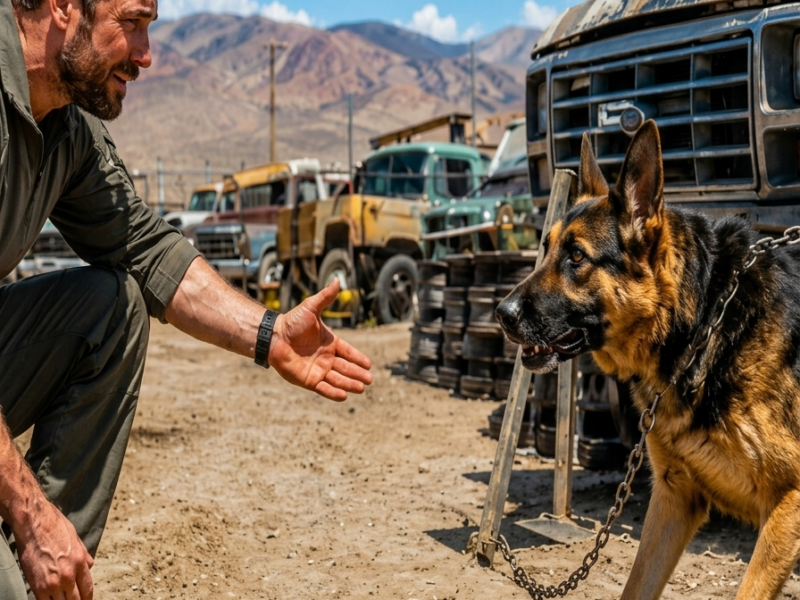
The auctioneer laughed when they chained my retired K9 to a scrap truck outside a warehouse in Norfolk, but before sunrise, six former SEALs stood between that dog and the crusher
The salt fog off the Elizabeth River smelled like dead diesel fuel, creosote, and rotting marsh grass. It rolled low across the cracked asphalt of the Norfolk scrap yard, clinging to the oxidized paint of decommissioned shipping containers and turning the gravel access lanes into black grease. Overhead, three high-pressure sodium lamps buzzed inside their wire cages, casting a jaundiced yellow light over the equipment graveyard.
At the far end of the yard, idling with a rhythmic, wet vibration that made my teeth ache, sat a six-ton industrial car crusher. Its hydraulic ram gleamed under a fresh film of oil. Beside it, backed up to the edge of the pit, was an open-bed flatbed truck outfitted with winches and steel ramps.
And chained to the bumper of a rusted Yale forklift, locked inside a heavy galvanized steel transport crate, was Duke.
The auctioneer was a thick-necked man named Miller who wore an oil-stained Carhartt vest over a thermal hoodie, his breath pluming in short, foul puffs of tobacco smoke. He stood on the lower step of the flatbed, a clipboard clamped under one arm and a can of chewing tobacco in his fist. He was laughing with the crane operator—a high, nasal bray that echoed off the corrugated steel siding of Warehouse 7.
“I told the salvage outfit they’re buying by gross tare weight,” Miller sneered, gesturing with his spit cup toward the cage. “Steel, copper wire, heavy machinery scrap, and three hundred pounds of livestock waste. They take the lot or they don’t get the bill of lading. Run the hoist cable, Frank. Let’s get this junk flattened before the state inspectors clock in at seven.”
Frank, a wiry yard hand missing two knuckles on his left hand, unspooled a heavy half-inch steel cable from the flatbed’s winch. He swung the forged steel hook with a careless, practiced arc, slamming it against the top mesh of the cage with a violent clang.
Inside the crate, a dark shape shifted.
I hadn’t seen Duke in three long years.
The last time my hands had touched his coat was on the scorched tarmac of an auxiliary airfield north of Erbil. I had been strapped flat to a carbon-fiber Stokes litter, two chest tubes bubbling into suction canisters, my left shoulder held together by field dressings and trauma tape after a reinforced masonry wall collapsed during a compound breach. Duke had been kneeling right over my chest, his muzzle smeared with brick dust and my own blood, whining at a pitch that cut through the roar of the twin turbine engines of the medevac bird.
When the flight medics pulled him off me, a canine handler from the joint logistics command took his braided lead. The handler told me Duke would be rotated back to the veterinary medical center at Lackland for combat stress observation, given an administrative evaluation, and processed for retirement. He looked me in the eye and swore on his service stripes that once my medical board concluded, the adoption papers would be waiting on my kitchen counter.
They never came. Every phone call I made to the logistics detachment hit a dead-end automated directory. Every Freedom of Information request was kicked back stamped EQUIPMENT DISPOSITION RESOLVED – NO RECORD FOUND.
Now, under the sickly yellow glare of an unpermitted maritime salvage yard in southern Virginia, the dog who had cleared sixty-two target compounds ahead of my assault element was crouched in two inches of standing, filthy water.
His broad, blocky Malinois head was covered in coarse, frosted gray that crawled up past his eyebrows and down his throat. The proud, iron-corded muscle across his hindquarters had atrophied into sharp ridges of bone; his left stifle joint was swollen to the size of a grapefruit, inflamed with the calcified agony of an untreated shrapnel wound we took together outside Al-Qaim.
He didn’t leap at the bars. He didn’t snarl. The terrifying, lightning-fast combat assault dog who had once pulled an armed foreign fighter out of a reinforced bunker by the collarbone was curled into a tight, defensive knot, his ribs showing through his matted coat like the slats of a broken barrel.
When the heavy winch hook struck the steel frame an inch above his ears, he didn’t even flinch. He just lowered his gray chin onto his crossed paws, his glazed, amber eyes staring into the oily dirt floor.
He had given up.
That single, submissive motion from a dog who had once stared down automatic gunfire broke something inside my chest that had stayed intact through four combat tours and eighteen months of physical therapy. A cold, blinding stillness settled into my spine.
I stepped out from behind the cab of my Chevy, my combat boots crunching into the wet limestone gravel.
“Take that hook off the cage,” I said.
The yard went quiet, save for the dull thrum of the diesel generator powering the crusher.
Miller stopped his laugh mid-breath. He turned on the running board, squinting through the salt mist with bloodshot, suspicious eyes. He took in my washed-out Carhartt coat, the faded ball cap pulled low over my cropped hair, and the stiff, hitching gait of my scarred leg.
“Yard’s closed to the public, friend,” Miller said, his voice dropping into the flat, rehearsed aggression of a man who dealt with code-enforcement officers by intimidating them. “Auction ended forty minutes ago. We’re loading cleared inventory. Get back across the perimeter ditch before I turn the yard dogs loose.”
I ignored him. I walked straight past the front fender of the flatbed, stopping two feet from the transport crate.
The stench coming off the metal floor was sickening—stale urine, damp rot, and the unmistakable sweet copper smell of an open, infected pressure sore.
“Duke,” I whispered.
The word was barely louder than the river breeze.
Inside the wire, the gray ears snapped upright.
His eyes, clouded with milky cataracts at the edges, locked onto my face. The deadness in his gaze vanished, replaced in a split second by a sharp, electric shock of pure recognition. He scrambled to his feet so fast his rear leg gave out on the slick steel floor, his hip slamming against the side panel. He scrambled up again, ignoring the pain, and pressed his entire face against the square wire mesh, whining with an intensity that rattled the bolts of the cage.
He pushed his black nose through the gap until the skin tore on the rusted wire, his hot, shallow breath hitting my knuckles.
“I see you, buddy,” I whispered, reaching through the mesh to press the flat of my palm against the side of his neck. His skin was burning with a low-grade infection, but his muscles bunched under my fingers, leaning all eighty pounds of his battered frame against my hand. “I’m here. I’ve got you.”
Miller hopped down from the truck bed, landing in the gravel with a heavy, wet stomp. He pulled a heavy three-cell Maglite from his belt, slapping the aluminum casing against his open palm.
“Hey! Deaf-mute! Get your hands off the merchandise!” Miller barked, closing the distance until he was four feet from my shoulder. “That dog is logged under scrap manifest B-nine. He’s already been billed, paid for, and transferred to the salvage operator.”
“Who bought him?” I asked, not taking my hand off Duke’s neck.
Miller spat a dark stream of tobacco juice against the wheel of the forklift. “Some private outfit out of North Carolina. Hog-doggers. They buy old working dogs for training bait. Or maybe they just drop the crate into the shredder for the iron weight. Doesn’t matter a damn bit to me. The paper is signed. Now step back before Frank cracks your skull with a cheater bar.”
Across the lane, Frank picked up a four-foot steel pipe from the tool tray of the flatbed, balancing it across his shoulder with a dull, yellow-toothed grin.
I didn’t reach for a weapon. I didn’t raise my voice. I looked Miller in the eyes.
“He’s a decorated multi-purpose canine assigned to Naval Special Warfare Development Group,” I said, every word clipped and even. “His service identification tattoo is branded inside his left ear: Charlie-Seven-Seven. If you put a winch cable on this cage, you are committing a felony under Title 18 of the United States Code, theft of government military property, and transport of stolen military ordnance.”
Miller threw his head back and laughed again, though his eyes darted nervously toward the open doors of Warehouse 7 behind him.
“You think you’re the first jarhead to wander in here waving regulations?” Miller sneered. “That dog was written off three years ago as non-viable medical salvage. The military didn’t want him. They auctioned his contract to Talon Logistics for twenty-five dollars. Talon owns him. I work for Talon. And Talon says he goes into the steel haul today.”
At the mention of the name Talon, Duke stopped whining.
His nose pulled back through the wire. His ears flattened against the broad crown of his skull, his lips curling back over yellowed, blunt teeth to expose black gums.
He didn’t bark at Miller. He didn’t look at Frank.
Duke turned his head toward the pitch-black, yawning bay doors of Warehouse 7, lowered his front shoulders into a rigid, three-point combat stance, and let out three short, sharp, deafening barks.
BARK. BARK. BARK.
A two-second pause. His tail went dead level with his spine.
BARK. BARK. BARK.
My stomach dropped into a cold, bottomless pit.
That wasn’t a warning growl. It wasn’t the erratic bark of a frightened animal.
That was Alert Code Three.
In the dry wadis of the Yemen border and the irrigated orchards of Helmand, Duke had used that exact three-pulse cadence to signal a single condition: Multiple concealed hostiles in an enclosed space with active electronic countermeasures.
Duke had smelled something inside that warehouse. Something he remembered from the worst night of our lives.
Miller’s face lost every drop of its ruddy color. His jaw worked silently for two seconds, his eyes darting frantically toward the dark interior of the building.
“Shut that goddamn animal up!” Miller hissed, his voice cracking. “Frank, hoist it! Hoist the crate right now!”
Frank lunged toward the winch lever on the flatbed.
I moved before his hand cleared his hip.
The three years of surgeries and the cold morning stiffness evaporated under pure operational reflex. I closed the five feet between us, grabbed the front of Frank’s insulated jacket with my left hand, and drove my right palm upward into the base of his chin. His teeth snapped together with a sickening click. I hooked his leading ankle with my boot, twisting his momentum, and slammed him face-first into the mud beside the flatbed’s dual tires. The cheater bar clattered harmlessly into the puddle.
Miller reached inside his Carhartt vest, his fingers wrapping around the checkered grip of a concealed snub-nosed revolver.
I drew my own sidearm—a beat-up Sig Sauer P226 that had stayed on my hip through every valley in Afghanistan—and leveled the tritium front sight directly between Miller’s eyes before his leather holster cleared his pocket.
The sharp, mechanical snick of the hammer cocking back was the only sound in the yard.
Miller froze, his thumb caught in his zipper, his knees visibly shaking against the yellow gravel.
“Take your hand off the grip,” I said, my voice dead and cold. “Slowly.”
He pulled his empty hand out, holding both palms at shoulder level. “You’re crazy. You just threw your life away over a broken-down dog. The local sheriff’s on our payroll. You won’t make it to the state line.”
“I’m not leaving the county,” I replied.
I kept the Sig steady with my right hand, pulled my ruggedized field phone from my pocket with my left, and hit a pre-programmed speed dial on the home screen.
The line connected on the first ring.
I didn’t give a greeting. I didn’t offer a situation report. I used the old team callsign that hadn’t been broadcast over a secure tactical net since the hospital plane landed at Dover.
“Trident Actual,” I said into the microphone. “Duke needs us. Scrap terminal four, south bank of the canal.”
I hung up without waiting for an answer.
I looked at the rusted transport crate. Duke had not moved. His amber eyes remained locked on the black, silent interior of Warehouse 7, his low growl vibrating through the floorboards of the cage like a live wire.
Twenty minutes. That was how long it would take if they were still the men I had served beside.
And as the first gray light of dawn began to bleed through the salt clouds over the Chesapeake Bay, the low, synchronized roar of high-displacement turbo-diesels began to rumble across the drawbridge two miles to the west.
The sound of the engines did not come like civilian traffic. There was no revving, no screeching of poorly balanced tires, no hesitation at the unmarked railroad crossing.
It was a low, rolling thrum—six heavy-duty trucks moving in a staggered convoy formation, running without headlights in the predawn murk. They swept around the corner of the industrial access road, their heavy steel brush guards cutting through the hanging ground mist like the bows of patrol craft.
The lead truck—a primer-gray Ram 3500 with dually rear wheels and an auxiliary fuel tank bolted into the bed—smashed through the flimsy tubular gate of the yard without tapping the brakes. The padlock snapped with a bright, metallic ping, the chain whipping into the ditch as the heavy truck swung sideways, locking its brakes to form an impenetrable barrier across the only exit lane.
Five more trucks poured through the gap, fanning out in a calculated tactical arc that boxed in the car crusher, the flatbed, and the mouth of the scrap pit.
The engines died in unison. The doors opened with a series of heavy, unhurried thuds.
Six men stepped out into the black mud.
None of them were wearing tactical gear. They didn’t carry long guns, plate carriers, or helmets. They wore the civilian clothes of men who worked for a living: oil-field duck canvas, faded flannel, hooded sweatshirts, and scarred steel-toe boots.
Marcus Vance, our former point breacher, stepped from the gray Ram. At six-foot-four and two hundred and sixty pounds, with a shaved head and a beard laced with silver, he moved with that terrifying, light-footed grace that big men only develop after years of clearing stairwells in the dark.
Behind him came Luke “Preacher” Campbell, who had carried our squad’s heavy machine gun through two tours in the Helmand; the Ortiz brothers, Gabe and Javier, who had handled communications and tactical surveillance; Miller, our sniper; and Ray Keller, who had served as the team’s senior corpsman before taking a paramedic slot in Portsmouth.
They didn’t look at the car crusher. They didn’t look at Frank, who was still groaning in the mud, holding his broken nose.
They looked at the rusted crate.
Vance walked across the gravel, his heavy boots splashing through the oily puddles. He stopped four inches from the mesh, dropped to both knees without caring about the filth soaking through his denim, and took off his heavy leather gloves.
“Hey, grease-monkey,” Vance whispered, his deep, gravelly voice cracking at the edges.
Duke’s entire body went limp against the wire. He let out a long, bubbling sigh, his gray muzzle resting directly in the hollow of Vance’s broad palms. The giant breacher pressed his forehead against the rusted metal of the cage, his eyes squeezed shut, his wide shoulders trembling against the cold.
“Look at what they did to him, Nathan,” Vance rasped, his voice dropping into a register that made the hair on Miller’s arms stand up. “Look at his legs. Look at his ears.”
Ray Keller, the corpsman, was already kneeling on the other side of the crate with a canvas trauma roll unzipped on the gravel. With gentle, clinical fingers, he checked Duke’s capillary refill, examined the ragged bedsores along his hips, and felt the swollen lymph nodes along his jaw.
“Severe systemic infection,” Ray said, his voice deadly quiet. “His hip has been dislocated and reset improperly. The joint capsule is full of fluid. If he’d gone into that crusher, he wouldn’t have even had the strength to stand up.”
Miller, the auctioneer, backed himself flat against the fuel tank of the flatbed, his hands still raised, his eyes darting wildly between the six massive, scarred men who had surrounded his staging pad.
“You boys are making a terrible mistake,” Miller stammered, trying to inject authority into a voice that was shaking with pure panic. “You think you’re the only combat vets in this county? The owner of this yard has connections all the way to the state capital. You lay a hand on this equipment, and every state trooper between here and Richmond will be hunting you down for armed robbery.”
Preacher Campbell stepped forward. He didn’t raise his fists. In his right hand, he carried a heavy, water-resistant fiberboard legal folder, thick with computer printouts and certified notary seals.
He didn’t shout. He walked up to Miller, placed the flat of his palm against the auctioneer’s sternum, and shoved him hard against the steel side of the truck. Before Miller could recover his balance, Preacher slammed the heavy folder onto the hood of the flatbed right under his nose.
“You’ve got an accounting problem, Miller,” Preacher said.
Miller stared at the blue cardstock cover. “What the hell is this?”
“Open it,” Preacher said.
Miller’s trembling fingers flipped the cover.
Inside were seventy pages of certified bank drafts, Department of the Navy procurement vouchers, and export bills of lading from the Port of Virginia.
“Page twelve,” Preacher ordered, his finger tapping the paper with the force of a hammer. “That’s the Navy medical disbursement voucher for Duke—assigned identification Charlie-Seven-Seven. Seven thousand eight hundred dollars appropriated by Congress for his specialized physical therapy, pain management, and permanent retirement boarding at the Little Creek naval annex.”
Preacher flipped three pages forward.
“Page fifteen. A private commercial invoice from Talon Logistics, signed by you, Miller. You billed the government for his daily boarding while you kept him locked in an unheated tool shed behind the salvage crane. You collected forty-two thousand dollars over thirty-six months for an animal you fed spoiled table scraps.”
Miller’s face turned from pale to an ash-gray that looked like rotting chalk. “I… I don’t handle the billing. I’m just the yard master. The front office sends the paperwork—”
“Page twenty-two,” Preacher interrupted, his voice dropping an octave, cold and merciless. “The bill of sale for Lot Forty-Two. You didn’t just sell him for scrap metal. You sold his microchip registry to an unauthorized foreign logistics broker operating out of an offshore account in Cyprus. You were selling our dogs’ medical files to cover up where the military research money was actually going.”
“We remembered our dogs, Miller,” Vance said from the mud, not looking up from Duke’s ears. “You forgot that we buried three of our brothers behind Duke’s tail. You thought because we took off the uniform, we forgot how to track a thief?”
Vance stood up. He reached into the bed of his Ram, pulled out a four-foot set of industrial forged steel bolt cutters, and stepped back to the transport crate.
“Wait!” Miller shrieked, his voice climbing into a womanish squeal. “Don’t cut that lock! If you breach that container, the tracking transponder trips! It pings the security team inside the warehouse!”
Vance didn’t even pause. He set the hardened carbon jaws against the shackle of the Master Lock.
He leaned his weight into the handles.
The steel shackle sheared with a violent, ringing CRACK that sounded like a rifle shot across the wet gravel.
The rusted wire door swung wide.
The yard fell into total, breathless silence.
Duke stood at the threshold of the crate. He didn’t rush out. His breath came in slow, ragged puffs of white vapor against the cold mist. He looked at Preacher. He looked at the Ortiz brothers. He looked at Vance, his tail giving one weak, hesitant twitch against the side panel.
Then, with an effort that made every muscle in his scarred hindquarters tremble with agony, Duke stepped out of the cage.
His swollen rear leg dragged through the black mud, but he refused to drop. He walked four paces across the gravel, his head held level, his amber eyes fixed entirely on my face.
When he reached the toes of my boots, he stopped.
He leaned his entire body against my shins, letting out a long, broken whine that seemed to carry the weight of three years of darkness, cold concrete, and starvation. Then, slowly, deliberately, he raised his heavy gray muzzle and laid his chin flat against my sternum.
I dropped to my knees in the mud.
I didn’t care about the grease. I didn’t care about the six men watching. I wrapped both arms around his matted, filthy neck, buried my face into the coarse fur of his shoulder, and let the tears come.
They came hot and bitter, washing the salt mist from my cheeks. Three years of guilt—three years of waking up in cold sweats, wondering if the dog who had pulled me from the burning rubble of Al-Qaim was sleeping on a warm rug or rotting in a ditch—poured out of me into the dirt of that Virginia scrap yard.
“I’m sorry, buddy,” I whispered into his ear, my voice shaking so hard I could barely form the words. “I’m so sorry. I should have come sooner. I should never have let them take you.”
Duke didn’t pull away. He pressed his cold, wet nose deep into the hollow of my throat, his breath warm and familiar against my collarbone.
His tail moved.
Once. A slow, heavy thump against the wet gravel.
Just once. But it was enough.
Behind us, the far gate creaked. The blue and red strobe of four Virginia State Police cruisers reflected against the low clouds as they turned off the main highway, responding to the automated dispatch call Preacher’s legal team had triggered fifteen minutes ago. Two naval criminal investigative agents stepped out of the lead cruiser, their badges gleaming in the gray dawn.
Within five minutes, Miller was in double-locked steel handcuffs, his face pressed against the wet hood of his own flatbed while the state troopers secured Frank and began taping off the perimeter.
Duke was lying on a dry wool blanket Ray Keller had laid out beside the running board of my truck, his heavy head resting squarely across the toe of my right boot. Ray had an IV line running into Duke’s cephalic vein, hanging the saline bag from the truck’s side mirror, while Vance sat beside the dog, gently stroking the frosted fur between his ears.
I stood leaning against the cab, holding a paper cup of lukewarm black coffee someone had handed me, watching the federal agents load Miller into the back of a cruiser.
I thought it was over.
I thought we had settled the score, broken the chain, and earned the right to load Duke into the cab of my Chevy and drive him home to my farm in the Shenandoah Valley, where he would spend the rest of his days chasing deer through the clover and sleeping beside my wood stove.
Then Javier Ortiz came sprinting out of the open loading bay of Warehouse 7.
He wasn’t running like a man who had found contraband. He was running like an operator who had just tripped a live bounding mine in a cleared hallway.
His face was dead white, his eyes wide and wild beneath his wool cap. In his hand, he clutched a heavy, green canvas field binder secured with red operational security tape—the kind used exclusively by the Special Operations Command Joint Staff at Fort Bragg.
He didn’t look at the police. He didn’t look at Miller.
He ran straight to my truck, skidded to a halt in the slick mud, and looked at Duke.
Then he looked at me.
“Nathan,” Javier gasped, his voice thin, ragged, and terrified. “The liquidation wasn’t just for the dogs.”
He held up the folder, his fingers trembling so hard the brass binder rings rattled.
“There’s a second tier to the disposal manifest,” Javier whispered. “There’s one more name on the liquidation list.”
I reached out and took the folder.
I tore the red tape with my thumb, flipped the heavy cover back, and looked at the top of the first page.
Printed in bold, black standard military type, stamped with an active covert liquidation authorization code and signed by an admiral I had saluted for seven years, was my own name.
The ink on the top page of the green binder was crisp, black, and completely indifferent to the fifteen years of blood I had left in four different theaters of war.
SUBJECT: MERCER, NATHAN E. – CHIEF PETTY OFFICER (SEAL) / RETIRED.
SERVICE IDENTIFICATION: 884-12-9014.
DISPOSITION: TERMINAL ADMINISTRATIVE RETIREMENT / CATEGORY FIVE.
DIRECTIVE: IMMEDIATE FORENSIC CONTAINMENT UPON RECOVERY OF K9 ASSET CHARLIE-SEVEN-SEVEN.
Below my name was a high-resolution satellite surveillance photograph of my hundred-acre farm outside Woodstock, Virginia.
The red grease pencil had drawn three concentric rings around the property: the perimeter fence line, the gravel driveway leading down from the state route, and a tight crosshair centered directly over the corrugated tin roof of my stone farmhouse. Scrawled in the margin, in the neat, slanted cursive of a staff officer who had spent thirty years behind a desk in the Pentagon, was a single handwritten notation:
Asset remains non-compliant regarding Al-Qaim after-action debriefs. Subject retains unmonitored communication with unit survivors. Initiate sanitization protocol forty-eight hours post-canine liquidation. Authorize deniable contractor assets. Make it look like a domestic propane explosion.
The paper didn’t feel real in my hands. It felt like grease-soaked parchment pulled from an old fire.
Vance stood up slowly from beside Duke, his massive frame blocking the morning light as he leaned over my shoulder. The giant breacher read the paragraph once, his eyes tracking the words with a slow, terrifying focus.
Then he looked down at the signature at the bottom of the directive.
The signature was broad, aggressive, and unmistakable: Rear Admiral Vance Sterling, Deputy Director of Naval Special Warfare Logistics.
“Sterling,” Vance growled, the name vibrating in his chest like an iron bell. “Sterling sat on the stage at your retirement ceremony in Coronado. He handed your sister the folded flag when they rolled you off the active rolls.”
“He didn’t hand her a flag,” I said, my voice dead and hollow in the salt air. “He handed her an alibi.”
Preacher Campbell and the Ortiz brothers closed in around the tailgate, their faces shadowed under their caps. The Virginia state troopers were forty yards away, their backs turned as they inventoried the flatbed, completely oblivious to the fact that the green binder in my hands held enough classified treason to collapse half the naval establishment in Tidewater.
“Al-Qaim,” Preacher whispered, his pale eyes narrowing into razor slits. “This isn’t about Duke’s medical vouchers, Nathan. It never was. The medical scam was just Miller’s side-hustle—petty cash for the contractor trash to keep them happy while they handled the bodies.”
“Tell me what happened in that basement, Nathan,” Ray Keller said, looking up from where he was taping the IV catheter to Duke’s leg. “You never told us the whole sequence. When the medevac picked you up, you were half-dead, and the command sealed the after-action report before we even left the forward staging base.”
I looked down at Duke.
The dog was watching me, his amber eyes clear, sharp, and totally focused despite the fever burning through his veins. When he heard the word Al-Qaim, his frosted ears twitched once, then laid back flat against his skull. He remembered. The memory lived in his bones just like the titanium pins lived in mine.
“We weren’t hunting an insurgent cell,” I said, the words tasting like copper and ash on my tongue. “We were hunting a logistics transfer that went rogue out of the port of Aqaba. Three shipping containers of experimental neuro-tactical equipment—direct-interface telemetry kits designed to link combat assault dogs and reconnaissance operators through encrypted military micro-nodes.”
“The Aegis Hound program,” Javier Ortiz murmured, his fingers twitching toward his pocket radio. “The tech that disappeared off the books during the Syrian withdrawal.”
“It didn’t disappear,” I said. “Sterling sold it. He had a private defense consortium lined up in Dubai that was willing to pay eighty million dollars for the working prototypes and the field trial data. But when my squad hit the compound at Al-Qaim, we arrived twenty minutes before the commercial transport could load the crates. We caught Sterling’s contractors in the middle of the staging operation.”
The pieces fell into place with the sickening, mathematical precision of an operational disaster.
“They blew the compound,” Preacher said, his voice dropping into a register so cold it didn’t even sound human. “They didn’t trip an enemy improvised explosive device. They dropped the basement ceiling with pre-planted thermite charges to bury the prototypes before you could secure the serial numbers.”
“Four of our brothers died under that stone,” I said, my knuckles turning white around the edges of the green folder. “Duke dragged me through forty feet of burning drywall while the ceiling was coming down. When he brought me out through the ventilation tunnel, he wasn’t just pulling an injured handler. He had the hard drive containing the complete telemetry export jammed between his teeth in a water-resistant field pouch. He dropped it into my tactical vest before the flight medics threw me on the litter.”
Vance grabbed my arm, his grip like an iron vise. “Where is the drive, Nathan?”
“It’s buried four feet under the concrete floor of my barn in Woodstock,” I said. “Right under the engine hoist where I keep my grandfather’s tractor.”
A dead, heavy silence settled over the yard.
Duke let out a low, shuddering breath, resting his heavy jaw back on the steel toe of my boot. He knew the drive was there. He had watched me pour the quick-set concrete over the steel ammo can the week after they discharged me from the medical facility at Bethesda.
“That’s why Duke had to go into the crusher,” Javier said, pointing a trembling finger at the green binder. “They knew Duke was the only asset that survived the blast who had the neural interface key embedded in his tracking microchip. The hard drive is completely encrypted with dual-spectrum military ciphers. You can’t read a single byte of Sterling’s financial transactions without the biological cipher chip inside Duke’s neck.”
“And once Duke was flattened into scrap metal,” Preacher added, “the cipher was destroyed forever. Sterling’s private contractors would roll onto your farm forty-eight hours later, burn your house to the ground, and write you off as a suicidal, broken combat vet who had an accident with a gas line. The Al-Qaim file would be closed permanently.”
“They’re not waiting forty-eight hours,” Ray Keller said suddenly, his eyes locked on the state route running along the canal.
We all turned.
Two miles down the two-lane blacktop, coming from the direction of the Little Creek amphibious base, three black Chevrolet Suburbans were moving fast through the thinning fog. They were running without sirens, their tinted windows reflecting the pale morning light like sheets of black obsidian. They didn’t slow down for the railroad tracks; they took the rise with a heavy, pneumatic bounce, closing the distance at eighty miles an hour.
“Sterling’s private security detail,” Javier said, pulling a compact radio scanner from his pocket. The speaker was chirping with encrypted, burst-frequency military digital comms. “They intercepted Miller’s automated distress beacon when Vance clipped the lock. They’re not coming to talk to the state troopers. They’re coming to scrub the zone.”
The state police officers at the gate saw the black SUVs coming. One of the troopers stepped into the center of the lane, his hand raised to direct the convoy toward the shoulder.
The lead Suburban didn’t tap its brakes. It swerved violently onto the gravel shoulder, threw a rooster-tail of black mud into the air, and smashed through the secondary chain-link gate sixty yards south of our position, tearing the galvanized fence from its posts.
The other two vehicles followed in an aggressive tactical column, sliding sideways to form a reinforced steel wedge that cut us off from the state police cruisers.
Doors flew open.
Eight men stepped out into the mud.
They weren’t local yard trash like Frank and Miller. They were dressed in sterile grey tactical soft-shells, carbon-knuckle gloves, and low-profile ballistic vests with no insignias, flags, or name tapes. They carried suppressed short-barreled carbines at the low ready, moving with the cold, synchronized muscle memory of active-duty Tier One operators who had left the service to collect six-figure paychecks from private defense contractors.
And stepping out of the front passenger seat of the center vehicle, wearing a tailored navy overcoat over his dress service khakis, was Rear Admiral Vance Sterling.
His silver hair was combed with parade-ground perfection, his gold service ribbons catching the yellow glare of the yard lights. He didn’t look at the state police officers, who were already drawing their sidearms forty yards away, shouting conflicting commands over the roar of the diesel engines.
Sterling looked straight across the gravel, his cold, pale blue eyes locking onto me.
Then his gaze dropped to the blanket where Duke lay, his gray muzzle resting on my boot.
“Chief Mercer,” Sterling called out, his voice smooth, resonant, and entirely untroubled by the armed standoff. “You always had a terrible habit of dragging broken equipment back across the wire.”
The cold wind coming off the canal seemed to freeze the water droplets in mid-air.
Forty yards away, the two state troopers were backed up against the quarter-panel of their cruiser, their service pistols drawn in a two-handed combat grip, their voices screaming into the wind.
“Drop your weapons! Driver, turn off the engine and step out with your hands visible! State Police!”
The contractors in the grey soft-shells didn’t even turn their heads.
Two of them smoothly shifted their positions, presenting their heavy ceramic body armor toward the state troopers, their short-barreled carbines held casually at the low ready, effectively walling the civilian law enforcement officers out of the operational envelope without firing a shot. They knew the troopers wouldn’t fire first against an admiral’s flagged detachment, and they knew the jurisdiction in a military-adjacent maritime scrap zone was murky enough to buy them ten minutes of absolute immunity.
Sterling took three slow, measured strides across the gravel, his polished dress shoes sinking slightly into the wet limestone dust. He stopped fifteen paces from the hood of my Chevy.
“Stand down, Nathan,” Sterling said, his voice carrying the calm, paternal authority he had used during our pre-mission briefings in the subterranean operations center at Tampa. “You had a distinguished career. Fifteen years of honorable service. Don’t throw away your retirement and your freedom over a piece of property that was condemned three years ago.”
Vance stepped around the driver’s side door of my truck, his massive shoulders blocking my frame from Sterling’s front-right shooter.
“Property, Admiral?” Vance rumbled, his voice thick with murder. “Duke took three pieces of shrapnel in his hip while he was clearing the cellar door for your extraction team. You called him a hero on the operational citation you signed.”
Sterling sighed, a soft, dismissive sound that was more insulting than a curse.
“He was an asset, Marcus,” Sterling said, looking at Vance like a schoolmaster dealing with a slow child. “A canine asset with an operational shelf life. In modern conflict, assets are expended to secure strategic objectives. You know that. Nathan knows that. We don’t build monuments to every firing pin that breaks during a breach.”
“And the four men who died in that basement?” I asked, stepping out from behind Vance’s shoulder.
My voice was flat, devoid of rage, stripped clean by the cold air.
“Were they broken firing pins too, sir? Did they have an operational shelf life?”
Sterling’s eyes narrowed slightly, the smooth charm hardening into the cold, bureaucratic steel that had survived five changes of presidential administration.
“Those men died in the performance of classified duties,” Sterling said, his tone dropping below freezing. “Their families were compensated. Their names are on the memorial wall at Langley. What happened in Al-Qaim is sealed under executive authority, Chief Mercer. It stays sealed.”
He gestured with a leather-gloved hand toward the truck.
“Hand over the animal,” Sterling commanded. “My medical team will take custody of the canine and the files. You and your men will climb into your trucks, drive back to your respective civilian lives, and this morning will be logged as an administrative recovery of misplaced naval equipment. If you refuse, every man standing beside you will be arrested under Title 18 for unauthorized possession of classified materials and armed interference with a military detachment.”
From the wool blanket beside my boot, a low, mechanical sound began to rise.
Duke hadn’t tried to stand. The IV line was still taped to his leg, the plastic tube fluttering in the breeze. But his head was up. His gray-frosted ears were locked onto Sterling’s chest, his black lips drawn back to expose his worn, stained canines.
He didn’t bark.
He let out a low, continuous, sub-audible growl that vibrated directly through the steel rim of my Chevy’s wheel. It was the sound he made when an explosive charge was five seconds from detonation—the sound of an animal that knew blood was about to hit the floor.
“He doesn’t want to go with you, Admiral,” I said.
Sterling’s jaw tightened. He turned slightly toward the team leader of his tactical detail—a lean, scarred contractor with an ear-piece wire running down his neck.
“Take the animal,” Sterling ordered softly. “Neutralize any active resistance.”
The contractor team leader took half a step forward, his finger sliding from the frame of his weapon down to the flat face of the trigger.
Before his boot touched the mud, six metallic sounds echoed across the yard in perfect, overlapping synchronization.
CLACK-CLACK.
CLACK-CLACK.
Preacher Campbell had brought a Remington 870 shotgun from behind the truck’s toolbox, the twelve-gauge bore pointed dead at the contractor’s throat.
The Ortiz brothers were standing shoulder-to-shoulder on the bed of Javier’s Dodge, both holding customized hunting rifles with variable-power optics dialed down to point-blank range, their crosshairs resting directly on the eye slits of the lead contractors’ ballistic glasses.
Ray Keller and Miller had their sidearms leveled from behind the engine blocks of the perimeter trucks, establishing an interlocking field of fire that turned the narrow gravel pad into a three-hundred-and-sixty-degree kill zone.
The contractor team leader froze.
He was a professional. He looked at the angles, looked at the lack of cover, and knew that if he squeezed his trigger, Sterling would be cut in half by heavy-caliber buckshot before his own first round cleared the suppressor.
“Easy, boys,” the team leader whispered through his throat mic, his eyes darting toward Sterling. “We don’t have the angles. They’ve got the high ground on the truck beds.”
“Shoot them,” Sterling hissed, his composure finally cracking into pure, venomous desperation. “They’re civilians! They have no legal authority here! Clear the perimeter and seize that crate!”
Nobody moved.
The wind shrieked through the corrugated steel of Warehouse 7, whipping the rain back into our faces.
Then, Duke stood up.
He didn’t use the truck to brace himself. He pushed his front paws into the mud, his scarred back legs shaking with an agony that made every breath hitch in his throat, and dragged himself upright.
The IV tube tore free from his vein, a single drop of dark blood welling on the white tape. He took one step forward, limping heavily, his broad chest pressing against the cold morning wind.
He walked past me.
He walked five paces into the open space between the trucks and stopped six feet from Admiral Sterling’s polished shoes.
The old dog didn’t lunge. He didn’t jump.
He stood there in the mud, his gray-washed muzzle held high, looking straight up into the face of the man who had ordered him to be crushed into scrap iron.
He let out three sharp, deafening barks.
BARK. BARK. BARK.
The alert. The signal that the target had been identified, classified, and marked for elimination.
Then, Duke turned his head toward the entrance of the scrap yard.
Above the screech of the salt wind, a new sound rolled across the river.
It wasn’t the throaty rumble of civilian pickups. It was the high-pitched, turbine scream of twin GE T700 engines.
Two MH-60M Black Hawk helicopters, running completely blacked out with low-visibility naval markings, dropped out of the low cloud deck over the Elizabeth River. Their rotor wash hit the scrap yard like a hurricane, flattening the salt grass, blowing the heavy plastic trash cans across the gravel, and sending a tidal wave of muddy water across the hood of Sterling’s Suburbans.
On the sides of the fuselages, the tactical emblems of the Naval Special Warfare Development Group gleamed in the gray dawn.
The real Navy had arrived.
The twin Black Hawks didn’t touch down on the gravel. They hovered six feet above the mud, their massive rotor wash creating a localized blizzard of salt spray, diesel exhaust, and loose limestone that forced Sterling’s contractors to cover their eyes and drop their carbines to the ground.
From the open side doors of the lead helicopter, four operators in full maritime counter-terrorism kit dropped into the muck, their suppressed rifles raised and locked onto Sterling’s private detail.
Behind them came a man in a salt-stained, unadorned naval service uniform, wearing the silver eagles of a Navy captain on his collar: Captain Thomas Briggs, the current commodore of Special Boat Squadron Two, and an officer who had served as my platoon commander during my very first deployment to the Persian Gulf.
Briggs walked through the hurricane of mud without blinking, his eyes locked on Sterling.
Behind Briggs came two federal agents from the Office of Naval Intelligence, their plastic evidence cases held tight against their chests, followed by three armed Navy Master-at-Arms with tactical flex-cuffs already dangling from their belts.
Sterling tried to pull his coat straight, but the wind tore the wool out of his grip, plastering his service ribbons against his collar.
“Briggs!” Sterling shouted over the screaming turbine engines. “What is the meaning of this operational breach? These men are in possession of classified naval assets—”
“Shut your mouth, Robert,” Captain Briggs said.
The voice wasn’t loud, but it cut through the rotor wash with the force of an iron blade.
Briggs didn’t salute. He walked past Sterling as if the three-star admiral were an abandoned piece of scrap metal, stopping two feet from where Duke stood shivering in the mud.
Briggs looked down at the old dog.
The captain’s stern, weathered face softened for a fraction of a second, his eyes tracking the gray fur around Duke’s muzzle and the bloody tape on his foreleg.
“Hey, Charlie-Seven-Seven,” Briggs whispered, his voice steady and low. “Good to see you on your feet, boy.”
Duke’s tail moved once. A short, quiet thump against the gravel.
Briggs turned back to face Sterling.
The captain pulled a sealed, red-bordered document from his leather flight jacket and held it two inches from Sterling’s nose.
“Rear Admiral Vance Sterling,” Briggs said, reading from the official text with cold, military cadence. “By order of the Judge Advocate General of the Navy and the United States District Court for the Eastern District of Virginia, you are hereby relieved of all command duties, stripped of your security clearances, and placed under immediate military arrest.”
Sterling took a stumbling step backward, his face turning the color of skim milk. “On what authority? You can’t relieve a flag officer on the word of a few disgruntled retirees!”
“On the authority of the automated telemetry backup that Duke’s collar transponder transmitted to the Little Creek server twenty minutes ago,” Briggs replied.
The captain pointed toward Duke’s neck.
Under the matted, gray-frosted fur along the dog’s throat, beneath the heavy leather collar we had buckled on three years ago, a tiny green LED was pulsing—slow, rhythmic, and clear.
“The moment Nathan’s team cut the padlock off that transport crate,” Briggs explained, his voice ringing across the silent yard, “the passive RFID backup in Duke’s neural collar re-established connection with the regional naval encrypted mesh. The hard drive buried under Nathan’s barn didn’t need to be dug up, Robert. The cipher key wasn’t in his head. The cipher key was the dog’s live biometric signature.”
Briggs took a step closer, his eyes boring into Sterling’s pale face.
“The moment Duke’s heart rate spiked when he recognized Nathan’s voice, the encryption node unlocked. Five gigabytes of off-book financial records, foreign bank transfers, and the true after-action report from the basement at Al-Qaim were dumped directly into the server of the Naval Criminal Investigative Service at the Washington Navy Yard.”
Sterling looked at Duke, his mouth opening and closing like a fish pulled out of the water.
“You… you used the animal as a relay?” Sterling whispered, his voice cracking into pure, pathetic ruin.
“No, Robert,” Briggs said softly. “The animal used you. He stayed alive in that cage for three years just long enough for his team to find him.”
Briggs signaled with two fingers.
The Master-at-Arms moved in without hesitation. They kicked Sterling’s legs apart, twisted his arms behind his back, and cinched the heavy plastic flex-cuffs tight around his wrists. The contractors in the grey soft-shells were already on their knees in the mud, their hands interlocked over their heads, their weapons being collected by the boarding team.
The yard grew quiet again as the Black Hawks pulled pitch, lifting off into the gray clouds, their engines fading into a distant whistle over the Chesapeake.
The state troopers were already taking statements from Preacher and the Ortiz brothers, their pens moving fast across their clipboards, their eyes full of a new, unspoken reverence as they looked at the six men in work clothes who had held the line.
I walked over to Duke and dropped back down to both knees.
The old dog didn’t look at the admiral being shoved into the back of a federal cruiser. He didn’t care about the helicopters or the paperwork. He leaned his heavy, scarred head against my chest, his warm breath soaking through my wet Carhartt jacket, his entire body relaxing into the mud.
“It’s over, buddy,” I murmured, my hand resting on the broad crown of his skull. “We’re going home.”
Ray Keller knelt beside us, carefully pulling the bloody tape from Duke’s leg and wrapping the joint in fresh, sterile compression bandages.
“His fever’s dropping, Nathan,” Ray said, wiping the sweat from his forehead with the back of his sleeve. “With three weeks of clean food, high-dose antibiotics, and a warm dry place to sleep, he’s got five good years left in him.”
Vance walked up, his heavy hands resting on the tailgate of my truck. He looked down at Duke, then at me.
“We’re following you out to the Shenandoah, Nathan,” Vance said, his voice deep and certain. “The six of us. We’re going to help you rebuild that perimeter fence, clear the timber out of the south pasture, and build this old boy a proper heated kennel on the back porch.”
“He’s not sleeping in a kennel, Marcus,” I said, smiling for the first time in three years as I looked up into the giant breacher’s face. “He’s sleeping on the rug right beside my boots.”
We lifted Duke together—Vance taking his broad shoulders, me supporting his hips—and laid him gently onto the thick wool blankets covering the back seat of my Chevy.
The old dog turned around once, slowly, easing his aching joints into the soft wool, and rested his gray muzzle on the open sill of the rear window.
I climbed into the driver’s seat, turned the key, and listened to the V8 engine roar to life.
Behind us, five more trucks started their engines, lining up in an unbroken column that stretched all the way to the broken gates of the yard.
As the morning sun finally broke through the clouds, burning away the salt mist and painting the Blue Ridge Mountains in the far distance with strokes of gold and amber, I shifted the truck into gear.
Duke gave one soft, quiet chuff from the back seat, his nose catching the clean, cold breeze of the open highway.
The chain was broken.
The watch was ended.
We were finally going home.
The end









