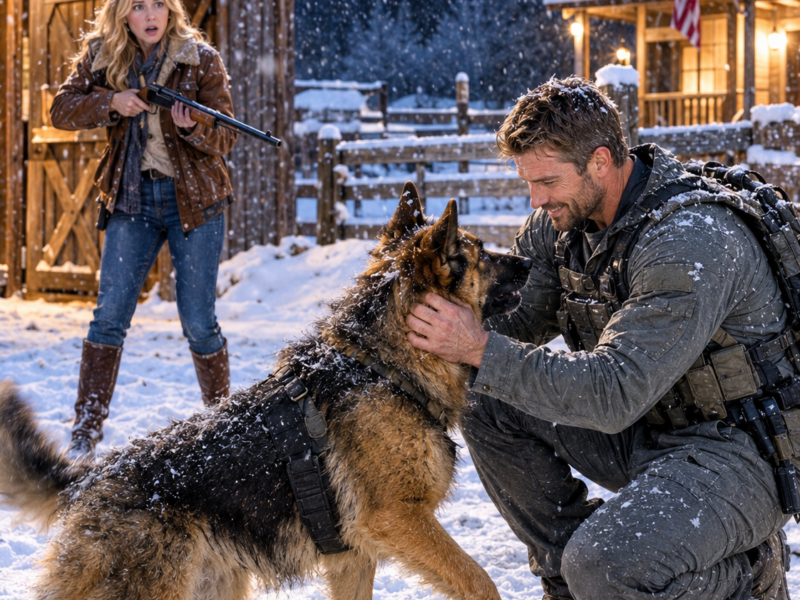
“The auctioneer laughed when I spent my last $3,000 on an abandoned military K9 nobody wanted, warning me that the scarred German Shepherd was too dangerous for a quiet ranch
I kept one hand on the shotgun beside the door, though I hated the way it felt in my grip.
Daniel Hayes stood on my porch with rain running off his jacket, looking less like a man who had come to threaten me and more like someone who had driven a hundred miles carrying a terrible secret.
Behind him, Ranger barked once from the darkness.
Daniel turned toward the sound, and something in his face softened.
“He remembers,” he whispered.
“Remembers what?”
“The night I promised him I’d come back.”
I didn’t lower the shotgun.
“You have about thirty seconds to explain why a Navy SEAL is standing on my porch at midnight, telling me stories about a dog I bought yesterday.”
Daniel nodded as though he’d expected nothing less.
“My name is Daniel Hayes. I served with Ranger for four years. He was assigned to my team before either of us knew what the other would be asked to survive.”
He reached slowly into his jacket.
“Don’t.”
He stopped immediately, both hands visible.
“Fair enough.” He glanced toward the driveway. “But before you decide whether I’m dangerous, you need to know that the people looking for Ranger may already be on your property.”
The rain tapped against the porch roof.
I looked past him toward the long stretch of gravel, the rusted cattle gate, and the dark fields beyond it.
Nothing moved.
“Who’s looking for him?”
“I don’t know everyone involved. I know enough to be worried.”
“That’s not an answer.”
“No,” he admitted. “It isn’t.”
From the outbuilding, Ranger barked again, deeper this time.
Daniel’s jaw tightened.
“He only sounds like that when he detects something he considers a direct threat.”
“Then maybe you should tell me what you brought to my ranch.”
Daniel looked at me for a long moment.
“May I come inside?”
I should have told him to leave.
My father had taught me never to invite trouble through a door simply because it arrived with a convincing explanation. But I also remembered the way Ranger had stared down the driveway before Daniel’s truck appeared, as if the dog had recognized a danger I couldn’t see.
I stepped aside.
“Keep your hands where I can see them.”
Daniel entered and stopped just inside the kitchen, taking in the chipped cabinets, the stack of unpaid bills near the refrigerator, and the family photograph on the wall.
My father stood in the picture beside a young version of me, both of us smiling beneath the ranch’s old wooden sign.
Daniel’s eyes lingered on it.
“Your father owned this place?”
“Until he died.”
“I’m sorry.”
The sincerity in his voice caught me off guard.
I set the shotgun against the wall but kept it within reach.
“Start talking.”
Daniel removed a small, waterproof envelope from his jacket and placed it on the kitchen table.
Inside was a photograph.
It showed three soldiers standing beside a military vehicle in a dusty landscape. One was Daniel, younger and thinner, with a rifle slung over his shoulder. Another man stood beside him, smiling at something outside the frame.
Between them sat Ranger, wearing a working harness.
The dog looked almost exactly as he did now, except for the scar that had not yet marked his shoulder.
I studied the smiling soldier.
“Who’s that?”
“Ethan Hayes. My younger brother.”
I looked up.
“The man Ranger saved.”
Daniel nodded.
“Three years ago, our unit was sent to extract a small team from a remote position after an operation went bad. We were supposed to be in and out before sunrise. Instead, the route we were given led us straight into an ambush.”
His voice remained controlled, but his fingers tightened around the edge of the table.
“Ethan was hit when the vehicle went down. We took cover behind a collapsed wall, and the radio went dead. We were outnumbered, pinned down, and running low on ammunition.”
He paused.
“Ranger was trained to locate people, detect explosives, and follow commands under fire. But that night, he did something nobody had trained him to do.”
“What?”
“He refused to leave Ethan.”
Daniel’s gaze moved toward the window.
“When the rest of us were ordered to fall back, Ranger stayed beside my brother. Ethan couldn’t move, and the incoming fire was getting closer. I tried to get to him, but my commanding officer pulled me back because he believed the position was about to collapse.”
“You left your brother?”
The question came out harsher than I intended.
Daniel didn’t flinch.
“Yes.”
The single word carried more pain than any explanation could have.
“I followed the order. I told myself I’d return with help. I told myself there was no other choice.”
He rubbed a thumb over a small scar on his knuckle.
“Ranger ignored the command to retreat. He dragged himself back through the debris and stayed with Ethan until another team reached them. My brother survived because that dog refused to abandon him.”
I glanced at the photograph again.
“So why was he labeled dangerous?”
“Because the official report said Ranger had attacked a soldier during the recovery operation.”
“Did he?”
“Not the way they claimed.”
Daniel explained that when the rescue team arrived, one of the soldiers tried to pull Ethan away without checking the area. Ranger, exhausted and injured, lunged at him and caught his sleeve. The soldier fell, hit his head, and later described the encounter as an unprovoked attack.
“Ranger was trying to stop him from moving Ethan through an area he believed was unsafe,” Daniel said. “He had been trained to identify danger. He was still doing his job.”
“But the report blamed him.”
“The report blamed him for disobeying orders, too. The incident became an excuse to remove him from active duty. They called it a behavioral problem.”
I remembered the auction listing.
Special handling required.
Three handlers.
A dog nobody wanted.
“And you let them sell him?”
Daniel looked down.
“I didn’t know he was being auctioned until yesterday.”
“Convenient.”
“I know how it sounds.”
“You expect me to believe nobody told you?”
“No. I expect you to question me.”
That answer was so unexpected that I had no immediate response.
Daniel continued.
“After the operation, Ethan spent months in recovery. I tried to get Ranger transferred to a rehabilitation program, but the paperwork kept getting delayed. Eventually, I was told he had been placed in a facility for dogs with serious behavioral issues.”
“And then?”
“And then the facility stopped returning my calls.”
The kitchen seemed to grow colder.
“Why didn’t you go there?”
“I did. I was told Ranger had been transferred. No one could tell me where.”
He pushed the photograph toward me.
“Three days ago, someone contacted Ethan and asked whether he still had a relationship with a military working dog named Ranger. The person claimed they were conducting an administrative review.”
“Who was it?”
“A man using a private number. He knew details that weren’t in the public record. He knew Ethan had been injured, knew Ranger had been present, and knew the official story had been disputed.”
Daniel reached into his pocket again, then stopped when he saw my expression.
“Phone,” he said. “I’m taking out my phone.”
He placed it on the table and opened a message.
The text contained a photograph of Ranger at the auction yard, taken from behind a fence.
Beneath it was a single sentence.
Confirm the dog’s final location. Do not contact the former handler.
I read it twice.
“Who sent that?”
“An account that disappeared before we could trace it.”
“Why would anyone care where a retired dog lives?”
“That’s the question that brought me here.”
A sharp metallic clatter sounded outside.
Ranger exploded into barking.
Daniel moved toward the back door, but I caught his sleeve.
“Wait.”
He stopped.
For the first time since he had arrived, I saw something like fear break through his composure.
“Your dog is warning us,” he said. “We need to listen.”
We switched off the kitchen light.
The ranch fell into darkness, broken only by the pale glow of the porch bulb.
Daniel stood near the window, watching the outbuilding. I took the flashlight from a drawer and moved toward the rear door.
He caught my wrist gently.
“Stay inside.”
“This is my ranch.”
“And if someone is out there, they may be counting on you to come outside alone.”
I pulled my hand free.
“Then we’ll go together.”
For a moment, he looked as if he wanted to argue.
Then he nodded.
We stepped onto the porch, keeping close to the wall. Rain had softened the gravel into mud, and the air smelled of wet earth and cold iron.
Ranger stood at the outbuilding entrance, his body rigid, his ears fixed toward the far fence line.
I aimed the flashlight where he was looking.
The beam caught a dark shape near the gate.
Then it disappeared.
“Did you see that?” I whispered.
“Yes.”
Daniel moved a few steps forward, scanning the fence without making sudden movements.
Ranger lowered his head and sniffed the ground. His growl deepened into something almost mechanical.
I followed the beam toward the gate.
A section of wire had been cut cleanly.
Beyond it, the grass was flattened in a narrow trail leading toward the old equipment shed my father had stopped using years ago.
“Someone came onto my property,” I said.
Daniel crouched beside the cut wire.
“They didn’t come to steal livestock.”
“How can you tell?”
“No footprints leading toward the barn, no attempt at the house windows. They came directly to this side of the ranch.”
“Why?”
He looked toward the shed.
“I don’t know yet.”
I wanted to call the sheriff, but Daniel asked me to wait while we checked that no one was still nearby. We moved only as far as the equipment shed, keeping the flashlight low.
The padlock hung open.
I was certain I had locked it that afternoon.
Inside, the air smelled of old hay, oil, and damp wood. Tools hung where my father had left them. A broken tractor tire leaned against the wall. Dust covered a workbench beneath a small window.
Nothing appeared to be missing.
Then Ranger entered.
He moved past the tools and stopped at the back wall, where an old metal cabinet stood beneath a shelf of rusted horseshoes.
His nose pressed against the cabinet door.
He whined.
Daniel’s expression changed.
“Has he been in here before?”
“No. I brought him to the ranch yesterday. I’ve barely had time to show him the pasture.”
Ranger scratched once at the cabinet.
I opened it.
Inside were old veterinary records, receipts, my father’s tax papers, and a dented tin box I remembered from childhood. Dad had always told me it held spare keys and nothing worth worrying about.
The box was gone.
In its place sat a small black object that didn’t belong among the paperwork.
Daniel leaned closer.
It was a compact storage drive, sealed inside a clear waterproof case.
A strip of white tape had been wrapped around it, and someone had written a single word in black marker.
RANGER.
I stared at it.
“Did you bring this?”
“No.”
“Do you know what it is?”
Daniel shook his head, but his eyes had narrowed.
“Don’t touch it with your bare hands.”
I stepped back.
“Someone broke into my shed, left this in my father’s cabinet, and wrote the dog’s name on it. You’re telling me you have no idea why?”
“I’m telling you the truth.”
“Then why does it feel like everybody knows something about my ranch except me?”
Daniel didn’t answer immediately.
He looked around the shed as though he were seeing it through someone else’s eyes.
“Because whoever left this may believe your father was involved in something connected to Ranger.”
“My father raised cattle. He fixed fences. He argued with the county about water rights. He wasn’t involved in military operations.”
“I didn’t say he was.”
“But you’re thinking it.”
“I’m thinking somebody went to considerable trouble to leave a message here rather than send it to me.”
The thought settled between us.
My father had been dead for eleven months. In that time, I had sorted his belongings, paid his debts where I could, and tried to keep the ranch from slipping away from me. I had found nothing that suggested he had secrets beyond the ones he kept about his failing health.
I reached for the storage drive, then stopped.
“Whoever did this could have put it anywhere. Why leave it here?”
Daniel looked at Ranger.
“Maybe the dog was the point.”
We returned to the farmhouse and called Sheriff Lena Brooks, who had known my father for years. She arrived twenty minutes later with a deputy, her raincoat shining beneath the porch light.
She inspected the cut fence, photographed the open shed, and sealed the storage drive in an evidence bag.
When she heard Daniel’s account, she studied him carefully.
“You’re saying someone has been tracking this dog since before the auction?”
“I’m saying somebody wanted to know where he went afterward.”
“And you came here without notifying law enforcement?”
“I didn’t know whether I could trust the people who might be involved.”
The sheriff’s expression hardened.
“That’s a dangerous assumption, Mr. Hayes.”
“So is assuming everyone with a badge has the same information.”
For a second, I thought she might order him off the property.
Instead, she turned to me.
“Your father ever mention a military contractor? A government investigation? Anything unusual about the ranch?”
“No.”
She glanced toward the darkened window.
“Any visitors you couldn’t explain?”
I thought of the last few months of Dad’s life. He had become quieter, more protective of his workshop, and increasingly insistent that I keep the old equipment shed locked.
At the time, I assumed he was frustrated by the bank notices and the possibility of losing the ranch.
“There was a man who came by last spring,” I said slowly. “Dad met him in the barn. They argued, but I couldn’t hear what they were saying. The man left in a gray SUV.”
“Did you recognize him?”
“No. Dad told me he was a land surveyor.”
The sheriff wrote something in her notebook.
“Did you believe him?”
“I didn’t have a reason not to.”
She looked at Daniel.
“Do you recognize the description?”
“No.”
Ranger had settled beside the kitchen table, his chin resting on his paws, but his eyes remained fixed on the hallway.
When the sheriff approached him, he lifted his head and watched her hand.
She stopped several feet away.
“Smart dog,” she murmured.
“He’s not dangerous unless he believes someone is a threat,” Daniel said.
“Most people say that about their dogs.”
“He’s not my dog anymore.”
The words came out quietly.
Ranger’s ears shifted toward him.
Daniel looked away.
The sheriff took the storage drive to her vehicle, promising to send it to a digital evidence technician first thing in the morning. Before leaving, she told me not to approach the shed alone and to call if I saw anyone near the property.
Then she pulled me aside on the porch.
“Your father helped me once when I was new to this county,” she said. “He was a stubborn man, but he was honest with me. If someone is using his land for something, I want to know.”
“So do I.”
“Then don’t let this man’s military background convince you he’s telling the whole story.”
I glanced through the window at Daniel.
“I won’t.”
After she left, Daniel sat at my kitchen table and rubbed both hands over his face.
The exhaustion I had noticed earlier now looked almost physical, as if he had been carrying it for years.
“Why did you come alone?” I asked.
“Because I didn’t know who else might be watching.”
“That’s not what I mean. You said Ethan was alive. Why didn’t you bring him?”
“Ethan’s still dealing with the injuries from that operation. He walks with a cane on bad days, and he has nightmares that leave him unable to sleep. When the message arrived, he recognized the details immediately.”
“What did he tell you?”
Daniel stared at the photograph on the table.
“He said, ‘If they’re asking about Ranger now, it means somebody finally found what we lost.’”
I waited.
“What did you lose?”
“I don’t know for certain.”
“You keep saying that.”
“Because I’m trying not to turn a suspicion into a fact.”
He explained that during the operation three years earlier, the team had been assigned to recover a sealed case from a temporary field station. The case was supposed to contain routine technical records. But after the ambush, it disappeared from the inventory.
The official investigation blamed the chaos of the evacuation.
Ethan had later told Daniel that he remembered seeing a soldier carrying the case away from the damaged vehicle, even as the rest of the team was being ordered to withdraw.
“He thought it was strange,” Daniel said. “But he was badly injured, and the details were confused. By the time he could give a full statement, the report had been closed.”
“And you think the drive contains information about that case?”
“I think it might. I also think somebody believed your father could help them find it.”
My stomach tightened.
“What could my father possibly know?”
Daniel looked toward the hallway.
“Maybe nothing. Maybe he found something on his land. Maybe the person who left that drive wanted us to believe he did.”
A floorboard creaked.
Ranger stood and walked into the hallway.
I followed him to my father’s old bedroom, which I had barely changed since his death. His flannel shirt still hung behind the door. A pair of reading glasses rested on the nightstand beside a half-finished crossword puzzle.
Ranger stopped at the bottom drawer of the dresser.
He sniffed the handle, then looked back at me.
I opened it.
Inside lay folded shirts, a collection of old photographs, and a leather notebook I had never seen before.
The notebook was wrapped in a plastic grocery bag.
On the first page, Dad had written a date from four years earlier.
Below it were several lines of numbers, a rough map of our eastern pasture, and a note in his unmistakable block handwriting.
If the dog ever returns, check the north marker.
I read it aloud.
Daniel stepped beside me.
“What date is that?”
“Four years ago.”
He took the notebook carefully and studied the map.
The north marker was a stone post near the far end of the property, close to a dry creek bed that divided our pasture from an abandoned mining road.
I had passed it hundreds of times.
“What does it mean?” I asked.
Daniel shook his head.
“I don’t know.”
Ranger gave a low whine.
I looked down at him.
The dog’s amber eyes were fixed on the notebook.
For the first time since I had bought him, I reached toward his head without thinking.
He stiffened, then remained still as my fingers touched the fur between his ears.
Daniel watched in silence.
“He trusts you,” he said.
“I don’t think he knows me well enough to trust anyone.”
“Trust doesn’t always start with knowing. Sometimes it starts with someone giving you room to decide.”
I pulled my hand back.
“Then tomorrow, we go to the north marker.”
Daniel nodded.
But when I went to lock the front door, I noticed something on the porch floor.
A small envelope had been pushed beneath the door while we were inside.
No stamp.
No return address.
Just my name, written in careful black letters.
Inside was a single photograph of my father standing beside the north marker, his face turned toward a man in a gray SUV.
The date printed on the back was from four years earlier.
Beneath it, someone had written:
Your father kept his promise. Make sure you keep yours.
I showed it to Daniel.
He studied the photograph, then looked toward the dark fields beyond the window.
“Now we know why they came tonight,” he said.
“Because of the drive?”
“Because of the promise.”
“What promise?”
He looked at me, and I saw that he was afraid of the answer.
“I think your father promised someone he would keep what they found out there hidden.”
At dawn, we drove to the north marker in my battered pickup, with Daniel beside me and Ranger in the back seat.
The rain had stopped, leaving the fields silver with moisture. Low clouds hung over the distant mountains, and the creek bed was filled with dark mud and scattered stones.
Ranger stood beside the truck while we studied the marker.
It was an old limestone post, worn smooth on one side. Dad had used it as a reference point when he repaired the eastern fence, but I had never noticed the narrow metal plate screwed into its base.
Daniel crouched to inspect it.
“Can you read that?”
I wiped away the dirt with my sleeve.
Three numbers were stamped into the plate.
They matched the first three digits in Dad’s notebook.
The rest of the numbers formed a coordinate.
Daniel pulled out his phone and entered them into an offline map.
A point appeared several hundred yards down the creek bed.
“Your father marked something here,” he said.
We followed the coordinates to a cluster of boulders near the abandoned mining road. Ranger moved ahead, nose close to the ground, then stopped beside a flat stone half-buried in the mud.
He pawed at it once.
I knelt and brushed away the loose dirt.
Beneath the stone was a small metal box, corroded around the edges but sealed with a newer locking clasp.
My hands shook as I lifted it free.
The box was heavier than it looked.
Daniel examined the clasp.
“Someone replaced this recently.”
“Who?”
“Maybe whoever came to the shed.”
He worked the clasp open with a small tool from his pocket.
Inside lay a waterproof pouch, several folded documents, and a tiny digital recorder.
The top document was a copy of a military transfer form.
It listed a sealed technical case as recovered after the operation three years earlier. The signature authorizing its transfer belonged to a senior logistics officer named Colonel Marcus Voss.
Daniel stared at the name.
“I know him.”
“Who is he?”
“He was responsible for coordinating equipment and records for our operation. He was also the officer who approved Ranger’s retirement review.”
I looked from the document to the recorder.
“Could he have been the one who blamed Ranger?”
“I don’t know. But he had access to the paperwork, and he knew where the missing case was supposed to go.”
The second document was a handwritten statement from my father.
It described how, four years earlier, he had found a damaged vehicle abandoned near the mining road after a storm. Inside, he discovered a sealed container and a man with a badly injured leg.
My father had called for help and kept the man warm until an ambulance arrived.
The man had asked him to hide the container.
Dad had refused at first.
But the stranger had warned him that the records inside could expose people who were using military contracts to divert equipment and falsify reports. He feared the container would disappear if it entered the official chain of custody.
My father had hidden it temporarily, then tried to contact an investigator whose name appeared in the documents.
Before the meeting could happen, the stranger died in the hospital.
Dad had kept the evidence because he believed someone would eventually come looking for it.
The final paragraph was brief.
I don’t know who is telling the truth anymore. I only know that the dog was there, and the dog saw what happened. If they ever come asking about him, the records must be found before they reach the people who want them destroyed.
I lowered the page.
“Dad knew about Ranger before I bought him.”
Daniel looked sick.
“He may have known about the operation, not necessarily the dog’s identity. The dates are close enough that he could have connected the two later.”
“But he wrote, ‘If the dog ever returns.’”
Daniel turned to the recorder.
“We need to hear what’s on this.”
He pressed the play button.
Static crackled, followed by a man’s strained voice.
“If this recording reaches anyone outside the chain of command, my name is Sergeant Paul Mercer. I was assigned to transport the case after the operation. I was ordered to change the inventory records and report that the case had been destroyed.”
A pause.
“I refused. The case contained copies of procurement records showing that equipment had been diverted through shell companies and charged to military contracts that never delivered what they promised. I was told the investigation would be buried, and that anyone who spoke would be accused of theft.”
The voice became quieter.
“I took the case because I believed it was the only way to preserve the evidence. I was injured before I could reach the investigator who agreed to meet me. A rancher found me. He hid the records because I asked him to, and he didn’t know who he could trust.”
A long silence followed.
Then the man spoke again.
“There was a working dog with the team. He tried to stop the wrong people from moving the injured soldier. If anyone has blamed that dog for what happened, they should know this: he did his job better than the people who gave the orders.”
The recording ended with a click.
I sat back on my heels.
For several seconds, the only sound was the wind moving through the grass.
“Your father kept this safe for four years,” Daniel said.
“And someone knew where it was.”
He nodded.
“Which means the person who came to the shed may not have been searching randomly. They may have known your father left a trail.”
I held the documents against my chest.
“My father died thinking he might have to protect this forever.”
“Maybe he thought the danger had passed.”
“Or maybe he thought no one would ever find it.”
Ranger approached and pressed his shoulder against my knee.
I rested my hand on his back.
The dog had been sold as a problem, passed between handlers, and labeled dangerous because he refused to obey an order that would have left a wounded man behind.
Now I understood why someone wanted him located.
He was a living piece of a story that powerful people had tried to erase.
We returned to the ranch and called Sheriff Brooks.
This time, Daniel gave her everything: the documents, the recording, the message, and the photograph of my father. She arranged for the evidence to be transferred directly to a state investigator and an independent military oversight office, with copies stored securely outside the county.
She also asked Daniel to contact Ethan and have him prepare a formal statement.
By noon, the first call came.
A woman from the oversight office confirmed that Colonel Voss was under preliminary investigation for falsifying records and diverting equipment through contractors linked to several military supply accounts. The evidence from the ranch could support the inquiry, but they would need witness statements and a chain of custody that could withstand scrutiny.
Then the woman added something that made Daniel grip the phone harder.
“Colonel Voss has been notified that a review is underway. We cannot guarantee he knows about the recovered documents, but we advise you not to approach him.”
Daniel thanked her and ended the call.
“He knows someone is moving against him,” he said.
“Can’t the authorities protect the evidence?”
“They can. But if he thinks Ranger is the last witness to something he can’t control, he may try to reach the dog before the investigation gets far enough.”
As if he understood, Ranger rose from his place beside the kitchen table and walked toward the window.
A vehicle was approaching the ranch.
This time it was not a dark pickup.
It was a gray SUV.
I recognized it from the photograph.
The vehicle stopped beside the porch, and a man in a charcoal coat stepped out. He was in his late fifties, with silver hair and a polished, composed face.
He looked at the farmhouse as though he had every right to be there.
Daniel moved between the window and the kitchen.
“Stay behind me.”
“No.”
He glanced at me.
I took the evidence bag containing the copy of my father’s statement and placed it in a kitchen drawer.
Then I opened the front door, keeping the screen door between us.
The man smiled politely.
“You must be the owner of the property.”
“I am.”
“My name is Marcus Voss. I understand you’ve acquired a retired military dog.”
Daniel appeared behind me.
Voss’s smile faded a fraction.
“Hayes. I was wondering when you’d show up.”
“You should have wondered why I would.”
“I’m here to resolve a misunderstanding.”
“You’ve had three years to resolve it.”
Voss glanced toward the outbuilding.
“I’d like to see the dog.”
“You can speak to the sheriff about that,” I said.
His eyes moved back to me.
“I understand your father was a careful man. He knew how to keep things where they belonged.”
The words were quiet, almost friendly.
But my skin prickled.
“You knew my father?”
“I met him once.”
“Then you know he didn’t appreciate people showing up uninvited.”
Voss’s expression hardened.
“Your father made a mistake by involving himself in matters he didn’t understand. I would hate to see you repeat it.”
Daniel stepped forward.
“Are you threatening her?”
“I’m offering advice.”
“Then offer it to the investigator who called your office this morning.”
For the first time, Voss looked genuinely unsettled.
Only for a second.
Then he adjusted his coat and returned to his practiced smile.
“I don’t know what you think you found, but old records can be misleading. The military has procedures for handling disputed material. If you turn over whatever you’ve discovered, we can avoid unnecessary trouble.”
“You mean you can make it disappear,” I said.
His gaze sharpened.
“You have no idea what you’re dealing with.”
“Maybe not. But I know what my father believed was worth protecting.”
I opened the screen door wider, not to invite him in but to make it clear I wasn’t afraid to face him.
“He left evidence. The sheriff has it. The oversight office has it. And if anything happens to me, Daniel, or Ranger, they’ll know exactly where to start looking.”
It wasn’t entirely true. The originals were secure, but I had no idea how many copies existed.
Still, Voss hesitated.
That was enough.
He stepped back toward his SUV.
“This is not over.”
“No,” Daniel said. “It isn’t.”
Voss drove away without another word.
I watched until the vehicle disappeared beyond the gate.
Then my knees began to shake.
Daniel didn’t touch me. He simply stood beside me until I could breathe normally again.
“You did well,” he said.
“I was terrified.”
“Those things can both be true.”
That afternoon, Ethan arrived.
He came in a rental car with a cane resting beside the passenger seat, a broad-shouldered man whose face looked older than his years. Daniel met him in the driveway, and for a moment neither brother spoke.
Then Ethan reached out and gripped Daniel’s shoulder.
“You found him.”
Daniel nodded toward Ranger.
The dog stood near the outbuilding, watching Ethan with cautious attention.
Ethan approached slowly and knelt with effort, leaving his hands open at his sides.
“Hey, Ranger,” he said softly. “You remember me?”
Ranger tilted his head.
Ethan gave a small, broken laugh.
“I suppose I look different.”
He didn’t reach for the dog.
Instead, he waited.
After a long moment, Ranger stepped forward and sniffed his hand. His ears relaxed, and he leaned his head against Ethan’s palm.
Ethan closed his eyes.
“I owe you my life,” he whispered.
Ranger remained beside him, calm and steady.
Daniel turned away, but I saw him wipe his face with the heel of his hand.
For the first time, I understood that the dog’s story wasn’t only about an operation or a missing case. It was about people who had survived something terrible and spent years carrying the parts they couldn’t explain.
Ethan gave his statement to the investigator that evening. His memory of the operation was incomplete, but the documents and recording supported the details he could confirm. The investigation widened over the following weeks, uncovering falsified invoices, altered equipment records, and a network of contractors who had profited from supplies that never reached the units that needed them.
Colonel Voss was removed from his position while the inquiry continued. He was eventually charged alongside two former contractors, and the case was referred for prosecution.
He never returned to the ranch.
The danger did not vanish overnight. Investigators interviewed me twice, and Sheriff Brooks arranged extra patrols until the property was secure. But the calls stopped, the unknown vehicles disappeared, and the evidence remained intact.
Daniel stayed longer than he intended.
At first, he told me he was waiting until the authorities confirmed Ranger was safe. Then he began helping me repair the fence, clear the old shed, and fix the gate that had sagged for years.
He never offered to buy the ranch or solve my financial problems. Instead, he showed me how to make a realistic plan for the cattle, which repairs could wait, and which local buyers paid fairly rather than taking advantage of people in trouble.
Ethan came back on weekends when his appointments allowed. He and Daniel sat on the porch with coffee, sometimes talking about the operation, sometimes about nothing important at all.
Ranger seemed to know when the conversation became difficult. He would settle between them, his body touching one brother’s boot and his head resting near the other.
One evening, a few months after the investigation began, I found Daniel standing beside the north marker.
The sun was setting behind the mountains, turning the grass copper and gold.
“You’re leaving,” I said.
He looked over his shoulder.
“I need to get back to my life. Whatever that looks like now.”
“Do you know what it looks like?”
“Not yet.”
He glanced toward the farmhouse, where Ranger lay on the porch, watching us.
“I spent a long time thinking I had failed my brother because I followed an order. I kept replaying that night, wondering if I should have disobeyed and gone back for him.”
“You couldn’t have known how it would end.”
“No. But Ranger did something I couldn’t.”
“He didn’t think about how it would look on a report.”
Daniel smiled faintly.
“Exactly.”
I looked down at the limestone marker.
“My father kept a promise to a man he barely knew. He must have been frightened.”
“He probably was.”
“Then why do it?”
Daniel considered the question.
“Maybe because he knew what it meant to be the only person left who could help.”
I thought about the months I had spent trying to save the ranch, about how often I had been tempted to sell it simply to stop feeling responsible for everything my father had left behind.
“I used to think keeping this place meant holding on to him,” I said. “Some days it felt like I was burying myself with him.”
Daniel listened without interrupting.
“Now I think maybe I can keep the ranch without living inside the past.”
“That sounds like a good place to start.”
When he left two days later, he didn’t make promises he couldn’t keep.
He told me he would visit, and I believed him because he had finally learned that returning mattered more than saying he would.
The next spring, I used the last of my savings to repair the barn roof and replace the broken section of fence. The ranch was still a struggle, but it was no longer a place I was trying to preserve out of guilt. It was a place I had chosen.
Ranger changed, too.
He began sleeping inside the farmhouse instead of sitting all night by the door. He learned the sound of the feed truck, the rhythm of the cattle moving through the pasture, and the particular creak of the porch step beneath my boots.
He never became a dog who greeted every stranger with a wagging tail.
Some evenings, he still watched the driveway for long stretches, his ears alert to distant engines and the movement of shadows beyond the gate.
I no longer mistook that vigilance for anger.
One warm afternoon, Ethan visited with Daniel. He brought a new collar for Ranger, plain and sturdy, with a small metal tag engraved with the dog’s name.
No military number.
No warning.
Just RANGER.
Ethan knelt to fasten it, and Ranger stood patiently beside him.
“I wish I could explain what you did for me,” Ethan said, scratching the dog beneath the chin. “But I don’t think you’d care about the words.”
Ranger nudged his hand.
Daniel laughed softly.
“He never did care about speeches.”
I watched them from the porch, the three of them framed against the open pasture.
For years, I had believed the ranch was the thing I had inherited from my father.
I understood now that it was also the place where his quiet choices had survived him, waiting for the right people to find them.
That night, I locked the farmhouse door and left the porch light on.
Ranger settled beside my chair, his head resting against my knee, while the last light faded over the fields.
For the first time since my father died, I didn’t feel as though I was guarding an empty house.
I felt as though I was home.
THE END.









