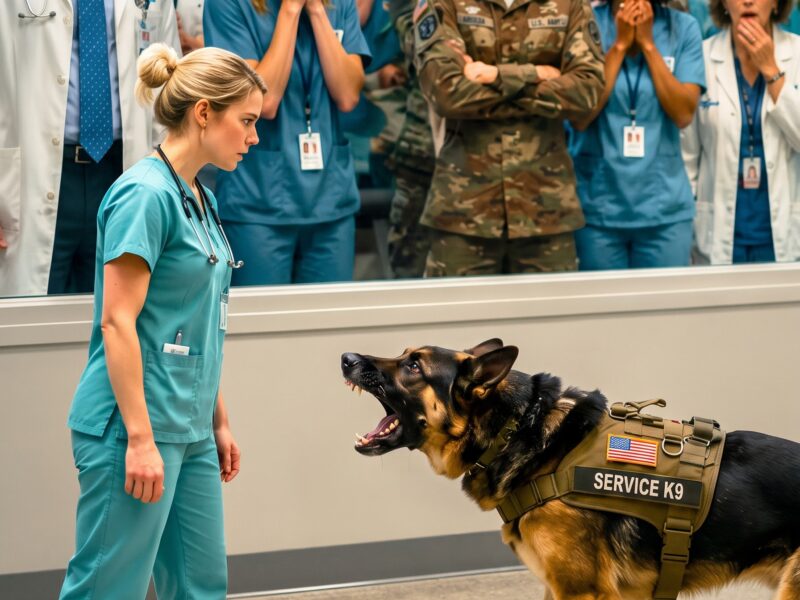
The Army commander dismissed me as “just a floor nurse” when I knelt beside a collapsed K9 outside the base hospital
The disinfectant at Fort Meade’s secondary clinic never quite masked the scent of copper and dust. For two years, I had learned to move like a ghost between the stainless steel charting stations and the recovery wards. I wore powder-blue hospital scrubs that softened my broad shoulders, kept my fingernails trimmed down to the pink, and answered whenever someone snapped their fingers and called for “Nurse Miller.” In a military hospital, civilian contract nurses were scenery. You were expected to take temperatures, wipe up spilled saline, empty bedpans, and keep your mouth shut while the officers talked about the real work.
Colonel Gregory Vance was one of those officers who wore authority like a heavy winter coat. He stood in the vestibule connecting the emergency intake to the rear tactical lot, his desert-camo sleeves rolled neatly to his forearms, hands locked behind his back. Between his spit-shined combat boots lay ninety pounds of convulsing Belgian Malinois.
The dog was slick with cold sweat, his black-and-tan flanks heaving in frantic, broken gasps. Beside him knelt a young specialist, barely twenty-two years old, his hands hovering over the animal’s ribs with the desperate, paralyzed tremor of someone watching his best friend die.
“He just collapsed during the obstacle run, sir,” the specialist stammered, his eyes wide and bloodshot. “We were doing the three-mile loaded march. He hit the ditch, convulsed twice, and dropped. His tongue is already turning gray.”
Colonel Vance didn’t look at the kid. He looked across the hallway, spotted me wheeling a cart of clean linen toward the supply closet, and flicked his wrist in dismissal.
“Get the floor nurse,” Vance said, his voice flat with indifference. “Keep him comfortable until Veterinary Corps gets off their asses and sends someone from the depot.”
I pushed the cart aside and hurried over. The linoleum was freezing beneath my knees as I dropped beside the animal. Vance didn’t even shift his boots out of the way. He looked down at my bent head, gave a faint sneer of distaste, and muttered, “Just keep him hydrated. If he goes into cardiac arrest, don’t waste the defibrillator. He’s an asset, but he’s not an officer.”
I didn’t answer. I didn’t care about Vance’s petty arrogance. All I saw was the dog.
He wasn’t an ordinary military working dog. His pelt bore the distinct parallel scars along the spine that came from fast-rope harness friction. Beneath his left ear was a tiny notched brand—a jagged double chevron.
“Shadow,” the handler pleaded, snapping his fingers in front of the glassy amber eyes. “Shadow, look at me. Up, buddy. Come on.”
The dog’s pupils were blown wide, fixed on nothing. His airway was rattling with thick, viscous fluid. Classic organophosphate reaction—or an anticholinergic block induced by a synthetic neurotoxin. It wasn’t heat stroke. You didn’t get pinpoint muscular tremors in the jaw from exhaustion.
Without thinking, my fingers slipped under the curve of his mandible, right against the carotid bifurcation. I pressed two fingers deep into the nerve cluster behind his ear, applying the precise rhythmic pulse that relieved sympathetic overload in high-drive tracking breeds.
“Easy, boy,” I murmured under my breath. “Breathe through the throat. Rustig.”
The Malinois shuddered. His tongue retracted. The frantic panting slowed, falling into a deep, shuddering lungful of air. His golden eyes, clouded with venomous confusion, rolled backward and suddenly snapped into sharp focus.
The young handler froze, his jaw slack. “How… how did you do that? He bites anyone who touches his muzzle. He took three stitches out of the vet’s arm last month.”
“He was suffocating on his own tongue,” I said softly, keeping my eyes fixed on the floor. “Laryngeal spasm. You relieve the cranial nerve pressure.”
It was a lie. You don’t learn that trick in civilian nursing school. You learn it in subterranean bunkers in Jordan when your animal has breathed aerosolized dust during an extraction and you have thirty seconds to keep him from choking to death before the extraction bird touches down.
Before Vance could question it, Shadow’s entire body went rigid.
His ears didn’t just rise; they swiveled forward, locking onto the corridor behind me like twin radar dishes. The hair along his spine stood up in a stiff, three-inch ridge. A low, subterranean vibration started deep inside his ribcage—not the defensive bark of a frightened animal, but the coiled, predatory warning of an assault canine preparing to kill.
“Everyone move back,” I said. My voice wasn’t the timid, quiet hum of Nurse Miller anymore. It cut through the air like cold steel.
Colonel Vance’s eyes narrowed into hard slits. “Is that an order, nurse?”
“No,” I replied, standing up slowly and placing myself directly between Vance and the dark hallway leading to the basement archives. “It’s a warning.”
Shadow scrambled to his feet. His bad leg buckled once, but he drove his claws deep into the waxed linoleum, ignoring the pain. He ignored his handler entirely. He pushed past the specialist’s knees, stepped directly to my right hip, and matched my stance, shoulder-to-knee.
He lowered his snout to the floor, sniffing along the edge of a heavy stainless-steel supply cart.
I knelt again. Caught under the wheel bracket was a two-inch strip of thick, ballistic nylon webbing. It was charred at the edges, coated in a fine layer of dry graphite powder.
I plucked it loose.
Vance stepped in, his boots clicking heavily. “What is that?”
“Part of a tactical harness,” I said, rubbing the coarse weave between my thumb and forefinger. “Mil-spec 800-denier Cordura. Treated for night-vision absorption.”
Vance’s face darkened with instant suspicion. He reached toward his holster, his hand resting casually on the flap. “And how would a third-shift floor nurse know the difference between nylon straps and tactical Cordura?”
I swallowed against the dry knot in my throat. The hospital hummed around us. “Because I used to wear one.”
The silence in the hallway was immediate. Even the fluorescent tubes seemed to buzz louder in the vacuum.
“You were military?” Vance asked, taking a half-step closer, his eyes scanning my face, searching for scars I had spent five years covering with foundation.
“Years ago.”
“What branch? What unit?”
I didn’t answer him. Instead, I clicked my tongue twice against the roof of my mouth and muttered a single, guttural syllable in Hungarian: “Keresd.”
Shadow didn’t look at his handler. He didn’t wait for a leash. He broke into a low, silent trot, heading straight past the pharmacy window, past the empty triage rooms, and stopped in front of the reinforced steel fire door of Sub-Basement Archive Three.
He sat. He didn’t bark. He simply pointed his muzzle at the keycard lock.
Vance pulled his master badge from his pocket, his jaw clenched, and swiped the reader. The heavy latch clicked open.
Inside, the room was cold and smelled of damp cardboard and stagnant air. The shelves were loaded with old paper manifests from decommissioned brigades. But on the center inspection table, bathed in the gray spill of emergency light, sat an olive-drab Pelican case.
Stenciled across the lid in faded black lacquer was an emblem that made my heart hammer against my ribs: an inverted silver dagger encircled by a coiled viper.
Task Force 37. The black-budget special reconnaissance element that had been officially erased from the Army’s books following the disaster at the Qalat Ridge.
Vance turned toward me, his hand fully on the grip of his sidearm now. “Who the hell are you?”
Before the words cleared his lips, Shadow began to growl.
The dog didn’t turn toward the dark corners. He didn’t face the door. He turned around, bared his long ivory canines, and leveled his snout directly at my chest.
I looked down.
Poking out from beneath the blue plastic laminate of my Mercy Hospital employee badge was a tiny, wafer-thin circuit board. A red micro-LED was pulsing at three-second intervals.
A passive RFID locator.
Someone had slipped it behind my ID during my shift. Someone who knew I was here. Someone who knew the dog would lead them straight to the archive.
I ripped the badge from my lanyard and crushed the plastic casing under my shoe.
My personal cell phone buzzed violently in my scrub pocket. One message from an unknown encrypted sender lit up the screen:
We know Shadow remembers you, Rachel. The Ridge wasn’t finished. See you in the dark.
I looked up from the screen. Vance was staring at me, his weapon half-cleared from its leather holster, his eyes full of cold realization.
Shadow pressed his flank hard against my thigh, his teeth clicking together in a silent snarl directed at the empty darkness of the hallway outside.
Nobody in that room was calling me a floor nurse anymore.
“Keep your hands where I can see them,” Colonel Vance commanded, clearing his Glock completely from the holster and holding it at low-ready. “Specialist, get on the radio. Call base security. Tell them we have a compromised facility and an unregistered asset in Sub-Basement Three.”
The young handler fumbled with his belt, but I reached out and slapped his hand down onto the radio holster.
“If you transmit on that band, you kill everyone on this floor,” I said.
Vance took a step forward, the muzzle of his weapon lifting toward my center mass. “You have three seconds to explain why I shouldn’t put a round through your kneecap, Rachel—if that’s even your real name.”
“My name is Captain Rachel Torres,” I said, meeting his eyes without blinking. “Serial number seven-four-niner, Task Force 37. And the people who left that beacon on my badge aren’t waiting outside the gate. They are already inside your perimeter wire.”
Vance’s jaw hardened, but I saw the hesitation in his eyes. A man who reaches colonel knows that some names don’t exist on standard rosters for a reason.
“Task Force 37 was deactivated six years ago,” Vance muttered, his voice dropping into a harsh whisper. “The whole command element was lost in an ordnance explosion outside Kandahar.”
“It wasn’t an ordnance explosion,” I said, pointing toward the metal Pelican case on the table. “It was an inside sweep. We recovered an encrypted hard drive from a rogue contractor pipeline called Praetorian Logistics. Before we could hand it over to the regional inspector, our command post took two thermobaric strikes from our own artillery battery. The files were listed as incinerated. Shadow and I pulled the primary backup drive out through the drainage tunnels.”
“And the dog?” Vance asked, his eyes darting toward the Malinois.
“His name isn’t Shadow,” I said softly, running my hand down the animal’s stiff back. “His callsign was Cerberus-Nine. He was bred and trained at the Kunduz clandestine kennel. He doesn’t respond to English commands because English gets you killed when local fighters are listening in the scrub. He works in Afrikaans and Hungarian.”
I looked at the case on the table. “Open it, Colonel. You’ll see why they poisoned him.”
Vance hesitated, then stepped around the table, keeping his eyes on me while his left hand popped the heavy polymer latches of the Pelican case. The seals hissed as the air broke.
Inside was no computer. There were no documents.
Sitting in custom-cut black foam was a synchronized military-grade radio frequency transmitter—its digital timer humming silently. The LED display read: 00:04:12.
Four minutes.
“They didn’t poison him to kill him,” I whispered, the cold reality settling like ice in my gut. “They knew he had respiratory scars from the Qalat fire. A mild organophosphate agent would make him drop without causing permanent damage. They knew the handler would run him to the nearest base clinic instead of waiting for an off-site veterinarian. And they knew I worked the third shift here.”
“A Trojan horse,” Vance whispered, the color draining from his face. “The beacon on your badge wasn’t to track you. It was a proximity trigger.”
“The moment I knelt next to him, the signal handshake completed,” I said. “The timer started. In three minutes and fifty seconds, that transmitter sends a high-frequency EMP burst through the clinic’s electrical grid. The primary substation will blow, the backup diesel engines will fry, and the outer perimeter gates will default to open-safe.”
“Specialist, sound the general alarm!” Vance yelled, reaching for the wall-mounted red pull station.
Before his fingers could touch the glass, the overhead lights didn’t just flicker—they turned violently red as the emergency circuit engaged prematurely.
From the floor above came the muffled thwack-thwack-thwack of suppressed automatic fire.
Two distinct double-taps. Then a third.
The security guards at the triage desk were already dead.
“They’re early,” I muttered, stripping off my scrub jacket. Beneath it, I wore a plain gray athletic shirt. I reached into the open supply cabinet behind the table, grabbed a box of heavy shears, two rolls of elastic adhesive bandage, and a twelve-gauge arterial catheter needle.
“What are you doing?” the young handler asked, his voice trembling.
“Preparing for an extraction,” I said. I looked down at the dog. “Cerberus. Hozzám.”
Shadow moved instantly, standing flush against my left knee. He looked up at me, his ears pinned back, his yellow eyes burning with the recognition of a life we had both tried to forget.
“Specialist, what’s your name?” I demanded.
“Miller, ma’am. Corporal David Miller.”
“Give me your sidearm, Corporal.”
Miller looked at Vance. Vance stared at the Pelican case, listening to the muffled combat boots advancing down the concrete stairs at the end of the hall. The tactical situation had completely outpaced his rank.
“Give it to her, Miller,” Vance said quietly, drawing his own backup weapon from his ankle holster. “We have four entry points to this basement. If they have suppressed submachine guns, they aren’t here to negotiate.”
Miller unholstered his M17 pistol and handed it to me. The weight of the polymer grip was familiar, an old, bitter tool returning to my palm after years of holding plastic syringes and saline bags. I checked the chamber with a single, practiced backward pull of the slide. Round in the pipe. Seventeen in the magazine.
“Colonel,” I said, keeping my voice low. “There are three men coming down the primary stairwell. Their footsteps are too synchronized for local militia. They’re moving in a three-man rolling wedge.”
“How can you tell?” Vance asked, straining to hear through the heavy concrete ceiling.
“Because,” I said, crouching beside Shadow and pointing toward the gap under the door, “Shadow isn’t smelling their boots. He’s smelling their weapon lubricant. Praetorian uses dry Teflon spray on their bolts. It smells like burnt almonds.”
The countdown on the Pelican case reached 00:00:10.
“Get behind the metal filing cabinets,” I commanded. “Down! Now!”
The counter hit zero.
There was no explosion. There was only a sharp, electric crack that felt like a needle passing through the back of my teeth. The emergency lights instantly died, plunging the archive into ink-black darkness. Every monitor, every wall clock, every backup battery in the building groaned and went dead.
Silence fell, absolute and suffocating.
Then, from the other side of the heavy steel archive door, came the scrape of a ceramic breaching charge being pressed against the lock cylinder.
The breach was deafening in the enclosed concrete space.
A sharp, violent slap of overpressure blew the lock assembly inward, showering the archive in white plaster dust and splintered steel. Through the smoking hole came a stun canister, bouncing twice across the linoleum before detonating in a blinding flash of magnesium and a concussive roar.
Vance and Miller grunted, ducking behind the heavy steel shelving, their hands clamped over their ears.
I had already turned my face to the wall, eyes shut, mouth open to equalize the pressure.
Shadow didn’t flinch. In the black-ops program, working dogs were conditioned to concussion grenades until the blast meant only one thing: food and blood.
Through the smoke stepped the first operator. He was wearing full high-cut ballistic armor, quad-tube night-vision goggles glowing faint green over his face, and carrying an integrally suppressed short-barrel rifle. The barrel swept left, searching for thermal signatures.
“Fogd!” I whispered.
Shadow launched from the shadows behind the door. He didn’t make a sound. No bark, no growl. He hit the operator’s chest like a seventy-pound artillery shell, his jaws clamping around the man’s throat just beneath the rim of the ballistic collar.
The impact drove the operator backward into the doorframe. The rifle clattered to the floor.
The second man in the stack tried to bring his weapon around, but the doorway was choked with his thrashing teammate.
I leaned around the edge of the filing cabinet, leveled Miller’s M17, and fired three rounds in rapid succession. The muzzle flash lit the room like lightning. Two rounds struck the second man’s heavy ceramic chest plate, knocking him off balance; the third found the unarmored junction between his neck and shoulder. He dropped hard, his weapon discharging wildly into the ceiling tiles.
“Clear the threshold!” I shouted.
Shadow released the first man’s crushed windpipe, spun on his haunches, and backed into the room, his teeth bared, dripping dark fluid.
The third operator didn’t push through the door. He knew the stack was compromised. We heard the rapid scuff of his boots retreating up the stairwell.
“Vance, get on his rifle!” I ordered, stepping over the fallen bodies in the doorway to retrieve the suppressed weapon from the first contractor’s rig.
Vance scrambled forward, coughing through the plaster dust, his hands shaking as he stripped the magazines from the dead man’s chest harness. The colonel was a logistics commander; he hadn’t seen close-quarters combat since the invasion of Iraq twenty years ago.
“Jesus Christ,” Vance whispered, staring down at the contractor’s tactical gear. He peeled back the velcro patch on the dead man’s shoulder.
It was a black rectangle bearing a stylized Latin inscription: Praetorian Tactical.
“They’re an American defense firm,” Vance stammered. “Their board of directors includes two retired three-star generals. They have security clearance at the Pentagon.”
“They had clearance to supply our fuel depots in Afghanistan,” I said, racking the charging handle of the captured rifle to verify the feed. “And they used that fuel convoy network to move stolen weapons, human cargo, and black-budget technology out of the country. When Task Force 37 uncovered the paper trail, Praetorian paid someone in Central Command to erase us.”
“And the drive?” Vance asked. “The drive they’re looking for?”
I pointed at Shadow.
The dog stood panting in the red gloom, his tail low, his amber eyes fixed on me.
“Shadow wasn’t just a combat tracker,” I said. “His tactical vest carried a hardened micro-transceiver connected to our unit’s central data link. When the bunker collapsed, the external housing was crushed, but the internal solid-state chip was fused into his subcutaneous medical transponder. The emergency vet who operated on him after the Qalat fire left it inside his shoulder because removing the shrapnel would have severed his brachial artery.”
Vance’s eyes widened. “The data is inside the dog.”
“Every transaction. Every bank routing number. Every name on the payroll,” I said. “For five years, they thought the drive was destroyed in the fire. But two weeks ago, this clinic updated its veterinary diagnostic software to the new DoD standard. When Corporal Miller brought Shadow in for his routine annual scan, the clinic’s digital scanner pinged the dormant chip.”
“That’s why they came,” Miller said from behind the cabinets, his face pale. “They weren’t tracking you. They were tracking the dog. And you just happened to be the one on duty.”
“No,” I said, shaking my head as the memory washed over me like cold water. “It wasn’t an accident. The message on my phone came from a satellite relay. The man running this hit team isn’t a contractor.”
I reached down and turned over the face of the second dead operative. In the dim light, I saw the distinctive tattoo on his wrist: a black Roman numeral IV.
“Major Marcus Kane,” I said, my teeth grinding together. “My former executive officer. The man who gave the coordinate grid for the artillery strike on our bunker.”
Suddenly, the hospital’s central fire suppression system engaged. Cold water began raining from the ceiling nozzles, hissing as it hit the hot barrels of our weapons.
Through the overhead speakers, a voice crackled through the static—smooth, calm, and terrifyingly familiar.
“Rachel,” Kane’s voice echoed through the wet corridors. “You always were remarkably stubborn. You survived the fire at Qalat, and now you’re making a mess of a perfectly good hospital. But you know how this ends. I have eighteen men holding the main lobby and the ambulance bay. You have an old dog with scarred lungs, an out-of-shape colonel, and a boy who barely knows how to hold his service pistol.”
Shadow let out a low, vibrating growl, his eyes fixed on the ceiling speaker.
“Send the dog out, Rachel,” Kane continued. “Give me the chip, and I’ll let the colonel and the boy walk out the front door. Stay in the basement, and I’ll vent liquid nitrogen from the laboratory storage down the utility ducts. You’ll freeze to death in ten minutes.”
I looked at Vance. The colonel was soaking wet, holding the captured rifle against his shoulder, his eyes wide but steady.
“What’s the play, Captain Torres?” Vance asked. For the first time, he used my real rank.
I looked at Shadow. The dog bumped his cold, wet nose against my palm, his breathing steady, his eyes bright with absolute trust.
“We don’t stay in the basement,” I said. “And we don’t give him the dog. We go up the laundry chute to the second floor, hit the pharmacy roof, and call in the one thing Marcus Kane didn’t plan for.”
“What’s that?” Miller asked.
I smiled, a cold, hard line across my scarred face. “A counter-ambush.”
The vertical service shaft smelled of damp lint, detergent, and rust.
It was twenty-four inches wide, designed for heavy canvas laundry bins dropped from the upper recovery wards. I went first, wedging my boots and elbows against the corrugated galvanized steel, climbing five feet at a time with the suppressed carbine slung across my back. Shadow followed in a harness I had jury-rigged from two high-tensile patient transfer sheets, his paws scrabbling against the metal as Vance and Miller pushed him from below.
Dogs don’t like vertical spaces. They panic when their feet lose the earth. But Shadow didn’t whine once. He kept his eyes locked on the soles of my shoes, his muscles trembling with effort, trusting the hands that had pulled him from the burning ruins of Qalat Ridge six years before.
We breached the second-floor service hatch into the orthopedic recovery unit.
The ward was dead quiet. The civilian patients had been evacuated during the initial brownout, leaving empty beds, dangling IV tubes, and the steady, rhythmic drip of water from the ceiling tiles. The floor was bathed in the pale, sickly yellow glow of the streetlights filtering through the heavy exterior windows.
“Miller, take the fire exit on the east corridor,” I whispered, kneeling behind a mobile charting desk. “Do not engage unless they corner you. Your only job is to get to the administrative building and tap into the hardwired landline to Fort Meade’s Provost Marshal.”
“I’m not leaving you, Captain,” Miller said, his knuckles white around his service pistol.
“You aren’t leaving me, Corporal. You’re my radio runner. Tell the Provost that Operation Black Dagger is compromised by domestic contractor assets. Use authorization code Omega-Nine-Nine. They’ll know what it means.”
Miller looked at Vance. The colonel nodded once, hard. “Go, son. That’s an order.”
Miller slipped through the shadows toward the fire door like a rabbit, his boots silent on the rubber runner.
Vance crouched beside me, checking his magazine. “That leaves you, me, and the dog against sixteen trained mercenaries.”
“Sixteen men who think they’re hunting a terrified nurse and a wounded animal,” I corrected. “They don’t know the layout of this wing. I’ve worked the night shift here for seven hundred days. I know every squeaky floor tile, every blind corner, and every supply cache that can be turned into an explosive.”
I reached into the medication prep room, pulled two glass bottles of concentrated ether, and taped them together with surgical adhesive. I stripped a lithium battery from a diagnostic monitor, shorted the terminals with a copper paperclip, and jammed it against the glass. The chemical heat began to rise instantly.
“What is that?” Vance asked, his eyes wide.
“An incendiary trap,” I said, placing the improvised device inside a metal waste bin and shoving it into the center of the main hallway intersection. “When they breach the west stairs, the thermal flare from their night-vision goggles will wash out their tubes, and the fumes will ignite the oxygen manifold above the door.”
Shadow’s ears suddenly flattened against his skull. He dropped his belly to the linoleum, crawling forward two feet until his head was level with the corner of the nursing station.
He let out a short, puffing exhale through his nose—the quietest warning a combat dog can give.
Footsteps.
Three men were moving down the north corridor, their boots muffled by tactical overshoes. They were using passive infrared beams, invisible to the naked eye, sweeping the walls in crisscross patterns.
“Vance, get behind the triage desk,” I breathed. “When the trap blows, take the man on the left. Leave the center for me.”
The three contractors rounded the corner. They moved with textbook precision, spaced five yards apart, weapons raised to cheek welds. The lead operator spotted the metal waste bin sitting in the middle of the hallway.
He paused, his rifle barrel dropping slightly as he brought his left hand up to signal a halt.
“Hold up,” he muttered over his throat mic. “We got an obstruction.”
Through his night-vision tubes, the heat signature of the shorted lithium battery must have looked like a massive thermal bloom. Before he could call for a retrograde movement, the ether bottle cracked from the internal pressure.
A concussive, white-hot fireball tore through the hallway ceiling.
The blast didn’t just illuminate the corridor—it ruptured the low-pressure oxygen line running behind the drywall. A roaring sheet of flame erupted across the ceiling, cascading downward like a waterfall of fire. The contractors screamed, their night-vision tubes blinding them with infinite white light as the intense heat overloaded the sensors.
“Now!” I yelled.
Vance fired three controlled double-taps from his captured rifle. The contractor on the left spun, his chest armor absorbing two rounds before a third caught him in the throat. He collapsed into the burning debris.
Shadow didn’t wait for a command. The dog knew the drill from dozens of night raids in the mountain compounds of Wardak. He charged directly through the curtain of smoke, ignoring the sparks singing his fur, and drove his shoulder into the knee of the middle operator.
The man went down with a sickening crack of bone. Shadow clamped his jaws onto the tactical vest strap, dragging the screaming contractor three feet across the linoleum before I stepped up and neutralized him with a single shot to the center mass.
The third contractor, his goggles ripped away, fell backward into an open patient room, firing his submachine gun on full automatic. The rounds chewed through the nurses’ desk, sending binders, computer monitors, and plastic shrapnel exploding in every direction.
A round caught Colonel Vance in the upper right shoulder. He grunted, dropping his weapon and tumbling backward onto the floor, clutching his collarbone as dark blood welled through his fingers.
“Colonel!” I shouted, dropping low to drag him behind the reinforced concrete pillar.
“I’m fine!” Vance gasped, his face gray with shock. “Just… through the meat. Get that son of a bitch!”
The third contractor had stopped firing. I heard the metallic click of an empty magazine dropping to the floor.
He was reloading. Three seconds.
I stepped out from behind the pillar, my carbine up, but the contractor was faster than I expected. Instead of reaching for a fresh magazine, he had pulled a flashbang grenade from his belt and hurled it toward the pillar.
The grenade bounced against the linoleum, spinning directly toward Vance’s exposed legs.
Shadow saw it.
Before I could dive, the Malinois surged forward. He didn’t run from the grenade. He scooped the heavy aluminum cylinder into his jaws, spun around in a desperate, frantic arc, and hurled it through the open doorway of the room the contractor was using for cover.
The flashbang detonated inside the small room with a window-shattering roar.
The contractor stumbled out of the room, clutching his bleeding ears, completely disoriented.
I didn’t waste a second. Two rounds to the chest plate. One to the pelvic girdle. The man dropped face-first into the smoke and didn’t move again.
I stood there in the burning corridor, my chest heaving, the barrel of my weapon smoking in the cold night air.
Shadow came back to my side. His whiskers were scorched, and a thin line of blood ran from a shrapnel nick on his left ear, but his amber eyes were clear, steady, and terrifyingly alive. He leaned his weight against my hip, his tail giving a single, hard thump against the floor.
“Good boy,” I whispered, my voice breaking slightly as I touched his scarred ear. “Good boy, Cerberus.”
From the end of the long hall, near the exterior windows overlooking the courtyard, came a slow, mocking round of applause.
Through the drifting smoke walked Major Marcus Kane.
He wore no helmet, no armor. He wore a crisp, dark tactical uniform with the sleeves rolled up, revealing the burn scars from the Qalat fire that covered his forearms like melted wax. In his right hand, he held a custom Kimber .45 pistol, pointed casually toward the floor.
Behind him stood four more heavily armed operators, their weapons raised and trained directly on my chest.
“You really haven’t lost your touch, Rachel,” Kane said, his cold, gray eyes sweeping over the burning ruins of the ward. “Six years hiding behind bedpans and thermometers, and you still fight like a cornered wolf.”
He glanced down at the dog.
“And Cerberus,” Kane murmured, a cruel smile touching his lips. “I should have put a bullet in his skull before we dropped the artillery on that bunker. He’s cost me sixty million dollars in contract renewals.”
I raised my carbine, leveling it directly between Kane’s eyes. “The game’s over, Marcus. The Provost Marshal knows. Fort Meade’s quick-reaction force is already rolling.”
Kane chuckled—a dry, rattling sound that made my skin crawl.
“Fort Meade is thirty miles away, Rachel,” Kane said softly. “And my birds are already landing on the roof.”
The wind from the helicopter rotors above shook the reinforced windows of the second floor.
It was a heavy, twin-engine Sikorsky—unmarked, matte-black, the private extraction transport of a corporation that operated beyond the reach of congressional oversight. The downwash beat against the exterior brick, rattling the shattered glass in the frames.
“Put the rifle down, Rachel,” Kane said, his tone conversational, as if we were discussing duty rosters in the tactical operations center back in Jalalabad. “You’re out of ammunition. That magazine in your carbine has exactly two rounds left. You checked the feed three rooms back, but you didn’t count the brass you threw down the laundry chute.”
He was right. I had two rounds. Five targets.
Behind me, Vance was propped against the concrete pillar, his face pale, his service weapon lying uselessly six inches from his limp fingers.
“You sell out your own men for a budget line, Marcus?” I asked, keeping my barrel locked on the center of his forehead. “Captain Evans. Miller’s brother. The six kids in the communications shack. They thought you were their commander.”
Kane’s smile vanished, replaced by the flat, hollow sociopathy that had made him such an effective intelligence officer before the money rotted him through.
“They were line items, Rachel,” Kane said. “The war was ending. The government was walking away from trillions in logistics infrastructure. Praetorian offered me a seat at the table. Do you know what happens to retired special operations majors when the theater closes? They become security consultants at shopping malls or teach marksmanship to rich tourists in Utah. I wanted the empire.”
He raised the Kimber .45, pointing it directly at Shadow’s head.
“Give me the dog. My medical team will extract the subcutaneous chip on the bird. I’ll leave you here with the colonel. You can tell your Provost Marshal whatever fairy tale you want. You’ll be a hero who survived an industrial terror incident.”
“And if I say no?”
Kane’s finger tightened on the trigger. “Then I put a hollow-point through the dog’s eye, take the chip from his carcass, and burn this floor until there isn’t enough DNA left of you to fill a thimble.”
Shadow felt the tension. He didn’t bark. He didn’t shift his weight. He simply lowered his head two inches, his yellow eyes burning into Kane with an ancient, predatory focus.
The dog remembered the man who had ordered the artillery strike. Dogs don’t understand politics, or contracts, or millions of dollars. But they understand the scent of betrayal. They remember the smell of the man who left them to burn beneath tons of collapsed concrete.
“Cerberus,” I whispered, barely moving my lips.
Kane frowned, his eyes flicking toward the dog. “What did you say?”
I didn’t answer him. I spoke the final combat release command—the one word we had drilled in the dead of night behind the kennels at Bagram, the command that was never written into any training manual because it turned an animal into an unstoppable missile of bone and muscle.
“Halál.”
Death.
Shadow didn’t jump forward. He jumped sideways.
He launched his heavy body into the lower frame of the heavy mobile medication cart to his left. The cart, laden with two hundred pounds of stainless-steel drawers and heavy saline bags, slammed into the legs of the two contractors flanking Kane’s left.
The two men tumbled backward, their weapons firing into the ceiling.
At the exact same instant, I dropped to one knee, pulled the trigger of my carbine twice, and emptied my last two rounds into the chest plates of the two contractors on the right. The kinetic energy knocked them backward into the burning debris of the fire trap.
Kane fired.
The .45 round ripped through the meat of my left shoulder, spinning me around. The pain was white-hot, blinding, throwing me hard against the linoleum. My carbine clattered out of reach.
Kane took a step forward, his pistol coming down to finish me. “You always were an idiot, Rachel.”
He never pulled the trigger.
Shadow hit him from the blind spot behind the pillar.
The seventy-pound Malinois struck Kane at thirty miles an hour, his jaws locking around the wrist of the man’s weapon hand with a force that crushed bone through flesh. The Kimber .45 flew across the hallway, shattering against the concrete wall.
Kane screamed—a high, ragged sound of pure agony—as he crashed to the floor with Shadow on top of him.
“Get off me!” Kane shrieked, driving his free fist into the dog’s scarred ribs. “Get him off!”
Shadow didn’t flinch. Even as Kane’s heavy blows landed against his flank, the dog tightened his grip, his neck muscles corded like steel cables, dragging Kane three feet across the floor toward the shattered exterior window.
The glass frame was gone, destroyed by the previous explosion. Beyond it lay a fifty-foot drop into the concrete loading dock below.
I pushed myself up from the floor, my vision tunneling from blood loss, my left arm hanging dead at my side. I scooped up Kane’s fallen Kimber .45 with my right hand, racked the slide against my thigh, and leveled it at the back of Kane’s head.
“Shadow, ereszd!” I commanded. Release.
Shadow’s jaws unlocked instantly. He backed away two paces, blood dripping from his muzzle, his breath coming in ragged, whistling gasps, but his eyes never leaving the fallen officer.
Kane lay on the edge of the window frame, clutching his shredded wrist, staring up at the barrel of his own pistol.
“You won’t shoot me,” Kane wheezed, blood flecking his lips. “You’re a soldier, Rachel. You follow the book. You need me alive to testify against the board.”
I looked down at him. Through the shattered window, the sky was turning from ink-black to the pale, bruised violet of dawn. In the distance, the wail of sirens—dozens of them, coming from the north gate—echoed across the airfield.
Military police cruisers, Humvees, and the heavy black Suburbans of the Federal Bureau of Investigation were flooding through the outer perimeter wire. Miller had made the call. The empire Kane had tried to build was unraveling in the morning light.
“You’re right, Marcus,” I said softly, my voice devoid of anger, devoid of hatred, empty as an open grave. “I am a soldier. But Captain Rachel Torres died six years ago in the desert.”
I lowered the pistol.
Before Kane could smile, Shadow gave a low, thunderous bark.
Kane flinched, his boots slipping on the slick, waterlogged linoleum at the edge of the sill. He reached out with his shattered wrist to catch the aluminum frame, but his crushed fingers couldn’t hold the weight.
He didn’t scream as he fell. There was only the sudden, violent rush of air, followed three seconds later by the heavy, dull thud of two hundred pounds of flesh hitting the concrete apron of the loading dock below.
Silence settled over the second floor.
The sprinkler system had finally stopped. The only sound was the cold morning wind whistling through the broken glass, carrying the scent of salt air, wet ashes, and the first hints of autumn.
Colonel Vance pulled himself up against the pillar, his face covered in soot, his hand pressed tight against his bleeding shoulder. He looked at the empty window, then down at the dead contractors scattered across the hallway, and finally at me.
“Captain Torres,” Vance said, his voice shaking with exhaustion.
“Miller,” I corrected softly, dropping the empty pistol onto the floor. “Nurse Miller.”
Heavy combat boots pounded up the east stairwell. A dozen heavily armed soldiers from Fort Meade’s Special Reaction Team burst onto the ward, their weapon lights cutting through the lingering smoke, followed closely by Corporal Miller and two federal agents in dark tactical jackets.
“Drop your weapons!” the lead team operator barked, before spotting Colonel Vance’s rank insignia. “Hold fire! Colonel on deck!”
Miller sprinted past the soldiers, sliding to his knees beside Shadow. “Shadow! You okay, boy? You made it!”
Shadow didn’t look at the corporal. He walked slowly past the armed soldiers, past the federal agents whose eyes widened as they took in the carnage of the room, and sat down at my right heel. He pressed his broad, warm head against my thigh, letting out a long, shuddering sigh of pure relief.
An FBI special agent stepped forward, his badge held out, his eyes darting between me, the dog, and the dead men on the floor.
“Who was in command here?” the agent asked, his voice stunned.
Colonel Vance pushed himself off the pillar, standing as straight as his shattered collarbone would allow. He looked at the agent, then looked down at me and the scarred dog sitting at my feet.
“I was,” Vance lied without a second of hesitation. “Colonel Gregory Vance. The hostile elements attempted an armed breach of our medical archives to retrieve classified operational telemetry. We were assisted by an unregistered civilian handler and her service animal.”
The agent frowned. “Her name?”
Vance met my eyes. For the first time since I had met him, there was no arrogance in his face. There was only the profound, unpayable debt of a soldier who had been dragged out of the dark by someone he had spent months dismissing.
“She’s just a floor nurse,” Vance said softly. “The best damn nurse this hospital has ever seen.”
The agent looked skeptical, but the arrival of the military trauma team cut him off. Medics swarmed the room, setting up stretchers, barking vitals, and cutting away my bloody scrub top to pack the bullet wound in my shoulder.
As they lifted me onto the gurney, Shadow walked beside it, his muzzle resting against the edge of the canvas, his tail giving a slow, steady sweep against the legs of the corpsmen.
Corporal Miller walked beside him, his eyes shining with tears. “Where does he go now, Rachel? If the unit doesn’t exist… what happens to him?”
I reached out with my good right hand, burying my fingers deep into the thick, coarse fur behind Shadow’s scarred ears.
“He goes home,” I whispered, closing my eyes as the morning sun finally broke over the roofline, bathing the gurney in warm, clean golden light. “He goes home with me.”
The end.









